Examination of the lattice QCD-motivated strong attractive Ω N potentials in the Ω^- n p system
Pith reviewed 2026-05-22 21:27 UTC · model grok-4.3
The pith
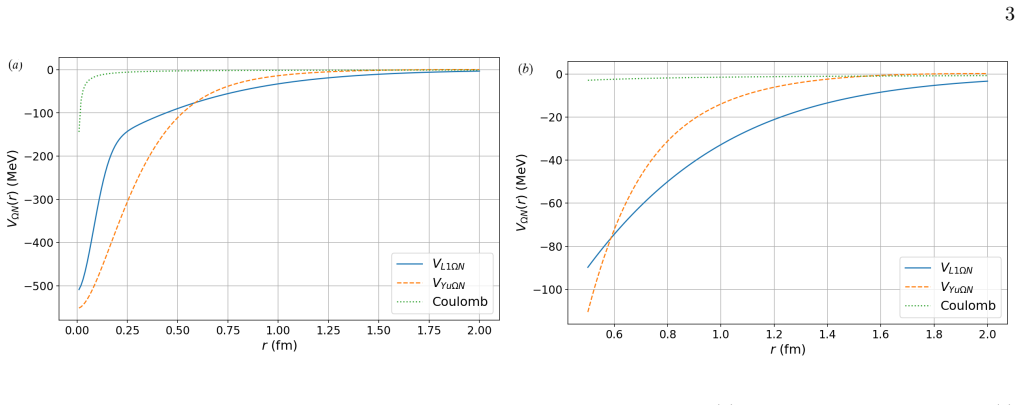
The large binding energy of the Ω−np system arises from the short-range behavior of the ΩN potentials.
A machine-rendered reading of the paper's core claim, the machinery that carries it, and where it could break.
Core claim
Within the ABC model for three non-identical particles, the Faddeev calculations demonstrate that the Ω−np system exhibits large binding driven by the short-range part of the strongly attractive ΩN potentials from lattice QCD, while the Coulomb interaction contributes only marginally by shifting the binding energy approximately equal to the Coulomb energy of the Ω−p pair and causing minor deviation from isosceles symmetry.
What carries the argument
The ABC model in Faddeev equations in configuration space applied to lattice-motivated ΩN potentials with included Coulomb force.
If this is right
- The ABC model yields different low-energy characteristics for the ΩNN system than previous AAC calculations.
- The Coulomb potential shifts the three-body binding energy by the Coulomb energy of the two-body BC subsystem.
- The spatial configuration deviates only slightly from isosceles triangle symmetry due to the Coulomb force.
- The strong ΩN interaction is the primary driver of both the binding energy and the spatial effects.
Where Pith is reading between the lines
- If the short-range behavior dominates, refining lattice QCD potentials at short distances could significantly impact predictions for other hypernuclear systems.
- Similar three-body calculations could test whether other meson-exchange or lattice potentials produce comparable binding without adjustable parameters.
- The marginal role of Coulomb suggests that electromagnetic effects can be treated perturbatively in such systems for first approximations.
Load-bearing premise
The lattice HAL QCD and Yukawa-type potentials accurately describe the short-range ΩN interaction and the ABC Faddeev treatment correctly models the low-energy three-body physics including Coulomb.
What would settle it
An experimental measurement of the binding energy of the Ω−np system or a more precise lattice QCD simulation resolving different short-range potential details that leads to substantially lower binding energy.
Figures


read the original abstract
Within the framework of the Faddeev equations in configuration space, we examine the $\Omega^{-} np$ system, employing strongly attractive lattice HAL QCD and Yukawa-type meson exchange potentials for the $\Omega N$ interaction. Our formalism incorporates the attractive Coulomb force between the $\Omega^{-}$ and proton, treating the system as three non-identical particle pairs (the $ABC$ model). In this study, we assess the impact of the Coulomb interaction on the system and compare our results with recent $\Omega NN$ ($AAC$ model) calculations obtained using various approaches. The $ABC$ model yields low-energy characteristics for the \(\Omega NN\) system that differ from previous calculations. The Coulomb potential has a marginal perturbative effect on the $AAC$ system, shifting the three-body binding energy by the Coulomb energy of the two-body $BC$ subsystem, but only slightly deviating the spatial configuration from isosceles triangle symmetry. These effects are primarily driven by the strong \(\Omega N\) interaction. We demonstrate that the large binding energy of the $\Omega^{-} np$ system arises from the short-range behavior of the $\Omega N$ potentials.
Editorial analysis
A structured set of objections, weighed in public.
Referee Report
Summary. The manuscript solves the Faddeev equations in configuration space for the Ω−np system (ABC model with non-identical particles) using lattice HAL QCD and Yukawa-type ΩN potentials that include strong short-range attraction. It incorporates the Ω−p Coulomb interaction, compares the resulting low-energy properties and binding energies to prior AAC-model calculations, assesses the perturbative role of Coulomb, and concludes that the large three-body binding energy is driven by the short-range part of the ΩN potentials.
Significance. If the central attribution holds, the work supplies a concrete numerical illustration of how lattice-QCD-motivated short-range ΩN attraction can produce substantial ΩNN binding, while clarifying the limited impact of Coulomb in the ABC versus AAC treatments. The direct use of externally supplied potentials and the Faddeev configuration-space approach are standard and reproducible in principle; the comparison across models adds value for the few-body community.
major comments (2)
- [Abstract / Conclusion] Abstract and concluding section: the central claim that 'the large binding energy of the Ω−np system arises from the short-range behavior of the ΩN potentials' is not secured by an explicit isolation of short-range versus long-range contributions. The calculations employ the full potentials and compare ABC versus AAC models, but contain no sensitivity test (e.g., short-range cutoff variation, core repulsion modification, or long-range tail truncation while holding the other fixed). Without such a test the attribution remains an interpretation rather than a demonstrated result.
- [Numerical results] Numerical results section: the reported binding energies and low-energy characteristics lack explicit error bars, convergence checks with respect to basis size or integration cutoff, and quantitative assessment of numerical stability. These omissions weaken in the quantitative differences quoted between ABC and AAC models and in the statement that Coulomb effects are 'marginal'.
minor comments (3)
- [Potential definitions] The manuscript should specify the precise functional forms and parameter values of the HAL QCD and Yukawa potentials (including any regularization) so that the calculations can be reproduced.
- [Introduction / Formalism] Notation for the ABC versus AAC models and for the particle labels (Ω−, n, p) should be introduced once and used consistently; occasional shifts between 'ΩNN' and 'Ω−np' are confusing.
- [Figures] Figure captions and axis labels should state the units and the precise observable plotted (e.g., binding energy in MeV, wave-function components).
Simulated Author's Rebuttal
We thank the referee for the careful reading of our manuscript and the constructive comments. We address each major comment in turn below.
read point-by-point responses
-
Referee: [Abstract / Conclusion] Abstract and concluding section: the central claim that 'the large binding energy of the Ω−np system arises from the short-range behavior of the ΩN potentials' is not secured by an explicit isolation of short-range versus long-range contributions. The calculations employ the full potentials and compare ABC versus AAC models, but contain no sensitivity test (e.g., short-range cutoff variation, core repulsion modification, or long-range tail truncation while holding the other fixed). Without such a test the attribution remains an interpretation rather than a demonstrated result.
Authors: We thank the referee for this observation. The attribution in the abstract and conclusion rests on the fact that both the lattice HAL QCD and Yukawa potentials employed are dominated by strong short-range attraction, as motivated by the underlying lattice data, while the long-range parts are comparatively weak. The ABC versus AAC comparison and the marginal role of the long-range Coulomb force further support that the binding is driven by the short-range ΩN component. Nevertheless, we agree that an explicit sensitivity test would make the claim more robust. In the revised manuscript we will therefore add a brief paragraph discussing the potential shapes and the expected dominance of the short-range region, and we will soften the wording in the abstract and conclusion from 'demonstrate' to 'indicate'. revision: partial
-
Referee: [Numerical results] Numerical results section: the reported binding energies and low-energy characteristics lack explicit error bars, convergence checks with respect to basis size or integration cutoff, and quantitative assessment of numerical stability. These omissions weaken in the quantitative differences quoted between ABC and AAC models and in the statement that Coulomb effects are 'marginal'.
Authors: We agree that explicit convergence and stability information would strengthen the quantitative statements. In the revised manuscript we will add a dedicated subsection (or appendix) presenting convergence tests with respect to basis size and integration cutoff, together with an assessment of numerical stability under small parameter variations. Where feasible we will also supply estimated uncertainties on the binding energies and low-energy observables to support the reported differences between the ABC and AAC models and the assessment of Coulomb effects. revision: yes
Circularity Check
No significant circularity
full rationale
The paper obtains binding energies and spatial configurations by direct numerical solution of the Faddeev equations in configuration space, using externally supplied lattice HAL QCD and Yukawa-type ΩN potentials together with the Coulomb interaction. No parameter is fitted to three-body observables and then relabeled as a prediction; no quantity is defined in terms of itself; and no load-bearing step reduces to a self-citation chain or an ansatz smuggled from prior work by the same authors. The demonstration that binding arises from short-range behavior is an interpretation of the numerical output rather than a reduction by construction, leaving the derivation self-contained.
Axiom & Free-Parameter Ledger
axioms (2)
- domain assumption The Faddeev equations in configuration space provide an accurate description of the three-body dynamics for the chosen potentials and Coulomb interaction.
- domain assumption The lattice HAL QCD and Yukawa potentials faithfully represent the ΩN strong interaction at the distances relevant for binding.
Reference graph
Works this paper leans on
-
[1]
Ω −n 5.30 1.26 – – – Ω−p 4.8 0.(9) -2.1595 3.47 -0.85
-
[2]
Ω −p – – -2.18 3.45 ≈ -0.9 VL2ΩN Ω−n 5.7 1.2 -1.3757 – Ω−p 4.7 1.(1) -2.2645 -0.89 VY uΩN Ω−n 10.2 0.75 -0.3385 – – [40]∗ Ω−n 7.4 – 0.3 3.8 – Ω−p 5.9 0.(7) -1.1794 – -0.84 [40]∗ Ω−p 5.3 0.75 – – ≈-0.9 ∗the lattice mass values. There are significant discrepancies between results for E2 obtained with HAL QCD potential and calculations based on the meson exc...
-
[3]
The numbers indicate rms distances between the particles
potentials. The numbers indicate rms distances between the particles. The Ω N pairs are differed due to the Coulomb attraction. The sizes of the particles and distances are not in scale. 7 TABLE II: The binding energy of the Ω d in AAC model when the Coulomb interaction is neglected. Calculations performed with different ΩN potentials and masses. The mass...
-
[4]
For comparison, in Table II are presented the corresponding results from Refs
potentials. For comparison, in Table II are presented the corresponding results from Refs. [43, 44]. The analysis of the results in Table II leads to the following conclusions: i. The different parameter sets for the Ω N interaction (1) and different N N potential change the ground state energy of the Ω N by about < 0.5 MeV when are used the physical mass...
-
[5]
R. L. Jaffe, Perhaps a Stable Dihyperon, Phys. Rev. Lett. 38, 195 (1977); Erratum 38, 617 (1977)
work page 1977
-
[6]
T. Yamazaki and Y. Akaishi, ( K −, π−) production of nuclear K − bound states in proton-rich systems via doorways, Phys. Lett. B 535, 70 (2002); Nuclear ¯K bound states in light nuclei, Phys. Rev. C 65, 044005 (2002)
work page 2002
-
[7]
T. Hyodo and D. Jido, The nature of the Λ(1405) resonance in chiral dynamics, Prog. Part. Nucl. Phys. 67, 55 (2012)
work page 2012
-
[8]
A. Gal, E. V. Hungerford, and D. J. Millener, Strangeness in nuclear physics, Rev. Mod. Phys. 88, 035004 (2016)
work page 2016
-
[9]
R. Ya. Kezerashvili, Strange Dibaryonic and Tribaryonic Clusters, Chapter in the book: Neutron Stars: Physics, Properties and Dynamics, Ed. N. Takibayev, K. Boshkayev, NOVA Science Publisher, New York, pp. 227-271, (2017)
work page 2017
-
[10]
R. Ya. Kezerashvili, S. M. Tsiklauri, N. Zh. Takibayev, Search and research of ¯KN N N and ¯K ¯KN N antikaonic clusters, Prog. Part. Nucl. Phys. 121, 103909 (2021)
work page 2021
-
[11]
K. Miyagawa, H. Kamada,W. Gl¨ ockle and V. Stoks, Properties of the bound Λ(Σ) N N system and hyperon-nucleon interactions, Phys. Rev. C 51, 2905 (1995)
work page 1995
-
[12]
I. N. Filikhin and S. L. Yakovlev, Calculation of the binding energy and of the parameters of low-energy scattering in the Λnp system, Phys. Atom. Nucl., 63, 223 (2000)
work page 2000
-
[13]
I. N. Filikhin and A. Gal, Faddeev-Yakubovsky Search for 4 ΛΛH, Phys. Rev. Lett. 89, 172502 (2002)
work page 2002
-
[14]
V. B. Belyaev, W. Sandhas, and I. I. Shlyk, 3- and 4- body meson-nuclear clusters, ArXiv: nucl-th0903.1703
work page internal anchor Pith review Pith/arXiv arXiv
-
[15]
V. B. Belyaev, S. A. Rakityansky, and W. Sandhas, Three-body resonances Λ nn and ΛΛn, Nucl. Phys. 803, 210 (2008)
work page 2008
-
[16]
H. Garcilazo, T. Fern´ andez-Caram´ es, and A. Valcarce, ΛN N and Σ N N systems at threshold, Phys. Rev. C 75, 034002 (2007)
work page 2007
-
[17]
V. B. Belyaev, W. Sandhas, and I. I. Shlyk, New nuclear three-body clusters ϕN N, Few Body Syst. 44 347. (2008)
work page 2008
-
[18]
S. A. Sofianos, G. J. Rampho, M. Braun and R. M. Adam, The ϕ-N N and ϕϕ–N N mesic nuclear systems, J. Phys. G: Nucl. Part. Phys. 37, 085109 (2010)
work page 2010
- [19]
-
[20]
H. Garcilazo and A. Valcarce, Light Ξ hypernuclei. Phys. Rev. C 92, 014004 (2015)
work page 2015
-
[21]
H. Garcilazo and A. Valcarce, Deeply bound Ξ tribaryon, Phys. Rev. C 93, 034001 (2016)
work page 2016
-
[22]
H. Garcilazo, A. Valcarce, and J. Vijande, Maximal isospin few-body systems of nucleons and Ξ hyperons. Phys. Rev. C 94, 024002 (2016)
work page 2016
- [23]
-
[24]
I. Filikhin, V. M. Suslov and B. Vlahovic, Faddeev calculations for light Ξ-hypernuclei, Mat. Model. Geom. 5, 1 (2017)
work page 2017
-
[25]
B. F. Gibson and I. R. Afnan, The Λ n scattering length and the Λ nn resonance, AIP Conf. Proc. 2130(1): 020005 (2019)
work page 2019
-
[26]
B. F. Gibson and I. R. Afnan, Exploring the unknown Λ n interaction, SciPost Phys. Proc. 3, 025 (2020)
work page 2020
- [27]
-
[28]
H. Garcilazo and A. Valcarce, ( I, J P ) = (1, 1/2+) ΣN N quasibound state, Symmetry 14, 2381 (2022)
work page 2022
-
[29]
F. Etminan, A. Aalimi, Examination of the ϕ-N N bound-state problem with lattice QCD N-ϕ potentials, Phys. Rev. C 109, 054002 (2024)
work page 2024
-
[30]
I. Filikhin, R. Ya. Kezerashvili, and B. Vlahovic, Possible 3 ϕH hypernucleus with HAL QCD interaction, Phys. Rev. D 110, L031502 (2024)
work page 2024
-
[31]
V. E. Barnes et al. Observation of a hyperon with strangeness minus three, Phys. Rev. Lett. 12, 204 (1964). 13
work page 1964
-
[32]
P. A. Zyla et al. Particle Data Group, Prog. Theor. Exp. Phys. 2020, 083C01 (2020)
work page 2020
-
[33]
https://pdg.lbl.gov/2007/listings/s024.pdf
Particle Data Group. https://pdg.lbl.gov/2007/listings/s024.pdf
work page 2007
-
[34]
J. Beringer et al. Review of Particle Physics, Phys. Rev. D 86, 010001 (2012)
work page 2012
-
[35]
T. Goldman, K. Maltman, G. J. Stephenson, Jr., K. E. Schmidt, and F. Wang, Strangeness -3 dibaryons, Phys. Rev. Lett. 59, 627 (1987)
work page 1987
-
[36]
Oka, Flavor-octet dibaryons in the quark model, Phys
M. Oka, Flavor-octet dibaryons in the quark model, Phys. Rev. D 38, 298 (1988)
work page 1988
-
[37]
Q. B. Li and P. N. Shen, NΩ and ∆Ω dibaryons in a SU (3) chiral quark model, Eur. Phys. J. A 8, 417 (2000)
work page 2000
-
[38]
H. Pang, J. Ping, F. Wang, J. Goldman, and E. Zhao, High strangeness dibaryons in the extended quark delocalization, color screening model, Phys. Rev. C 69, 065207 (2004)
work page 2004
-
[39]
X. Zhu, H. Huang, J. Ping, and F.Wang, Configuration mixing and effective baryon-baryon interactions, Phys. Rev. C 92, 035210 (2015)
work page 2015
- [40]
-
[41]
Production of the Ω N Bound State
T. Sekihara, Testing the Ω N Interaction in the “Production of the Ω N Bound State”, Workshop on Physics of Omega baryons at the J-PARC-K10 beam line (on-line, Jun. 7-9, 2021)
work page 2021
-
[42]
F. Etminan et al. (HAL QCD Collaboration), Spin-2 Ω N dibaryon from lattice QCD, Nucl. Phys. A 928, 89 (2014)
work page 2014
- [43]
-
[44]
T. Sekihara, Y. Kamiya, and T. Hyodo, Ω N interaction: Meson exchanges, inelastic channels, and quasibound state, Phys. Rev. C 98, 015205 (2018)
work page 2018
-
[45]
Iritani et al., Ω N dibaryon from lattice QCD near the physical point, Phys
T. Iritani et al., Ω N dibaryon from lattice QCD near the physical point, Phys. Lett. B 792, 284 (2019)
work page 2019
-
[46]
J. Haidenbauer, S. Petschauer, N. Kaiser, U.G. Meissner, and W. Weise, Scattering of decuplet baryons in chiral effective field theory, Eur. Phys. J. C 77, 760 (2017)
work page 2017
-
[47]
H. Garcilazo and A. Valcarce, Ω d bound state, Phys. Rev. C 98, 024002 (2018)
work page 2018
-
[48]
H. Garcilazo and A. Valcarce, Ω N N and ΩΩN states, Phys. Rev. C 99, 014001 (2019)
work page 2019
-
[49]
L. Zhang, Song Zhang, and Y-G. Ma, Production of OmegaN N and OmegaΩN in ultra-relativistic heavy-ion collisions, Eur. Phys. J. C 82, 416 (2022)
work page 2022
-
[50]
F. Etminan, Z. Sanchuli, and M. M. Firoozabadi, Geometrical properties of NN three-body states by realistic NN and first principles Lattice QCD Ω N potentials. Nucl. Phys. A 1033 122639 (2023)
work page 2023
-
[51]
R. Malfliet and J. Tjon, Solution of the Faddeev equations for the triton problem using local two-particle interactions, Nucl. Phys. A 127 161–168 (1969). https://doi .org /10 .1016 /0375 -9474(69 )90775 -1, https://www.sciencedirect .com /science /article /pii /0375947469907751
work page 1969
-
[52]
I. R. Afnan and Y. C. Tang, Investigation of nuclear three- and four-body systems with soft-core nucleon-nucleon potentials, Phys. Rev. textbf175, 1337 (1968)
work page 1968
-
[53]
L. D. Faddeev, Scattering theory for a three-particle system, ZhETF 39, 1459 (1961); [Sov. Phys. JETP 12, 1014 (1961)]
work page 1961
-
[54]
L.D. Faddeev, Mathematical problems of the quantum theory of scattering for a system of three particles, Proc. Math. Inst. Acad. Sciences USSR 69, 1-122 (1963)
work page 1963
-
[55]
H. P. Noyes and H. Fiedeldey, In: Three-Particle Scattering in Quantum Mechanics (Gillespie, J., Nutall, J., eds.), p. 195. New York, Benjamin, 1968
work page 1968
-
[56]
C. Gignoux, C., Laverne, and S. P. Merkuriev, Solution of the Three-Body Scattering Problem in Configuration Space, Phys. Rev. Lett. 33, 1350 (1974)
work page 1974
-
[57]
L. D. Faddeev and S. P. Merkuriev, Quantum Scattering Theory for Several Particle Systems (Kluwer Academic, Dordrecht,
-
[58]
A.A. Kvitsinsky, Yu.A. Kuperin, S.P. Merkuriev, A.K. Motovilov and S.L. Yakovlev, N-body Quantum Problem in Con- figuration Space. Fiz. Elem. Chastits At. Yadra 17, 267 (1986) (in Russian); http://www1.jinr.ru/Archive/Pepan/1986-v17/v-17-2.htm
work page 1986
-
[59]
R. Ya. Kezerashvili, Sh. M. Tsiklauri, I. Filikhin, V. M.Suslov, and B. Vlahovic, Three-body calculations for the K −pp system within potential models, J. Phys. G: Nucl. Part. Phys. 43, 065104 (2016)
work page 2016
-
[60]
I. Filikhin, R. Ya. Kezerashvili, and B. Vlahovic, On binding energy of trions in bulk materials, Phys. Lett. A 382, 787 (2018)
work page 2018
-
[61]
I. Filikhin, R. Ya. Kezerashvili, V. M. Suslov, S.M. Tsiklauri, and B. Vlahovic, Three-body model for KK ¯K resonance, Phys. Rev. D 102, 094027 (2020)
work page 2020
-
[62]
Pohl, R. et al. The size of the proton, Nature 466, 213 (2010)
work page 2010
-
[63]
A. Antognini, F. Nez, K. Schuhmann, et al., Proton structure from the measurement of 2S-2P transition frequencies of muonic hydrogen, Science 339, 417 (2013)
work page 2013
-
[64]
Beyer, A. et al. The Rydberg constant and proton size from atomic hydrogen, Science 358, 79 (2017)
work page 2017
-
[65]
Fleurbaey, H. New measurement of the 1S–3S transition frequency of hydrogen: contribution to the proton charge radius puzzle, Phys. Rev. Lett. 120, 183001 (2018)
work page 2018
- [66]
-
[67]
E. Tiesinga, P. J. Mohr, D. B. Newell, B. N. Taylor, CODATA Recommended Values of the Fundamental Physical Constants: 2018. J. Phys. Chem. Ref. Data 50, 033105 (2021)
work page 2018
-
[68]
S. Boinepalli, D. B. Leinweber, P. J. Moran, A. G. Williams, J. M. Zanotti, and J. B. Zhang, Electromagnetic structure of decuplet baryons towards the chiral regime, Phys. Rev. D 80, 054505 (2009). 14
work page 2009
-
[69]
Omega-baryon electromagnetic form factors from lattice QCD, The XXVII International Symposium on Lattice Field Theory, PoS 091 PoS(LAT2009)155 (2009). DOI: 10.22323/1.091.0155
-
[70]
Gongyo, et al., (HAL QCD Collaboration) Most strange dibaryon from lattice QCD, Phys
S. Gongyo, et al., (HAL QCD Collaboration) Most strange dibaryon from lattice QCD, Phys. Rev. Lett. 120, 212001 (2018)
work page 2018
-
[71]
L. D. Landau and E. M. Lifshitz, Quantum mechanics: non-relativistic theory, Elselver, 2013
work page 2013
-
[72]
A. M. Perelomov and Ya. B. Zeldovich Quantum Mechanics, Selected Topics. World Scientific, 1998
work page 1998
- [73]
-
[74]
I. Filikhin, R. Ya. Kezerashvili, V. M. Suslov, and B. Vlahovic, On mass polarization effect in three-body nuclear systems, Few-Body Syst 59, 33 (2018)
work page 2018
-
[75]
S. L. Yakovlev and I. N. Filikhin, Cluster reduction of the four-body Yakubovsky equations in configuration space for the bound-state problem and for low-energy scattering, Phys. At. Nucl. 60, 1794 (1997); arXiv:nucl-th/9701009
work page internal anchor Pith review Pith/arXiv arXiv 1997
-
[76]
Witten, Cosmic separation of phases
E. Witten, Cosmic separation of phases. Phys. Rev. D. 30, 272 (1984). doi:10.1103/PhysRevD.30.272
-
[77]
E. Farhi and R. L. Jaffe, Strange matter. Phys. Rev. D. 30, 2379 (1984). doi:10.1103/PhysRevD.30. 2379
-
[78]
X-L Zhang, Y-F Huang. and Z-C. Zou, Recent progresses in strange quark stars, Front. Astron. Space Sci. 11, 1409463 (2024). https://doi.org/10.3389/fspas.2024.1409463
discussion (0)
Sign in with ORCID, Apple, or X to comment. Anyone can read and Pith papers without signing in.