Neural Wave Functions for High-Pressure Atomic Hydrogen
Pith reviewed 2026-05-22 20:01 UTC · model grok-4.3
The pith
Neural quantum states yield Born-Oppenheimer and beyond-Born-Oppenheimer energies for atomic hydrogen that match or fall below prior projector Monte Carlo results up to 128 atoms.
A machine-rendered reading of the paper's core claim, the machinery that carries it, and where it could break.
Core claim
We leverage the power of neural quantum states to describe the ground state wave function of solid and liquid atomic hydrogen, including both electronic and protonic degrees of freedom. For static protons, the resulting Born-Oppenheimer energies are consistently comparable to or lower than all previous projector Monte Carlo results for systems containing up to 128 hydrogen atoms. The same level of accuracy is preserved upon inclusion of nuclear quantum effects, thus going beyond the Born-Oppenheimer approximation. In addition, our description overcomes major limitations of current wave functions, notably by avoiding any explicit symmetry assumption on the expected quantum crystal, and sidetr
What carries the argument
Neural quantum states: a neural-network ansatz for the joint electron-proton wave function that is directly variationally optimized without imaginary-time projection.
If this is right
- Born-Oppenheimer energies remain at or below prior benchmarks for systems up to 128 atoms.
- The same accuracy level is retained when nuclear quantum effects are included.
- No explicit symmetry constraint on the crystal structure is required.
- Imaginary-time evolution problems caused by disparate electron and proton masses are bypassed.
- Crystal formation can be followed continuously up to the pressure-induced melting point.
Where Pith is reading between the lines
- The same variational approach could be applied to other light-element systems in which nuclear quantum motion matters.
- Because the method does not rely on fixed-proton approximations, it may be used to test how nuclear delocalization alters predicted phase boundaries.
- The absence of an imposed crystal symmetry opens the possibility of discovering unanticipated ordered or disordered proton arrangements at high density.
Load-bearing premise
The neural-network form must be flexible enough to reach the true ground-state energy (or at least lower than all previous methods) for the chosen system sizes and densities.
What would settle it
A single calculation on a 128-atom hydrogen system at a density previously studied by projector Monte Carlo, in which the variational energy obtained from the neural wave function lies above the lowest previously published projector Monte Carlo energy.
Figures
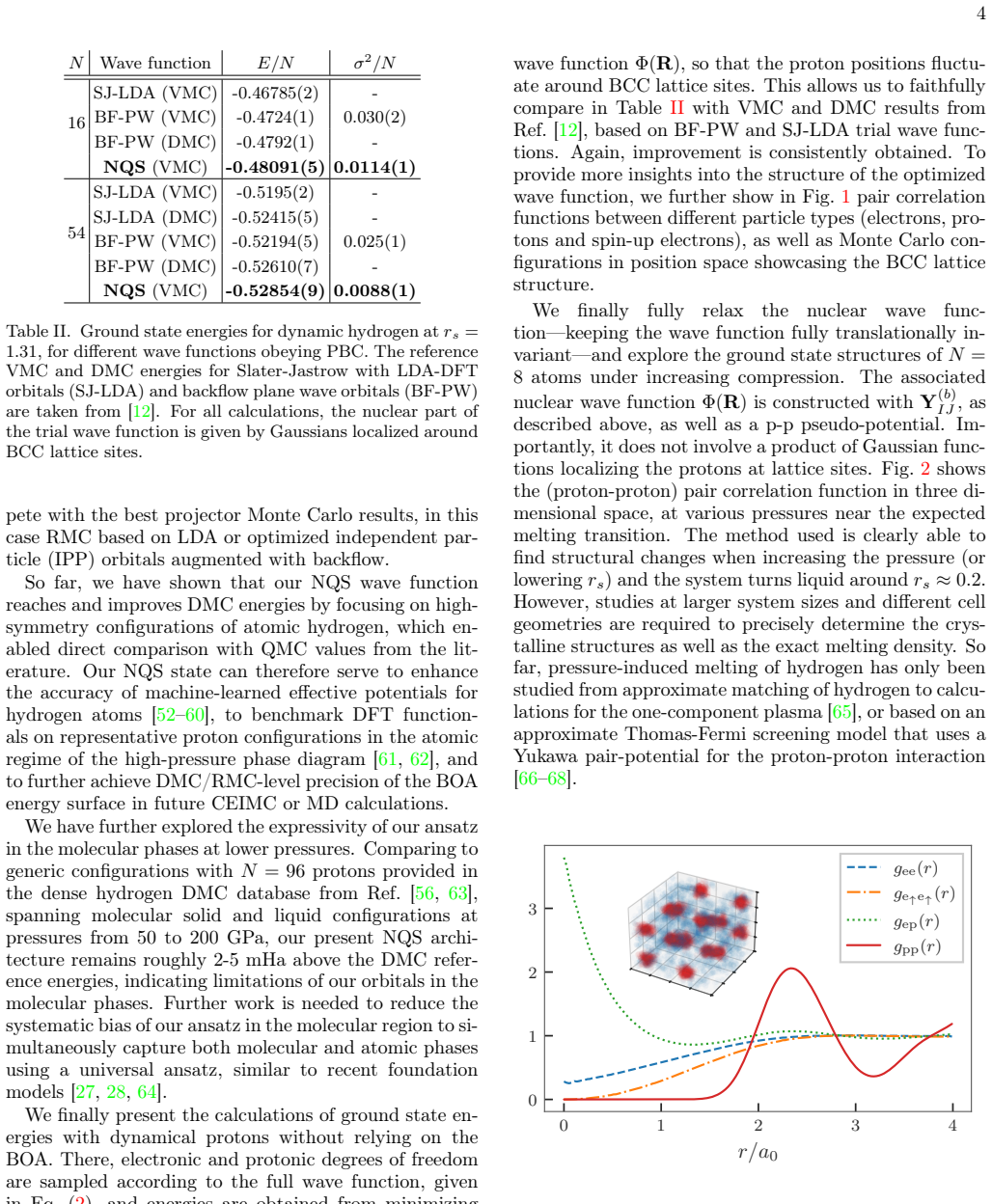

read the original abstract
We leverage the power of neural quantum states to describe the ground state wave function of solid and liquid atomic hydrogen, including both electronic and protonic degrees of freedom. For static protons, the resulting Born-Oppenheimer energies are consistently comparable to or lower than all previous projector Monte Carlo results for systems containing up to $128$ hydrogen atoms. The same level of accuracy is preserved upon inclusion of nuclear quantum effects, thus going beyond the Born-Oppenheimer approximation. In addition, our description overcomes major limitations of current wave functions, notably by avoiding any explicit symmetry assumption on the expected quantum crystal, and sidestepping efficiency issues of imaginary time evolution with disparate mass scales. As a first application, we examine crystal formation in an extremely high-density region up to pressure-induced melting.
Editorial analysis
A structured set of objections, weighed in public.
Referee Report
Summary. The manuscript develops neural quantum states as a variational ansatz for the ground-state wave function of atomic hydrogen at high pressure, treating electrons and protons on equal footing. For static protons the Born-Oppenheimer energies up to 128 atoms are reported to be comparable to or lower than existing projector Monte Carlo benchmarks; the same accuracy is claimed when nuclear quantum effects are included, allowing study of crystal formation and pressure-induced melting without explicit symmetry assumptions on the proton lattice or imaginary-time evolution across disparate mass scales.
Significance. If the variational energies are shown to be robust upper bounds with controlled statistical and systematic errors, the work would establish neural ansatzes as a practical route to fermionic systems with quantum nuclei, bypassing fixed-node bias and symmetry constraints that limit conventional methods. The ability to treat the crystal-liquid transition without presupposed order parameters would be a concrete advance for high-pressure hydrogen physics.
major comments (3)
- [§4.2, Table 2] §4.2 and Table 2: the claim that neural energies are 'consistently comparable to or lower' than projector Monte Carlo for N=128 requires explicit statistical uncertainties, number of independent optimizations, and energy variance; without these diagnostics it is impossible to rule out that the reported values reflect incomplete sampling rather than a true variational improvement.
- [§5.3] §5.3, the joint electron-proton optimization: the manuscript provides no convergence tests with respect to network depth/width or proton-configuration sampling density across the melting line; because the configuration space grows exponentially, this information is load-bearing for the assertion that nuclear quantum effects preserve the same accuracy level.
- [Eq. (8)] Eq. (8) and surrounding text: the neural ansatz is stated to avoid explicit symmetry assumptions, yet the optimization procedure is not shown to explore both crystalline and liquid proton arrangements on equal footing; a diagnostic (e.g., order-parameter histograms from multiple runs) is needed to substantiate that the method does not implicitly favor one phase.
minor comments (2)
- [Figure 4] Figure 4 caption should state the exact system size, density, and temperature for each panel to allow direct comparison with the energy data in Table 2.
- [References] The reference list omits several recent works on neural-network representations of quantum nuclei; adding them would strengthen the positioning of the method.
Simulated Author's Rebuttal
We thank the referee for their careful reading of the manuscript and for the constructive comments, which have helped us strengthen the presentation of our results. We address each major comment below and have incorporated revisions to provide the requested diagnostics and tests.
read point-by-point responses
-
Referee: [§4.2, Table 2] §4.2 and Table 2: the claim that neural energies are 'consistently comparable to or lower' than projector Monte Carlo for N=128 requires explicit statistical uncertainties, number of independent optimizations, and energy variance; without these diagnostics it is impossible to rule out that the reported values reflect incomplete sampling rather than a true variational improvement.
Authors: We agree that these statistical details are necessary to substantiate the variational improvement. In the revised manuscript we have expanded Table 2 to include error bars obtained from five independent optimizations for the N=128 case, together with the corresponding energy variances. The updated text in §4.2 now explicitly states the number of independent runs and confirms that the reported energies remain robust upper bounds. revision: yes
-
Referee: [§5.3] §5.3, the joint electron-proton optimization: the manuscript provides no convergence tests with respect to network depth/width or proton-configuration sampling density across the melting line; because the configuration space grows exponentially, this information is load-bearing for the assertion that nuclear quantum effects preserve the same accuracy level.
Authors: We acknowledge the importance of these convergence tests. The revised supplementary information now contains additional convergence studies with respect to network depth and width performed at representative densities along the melting line, as well as tests varying the proton-configuration sampling density. These results support that the reported accuracy level is preserved when nuclear quantum effects are included. revision: yes
-
Referee: [Eq. (8)] Eq. (8) and surrounding text: the neural ansatz is stated to avoid explicit symmetry assumptions, yet the optimization procedure is not shown to explore both crystalline and liquid proton arrangements on equal footing; a diagnostic (e.g., order-parameter histograms from multiple runs) is needed to substantiate that the method does not implicitly favor one phase.
Authors: We agree that an explicit diagnostic strengthens the claim. The revised manuscript includes order-parameter histograms compiled from multiple independent optimizations initiated from both crystalline and disordered proton configurations. These histograms demonstrate that the variational optimization samples both crystalline and liquid-like proton arrangements without evident bias toward one phase. revision: yes
Circularity Check
No significant circularity; variational upper bound is independent of inputs
full rationale
The paper applies the standard variational Monte Carlo method to a neural-network ansatz for the joint electron-proton wave function of atomic hydrogen. The central results are obtained by direct minimization of the energy expectation value computed from the ansatz, which by the variational theorem yields an upper bound to the true ground-state energy. This computation does not reduce to any fitted parameter renamed as a prediction, nor does it rely on a self-citation chain for its load-bearing steps. The comparison to prior projector Monte Carlo results is an external benchmark, not an internal re-derivation. Minor references to the neural quantum states framework exist but are not required to establish the reported energies or the preservation of accuracy with nuclear quantum effects.
Axiom & Free-Parameter Ledger
axioms (1)
- standard math Variational principle: the expectation value of the Hamiltonian in any trial wave function is an upper bound to the true ground-state energy.
Forward citations
Cited by 1 Pith paper
-
A Denser Hydrogen Inferred from First-Principles Simulations Challenges Jupiter's Interior Models
First-principles simulations find denser hydrogen at planetary conditions, implying lower bulk metallicity for Jupiter.
Reference graph
Works this paper leans on
-
[1]
Neural Wave Functions for High-Pressure Atomic Hydrogen
methods, operating at temperatures substantially below the electronic Fermi temperature, but high enough to describe nuclear motion within the adiabatic approximation (i.e. the BOA). Within the BOA, robust QMC trial wave functions are built from Hartree-Fock or density functional theory (DFT) band structure methods [10, 11, 15, 16], and improved with back...
work page internal anchor Pith review Pith/arXiv arXiv 2025
- [2]
-
[3]
A. F. Goncharov, R. J. Hemley, and H.-k. Mao, The Jour- nal of Chemical Physics134, 174501 (2011)
work page 2011
-
[4]
E. Gregoryanz, C. Ji, P. Dalladay-Simpson, B. Li, R. T. Howie, and H.-K. Mao, Matter and Radiation at Ex- tremes5, 038101 (2020)
work page 2020
-
[5]
J. M. McMahon, M. A. Morales, C. Pierleoni, and D. M. Ceperley, Rev. Mod. Phys.84, 1607 (2012)
work page 2012
-
[6]
M.Bonitz, J.Vorberger, M.Bethkenhagen, M.P.Böhme, D. M. Ceperley, A. Filinov, T. Gawne, F. Graziani, G. Gregori, P. Hamann, S. B. Hansen, M. Holzmann, S. X. Hu, H. Kählert, V. V. Karasiev, U. Kleinschmidt, L. Kordts, C. Makait, B. Militzer, Z. A. Moldabekov, C. Pierleoni, M. Preising, K. Ramakrishna, R. Redmer, S. Schwalbe, P. Svensson, and T. Dornheim, P...
work page 2024
- [7]
-
[8]
D. M. Ceperley and B. J. Alder, Physical Review B36, 2092 (1987)
work page 2092
- [9]
-
[10]
C.Pierleoni, D.Ceperley, B.Bernu,andW.Magro,Phys- ical Review Letters73, 2145 (1994)
work page 1994
- [11]
- [12]
-
[13]
M. Holzmann, C. Pierleoni, and D. M. Ceperley, Com- puter Physics Communications169, 421 (2005), proceed- ings of the Europhysics Conference on Computational Physics 2004
work page 2005
-
[14]
C. Pierleoni, D. Ceperley, and M. Holzmann, Physical Review Letters93, 146402 (2004)
work page 2004
- [15]
-
[16]
X. W. Wang, J. Zhu, S. G. Louie, and S. Fahy, Phys. Rev. Lett.65, 2414 (1990)
work page 1990
-
[17]
C. Pierleoni, K. T. Delaney, M. A. Morales, D. M. Ceper- ley, and M. Holzmann, Computer Physics Communica- tions179, 89 (2008), special issue based on the Confer- ence on Computational Physics 2007
work page 2008
-
[18]
M. Holzmann, D. M. Ceperley, C. Pierleoni, and K. Esler, Phys. Rev. E68, 046707 (2003)
work page 2003
-
[19]
C. Pierleoni and D. Ceperley, The coupled electron-ion monte carlo method, inComputer Simulations in Con- densed Matter Systems: From Materials to Chemical Bi- ology Volume 1, edited by M. Ferrario, G. Ciccotti, and K. Binder (Springer Berlin Heidelberg, Berlin, Heidel- berg, 2006) pp. 641–683
work page 2006
-
[20]
Holzmann, High-pressure phases of hydrogen, inCor- relations and Phase Transitions, edited by E
M. Holzmann, High-pressure phases of hydrogen, inCor- relations and Phase Transitions, edited by E. Pavarini and E. Koch (Verlag des Forschungszentrums Jülich, Jülich, 2024)
work page 2024
- [21]
- [22]
-
[23]
M. Ruggeri, M. Holzmann, D. M. Ceperley, and C. Pier- leoni, Phys. Rev. B102, 144108 (2020)
work page 2020
- [24]
-
[25]
D. Pfau, J. S. Spencer, A. G. Matthews, and W. M. C. Foulkes, Physical review research2, 033429 (2020)
work page 2020
- [26]
- [27]
- [28]
-
[29]
M. Scherbela, L. Gerard, and P. Grohs, Nature Commu- nications15, 120 (2024)
work page 2024
-
[30]
Y. Zhang, B. Jiang, and H. Guo, Journal of Chem- ical Theory and Computation21, 670 (2025), pMID: 39772624, https://doi.org/10.1021/acs.jctc.4c01287
-
[31]
J. Hermann, J. Spencer, K. Choo, A. Mezzacapo, W. M. C. Foulkes, D. Pfau, G. Carleo, and F. Noé, Na- ture Reviews Chemistry7, 692 (2023)
work page 2023
-
[32]
M. Scherbela, N. Gao, P. Grohs, and S. Günnemann, Ac- curate Ab-initio Neural-network Solutions to Large-Scale Electronic Structure Problems (2025), arXiv:2504.06087 [physics]
- [33]
- [34]
-
[35]
X. Li, Z. Li, and J. Chen, Nature Communications13, 7895 (2022)
work page 2022
-
[36]
G. Cassella, H. Sutterud, S. Azadi, N. D. Drummond, D. Pfau, J. S. Spencer, and W. M. C. Foulkes, Phys. Rev. Lett.130, 036401 (2023)
work page 2023
- [37]
- [38]
- [39]
-
[40]
M. Ruggeri, S. Moroni, and M. Holzmann, Phys. Rev. Lett.120, 205302 (2018)
work page 2018
-
[41]
D. Linteau, G. Pescia, J. Nys, G. Carleo, and M. Holz- mann, Phase diagram and crystal melting of helium-4 in two dimensions (2024), arXiv:2412.05332 [cond-mat.stat- mech]
-
[42]
P. P. Ewald, Annalen der Physik369, 253 (1921)
work page 1921
- [43]
-
[44]
D. M. Ceperley, J. Stat. Phys.63, 1237 (1991)
work page 1991
- [45]
-
[46]
L. H. Nosanow, Phys. Rev. Lett.13, 270 (1964)
work page 1964
- [47]
- [48]
-
[49]
M. Holzmann, R. C. Clay, M. A. Morales, N. M. Tub- man, D. M. Ceperley, and C. Pierleoni, Phys. Rev. B94, 035126 (2016)
work page 2016
-
[50]
C. Lin, F. H. Zong, and D. M. Ceperley, Phys. Rev. E 64, 016702 (2001)
work page 2001
- [51]
-
[52]
M. A. Morales, R. Clay, C. Pierleoni, and D. M. Ceperley, Entropy16, 287 (2014)
work page 2014
-
[53]
H. Zong, H. Wiebe, and G. J. Ackland, Nature commu- nications11, 5014 (2020)
work page 2020
- [54]
-
[55]
V. V. Karasiev, J. Hinz, S. Hu, and S. Trickey, Nature 600, E12 (2021)
work page 2021
-
[56]
A. Tirelli, G. Tenti, K. Nakano, and S. Sorella, Phys. Rev. B106, L041105 (2022)
work page 2022
-
[57]
H. Niu, Y. Yang, S. Jensen, M. Holzmann, C. Pierleoni, and D. M. Ceperley, Phys. Rev. Lett.130, 076102 (2023)
work page 2023
-
[58]
S. Goswami, S. Jensen, Y. Yang, M. Holzmann, C. Pier- leoni, and D. M. Ceperley, The Journal of Chemical Physics162, 054118 (2025)
work page 2025
- [59]
- [60]
-
[61]
K. K. Ly and D. M. Ceperley, Phys. Rev. B111, 104102 (2025)
work page 2025
-
[62]
R. C. Clay, M. Holzmann, D. M. Ceperley, and M. A. Morales, Phys. Rev. B93, 035121 (2016)
work page 2016
-
[63]
A Denser Hydrogen Inferred from First-Principles Simulations Challenges Jupiter's Interior Models
C. Cozza, K. Nakano, S. Howard, H. Xie, R. Helled, and G. Mazzola, A denser hydrogen inferred from first- principles simulations challenges jupiter’s interior models (2025), arXiv:2501.12925 [astro-ph.EP]
work page internal anchor Pith review Pith/arXiv arXiv 2025
-
[64]
Y. Yang, S. Jensen, D. Ceperley, K. Kowalik, and M. Turk, https://qmc-hamm.hub.yt/data.html (2022)
work page 2022
- [65]
-
[66]
M. D. Jones and D. M. Ceperley, Phys. Rev. Lett.76, 4572 (1996)
work page 1996
-
[67]
K. K. Mon, G. V. Chester, and N. W. Ashcroft, Phys. Rev. B21, 2641 (1980)
work page 1980
-
[68]
D. M. Ceperley, Quantum monte carlo simulation of sys- tems at high pressure, inSimple Molecular Systems at Very High Density, edited by P. L. A. Polian and N. Boc- cara (Plenum Press, 1989)
work page 1989
-
[69]
B. Militzer and R. L. Graham, Journal of Physics and Chemistry of Solids67, 2136 (2006)
work page 2006
- [70]
-
[71]
F. Vicentini, D. Hofmann, A. Szabó, D. Wu, C. Roth, C. Giuliani, G. Pescia, J. Nys, V. Vargas-Calderón, N. Astrakhantsev, and G. Carleo, SciPost Phys. Code- bases , 7 (2022)
work page 2022
-
[72]
J. Bradbury, R. Frostig, P. Hawkins, M. J. Johnson, C. Leary, D. Maclaurin, G. Necula, A. Paszke, J. Van- derPlas, S. Wanderman-Milne, and Q. Zhang, JAX: com- posable transformations of Python+NumPy programs (2018)
work page 2018
-
[73]
D. Häfner and F. Vicentini, Journal of Open Source Soft- ware6, 3419 (2021)
work page 2021
-
[74]
N. Gao, J. Köhler, and A. Foster, folx - forward laplacian for jax (2023)
work page 2023
-
[75]
Chen, Poor man’s forward laplacian (using jax tracer!) (2024)
Y. Chen, Poor man’s forward laplacian (using jax tracer!) (2024)
work page 2024
-
[76]
R. Li, H. Ye, D. Jiang, X. Wen, C. Wang, Z. Li, X. Li, D. He, J. Chen, W. Ren, and L. Wang, Nature Machine Intelligence6, 209 (2024)
work page 2024
-
[77]
J. Kim, G. Pescia, B. Fore, J. Nys, G. Carleo, S. Gan- dolfi, M. Hjorth-Jensen, and A. Lovato, Communications Physics7, 148 (2024)
work page 2024
-
[78]
J. Nys, G. Pescia, A. Sinibaldi, and G. Carleo, Nature Communications15, 9404 (2024)
work page 2024
-
[79]
C. Pierleoni, K. T. Delaney, M. A. Morales, D. M. Ceper- ley, and M. Holzmann, Series on Advances in Quantum Many-Body Theory , 217 (2008)
work page 2008
-
[80]
BF-PW” correspondstoametallicwavefunctionusingbackflowplanewaveorbitals, “BF-LDA
H. J. Monkhorst and J. D. Pack, Phys. Rev. B13, 5188 (1976). 8 END MA TTER I. MESSAGE-P ASSING NEURAL NETWORK (MPNN) IMPLEMENT A TION The implementation used in this work is detailed in Algorithm 1. Other recent MPNN implementations for NQS were presented for instance in [40, 47, 76, 77]. Algorithm 1MPNN Data–Given a Monte-Carlo configuration((r1, s1), . ...
work page 1976
discussion (0)
Sign in with ORCID, Apple, or X to comment. Anyone can read and Pith papers without signing in.