REVIEW 16 references
Modular-Cam: Modular Dynamic Camera-view Video Generation with LLM
T0 review · reviewed 2026-08-16 · deepseek-v4-flash
Pith's one-line read Modular-Cam combines LLM-based prompt decomposition, per-motion LoRA modules, and ControlNet-based scene conditioning to generate multi-scene videos with camera-view control.
The pith
A machine-rendered reading of the paper's core claim, the machinery that carries it, and where it could break.
The reading
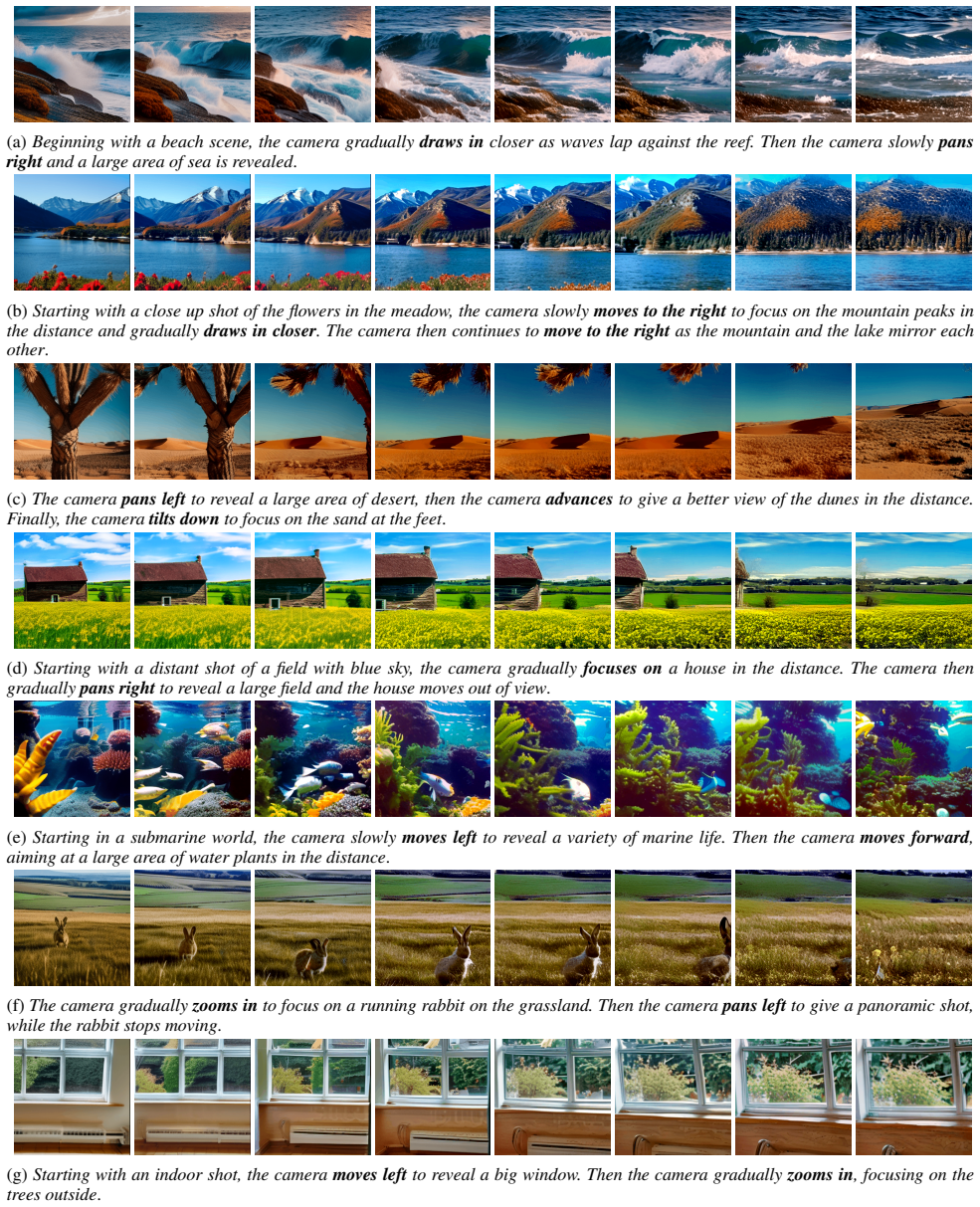
For camera control, the authors train a separate low-rank adapter, called a CamOperator, for each of the six motions. The adapters are added to a model built on AnimateDiff, and the LLM chooses which adapter to plug in for each scene. The authors claim the adapters can be combined, so a scene can use both a pan and a zoom. Between scenes, the last frame of the previous scene is fed into a ControlNet-based module, AdaControlNet, which also normalizes the colors of the new scene and randomly blends the first frame so the transition looks continuous.
The results shown in the paper look plausible, and the ablations support the role of each module. However, the quantitative evaluation is weaker. The test prompts were generated by the authors with ChatGPT, the closest LLM-based multi-scene baselines were not included in the comparison table, and camera accuracy was never measured numerically. No code or weights are released. So the paper is a convincing demonstration of an idea, but not yet a fully verified method.
Extended reading notes
Core claim
Modular-Cam is capable of generating high-quality multi-scene dynamic camera-view videos, ensuring consistency across multiple scenes, and providing a modular method to achieve fine-grained control of the contents and camera movements in the video (Contributions, Introduction). If this is true, the system would be a practical modular recipe for long, multi-shot video generation with explicit camera direction.
Load-bearing premise
The assumption that six LoRA motion modules trained on synthetic augmented videos transfer to natural video content and remain composable, so that additive LoRA weights (Equation 4: W = W_TT + A_CO * B_CO) can simulate arbitrary camera paths such as 'ZoomIn + PanLeft'. The paper asserts 'theoretically simulate any motion pattern' (CamOperator with Modular Network) without experiments verifying transfer or composition, and it is the load-bearing premise for the 'fine-grained control' part of the central claim.
Signed reviews
Editorial analysis
A structured set of objections, weighed in public.
Assumptions & free parameters
free parameters (1)
- randomized blending intensity lambda =
0.5
assumptions (3)
- ad hoc to paper Six basic CamOperators, trained on simulated data with simple augmentations, transfer to natural video content and remain composable when their LoRA weights are added.
- domain assumption ChatGPT3.5-turbo reliably decomposes arbitrary user instructions into scene descriptions and transition actions from the fixed six-motion vocabulary.
- domain assumption Adaptive pixel normalization and randomized blending on the first frame yield visually smooth transitions without harming temporal coherence.
Cite this review
Pith. "Pith review of Modular-Cam: Modular Dynamic Camera-view Video Generation with LLM." pith.science (2026). https://pith.science/paper/JH5SQQPN
@misc{pith2026250412048,
  author       = {Pith},
  title        = {Pith review of: Modular-Cam: Modular Dynamic Camera-view Video Generation with LLM},
  year         = {2026},
  howpublished = {\url{https://pith.science/paper/JH5SQQPN}},
  note         = {Machine review of arXiv:2504.12048}
}
read the original abstract
Text-to-Video generation, which utilizes the provided text prompt to generate high-quality videos, has drawn increasing attention and achieved great success due to the development of diffusion models recently. Existing methods mainly rely on a pre-trained text encoder to capture the semantic information and perform cross attention with the encoded text prompt to guide the generation of video. However, when it comes to complex prompts that contain dynamic scenes and multiple camera-view transformations, these methods can not decompose the overall information into separate scenes, as well as fail to smoothly change scenes based on the corresponding camera-views. To solve these problems, we propose a novel method, i.e., Modular-Cam. Specifically, to better understand a given complex prompt, we utilize a large language model to analyze user instructions and decouple them into multiple scenes together with transition actions. To generate a video containing dynamic scenes that match the given camera-views, we incorporate the widely-used temporal transformer into the diffusion model to ensure continuity within a single scene and propose CamOperator, a modular network based module that well controls the camera movements. Moreover, we propose AdaControlNet, which utilizes ControlNet to ensure consistency across scenes and adaptively adjusts the color tone of the generated video. Extensive qualitative and quantitative experiments prove our proposed Modular-Cam's strong capability of generating multi-scene videos together with its ability to achieve fine-grained control of camera movements. Generated results are available at https://modular-cam.github.io.
Figures


Figures from the paper (3 more)


Reference graph
Works this paper leans on
-
[5]
LoRA: Low-Rank Adaptation of Large Language Models. CoRR, abs/2106.09685. Huang, H.; Feng, Y .; Shi, C.; Xu, L.; Yu, J.; and Yang, S. 2024a. Free-bloom: Zero-shot text-to-video generator with llm director and ldm animator.Advances in Neural Informa- tion Processing Systems,
-
[7]
arXiv preprint arXiv:2309.17444
Llm-grounded video diffusion models. arXiv preprint arXiv:2309.17444. Lin, H.; Zala, A.; Cho, J.; and Bansal, M
-
[8]
arXiv preprint arXiv:2309.15091
Videodi- rectorgpt: Consistent multi-scene video generation via llm- guided planning. arXiv preprint arXiv:2309.15091. Long, F.; Qiu, Z.; Yao, T.; and Mei, T
-
[9]
arXiv preprint arXiv:2401.01256
Videodrafter: Content-consistent multi-scene video generation with llm. arXiv preprint arXiv:2401.01256. Lu, Y .; Zhu, L.; Fan, H.; and Yang, Y
-
[10]
arXiv preprint arXiv:2311.15813
Flowzero: Zero- shot text-to-video synthesis with llm-driven dynamic scene syntax. arXiv preprint arXiv:2311.15813. Qiu, H.; Xia, M.; Zhang, Y .; He, Y .; Wang, X.; Shan, Y .; and Liu, Z
-
[11]
arXiv preprint arXiv:2310.15169
Freenoise: Tuning-free longer video diffusion via noise rescheduling. arXiv preprint arXiv:2310.15169. Radford, A.; Kim, J. W.; Hallacy, C.; Ramesh, A.; Goh, G.; Agarwal, S.; Sastry, G.; Askell, A.; Mishkin, P.; Clark, J.; et al
-
[14]
arXiv preprint arXiv:2209.14792
Make-a-video: Text-to-video generation without text-video data. arXiv preprint arXiv:2209.14792. Song, Y .; and Ermon, S
-
[16]
LoRA2 (Hu et al. 2021). The LLM used in LLM-Director is chatgpt3.5-turbo-1106. The rank of the LoRA layers in CamOperator is set to
work page 2021
Show all 16 references
-
[30]
Wang, F.-Y .; Chen, W.; Song, G.; Ye, H.-J.; Liu, Y .; and Li, H. 2023a. Gen-l-video: Multi-text to long video generation via temporal co-denoising. arXiv preprint arXiv:2305.18264. Wang, J.; Yuan, H.; Chen, D.; Zhang, Y .; Wang, X.; and Zhang, S. 2023b. Modelscope text-to-vid...
-
[36]
Guo, Y .; Yang, C.; Rao, A.; Agrawala, M.; Lin, D.; and Dai, B. 2023a. Sparsectrl: Adding sparse controls to text-to-video diffusion models. arXiv preprint arXiv:2311.16933. Guo, Y .; Yang, C.; Rao, A.; Wang, Y .; Qiao, Y .; Lin, D.; and Dai, B. 2023b. Animatediff: Animate you...
-
[2014]
arXiv preprint arXiv:1412.6980
Adam: A method for stochastic optimization. arXiv preprint arXiv:1412.6980. Lian, L.; Shi, B.; Yala, A.; Darrell, T.; and Li, B
-
[2015]
In Medical image computing and computer-assisted intervention–MICCAI 2015: 18th international conference, Munich, Germany, October 5-9, 2015, proceedings, part III 18, 234–241
U-net: Convolutional networks for biomedical image segmenta- tion. In Medical image computing and computer-assisted intervention–MICCAI 2015: 18th international conference, Munich, Germany, October 5-9, 2015, proceedings, part III 18, 234–241. Springer. Ruiz, N.; Li, Y .; Jamp...
2015
-
[2021]
In Proceedings of the IEEE/CVF international conference on computer vision, 1728–1738
Frozen in time: A joint video and image encoder for end-to- end retrieval. In Proceedings of the IEEE/CVF international conference on computer vision, 1728–1738. Blattmann, A.; Dockhorn, T.; Kulal, S.; Mendelevitch, D.; Kilian, M.; Lorenz, D.; Levi, Y .; English, Z.; V oleti, ...
-
[2022]
arXiv preprint arXiv:2204.06125, 1(2):
Hierarchical text-conditional image generation with clip latents. arXiv preprint arXiv:2204.06125, 1(2):
-
[2023]
arXiv preprint arXiv:2303.08774
Gpt-4 technical report. arXiv preprint arXiv:2303.08774. Avrahami, O.; Lischinski, D.; and Fried, O
-
[2024]
arXiv preprint arXiv:2403.14773
Streamingt2v: Consistent, dynamic, and extendable long video generation from text. arXiv preprint arXiv:2403.14773. Ho, J.; Chan, W.; Saharia, C.; Whang, J.; Gao, R.; Gritsenko, A.; Kingma, D. P.; Poole, B.; Norouzi, M.; Fleet, D. J.; et al. 2022a. Imagen video: High definitio...
Reviewed August 16, 2026 · model on record in the stance chip above.
Discussion (0). Continue with ORCID to comment.