REVIEW 40 references
Single-shot Star-convex Polygon-based Instance Segmentation for Spatially-correlated Biomedical Objects
T0 review · reviewed 2026-08-16 · deepseek-v4-flash
Pith's one-line read A branched StarDist architecture with a within-boundary penalty segments nested biomedical objects such as nuclei in cells and plaques in wells in one shot, with a new joint true-positive metric.
desk verdict A useful single-shot extension of StarDist for nested objects, but the WBR penalty's gradient path and the JTPR metric need fixing before the claims hold. read the letter →
The pith
A machine-rendered reading of the paper's core claim, the machinery that carries it, and where it could break.
The reading
The new part is a penalty called Within Boundary Regularisation. It checks, pixel by pixel, whether the predicted inner objects leak outside the predicted outer objects. If they do, the loss becomes larger. In principle this should push the model to keep nuclei inside cells and plaques inside wells. The authors also propose a new evaluation score, JTPR, which counts objects as successful only when both the inner object and its containing outer object are found together.
The method is tested on two published datasets of fluorescence microscopy and plate photographs. On the standard IoUR and AP metrics the new models are competitive but not always best. On their own JTPR score, the models often lead, though on one dataset the plain StarDist baseline scores higher on the inner object. The paper currently provides no code and no error bars, and it does not explain how the penalty is differentiated during training, which is a key detail. The idea is useful and likely to be built upon, but the evidence as written leaves room for doubt.
Extended reading notes
Core claim
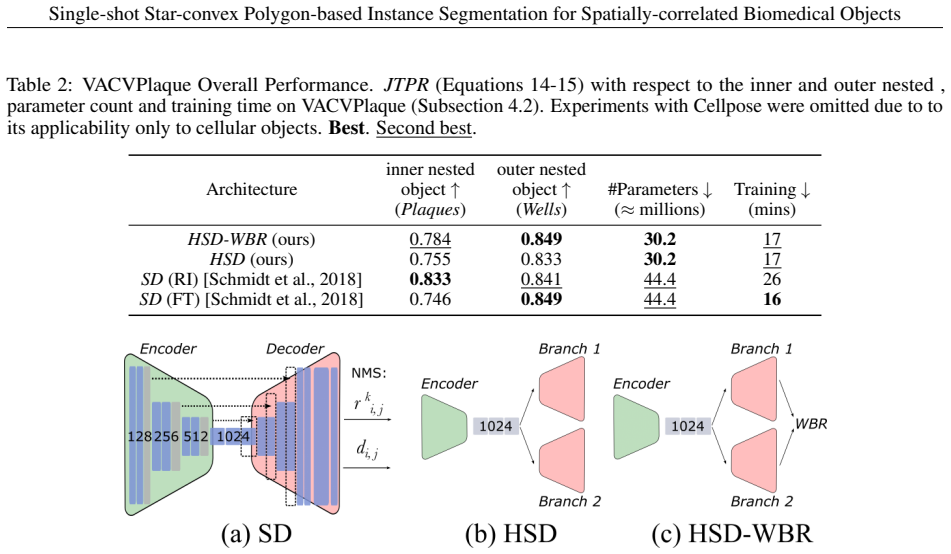
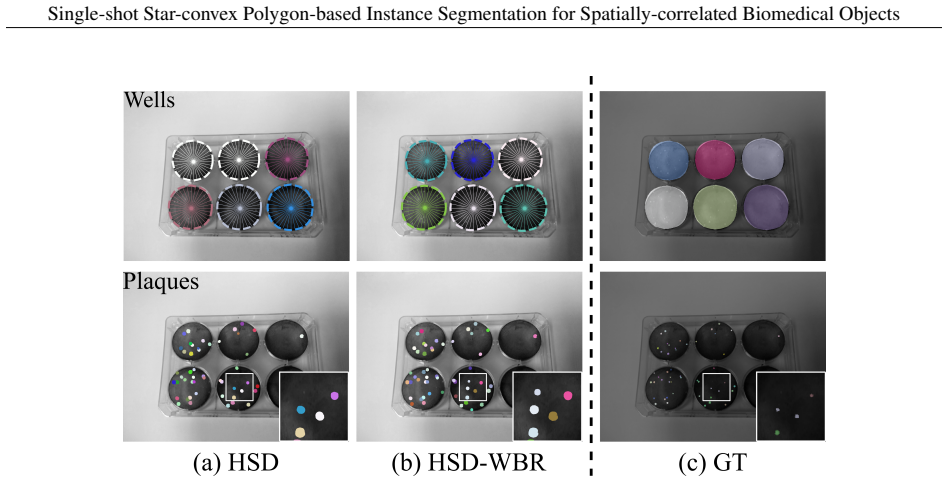
The central assertion is that the proposed branched StarDist architectures HSD and HSD-WBR achieve nested instance segmentation of spatially correlated biomedical objects in a single shot, and that HSD-WBR, through the Within Boundary Regularisation penalty, outperforms StarDist and Cellpose on the proposed Joint TP rate (JTPR) criterion while remaining competitive on IoUR and AP (Abstract; Section 1; Tables 1-2).
Load-bearing premise
The WBR penalty, as defined in Equation 5 on predicted instance masks, must provide a usable training gradient. If the masks come from the non-differentiable NMS and polygon construction pipeline, the penalty term Lambda is a constant with respect to network parameters and cannot change learning, making HSD-WBR equivalent to HSD during training. The paper never states how gradients are obtained for Lambda, so the central mechanism may be inert (Section 3.3, Equation 5).
Signed reviews
Editorial analysis
A structured set of objections, weighed in public.
Assumptions & free parameters
free parameters (5)
- lambda1 =
0.2
- lambda2 =
0.0001
- lambda3 =
1
- epsilon =
1e-7
- IoU threshold tau =
optimal per model and metric on test set
assumptions (3)
- domain assumption Both object classes in each dataset are well approximated by star-convex polygons with K=32 radial directions.
- domain assumption Nuclei are always inside cytoplasm, and plaques are always inside wells; the containment relation is strict and known ahead of time.
- ad hoc to paper The WBR penalty computed on predicted instance masks can be differentiated with respect to network parameters.
Cite this review
Pith. "Pith review of Single-shot Star-convex Polygon-based Instance Segmentation for Spatially-correlated Biomedical Objects." pith.science (2026). https://pith.science/paper/PP5EXVYA
@misc{pith2026250412078,
  author       = {Pith},
  title        = {Pith review of: Single-shot Star-convex Polygon-based Instance Segmentation for Spatially-correlated Biomedical Objects},
  year         = {2026},
  howpublished = {\url{https://pith.science/paper/PP5EXVYA}},
  note         = {Machine review of arXiv:2504.12078}
}
abstract
Biomedical images often contain objects known to be spatially correlated or nested due to their inherent properties, leading to semantic relations. Examples include cell nuclei being nested within eukaryotic cells and colonies growing exclusively within their culture dishes. While these semantic relations bear key importance, detection tasks are often formulated independently, requiring multi-shot analysis pipelines. Importantly, spatial correlation could constitute a fundamental prior facilitating learning of more meaningful representations for tasks like instance segmentation. This knowledge has, thus far, not been utilised by the biomedical computer vision community. We argue that the instance segmentation of two or more categories of objects can be achieved in parallel. We achieve this via two architectures HydraStarDist (HSD) and the novel (HSD-WBR) based on the widely-used StarDist (SD), to take advantage of the star-convexity of our target objects. HSD and HSD-WBR are constructed to be capable of incorporating their interactions as constraints into account. HSD implicitly incorporates spatial correlation priors based on object interaction through a joint encoder. HSD-WBR further enforces the prior in a regularisation layer with the penalty we proposed named Within Boundary Regularisation Penalty (WBR). Both architectures achieve nested instance segmentation in a single shot. We demonstrate their competitiveness based on $IoU_R$ and AP and superiority in a new, task-relevant criteria, Joint TP rate (JTPR) compared to their baseline SD and Cellpose. Our approach can be further modified to capture partial-inclusion/-exclusion in multi-object interactions in fluorescent or brightfield microscopy or digital imaging. Finally, our strategy suggests gains by making this learning single-shot and computationally efficient.
Figures


Figures from the paper (5 more)




Reference graph
Works this paper leans on
-
[1]
Cell detection with star-convex polygons
Uwe Schmidt, Martin Weigert, Coleman Broaddus, and Gene Myers. Cell detection with star-convex polygons. In Medical Image Computing and Computer Assisted Intervention - MICCAI 2018 - 21st International Conference, Granada, Spain, September 16-20, 2018, Proceedings, Part II , pages 265--273, 2018. doi:10.1007/978-3-030-00934-2_30
-
[2]
Cellpose: a generalist algorithm for cellular segmentation
Carsen Stringer, Tim Wang, Michalis Michaelos, and Marius Pachitariu. Cellpose: a generalist algorithm for cellular segmentation. Nature Methods, 18 0 (1): 0 100--106, 2021. doi:10.1038/s41592-020-01018-x
-
[3]
Anne E. Carpenter, Thouis R. Jones, M.R. Lamprecht, Colin Clarke, In Han Kang, Ola Friman, David A. Guertin, Joo Han Chang, Robert A. Lindquist, Jason Moffat, et al. Cellprofiler: image analysis software for identifying and quantifying cell phenotypes. Genome biology, 7: 0 1--11, 2006. doi:10.1186/gb-2006-7-10-r100
-
[4]
M.P. Humphries, P. Maxwell, and M. Salto-Tellez. Qupath: The global impact of an open source digital pathology system. Computational and Structural Biotechnology Journal, 19: 0 852--859, 2021. doi:10.1038/s41598-017-17204-5
-
[5]
Vaccinia virus vaccines: past, present and future
Bertram L Jacobs, Jeffrey O Langland, Karen V Kibler, Karen L Denzler, Stacy D White, Susan A Holechek, Shukmei Wong, Trung Huynh, and Carole R Baskin. Vaccinia virus vaccines: past, present and future. Antiviral Res., 84 0 (1): 0 1--13, October 2009
work page 2009
-
[6]
U-net: Convolutional networks for biomedical image segmentation
Olaf Ronneberger, Philipp Fischer, and Thomas Brox. U-net: Convolutional networks for biomedical image segmentation. In Medical Image Computing and Computer-Assisted Intervention – MICCAI 2015, pages 234--241, 2015. doi:10.1007/978-3-319-24574-4_28
-
[7]
Isoodl: Instance segmentation of overlapping biological objects using deep learning
Anton Bohm, Annekathrin Ucker, Tim Jager, Olaf Ronneberger, and Thorsten Falk. Isoodl: Instance segmentation of overlapping biological objects using deep learning. In 2018 IEEE 15th International Symposium on Biomedical Imaging (ISBI 2018), pages 1225--1229. IEEE, 2018. doi:10.1109/ISBI.2018.8363792
arXiv 2018
-
[8]
Isoov2dl - semantic instance segmentation of touching and overlapping objects
Anton Bohm, Annekathrin Ucker, Tim Jager, Olaf Ronneberger, and Thorsten Falk. Isoov2dl - semantic instance segmentation of touching and overlapping objects. In 2019 IEEE 16th International Symposium on Biomedical Imaging (ISBI 2019), pages 343--347. IEEE, 2019. doi:10.1109/ISBI.2019.8759334
arXiv 2019
Show all 40 references
-
[9]
A novel medical image segmentation approach by using multi-branch segmentation network based on local and global information synchronous learning
Shangzhu Jin, Sheng Yu, Jun Peng, Hongyi Wang, and Yan Zhao. A novel medical image segmentation approach by using multi-branch segmentation network based on local and global information synchronous learning. Nature Scientific Reports, 13 0 (1): 0 6762, 2023. doi:10.1038/s41598...
2023 doi
-
[10]
Double branch parallel network for segmentation of buildings and waters in remote sensing images
Jing Chen, Min Xia, Dehao Wang, and Haifeng Lin. Double branch parallel network for segmentation of buildings and waters in remote sensing images. Remote Sensing, 15 0 (6), 2023 a . doi:10.3390/rs15061536
2023 doi
-
[11]
Globally optimal segmentation of multi-region objects
A Delong and Y Boykov. Globally optimal segmentation of multi-region objects. In textit 2009 IEEE 12th International Conference on Computer Vision , pages 285--292. 2009
2009
-
[12]
Fast approximate energy minimization with label costs
A Delong, A Osokin, H N Isack, and Y Boykov. Fast approximate energy minimization with label costs. In textit 2010 IEEE Computer Society Conference on Computer Vision and Pattern Recognition , pages 2173--2180. 2010
2010
-
[13]
Computer vision approaches to medical image analysis
M Sonka, editor. Computer vision approaches to medical image analysis. textit\ Springer\ , Berlin, Germany, 2006
2006
-
[14]
Understanding humans in crowded scenes: Deep nested adversarial learning and a new benchmark for Multi-Human parsing
J Zhao, J Li, Y Cheng, T Sim, S Yan, and J Feng. Understanding humans in crowded scenes: Deep nested adversarial learning and a new benchmark for Multi-Human parsing. In textit Proceedings of the 26th ACM international conference on Multimedia , pages 792--800. 2018
2018
-
[15]
The distribution of the flora in the alpine zone.1
Paul Jaccard. The distribution of the flora in the alpine zone.1. New Phytologist, 11 0 (2): 0 37--50, 1912. doi:10.1111/j.1469-8137.1912.tb05611.x
1912
-
[16]
A delay metric for video object detection: What average precision fails to tell
Huizi Mao, Xiaodong Yang, and Bill Dally. A delay metric for video object detection: What average precision fails to tell. In 2019 IEEE/CVF International Conference on Computer Vision ( ICCV ) . IEEE, October 2019
2019
-
[17]
Robust and decomposable average precision for image retrieval
E Ramzi, N Thome, C Rambour, N Audebert, and X Bitot. Robust and decomposable average precision for image retrieval. In Neural Information Processing Systems. 2021
2021
-
[18]
SortedAP : Rethinking evaluation metrics for instance segmentation
Long Chen, Yuli Wu, Johannes Stegmaier, and Dorit Merhof. SortedAP : Rethinking evaluation metrics for instance segmentation. In 2023 IEEE/CVF International Conference on Computer Vision Workshops ( ICCVW ) , pages 3925--3931. IEEE, October 2023 b
2023
-
[19]
Allen Kent, M. M. Berry, Fred U. Luehrs, and James W. Perry. Machine literature searching viii. operational criteria for designing information retrieval systems. American Documentation, 6: 0 93--101, 1955. doi:10.1002/asi.5090060209
1955 doi
-
[20]
Gismondi
Marco Cacciabue, Anabella Currá, and Maria I. Gismondi. Viralplaque: a fiji macro for automated assessment of viral plaque statistics. PeerJ, 7: 0 e7729, 2019. doi:10.7717/peerj.7729
2019 doi
-
[21]
Machine-learning-based automated quantification machine for virus plaque assay counting
Gridsada Phanomchoeng, Chayatorn Kukiattikoon, Suphanut Plengkham, Siwaporn Boonyasuppayakorn, Saran Salakij, Suvit Poomrittigul, and Lunchakorn Wuttisittikulkij. Machine-learning-based automated quantification machine for virus plaque assay counting. PeerJ Computer Science, 8...
2022 doi
-
[22]
Deep learning
Yann LeCun, Yoshua Bengio, and Geoffrey Hinton. Deep learning. Nature, 521 0 (7553): 0 436--444, 2015. doi:10.1038/nature14539
2015 doi
-
[23]
James R. Munkres. Topology. Featured Titles for Topology. Prentice Hall, Incorporated, 2000. ISBN 978-0-13-181629-9
2000
-
[24]
Optimizing star-convex functions
Jasper Lee and Paul Valiant. Optimizing star-convex functions. In 2016 IEEE 57th Annual Symposium on Foundations of Computer Science, pages 603--614, 2016. doi:10.1109/FOCS.2016.71
2016 doi
-
[25]
A computational approach to edge detection
John Canny. A computational approach to edge detection. IEEE Trans. Pattern Anal. Mach. Intell., PAMI-8 0 (6): 0 679--698, November 1986
1986
-
[26]
A mathematical theory of communication
Claude Elwood Shannon. A mathematical theory of communication. The Bell System Technical Journal, 27: 0 379--423, 1948. doi:http://dx.doi.org/10.1002/j.1538-7305.1948.tb01338.x
1948
-
[27]
Anomaly Detection and Complex Event Processing over IoT Data Streams With Application to eHealth and Patient Data Monitoring; Mean Absolute Error
Patrick Schneider and Fatos Xhafa. Anomaly Detection and Complex Event Processing over IoT Data Streams With Application to eHealth and Patient Data Monitoring; Mean Absolute Error. Academic Press, 2022. ISBN 978-0-12-823818-9. doi:10.1016/C2020-0-00589-X
2022 doi
-
[28]
Splinedist: Automated cell segmentation with spline curves
Soham Mandal and Virginie Uhlmann. Splinedist: Automated cell segmentation with spline curves. In 2021 IEEE 18th International Symposium on Biomedical Imaging (ISBI), pages 1082--1086, 2021. doi:10.1109/ISBI48211.2021.9433928
2021
-
[29]
Set Theory: An Introduction to Independence Proofs
Kenneth Kunen. Set Theory: An Introduction to Independence Proofs. North-Holland, 1980. ISBN 0444868399, 0444564020. doi:10.2307/2274070
1980 doi
-
[30]
HeLaCytoNuc: fluorescence microscopy dataset with segmentation masks for cell nuclei and cytoplasm , June 2024 a
Trina De, Adrian Urbanski, Subasini Thangamani, Maria Wyrzykowska, and Artur Yakimovich. HeLaCytoNuc: fluorescence microscopy dataset with segmentation masks for cell nuclei and cytoplasm , June 2024 a . URL https://doi.org/10.14278/rodare.3001
2024 doi
-
[31]
Lee R. Dice. Measures of the amount of ecologic association between species. Ecology, Ecological Society of America, 26 0 (3): 0 297--302, 1945. doi:10.2307/1932409
1945 doi
-
[32]
T. A. Sorensen. A method of establishing groups of equal amplitude in plant sociology based on similarity of species content and its application to analyses of the vegetation on Danish commons, volume 5(4). Kongelige Danske Videnskabernes Selskab, 1948
1948
-
[33]
VACVPlaque: mobile photography of Vaccinia virus plaque assay with segmentation masks , June 2024 b
Trina De, Adrian Urbanski, Subasini Thangamani, Maria Wyrzykowska, and Artur Yakimovich. VACVPlaque: mobile photography of Vaccinia virus plaque assay with segmentation masks , June 2024 b . URL https://doi.org/10.14278/rodare.3003
2024 doi
-
[34]
TensorFlow : Large-scale machine learning on heterogeneous systems, 2015
Mart\' i n Abadi et al. TensorFlow : Large-scale machine learning on heterogeneous systems, 2015. URL https://www.tensorflow.org/. Software available from tensorflow.org
2015
-
[35]
PyTorch : An imperative style, High-Performance deep learning library
A Paszke. PyTorch : An imperative style, High-Performance deep learning library. In textit Proceedings of the 33rd International Conference on Neural Information Processing Systems , volume 721, pages 8026--8037. Curran Associates Inc, Red Hook, NY, USA, Article
-
[36]
Kingma and Jimmy Ba
Diederik P. Kingma and Jimmy Ba. Adam: A method for stochastic optimization. In ICLR, 2015. URL http://arxiv.org/abs/1412.6980
2015 arXiv
-
[37]
Pytorch 1.9.0 documentation: Reducelronplateau, 2016
Adam Paszke, Sam Gross, Soumith Chintala, and Gregory Chanan. Pytorch 1.9.0 documentation: Reducelronplateau, 2016. URL https://pytorch.org/docs/stable/generated/torch.optim.lr\_scheduler.ReduceLROnPlateau.html
2016
-
[38]
Bertsekas
Dimitri P. Bertsekas. Incremental gradient, subgradient, and proximal methods for convex optimization: A survey. In Optimization for Machine Learning. The MIT Press, 2011
2011
-
[39]
Lightweight deep learning for resource-constrained environments: A survey
Hou-I Liu, Marco Galindo, Hongxia Xie, Lai-Kuan Wong, Hong-Han Shuai, Yung-Hui Li, and Wen-Huang Cheng. Lightweight deep learning for resource-constrained environments: A survey. ACM Comput. Surv., 56 0 (10): 0 1--42, October 2024
2024
- [40]
Reviewed August 16, 2026 · model on record in the stance chip above.
Discussion (0). Continue with ORCID to comment.