REVIEW 57 references
PINNs for Solving Unsteady Maxwell's Equations: Convergence Issues and Comparative Assessment with Compact Schemes
T0 review · reviewed 2026-08-16 · deepseek-v4-flash
Pith's one-line read Configured PINNs with Fourier features, periodic mappings, and causal training match or exceed traditional finite-difference solvers on 1D and 2D unsteady Maxwell test cases, though NTK analysis shows convergence effort does not track spatial error.
desk verdict Useful ablation and NTK diagnostic for PINNs on unsteady Maxwell, but the headline accuracy claims overreach the reported numbers. read the letter →
The pith
A machine-rendered reading of the paper's core claim, the machinery that carries it, and where it could break.
The reading
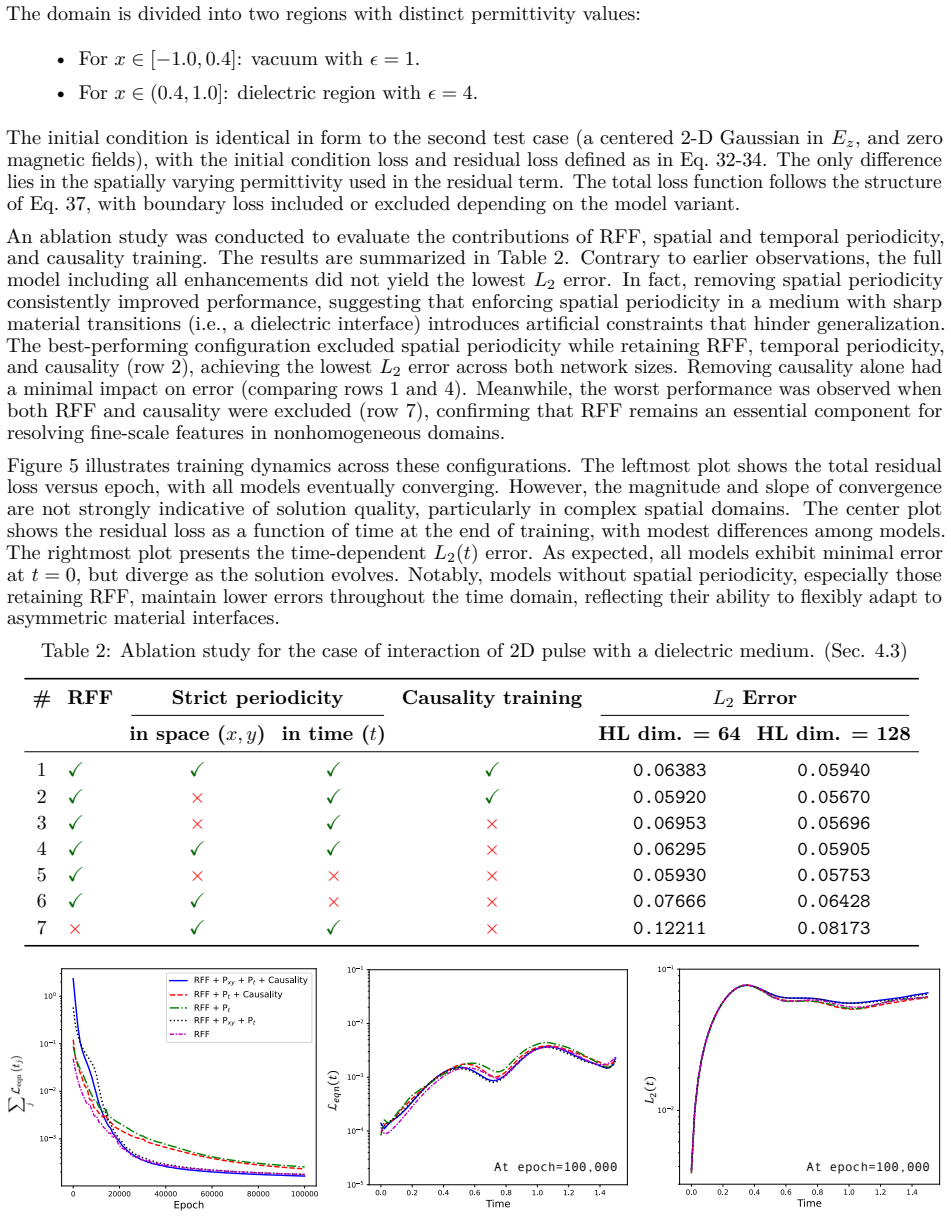
The authors find that PINNs need extra ingredients to work well. Adding random Fourier features to handle high frequencies, enforcing periodicity as a hard constraint, and training time slices from early to late (causal training) all help. In the 2D periodic case, the full configuration reaches an L2 error around 4%; without Fourier features, the error jumps to 10% or more. In the dielectric case, enforcing spatial periodicity hurts because the medium is not periodic, and the best configuration omits it.
The paper also uses a Neural Tangent Kernel (NTK) analysis to see where the network learns fastest. It reports that the local convergence rate tracks the time-dependent error, but not the spatial error. That suggests the network does not automatically spend more effort on difficult spatial regions. The main weaknesses are that the headline 1D result has no quantitative error measurement, one prose claim contradicts its own ablation table, and the NTK 'convergence rate' is defined as an average eigenvalue rather than the standard NTK minimum eigenvalue.
Extended reading notes
Core claim
Section 6 states: 'PINNs, when equipped with appropriately chosen enhancements such as RFF and domain-aware priors, can match or exceed traditional solvers for Maxwell's equations in structured and smooth domains.' If true, a properly configured PINN is a viable mesh-free alternative to FDTD and Pade for simple unsteady electromagnetic problems, and the NTK diagnostic (Section 5) predicts where training will not converge efficiently.
Load-bearing premise
Section 4.1 claims the PINN 'accurately captures the field distribution and sharply resolves the discontinuity' for the 1D Gaussian pulse, but no error norm is reported and the network uses smooth tanh activations that cannot represent a true derivative discontinuity. If the oscillation-free PINN solution is actually a smeared approximation, the primary evidence for the 'surpass traditional solvers' claim in the conclusions collapses.
Signed reviews
Editorial analysis
A structured set of objections, weighed in public.
Assumptions & free parameters
free parameters (5)
- Temporal period P_t =
not reported (trainable)
- Loss weights lambda_IC, lambda_BC, lambda_res =
1D: 20, 20, 1; 2D: 50, 50, 1 (Eq. 37)
- RFF scale sigma =
2
- Causality rate epsilon =
not reported
- Network depth L and width =
width 64 or 128; depth not stated
assumptions (4)
- domain assumption Strong form of Maxwell's equations with piecewise constant permittivity is valid at the dielectric interface without explicit interface conditions
- ad hoc to paper A non-periodic dielectric problem can be treated with periodic boundary conditions because the pulse is well-contained
- ad hoc to paper Trainable temporal periodicity does not harm accuracy on a non-periodic-in-time problem
- standard math NTK theory for infinite-width networks approximates finite-width training dynamics
invented entities (1)
-
Local convergence rate C(x,t) defined as the mean NTK eigenvalue
Cite this review
Pith. "Pith review of PINNs for Solving Unsteady Maxwell's Equations: Convergence Issues and Comparative Assessment with Compact Schemes." pith.science (2026). https://pith.science/paper/3SKNKCCH
@misc{pith2026250412144,
  author       = {Pith},
  title        = {Pith review of: PINNs for Solving Unsteady Maxwell's Equations: Convergence Issues and Comparative Assessment with Compact Schemes},
  year         = {2026},
  howpublished = {\url{https://pith.science/paper/3SKNKCCH}},
  note         = {Machine review of arXiv:2504.12144}
}
read the original abstract
Physics-Informed Neural Networks (PINNs) have recently emerged as a promising alternative for solving partial differential equations, offering a mesh-free framework that incorporates physical laws directly into the learning process. In this study, we explore the application of PINNs for solving unsteady Maxwell's equations and compare their performance with two established numerical methods: the Finite-Difference Time-Domain (FDTD) method and a compact Pade scheme with filtering. Three benchmark problems are considered, ranging from 1D free-space wave propagation to 2D Gaussian pulses in periodic and dielectric media. We assess the effectiveness of convergence-enhancing strategies for PINNs, including random Fourier features, spatio-temporal periodicity, and temporal causality training. An ablation study highlights that architectural choices must align with the underlying physics. Additionally, we employ a Neural Tangent Kernel framework to examine the spatio-temporal convergence behavior of PINNs. Results show that convergence rates correlate with error over time but not in space, revealing a limitation in how training dynamics allocate learning effort. Overall, this study demonstrates that PINNs, when properly configured, can match or surpass traditional solvers in accuracy and flexibility, though challenges remain in addressing spatial inhomogeneity and adapting training to localized complexity.
Figures


Figures from the paper (5 more)



Reference graph
Works this paper leans on
-
[1]
Wireless communications channel modeling based on numerical solutions of maxwell equations
King Lam, Peng Xu, Leung Tsang, Qin Li, and Kin Lai. Wireless communications channel modeling based on numerical solutions of maxwell equations. InProceedings of the Wireless Communications and Technology Conference, pages 261–262, 2003
work page 2003
-
[2]
M. Makarenko, A. Burguete-Lopez, F. Getman, and A. Fratalocchi. Generalized maxwell projections for multi-mode network photonics.Scientific Reports, 10(1):9038, Jun. 2020
work page 2020
-
[3]
R. Thompson and T. Moeller. A maxwell formulation for the equations of a plasma.Physics of Plasmas, 19:010702, 2012
work page 2012
-
[4]
Jeffrey W. Banks Michael J. Jenkinson. High-order accurate fdtd schemes for dispersive maxwell’s equations in second-order form using recursive convolutions.Journal of Computational and Applied Mathematics, 336:192–218, 2018
work page 2018
-
[5]
Finite element method for the solution of maxwell’s equations in multiple media
Ching-Lung Chang. Finite element method for the solution of maxwell’s equations in multiple media. Applied Mathematics and Computation, 25(2):89–99, 1988
1988
-
[6]
F. Hermeline, S. Layouni, and P. Omnes. A finite volume method for the approximation of maxwell’s equations in two space dimensions on arbitrary meshes.Journal of Computational Physics, 227(22):9365– 9388, 2008
work page 2008
-
[7]
Raissi, P
M. Raissi, P. Perdikaris, and G. E. Karniadakis. Physics-informed neural networks: A deep learning framework for solving forward and inverse problems involving nonlinear partial differential equations. Journal of Computational Physics, 378:686–707, 2019
2019
- [8]
Show all 57 references
-
[9]
On the eigenvector bias of fourier feature networks: From regression to solving multi-scale pdes with physics-informed neural networks.arXiv preprint arXiv:2012.10047, 2020
Sifan Wang, Hanwen Wang, and Paris Perdikaris. On the eigenvector bias of fourier feature networks: From regression to solving multi-scale pdes with physics-informed neural networks.arXiv preprint arXiv:2012.10047, 2020
2012 arXiv
-
[10]
When and why pinns fail to train: A neural tangent kernel perspective
Sifan Wang, Xinling Yu, and Paris Perdikaris. When and why pinns fail to train: A neural tangent kernel perspective. Journal of Computational Physics, 449:110768, 2022
2022
-
[11]
S. Wang, S. Sankaran, H. Wang, and P. Perdikaris. An expert’s guide to training physics-informed neural networks.arXiv Preprint, Aug. 2023
2023
-
[12]
From pinns to pikans: Recent advances in physics-informed machine learning
Juan Diego Toscano, Vivek Oommen, Alan John Varghese, Zongren Zou, Nazanin Ahmadi Daryakenari, Chenxi Wu, and George Em Karniadakis. From pinns to pikans: Recent advances in physics-informed machine learning. Machine Learning for Computational Science and Engineering, 1(1):1–43, 2025
2025
-
[13]
Rahaman, A
N. Rahaman, A. Baratin, D. Arpit, F. Draxler, M. Lin, F. Hamprecht, Y. Bengio, and A. Courville. On the spectral bias of neural networks. InProceedings of the International Conference on Machine Learning, pages 5301–5310, 2019
2019
-
[14]
Basri, M
R. Basri, M. Galun, A. Geifman, D. Jacobs, Y. Kasten, and S. Kritchman. Frequency bias in neural networks for input of non-uniform density.arXiv preprint, 2020
2020
-
[15]
Random features for large-scale kernel machines
Ali Rahimi and Benjamin Recht. Random features for large-scale kernel machines. InAdvances in neural information processing systems, pages 1177–1184, 2007
2007
-
[16]
Random weight factorization improves the training of continuous neural representations.arXiv preprint arXiv:2210.01274, 2022
Sifan Wang, Hanwen Wang, Jacob H Seidman, and Paris Perdikaris. Random weight factorization improves the training of continuous neural representations.arXiv preprint arXiv:2210.01274, 2022
2022 arXiv
-
[17]
Dong and N
S. Dong and N. Ni. A method for representing periodic functions and enforcing exactly periodic boundary conditions with deep neural networks.Journal of Computational Physics, 435:110242, 2021
2021
-
[18]
S. Wang, S. Sankaran, and P. Perdikaris. Respecting causality is all you need for training physics-informed neural networks.arXiv preprint, 2022
2022
-
[19]
Liu and Jorge Nocedal
Dong C. Liu and Jorge Nocedal. On the limited memory bfgs method for large scale optimization. Mathematical Programming, 45(1-3):503–528, 1989
1989
-
[20]
Challenges in training pinns: A loss landscape perspective.arXiv preprint arXiv:2402.01868, 2024
Pratik Rathore, Weimu Lei, Zachary Frangella, Lu Lu, and Madeleine Udell. Challenges in training pinns: A loss landscape perspective.arXiv preprint arXiv:2402.01868, 2024
2024 arXiv
-
[21]
Nysnewton: Fast neural network training with nyström approximation.arXiv preprint, 2023
Shaobo Gu, Xiao Wang, Ziyan Wang, and Jinchao Xu. Nysnewton: Fast neural network training with nyström approximation.arXiv preprint, 2023
2023
-
[22]
S. S. Oren and D. G. Luenberger. Self-scaling variable metric (ssvm) algorithms. part i: Criteria and sufficient conditions for scaling a class of algorithms.Management Science, 20(5):845–862, 1974
1974
-
[23]
Which optimizer works best for physics-informed neural networks and kolmogorov-arnold networks?arXiv preprint arXiv:2501.16371, 2025
Elham Kiyani, Khemraj Shukla, Jorge F Urbán, Jérôme Darbon, and George Em Karniadakis. Which optimizer works best for physics-informed neural networks and kolmogorov-arnold networks?arXiv preprint arXiv:2501.16371, 2025
2025
-
[24]
Residual-based attention in physics-informed neural networks.Computer Methods in Applied Mechanics and Engineering, 421:116805, 2024
Sokratis J Anagnostopoulos, Juan Diego Toscano, Nikolaos Stergiopulos, and George Em Karniadakis. Residual-based attention in physics-informed neural networks.Computer Methods in Applied Mechanics and Engineering, 421:116805, 2024
2024
-
[25]
Understanding and mitigating gradient flow pathologies in physics-informed neural networks.SIAM Journal on Scientific Computing, 43(5):A3055–A3081, 2021
Sifan Wang, Yujun Teng, and Paris Perdikaris. Understanding and mitigating gradient flow pathologies in physics-informed neural networks.SIAM Journal on Scientific Computing, 43(5):A3055–A3081, 2021
2021
-
[26]
Self-adaptive loss balanced physics-informed neural networks
Zixue Xiang, Wei Peng, Xu Liu, and Wen Yao. Self-adaptive loss balanced physics-informed neural networks. Neurocomputing, 496:11–34, 2022
2022
-
[27]
Self-adaptive physics-informed neural networks.Journal of Computational Physics, 474:111722, 2023
Levi D McClenny and Ulisses M Braga-Neto. Self-adaptive physics-informed neural networks.Journal of Computational Physics, 474:111722, 2023
2023
-
[28]
Chenxi Wu, Min Zhu, Qinyang Tan, Yadhu Kartha, and Lu Lu. A comprehensive study of non-adaptive and residual-based adaptive sampling for physics-informed neural networks.Computer Methods in Applied Mechanics and Engineering, 403:115671, 2023
2023
-
[29]
Causality-guided adaptive sampling method for physics-informed neural networks
Shuning Lin and Yong Chen. Causality-guided adaptive sampling method for physics-informed neural networks. arXiv preprint arXiv:2409.01536, 2024
2024 arXiv
-
[30]
Conservative physics-informed neural networks on discrete domains for conservation laws: Applications to forward and inverse problems
Ameya D Jagtap, Ehsan Kharazmi, and George Em Karniadakis. Conservative physics-informed neural networks on discrete domains for conservation laws: Applications to forward and inverse problems. Computer Methods in Applied Mechanics and Engineering, 365:113028, 2020. 16
2020
-
[31]
Solving allen-cahn and cahn-hilliard equations using the adaptive physics informed neural networks.arXiv preprint arXiv:2007.04542, 2020
Colby L Wight and Jia Zhao. Solving allen-cahn and cahn-hilliard equations using the adaptive physics informed neural networks.arXiv preprint arXiv:2007.04542, 2020
2007 arXiv
-
[32]
Charac- terizing possible failure modes in physics-informed neural networks.Advances in neural information processing systems, 34:26548–26560, 2021
Aditi Krishnapriyan, Amir Gholami, Shandian Zhe, Robert Kirby, and Michael W Mahoney. Charac- terizing possible failure modes in physics-informed neural networks.Advances in neural information processing systems, 34:26548–26560, 2021
2021
-
[33]
J. Liu, P. Borja, and C. Della Santina. Physics-informed neural networks to model and control robots: A theoretical and experimental investigation.Advanced Intelligent Systems, 6(5):Article 2300385, 2024
2024
-
[34]
W. Gu, S. Primatesta, and A. Rizzo. Physics-informed neural network for quadrotor dynamical modeling. Robotics and Autonomous Systems, 171:104569, 2024
2024
-
[35]
L. Liu, Y. Wang, and W. Chi. Image recognition technology based on machine learning.IEEE Access, pages 1–1, 2020
2020
-
[36]
X. Guo, W. Li, and F. Iorio. Convolutional neural networks for steady flow approximation. InProceedings of the 22nd ACM SIGKDD International Conference on Knowledge Discovery and Data Mining, pages 481–490, 2016
2016
-
[37]
K. T. Carlberg, A. Jameson, M. J. Kochenderfer, J. Morton, L. Peng, and F. D. Witherden. Recovering missing cfd data for high-order discretizations using deep neural networks and dynamics learning.Journal of Computational Physics, 395:105–124, 2019
2019
-
[38]
Safikhani, M
H. Safikhani, M. A. Akhavan-Behabadi, N. Nariman-Zadeh, and M. J. Mahmood Abadi. Modeling and multi-objective optimization of square cyclones using cfd and neural networks.Chemical Engineering Research and Design, 89(3):301–309, 2011
2011
-
[39]
Kamilaris and F
A. Kamilaris and F. X. Prenafeta-Boldú. A review of the use of convolutional neural networks in agriculture. The Journal of Agricultural Science, 156(3):312–322, 2018
2018
-
[40]
Y. R. Zheng, Z. Y. Huang, X. Z. Gong, and X. Z. Zheng. Implementation of maxwell’s equations solving algorithm based on pinn. In2024 IEEE International Conference on Computational Electromagnetics (ICCEM), pages 1–3, Nanjing, China, 2024
2024
-
[41]
Nohra and S
M. Nohra and S. Dufour. Physics-informed neural networks for the numerical modeling of steady-state and transient electromagnetic problems with discontinuous media.arXiv preprint, June 2024
2024
-
[42]
Neural tangent kernel: Convergence and generaliza- tion in neural networks.Advances in neural information processing systems, 31, 2018
Arthur Jacot, Franck Gabriel, and Clément Hongler. Neural tangent kernel: Convergence and generaliza- tion in neural networks.Advances in neural information processing systems, 31, 2018
2018
-
[43]
Zhang and H
Y. Zhang and H. Fu. Physics-informed deep neural network for inhomogeneous magnetized plasma parameter inversion.IEEE Antennas and Wireless Propagation Letters, 21(6):1001–1006, 2022
2022
-
[44]
Physics-informed neural networks for imaging and parameter retrieval of photonic nanostructures from near-field data.arXiv preprint arXiv:2109.12754, 2021
Yuyao Chen and Luca Dal Negro. Physics-informed neural networks for imaging and parameter retrieval of photonic nanostructures from near-field data.arXiv preprint arXiv:2109.12754, 2021
2021 arXiv
-
[45]
Magnetostatics and micromagnetics with physics informed neural networks.arXiv preprint arXiv:2106.03362, 2021
Alexander Kovacs, Lukas Exl, Alexander Kornell, Johann Fischbacher, Markus Hovorka, Markus Gusen- bauer, Leoni Breth, Harald Oezelt, Dirk Praetorius, Dieter Suess, and Thomas Schrefl. Magnetostatics and micromagnetics with physics informed neural networks.arXiv preprint arXiv:...
2021 arXiv
-
[46]
A domain-adaptive physics-informed neural network for inverse problems of maxwell’s equations in heterogeneous media.arXiv preprint arXiv:2308.06436, 2023
Shiyuan Piao, Hong Gu, Aina Wang, and Pan Qin. A domain-adaptive physics-informed neural network for inverse problems of maxwell’s equations in heterogeneous media.arXiv preprint arXiv:2308.06436, 2023
2023 arXiv
-
[47]
Rosskopf, and V
Philipp Brendel, A. Rosskopf, and V. Medvedev. Physics-informed neural networks for quasi-static maxwell’s equations. Fraunhofer IISB Erlangen, 2022
2022
-
[48]
Maxwellnet: Physics-driven deep neural network training based on maxwell’s equations
Joowon Lim and Demetri Psaltis. Maxwellnet: Physics-driven deep neural network training based on maxwell’s equations. Apl Photonics, 7(1), 2022
2022
-
[49]
Wiley, 2020
Jennifer Houle and Dennis Sullivan.Electromagnetic Simulation Using the FDTD Method with Python. Wiley, 2020
2020
-
[50]
On exact computation with an infinitely wide neural net.Advances in neural information processing systems, 32, 2019
Sanjeev Arora, Simon S Du, Wei Hu, Zhiyuan Li, Russ R Salakhutdinov, and Ruosong Wang. On exact computation with an infinitely wide neural net.Advances in neural information processing systems, 32, 2019
2019
-
[51]
Wide neural networks of any depth evolve as linear models under gradient descent
Jaehoon Lee, Lechao Xiao, Samuel Schoenholz, Yasaman Bahri, Roman Novak, Jascha Sohl-Dickstein, and Jeffrey Pennington. Wide neural networks of any depth evolve as linear models under gradient descent. Advances in neural information processing systems, 32, 2019. 17
2019
-
[52]
Greg Yang. Scaling limits of wide neural networks with weight sharing: Gaussian process behavior, gradient independence, and neural tangent kernel derivation.arXiv preprint arXiv:1902.04760, 2019
1902 arXiv
-
[53]
Numerical solution of initial boundary value problems involving maxwell’s equations in isotropic media
Kane Yee. Numerical solution of initial boundary value problems involving maxwell’s equations in isotropic media. IEEE Transactions on antennas and propagation, 14(3):302–307, 1966
1966
-
[54]
Computational electromagnetics: the finite- difference time-domain method.The Electrical Engineering Handbook, 3(629-670):15, 2005
Allen Taflove, Susan C Hagness, and Melinda Piket-May. Computational electromagnetics: the finite- difference time-domain method.The Electrical Engineering Handbook, 3(629-670):15, 2005
2005
-
[55]
Compact finite difference schemes with spectral-like resolution.Journal of computational physics, 103(1):16–42, 1992
Sanjiva K Lele. Compact finite difference schemes with spectral-like resolution.Journal of computational physics, 103(1):16–42, 1992
1992
-
[56]
On the use of higher-order finite-difference schemes on curvilinear and deforming meshes.Journal of Computational Physics, 181(1):155–185, 2002
Miguel R Visbal and Datta V Gaitonde. On the use of higher-order finite-difference schemes on curvilinear and deforming meshes.Journal of Computational Physics, 181(1):155–185, 2002
2002
-
[57]
On the use of high order central difference schemes for differential equation based wall distance computations
Hemanth Chandra Vamsi Kakumani, Nagabhushana Rao Vadlamani, and Paul Gary Tucker. On the use of high order central difference schemes for differential equation based wall distance computations. Computers & Fluids, 248:105666, 2022. 18
2022
Reviewed August 16, 2026 · model on record in the stance chip above.
Discussion (0). Continue with ORCID to comment.