REVIEW 3 major objections 5 minor 74 references
CodingHomo: Bootstrapping Deep Homography With Video Coding
T0 review · 3 major / 5 minor · reviewed 2026-08-16 · deepseek-v4-flash
Pith's one-line read Motion vectors already embedded in H.264 video, normally discarded at decode time, can be fused with image features through learned masks to give unsupervised homography its best reported accuracy: 0.31 on CA-unsup and 1.21 on GHOF.
desk verdict Solid niche advance using H.264 MVs for unsupervised homography; credible but needs a clearer GHOF training protocol and validation-based alpha. read the letter →
The pith
A machine-rendered reading of the paper's core claim, the machinery that carries it, and where it could break.
The reading
What carries the argument
The load-bearing mechanism is a pair of learned masks built by comparing two motion fields: the blockwise motion-vector flow $V^i_{ab}$ extracted from the H.264 bitstream and the current homography flow $H^i_{ab}$. In the Mask-Guided Fusion (MGF) module, a mask generator $G_m$ outputs a motion-rejection mask $M^i_m$ whose confidence values are modeled with conditionally independent Laplace distributions, and a fusion network predicts a residual homography added to $H^i_{ab}$. The Mask-Guided Homography Estimation (MGHE) module applies an adjusted mask $\hat{M}^{i-1}_m = M^{i-1}_m(1-\alpha)+\alpha$ to the warped source and target features before a Swin transformer refinement, so early noisy estimates cannot zero out the features. Finally, the Enhanced Motion Mask $M_e = G_c(F'_a,F_b)\cdot G_m(H_{ab},V_{ab})$ multiplies a coplanarity-aware feature mask with the motion-rejection mask and weights the unsupervised loss, trained with a negative log-likelihood term that keeps the mask from collapsing to all zeros.
What would settle it
Replace the H.264 motion-vector input with a scrambled or all-zero flow on the CA-unsup test set and compare average point-matching error: if it remains near 0.31 the motion prior is not load-bearing, and if it jumps toward the 0.36-0.46 range seen in the no-mask ablations, the prior is confirmed as the source of the gain.
Extended reading notes
Core claim
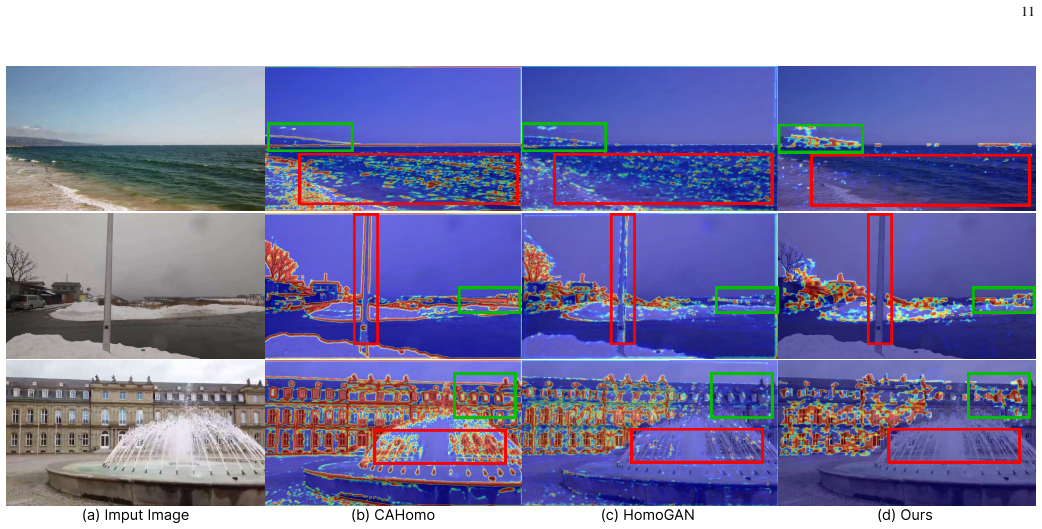
The paper's central claim is that motion vectors already present in coded video, which are ordinarily discarded after decoding, constitute an effective and entirely free prior for unsupervised homography estimation, and that a network can learn to use them by masking. CodingHomo predicts a homography from reconstructed H.264 frame pairs plus their motion-vector flows; the mask-guided fusion and mask-guided estimation modules suppress foreground and parallax motion while the enhanced motion mask concentrates the loss on the dominant plane. The paper reports that this reaches an average point-matching error of 0.31 on CA-unsup, a reduction from 0.34 for the previous best method, and 1.21 on GHOF, a reduction from 1.72, including generalization to fog, rain, and snow scenes not present in training.
Load-bearing premise
The masks only help if the codec's motion vectors and the current homography agree about the dominant plane; when the initial homography is far wrong or the true motion is larger than the codec's short search window, the prior stops being informative and the method has no backup signal.
Editorial extensions
If this is right
- Because the motion vectors are extracted from the bitstream during normal decoding, the method adds no bitrate cost and no new labeling; any pipeline that already decodes H.264 video can obtain the prior for free.
- The reported generalization to fog, rain, and snow on GHOF, categories absent from training, indicates that the MV prior transfers across appearance domains better than photometric or feature losses alone.
- The ablation numbers attribute most of the gain to the learned masks: removing the motion-rejection mask raises CA-unsup error from 0.31 to 0.36, and removing the mask from the loss raises it to 0.46, so the mask mechanism, not the raw MVs, is what carries the improvement.
- The coarse-to-fine estimator inherits a transformer pyramid, but the MGHE module lets the mask prune features before each refinement stage, which is what the paper credits for handling large foregrounds and multiple planes.
- The approach is stated to extend naturally to HEVC/H.265 and VVC/H.266, since MV extraction is a standard decoding step; the H.264 choice is made because the CA-unsup dataset was encoded in that format.
Reading between the lines
- Editorial extension: the same mask-guided fusion pattern could be applied to other decode-side priors, such as residual energy, block partition structure, or reference-frame indexes, to distinguish static background from dynamic objects; the paper does not explore these.
- Editorial boundary: because H.264 motion search is typically capped around a 16-pixel window, the method is inherently a small-baseline estimator, and feature-based methods may remain necessary for large displacements unless codec search ranges are enlarged.
- Editorial test: swapping the H.264 MVs for optical flow computed from the decoded frames would show whether the gain comes specifically from the codec prior or from any dense motion signal; the paper's mechanism does not logically require the MVs to originate from a codec.
Signed reviews
Editorial analysis
A structured set of objections, weighed in public.
Referee Report
Summary. The paper presents CodingHomo, an unsupervised deep homography estimation framework that augments image pairs with motion vectors extracted from H.264/AVC video bitstreams. The main technical contributions are a Mask-Guided Fusion (MGF) module that fuses a coarse homography with motion vectors under a learned motion-rejection mask, a Mask-Guided Homography Estimation (MGHE) module that uses the mask in coarse-to-fine refinement, and an Enhanced Motion Mask (EMM) that combines a coplanarity-aware mask with a motion-rejection mask for loss weighting, trained with a negative log-likelihood loss. Experiments on the CA-unsup dataset report state-of-the-art average point matching error (0.31 PME) and a generalization experiment on the GHOF dataset reports a larger improvement (1.21 PME), with qualitative results on fog, rain, and snow scenes. Code and dataset are promised publicly.
Significance. If the empirical results are reproducible, this is a novel and useful direction: it is the first unsupervised homography framework to exploit codec motion vectors as a prior, and the engineering is solid in several respects. The paper includes comparisons against feature-based, supervised, and unsupervised baselines on two datasets, per-component ablations, standard deviations, a t-test, robustness curves, and a public code/data commitment. These strengths make the central claim clearly testable. The main risks are protocol-level: the GHOF generalization experiment does not state whether GHOF training frames were used in any way, and the hyperparameter α is selected on the test set. Both are fixable with clarifications or additional experiments, so the paper is best treated as a major revision rather than a rejection.
major comments (3)
- [Section IV-C2 / Section IV-A] The GHOF generalization experiment lacks an explicit training protocol. The paper reports GHOF as a generalization test and emphasizes improvements on unseen fog, rain, and snow scenes, but Section IV-A states that GHOF includes a training set of approximately 10,000 frames, and Section IV-C2 only says "we added the corresponding MVs to the test set (GHOF)". It is never stated whether the network, the mask generators, or the hyperparameter α were trained or tuned on any GHOF frames. Since the largest reported relative gain (1.72 to 1.21, 29.65%) occurs on the GHOF categories, this omission leaves open the possibility that the improvement reflects learning GHOF-specific MV/homography statistics rather than a generalizable motion prior. Please state definitively which GHOF data were used for training, validation, and model selection; if none were used, say so explicitly.
- [Section IV-F / Table IV] The floor parameter α in Eq. (6) is selected on the CA-unsup test set. Table IV reports PME on the test set for α ∈ {1.0, 0.4, 0.2, 0.0}, and the final model uses α = 0.2 from that table. This is test-set model selection, so the PME values in Table I and the t-test against RealSH (t = 3.7102) are obtained from a model whose hyperparameter was tuned on the same test set, while the comparison methods were not afforded such tuning. Please introduce a validation split, select α on it, and report the corresponding test numbers, or report all α variants on a held-out validation set to establish that the SOTA claim is not an artifact of test-set tuning.
- [Section IV-C1] The statement "All learning-based methods are trained on the CA-sup dateset" is inconsistent with the rest of the manuscript, where CAHomo, BasesHomo, and HomoGAN are described as unsupervised methods trained on CA-unsup. If some comparison methods were trained on a different dataset (for example RealSH on CA-sup), the comparison in Tables I and II is not controlled; if the sentence is a typo, it should be corrected. Please specify the exact training data and protocol for every learning-based baseline, including RealSH and the unsupervised methods.
minor comments (5)
- [Section III-B] Please fix the typo "A VC/H.264" (should be "AVC/H.264") and the repeated "video video coding" in the same section.
- [Table I] The row labeled "I3×3" is not defined in the text or caption; please state explicitly that it is the identity-transform baseline.
- [Figure 2 caption] The caption says "Red block donates a dynamic vehicle"; "donates" should be "denotes".
- [Section IV-A / IV-C2] The encoder configuration used to generate the H.264 bitstreams and MVs for GHOF is not reported. The paper only says MVs were "added" to GHOF; without encoder settings (QP, search range, frame structure, minimum block size, reference-frame count), the motion-vector input is not reproducible.
- [Section III-D] The mask notation is inconsistent: "Mi−1m", "Mi m", and "fMi−1m" are used without a uniform convention. Please define the superscript/subscript placement clearly and use it consistently through Eqs. (5)–(7).
Circularity Check
No significant circularity: the central claim is an empirical benchmark result evaluated on held-out ground truth, and the MVs and masks are internal inputs/training objectives rather than predictions that reproduce their own inputs.
full rationale
The paper's central claim is an empirical benchmark result: CodingHomo is trained with an unsupervised photometric/NLL objective on CA-unsup training pairs and evaluated by average L2 point-matching error against held-out ground-truth correspondences on the CA-unsup and GHOF test sets. The motion vectors are codec inputs extracted from the bitstream, not labels derived from the target homography; the learned masks are internal gating modules whose supervision (Eqs. 4, 8, 12) depends on the current estimate H_ab and the codec flow V_ab, but this is a training objective, not a prediction of the test metric. No equation defines the reported PME in terms of the training loss, and no fitted parameter is renamed as a prediction. The GHOF generalization experiment states that fog/rain scenes 'were not included in the training dataset (CA-unsup)' and that MVs were added only to the test set; whether that protocol was fully followed is a reproducibility question, not a circularity one. Self-citations to CAHomo, HomoGAN, RealSH, and GHOF are used as baselines, datasets, and borrowed backbone components; they are not invoked as uniqueness theorems or as the justification for the empirical improvement. The claimed derivation chain is therefore self-contained with respect to circularity.
Assumptions & free parameters
free parameters (3)
- alpha (mask floor in MGHE) =
0.2
- BCE loss weight in plane loss =
0.05
- Number of coarse-to-fine scale levels =
3
assumptions (4)
- domain assumption H.264 motion vectors can be extracted losslessly during decoding and represent inter-frame block motion.
- ad hoc to paper Motion vector flow and homography flow are commensurate representations, so their pixel-wise difference can be modeled by a Laplace distribution whose variance is the mask.
- domain assumption The dominant-plane homography is the transformation that aligns the largest image region, and MVs in that region are consistent with the homography.
- domain assumption The MVs in the test videos have a bounded search range (around 16 pixels), so the method is only valid for small-baseline motions.
Cite this review
Pith. "Pith review of CodingHomo: Bootstrapping Deep Homography With Video Coding." pith.science (2026). https://pith.science/paper/EKVBD4PE
@misc{pith2026250412165,
  author       = {Pith},
  title        = {Pith review of: CodingHomo: Bootstrapping Deep Homography With Video Coding},
  year         = {2026},
  howpublished = {\url{https://pith.science/paper/EKVBD4PE}},
  note         = {Machine review of arXiv:2504.12165}
}
read the original abstract
Homography estimation is a fundamental task in computer vision with applications in diverse fields. Recent advances in deep learning have improved homography estimation, particularly with unsupervised learning approaches, offering increased robustness and generalizability. However, accurately predicting homography, especially in complex motions, remains a challenge. In response, this work introduces a novel method leveraging video coding, particularly by harnessing inherent motion vectors (MVs) present in videos. We present CodingHomo, an unsupervised framework for homography estimation. Our framework features a Mask-Guided Fusion (MGF) module that identifies and utilizes beneficial features among the MVs, thereby enhancing the accuracy of homography prediction. Additionally, the Mask-Guided Homography Estimation (MGHE) module is presented for eliminating undesired features in the coarse-to-fine homography refinement process. CodingHomo outperforms existing state-of-the-art unsupervised methods, delivering good robustness and generalizability. The code and dataset are available at: \href{github}{https://github.com/liuyike422/CodingHomo
Figures


Figures from the paper (10 more)




Reference graph
Works this paper leans on
-
[1]
Hartley and A
R. Hartley and A. Zisserman, Multiple view geometry in computer vision. Cambridge university press, 2003
2003
-
[2]
Homography loss for monocular 3d object detection,
J. Gu, B. Wu, L. Fan, J. Huang, S. Cao, Z. Xiang, and X.-S. Hua, “Homography loss for monocular 3d object detection,” in Proceedings of the IEEE/CVF Conference on Computer Vision and Pattern Recognition, 2022, pp. 1080–1089
work page 2022
-
[3]
Homography guided temporal fusion for road line and marking segmentation,
S. Wang, C. Nguyen, J. Liu, K. Zhang, W. Luo, Y . Zhang, S. Muthu, F. A. Maken, and H. Li, “Homography guided temporal fusion for road line and marking segmentation,” in Proceedings of the IEEE/CVF International Conference on Computer Vision , 2023, pp. 1075–1085
work page 2023
-
[4]
R. Fan, H. Wang, P. Cai, J. Wu, M. J. Bocus, L. Qiao, and M. Liu, “Learning collision-free space detection from stereo images: Homogra- phy matrix brings better data augmentation,” IEEE/ASME Transactions on Mechatronics, vol. 27, no. 1, pp. 225–233, 2021
work page 2021
-
[5]
W. Li, J. Fan, S. Li, Z. Tian, D. Ai, H. Song, and J. Yang, “Homography- based robust pose compensation and fusion imaging for augmented reality based endoscopic navigation system,” Computers in Biology and Medicine, vol. 138, p. 104864, 2021
work page 2021
-
[6]
M. Huber, J. B. Mitchell, R. Henry, S. Ourselin, T. Vercauteren, and C. Bergeles, “Homography-based visual servoing with remote center of motion for semi-autonomous robotic endoscope manipulation,” in 2021 International Symposium on Medical Robotics (ISMR) . IEEE, 2021, pp. 1–7
work page 2021
-
[7]
Stereo correspon- dence and reconstruction of endoscopic data challenge,
M. Allan, J. Mcleod, C. Wang, J. C. Rosenthal, Z. Hu, N. Gard, P. Eisert, K. X. Fu, T. Zeffiro, W. Xia et al. , “Stereo correspon- dence and reconstruction of endoscopic data challenge,” arXiv preprint arXiv:2101.01133, 2021
arXiv 2021
-
[8]
Deep high dynamic range imaging with large foreground motions,
S. Wu, J. Xu, Y .-W. Tai, and C.-K. Tang, “Deep high dynamic range imaging with large foreground motions,” in Proceedings of the European Conference on Computer Vision (ECCV) , 2018, pp. 117–132. 14
work page 2018
Show all 74 references
-
[9]
Adnet: Attention-guided deformable convolutional network for high dynamic range imaging,
Z. Liu, W. Lin, X. Li, Q. Rao, T. Jiang, M. Han, H. Fan, J. Sun, and S. Liu, “Adnet: Attention-guided deformable convolutional network for high dynamic range imaging,” in Proceedings of the IEEE/CVF Conference on Computer Vision and Pattern Recognition, 2021, pp. 463– 470
2021
-
[10]
Ghost-free high dynamic range imaging with context-aware transformer,
Z. Liu, Y . Wang, B. Zeng, and S. Liu, “Ghost-free high dynamic range imaging with context-aware transformer,” in Proceedings of the European Conference on Computer Vision (ECCV) . Springer, 2022, pp. 344–360
2022
-
[11]
Fast burst images denoising,
Z. Liu, L. Yuan, X. Tang, M. Uyttendaele, and J. Sun, “Fast burst images denoising,” ACM Transactions on Graphics (TOG) , vol. 33, no. 6, pp. 1–9, 2014
2014
-
[12]
Deep burst super- resolution,
G. Bhat, M. Danelljan, L. Van Gool, and R. Timofte, “Deep burst super- resolution,” in Proceedings of the IEEE/CVF Conference on Computer Vision and Pattern Recognition , 2021, pp. 9209–9218
2021
-
[13]
Bundled camera paths for video stabilization,
S. Liu, L. Yuan, P. Tan, and J. Sun, “Bundled camera paths for video stabilization,” ACM Transactions on Graphics (TOG), vol. 32, no. 4, pp. 1–10, 2013
2013
-
[14]
Minimum latency deep online video stabilization,
Z. Zhang, Z. Liu, P. Tan, B. Zeng, and S. Liu, “Minimum latency deep online video stabilization,” in Proceedings of the IEEE/CVF International Conference on Computer Vision, 2023, pp. 23 030–23 039
2023
-
[15]
Gl-rg: Global-local representation granularity for video captioning,
L. Yan, Q. Wang, Y . Cui, F. Feng, X. Quan, X. Zhang, and D. Liu, “Gl-rg: Global-local representation granularity for video captioning,” in Proceedings of the Thirty-First International Joint Conference on Artificial Intelligence, IJCAI-22 , 2022, pp. 2769–2775
2022
-
[16]
Video captioning using global-local representation,
L. Yan, S. Ma, Q. Wang, Y . Chen, X. Zhang, A. Savakis, and D. Liu, “Video captioning using global-local representation,” IEEE Transactions on Circuits and Systems for Video Technology, vol. 32, no. 10, pp. 6642– 6656, 2022
2022
-
[17]
Solve the puzzle of instance segmentation in videos: A weakly supervised framework with spatio-temporal collaboration,
L. Yan, Q. Wang, S. Ma, J. Wang, and C. Yu, “Solve the puzzle of instance segmentation in videos: A weakly supervised framework with spatio-temporal collaboration,” IEEE Transactions on Circuits and Systems for Video Technology, vol. 33, no. 1, pp. 393–406, 2022
2022
-
[18]
Sg-net: Spatial granularity network for one-stage video instance segmentation,
D. Liu, Y . Cui, W. Tan, and Y . Chen, “Sg-net: Spatial granularity network for one-stage video instance segmentation,” in Proceedings of the IEEE/CVF Conference on Computer Vision and Pattern Recognition, 2021, pp. 9816–9825
2021
-
[19]
Tf-blender: Temporal feature blender for video object detection,
Y . Cui, L. Yan, Z. Cao, and D. Liu, “Tf-blender: Temporal feature blender for video object detection,” in Proceedings of the IEEE/CVF International Conference on Computer Vision , 2021, pp. 8138–8147
2021
-
[20]
Video object detection for autonomous driving: Motion-aid feature calibration,
D. Liu, Y . Cui, Y . Chen, J. Zhang, and B. Fan, “Video object detection for autonomous driving: Motion-aid feature calibration,” Neurocomput- ing, vol. 409, pp. 1–11, 2020
2020
-
[21]
Distinctive image features from scale-invariant keypoints,
D. G. Lowe, “Distinctive image features from scale-invariant keypoints,” International Journal of Computer Vision , vol. 60, pp. 91–110, 2004
2004
-
[22]
Speeded-up robust features (surf),
H. Bay, A. Ess, T. Tuytelaars, and L. Van Gool, “Speeded-up robust features (surf),” Computer Vision and Image Understanding , vol. 110, no. 3, pp. 346–359, 2008
2008
-
[23]
Orb: An efficient alternative to sift or surf,
E. Rublee, V . Rabaud, K. Konolige, and G. Bradski, “Orb: An efficient alternative to sift or surf,” in Proceedings of the IEEE/CVF International Conference on Computer Vision . Ieee, 2011, pp. 2564–2571
2011
-
[24]
Random sample consensus: a paradigm for model fitting with applications to image analysis and automated cartography,
M. A. Fischler and R. C. Bolles, “Random sample consensus: a paradigm for model fitting with applications to image analysis and automated cartography,” Communications of the ACM, vol. 24, no. 6, pp. 381–395, 1981
1981
-
[25]
Content-aware unsupervised deep homography estimation,
J. Zhang, C. Wang, S. Liu, L. Jia, N. Ye, J. Wang, J. Zhou, and J. Sun, “Content-aware unsupervised deep homography estimation,” in Proceedings of the European Conference on Computer Vision (ECCV) . Springer, 2020, pp. 653–669
2020
-
[26]
Gyroflow+: Gyroscope-guided unsupervised deep homography and optical flow learning,
H. Li, K. Luo, B. Zeng, and S. Liu, “Gyroflow+: Gyroscope-guided unsupervised deep homography and optical flow learning,” International Journal of Computer Vision , pp. 1–19, 2024
2024
-
[27]
Deep image homogra- phy estimation,
D. DeTone, T. Malisiewicz, and A. Rabinovich, “Deep image homogra- phy estimation,” arXiv preprint arXiv:1606.03798 , 2016
2016 arXiv
-
[28]
Localtrans: A multiscale local transformer network for cross-resolution homography estimation,
R. Shao, G. Wu, Y . Zhou, Y . Fu, L. Fang, and Y . Liu, “Localtrans: A multiscale local transformer network for cross-resolution homography estimation,” in Proceedings of the IEEE/CVF International Conference on Computer Vision , 2021, pp. 14 890–14 899
2021
-
[29]
Iterative deep homography estimation,
S.-Y . Cao, J. Hu, Z. Sheng, and H.-L. Shen, “Iterative deep homography estimation,” in Proceedings of the IEEE/CVF Conference on Computer Vision and Pattern Recognition , 2022, pp. 1879–1888
2022
-
[30]
Supervised homography learning with realistic dataset generation,
H. Jiang, H. Li, S. Han, H. Fan, B. Zeng, and S. Liu, “Supervised homography learning with realistic dataset generation,” in Proceedings of the IEEE/CVF International Conference on Computer Vision , 2023, pp. 9806–9815
2023
-
[31]
Microsoft coco: Common objects in context,
T.-Y . Lin, M. Maire, S. Belongie, J. Hays, P. Perona, D. Ramanan, P. Doll ´ar, and C. L. Zitnick, “Microsoft coco: Common objects in context,” in Proceedings of the European Conference on Computer Vision (ECCV). Springer, 2014, pp. 740–755
2014
-
[32]
Unsupervised deep homography: A fast and robust homography esti- mation model,
T. Nguyen, S. W. Chen, S. S. Shivakumar, C. J. Taylor, and V . Kumar, “Unsupervised deep homography: A fast and robust homography esti- mation model,” IEEE Robotics and Automation Letters , vol. 3, no. 3, pp. 2346–2353, 2018
2018
-
[33]
Motion basis learning for unsupervised deep homography estimation with subspace projection,
N. Ye, C. Wang, H. Fan, and S. Liu, “Motion basis learning for unsupervised deep homography estimation with subspace projection,” in Proceedings of the IEEE/CVF International Conference on Computer Vision, 2021, pp. 13 117–13 125
2021
-
[34]
Unsupervised homography estimation with coplanarity-aware gan,
M. Hong, Y . Lu, N. Ye, C. Lin, Q. Zhao, and S. Liu, “Unsupervised homography estimation with coplanarity-aware gan,” in Proceedings of the IEEE/CVF Conference on Computer Vision and Pattern Recognition, 2022, pp. 17 663–17 672
2022
-
[35]
Codingflow: Enable video coding for video stabilization,
S. Liu, M. Li, S. Zhu, and B. Zeng, “Codingflow: Enable video coding for video stabilization,” IEEE Transactions on Image Processing, vol. 26, no. 7, pp. 3291–3302, 2017
2017
-
[36]
Overview of the h. 264/avc video coding standard,
T. Wiegand, G. J. Sullivan, G. Bjontegaard, and A. Luthra, “Overview of the h. 264/avc video coding standard,” IEEE Transactions on Circuits and Systems for Video Technology , vol. 13, no. 7, pp. 560–576, 2003
2003
-
[37]
Overview of the high efficiency video coding (hevc) standard,
G. J. Sullivan, J.-R. Ohm, W.-J. Han, and T. Wiegand, “Overview of the high efficiency video coding (hevc) standard,” IEEE Transactions on Circuits and Systems for Video Technology , vol. 22, no. 12, pp. 1649– 1668, 2012
2012
-
[38]
Overview of the versatile video coding (vvc) standard and its applications,
B. Bross, Y .-K. Wang, Y . Ye, S. Liu, J. Chen, G. J. Sullivan, and J.- R. Ohm, “Overview of the versatile video coding (vvc) standard and its applications,” IEEE Transactions on Circuits and Systems for Video Technology, vol. 31, no. 10, pp. 3736–3764, 2021
2021
-
[39]
Discrete cosine transform,
N. Ahmed, T. Natarajan, and K. R. Rao, “Discrete cosine transform,” IEEE Transactions on Computers , vol. 100, no. 1, pp. 90–93, 1974
1974
-
[40]
Context-based adaptive binary arithmetic coding in the h. 264/avc video compression standard,
D. Marpe, H. Schwarz, and T. Wiegand, “Context-based adaptive binary arithmetic coding in the h. 264/avc video compression standard,” IEEE Transactions on Circuits and Systems for Video Technology , vol. 13, no. 7, pp. 620–636, 2003
2003
-
[41]
Adaptive deblocking filter,
P. List, A. Joch, J. Lainema, G. Bjontegaard, and M. Karczewicz, “Adaptive deblocking filter,”IEEE Transactions on Circuits and Systems for Video Technology, vol. 13, no. 7, pp. 614–619, 2003
2003
-
[42]
Dvc: An end-to-end deep video compression framework,
G. Lu, W. Ouyang, D. Xu, X. Zhang, C. Cai, and Z. Gao, “Dvc: An end-to-end deep video compression framework,” in Proceedings of the IEEE/CVF Conference on Computer Vision and Pattern Recognition , 2019, pp. 11 006–11 015
2019
-
[43]
M-lvc: Multiple frames prediction for learned video compression,
J. Lin, D. Liu, H. Li, and F. Wu, “M-lvc: Multiple frames prediction for learned video compression,” in Proceedings of the IEEE/CVF Confer- ence on Computer Vision and Pattern Recognition, 2020, pp. 3546–3554
2020
-
[44]
Fvc: A new framework towards deep video compression in feature space,
Z. Hu, G. Lu, and D. Xu, “Fvc: A new framework towards deep video compression in feature space,” in Proceedings of the IEEE/CVF Conference on Computer Vision and Pattern Recognition , 2021, pp. 1502–1511
2021
-
[45]
Displacement measurement and its application in interframe image coding,
J. Jain and A. Jain, “Displacement measurement and its application in interframe image coding,” IEEE Transactions on Communications , vol. 29, no. 12, pp. 1799–1808, 1981
1981
-
[46]
Interframe coding that follows the motion,
Y . Taki, M. Hatori, and S. Tanaka, “Interframe coding that follows the motion,” Proc. Institute of Electronics and Communication Engineers Jpn. Annu. Conv.(IECEJ), p. 1263, 1974
1974
-
[47]
Motion-compensated interframe coding for video conferenc- ing,
T. Koga, “Motion-compensated interframe coding for video conferenc- ing,” in Proc. National Telecommunications Conference, 1981, 1981, pp. G5–3
1981
-
[48]
A new three-step search algorithm for block motion estimation,
R. Li, B. Zeng, and M. L. Liou, “A new three-step search algorithm for block motion estimation,” IEEE Transactions on Circuits and Systems for Video Technology, vol. 4, no. 4, pp. 438–442, 1994
1994
-
[49]
A novel four-step search algorithm for fast block motion estimation,
L.-M. Po and W.-C. Ma, “A novel four-step search algorithm for fast block motion estimation,” IEEE Transactions on Circuits and Systems for Video Technology, vol. 6, no. 3, pp. 313–317, 1996
1996
-
[50]
A new diamond search algorithm for fast block- matching motion estimation,
S. Zhu and K.-K. Ma, “A new diamond search algorithm for fast block- matching motion estimation,” IEEE Transactions on Image Processing , vol. 9, no. 2, pp. 287–290, 2000
2000
-
[51]
K-nearest neighbour classifiers-a tutorial,
P. Cunningham and S. J. Delany, “K-nearest neighbour classifiers-a tutorial,” ACM Computing Surveys (CSUR) , vol. 54, no. 6, pp. 1–25, 2021
2021
-
[52]
Lift: Learned invariant feature transform,
K. M. Yi, E. Trulls, V . Lepetit, and P. Fua, “Lift: Learned invariant feature transform,” in Proceedings of the European Conference on Computer Vision (ECCV) . Springer, 2016, pp. 467–483
2016
-
[53]
Self-supervised interest point detection and description for fisheye and perspective images,
M. Mera-Trujillo, S. Patel, Y . Gu, and G. Doretto, “Self-supervised interest point detection and description for fisheye and perspective images,” in Proceedings of the IEEE/CVF Conference on Computer Vision and Pattern Recognition , 2023, pp. 6497–6506. 15
2023
-
[54]
Sosnet: Second order similarity regularization for local descriptor learning,
Y . Tian, X. Yu, B. Fan, F. Wu, H. Heijnen, and V . Balntas, “Sosnet: Second order similarity regularization for local descriptor learning,” in Proceedings of the IEEE/CVF Conference on Computer Vision and Pattern Recognition, 2019, pp. 11 016–11 025
2019
-
[55]
Magsac: marginalizing sample consensus,
D. Barath, J. Matas, and J. Noskova, “Magsac: marginalizing sample consensus,” in Proceedings of the IEEE/CVF Conference on Computer Vision and Pattern Recognition , 2019, pp. 10 197–10 205
2019
-
[56]
Magsac++, a fast, reliable and accurate robust estimator,
D. Barath, J. Noskova, M. Ivashechkin, and J. Matas, “Magsac++, a fast, reliable and accurate robust estimator,” in Proceedings of the IEEE/CVF Conference on Computer Vision and Pattern Recognition , 2020, pp. 1304–1312
2020
-
[57]
Clkn: Cascaded lucas- kanade networks for image alignment,
C.-H. Chang, C.-N. Chou, and E. Y . Chang, “Clkn: Cascaded lucas- kanade networks for image alignment,” in Proceedings of the IEEE/CVF Conference on Computer Vision and Pattern Recognition , 2017, pp. 2213–2221
2017
-
[58]
Robust homography estimation via dual principal component pursuit,
T. Ding, Y . Yang, Z. Zhu, D. P. Robinson, R. Vidal, L. Kneip, and M. C. Tsakiris, “Robust homography estimation via dual principal component pursuit,” in Proceedings of the IEEE/CVF Conference on Computer Vision and Pattern Recognition , 2020, pp. 6080–6089
2020
-
[59]
Gyroflow: gyroscope-guided unsupervised optical flow learning,
H. Li, K. Luo, and S. Liu, “Gyroflow: gyroscope-guided unsupervised optical flow learning,” in Proceedings of the IEEE/CVF Conference on Computer Vision and Pattern Recognition , 2021, pp. 12 869–12 878
2021
-
[60]
Asflow: Unsupervised optical flow learning with adaptive pyramid sampling,
S. Liu, K. Luo, A. Luo, C. Wang, F. Meng, and B. Zeng, “Asflow: Unsupervised optical flow learning with adaptive pyramid sampling,” IEEE Transactions on Circuits and Systems for Video Technology , vol. 32, no. 7, pp. 4282–4295, 2022
2022
-
[61]
Realflow: Em-based realistic optical flow dataset generation from videos,
Y . Han, K. Luo, A. Luo, J. Liu, H. Fan, G. Luo, and S. Liu, “Realflow: Em-based realistic optical flow dataset generation from videos,” in Proceedings of the European Conference on Computer Vision (ECCV) . Springer, 2022, pp. 288–305
2022
-
[62]
Learning optical flow with kernel patch attention,
A. Luo, F. Yang, X. Li, and S. Liu, “Learning optical flow with kernel patch attention,” in Proceedings of the IEEE/CVF Conference on Computer Vision and Pattern Recognition , 2022, pp. 8906–8915
2022
-
[63]
Pdc-net+: En- hanced probabilistic dense correspondence network,
P. Truong, M. Danelljan, R. Timofte, and L. Van Gool, “Pdc-net+: En- hanced probabilistic dense correspondence network,” IEEE Transactions on Pattern Analysis and Machine Intelligence , 2023
2023
-
[64]
Glu-net: Global-local uni- versal network for dense flow and correspondences,
P. Truong, M. Danelljan, and R. Timofte, “Glu-net: Global-local uni- versal network for dense flow and correspondences,” in Proceedings of the IEEE/CVF Conference on Computer Vision and Pattern Recognition, 2020, pp. 6258–6268
2020
-
[65]
Deep homography estimation for dynamic scenes,
H. Le, F. Liu, S. Zhang, and A. Agarwala, “Deep homography estimation for dynamic scenes,” in Proceedings of the IEEE/CVF Conference on Computer Vision and Pattern Recognition , 2020, pp. 7652–7661
2020
-
[66]
Semi-supervised deep large-baseline homography estimation with progressive equivalence con- straint,
H. Jiang, H. Li, Y . Lu, S. Han, and S. Liu, “Semi-supervised deep large-baseline homography estimation with progressive equivalence con- straint,” in Proceedings of the AAAI Conference on Artificial Intelligence, vol. 37, no. 1, 2023, pp. 1024–1032
2023
-
[67]
Compressed domain deep video super-resolution,
P. Chen, W. Yang, M. Wang, L. Sun, K. Hu, and S. Wang, “Compressed domain deep video super-resolution,” IEEE Transactions on Image Processing, vol. 30, pp. 7156–7169, 2021
2021
-
[68]
Real-time action recognition with deeply transferred motion vector cnns,
B. Zhang, L. Wang, Z. Wang, Y . Qiao, and H. Wang, “Real-time action recognition with deeply transferred motion vector cnns,” IEEE Transactions on Image Processing, vol. 27, no. 5, pp. 2326–2339, 2018
2018
-
[69]
Cpga: Coding priors-guided aggregation network for compressed video quality enhancement,
Q. Zhu, J. Hao, Y . Ding, Y . Liu, Q. Mo, M. Sun, C. Zhou, and S. Zhu, “Cpga: Coding priors-guided aggregation network for compressed video quality enhancement,” arXiv preprint arXiv:2403.10362 , 2024
2024 arXiv
-
[70]
Real time video object segmentation in compressed domain,
Z. Tan, B. Liu, Q. Chu, H. Zhong, Y . Wu, W. Li, and N. Yu, “Real time video object segmentation in compressed domain,” IEEE Transactions on Circuits and Systems for Video Technology , vol. 31, no. 1, pp. 175– 188, 2020
2020
-
[71]
Mvflow: Deep optical flow estimation of compressed videos with motion vector prior,
S. Zhou, X. Jiang, W. Tan, R. He, and B. Yan, “Mvflow: Deep optical flow estimation of compressed videos with motion vector prior,” in Proceedings of the 31st ACM International Conference on Multimedia , 2023, pp. 1964–1974
2023
-
[72]
Superglue: Learning feature matching with graph neural networks,
P.-E. Sarlin, D. DeTone, T. Malisiewicz, and A. Rabinovich, “Superglue: Learning feature matching with graph neural networks,” in Proceedings of the IEEE/CVF Conference on Computer Vision and Pattern Recogni- tion, 2020, pp. 4938–4947
2020
-
[73]
Loftr: Detector- free local feature matching with transformers,
J. Sun, Z. Shen, Y . Wang, H. Bao, and X. Zhou, “Loftr: Detector- free local feature matching with transformers,” in Proceedings of the IEEE/CVF Conference on Computer Vision and Pattern Recognition , 2021, pp. 8922–8931
2021
-
[74]
Adam: A method for stochastic optimization,
D. P. Kingma and J. Ba, “Adam: A method for stochastic optimization,” in Proc. ICLR, 2015. Yike Liu received the B.E. degrees from the Univer- sity of Electronic Science and Technology of China (UESTC), Chengdu, China, in 2020. Currently, he is a Ph.D. student at School of Inf...
2015
Reviewed August 16, 2026 · model on record in the stance chip above.
Discussion (0). Continue with ORCID to comment.