REVIEW 4 major objections 7 minor 54 references
Coding-Prior Guided Diffusion Network for Video Deblurring
T0 review · 4 major / 7 minor · reviewed 2026-08-16 · deepseek-v4-flash
Pith's one-line read CPGD-Net claims that pairing video codec motion vectors and residuals with a pretrained diffusion model yields state-of-the-art perceptual quality in video deblurring.
desk verdict A genuinely novel combination of codec side-information and diffusion conditioning, undercut by an evaluation that cannot support the SOTA claim. read the letter →
The pith
A machine-rendered reading of the paper's core claim, the machinery that carries it, and where it could break.
The reading
What carries the argument
The load-bearing objects are the two codec priors: motion vectors $V_{t-1\to t}$, which warp previous-frame features, and coding residuals $R_{t-1\to t}$, normalized to $[0,1]$, which are added as skip connections to deformable-convolution offsets and masks in the Coding-Prior Feature Alignment (CPFA) block. In the Coding-Prior Controlled Generation (CPC) module, a control network takes $V$ and $R$, converts them through a linear layer into an attention mask $A$, and modulates the query of self-attention in the denoising U-Net, steering generation toward motion-affected regions. The pretrained diffusion model supplies realistic texture priors; the codec priors supply motion and attention.
What would settle it
Encode the same test videos with different codecs (for example HEVC versus VVC) and widely different bitrates, then compare the residual maps with known blur masks; if residual maps change with compression decisions far more than with blur content, the attention masks would amplify coding artifacts instead of restoring detail. A concrete check would compute the overlap between large-residual regions and ground-truth blur regions on the GoPro dataset under VVC at QP 22 versus QP 37.
Extended reading notes
Core claim
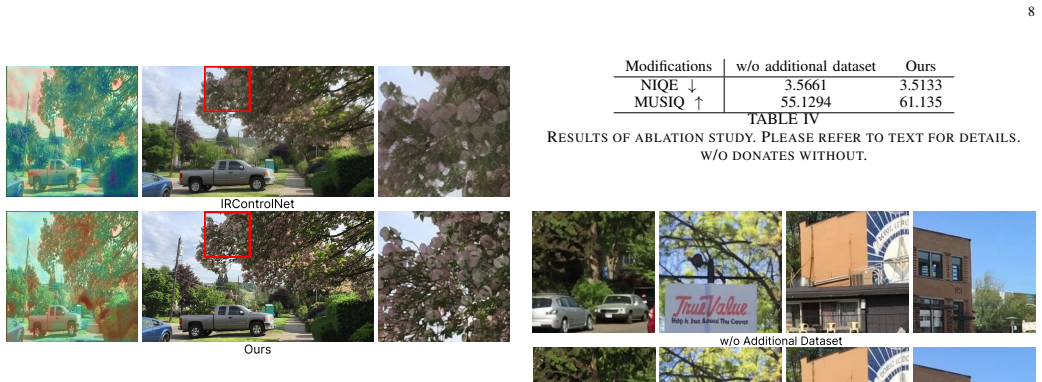
On its own terms, the central discovery is that coding residuals - the parts of a compressed frame that motion compensation could not predict - act as a reliable map of where blur, occlusion, and texture change live, and that this map can be converted into attention masks that guide both a deformable alignment stage and a diffusion-based refinement stage. The paper shows that replacing optical flow with free motion vectors is competitive while costing zero added computation, and that removing residual masks hurts quality. It also demonstrates that the diffusion stage only works well when the first alignment stage is present and when additional high-quality training data is used; without these, the generator overfits and reproduces reference frames with insufficient detail.
Load-bearing premise
The whole pipeline depends on the assumption that regions with large coding residuals reliably mark where motion blur and texture loss occur, even though coding residuals are also shaped by encoder decisions like quantization and rate control.
Editorial extensions
If this is right
- Video deblurring can be performed on compressed streams with no extra optical-flow computation, since motion vectors come from the decoder.
- Coding residuals provide a cheap prior for where deblurring should focus, potentially useful for other restoration tasks.
- Perceptual quality metrics NIQE and MUSIQ can diverge sharply from PSNR and SSIM; evaluation of generative deblurring should consider both.
- Diffusion-based refinement requires a strong initial restoration stage, otherwise blurred regions remain unresolved.
- Additional high-quality training data beyond the deblurring benchmarks is needed to prevent generative overfitting.
Reading between the lines
- The residual-as-blur-map assumption likely depends on the encoder, bitrate, and GOP structure; testing on HEVC or AVC or at low bitrates would show whether compression decisions, not blur, shape the masks.
- An ablation that replaces coding-residual masks with random or edge-based masks would isolate whether the coding prior contributes beyond generic attention.
- The same two-stage recipe - codec priors for alignment and a control-conditioned diffusion for detail - may transfer to compressed-domain video super-resolution or video frame interpolation.
- A user study rather than no-reference metrics would test whether the claimed perceptual gains survive human judgment, since NIQE and MUSIQ are only proxies.
Signed reviews
Editorial analysis
A structured set of objections, weighed in public.
Referee Report
Summary. The paper proposes CPGD-Net, a two-stage video deblurring framework that combines coding priors from video compression (motion vectors and coding residuals) with a pretrained Stable Diffusion model via a ControlNet-like module. Stage 1 (CPFP) aligns features using motion vectors and residual-derived attention masks, producing an initial restoration. Stage 2 (CPC) injects coding priors into the diffusion model's attention to guide high-detail synthesis. The authors claim state-of-the-art perceptual quality, reporting NIQE reductions of 27–30% and MUSIQ gains of 7–28% on GoPro and DVD, while accepting substantially lower PSNR/SSIM than all baselines. Ablations show the contribution of each component and compare motion vectors with RAFT optical flow.
Significance. The core idea of exploiting codec-side motion vectors and coding residuals as priors for video deblurring is novel and potentially practical, since MVs come at no extra computational cost. The two-stage design, ablations, and the decision to open-source code and data are positive features. If the perceptual claim were backed by proper human evaluation and the missing diffusion-based baseline were included, this would be a useful contribution to the video deblurring literature. However, the current evaluation is not sufficient to support the central claim.
major comments (4)
- [Table I] The reported PSNR values for GoPro and DVD are identical (26.80) and the SSIM values are nearly identical (0.7808 and 0.7809) across two different datasets, which is statistically implausible. This suggests a reporting error, perhaps from copying a single result or applying the same test set. Because the paper's quantitative narrative depends heavily on these numbers, the authors must correct Table I and rerun all metrics, or provide an explanation for the coincidence.
- [Section IV.C, Table I] The central claim of 'state-of-the-art perceptual quality' rests entirely on the no-reference metrics NIQE and MUSIQ, with no user study. Given that PSNR drops by roughly 9 dB relative to the best baselines (e.g., 26.80 vs 35.98 on GoPro) and SSIM drops by about 0.2, the burden of proof is high. No-reference metrics are known to favor generative outputs that add high-contrast but possibly hallucinated texture, and neither NIQE nor MUSIQ is calibrated for video deblurring outputs. The authors should provide a human perceptual study (e.g., paired comparison or MOS) and also report full-reference perceptual metrics such as LPIPS on the restored content to demonstrate that the improvements are genuine and not merely artifacts of no-reference scoring.
- [Section II.A, Table I] The paper cites VD-Diff [22] as the only prior diffusion-based video deblurring method, but does not compare against it in Table I or elsewhere. If the paper claims state-of-the-art performance, omitting the most relevant baseline leaves the claim unverified. The authors should add VD-Diff (and any other diffusion-based video deblurring baselines) to the quantitative and qualitative comparisons, and discuss any differences in the evaluation protocol that would justify exclusion.
- [Section III.A, Section IV.B] The assumption that coding residuals identify blur, occlusion, and texture variation is load-bearing for the CPFA masks (Eqs. 2–3) and the CPC attention mask (Eq. 6), yet it is never tested across different codecs, bitrates, or encoder configurations. All experiments use VVC with an unspecified configuration, and the residual distribution is strongly shaped by quantization, rate control, and GOP structure. As presented, the claimed benefit of coding priors may not generalize. The authors should at least specify the VVC configuration used, and ideally ablate over a range of bitrates and codecs (e.g., H.264/H.265) to show that the attention masks remain beneficial and do not amplify coding artifacts.
minor comments (7)
- [Figure 2] The text prompt in the figure contains a typo: 'High quility' should be 'High quality'.
- [Figure 4 caption] The caption reads 'Detile of the CPFA block' and should be 'Detail of the CPFA block'.
- [Section II.B] The phrase 'pre-train diffusion models' should be 'pre-trained diffusion models'.
- [Abstract and Section V.G] The abstract reports 'up to 30% improvement in IQA metrics' while the conclusion gives specific 28%/7% MUSIQ and 30%/27% NIQE gains; these numbers should be made consistent in one place.
- [Tables II and III] The abbreviation 'W/O DONATES WITHOUT' is unclear; presumably it means 'w/o denotes without', but it reads awkwardly and should be rewritten.
- [Section IV.B] The implementation refers to a 'spaced DDPM sampling schedule' with citation [42], but it is not clear whether the final inference uses DDIM, DDPM, or another sampler. Please specify the exact sampling algorithm and number of steps used for the reported results.
- [Section III.C] Several equations and sentences lack spaces, e.g., 'V andR' and 'F L i'; please fix these formatting issues for readability.
Circularity Check
No significant circularity; reported NIQE/MUSIQ gains are held-out measurements against external baselines, not constructed identities.
full rationale
The paper's derivation chain contains no step in which a predicted quantity is defined in terms of the fitted output or in which a load-bearing result reduces to a self-citation. The coding-prior modules (Eqs. 1-7) are architectural constructions: motion vectors and coding residuals are inputs to learned warping, deformable-convolution offset/mask predictors, and attention modulators, trained with L1 loss and a diffusion objective, not optimized directly toward the reported no-reference metrics. The improvements in NIQE and MUSIQ are empirical measurements on held-out GoPro and DVD test sets compared with external baselines; no equation in the paper makes those metrics equal to a fitted parameter or to the training objective by construction. The paper does cite prior work by overlapping authors ([3], [16], [30]) for the general usefulness of coding priors, but the central contribution is independently checked against RAFT (Table III) and IRControlNet (Table II), so those self-citations are contextual rather than load-bearing. The reliance on no-reference metrics in place of a human study, the missing VD-Diff comparison in Table I, the identical PSNR values across datasets, and the acknowledged generative tendency to add content beyond ground truth are evaluation and correctness concerns, not circular derivation. The paper's own caveats about perception-distortion tradeoff and dataset artifacts are limitations, but they do not reveal a self-referential argument. Therefore, no circular step meeting the quoted-equation standard is present.
Assumptions & free parameters
free parameters (4)
- VVC encoding configuration =
not reported
- Stage-2 loss weighting =
not reported
- Text prompt =
'High quility, sharp, deblur,...'
- DDPM sampling steps =
50
assumptions (4)
- domain assumption Large coding residuals indicate motion-induced blur, occlusion, or significant texture variation.
- domain assumption Motion vectors from video codecs are accurate enough for direct feature warping in deblurring.
- domain assumption Pretrained Stable Diffusion contains image priors that improve deblurring when conditioned properly.
- domain assumption NIQE and MUSIQ are valid measures of perceptual quality for deblurred video.
Cite this review
Pith. "Pith review of Coding-Prior Guided Diffusion Network for Video Deblurring." pith.science (2026). https://pith.science/paper/L2BUKU62
@misc{pith2026250412222,
  author       = {Pith},
  title        = {Pith review of: Coding-Prior Guided Diffusion Network for Video Deblurring},
  year         = {2026},
  howpublished = {\url{https://pith.science/paper/L2BUKU62}},
  note         = {Machine review of arXiv:2504.12222}
}
read the original abstract
While recent video deblurring methods have advanced significantly, they often overlook two valuable prior information: (1) motion vectors (MVs) and coding residuals (CRs) from video codecs, which provide efficient inter-frame alignment cues, and (2) the rich real-world knowledge embedded in pre-trained diffusion generative models. We present CPGDNet, a novel two-stage framework that effectively leverages both coding priors and generative diffusion priors for high-quality deblurring. First, our coding-prior feature propagation (CPFP) module utilizes MVs for efficient frame alignment and CRs to generate attention masks, addressing motion inaccuracies and texture variations. Second, a coding-prior controlled generation (CPC) module network integrates coding priors into a pretrained diffusion model, guiding it to enhance critical regions and synthesize realistic details. Experiments demonstrate our method achieves state-of-the-art perceptual quality with up to 30% improvement in IQA metrics. Both the code and the codingprior-augmented dataset will be open-sourced.
Figures


Figures from the paper (6 more)


Reference graph
Works this paper leans on
-
[22]
Rethinking video deblurring with wavelet-aware dy- namic transformer and diffusion model,
C. Rao, G. Li, Z. Lan, J. Sun, J. Luan, W. Xing, L. Zhao, H. Lin, J. Dong, and D. Zhang, “Rethinking video deblurring with wavelet-aware dy- namic transformer and diffusion model,” in European Conference on Computer Vision. Springer, 2024, pp. 421–437
work page 2024
-
[1]
Visual tracking in the presence of motion blur,
H. Jin, P. Favaro, and R. Cipolla, “Visual tracking in the presence of motion blur,” in 2005 IEEE Computer Society Conference on Computer Vision and Pattern Recognition (CVPR’05) , vol. 2. IEEE, 2005, pp. 18–25
work page 2005
-
[2]
Bundled camera paths for video stabilization,
S. Liu, L. Yuan, P. Tan, and J. Sun, “Bundled camera paths for video stabilization,” ACM transactions on graphics (TOG) , vol. 32, no. 4, pp. 1–10, 2013
work page 2013
-
[3]
Minimum latency deep online video stabilization and its extensions,
S. Liu, Z. Zhang, Z. Liu, P. Tan, and B. Zeng, “Minimum latency deep online video stabilization and its extensions,” IEEE Transactions on Pattern Analysis and Machine Intelligence , 2024
work page 2024
-
[4]
Overview of the h. 264/avc video coding standard,
T. Wiegand, G. J. Sullivan, G. Bjontegaard, and A. Luthra, “Overview of the h. 264/avc video coding standard,” IEEE Transactions on circuits and systems for video technology , vol. 13, no. 7, pp. 560–576, 2003
2003
-
[5]
Overview of the high efficiency video coding (hevc) standard,
G. J. Sullivan, J.-R. Ohm, W.-J. Han, and T. Wiegand, “Overview of the high efficiency video coding (hevc) standard,” IEEE Transactions on circuits and systems for video technology , vol. 22, no. 12, pp. 1649– 1668, 2012
2012
-
[6]
Overview of the versatile video coding (vvc) standard and its applications,
B. Bross, Y .-K. Wang, Y . Ye, S. Liu, J. Chen, G. J. Sullivan, and J.- R. Ohm, “Overview of the versatile video coding (vvc) standard and its applications,” IEEE Transactions on Circuits and Systems for Video Technology, vol. 31, no. 10, pp. 3736–3764, 2021
2021
-
[7]
Recurrent video deblurring with blur-invariant motion estimation and pixel volumes,
H. Son, J. Lee, J. Lee, S. Cho, and S. Lee, “Recurrent video deblurring with blur-invariant motion estimation and pixel volumes,” ACM Trans- actions on Graphics (TOG) , vol. 40, no. 5, pp. 1–18, 2021
2021
Show all 54 references
-
[8]
Spatio-temporal deformable attention network for video deblurring,
H. Zhang, H. Xie, and H. Yao, “Spatio-temporal deformable attention network for video deblurring,” in European Conference on Computer Vision. Springer, 2022, pp. 581–596
2022
-
[9]
Basicvsr++: Improving video super-resolution with enhanced propagation and alignment,
K. C. Chan, S. Zhou, X. Xu, and C. C. Loy, “Basicvsr++: Improving video super-resolution with enhanced propagation and alignment,” in Proceedings of the IEEE/CVF conference on computer vision and pattern recognition, 2022, pp. 5972–5981
2022
-
[10]
Multi-scale memory-based video deblurring,
B. Ji and A. Yao, “Multi-scale memory-based video deblurring,” in Proceedings of the IEEE/CVF Conference on Computer Vision and Pattern Recognition, 2022, pp. 1919–1928
2022
-
[11]
Recurrent video restoration transformer with guided deformable attention,
J. Liang, Y . Fan, X. Xiang, R. Ranjan, E. Ilg, S. Green, J. Cao, K. Zhang, R. Timofte, and L. V . Gool, “Recurrent video restoration transformer with guided deformable attention,” Advances in Neural Information Processing Systems, vol. 35, pp. 378–393, 2022
2022
-
[12]
Vrt: A video restoration transformer,
J. Liang, J. Cao, Y . Fan, K. Zhang, R. Ranjan, Y . Li, R. Timofte, and L. Van Gool, “Vrt: A video restoration transformer,” IEEE Transactions on Image Processing , 2024
2024
-
[13]
Blur-aware spatio-temporal sparse transformer for video deblurring,
H. Zhang, H. Xie, and H. Yao, “Blur-aware spatio-temporal sparse transformer for video deblurring,” in Proceedings of the IEEE/CVF Conference on Computer Vision and Pattern Recognition , 2024, pp. 2673–2681
2024
-
[14]
Displacement measurement and its application in interframe image coding,
J. Jain and A. Jain, “Displacement measurement and its application in interframe image coding,” IEEE Transactions on Communications , vol. 29, no. 12, pp. 1799–1808, 1981
1981
-
[15]
Interframe coding that follows the motion,
Y . Taki, M. Hatori, and S. Tanaka, “Interframe coding that follows the motion,” Proc. Institute of Electronics and Communication Engineers Jpn. Annu. Conv.(IECEJ) , p. 1263, 1974
1974
-
[16]
Codinghomo: Bootstrapping deep homography with video coding,
Y . Liu, H. Li, S. Liu, and B. Zeng, “Codinghomo: Bootstrapping deep homography with video coding,” IEEE Transactions on Circuits and Systems for Video Technology , 2024
2024
-
[17]
Mvflow: deep optical flow estimation of compressed videos with motion vector prior,
S. Zhou, X. Jiang, W. Tan, R. He, and B. Yan, “Mvflow: deep optical flow estimation of compressed videos with motion vector prior,” in Proceedings of the 31st ACM International Conference on Multimedia , 2023, pp. 1964–1974
2023
-
[18]
Denoising diffusion probabilistic models,
J. Ho, A. Jain, and P. Abbeel, “Denoising diffusion probabilistic models,” Advances in neural information processing systems , vol. 33, pp. 6840– 6851, 2020
2020
-
[19]
High- resolution image synthesis with latent diffusion models,
R. Rombach, A. Blattmann, D. Lorenz, P. Esser, and B. Ommer, “High- resolution image synthesis with latent diffusion models,” in Proceedings of the IEEE/CVF conference on computer vision and pattern recognition , 2022, pp. 10 684–10 695
2022
-
[20]
Adding conditional control to text-to-image diffusion models,
L. Zhang, A. Rao, and M. Agrawala, “Adding conditional control to text-to-image diffusion models,” in Proceedings of the IEEE/CVF international conference on computer vision , 2023, pp. 3836–3847
2023
-
[21]
Sora: A review on background, technology, limitations, and opportunities of large vision models,
Y . Liu, K. Zhang, Y . Li, Z. Yan, C. Gao, R. Chen, Z. Yuan, Y . Huang, H. Sun, J. Gao et al. , “Sora: A review on background, technology, limitations, and opportunities of large vision models,” arXiv preprint arXiv:2402.17177, 2024
2024 arXiv
-
[23]
Online video deblurring via dynamic temporal blending network,
T. Hyun Kim, K. Mu Lee, B. Scholkopf, and M. Hirsch, “Online video deblurring via dynamic temporal blending network,” in Proceedings of the IEEE international conference on computer vision , 2017, pp. 4038– 4047
2017
-
[24]
Recurrent neural networks with intra- frame iterations for video deblurring,
S. Nah, S. Son, and K. M. Lee, “Recurrent neural networks with intra- frame iterations for video deblurring,” in Proceedings of the IEEE/CVF conference on computer vision and pattern recognition , 2019, pp. 8102– 8111
2019
-
[25]
Denoising diffusion implicit models,
J. Song, C. Meng, and S. Ermon, “Denoising diffusion implicit models,” arXiv preprint arXiv:2010.02502 , 2020
2010 arXiv
-
[26]
Zero-shot image restoration using denoising diffusion null-space model,
Y . Wang, J. Yu, and J. Zhang, “Zero-shot image restoration using denoising diffusion null-space model,” arXiv preprint arXiv:2212.00490, 2022
2022 arXiv
-
[27]
Diffir: Efficient diffusion model for image restoration,
B. Xia, Y . Zhang, S. Wang, Y . Wang, X. Wu, Y . Tian, W. Yang, and L. Van Gool, “Diffir: Efficient diffusion model for image restoration,” in Proceedings of the IEEE/CVF International Conference on Computer Vision, 2023, pp. 13 095–13 105
2023
-
[28]
Diffbir: Toward blind image restoration with generative diffusion prior,
X. Lin, J. He, Z. Chen, Z. Lyu, B. Dai, F. Yu, Y . Qiao, W. Ouyang, and C. Dong, “Diffbir: Toward blind image restoration with generative diffusion prior,” in European Conference on Computer Vision. Springer, 2024, pp. 430–448
2024
-
[29]
Multiscale structure guided diffusion for image deblurring,
M. Ren, M. Delbracio, H. Talebi, G. Gerig, and P. Milanfar, “Multiscale structure guided diffusion for image deblurring,” in Proceedings of the IEEE/CVF International Conference on Computer Vision , 2023, pp. 10 721–10 733
2023
-
[30]
Codingflow: Enable video coding for video stabilization,
S. Liu, M. Li, S. Zhu, and B. Zeng, “Codingflow: Enable video coding for video stabilization,” IEEE Transactions on Image Processing, vol. 26, no. 7, pp. 3291–3302, 2017
2017
-
[31]
When bitstream prior meets deep prior: Compressed video super-resolution with learning from decoding,
P. Chen, W. Yang, L. Sun, and S. Wang, “When bitstream prior meets deep prior: Compressed video super-resolution with learning from decoding,” in Proceedings of the 28th ACM International Conference on Multimedia, 2020, pp. 1000–1008
2020
-
[32]
Real-time action recognition with deeply transferred motion vector cnns,
B. Zhang, L. Wang, Z. Wang, Y . Qiao, and H. Wang, “Real-time action recognition with deeply transferred motion vector cnns,” IEEE Transactions on Image Processing , vol. 27, no. 5, pp. 2326–2339, 2018
2018
-
[33]
Cpga: Coding priors-guided aggregation network for compressed video quality enhancement,
Q. Zhu, J. Hao, Y . Ding, Y . Liu, Q. Mo, M. Sun, C. Zhou, and S. Zhu, “Cpga: Coding priors-guided aggregation network for compressed video quality enhancement,” in Proceedings of the IEEE/CVF Conference on Computer Vision and Pattern Recognition , 2024, pp. 2964–2974
2024
-
[34]
Real time video object segmentation in compressed domain,
Z. Tan, B. Liu, Q. Chu, H. Zhong, Y . Wu, W. Li, and N. Yu, “Real time video object segmentation in compressed domain,” IEEE Transactions on Circuits and Systems for Video Technology , vol. 31, no. 1, pp. 175– 188, 2020
2020
-
[35]
Deep multi-scale convolutional neural network for dynamic scene deblurring,
S. Nah, T. Hyun Kim, and K. Mu Lee, “Deep multi-scale convolutional neural network for dynamic scene deblurring,” in Proceedings of the IEEE conference on computer vision and pattern recognition , 2017, pp. 3883–3891
2017
-
[36]
Deep video deblurring for hand-held cameras,
S. Su, M. Delbracio, J. Wang, G. Sapiro, W. Heidrich, and O. Wang, “Deep video deblurring for hand-held cameras,” in Proceedings of the IEEE conference on computer vision and pattern recognition , 2017, pp. 1279–1288
2017
-
[37]
Common test conditions and software reference configura- tions,
F. Bossen, “Common test conditions and software reference configura- tions,” in 3rd. JCT-VC Meeting, Guangzhou, CN, October 2010 , 2010
2010
-
[38]
Subjective and objective quality assessment of compressed 4k uhd videos for immersive experience,
M. Cheon and J.-S. Lee, “Subjective and objective quality assessment of compressed 4k uhd videos for immersive experience,” IEEE Trans- actions on Circuits and Systems for Video Technology , vol. 28, no. 7, pp. 1467–1480, 2017
2017
-
[39]
Pytorch: An imperative style, high-performance deep learn- ing library,
A. Paszke, “Pytorch: An imperative style, high-performance deep learn- ing library,” arXiv preprint arXiv:1912.01703 , 2019
1912 arXiv
-
[40]
Adam: A method for stochastic optimization,
D. P. Kingma and J. Ba, “Adam: A method for stochastic optimization,” arXiv preprint arXiv:1412.6980 , 2014
2014 arXiv
-
[41]
Towards robust blind face restoration with codebook lookup transformer,
S. Zhou, K. Chan, C. Li, and C. C. Loy, “Towards robust blind face restoration with codebook lookup transformer,” Advances in Neural Information Processing Systems , vol. 35, pp. 30 599–30 611, 2022
2022
-
[42]
Improved denoising diffusion probabilis- tic models,
A. Q. Nichol and P. Dhariwal, “Improved denoising diffusion probabilis- tic models,” in International conference on machine learning . PMLR, 2021, pp. 8162–8171
2021
-
[43]
Cascaded deep video deblurring using temporal sharpness prior,
J. Pan, H. Bai, and J. Tang, “Cascaded deep video deblurring using temporal sharpness prior,” in Proceedings of the IEEE/CVF conference on computer vision and pattern recognition , 2020, pp. 3043–3051
2020
-
[44]
Deep discriminative spatial and temporal network for efficient video deblurring,
J. Pan, B. Xu, J. Dong, J. Ge, and J. Tang, “Deep discriminative spatial and temporal network for efficient video deblurring,” in Proceedings of the IEEE/CVF Conference on Computer Vision and Pattern Recognition , 2023, pp. 22 191–22 200. 10
2023
-
[45]
A simple baseline for video restoration with grouped spatial-temporal shift,
D. Li, X. Shi, Y . Zhang, K. C. Cheung, S. See, X. Wang, H. Qin, and H. Li, “A simple baseline for video restoration with grouped spatial-temporal shift,” in Proceedings of the IEEE/CVF Conference on Computer Vision and Pattern Recognition , 2023, pp. 9822–9832
2023
-
[46]
The unreasonable effectiveness of deep features as a perceptual metric,
R. Zhang, P. Isola, A. A. Efros, E. Shechtman, and O. Wang, “The unreasonable effectiveness of deep features as a perceptual metric,” in Proceedings of the IEEE conference on computer vision and pattern recognition, 2018, pp. 586–595
2018
-
[47]
Making a “completely blind
A. Mittal, R. Soundararajan, and A. C. Bovik, “Making a “completely blind” image quality analyzer,” IEEE Signal processing letters , vol. 20, no. 3, pp. 209–212, 2012
2012
-
[48]
Musiq: Multi- scale image quality transformer,
J. Ke, Q. Wang, Y . Wang, P. Milanfar, and F. Yang, “Musiq: Multi- scale image quality transformer,” in Proceedings of the IEEE/CVF international conference on computer vision , 2021, pp. 5148–5157
2021
-
[49]
The perception-distortion tradeoff,
Y . Blau and T. Michaeli, “The perception-distortion tradeoff,” in Pro- ceedings of the IEEE conference on computer vision and pattern recognition, 2018, pp. 6228–6237
2018
-
[50]
Pipal: a large-scale image quality assessment dataset for perceptual image restoration,
G. Jinjin, C. Haoming, C. Haoyu, Y . Xiaoxing, J. S. Ren, and D. Chao, “Pipal: a large-scale image quality assessment dataset for perceptual image restoration,” in Computer Vision–ECCV 2020: 16th European Conference, Glasgow, UK, August 23–28, 2020, Proceedings, Part XI
2020
-
[51]
Springer, 2020, pp. 633–651
2020
-
[52]
Image processing using multi-code gan prior,
J. Gu, Y . Shen, and B. Zhou, “Image processing using multi-code gan prior,” in Proceedings of the IEEE/CVF conference on computer vision and pattern recognition , 2020, pp. 3012–3021
2020
-
[53]
Scaling up to excellence: Practicing model scaling for photo- realistic image restoration in the wild,
F. Yu, J. Gu, Z. Li, J. Hu, X. Kong, X. Wang, J. He, Y . Qiao, and C. Dong, “Scaling up to excellence: Practicing model scaling for photo- realistic image restoration in the wild,” in Proceedings of the IEEE/CVF Conference on Computer Vision and Pattern Recognition , 2024, pp....
2024
-
[54]
Raft: Recurrent all-pairs field transforms for opti- cal flow,
Z. Teed and J. Deng, “Raft: Recurrent all-pairs field transforms for opti- cal flow,” in Computer Vision–ECCV 2020: 16th European Conference, Glasgow, UK, August 23–28, 2020, Proceedings, Part II 16 . Springer, 2020, pp. 402–419
2020
Reviewed August 16, 2026 · model on record in the stance chip above.
Discussion (0). Continue with ORCID to comment.