Quantum Cramer-Rao Precision Limit of Noisy Continuous Sensing
Pith reviewed 2026-05-22 19:54 UTC · model grok-4.3
The pith
A numerically efficient method computes the quantum Cramer-Rao bound for continuously monitored sensors under general noise.
A machine-rendered reading of the paper's core claim, the machinery that carries it, and where it could break.
Core claim
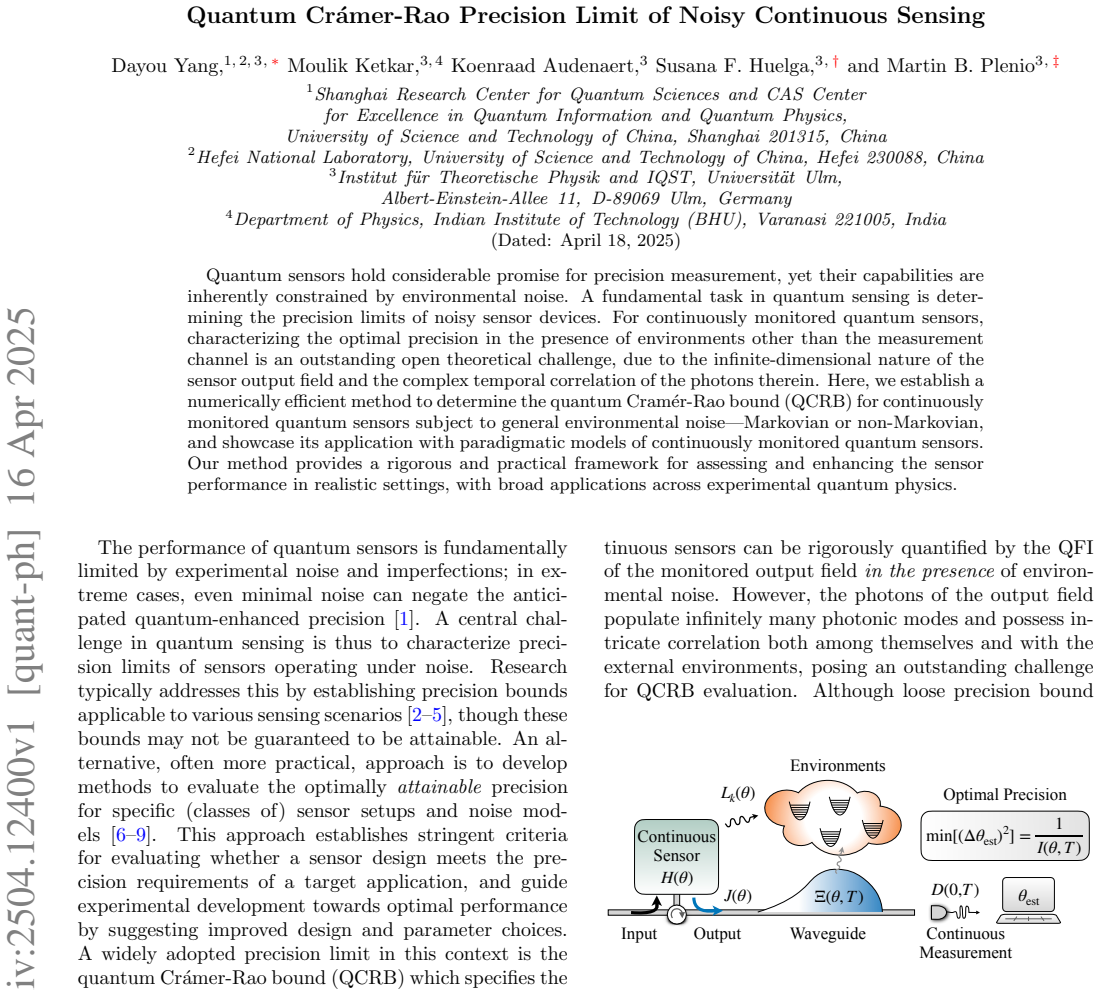
We establish a numerically efficient method to determine the quantum Cramer-Rao bound for continuously monitored quantum sensors subject to general environmental noise -- Markovian or non-Markovian, and showcase its application with paradigmatic models of continuously monitored quantum sensors. Applicable to both constant-parameter and waveform estimation, our method provides a rigorous and practical framework for assessing and enhancing the sensor performance in realistic settings.
What carries the argument
Numerically efficient reduction of the infinite-dimensional output field and its temporal photon correlations to a computation of the quantum Cramer-Rao bound.
If this is right
- The bound holds for both Markovian and non-Markovian environmental noise.
- The same procedure covers estimation of a constant parameter and estimation of a time-dependent waveform.
- The method yields concrete numerical values that can be used to compare sensor designs under realistic noise.
- It supplies a practical tool for quantifying how much environmental noise degrades the ultimate precision.
Where Pith is reading between the lines
- Designers could run the method on candidate sensor Hamiltonians before fabrication to rank expected performance.
- The framework might be extended to sensors whose noise statistics are learned from data rather than assumed.
- Similar reductions could apply to multi-sensor networks where shared output fields introduce cross-correlations.
Load-bearing premise
The infinite-dimensional output field and temporal photon correlations can be reduced to a tractable numerical computation without losing essential precision-limit information.
What would settle it
Apply the method to one of the paper's paradigmatic models and check whether the computed bound is saturated by an explicit measurement strategy whose achieved variance matches the predicted limit.
Figures


read the original abstract
Quantum sensors hold considerable promise for precision measurement, yet their capabilities are inherently constrained by environmental noise. A fundamental task in quantum sensing is determining the precision limit of noisy sensor devices. For continuously monitored quantum sensors, characterizing the optimal precision in the presence of environments other than the measurement channel is an outstanding open theoretical challenge, due to the infinite-dimensional nature of the sensor output field and the complex temporal correlation of the photons therein. Here, we establish a numerically efficient method to determine the quantum Cramer-Rao bound for continuously monitored quantum sensors subject to general environmental noise -- Markovian or non-Markovian, and showcase its application with paradigmatic models of continuously monitored quantum sensors. Applicable to both constant-parameter and waveform estimation, our method provides a rigorous and practical framework for assessing and enhancing the sensor performance in realistic settings, with broad applications across experimental quantum physics.
Editorial analysis
A structured set of objections, weighed in public.
Referee Report
Summary. The manuscript claims to establish a numerically efficient method to determine the quantum Cramer-Rao bound for continuously monitored quantum sensors subject to general environmental noise (Markovian or non-Markovian). The approach addresses the infinite-dimensional output field and temporal photon correlations, and is demonstrated on paradigmatic models for both constant-parameter and waveform estimation.
Significance. If the numerical scheme is accurate, the work addresses an open theoretical challenge in quantum sensing by supplying a practical tool to assess precision limits under realistic noise, with potential broad impact on experimental quantum physics. The claimed applicability to non-Markovian environments would be a notable advance if the reduction of the output field is shown to retain all essential information.
major comments (1)
- [Abstract] Abstract: the central claim requires that the infinite-dimensional output field and temporal correlations can be reduced to a tractable numerical scheme without loss of essential QCRB information for arbitrary non-Markovian noise; no explicit error bound, truncation criterion, or validation against a known solvable non-Markovian case is indicated, leaving open the possibility of systematic bias for long-memory environments.
minor comments (1)
- The abstract would benefit from a single sentence naming the core numerical technique (e.g., the form of discretization or memory truncation employed).
Simulated Author's Rebuttal
We thank the referee for their thorough review and constructive feedback on our manuscript. The major comment raises a valid point regarding the need for clearer justification of the numerical reduction for non-Markovian cases. We address this below and will revise the manuscript to incorporate additional details on error analysis and validation.
read point-by-point responses
-
Referee: [Abstract] Abstract: the central claim requires that the infinite-dimensional output field and temporal correlations can be reduced to a tractable numerical scheme without loss of essential QCRB information for arbitrary non-Markovian noise; no explicit error bound, truncation criterion, or validation against a known solvable non-Markovian case is indicated, leaving open the possibility of systematic bias for long-memory environments.
Authors: We appreciate the referee's emphasis on rigor for the non-Markovian extension. The method in the manuscript reduces the output field via a finite basis expansion of the temporal modes, chosen to capture the noise correlation function up to a chosen cutoff. This retains all information in the limit of infinite basis size, with the QCRB computed via the resulting finite-dimensional quantum Fisher information. We agree that an explicit error bound and truncation criterion were not sufficiently detailed. In the revised version, we will add a dedicated subsection in the Methods explaining the truncation based on the integrated correlation time (with a quantitative convergence plot versus basis dimension) and derive a perturbative error estimate for the QCRB under decaying correlations. For validation, exact closed-form non-Markovian solutions are scarce in the continuous-monitoring setting; we will therefore include a direct comparison to the exactly solvable Markovian limit (recovering known results) and demonstrate numerical convergence for a non-Markovian Ornstein-Uhlenbeck noise model with increasing memory time. These additions will address the concern of possible systematic bias for long-memory environments. revision: yes
Circularity Check
No significant circularity in derivation of numerical QCRB method
full rationale
The paper introduces a numerically efficient method for computing the quantum Cramer-Rao bound under general Markovian or non-Markovian noise for continuously monitored sensors. No load-bearing steps reduce by construction to fitted inputs, self-definitions, or self-citation chains; the central claim rests on an independent reduction of the infinite-dimensional output field and photon correlations to a tractable scheme, presented without tautological renaming or ansatz smuggling. The approach is self-contained against external benchmarks for the paradigmatic models shown, with no evidence that any prediction equals its input by definition. This is the expected honest non-finding for a methods paper whose core contribution is a new computational framework.
Axiom & Free-Parameter Ledger
Lean theorems connected to this paper
-
IndisputableMonolith/Cost/FunctionalEquation.leanwashburn_uniqueness_aczel unclear?
unclearRelation between the paper passage and the cited Recognition theorem.
We establish a numerically efficient method to determine the quantum Cramer-Rao bound for continuously monitored quantum sensors subject to general environmental noise—Markovian or non-Markovian... via generalized replica master equations (GRMEs) and time-evolving block decimation
-
IndisputableMonolith/Foundation/RealityFromDistinction.leanreality_from_one_distinction unclear?
unclearRelation between the paper passage and the cited Recognition theorem.
the output field formally contains infinitely many photonic frequency modes... represented as continuous matrix product operators (cMPOs) in the infinitesimal time-bin basis
What do these tags mean?
- matches
- The paper's claim is directly supported by a theorem in the formal canon.
- supports
- The theorem supports part of the paper's argument, but the paper may add assumptions or extra steps.
- extends
- The paper goes beyond the formal theorem; the theorem is a base layer rather than the whole result.
- uses
- The paper appears to rely on the theorem as machinery.
- contradicts
- The paper's claim conflicts with a theorem or certificate in the canon.
- unclear
- Pith found a possible connection, but the passage is too broad, indirect, or ambiguous to say the theorem truly supports the claim.
Reference graph
Works this paper leans on
-
[1]
Exponentially convergent series In(θ) Consider a general parameter-dependent quantum state Ξ( θ). The QFI can be expressed as tr[Ξ( θ)L2], with L the symmetric logarithmic derivative (SLD) op- erator defined via ∂θΞ = ( LΞ + ΞL)/2. We denote the eigen-decomposition of the density operator as Ξ( θ) =P λ λ |λ⟩ ⟨λ|. The QFI of the state can hence be expresse...
-
[2]
(5a) and (5b) of the main text, i.e., to relate the approximate QFI In(θ) to the Bargmann invariants
Relating In(θ) to the Bargmann invariants Our goal here is to derive Eqs. (5a) and (5b) of the main text, i.e., to relate the approximate QFI In(θ) to the Bargmann invariants. The QFI In(θ) are defined in Eq. (16), which can be converted to In(θ) = X λ,λ′ nX j=0 jX m=0 j m (−1)m (λ + λ′)m+2 2Λm+1 |⟨λ|L|λ′⟩|2 =2 nX m=0 nX j=m j m (−1)m Λm+1 × mX l=0 m l tr...
-
[3]
(19) and (20), with the parameter Λ therein left unspecified
Application to scenarios of continuous sensing In the above, we have established for a general den- sity operator Ξ( θ) the approximate formulae of its QFI, Eqs. (19) and (20), with the parameter Λ therein left unspecified. Now let us consider the sensing scenario studied in the main text, where Ξ( θ) = Ξ( θ, T) is the density operator of the multi-photon...
-
[4]
Implementation of the TEBD While the GRME (6) is formulated under periodic boundary conditions (PBC), the TEBD algorithm is typically implemented with open boundary conditions (OBC). This choice is advantageous because, under OBC, matrix product states (MPSs) have a well-defined orthog- onality center [31], which facilitates bond dimension trun- cation du...
-
[5]
Asm+2 [m+2]s1 ⊗ · · · ⊗ sm+2, (27) where sβ (with s = 1, 2, . . . , D2) labels the local basis of the single-replica Liouville space, and the matrices Asβ [β] associated with site β has dimension χ × χ, with χ being the truncation bond dimension. 9 2 10 20 30 m + 2 0 10 20 30 ( G f + G b ) T 0 5 10 2 10 20 30m + 2 0 10 20 ( G f + G b ) T 1 2 S ( m , T ) (...
-
[6]
Entanglement area law of the solution of the generalized replica master equation As introduced in the main text, the dissipative na- ture of the GRME (6) leads to an area law of the bi- partite entanglement entropy of ϱ(Θ, T) for all propaga- tion time T , allowing for scaling the TEBD algorithm to large replica number and for long evolution time. Useful ...
-
[7]
Summary of the pseudomode approach The key idea of the pseudomode approach, as illus- trated in Fig. 6(a-b), is to map the original (potentially highly structured and non-Markovian) environment of the open system onto a simpler configuration, consist- ing of a small number of auxiliary bosonic modes—the pseudomodes—which in turn are coupled to independent...
-
[8]
Incorporation of the pseudomode approach into the description of noisy continuous sensors In a general scenario of continuous sensing, as shown in Fig. 6(c-d), an open sensor (S) is coupled with a waveg- uide (W), and both may interact with (potentially non- Markovian) environments (Es). For simplicity, let us consider the situation that only the sensor i...
-
[9]
Illustration of the method Let us illustrate the method at the example of a driven- dissipative two-level sensor interfaced unidirectionally with a waveguide, and simultaneous subjected to non- Markovian dephasing, cf. Fig. 3(c) of the main text. The global Hamiltonian of the sensor, waveguide and en- vironment in the interaction picture is given by Eq. (...
-
[10]
S. F. Huelga, C. Macchiavello, T. Pellizzari, A. K. Ekert, M. B. Plenio, and J. I. Cirac, Improvement of frequency standards with quantum entanglement, Phys. Rev. Lett. 79, 3865 (1997)
work page 1997
-
[11]
B. M. Escher, R. L. de Matos Filho, and L. Davidovich, General framework for estimating the ultimate preci- sion limit in noisy quantum-enhanced metrology, Nature Physics 7, 406 (2011)
work page 2011
-
[12]
R. Demkowicz-Dobrza´ nski, J. Ko lody´ nski, and M. Gut ¸˘ a, The elusive heisenberg limit in quantum-enhanced metrology, Nature Communications 3, 1063 (2012)
work page 2012
- [13]
-
[14]
R. Demkowicz-Dobrza´ nski, J. Czajkowski, and P. Sekatski, Adaptive quantum metrology under general markovian noise, Phys. Rev. X 7, 041009 (2017)
work page 2017
-
[15]
Y. Matsuzaki, S. C. Benjamin, and J. Fitzsimons, Mag- netic field sensing beyond the standard quantum limit under the effect of decoherence, Phys. Rev. A 84, 012103 (2011)
work page 2011
-
[16]
A. W. Chin, S. F. Huelga, and M. B. Plenio, Quantum metrology in non-markovian environments, Phys. Rev. Lett. 109, 233601 (2012)
work page 2012
-
[17]
K. Chabuda, J. Dziarmaga, T. J. Osborne, and R. Demkowicz-Dobrza´ nski, Tensor-network approach for quantum metrology in many-body quantum systems, Na- ture Communications 11, 250 (2020)
work page 2020
-
[18]
A. Altherr and Y. Yang, Quantum metrology for non- markovian processes, Phys. Rev. Lett. 127, 060501 (2021)
work page 2021
-
[19]
S. L. Braunstein and C. M. Caves, Statistical distance and the geometry of quantum states, Phys. Rev. Lett. 72, 3439 (1994)
work page 1994
-
[20]
V. B. Braginsky and F. Y. Khalili, Quantum Measure- ment (CUP, Cambridge, 1992)
work page 1992
-
[21]
Carmichael, An Open Systems Approach to Quantum Optics (Springer, Berlin, 1993)
H. Carmichael, An Open Systems Approach to Quantum Optics (Springer, Berlin, 1993)
work page 1993
-
[22]
M. B. Plenio and P. L. Knight, The quantum-jump ap- proach to dissipative dynamics in quantum optics, Rev. Mod. Phys. 70, 101 (1998)
work page 1998
- [23]
-
[24]
H. M. Wiseman and G. J. Milburn, Quantum measure- ment and control (CUP, 2009)
work page 2009
-
[25]
C. Gardiner and P. Zoller, The Quantum World of Ultra- Cold Atoms and Light Book II (ICP, London, 2015)
work page 2015
-
[26]
B. P. Abbott et al. (LIGO Scientific Collaboration and Virgo Collaboration), Observation of gravitational waves from a binary black hole merger, Phys. Rev. Lett. 116, 061102 (2016)
work page 2016
-
[27]
S. L. Danilishin and F. Y. Khalili, Quantum measure- ment theory in gravitational-wave detectors, Living Re- views in Relativity 15, 5 (2012)
work page 2012
-
[28]
C. B. Møller, R. A. Thomas, G. Vasilakis, E. Zeuthen, Y. Tsaturyan, M. Balabas, K. Jensen, A. Schliesser, K. Hammerer, and E. S. Polzik, Quantum back-action- evading measurement of motion in a negative mass ref- erence frame, Nature 547, 191 (2017)
work page 2017
-
[29]
G. Colangelo, F. M. Ciurana, L. C. Bianchet, R. J. Sewell, and M. W. Mitchell, Simultaneous tracking of spin angle and amplitude beyond classical limits, Nature 543, 525 (2017)
work page 2017
- [30]
-
[31]
D.-S. Ding, Z.-K. Liu, B.-S. Shi, G.-C. Guo, K. Mølmer, and C. S. Adams, Enhanced metrology at the critical point of a many-body rydberg atomic system, Nature Physics (2022)
work page 2022
-
[32]
K.-D. Wu, C. Xie, C.-F. Li, G.-C. Guo, C.-L. Zou, 13 and G.-Y. Xiang, Nonlinearity-enhanced continuous mi- crowave detection based on stochastic resonance, Science Advances 10, eado8130 (2024)
work page 2024
- [33]
- [34]
-
[35]
Tsang, Quantum metrology with open dynamical sys- tems, New Journal of Physics 15, 073005 (2013)
M. Tsang, Quantum metrology with open dynamical sys- tems, New Journal of Physics 15, 073005 (2013)
work page 2013
-
[36]
D. Yang, S. F. Huelga, and M. B. Plenio, Efficient infor- mation retrieval for sensing via continuous measurement, Phys. Rev. X 13, 031012 (2023)
work page 2023
- [37]
-
[38]
S. Gammelmark and K. Mølmer, Fisher information and the quantum cram´ er-rao sensitivity limit of continuous measurements, Phys. Rev. Lett. 112, 170401 (2014)
work page 2014
- [39]
-
[40]
J. I. Cirac, D. P´ erez-Garc´ ıa, N. Schuch, and F. Ver- straete, Matrix product states and projected entangled pair states: Concepts, symmetries, theorems, Rev. Mod. Phys. 93, 045003 (2021)
work page 2021
- [41]
- [42]
- [43]
-
[44]
A. Rivas and S. F. Huelga, Open Quantum Systems (Springer Berlin Heidelberg, 2012)
work page 2012
-
[45]
Such modeling accounts for not only sensor decoherence but also waveguide decoherence via suitable global uni- tary transformations involving the sensor and waveguide
-
[46]
F. Verstraete and J. I. Cirac, Continuous matrix product states for quantum fields, Phys. Rev. Lett. 104, 190405 (2010)
work page 2010
-
[47]
T. J. Osborne, J. Eisert, and F. Verstraete, Holographic quantum states, Phys. Rev. Lett. 105, 260401 (2010)
work page 2010
-
[48]
R. D. Gill and B. Y. Levit, Applications of the van trees inequality: A bayesian cram´ er-rao bound, Bernoulli1, 59 (1995)
work page 1995
-
[49]
V. Bargmann, Note on Wigner’s Theorem on Symme- try Operations, Journal of Mathematical Physics 5, 862 (1964)
work page 1964
-
[50]
See Appendices for details
-
[51]
R. Oliveira, O. Dahlsten, and M. Plenio, Generic en- tanglement can be generated efficiently, Physical Review Letters 98, 130502 (2007)
work page 2007
-
[52]
O. Dahlsten, R. Oliveira, and M. Plenio, The emergence of typical entanglement in two-party random processes, Journal of Physics A: Mathematical and Theoretical 40, 8081 (2007)
work page 2007
-
[53]
F. Verstraete and J. Cirac, Matrix product states rep- resent ground states faithfully, Physical Review B 73, 094423 (2006)
work page 2006
-
[54]
M. Khanahmadi and K. Mølmer, Qubit readout and quantum sensing with pulses of quantum radiation, Phys. Rev. A 107, 013705 (2023)
work page 2023
-
[55]
S. Mukamel, M. Freyberger, W. Schleich, M. Bellini, A. Zavatta, G. Leuchs, C. Silberhorn, R. W. Boyd, L. L. S´ anchez-Soto, A. Stefanov, M. Barbieri, A. Paterova, L. Krivitsky, S. Shwartz, K. Tamasaku, K. Dorfman, F. Schlawin, V. Sandoghdar, M. Raymer, A. Marcus, O. Varnavski, T. Goodson, Z.-Y. Zhou, B.-S. Shi, S. As- ban, M. Scully, G. Agarwal, T. Peng, ...
work page 2020
-
[56]
F. Albarelli, E. Bisketzi, A. Khan, and A. Datta, Fun- damental limits of pulsed quantum light spectroscopy: Dipole moment estimation, Phys. Rev. A 107, 062601 (2023)
work page 2023
-
[57]
D. Tamascelli, A. Smirne, S. F. Huelga, and M. B. Plenio, Nonperturbative treatment of non-markovian dynamics of open quantum systems, Phys. Rev. Lett. 120, 030402 (2018)
work page 2018
- [58]
-
[59]
N. Lorenzoni, N. Cho, J. Lim, D. Tamascelli, S. F. Huelga, and M. B. Plenio, Systematic coarse graining of environments for the nonperturbative simulation of open quantum systems, Phys. Rev. Lett. 132, 100403 (2024)
work page 2024
-
[60]
A. Godley and M. Guta, Adaptive measurement fil- ter: efficient strategy for optimal estimation of quantum Markov chains, Quantum 7, 973 (2023)
work page 2023
-
[61]
Tsang, Quantum reversal: a general theory of coher- ent quantum absorbers, Quantum 9, 1650 (2025)
M. Tsang, Quantum reversal: a general theory of coher- ent quantum absorbers, Quantum 9, 1650 (2025)
work page 2025
-
[62]
J. Johansson, P. Nation, and F. Nori, Qutip 2: A python framework for the dynamics of open quantum systems, Computer Physics Communications 184, 1234 (2013)
work page 2013
-
[63]
B. R. Mollow, Pure-state analysis of resonant light scat- tering: Radiative damping, saturation, and multiphoton effects, Phys. Rev. A 12, 1919 (1975)
work page 1919
-
[64]
C. W. Helstrom, Quantum detection and estimation the- ory (Academic Press, 1976)
work page 1976
-
[65]
A. Rath, C. Branciard, A. Minguzzi, and B. Vermersch, Quantum fisher information from randomized measure- ments, Phys. Rev. Lett. 127, 260501 (2021)
work page 2021
-
[66]
S. Paeckel, T. K¨ ohler, A. Swoboda, S. R. Manmana, U. Schollw¨ ock, and C. Hubig, Time-evolution methods for matrix-product states, Annals of Physics 411, 167998 (2019)
work page 2019
-
[67]
Imamoglu, Stochastic wave-function approach to non- markovian systems, Phys
A. Imamoglu, Stochastic wave-function approach to non- markovian systems, Phys. Rev. A 50, 3650 (1994)
work page 1994
-
[68]
B. M. Garraway, Nonperturbative decay of an atomic sys- tem in a cavity, Phys. Rev. A 55, 2290 (1997)
work page 1997
-
[69]
F. Mascherpa, A. Smirne, S. F. Huelga, and M. B. Plenio, Open systems with error bounds: Spin-boson model with spectral density variations, Phys. Rev. Lett. 118, 100401 (2017)
work page 2017
discussion (0)
Sign in with ORCID, Apple, or X to comment. Anyone can read and Pith papers without signing in.