Anomalous Electrical Transport in the Kagome Magnet YbFe₆Ge₆
Pith reviewed 2026-05-22 19:32 UTC · model grok-4.3
The pith
Anomalous Hall effect appears in collinear kagome antiferromagnet
A machine-rendered reading of the paper's core claim, the machinery that carries it, and where it could break.
Core claim
The central claim is that the anomalous Hall effect observed below the spin reorientation transition in YbFe6Ge6 arises from a dynamic scalar spin chirality supported by gapless spin excitations in the A-type collinear antiferromagnetic state, enabled by the Yb-Fe interactions.
What carries the argument
Dynamic scalar spin chirality supported by gapless spin excitations and Yb-Fe interactions.
Load-bearing premise
The assumption that gapless spin excitations combined with Yb-Fe coupling are sufficient to produce a dynamic scalar spin chirality that fully accounts for the measured anomalous Hall conductivity.
What would settle it
A direct calculation demonstrating that the dynamic chirality cannot generate an anomalous Hall conductivity of the observed size, or the discovery of a similar material where the gap closes without producing an anomalous Hall effect.
Figures


read the original abstract
Two-dimensional (2D) kagome metals offer a unique platform for exploring electron correlation phenomena derived from quantum many-body effects. Here, we report a combined study of electrical magnetotransport and neutron scattering on YbFe$_6$Ge$_6$, where the Fe moments in the 2D kagome layers exhibit an $A$-type collinear antiferromagnetic order below $T_{\rm{N}} \approx 500$ K. Interactions between the Fe ions in the layers and the localized Yb magnetic ions in between reorient the $c$-axis aligned Fe moments to the kagome plane below $T_{\rm{SR}} \approx 63$ K. Our magnetotransport measurements show an intriguing anomalous Hall effect (AHE) that emerges in the spin-reorientated collinear state, accompanied by the closing of the spin anisotropy gap as revealed from inelastic neutron scattering. The gapless spin excitations and the Yb-Fe interaction are able to support a dynamic scalar spin chirality, which explains the observed AHE. Therefore, our study demonstrates spin fluctuations may provide an additional scattering channel for the conduction electrons and give rise to AHE even in a collinear antiferromagnet.
Editorial analysis
A structured set of objections, weighed in public.
Referee Report
Summary. The manuscript reports a combined magnetotransport and inelastic neutron scattering study of the kagome magnet YbFe6Ge6. The Fe sublattice exhibits A-type collinear antiferromagnetic order below TN ≈ 500 K that reorients into the kagome plane below TSR ≈ 63 K due to Yb-Fe coupling. An anomalous Hall effect appears in the reoriented collinear state and coincides with closure of the spin anisotropy gap. The authors propose that the resulting gapless excitations, together with Yb-Fe interactions, generate a dynamic scalar spin chirality that produces the observed AHE via an additional scattering channel for conduction electrons.
Significance. If the proposed mechanism can be placed on a quantitative footing, the work would demonstrate a route to anomalous Hall conductivity in a collinear antiferromagnet driven by spin fluctuations rather than static Berry curvature, which is of broad interest for kagome and frustrated magnets. The experimental correlation between gap closure and AHE onset is clearly presented, but the explanatory power remains limited without a microscopic link between the INS spectrum and the measured Hall conductivity.
major comments (2)
- [Abstract] Abstract and Discussion: The central claim that 'the gapless spin excitations and the Yb-Fe interaction are able to support a dynamic scalar spin chirality, which explains the observed AHE' is presented without a quantitative model. No fitted spin Hamiltonian from the INS data, no estimate of the chirality fluctuation amplitude, and no Kubo or scattering-rate calculation that converts the observed spin-wave spectrum into a predicted σ_AHE(T) are provided for comparison with transport measurements. This absence is load-bearing for the proposed mechanism.
- [Discussion] The inference of dynamic scalar spin chirality rests on the same transport and neutron data it is invoked to explain, creating a circularity that weakens the explanatory claim. An independent benchmark (e.g., a microscopic calculation or comparison to a related compound with known chirality) is needed to break the loop.
minor comments (2)
- [Introduction] The temperatures TN and TSR should be introduced with explicit numerical values and definitions in the first paragraph of the main text for clarity.
- [Figures] Figure captions for the Hall resistivity and neutron spectra should explicitly state the field and temperature ranges shown and note any background subtraction procedures.
Simulated Author's Rebuttal
We thank the referee for their careful reading of the manuscript and for acknowledging the experimental correlation between gap closure and the onset of the anomalous Hall effect. We address the two major comments below, providing the strongest honest defense of our qualitative proposal while acknowledging its limitations.
read point-by-point responses
-
Referee: [Abstract] Abstract and Discussion: The central claim that 'the gapless spin excitations and the Yb-Fe interaction are able to support a dynamic scalar spin chirality, which explains the observed AHE' is presented without a quantitative model. No fitted spin Hamiltonian from the INS data, no estimate of the chirality fluctuation amplitude, and no Kubo or scattering-rate calculation that converts the observed spin-wave spectrum into a predicted σ_AHE(T) are provided for comparison with transport measurements. This absence is load-bearing for the proposed mechanism.
Authors: We agree that a quantitative microscopic calculation would strengthen the proposed mechanism. Deriving a complete spin Hamiltonian from the INS data and computing the resulting dynamic chirality contribution to σ_AHE via the Kubo formula or scattering rates represents a substantial separate theoretical project. The present work is primarily experimental and focuses on establishing the clear correlation between the closing of the anisotropy gap (directly measured by INS) and the appearance of the AHE in the reoriented state, together with the known Yb-Fe coupling that drives the reorientation. This experimental link provides the foundation for the qualitative interpretation; we do not claim a quantitative prediction at this stage. revision: no
-
Referee: [Discussion] The inference of dynamic scalar spin chirality rests on the same transport and neutron data it is invoked to explain, creating a circularity that weakens the explanatory claim. An independent benchmark (e.g., a microscopic calculation or comparison to a related compound with known chirality) is needed to break the loop.
Authors: The reasoning is not fully circular. The INS spectra furnish independent spectroscopic evidence for gap closure below TSR that is separate from the transport measurements, while the spin reorientation itself is confirmed by both neutron diffraction and magnetization data. The dynamic scalar spin chirality is then proposed as the natural consequence of gapless fluctuations in the presence of the established Yb-Fe interaction. We acknowledge that an independent microscopic benchmark or comparison to another material would be valuable, but no directly analogous compound with both gapless excitations and reported AHE in a collinear state is available for such a comparison at present. revision: no
- A fitted spin Hamiltonian from the INS data together with a quantitative Kubo or scattering-rate calculation that predicts the magnitude and temperature dependence of σ_AHE
Circularity Check
Dynamic scalar spin chirality invoked to explain AHE reduces to qualitative coincidence of gap closure and transport data without independent calculation
specific steps
-
other
[Abstract and discussion section (inferred from claim structure)]
"The gapless spin excitations and the Yb-Fe interaction are able to support a dynamic scalar spin chirality, which explains the observed AHE."
The gapless excitations and Yb-Fe interaction are directly measured in the neutron and magnetotransport data; the dynamic scalar spin chirality is then posited as supported by those same observations and declared to explain the AHE measured in the identical dataset, with no separate quantitative derivation or external benchmark provided to break the inference loop.
full rationale
The paper's central claim asserts that gapless spin excitations plus Yb-Fe coupling support a dynamic scalar spin chirality that produces the observed AHE in the collinear state. This is presented as an explanation supported by the temporal coincidence of spin anisotropy gap closure (from INS) and AHE onset (from transport), but the manuscript supplies no microscopic Hamiltonian, no fitted spin-wave model, and no Kubo or scattering calculation that converts the measured spectrum into a predicted σ_AHE(T). The mechanism is therefore inferred from the same datasets it is invoked to explain, satisfying the criteria for partial circularity under the 'fitted input called prediction' and 'other' patterns.
Axiom & Free-Parameter Ledger
axioms (1)
- domain assumption A-type collinear antiferromagnetic order of Fe moments below TN and reorientation below TSR due to Yb-Fe interactions.
invented entities (1)
-
dynamic scalar spin chirality
no independent evidence
Reference graph
Works this paper leans on
-
[1]
E. H. Hall, American Journal of Mathematics 2, 287 (1879)
-
[2]
E. H. Hall, Philosophical Magazine 12, 157 (1881)
- [3]
-
[4]
N. Nagaosa, J. Sinova, S. Onoda, A. H. MacDonald, and N. P. Ong, Rev. Mod. Phys. 82, 1539 (2010)
work page 2010
- [5]
-
[6]
H. Chen, Q. Niu, and A. H. MacDonald, Phys. Rev. Lett. 112, 017205 (2014)
work page 2014
-
[7]
L. ˇSmejkal, A. H. MacDonald, J. Sinova, S. Nakat- suji, and T. Jungwirth, Nature Reviews Materials 7, 482 (2022)
work page 2022
-
[8]
E. V. Gomonay and V. M. Loktev, Low Temperature Physics 40, 17 (2014)
work page 2014
-
[9]
N. Kanazawa, Y. Onose, T. Arima, D. Okuyama, K. Ohoyama, S. Wakimoto, K. Kakurai, S. Ishiwata, and Y. Tokura, Phys. Rev. Lett. 106, 156603 (2011)
work page 2011
-
[10]
T. Kurumaji, T. Nakajima, M. Hirschberger, A. Kikkawa, Y. Yamasaki, H. Sagayama, H. Nakao, Y. Taguchi, T.-h. Arima, and Y. Tokura, Science 365, 914 (2019)
work page 2019
-
[11]
M. Hirschberger, T. Nakajima, S. Gao, L. Peng, A. Kikkawa, T. Kurumaji, M. Kriener, Y. Yamasaki, H. Sagayama, H. Nakao, K. Ohishi, K. Kakurai, Y. Taguchi, X. Yu, T.-h. Arima, and Y. Tokura, Na- ture Communications 10, 5831 (2019)
work page 2019
-
[12]
G. Kimbell, C. Kim, W. Wu, M. Cuoco, and J. W. Robinson, Communications Materials 3, 19 (2022)
work page 2022
- [13]
-
[14]
The distinction between “anomalous Hall effect” and “topological Hall effect” in the literature is not unam- biguous. Sometimes, anomalous Hall effect is broadly used to refer topological Hall effect, as also noted by [12]. In this paper, since we do not discuss the topological property, we use anomalous Hall effect to refer the Hall effect other than the...
-
[15]
S. A. Yang, H. Pan, Y. Yao, and Q. Niu, Phys. Rev. B 83, 125122 (2011)
work page 2011
- [16]
- [17]
- [18]
-
[19]
N. J. Ghimire, R. L. Dally, L. Poudel, D. Jones, D. Michel, N. T. Magar, M. Bleuel, M. A. McGuire, 6 J. Jiang, J. Mitchell, J. W. Lynn, and I. I. Mazin, Science Advances 6, eabe2680 (2020)
work page 2020
-
[20]
Q. Wang, K. J. Neubauer, C. Duan, Q. Yin, S. Fujitsu, H. Hosono, F. Ye, R. Zhang, S. Chi, K. Krycka, H. Lei, and P. Dai, Phys. Rev. B 103, 014416 (2021)
work page 2021
- [21]
-
[22]
K. Fruhling, A. Streeter, S. Mardanya, X. Wang, P. Baral, O. Zaharko, I. I. Mazin, S. Chowdhury, W. D. Ratcliff, and F. Tafti, Phys. Rev. Mater. 8, 094411 (2024)
work page 2024
-
[23]
K. K. Kolincio, M. Hirschberger, J. Masell, S. Gao, A. Kikkawa, Y. Taguchi, T. hisa Arima, N. Nagaosa, and Y. Tokura, Proceedings of the National Academy of Sciences 118, e2023588118 (2021)
work page 2021
-
[24]
K. K. Kolincio, M. Hirschberger, J. Masell, T.-h. Arima, N. Nagaosa, and Y. Tokura, Phys. Rev. Lett. 130, 136701 (2023)
work page 2023
-
[25]
S. Roychowdhury, K. Samanta, S. Singh, W. Schnelle, Y. Zhang, J. Noky, M. G. Vergniory, C. Shekhar, and C. Felser, Proceedings of the National Academy of Sci- ences 121, e2401970121 (2024)
work page 2024
-
[26]
G. Venturini, R. Welter, and B. Malaman, Journal of Alloys and Compounds 185, 99 (1992)
work page 1992
-
[27]
T. Mazet and B. Malaman, Journal of Physics: Con- densed Matter 12, 1085 (2000)
work page 2000
-
[28]
M. A. Avila, T. Takabatake, Y. Takahashi, S. L. Bud’ko, and P. Canfield, Journal of Physics: Condensed Matter 17, 6969 (2005)
work page 2005
-
[29]
J. M. Cadogan and D. H. Ryan, Journal of Physics: Con- densed Matter 22, 016009 (2009)
work page 2009
-
[30]
D. H. Ryan, J. M. Cadogan, and R. Gagnon, Journal of Physics: Conference Series 217, 012124 (2010)
work page 2010
-
[31]
W. Wang, M. W. Daniels, Z. Liao, Y. Zhao, J. Wang, G. Koster, G. Rijnders, C.-Z. Chang, D. Xiao, and W. Wu, Nature Materials 18, 1054 (2019)
work page 2019
- [32]
-
[33]
T. Mazet and B. Malaman, Journal of Alloys and Com- pounds 325, 67 (2001)
work page 2001
- [34]
-
[35]
Venturini, Zeitschrift f¨ ur Kristallographie-Crystalline Materials 221, 511 (2006)
G. Venturini, Zeitschrift f¨ ur Kristallographie-Crystalline Materials 221, 511 (2006)
work page 2006
-
[36]
See Supplemental Material [url] for additional data and analyses, which includes Refs. [53–70]
- [37]
-
[38]
L. Wang, J. Zhu, H. Chen, H. Wang, J. Liu, Y.-X. Huang, B. Jiang, J. Zhao, H. Shi, G. Tian, H. Wang, Y. Yao, D. Yu, Z. Wang, C. Xiao, S. A. Yang, and X. Wu, Phys. Rev. Lett. 132, 106601 (2024)
work page 2024
- [39]
-
[40]
N. W. Ashcroft and N. D. Mermin, Solid State Physics (Holt-Saunders, New York, 1976)
work page 1976
-
[41]
Z. Zhu, B. Fauqu´ e, K. Behnia, and Y. Fuseya, Journal of Physics: Condensed Matter 30, 313001 (2018)
work page 2018
- [42]
-
[43]
L. Chen, X. Teng, H. Tan, B. L. Winn, G. E. Granorth, F. Ye, D. H. Yu, R. A. Mole, B. Gao, B. Yan, M. Yi, and P. Dai, Nature Communications 15, 1918 (2024)
work page 1918
- [44]
-
[45]
B. C. Sales, J. Yan, W. R. Meier, A. D. Christianson, S. Okamoto, and M. A. McGuire, Phys. Rev. Mater. 3, 114203 (2019)
work page 2019
- [46]
-
[47]
Y. Xie, L. Chen, T. Chen, Q. Wang, Q. Yin, J. R. Stew- art, M. B. Stone, L. L. Daemen, E. Feng, H. Cao, H. Lei, Z. Yin, A. H. MacDonald, and P. Dai, Communications Physics 4, 240 (2021)
work page 2021
-
[48]
S.-H. Do, K. Kaneko, R. Kajimoto, K. Kamazawa, M. B. Stone, J. Y. Y. Lin, S. Itoh, T. Masuda, G. D. Samolyuk, E. Dagotto, W. R. Meier, B. C. Sales, H. Miao, and A. D. Christianson, Phys. Rev. B 105, L180403 (2022)
work page 2022
-
[49]
N. Abe, Y. Hano, H. Ishizuka, Y. Kozuka, T. Tadano, Y. Tsujimoto, K. Yamaura, S. Ishiwata, and J. Fujioka, npj Quantum Materials 9, 41 (2024)
work page 2024
-
[50]
H. Jeon, H. Seo, J. Seo, Y. H. Kim, E. S. Choi, Y. Jo, H. N. Lee, J. M. Ok, and J. S. Kim, Communications Physics 7, 162 (2024)
work page 2024
-
[51]
Y. Fujishiro, N. Kanazawa, R. Kurihara, H. Ishizuka, T. Hori, F. S. Yasin, X. Yu, A. Tsukazaki, M. Ichikawa, M. Kawasaki, N. Nagaosa, M. Tokunaga, and Y. Tokura, Nature Communications 12, 317 (2021)
work page 2021
-
[52]
M. F. Collins and W. Marshall, Proceedings of the Phys- ical Society 92, 390 (1967)
work page 1967
-
[53]
V. Petˇ r´ ıˇ cek, M. Duˇ sek, and L. Palatinus, Zeitschrift f¨ ur Kristallographie - Crystalline Materials 229, 345 (2014)
work page 2014
-
[54]
L. Ye, T. Suzuki, and J. G. Checkelsky, Phys. Rev. B 95, 174405 (2017)
work page 2017
-
[55]
D. Ram, J. Singh, M. K. Hooda, O. Pavlosiuk, V. Kan- chana, Z. Hossain, and D. Kaczorowski, Phys. Rev. B 107, 085137 (2023)
work page 2023
-
[56]
F. Ye, Y. Liu, R. Whitfield, R. Osborn, and S. Rosenkranz, Journal of Applied Crystallography 51, 315 (2018)
work page 2018
- [57]
-
[58]
Rodr´ ıguez-Carvajal, Physica B: Condensed Matter 192, 55 (1993)
J. Rodr´ ıguez-Carvajal, Physica B: Condensed Matter 192, 55 (1993)
work page 1993
-
[59]
G. Shirane, S. M. Shapiro, and J. M. Tranquada, Neu- tron scattering with a triple-axis spectrometer: basic tech- niques (Cambridge University Press, 2002)
work page 2002
-
[60]
D. C. Johnston, Phys. Rev. Lett. 109, 077201 (2012)
work page 2012
-
[61]
D. C. Johnston, Phys. Rev. B 96, 104405 (2017)
work page 2017
-
[62]
J. Bernhard, B. Lebech, and O. Beckman, Journal of Physics F: Metal Physics 14, 2379 (1984)
work page 1984
-
[63]
A. Neubauer, C. Pfleiderer, B. Binz, A. Rosch, R. Ritz, P. G. Niklowitz, and P. B¨ oni, Phys. Rev. Lett. 102, 186602 (2009)
work page 2009
- [64]
-
[65]
Wood et al., Applied Crystallography 51, 294 (2018)
K. Wood et al., Applied Crystallography 51, 294 (2018)
work page 2018
-
[66]
D. L. Abernathy, M. B. Stone, M. J. Loguillo, M. S. Lucas, O. Delaire, X. Tang, J. Y. Y. Lin, and B. Fultz, Review of Scientific Instruments 83, 015114 (2012)
work page 2012
- [67]
-
[68]
O. Arnold et al. , Nuclear Instruments and Methods in Physics Research Section A: Accelerators, Spectrometers, Detectors and Associated Equipment 764, 156 (2014)
work page 2014
- [69]
-
[70]
Anomalous Electrical Transport in the Kagome Magnet YbFe6Ge6
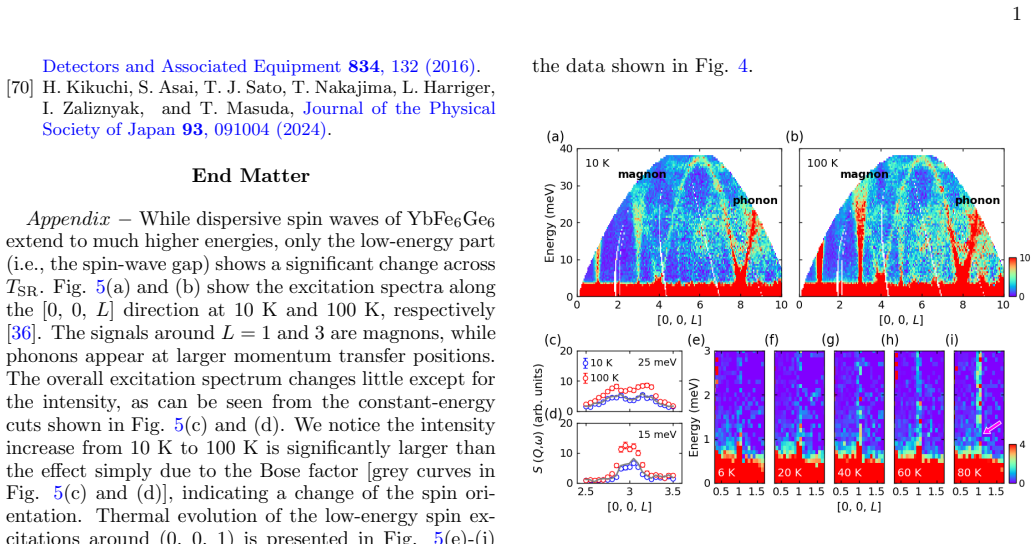
H. Kikuchi, S. Asai, T. J. Sato, T. Nakajima, L. Harriger, I. Zaliznyak, and T. Masuda, Journal of the Physical Society of Japan 93, 091004 (2024). End Matter Appendix − While dispersive spin waves of YbFe6Ge6 extend to much higher energies, only the low-energy part (i.e., the spin-wave gap) shows a significant change across TSR. Fig. 5(a) and (b) show th...
work page 2024
-
[71]
(S8) The irreducible representations (IRs) and their basis vectors (BVs) are listed in Table IV. Assuming Fe ions have the same magnetic moment size, we can construct all possible magnetic structures from these BVs, which are explicitly shown in Fig. S16. Among them, ferromagnetic structures Ψ 1 [Fig. S16(a)] and Ψ 8 − Ψ9 [Fig. S16(e)] are irrelevant to t...
discussion (0)
Sign in with ORCID, Apple, or X to comment. Anyone can read and Pith papers without signing in.