REVIEW 3 major objections 5 minor 1 cited by
Transferring linearly fixed QAOA angles: performance and real device results
T0 review · 3 major / 5 minor · reviewed 2026-08-16 · deepseek-v4-flash
Pith's one-line read The paper claims QAOA's 2p angle parameters collapse to four linear coefficients that transfer across problem instances at zero optimization cost, with energy-scale normalization as the key.
desk verdict Honest small-system transfer evidence, but the 80-qubit scaling claim leans on an energy normalization that is unavailable in practice. read the letter →
The pith
A machine-rendered reading of the paper's core claim, the machinery that carries it, and where it could break.
The reading
What carries the argument
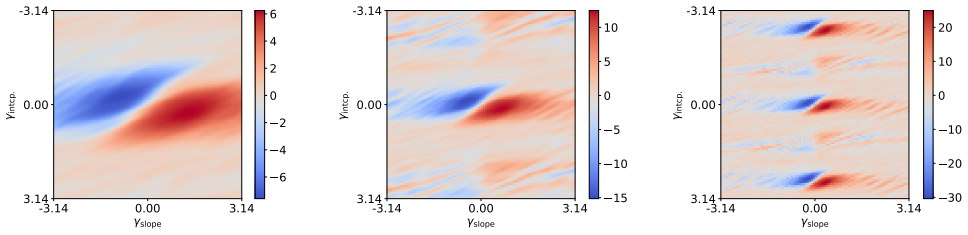
The central object is the linear-parameter constraint, called LINXFER in the paper, which fixes each layer's angles as $\gamma_l=\gamma_{\mathrm{slope}}(l/p)+\gamma_{\mathrm{intcp.}}$ and $\beta_l=\beta_{\mathrm{slope}}(l/p)+\beta_{\mathrm{intcp.}}$, leaving four numbers regardless of the number of layers $p$. It is supported by two observations: in the $p\to\infty$ limit QAOA converges to adiabatic evolution, where linear schedules are natural, and the parameters produced by INTERP and FOURIER are empirically close to linear. The mechanism that carries the transfer argument is energy-scale normalization: normalizing the Hamiltonian by a factor rescales the $\gamma$-axis of the landscape, effectively zooming the four-parameter cost surface so that parameters tuned for one instance line up with the optimum of another. The paper also uses matrix-product-state simulation to reach system sizes beyond state-vector simulation, with the bond dimension fixed at 32 after a convergence check.
What would settle it
Run the transfer on a fresh random Ising instance of 32 to 80 qubits, estimating the energy scale from data available before solving (edge count, mean coupling magnitude, or the semidefinite relaxation bound) instead of the exact ground-state energy, then apply the paper's toy linear angles and compare the approximation ratio on an MPS simulator. If the ratio systematically falls toward the random-sampling baseline or below 0.8, the zero-cost transfer claim fails in exactly the practical setting the paper targets.
Extended reading notes
Core claim
The central discovery is that QAOA's optimizable angles can be constrained to strict linear functions of the layer index, $\gamma_l=\gamma_{\mathrm{slope}}(l/p)+\gamma_{\mathrm{intcp.}}$ and $\beta_l=\beta_{\mathrm{slope}}(l/p)+\beta_{\mathrm{intcp.}}$, collapsing the variational search from $2p$ dimensions to four. Empirically, the angles recovered by standard QAOA, INTERP, and FOURIER lie near such straight lines, and the four-parameter landscape has a consistent structure across random Ising instances of varying size and connectivity. A parameter set optimized once on one 16-qubit instance transfers to other instances with only a few percentage points of approximation-ratio loss, and with energy-scale normalization an unoptimized toy schedule ($\gamma_l=-l/p-1$, $\beta_l=-l/p+1$) attains $\langle E\rangle/E_{\mathrm{SA}}\gtrsim 0.8$ for random Ising instances up to 80 qubits. The same landscape pattern remains recognizable on a real superconducting processor under hardware noise. The paper concludes that energy scale is the main knob for transfer: scaling the Hamiltonian acts as a zoom on the landscape, so matching the source and target energy scales is what makes zero-cost transfer work.
Load-bearing premise
The practical transfer claim depends on knowing the target problem's energy scale in advance, because without normalization derived from the ground-state energy the transferred angles perform no better than random sampling, and that energy is not generally known for a new instance.
Editorial extensions
If this is right
- New random Ising instances can be attacked with zero per-instance classical optimization: pre-trained or even hand-set linear angles are plugged in directly, so the cost no longer grows with circuit depth.
- The same fixed linear schedule, normalized by the energy scale, achieves typical approximation ratios above 0.8 on random Ising instances up to 80 qubits, a size where direct classical optimization of the angles is impractical.
- Compared with INTERP and FOURIER, the classical overhead drops by orders of magnitude for deep circuits, at the cost of at most a few percentage points in solution quality.
- Because the landscape structure persists under hardware noise, transferable linear parameters remain usable on current noisy quantum processors without error correction.
- Similar landscape patterns appear across spin-glass and max-cut problems, so transfer need not be limited to instances of the same distribution; adjusting the energy scale is the main requirement.
Reading between the lines
- The paper's normalization uses the exact ground-state energy $E_{\mathrm{SA}}$, which it admits is unknown for a fresh instance; a direct testable extension is to replace it with a cheap classical estimate (edge count, mean coupling magnitude, or the semidefinite relaxation bound) and measure how much the transferred approximation ratio drops.
- Because a strict linear schedule is a very constrained ansatz, the natural next question is whether a piecewise-linear schedule with a few breakpoints (say 8 parameters) preserves transferability while closing the residual gap to fully optimized QAOA at fixed depth.
- The observation that coupling noise in the spin-glass model behaves like hardware noise on the $R_{ZZ}$ gates suggests normalization could double as a crude error-mitigation knob: rescaling the Hamiltonian to suppress landscape distortion before sampling on noisy hardware.
Signed reviews
Editorial analysis
A structured set of objections, weighed in public.
Referee Report
Summary. The paper proposes constraining QAOA parameters to linear functions of the layer index, reducing the parameter space to four dimensions regardless of depth (LINXFER), and claims these parameters transfer between problem instances without instance-specific optimization. The authors compare LINXFER against standard QAOA, INTERP, and FOURIER on 16-qubit random Ising instances using noiseless simulation; study the structure of the reduced cost landscape on both a simulator and IBM's Eagle processor; investigate energy-scale normalization as a mechanism for transferability; and report approximation ratios above 0.8 for random Ising instances up to 80 qubits using a toy linear schedule normalized by |ESA|/sqrt(n_edges). They also provide cross-problem landscape evidence for SK models and max-cut.
Significance. If the transferability claim holds, the paper would offer a practical reduction of QAOA's classical optimization overhead, with a clear route to deploying fixed-angle circuits on near-term hardware. The 16-qubit transfer experiment is genuinely predictive: parameters optimized on one reference instance are applied to fresh instances and compared with optimization-based baselines. The real-device landscape measurement is a useful NISQ-era datapoint. The paper is also unusually candid about its own limitations, explicitly noting that ESA is not known in practice and that the large-instance normalization is heuristic. Those caveats, however, are located precisely where the scalable-transfer claim is made, and they materially affect what the results establish.
major comments (3)
- [§III-C, Eq. (6), Fig. 7] The large-system transfer experiment is conditioned on normalizing the target Hamiltonian by |ESA|/sqrt(n_edges), where ESA is the simulated-annealing ground-state energy of each target instance. As the text acknowledges, ESA is not known in practice, and the suggested proxies (Goemans-Williamson energy or n_edges) are never tested against the exact ESA. Without such a test, the headline claim of zero-cost application to new instances in the large-system regime is not established; Fig. 6 shows that without this normalization the same parameters perform at the level of random sampling. The paper should report, for its 8-instance samples, the distribution of |ESA|/sqrt(n_edges) and how well the proposed proxies track it, or explicitly restrict the scalable-transfer claim to the oracle-normalized setting.
- [§III-C, Eq. (6)] The 80-qubit experiment does not actually transfer parameters that were learned on a source instance. Equation (6) is a hand-chosen toy schedule with all slopes and intercepts set to unit magnitude, and the text states it was never optimized for any problem instance. What Fig. 7 demonstrates is therefore that a particular fixed linear schedule, after rescaling with the target's exact ground-state energy, achieves high approximation ratios. It does not demonstrate transfer of the linearly optimized parameters that are the subject of the paper's central claim. To support the title and abstract, the large-system experiment should use a parameter set obtained by optimizing on a reference instance (e.g., Eq. (5) or a Bayesian-optimized set at the same p) and then apply the same normalization argument.
- [Table I, p = 16 row] The claim that LINXFER is within error bars of the other methods 'for most p cases' is hedged, but the p=16 data point is a clear exception: LINXFER achieves 0.91(2) while INTERP and FOURIER achieve 0.97(1) and 0.96(2), respectively, which are outside the reported error bars. This is a performance gap of roughly five to six percentage points at increased depth, and it is directly relevant to the paper's argument that LINXFER sacrifices only a few percentage points while eliminating classical overhead. The paper should discuss whether the gap grows with p and what that implies for the practical value of the zero-cost advantage on deeper circuits.
minor comments (5)
- [§III-A] The sentence 'We sorely aim to demonstrate' should read 'We solely aim to demonstrate'.
- [Algorithm 1, line 11] The objective function in Algorithm 1 is written as 'f (γslope,γintcp.,βslope,βintcp.): ⟨H⟩ using γ,β ← SET(...)', but the Hamiltonian H is not listed as an input; the pseudocode would be clearer if the Hamiltonian were passed as an argument.
- [Figure 3 caption] The phrase 'an IBM's Eagle quantum processor' is grammatically awkward; 'an IBM Eagle quantum processor' or 'IBM's Eagle quantum processor' would be clearer.
- [§III-C] The sentence 'One do not necessarily know ESA' contains a grammatical error and should be rephrased, for example, 'One does not necessarily know ESA.'
- [Table II] The sudden drop in optimization time for Standard QAOA and FOURIER at p=16 is attributed to stronger expressive power, but the explanation would be clearer if the footnote were expanded in the main text.
Circularity Check
Energy-scale normalization is an exact QAOA rescaling identity that uses the target's own quasi-ground-state energy, but the core 16-qubit transfer tests are genuinely predictive.
-
self definitional
[Section III-B (Figs. 4-5) and Section III-C (Eq. (6), Figs. 6-7)]
"This is natural since the normalization factor of Hamiltonian converts the periodicity in γ-plane; multiplying the Hamiltonian by a factor corresponds to dividing the optimal γ parameters by the same factor. ... we apply a toy parameter set ... to large instances with normalizing the target Hamiltonian by |ESA|/√nedges."
The claimed scale-dependence of transferability is the exact rescaling identity of the QAOA phase operator: for H' = cH, e^{-iγH'} = e^{-i(γc)H}, so the optimal γ for H' is γ/c. The large-instance experiment sets c = |ESA|/√n_edges using the target instance's own simulated-annealing quasi-ground-state energy, so the normalization is an input taken from the target optimum rather than a parameter-free transfer. Thus the improvement over the unnormalized histograms in Fig. 6 is a demonstration that a correctly rescaled O(1) schedule performs well, not an independent prediction that parameters transfer without knowing the target's energy scale. The Introduction's 'zero-cost application' claim is therefore partially dependent on an instance-specific classical computation, though the Sec.
full rationale
The core LINXFER comparison is not circular: Eq. (5) is optimized once on a reference 16-qubit instance and then evaluated on fresh instances without retuning, and INTERP/FOURIER are external benchmarks. The self-citation to the authors' previous work [21] for landscape similarity is not load-bearing because Fig. 3 reproduces the landscape in this paper and the transfer results are computed independently. The only step that approaches circularity is the energy-scale normalization: the paper itself states that multiplying the Hamiltonian by a factor divides the optimal gamma parameters by the same factor, which is an exact identity, and the large-system experiment uses the target's ESA to set the normalization. This makes the headline 'zero-cost application to new problems' contingent on knowing or estimating ESA, which the paper acknowledges and for which it offers only an untested Goemans-Williamson proxy. However, the approximation ratios in Fig. 7 are not forced by the identity alone; they still require the toy schedule to produce a good state on normalized instances, so the circularity is partial rather than total. On balance the central transfer claim has independent empirical content, so the score is 3 rather than higher.
Assumptions & free parameters
free parameters (3)
- LINXFER reference parameters (gamma_slope, gamma_intercept, beta_slope, beta_intercept) =
-0.376, -0.165, -0.881, 0.913 (Eq. 5)
- Energy-scale normalization denominator |ESA|/sqrt(n_edges) =
varies per instance
- Toy linear parameters (slope and intercept for gamma and beta) =
gamma: slope -1, intercept -1; beta: slope -1, intercept +1 (Eq. 6)
assumptions (4)
- domain assumption Optimal QAOA parameters for the random Ising model concentrate and can be approximated by linear schedules.
- standard math The QAOA evolution rescales exactly under Hamiltonian multiplication: e^{-i gamma c H} = e^{-i (gamma c) H}.
- domain assumption The matrix product state simulator with bond dimension 32 is accurate for QAOA on random Ising instances up to 80 qubits.
- domain assumption A single parameter set optimized on one random Ising instance is representative of other instances from the same distribution.
Cite this review
Pith. "Pith review of Transferring linearly fixed QAOA angles: performance and real device results." pith.science (2026). https://pith.science/paper/FAUOGARF
@misc{pith2026250412632,
  author       = {Pith},
  title        = {Pith review of: Transferring linearly fixed QAOA angles: performance and real device results},
  year         = {2026},
  howpublished = {\url{https://pith.science/paper/FAUOGARF}},
  note         = {Machine review of arXiv:2504.12632}
}
read the original abstract
Quantum Approximate Optimization Algorithm (QAOA) enables solving combinatorial optimization problems on quantum computers by optimizing variational parameters for quantum circuits. We investigate a simplified approach that combines linear parameterization with parameter transferring, reducing the parameter space to just 4 dimensions regardless of the number of layers. This simplification draws inspiration from quantum annealing schedules providing both theoretical grounding and practical advantages. We compare this combined approach with standard QAOA and other parameter setting strategies such as INTERP and FOURIER, which require computationally demanding incremental layer-by-layer optimization. Notably, previously known methods like INTERP and FOURIER yield parameters that can be well fitted by linear functions, which supports our linearization strategy. Our analysis reveals that for the random Ising model, cost landscapes in this reduced parameter space demonstrate consistent structural patterns across different problem instances. Our experiments extend from classical simulation to actual quantum hardware implementation on IBM's Eagle processor, demonstrating the approach's viability on current NISQ devices. Furthermore, the numerical results indicate that parameter transferability primarily depends on the energy scale of problem instances, with normalization techniques improving transfer quality. Most of our numerical experiments are conducted on the random Ising model, while problem-dependence is also investigated across other models. A key advantage of parameter transferring is the complete elimination of instance-specific classical optimization overhead, as pre-trained parameters can be directly applied to other problem instances, reducing classical optimization costs by orders of magnitude for deeper circuits.
Figures


Figures from the paper (7 more)


Forward citations
Cited by 1 Pith paper
-
SAFE ma-QAOA: Surrogate-Assisted and Fine-Tuning Enhanced Multi-Angle QAOA with Parameter Distillation
SAFE ma-QAOA achieves 64.3% fewer active parameters and 94.5% lower estimated QPU workload via surrogate pre-training and parameter distillation on Sherrington-Kirkpatrick, 2D spin glass, and Max-Cut instances.
Reference graph
Works this paper leans on
-
[1]
A Quan- tum Approximate Optimization Algorithm,
E. Farhi, J. Goldstone, and S. Gutmann, “A Quan- tum Approximate Optimization Algorithm,” Nov. 2014. arXiv: 1411.4028 [quant-ph]. 10Note that the entanglement in the system grows with the number of qubits, the circuit depth, and what kinds of gates are involved. Thus it is always difficult to define the “minimum required bond dimension” in actual use case...
arXiv 2014
-
[2]
A Review on Quantum Approximate Optimization Algorithm and its Variants,
K. Blekos, D. Brand, A. Ceschini, et al., “A Review on Quantum Approximate Optimization Algorithm and its Variants,” Jun. 2023. arXiv: 2306.09198[quant-ph]
arXiv 2023
-
[3]
Quantum Optimization: Potential, Challenges, and the Path Forward,
A. Abbas et al. , “Quantum Optimization: Potential, Challenges, and the Path Forward,” Dec. 2023. arXiv: 2312.02279 [quant-ph]
arXiv 2023
-
[4]
Quantum Computation by Adiabatic Evolution,
E. Farhi, J. Goldstone, S. Gutmann, and M. Sipser, “Quantum Computation by Adiabatic Evolution,” Jan
-
[5]
Quantum annealing in the transverse Ising model,
T. Kadowaki and H. Nishimori, “Quantum annealing in the transverse Ising model,” Phys. Rev. E, vol. 58, no. 5, p. 5355, Nov. 1998. arXiv: cond-mat/9804280
arXiv 1998
-
[6]
Quantum annealing ini- tialization of the quantum approximate optimization algorithm,
S. H. Sack and M. Serbyn, “Quantum annealing ini- tialization of the quantum approximate optimization algorithm,” Quantum, vol. 5, p. 491, Jul. 2021. arXiv: 2101.05742 [quant-ph]
arXiv 2021
-
[7]
L. Zhou, S.-T. Wang, S. Choi, H. Pichler, and M. D. Lukin, “Quantum Approximate Optimization Algorithm: Performance, Mechanism, and Implemen- tation on Near-Term Devices,” Phys. Rev. X , vol. 10, no. 2, p. 021 067, Jun. 2020. arXiv: 1812 . 01041 [quant-ph]
work page 2020
-
[8]
Parameter Transfer for Quantum Approximate Optimization of Weighted MaxCut,
R. Shaydulin, P. C. Lotshaw, J. Larson, J. Ostrowski, and T. S. Humble, “Parameter Transfer for Quantum Approximate Optimization of Weighted MaxCut,” ACM Trans. Quant. Comput., vol. 4, no. 3, p. 19, Apr. 2023. arXiv: 2201.11785 [quant-ph]
arXiv 2023
Show all 42 references
-
[9]
Pa- rameter Setting in Quantum Approximate Optimization of Weighted Problems,
S. H. Sureshbabu, D. Herman, R. Shaydulin, et al., “Pa- rameter Setting in Quantum Approximate Optimization of Weighted Problems,” Quantum, vol. 8, p. 1231, Jan
-
[10]
From the Quantum Approximate Optimization Algorithm to a Quantum Alternating Operator Ansatz,
S. Hadfield, Z. Wang, B. O’Gorman, E. G. Rieffel, D. Venturelli, and R. Biswas, “From the Quantum Approximate Optimization Algorithm to a Quantum Alternating Operator Ansatz,” Sep. 2017. arXiv: 1709. 03489 [quant-ph]
2017
-
[11]
Quantum Alternating Operator Ansatz (QAOA) Phase Diagrams and Applications for Quantum Chemistry,
V . Kremenetski, T. Hogg, S. Hadfield, S. J. Cotton, and N. M. Tubman, “Quantum Alternating Operator Ansatz (QAOA) Phase Diagrams and Applications for Quantum Chemistry,”arXiv e-prints, arXiv:2108.13056, arXiv:2108.13056, Aug. 2021. arXiv: 2108 . 13056 [quant-ph]
2021 arXiv
-
[12]
Quantum Alternating Operator Ansatz (QAOA) beyond low depth with gradually changing uni- taries,
V . Kremenetski, A. Apte, T. Hogg, S. Hadfield, and N. M. Tubman, “Quantum Alternating Operator Ansatz (QAOA) beyond low depth with gradually changing uni- taries,” May 2023. arXiv: 2305.04455 [quant-ph]
2023 arXiv
-
[13]
Clas- sical symmetries and the Quantum Approximate Op- timization Algorithm,
R. Shaydulin, S. Hadfield, T. Hogg, and I. Safro, “Clas- sical symmetries and the Quantum Approximate Op- timization Algorithm,” Quantum Inf. Process , vol. 20, no. 11, p. 359, 2021. arXiv: 2012.04713 [quant-ph]
2021 arXiv
-
[14]
Adiabatic-Passage-Based Pa- rameter Setting for Quantum Approximate Optimiza- tion Algorithm,
M. Wu and H. Chen, “Adiabatic-Passage-Based Pa- rameter Setting for Quantum Approximate Optimiza- tion Algorithm,” Nov. 2023. arXiv: 2312 . 00077 [quant-ph]
2023
-
[15]
Transfer learning of optimal QAOA parameters in combinatorial optimization,
J. A. Montanez-Barrera, D. Willsch, and K. Michielsen, “Transfer learning of optimal QAOA parameters in combinatorial optimization,” Feb. 2024. arXiv: 2402 . 05549 [quant-ph]
2024
-
[16]
Optuna: A next-generation hyperparameter optimiza- tion framework,
T. Akiba, S. Sano, T. Yanase, T. Ohta, and M. Koyama, “Optuna: A next-generation hyperparameter optimiza- tion framework,” in Proceedings of the 25th ACM SIGKDD International Conference on Knowledge Dis- covery & Data Mining , ser. KDD ’19, Anchorage, AK, USA: Association for ...
2019 arXiv
-
[17]
Parameter concentrations in quantum approximate op- timization,
V . Akshay, D. Rabinovich, E. Campos, and J. Biamonte, “Parameter concentrations in quantum approximate op- timization,” Phys. Rev. A , vol. 104, no. 1, p. L010401, Jul. 2021. arXiv: 2103.11976 [quant-ph]
2021 arXiv
-
[18]
For Fixed Control Parameters the Quantum Approximate Optimization Algorithm’s Objective Function Value Concentrates for Typical In- stances,
F. G. S. L. Brandao, M. Broughton, E. Farhi, S. Gut- mann, and H. Neven, “For Fixed Control Parameters the Quantum Approximate Optimization Algorithm’s Objective Function Value Concentrates for Typical In- stances,” Dec. 2018. arXiv: 1812.04170 [quant-ph]
2018 arXiv
-
[19]
The Quantum Approximate Optimization Algorithm and the Sherrington-Kirkpatrick Model at Infinite Size,
E. Farhi, J. Goldstone, S. Gutmann, and L. Zhou, “The Quantum Approximate Optimization Algorithm and the Sherrington-Kirkpatrick Model at Infinite Size,” Quantum, vol. 6, p. 759, Jul. 2022. arXiv: 1910.08187 [quant-ph]
2022 arXiv
-
[20]
Grover- QAOA for 3-SAT: Quadratic Speedup, Fair-Sampling, and Parameter Clustering,
Z. Zhang, R. Paredes, B. Sundar, et al. , “Grover- QAOA for 3-SAT: Quadratic Speedup, Fair-Sampling, and Parameter Clustering,” Feb. 2024. arXiv: 2402 . 02585 [quant-ph]
2024
-
[21]
Linearly simplified qaoa parameters and transferability,
R. Sakai, H. Matsuyama, W.-H. Tam, Y . Yamashiro, and K. Fujii, “Linearly simplified qaoa parameters and transferability,” arXiv preprint, 2024. arXiv: 2405. 00655 [quant-ph]
2024
-
[22]
Ising formulations of many NP problems,
A. Lucas, “Ising formulations of many NP problems,” Front. Phys., vol. 2, p. 5, Feb. 2014. arXiv: 1302.5843 [cond-mat.stat-mech]
2014 arXiv
-
[23]
Beitrag zum Verst ¨andnis der magnetischen Erscheinungen in festen K ¨orpern,
W. Lenz, “Beitrag zum Verst ¨andnis der magnetischen Erscheinungen in festen K ¨orpern,” Z. Phys. , vol. 21, pp. 613–615, 1920
1920
-
[24]
Beitrag zur Theorie des Ferromagnetismus,
E. Ising, “Beitrag zur Theorie des Ferromagnetismus,” Z. Phys., vol. 31, pp. 253–258, 1925
1925
-
[25]
Solvable Model of a Spin-Glass,
D. Sherrington and S. Kirkpatrick, “Solvable Model of a Spin-Glass,” Phys. Rev. Lett., vol. 35, pp. 1792–1796, Dec. 1975
1975
-
[26]
Parameters Fixing Strategy for Quantum Approximate Optimization Algorithm,
X. Lee, Y . Saito, D. Cai, and N. Asai, “Parameters Fixing Strategy for Quantum Approximate Optimization Algorithm,” in 2021 IEEE International Conference on Quantum Computing and Engineering (QCE) , Aug
2021
-
[27]
Iterative Layerwise Training for Quantum Approxi- mate Optimization Algorithm,
X. Lee, X. Yan, N. Xie, Y . Saito, D. Cai, and N. Asai, “Iterative Layerwise Training for Quantum Approxi- mate Optimization Algorithm,” Sep. 2023. arXiv: 2309. 13552 [quant-ph]
2023
-
[28]
A depth- progressive initialization strategy for quantum approx- imate optimization algorithm,
X. Lee, N. Xie, D. Cai, Y . Saito, and N. Asai, “A depth- progressive initialization strategy for quantum approx- imate optimization algorithm,” Mathematics, vol. 11, no. 9, May 2023. arXiv: 2209.11348 [quant-ph]
2023 arXiv
-
[29]
Itera- tive Interpolation Schedules for Quantum Approximate Optimization Algorithm,
A. Apte, S. H. Sureshbabu, R. Shaydulin, et al., “Itera- tive Interpolation Schedules for Quantum Approximate Optimization Algorithm,” Apr. 2025. arXiv: 2504.01694 [quant-ph]
2025 arXiv
-
[30]
Qulacs: A fast and versatile quantum circuit simulator for research purpose,
Y . Suzuki, Y . Kawase, Y . Masumura, et al., “Qulacs: A fast and versatile quantum circuit simulator for research purpose,” Quantum, vol. 5, p. 559, Oct. 2021. arXiv: 2011.13524 [quant-ph]
2021 arXiv
-
[31]
Exper- imental Benchmarking of an Automated Deterministic Error-Suppression Workflow for Quantum Algorithms,
P. S. Mundada, A. Barbosa, S. Maity, et al. , “Exper- imental Benchmarking of an Automated Deterministic Error-Suppression Workflow for Quantum Algorithms,” Phys. Rev. Applied , vol. 20, no. 2, p. 024 034, 2023. arXiv: 2209.06864 [quant-ph]
2023 arXiv
-
[32]
Openjij: Framework for the ising model and qubo , version 0.6.16, An open source software for the Ising model and quadratic unconstrained binary optimization (QUBO), Jij Inc., 2023
2023
-
[33]
Improved approximation algorithms for maximum cut and satis- fiability problems using semidefinite programming,
M. X. Goemans and D. P. Williamson, “Improved approximation algorithms for maximum cut and satis- fiability problems using semidefinite programming,” J. ACM, vol. 42, no. 6, pp. 1115–1145, Nov. 1995
1995
-
[34]
Towards a universal QAOA protocol: Evidence of a scaling advan- tage in solving some combinatorial optimization prob- lems,
J. A. Montanez-Barrera and K. Michielsen, “Towards a universal QAOA protocol: Evidence of a scaling advan- tage in solving some combinatorial optimization prob- lems,” May 2024. arXiv: 2405.09169 [quant-ph]
2024 arXiv
-
[35]
Efficient Online Quantum Circuit Learning with No Upfront Training,
T. O’Leary, P. Czarnik, E. Pelofske, A. T. Sornborger, M. McKerns, and L. Cincio, “Efficient Online Quantum Circuit Learning with No Upfront Training,” Jan. 2025. arXiv: 2501.04636 [quant-ph]
2025
-
[36]
Implementing transferable annealing protocols for combinatorial optimization on neutral- atom quantum processors: A case study on smart charg- ing of electric vehicles,
L. Leclerc, C. Dalyac, P. Bendotti, R. Griset, J. Mikael, and L. Henriet, “Implementing transferable annealing protocols for combinatorial optimization on neutral- atom quantum processors: A case study on smart charg- ing of electric vehicles,” Phys. Rev. A , vol. 111, no. 3, ...
2025 arXiv
-
[37]
A Practically Scalable Approach to the Closest Vector Problem for Sieving via QAOA with Fixed Angles,
B. Priestley and P. Wallden, “A Practically Scalable Approach to the Closest Vector Problem for Sieving via QAOA with Fixed Angles,” Mar. 2025. arXiv: 2503. 08403 [quant-ph]
2025
-
[38]
Improving quantum approximate opti- mization by noise-directed adaptive remapping,
F. B. Maciejewski, J. Biamonte, S. Hadfield, and D. Venturelli, “Improving quantum approximate opti- mization by noise-directed adaptive remapping,” arXiv preprint, 2024. arXiv: 2404.01412 [quant-ph]
2024
-
[39]
Entanglement perspective on the quantum approximate optimization algorithm,
M. Dupont, N. Didier, M. J. Hodson, J. E. Moore, and M. J. Reagor, “Entanglement perspective on the quantum approximate optimization algorithm,” Phys. Rev. A, vol. 106, no. 2, p. 022 423, 2022. arXiv: 2206. 07024 [quant-ph]
2022
-
[2000]
arXiv: quant-ph/0001106
-
[2021]
arXiv: 2108.05288 [quant-ph]
-
[2024]
arXiv: 2305.15201 [quant-ph]
Reviewed August 16, 2026 · model on record in the stance chip above.
Discussion (0). Continue with ORCID to comment.