REVIEW 2 major objections 4 minor 46 references
Miura transformation in bidifferential calculus and a vectorial Darboux transformation for the Fokas-Lenells equation
T0 review · 2 major / 4 minor · reviewed 2026-08-16 · deepseek-v4-flash
Pith's one-line read A matrix-valued binary Darboux transformation, obtained by dressing the Miura transformation rather than the equation itself, reduces to a compact formula that generates breathers, dark and bright solitons, and rogue waves of the…
desk verdict Solid method paper with a new Miura-preservation theorem and a vectorial Darboux for Fokas-Lenells; main results hold, but the multi-dark/bright section has an unverified step. read the letter →
The pith
A machine-rendered reading of the paper's core claim, the machinery that carries it, and where it could break.
The reading
What carries the argument
The mechanism is the binary Darboux transformation of bidifferential calculus. In this framework a one-form $A$ with $dA = 0$ and $\bar d A = A^2$ is dressed by $A' = A - d(\theta\Omega^{-1}\eta)$, where $\theta$, $\eta$, and $\Omega$ solve auxiliary linear equations; Theorem 2.4 shows that if $(\phi,g)$ satisfies the Miura equation $(\bar d g)g^{-1} = d\phi$, the transformed pair satisfies it too. For the Fokas-Lenells application the calculus is built from $2\times 2$ matrix functions of $(x,t)$ with two Grassmann one-form directions, and the load-bearing identities are the Sylvester equation $\Gamma\Omega - \Omega\Delta = \eta_1\theta_1 + \eta_2\theta_2$ and, after the reduction, the Lyapunov equation (4.11). The reduction to the scalar equation is carried by the ansatz $\Delta = -\Gamma^\dagger$ together with $\theta_1 = \eta_1^\dagger(i\Gamma^\dagger + |u|^2I) - iu^*\eta_2^\dagger$ and $\theta_2 = iu\eta_1^\dagger + \eta_2^\dagger$, which forces $v' = u'^*$.
What would settle it
For the plane-wave seed (3.12), choose a $2\times 2$ diagonal matrix $\Gamma$ satisfying the spectrum condition and generic constant vectors, solve (4.10) and the Lyapunov equation (4.11), form $u'$ by (4.12), and substitute into (1.1); the theorem asserts the residual vanishes identically, so any nonzero residual for such data would falsify it.
Extended reading notes
Core claim
The central claim is Theorem 4.6: let $\Gamma$ be an invertible constant $n\times n$ matrix such that $\Gamma$ and $-\Gamma^\dagger$ share no eigenvalue, let $u$ solve the Fokas-Lenells equation (1.1), and let $\eta_1$ and $\tilde{\eta}_2$ solve the linear system (4.10). If $\Omega$ solves the Lyapunov equation $\Gamma\Omega + \Omega\Gamma^\dagger = i\eta_1\eta_1^\dagger\Gamma^\dagger + \tilde{\eta}_2\tilde{\eta}_2^\dagger$ and is invertible in an open set, then $u' = u - \tilde{\eta}_2^\dagger\Omega^{-1}\eta_1$ again solves (1.1). This is reached by first deriving a vectorial binary Darboux transformation for the coupled Fokas-Lenells system (Theorem 3.4), then implementing the reduction $v = u^*$ through a specific choice of the Darboux data. The same bidifferential-calculus mechanism also produces Miura transformations from the coupled system to the first negative AKNS member and to its pseudodual. With a plane-wave seed, the paper obtains breathers, dark and bright solitons, and rogue waves, including high-order examples from Jordan-block data.
Load-bearing premise
The scalar Fokas-Lenells reduction rests on a particular way of packaging the auxiliary solutions and on an identity that, in degenerate cases, must be imposed separately; if that identity fails, the transformation only solves the coupled system and the scalar conclusion does not follow.
Editorial extensions
If this is right
- Every solution of the Fokas-Lenells equation can be dressed in a single step: the vectorial data encode an $n$-parameter family of new solutions without repeated application of a scalar Darboux transformation.
- All known soliton families of the equation, namely breathers, dark and bright solitons, and rogue waves, arise from one plane-wave seed by choosing different matrices $\Gamma$, so the method unifies earlier separate derivations.
- Because Theorem 2.4 dresses the Miura relation itself, any pair of integrable equations connected by a Miura transformation can be dressed simultaneously by the same construction.
- Using non-diagonal or Jordan-form matrices $\Gamma$ produces solutions such as positons and higher-order rogue waves that other methods reach only by taking limits of ordinary multi-solitons.
- The $n=1$ linear system is a Lax pair for the Fokas-Lenells equation; promoting the spectral parameter to a matrix is what makes the vectorial transformation act in a single step.
Reading between the lines
- The same strategy of dressing the Miura map should carry over to other integrable hierarchies: wherever two equations are linked by a Miura relation expressible in bidifferential calculus, one Darboux step should generate solutions of both.
- The reduction identity (4.14) can be read as a reality condition on the Darboux data; recasting it as a symmetry or gauge constraint might yield a bidifferential calculus that describes the Fokas-Lenells equation directly, avoiding the coupled-system detour.
- Combining eigenvalues of different types in one block-diagonal $\Gamma$, for instance a breather eigenvalue together with a rogue-wave Jordan-block eigenvalue, should produce hybrid solutions in a single formula; the paper notes the possibility but does not work out explicit examples.
- For nonzero boundary conditions the degenerate case leaves constants in $\Omega$ that are fixed by (5.7); these constants are natural candidates for the physical parameters of dark and bright solitons, suggesting a direct comparison with inverse-scattering data.
Signed reviews
Editorial analysis
A structured set of objections, weighed in public.
Referee Report
Summary. This paper develops a binary Darboux transformation in the framework of bidifferential calculus. Its first main result (Theorem 2.4) states that a Darboux transformation preserves the Miura-transformation equation (2.11) whenever it preserves the two integrable equations (2.7) and (2.9). Specializing to a 2x2 matrix calculus, the authors derive a vectorial binary Darboux transformation (Theorem 3.4) for the coupled Fokas-Lenells system (1.2), together with Miura-type reductions to a negative AKNS equation and to a sine-Gordon-type system. The reduction v=u* is then imposed on the Darboux data, leading to a vectorial Darboux transformation for the scalar Fokas-Lenells equation (Theorem 4.6). Applications with a plane-wave seed produce breathers, dark and bright solitons, and rogue-wave solutions, including a multi-soliton superposition formula in the degenerate dark-soliton case.
Significance. If correct, the paper's significance is substantial: it gives a general mechanism for preserving Miura transformations under binary Darboux transformations, and it supplies a vectorial Darboux transformation for the Fokas-Lenells equation that goes beyond the zero-seed case. The derivations are algebraic and mostly complete; Theorem 2.4 is proved in detail, and the reductions leading to Theorems 3.4 and 4.6 are spelled out. The explicit solution families, including Jordan-block 'positon' and rogue-wave examples, are a useful addition. The derivation is not circular: the target results do not reduce to the cited prior work, and the genuinely new content lies in the Miura-preservation theorem and in the reduction conditions (4.13). The significance is tempered, however, by the unverified degenerate multi-soliton construction in Section 5.2, which currently rests on assumptions that are not checked.
major comments (2)
- [Section 5.2, displayed definition of Omega_ij] The n-dark/bright superposition formula is asserted for Gamma = -i diag(k_1,...,k_n) with k_j > 0. For such Gamma, the spectrum condition of Theorem 4.6 (Gamma and -Gamma^dagger have no common eigenvalue) is violated, so the Lyapunov equation (4.11) no longer implies the identity (4.14) or the differential equations (4.15); these must be imposed as separate assumptions, as stated in Remark 4.7. For i != j, the manuscript supplies only the algebraic expression Omega_ij = i/(k_i-k_j)(-chi_{1i} chi_{1j}^* k_j + chi_{2i} chi_{2j}^*) obtained from (4.11). No verification is given that these off-diagonal entries satisfy the x- and t-equations (5.6), nor that Omega is compatible in the sense Omega_xt = Omega_tx. Since the homogeneous Lyapunov equation has nontrivial solutions in this degenerate case, the algebraic equation does not determine the x,t-dependence of Omega. Without (5.6), the resulting u' need not be a Darboux output of Theorem 4.6, and the n-dark/bright superposition claim of Section 5.2 is unsupported. Please either prove (5.6) and compatibility for the proposed off-diagonal data, or state this class as conditional pending such a check.
- [Section 3.1, Eq. (3.17) and footnote 7] The Miura transformation from the coupled Fokas-Lenells system to the first member of the negative AKNS hierarchy is formulated with equations containing an indefinite integral. Footnote 7 concedes that the integral should be replaced by an auxiliary function w with w_t = (phi_22 - phi_11)_x. As written, therefore, (3.17) is not a well-defined local system, and the claim that (3.6) and (3.7) constitute a Miura transformation to that hierarchy is only formal. The revision should rewrite (3.17) with the auxiliary function and state the resulting system and the transformation to it explicitly.
minor comments (4)
- [Section 6, final paragraph] The phrase 'conditions (3.3)' appears to be a mis-reference; the reduction ansatz actually used in Section 4 is (4.13).
- [Throughout] The same symbol phi is used for the plane-wave phase in (3.12), for the potential in Corollary 2.2, and for phi(gamma) in (4.8); this complicates reading and should be disambiguated.
- [Section 5.1(1)] The statement that the generated solutions include Akhmediev- and Kuznetsov-Ma-type breathers is not substantiated by an identification of the corresponding parameter ranges; a short explanation would allow the reader to check this claim.
- [Proof of Theorem 3.4] Several 'straightforward' algebraic simplifications are left implicit in the passage from the theta,eta systems to (3.8); adding the intermediate linear system would improve reproducibility.
Circularity Check
No significant circularity: the central Darboux and Miura results are derived from general bidifferential-calculus theorems and external results, not by fitting inputs to the Fokas-Lenells equation.
full rationale
The paper's main claims—Theorem 2.4 (Miura preservation under binary Darboux), Theorem 3.4 (vectorial binary Darboux for the coupled Fokas-Lenells system), and Theorem 4.6 (reduction to the scalar Fokas-Lenells equation)—are obtained by applying a general bidifferential-calculus Darboux framework to a concrete calculus, then implementing the reduction v = u*. The reduction ansatz (4.13) is explicitly stated and verified against the linear system, and the key identity (4.14) is derived from the Lyapunov equation under the spectrum condition, not assumed as the target result. Proposition 3.1 from [35] is quoted as an external result and is also independently verified in the paper by direct computation. The authors' own earlier framework papers [34,36,38,41,44] supply general algebraic tools or companion examples, but none of the load-bearing steps reduces to a self-citation: Theorem 2.4 is proven in the text, and the universal theorems from [36] are framework results independent of the Fokas-Lenells equation. The validation against known Hirota, Riemann-Hilbert, and Darboux-derived soliton classes is an external check, not the source of the derivation. The Section 5.2 degenerate dark/bright construction leaves a technical gap—the off-diagonal Omega components are given algebraically without an explicit verification of the supplementary equations (4.15)—but this is a correctness/completeness concern, not circularity, since the construction does not presuppose the claimed n-soliton solution. Overall, no claimed prediction or first-principles result is equivalent by construction to its inputs, so the circularity score is 0.
Assumptions & free parameters
assumptions (4)
- domain assumption The algebra A of smooth functions on R^2 and the graded algebra Ω = Mat(A) ⊗ Λ(C^2), with d and d-bar defined in Section 3, form a bidifferential calculus.
- domain assumption Solutions are considered on open subsets of R^2 where u, u_x, v, g22 are non-zero (Lemma 3.3), the matrices Δ and Γ are invertible, and Ω is invertible.
- ad hoc to paper The reduction conditions (4.13), θ1 = η1† (i Γ† + |u|^2 I) - i u* η2†, θ2 = i u η1† + η2†, are imposed.
- domain assumption In Section 5, the plane wave seed (3.12) and parameter restrictions (e.g., α = |A|^{-2}, |A|^2 > α^{-1} for dark solitons, R2 having a square root) are assumed.
Cite this review
Pith. "Pith review of Miura transformation in bidifferential calculus and a vectorial Darboux transformation for the Fokas-Lenells equation." pith.science (2026). https://pith.science/paper/KGOI6A2I
@misc{pith2026250412822,
  author       = {Pith},
  title        = {Pith review of: Miura transformation in bidifferential calculus and a vectorial Darboux transformation for the Fokas-Lenells equation},
  year         = {2026},
  howpublished = {\url{https://pith.science/paper/KGOI6A2I}},
  note         = {Machine review of arXiv:2504.12822}
}
read the original abstract
Using a general result of bidifferential calculus and recent results of other authors, a vectorial binary Darboux transformation is derived for the first member of the "negative" part of the potential Kaup-Newell hierarchy, which is a system of two coupled Fokas-Lenells equations. Miura transformations are found from the latter to the first member of the negative part of the AKNS hierarchy and also to its "pseudodual". The reduction to the Fokas-Lenells equation is implemented and exact solutions with a plane wave seed generated.
Figures
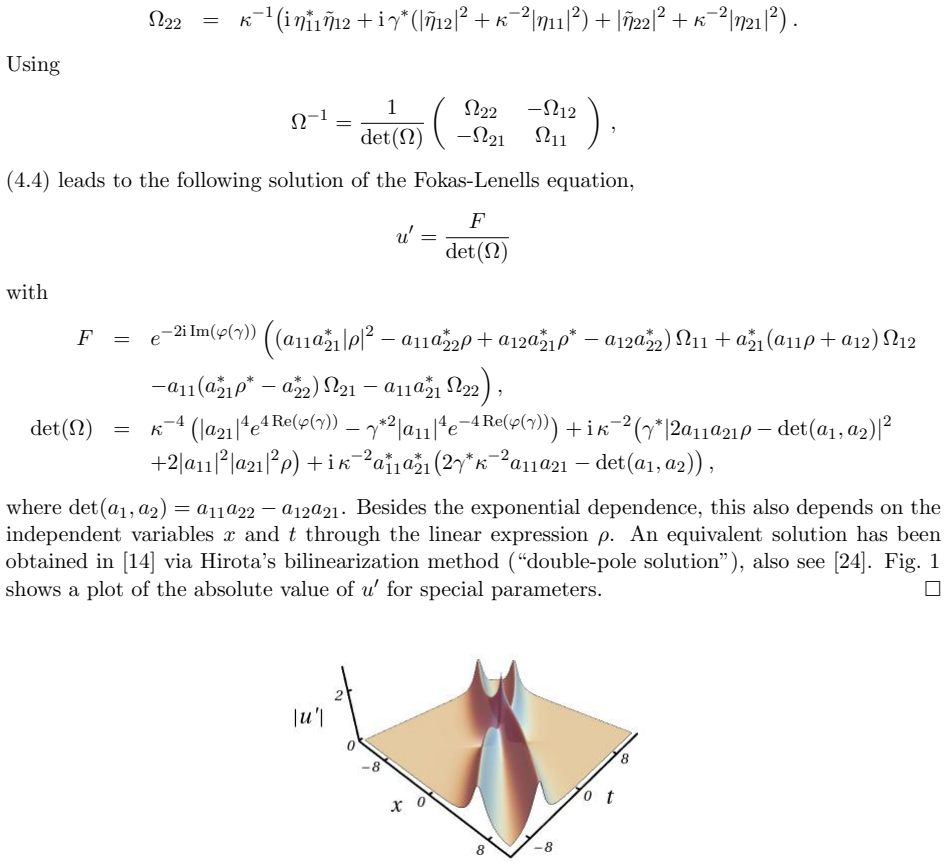


Figures from the paper (4 more)


Reference graph
Works this paper leans on
- [30]
-
[1]
J. Lenells. Exactly solvable model for nonlinear pulse propagation in optical fibers. Stud. Appl. Math. , 123:215–232, 2009
work page 2009
-
[2]
A.S. Fokas. On a class of physically important integrable equations. Physica D, 87:145–150, 1995
work page 1995
-
[3]
J. Lenells and A.S. Fokas. On a novel integrable generalization of the nonlinear Schr¨ odinger equation. Nonlinearity, 22:11–27, 2009
work page 2009
-
[4]
V.S. Gerdzhikov, M.I. Ivanov, and P.P. Kulish. Quadratic bundle and nonlinear equations. Theor. Math. Phys., 44:784–795, 1980
work page 1980
-
[5]
Z. Yang and Y. Zeng. On generating equations for the Kaup-Newell hierarchy. Appl. Math. J. Chinese Univ. Ser. B , 22:413–420, 2007
work page 2007
- [6]
-
[7]
G.S. Franca, J.F. Gomes, and A.H. Zimerman. The algebraic structure behind the derivative nonlinear Schr¨ odinger equation.J. Phys. A: Math. Theor. , 46:305201, 2013
work page 2013
Show all 46 references
-
[8]
Zhang, J.W
Y. Zhang, J.W. Yang, K.W. Chow, and C.F. Wu. Solitons, breathers and rogue waves for the cou- pled Fokas-Lenells system via Darboux transformation. Nonlinear Analysis: Real World Applications , 33:237–252, 2017
2017
-
[9]
Ling, B.-F
L. Ling, B.-F. Feng, and Z. Zhu. General soliton solutions to a coupled Fokas-Lenells equation.Nonlinear Analysis: Real World Applications , 40:185–214, 2018
2018
-
[10]
Kang, T.-C
Z.-Z. Kang, T.-C. Xia, and X. Ma. Multi-soliton solutions for the coupled Fokas-Lenells system via Riemann-Hilbert approach. Chin. Phys. Lett. , 35:070201, 2018
2018
-
[11]
S. Chen, Y. Ye, J.M. Soto-Crespo, P. Grelu, and F. Baronio. Peregrine solitons beyond the threefold limit and their two-soliton interactions. Phys. Rev. Lett., 121:104101, 2018
2018
-
[12]
Y. Ye, Y. Zhou, S. Chen, F. Baronio, and P. Grelu. General rogue wave solutions of the coupled Fokas-Lenells equations and non-recursive Darboux transformation. Proc. R. Soc. A , 475:20180806, 2019
2019
-
[13]
Ling and H
L. Ling and H. Su. Rogue waves and their patterns for the coupled Fokas-Lenells equations. Physica D: Nonlinear Phenomena , 461:134111, 2024
2024
-
[14]
S.Z. Liu, J. Wang, and D.J. Zhang. The Fokas-Lenells equations: Bilinear approach. Stud. Appl. Math., 148:651–688, 2022. 23
2022
-
[15]
Vekslerchik
V.E. Vekslerchik. Lattice representation and dark solitons of the Fokas-Lenells equation. Nonlinearity, 24:1165–1175, 2011
2011
-
[16]
Y. Matsuno. A direct method of solution for the Fokas-Lenells derivative nonlinear Schr¨ odinger equation: I. Bright soliton solutions. J. Phys. A: Math. Theor. , 45:235202, 2012
2012
-
[17]
Y. Matsuno. A direct method of solution for the Fokas-Lenells derivative nonlinear Schr¨ odinger equation: II. Dark soliton solutions. J. Phys. A: Math. Theor. , 45:475202, 2012
2012
-
[18]
Liu, C.C
F. Liu, C.C. Zhou, X. L¨ u, and H. Xu. Dynamic behaviors of optical solitons for Fokas-Lenells equation in optical fiber. Optik - International Journal for Light and Electron Optics , 224:165237, 2020
2020
-
[19]
Dutta, S
R. Dutta, S. Talukdar, G.K. Saharia, and S. Nandy. Fokas-Lenells equation dark soliton and gauge equivalent spin equation. Optical and Quantum Electronics , 55:1183, 2023
2023
-
[20]
Zhao and E
Y. Zhao and E. Fan. Inverse scattering transformation for the Fokas-Lenells equation with nonzero boundary conditions. J. Nonl. Math. Phys. , 28:38–52, 2021
2021
-
[21]
Cheng and E
Q. Cheng and E. Fan. The Fokas-Lenells equation on the line: Global well-posedness with solitons. J. Diff. Eq., 366:320–344, 2023
2023
-
[22]
Ai and J
L. Ai and J. Xu. On a Riemann-Hilbert problem for the Fokas-Lenells equation. Appl. Math. Lett. , 87:57–63, 2019
2019
-
[23]
Zhang and S.F
X.F. Zhang and S.F. Tian. Riemann-Hilbert problem for the Fokas-Lenells equation in the presence of high-order discrete spectrum with non-vanishing boundary conditions. J. Math. Phys. , 64:051503, 2023
2023
-
[24]
Zhang, D
Y. Zhang, D. Qiu, and J. He. Explicit Nth order solutions of Fokas-Lenells equation based on revised Riemann-Hilbert approach. J. Math. Phys. , 64:053502, 2023
2023
-
[25]
Y. Zhao, E. Fan, and Y. Hou. Algebro-geometric solutions and their reductions for the Fokas-Lenells hierarchy. J. Nonl. Math. Phys. , 20:355–393, 2013
2013
-
[26]
Zhao and N
Y.-N. Zhao and N. Wang. The exact solutions of Fokas-Lenells equation based on Jacobi elliptic function expansion method. Boundary Value Problems, 2022:93, 2022
2022
-
[27]
J. Lenells. Dressing for a novel integrable generalization of the nonlinear Schr¨ odinger equation. J. Nonlinear Sci., 20:709–722, 2010
2010
-
[28]
J. He, S. Xu, and K. Porsezian. Rogue waves of the Fokas-Lenells equation. J. Phys. Soc. Jpn. , 81:124007, 2012
2012
-
[29]
S. Xu, J. He, Y. Cheng, and K. Porsezian. The n-order rogue waves of Fokas-Lenells equation. Math. Meth. Appl. Sci. , 38:1106–1126, 2015
2015
-
[31]
Matveev and M.A
V.B. Matveev and M.A. Salle. Darboux Transformations and Solitons . Springer Series in Nonlinear Dynamics. Springer, Berlin, 1991
1991
-
[32]
M. Ma˜ nas. Darboux transformations for the nonlinear Schr¨ odinger equations.J. Phys. A: Math. Gen. , 29:7721–7737, 1996
1996
-
[33]
Dimakis and F
A. Dimakis and F. M¨ uller-Hoissen. Bi-differential calculi and integrable models. J. Phys. A: Math. Gen., 33:957–974, 2000
2000
-
[34]
Ye and Y
R. Ye and Y. Zhang. A vectorial Darboux transformation for the Fokas-Lenells system. Chaos, Solitons & Fractals, 169:113223, 2023
2023
-
[35]
S. Li, S. Liu, and D. Zhang. From the self-dual Yang-Mills equation to the Fokas-Lenells equation. arXiv:2411.10807 [nlin.SI], 2024
2024 arXiv
-
[36]
Dimakis and F
A. Dimakis and F. M¨ uller-Hoissen. Binary Darboux transformations in bidifferential calculus and integrable reductions of vacuum Einstein equations. SIGMA, 9:009, 2013. 24
2013
-
[37]
Dimakis and F
A. Dimakis and F. M¨ uller-Hoissen. Differential calculi on associative algebras and integrable systems. In S. Silvestrov, A. Malyarenko, and M. Ranˇ ci´ c, editors,Algebraic Structures and Applications, volume 317 of Springer Proceedings in Mathematics & Statistics , pages 38...
-
[38]
Chvartatskyi, A
O. Chvartatskyi, A. Dimakis, and F. M¨ uller-Hoissen. Self-consistent sources for integrable equations via deformations of binary Darboux transformations. Lett. Math. Phys. , 106:1139–1179, 2016
2016
-
[39]
Dimakis and F
A. Dimakis and F. M¨ uller-Hoissen. Bidifferential calculus approach to AKNS hierarchies and their solutions. SIGMA, 6:055, 2010
2010
-
[40]
Dimakis, N
A. Dimakis, N. Kanning, and F. M¨ uller-Hoissen. Bidifferential calculus, matrix SIT and sine-Gordon equations. Acta Polytechnica, 51:33–37, 2011
2011
-
[41]
M¨ uller-Hoissen
F. M¨ uller-Hoissen. A vectorial binary Darboux transformation for the first member of the negative part of the AKNS hierarchy. J. Phys. A: Math. Theor. , 56:125701, 2023
2023
-
[42]
Gerdjikov, B
V.S. Gerdjikov, B. Kostadinov, and S. Mishev. Two soliton interaction of Zakharov-Mikhailov spinor models. J. Phys.: Conf. Ser. , 2719:012003, 2024
2024
-
[43]
Ablowitz, D.J
M.J. Ablowitz, D.J. Kaup, A.C. Newell, and H. Segur. Nonlinear-evolution equations of physical sig- nificance. Phys. Rev. Lett., 31:125–127, 1973
1973
-
[44]
Chvartatskyi and F
O. Chvartatskyi and F. M¨ uller-Hoissen. NLS breathers, rogue waves, and solutions of the Lyapunov equation for Jordan blocks. J. Phys. A: Math. Theor. , 50:155204, 2017
2017
-
[45]
Z. Wang, L. He, Z. Qin, R. Grimshaw, and G. Mu. High-order rogue waves and their dynamics of the Fokas-Lenells equation revisited: a variable separation technique. Nonlinear Dyn., 98:2067–2077, 2019
2019
-
[46]
Gerdjikov and R
V. Gerdjikov and R. Ivanov. Multicomponent Fokas-Lenells equations on Hermitian symmetric spaces. Nonlinearity, 34:939, 2021. 25
2021
Reviewed August 16, 2026 · model on record in the stance chip above.
Discussion (0). Continue with ORCID to comment.