REVIEW 3 major objections 4 minor 1 cited by
When do Random Forests work?
T0 review · 3 major / 4 minor · reviewed 2026-08-16 · deepseek-v4-flash
Pith's one-line read Randomization wins exactly when variance beats squared bias
desk verdict Worth a real refereeing; the correlated-covariate finding is new and plausible, but the paper's explanation leans entirely on one of two equally valid bias-variance decompositions and never checks the other. read the letter →
The pith
A machine-rendered reading of the paper's core claim, the machinery that carries it, and where it could break.
The reading
What carries the argument
The argument rests on three formal pieces. Proposition 1 fixes an unconditional out-of-sample MSE and writes it as squared bias plus variance plus irreducible noise, conditioning on covariates first. Proposition 2 shows that, for a large ensemble, variance equals the pairwise correlation between two trees times the variance of a single tree, which isolates the decorrelation effect of randomization. Proposition 3 proves that the relative difference in MSE between bagging and forests is unchanged when the regression function is normalized to unit variance. Together they reduce the question "does randomization help?" to a comparison of two numbers: the variance saved by decorrelation against the squared bias added by restricted splits.
What would settle it
Run the same simulations at a fixed moderate SNR with a new regression function and correlated covariates: if forests beat bagging while the bias-variance decomposition shows squared bias still larger than variance, or if increasing correlation raises rather than lowers bias for both methods, the paper's mechanism fails.
Extended reading notes
Core claim
The paper's central claim is that split randomization is effective precisely when variance dominates squared bias, and that this can happen for reasons unrelated to noise level. Using three benchmark data-generating processes, the authors show that randomization decorrelates trees in every scenario and always lowers ensemble variance, yet it increases squared bias in most scenarios; forests beat bagging in low-SNR settings because variance is the larger term, and lose in high-SNR settings because bias dominates. At fixed moderate SNR, covariate structure flips the balance: fat tails and irrelevant covariates push bias up, making randomization ineffective, while mutual correlation among covariates lowers bias for both methods and lets forests beat bagging. The paper further proves that the relative MSE gap between bagging and forests is invariant to rescaling the regression function, and that the bias-variance split depends on the order of conditioning, so comparisons must state which decomposition they use.
Load-bearing premise
The conclusions are drawn from three simulated regression functions with default forest settings (mtry = floor(p/3), node size 5, 500 trees), so the qualitative claims assume these benchmarks represent behavior on other data-generating processes and hyperparameter choices.
Editorial extensions
If this is right
- At low signal-to-noise ratio, forests consistently outperform bagging on all three benchmark DGPs, because variance dominates squared bias for both methods.
- At high SNR, bagging tends to win by a larger margin than forests win at low SNR, so the cost of using randomization where it does not help is asymmetric.
- Fat-tailed covariates make split randomization worse: the squared-bias increase appears mainly in the tails of the covariate distribution.
- Adding irrelevant covariates raises bias for both methods, and randomization makes it worse, so bagging outperforms forests once enough irrelevant covariates are present.
- Mutual correlation among covariates reduces squared bias for bagging and forests, so forests beat bagging at moderate SNR; with perfect correlation the two methods coincide.
Reading between the lines
- If correlated covariates reduce the harm of missing a good split, then the same mechanism should strengthen other randomized ensembles, such as extremely randomized trees; that is a testable extension the paper does not run.
- The results suggest a practical diagnostic for a given dataset: estimate the squared-bias and variance terms on validation splits, and choose bagging versus forest by which term dominates, rather than by SNR alone.
- The normalization-invariance result implies percentage MSE gaps reported under any scaling of the regression function are comparable, which could make cross-paper comparisons of forest-versus-bagging gains more meaningful.
- A natural next simulation is to replace equicorrelated covariates with block or autocorrelated structures and check whether the bias-reduction effect persists when correlation is uneven, since real data rarely have constant pairwise correlations.
Signed reviews
Editorial analysis
A structured set of objections, weighed in public.
Referee Report
Summary. The paper asks under what data conditions randomizing split directions in random forests improves out-of-sample MSE relative to bagging, and uses bias–variance decompositions to explain the differences. It states three elementary propositions: an unconditional bias–variance decomposition conditioning on X (Eq. 6), an alternative decomposition conditioning on the fitted model (Eq. 7), a large-B variance formula in terms of tree correlation (Proposition 2), and invariance of relative MSE difference to normalization of the regression function (Proposition 3). The simulation study replicates three DGPs (N-LINEAR, U-MARS, U-HIDDEN) from Hastie et al. (2009), Mentch and Zhou (2020), and Liu and Mazumder (2024) at SNR 0.05, 1, and 6, then extends the setup to fat-tailed covariate distributions, irrelevant covariates, and correlated covariates at SNR=1, with 500 training sets and one 10,000-point test set. The main findings are that randomization decorrelates trees in all settings, that forests beat bagging at low SNR because variance dominates bias, and that with correlated covariates bias shrinks for both methods so that randomization is effective; with fat-tailed covariates and irrelevant covariates, bias increases and randomization tends to hurt.
Significance. If the empirical conclusions hold up, the paper makes a useful conceptual contribution by shifting the discussion from SNR alone to the bias–variance balance and by documenting that correlated covariates reduce bias in both bagging and forests, an observation that goes beyond the standard variance-reduction story. The paper's strengths are that its propositions are elementary, correctly proved, and clearly stated; the simulation protocol is careful and reproducible, with 500 training sets, a single large test set, explicit SNR levels, and the default randomForest implementation; and Proposition 3 provides a clean normalization-invariance result for the reported relative differences. The study is, however, limited to three benchmark DGPs, one set of default hyperparameters, and a single decomposition choice, which restricts how far the 'because' clauses in the abstract can be generalized.
major comments (3)
- [Section 2.1, Eq. (7)] The paper's central explanatory claims, such as 'forests outperform bagging when the SNR is low because variance dominates bias for both methods' and 'randomization tends to be effective [with correlated covariates] because variance dominates bias', are evaluated exclusively under decomposition (6). The authors introduce decomposition (7), conditioning on the fitted model, and explicitly state that the two decompositions can disagree about whether bias or variance dominates and about which term drives an MSE improvement. No table in the manuscript reports the bias and variance terms under (7), so the asserted mechanism is not robust to the decomposition choice. Since the non-uniqueness is acknowledged in Section 2.1, the manuscript should either report both decompositions for the key comparisons (at least Tables 1, 4, 5, and 6) or provide a substantive argument for why (6) is the relevant conditioning for the causal statements; without this, the 'because' claims are conditional on an arbitrary convention.
- [Sections 3-4, Tables 1-13] The bias and variance components are reported as point estimates without Monte Carlo standard errors. The t-statistic of Eq. (16) is applied only to the difference in MSE, not to the bias and variance components. Several qualitative conclusions rest on small component differences, such as Table 6's N-HIDDEN bias terms (0.01 vs 0.02) and Table 4's LINEAR relative difference of 0.37%. Without standard errors or confidence intervals for the bias and variance terms, the claims that 'bias dominates variance' or that 'bias increases by more for forest' cannot be distinguished from estimation noise. Please add simulation standard errors or paired intervals for the bias and variance columns, at least for the key tables in Sections 3 and 4.
- [Section 4, first paragraph] All extensions fix n=250, mtry=floor(p/3), node size 5, and 500 trees. Because the paper's title and abstract make general claims about when random forests work, the absence of any variation in mtry or tree depth leaves open whether the bias-variance balance findings are artifacts of these defaults. The mtry value directly controls the bias-variance tradeoff in Proposition 2, so the qualitative conclusions could change under other settings. A small sensitivity analysis over mtry (or at least a clearly bounded claims statement in the conclusion) would make the stated generality match the evidence actually presented.
minor comments (4)
- [Section 4.3] The statement 'Why increasing rho can result in forests even outperforming bagging, as happens for rho=0.9 in this example, is something we cannot explain' is an honest limitation, but it leaves a headline-adjacent observation without any diagnostic follow-up; a brief speculation or a plot of the conditional bias and variance at rho=0.9 would help the reader understand the reversal.
- [Table 4] The table header lists the covariate distribution for three models in a single row, which is compact but hard to parse because the model names and distributions are not repeated in separate columns; consider restructuring the table or adding a clearer caption.
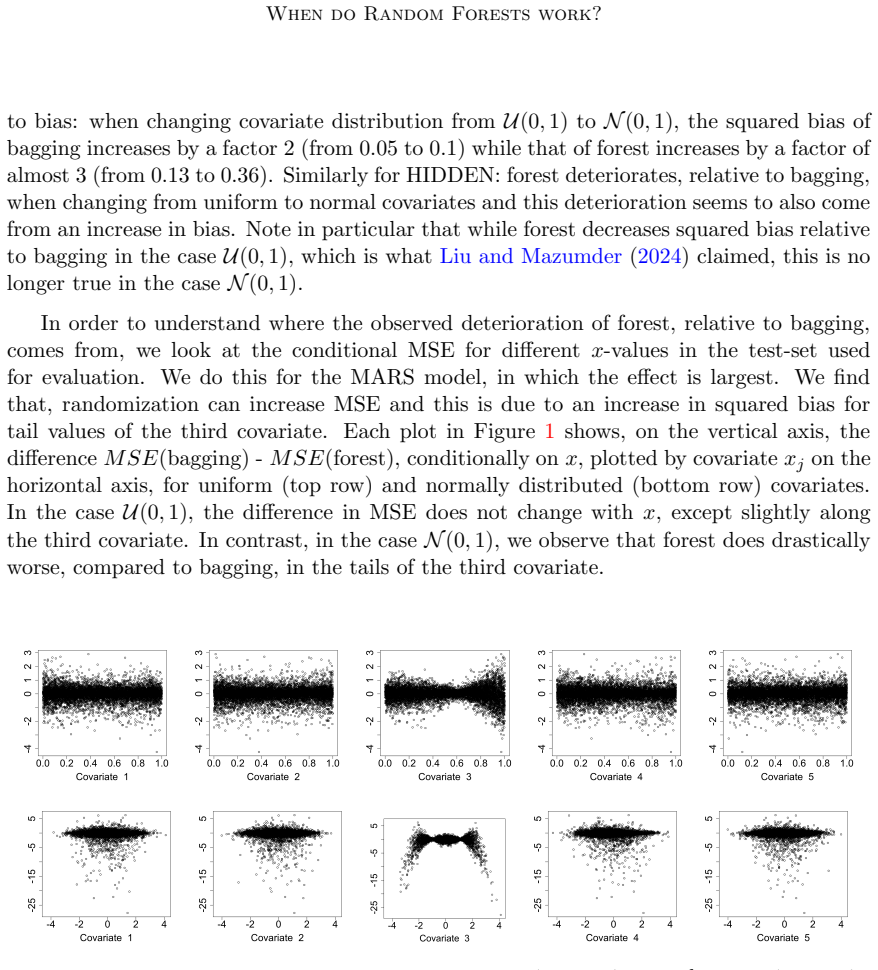
- [Figures 1 and 2] The text describes these figures in detail but the figures themselves are not reproduced in the manuscript text provided; if they appear in the full submission, please ensure each panel has clear axis labels and a legend so the conditional MSE differences are interpretable.
- [Section 2.1] The sentence 'What we've observed in prior literature is that the average prediction at a given value is used as a proxy for the true regression function' would benefit from a citation and a precise definition of the proxy, since the claim that the bias term is 'effectively eliminated' depends on whether the proxy is exactly the conditional mean.
Circularity Check
No significant circularity: the paper's claims are supported by simulations and elementary derivations, not by construction or fitted inputs.
full rationale
The paper does not fit any free parameter and then 'predict' a derived quantity: all comparisons use the standard randomForest implementation on three benchmark DGPs taken from prior literature (Hastie et al. 2009; Mentch and Zhou 2020; Liu and Mazumder 2024), with out-of-sample MSE and its bias/variance components estimated on held-out test sets. Propositions 1-3 are elementary decompositions and a normalization-invariance result, each proved in Appendix A without assuming the conclusions. The causal-sounding claims ('forests outperform bagging when the SNR is low because variance dominates bias') are empirical interpretations of the reported simulation tables, not tautologies. Section 2.1 explicitly warns that the bias/variance split is not unique and presents decomposition (7) as an alternative; while the explanation is therefore convention-dependent, the dependence is disclosed and does not make the relative-MSE evidence circular. The only self-citations (Revelas et al. 2024, in the introduction and footnote 8) are auxiliary references to subagging and to a formal cell-size bias relation, and neither is load-bearing for the paper's central claims. Accordingly, no circular step satisfies the quoted-equation reduction criterion, so the correct finding is no significant circularity.
Assumptions & free parameters
assumptions (5)
- domain assumption The data-generating processes are Y = f(X) + epsilon with E[epsilon|X] = 0 and finite variance (Eq. 1).
- domain assumption The bias-variance decomposition conditioning on X first (Eq. 6) is used to attribute improvements to bias or variance; an alternative conditioning on the fitted model gives different terms.
- domain assumption The randomForest R implementation with default parameters (B=500 trees, node size 5, mtry=floor(p/3)) is representative of random forest behavior.
- domain assumption The three benchmark DGPs (N-LINEAR, U-MARS, U-HIDDEN) are representative enough to support general statements about when randomization works.
- standard math Standard probability results used in Propositions 1-3 (law of total expectation, variance decomposition for averages of i.i.d. components).
Cite this review
Pith. "Pith review of When do Random Forests work?." pith.science (2026). https://pith.science/paper/AYLYZA63
@misc{pith2026250412860,
  author       = {Pith},
  title        = {Pith review of: When do Random Forests work?},
  year         = {2026},
  howpublished = {\url{https://pith.science/paper/AYLYZA63}},
  note         = {Machine review of arXiv:2504.12860}
}
read the original abstract
We study the effectiveness of randomizing split-directions in random forests. Prior literature has shown that, on the one hand, randomization can reduce variance through decorrelation, and, on the other hand, randomization regularizes and works in low signal-to-noise ratio (SNR) environments. First, we bring together and revisit decorrelation and regularization by presenting a systematic analysis of out-of-sample mean-squared error (MSE) for different SNR scenarios based on commonly-used data-generating processes. We find that variance reduction tends to increase with the SNR and forests outperform bagging when the SNR is low because, in low SNR cases, variance dominates bias for both methods. Second, we show that the effectiveness of randomization is a question that goes beyond the SNR. We present a simulation study with fixed and moderate SNR, in which we examine the effectiveness of randomization for other data characteristics. In particular, we find that (i) randomization can increase bias in the presence of fat tails in the distribution of covariates; (ii) in the presence of irrelevant covariates randomization is ineffective because bias dominates variance; and (iii) when covariates are mutually correlated randomization tends to be effective because variance dominates bias. Beyond randomization, we find that, for both bagging and random forests, bias can be significantly reduced in the presence of correlated covariates. This last finding goes beyond the prevailing view that averaging mostly works by variance reduction. Given that in practice covariates are often correlated, our findings on correlated covariates could open the way for a better understanding of why random forests work well in many applications.
Figures


Figures from the paper (5 more)


Forward citations
Cited by 1 Pith paper
-
Parallel gradient boosting for flexible estimation of conditional distributions
A modified gradient-boosting algorithm trains one univariate weak learner per iteration for all output targets, giving similar accuracy to XGBoost for multiple quantile regression while cutting runtime by up to roughly 50x.
Reference graph
Works this paper leans on
-
[1]
Is interpolation benign for random forest regression? In International Conference on Artificial Intelligence and Statistics, pages 5493--5548
Ludovic Arnould, Claire Boyer, and Erwan Scornet. Is interpolation benign for random forest regression? In International Conference on Artificial Intelligence and Statistics, pages 5493--5548. PMLR, 2023
2023
-
[2]
Susan Athey, Julie Tibshirani, and Stefan Wager. Generalized random forests . The Annals of Statistics, 47 0 (2): 0 1148 -- 1178, 2019
work page 2019
-
[3]
Elliot Beck, Damian Kozbur, and Michael Wolf. The hedged random forest. Available at SSRN 5032102 https://ssrn.com/abstract=5032102 , 2024
work page 2024
-
[4]
Analysis of a random forests model
G \'e rard Biau. Analysis of a random forests model. The Journal of Machine Learning Research, 13 0 (1): 0 1063--1095, 2012
2012
-
[5]
Bagging predictors
Leo Breiman. Bagging predictors. Machine learning, 24: 0 123--140, 1996
1996
-
[6]
Random forests
Leo Breiman. Random forests. Machine learning, 45: 0 5--32, 2001
2001
-
[7]
Classification and regression trees
Leo Breiman, Jerome Friedman, Richard Olshen, and Charles Stone. Classification and regression trees. CRC Press, 1984
work page 1984
-
[8]
Peter B \"u hlmann and Bin Yu. Analyzing bagging. Annals of Statistics, 30 0 (4): 0 927--961, 2002
work page 2002
Show all 27 references
-
[9]
On the pointwise behavior of recursive partitioning and its implications for heterogeneous causal effect estimation
Matias D Cattaneo, Jason M Klusowski, and Peter M Tian. On the pointwise behavior of recursive partitioning and its implications for heterogeneous causal effect estimation. arXiv preprint arXiv:2211.10805 https://arxiv.org/abs/2211.10805 , 2022
2022 arXiv
-
[10]
Optimal weighted random forests
Xinyu Chen, Dalei Yu, and Xinyu Zhang. Optimal weighted random forests. Journal of Machine Learning Research, 25 0 (320): 0 1--81, 2024
2024
-
[11]
Asymptotic properties of high-dimensional random forests
Chien-Ming Chi, Patrick Vossler, Yingying Fan, and Jinchi Lv. Asymptotic properties of high-dimensional random forests. The Annals of Statistics, 50 0 (6): 0 3415--3438, 2022
2022
-
[12]
Why do random forests work? understanding tree ensembles as self-regularizing adaptive smoothers
Alicia Curth, Alan Jeffares, and Mihaela van der Schaar. Why do random forests work? understanding tree ensembles as self-regularizing adaptive smoothers. arXiv preprint arXiv:2402.01502 https://arxiv.org/abs/2402.01502 , 2024
2024 arXiv
-
[13]
Extremely randomized trees
Pierre Geurts, Damien Ernst, and Louis Wehenkel. Extremely randomized trees. Machine learning, 63: 0 3--42, 2006
2006
-
[14]
The elements of statistical learning: data mining, inference, and prediction, volume 2
Trevor Hastie, Robert Tibshirani, Jerome H Friedman, and Jerome H Friedman. The elements of statistical learning: data mining, inference, and prediction, volume 2. Springer, 2009
2009
-
[15]
The effect of splitting on random forests
Hemant Ishwaran. The effect of splitting on random forests. Machine learning, 99: 0 75--118, 2015
2015
-
[16]
Random forests and adaptive nearest neighbors
Yi Lin and Yongho Jeon. Random forests and adaptive nearest neighbors. Journal of the American Statistical Association, 101 0 (474): 0 578--590, 2006
2006
-
[17]
Randomization can reduce both bias and variance: A case study in random forests
Brian Liu and Rahul Mazumder. Randomization can reduce both bias and variance: A case study in random forests. arXiv preprint arXiv:2402.12668 https://arxiv.org/abs/2402.12668 , 2024
2024 arXiv
-
[18]
Miles E. Lopes. Estimating the algorithmic variance of randomized ensembles via the bootstrap . The Annals of Statistics, 47 0 (2): 0 1088 -- 1112, 2019
2019
-
[19]
Quantifying uncertainty in random forests via confidence intervals and hypothesis tests
Lucas Mentch and Giles Hooker. Quantifying uncertainty in random forests via confidence intervals and hypothesis tests. Journal of Machine Learning Research, 17 0 (26): 0 1--41, 2016
2016
-
[20]
Randomization as regularization: A degrees of freedom explanation for random forest success
Lucas Mentch and Siyu Zhou. Randomization as regularization: A degrees of freedom explanation for random forest success. Journal of Machine Learning Research, 21 0 (171): 0 1--36, 2020
2020
-
[21]
To tune or not to tune the number of trees in random forest
Philipp Probst and Anne-Laure Boulesteix. To tune or not to tune the number of trees in random forest. Journal of Machine Learning Research, 18 0 (181): 0 1--18, 2018
2018
-
[22]
When does subagging work? arXiv preprint arXiv:2404.01832 https://arxiv.org/abs/2404.01832 , 2024
Christos Revelas, Otilia Boldea, and Bas JM Werker. When does subagging work? arXiv preprint arXiv:2404.01832 https://arxiv.org/abs/2404.01832 , 2024
2024 arXiv
-
[23]
Tuning parameters in random forests
Erwan Scornet. Tuning parameters in random forests. ESAIM: Proceedings and Surveys, 60: 0 144--162, 2017
2017
-
[24]
Consistency of random forests
Erwan Scornet, G \'e rard Biau, and Jean-Philippe Vert. Consistency of random forests . Annals of Statistics, 43 0 (4): 0 1716 -- 1741, 2015
2015
-
[25]
Estimation and inference of heterogeneous treatment effects using random forests
Stefan Wager and Susan Athey. Estimation and inference of heterogeneous treatment effects using random forests. Journal of the American Statistical Association, 113 0 (523): 0 1228--1242, 2018
2018
-
[26]
Explaining the success of adaboost and random forests as interpolating classifiers
Abraham J Wyner, Matthew Olson, Justin Bleich, and David Mease. Explaining the success of adaboost and random forests as interpolating classifiers. Journal of Machine Learning Research, 18 0 (48): 0 1--33, 2017
2017
-
[27]
Trees, forests, chickens, and eggs: when and why to prune trees in a random forest
Siyu Zhou and Lucas Mentch. Trees, forests, chickens, and eggs: when and why to prune trees in a random forest. Statistical Analysis and Data Mining: The ASA Data Science Journal, 16 0 (1): 0 45--64, 2023
2023
Reviewed August 16, 2026 · model on record in the stance chip above.
Discussion (0). Continue with ORCID to comment.