REVIEW 4 major objections 5 minor 88 references
An All-Atom Generative Model for Designing Protein Complexes
T0 review · 4 major / 5 minor · reviewed 2026-08-16 · deepseek-v4-flash
Pith's one-line read APM generates protein complexes from scratch, with all-atom sidechain modeling producing roughly twice the computed binding energy of a Chroma-based baseline.
desk verdict Genuinely new multi-chain all-atom generative model with honest limitations, but the 'binding capability' claim rests on Rosetta energies and one SOTA sentence is undercut by its own peptide table. read the letter →
The pith
A machine-rendered reading of the paper's core claim, the machinery that carries it, and where it could break.
The reading
What carries the argument
The load-bearing object is the all-atom residue representation — amino acid type, backbone frame in $\mathrm{SE}(3)$, and sidechain torsion angles $\chi \in [0,2\pi)^4$ — plus the three-module architecture that uses it. Module one (Seq&BB) is a flow-matching generator over discrete sequence tokens and $\mathrm{SE}(3)$ backbone frames, trained with decoupled noising of the two modalities plus a consistency loss; module two (Sidechain) is a one-step packer that predicts $\chi$ from the generated sequence and backbone; module three (Refine) takes the predicted all-atom structure and corrects sequence and backbone before the next denoising step. The integrated design matters because sidechain prediction needs clean sequences and structures, so the sidechain cannot simply be another flow-matching head without amino-acid-type leakage; instead it is activated only late in sampling ($t \ge 0.8$), and the Refine module lets all-atom information feed back into the backbone and sequence. A protein language model supplies sequence understanding to all three modules.
What would settle it
Synthesize genes for a set of APM-generated two-chain complexes spanning the reported ΔG range, express and purify the chains, and measure dissociation constants by surface plasmon resonance or isothermal titration calorimetry; if the measured affinities do not correlate with the reported Rosetta ΔG values, the claim that APM designs binding-capable complexes is unsupported.
Extended reading notes
Core claim
On its own terms, APM's discovery is that a protein complex can be generated natively as a joint object — sequence, backbone, and sidechain conformations together — rather than as separate chains stitched together or as a backbone that is later packed. The model represents each residue by amino-acid type, an $\mathrm{SE}(3)$ backbone frame, and up to four sidechain torsion angles $\chi$, and it generates the sequence and backbone with flow matching while a dedicated sidechain module predicts $\chi$ and a refinement module re-optimizes the whole all-atom structure during the last part of sampling. The authors argue that the all-atom loop is doing real work: ablating it (APMBB, residue-level only) lowers computed binding strength and raises interface RMSD, and the sidechain torsion angles carry amino-acid-type information that would leak if the sidechain were noised jointly. In multi-chain inverse folding, APM's amino acid recovery is 61.26% versus 46.17% for ProteinMPNN, and in the downstream tasks APM's fine-tuned antibody designs have lower total and binding energies than the compared methods while its peptides are the only ones producing a meaningful share of high-quality DockQ designs.
Load-bearing premise
The load-bearing premise is that Rosetta's computed binding energy after relaxation is a trustworthy stand-in for real binding: if those energies do not predict what happens in a wet-lab binding assay, the paper's central claim about 'binding capabilities' reduces to a claim about favorable simulation scores.
Editorial extensions
If this is right
- Designing a complex no longer has to be staged as separate backbone generation, sequence design, and sidechain packing: APM outputs all three together, and its ablation suggests the sidechain loop is essential to interface quality.
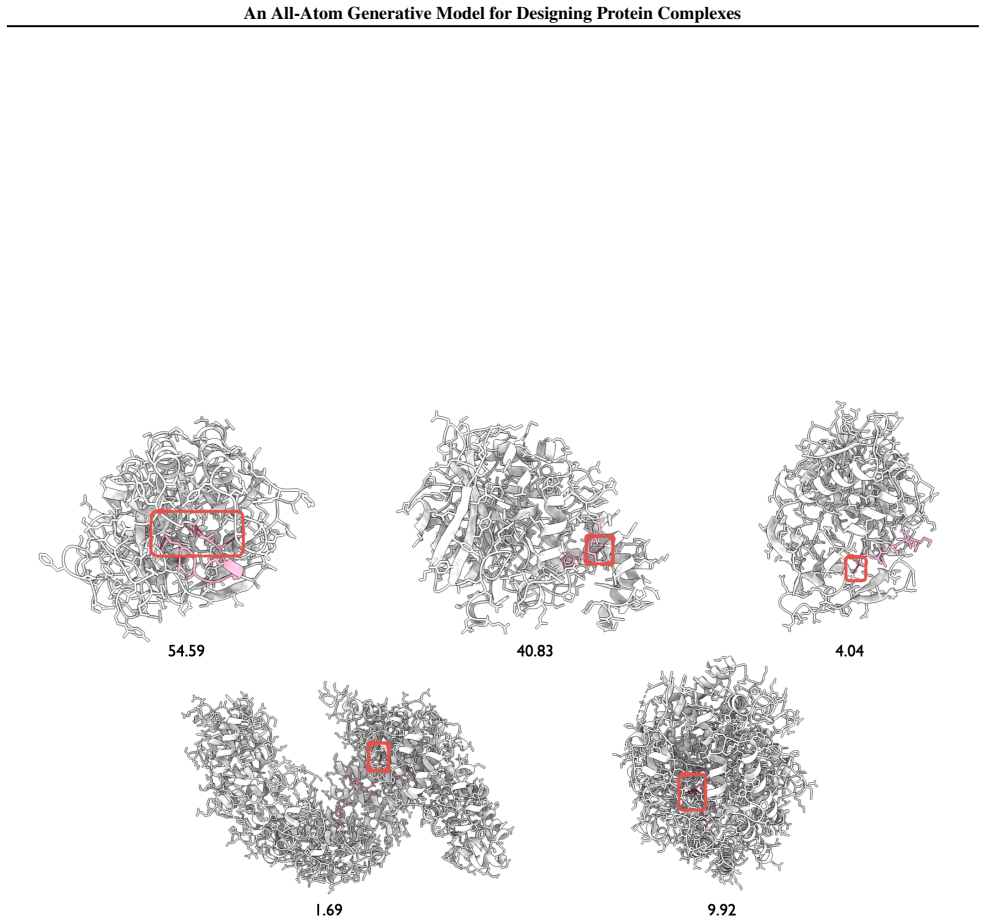
- Complex generation with two chains of length 100-100 yields computed binding energies roughly double those of the Chroma-plus-ProteinMPNN pipeline, indicating the all-atom co-generation path is competitive at directly producing tightly bound interfaces.
- Multi-chain inverse folding works: APM's 61.26% amino acid recovery on the multi-chain test set exceeds the single-chain-oriented ProteinMPNN baseline, so sequences of existing complexes can be redesigned while preserving structure.
- Supervised fine-tuning turns the general model into a specialist: antibody CDR-H3 co-design and peptide design both improve, while zero-shot sampling still produces low computed binding energies, making the same checkpoint usable in both modes.
- Longer binder design against targets such as IL-7RA, PD-1, and TNF-α is reachable zero-shot, with computed binding energies comparable to the RFdiffusion baseline across six of seven targets.
Reading between the lines
- If the Rosetta proxy survives wet-lab testing, the natural next step is to measure the correlation between ΔG rankings and experimental affinities; a positive correlation would make the model's energies usable as a screening prior for binder leads.
- The three-module split suggests a general recipe for discrete-continuous co-generation: keep the sidechain as a one-step conditional predictor rather than a noised channel, and let refinement feed all-atom information back into the backbone. The same pattern could transfer to other joint design problems, though the paper does not claim this.
- The chain-by-chain sampling mode produces weaker interfaces and visible clashes, which suggests that simultaneous generation is important for interface complementarity; the paper reports this behavior but does not elevate it to a design principle.
- Zero-shot antibody designs with low binding energy but unnatural CDR-H3 shapes imply that the model's binding prior is generic rather than antibody-specific, and that targeted fine-tuning changes the binding mode rather than merely improving affinity.
Signed reviews
Editorial analysis
A structured set of objections, weighed in public.
Referee Report
Summary. The paper presents APM, an all-atom generative model for multi-chain protein complexes. The model is composed of three modules: a sequence/backbone flow-matching module, a sidechain prediction module, and a refinement module, trained in two phases with a mixture of single-chain and multi-chain protein data and ESM2 embeddings. The authors report benchmarks on single-chain folding and inverse-folding, multi-chain folding and inverse-folding, unconditional multi-chain complex generation, antibody CDR-H3 co-design on the RAbD benchmark, peptide design on PepBench/LNR, and zero-shot binder design against several targets. The headline claim is that APM designs protein complexes with binding capabilities from scratch, supported mainly by pyRosetta binding-energy calculations and by Boltz-1 confidence and DockQ metrics.
Significance. APM addresses a timely gap in multi-chain all-atom protein generation. If the reported results are reliable, the model is a useful contribution: it natively supports multi-chain generation without pseudo-linkers, integrates sidechain torsion angles for inter-chain modeling, and achieves competitive or superior scores on standard antibody and peptide benchmarks. The authors release code, and the two-phase training scheme with a consistency loss and a refine module is clearly described. However, the paper's strongest claim, that APM designs complexes 'with binding capabilities from scratch,' is only supported by computational proxies (Rosetta ΔG, pLDDT/ipTM), which the authors themselves note require wet-lab validation; the headline should be scaled back accordingly.
major comments (4)
- [§4.3.2, Table 4; §F] The central claim of the abstract ('designing protein complexes with binding capabilities from scratch') is supported only by pyRosetta relaxation and ΔG calculations in Table 4 and by pLDDT/ipTM confidence scores in Section F. The authors explicitly concede in Section F that 'the actual effectiveness still requires validation through wet lab experiments.' No ITC, SPR, co-purification, or other affinity measurement is reported. As written, the headline claim is load-bearing and stronger than the evidence: the results establish that APM generates complexes with favorable Rosetta energies under the chosen relaxation protocol, not that it designs binders. I recommend either adding experimental validation or qualifying the abstract and Section 4.3.2 claims as computational binding-affinity predictions.
- [§4.4.2, Table 5] The claim that APM's peptide designs show 'significantly outperforming other methods' on functionality is not supported by Table 5. In that table, RFDiffusion achieves a better mean ΔG (-23.27 vs -19.90 for APMSFT) and a higher fraction of favorable complexes (%<0 = 78.58 vs 69.34). RFDiffusion also has higher pLDDT (69.65 vs 60.36), ipTM (0.73 vs 0.66), and Success (46.28% vs 29.22%). APM's advantage is limited to DockQ and the high-quality DockQ fraction. The text should be revised to report these performance gaps accurately and to describe APM as competitive on functionality and foldability rather than superior.
- [§4.3.2, Table 4] The comparison for binding energies uses only three fixed length combinations (50-100, 100-100, 100-200), and the reported averages and medians are presented without variance, confidence intervals, or statistical tests. Because the difficulty of achieving favorable Rosetta energies depends strongly on chain lengths and composition, a near-constant length regime cannot establish a general claim of superior inter-chain modeling. I ask for seed-level variability, analogous to Table 7 in Appendix D.2, and, if feasible, a benchmark on a broader set of native complex geometries with matched chain-length distributions.
- [§4.3.2, APMBB ablation] The sentence 'this proves the importance of the all-atom information in the inter-chain interactions modeling' is too strong for the reported ablation. APMBB differs from full APM not only in the absence of all-atom information in the backbone generation path, but also in the absence of the SidechainModule and RefineModule entirely, including their sequence-level corrections. The observed energy gap could be due to the refinement module or to differences in the sampling schedule rather than to the sidechain torsions per se. A cleaner ablation would feed the same Seq&BBModule predictions through the Sidechain/Refine modules with and without the torsion features, or otherwise isolate the information channel.
minor comments (5)
- [Table 4] The APM entry for 100-100 ΔGRAA reads '-130.31-134.57' and should be '-130.31/-134.57'; this formatting issue appears in at least one other table row.
- [Table 3, §4.3.1] The text should state more explicitly that the multi-chain folding comparison favors APM only against Boltz-1 without MSA; the gap to Boltz-1 with MSA (RMSD 12.6 vs 5.40, TM 0.64 vs 0.87) is large and deserves a clearer caveat in the main discussion.
- [§A.3] The word 'resdiue' should be 'residue'.
- [§3.3.1, Eq. (19)] The consistency loss in Eq. (19) uses tS and tT before the notation for the decoupled noising times is formally defined; a brief definition would improve readability.
- [§3.4, Eq. (24)] The sequence sampling temperature schedule in Eq. (24) uses hyperparameters Tmax and λ whose numerical values appear only in Appendix D.1; stating them in the main text would aid reproducibility.
Circularity Check
No significant circularity: APM's headline results are measured with external instruments and benchmarks, and the paper's training objectives do not contain the evaluation metrics.
full rationale
APM's derivation chain is self-contained. The training objectives are flow-matching reconstruction of sequence and backbone (Lflow-matching), sidechain packing and reconstruction (LPacking), and a refinement correction loss (Lcorr) against PDB ground-truth structures; none of these losses includes pyRosetta ΔG, Boltz-1 confidence, DockQ, or the RAbD/PepBench metrics. The headline binding-capability results in Table 4 are computed by pyRosetta after relaxation for both APM and the Chroma baselines under the same length combinations, and no equation in the paper makes the reported ΔG a fitted parameter of APM or a term in its training loss. The RAbD, PepBench/LNR, and binder-design evaluations likewise rely on external benchmarks and predictors (SAbDab/RAbD, Boltz-1, DockQ, pyRosetta), and the SFT protocols are not shown to optimize the evaluation metrics. Several citations are to the authors' own prior work (ProteinBench, AbDPO, DPLM), but these supply evaluation protocols, baselines, and related-work context rather than the validity of APM's generative mechanism; they are not load-bearing in the sense of making a prediction equal to its input. The only notable caveat is Section F's explicit concession that 'the actual effectiveness still requires validation through wet lab experiments,' which is an external-validity limitation on the binding-capability claim, not a circular derivation. No step was found where a result is defined in terms of itself or where a fitted value is renamed as a prediction.
Assumptions & free parameters
free parameters (7)
- Sidechain/Refine activation threshold T =
0.8
- Consistency loss weight =
0.3
- Refine auxiliary loss weights =
0.25 each
- Inference rotation schedule constant c =
10
- Sequence sampling temperature parameters =
T_max=30, lambda=30
- Data filtering thresholds =
pLDDT >85 (Swiss-Prot), pLDDT >95 (AFDB)
- Folding/inverse-folding task probability =
50%
assumptions (5)
- domain assumption Sidechain conformation can be fully represented by amino acid type plus up to four torsion angles; this suffices for modeling inter-chain interactions.
- domain assumption The uniform SO(3) prior and geodesic interpolation define a valid flow-matching path; the exponential inference schedule with c=10 is compatible despite a linear training schedule.
- domain assumption Single-chain ESM2-650M representations, aggregated per chain, generalize to multi-chain complex modeling.
- domain assumption The multi-chain test set of 273 proteins (samples missing cluster IDs) is representative for multi-chain folding and inverse-folding evaluation.
- domain assumption Rosetta relax ΔG is a meaningful proxy for binding affinity in evaluating generated complexes.
Cite this review
Pith. "Pith review of An All-Atom Generative Model for Designing Protein Complexes." pith.science (2026). https://pith.science/paper/4XLIQK7F
@misc{pith2026250413075,
  author       = {Pith},
  title        = {Pith review of: An All-Atom Generative Model for Designing Protein Complexes},
  year         = {2026},
  howpublished = {\url{https://pith.science/paper/4XLIQK7F}},
  note         = {Machine review of arXiv:2504.13075}
}
read the original abstract
Proteins typically exist in complexes, interacting with other proteins or biomolecules to perform their specific biological roles. Research on single-chain protein modeling has been extensively and deeply explored, with advancements seen in models like the series of ESM and AlphaFold2. Despite these developments, the study and modeling of multi-chain proteins remain largely uncharted, though they are vital for understanding biological functions. Recognizing the importance of these interactions, we introduce APM (All-Atom Protein Generative Model), a model specifically designed for modeling multi-chain proteins. By integrating atom-level information and leveraging data on multi-chain proteins, APM is capable of precisely modeling inter-chain interactions and designing protein complexes with binding capabilities from scratch. It also performs folding and inverse-folding tasks for multi-chain proteins. Moreover, APM demonstrates versatility in downstream applications: it achieves enhanced performance through supervised fine-tuning (SFT) while also supporting zero-shot sampling in certain tasks, achieving state-of-the-art results. We released our code at https://github.com/bytedance/apm.
Figures


Figures from the paper (10 more)




Reference graph
Works this paper leans on
-
[1]
write newline
" write newline "" before.all 'output.state := FUNCTION n.dashify 't := "" t empty not t #1 #1 substring "-" = t #1 #2 substring "--" = not "--" * t #2 global.max substring 't := t #1 #1 substring "-" = "-" * t #2 global.max substring 't := while if t #1 #1 substring * t #2 global.max substring 't := if while FUNCTION format.date year duplicate empty "emp...
-
[2]
J., Bambrick, J., et al
Abramson, J., Adler, J., Dunger, J., Evans, R., Green, T., Pritzel, A., Ronneberger, O., Willmore, L., Ballard, A. J., Bambrick, J., et al. Accurate structure prediction of biomolecular interactions with alphafold 3. Nature, 2024
2024
-
[3]
D., Hu, X., Adachi, Y., Schief, W
Adolf-Bryfogle, J., Kalyuzhniy, O., Kubitz, M., Weitzner, B. D., Hu, X., Adachi, Y., Schief, W. R., and Dunbrack Jr, R. L. Rosettaantibodydesign (rabd): A general framework for computational antibody design. PLoS computational biology, 2018
2018
-
[4]
X., Fusi, N., Amini, A
Alamdari, S., Thakkar, N., van den Berg, R., Tenenholtz, N., Strome, B., Moses, A., Lu, A. X., Fusi, N., Amini, A. P., and Yang, K. K. Protein generation with evolutionary diffusion: sequence is all you need. BioRxiv, 2023
2023
-
[5]
F., Leaver-Fay, A., Jeliazkov, J
Alford, R. F., Leaver-Fay, A., Jeliazkov, J. R., O’Meara, M. J., DiMaio, F. P., Park, H., Shapovalov, M. V., Renfrew, P. D., Mulligan, V. K., Kappel, K., et al. The rosetta all-atom energy function for macromolecular modeling and design. Journal of chemical theory and computation, 2017
2017
-
[6]
R., Wang, J., Cong, Q., Kinch, L
Baek, M., DiMaio, F., Anishchenko, I., Dauparas, J., Ovchinnikov, S., Lee, G. R., Wang, J., Cong, Q., Kinch, L. N., Schaeffer, R. D., et al. Accurate prediction of protein structures and interactions using a three-track neural network. Science, 2021
2021
-
[7]
and Wallner, B
Basu, S. and Wallner, B. Dockq: a quality measure for protein-protein docking models. PloS one, 2016
2016
-
[8]
R., Watson, J
Bennett, N. R., Watson, J. L., Ragotte, R. J., Borst, A. J., See, D. L., Weidle, C., Biswas, R., Yu, Y., Shrock, E. L., Ault, R., et al. Atomically accurate de novo design of antibodies with rfdiffusion. bioRxiv, pp.\ 2024--03, 2025
2024
Show all 88 references
-
[9]
M., Westbrook, J., Feng, Z., Gilliland, G., Bhat, T
Berman, H. M., Westbrook, J., Feng, Z., Gilliland, G., Bhat, T. N., Weissig, H., Shindyalov, I. N., and Bourne, P. E. The protein data bank. Nucleic acids research, 2000
2000
-
[10]
J., Michoud, K., O'Donovan, C., Phan, I., et al
Boeckmann, B., Bairoch, A., Apweiler, R., Blatter, M.-C., Estreicher, A., Gasteiger, E., Martin, M. J., Michoud, K., O'Donovan, C., Phan, I., et al. The swiss-prot protein knowledgebase and its supplement trembl in 2003. Nucleic acids research, 2003
2003
-
[11]
C., Korablyov, M., Bronstein, M
Bose, J., Akhound-Sadegh, T., Huguet, G., FATRAS, K., Rector-Brooks, J., Liu, C.-H., Nica, A. C., Korablyov, M., Bronstein, M. M., and Tong, A. Se (3)-stochastic flow matching for protein backbone generation. In The Twelfth International Conference on Learning Representations, 2023
2023
-
[12]
Generative flows on discrete state-spaces: Enabling multimodal flows with applications to protein co-design
Campbell, A., Yim, J., Barzilay, R., Rainforth, T., and Jaakkola, T. Generative flows on discrete state-spaces: Enabling multimodal flows with applications to protein co-design. In ICML, 2024
2024
-
[13]
Chaudhury, S., Lyskov, S., and Gray, J. J. Pyrosetta: a script-based interface for implementing molecular modeling algorithms using rosetta. Bioinformatics, 2010
2010
-
[14]
Chen, R. T. Q. and Lipman, Y. Flow matching on general geometries. In ICLR, 2024
2024
-
[15]
E., Kim, J., Cheng, L., El Nesr, G., Xu, M., Shuai, R
Chu, A. E., Kim, J., Cheng, L., El Nesr, G., Xu, M., Shuai, R. W., and Huang, P.-S. An all-atom protein generative model. Proceedings of the National Academy of Sciences, 2024 a
2024
-
[16]
E., Kim, J., Cheng, L., El Nesr, G., Xu, M., Shuai, R
Chu, A. E., Kim, J., Cheng, L., El Nesr, G., Xu, M., Shuai, R. W., and Huang, P.-S. An all-atom protein generative model. Proceedings of the National Academy of Sciences, 2024 b
2024
-
[17]
Y., Ermon, S., Rudra, A., and R \'e , C
Dao, T., Fu, D. Y., Ermon, S., Rudra, A., and R \'e , C. Flash A ttention: Fast and memory-efficient exact attention with IO -awareness. In Advances in Neural Information Processing Systems (NeurIPS), 2022
2022
-
[18]
J., Milles, L
Dauparas, J., Anishchenko, I., Bennett, N., Bai, H., Ragotte, R. J., Milles, L. F., Wicky, B. I., Courbet, A., de Haas, R. J., Bethel, N., et al. Robust deep learning--based protein sequence design using proteinmpnn. Science, 2022
2022
-
[19]
Dunbar, J., Krawczyk, K., Leem, J., Baker, T., Fuchs, A., Georges, G., Shi, J., and Deane, C. M. Sabdab: the structural antibody database. Nucleic acids research, 2014
2014
-
[20]
D., McGibbon, R
Eastman, P., Swails, J., Chodera, J. D., McGibbon, R. T., Zhao, Y., Beauchamp, K. A., Wang, L.-P., Simmonett, A. C., Harrigan, M. P., Stern, C. D., et al. Openmm 7: Rapid development of high performance algorithms for molecular dynamics. PLoS computational biology, 13 0 (7): 0...
2017
-
[21]
and Huber, R
Engh, R. and Huber, R. Structure quality and target parameters. 2006
2006
-
[22]
Protein complex prediction with alphafold-multimer
Evans, R., O’Neill, M., Pritzel, A., Antropova, N., Senior, A., Green, T., Z \' dek, A., Bates, R., Blackwell, S., Yim, J., et al. Protein complex prediction with alphafold-multimer. biorxiv, 2021
2021
-
[23]
Fred Zhangzhi Peng, P. C. and contributors. Faesm: An efficient pytorch implementation of evolutionary scale modeling (esm). https://github.com/pengzhangzhi/faesm, 2024. Efficient PyTorch implementation of ESM with FlashAttention and Scalar Dot-Product Attention (SDPA)
2024
-
[24]
Pre-training antibody language models for antigen-specific computational antibody design
Gao, K., Wu, L., Zhu, J., Peng, T., Xia, Y., He, L., Xie, S., Qin, T., Liu, H., He, K., et al. Pre-training antibody language models for antigen-specific computational antibody design. In KDD, 2023
2023
-
[25]
Alphafold2 models indicate that protein sequence determines both structure and dynamics
Guo, H.-B., Perminov, A., Bekele, S., Kedziora, G., Farajollahi, S., Varaljay, V., Hinkle, K., Molinero, V., Meister, K., Hung, C., et al. Alphafold2 models indicate that protein sequence determines both structure and dynamics. Scientific reports, 12 0 (1): 0 10696, 2022
2022
-
[26]
J., Oktay, D., Lin, Z., Verkuil, R., Tran, V
Hayes, T., Rao, R., Akin, H., Sofroniew, N. J., Oktay, D., Lin, Z., Verkuil, R., Tran, V. Q., Deaton, J., Wiggert, M., et al. Simulating 500 million years of evolution with a language model. Science, 2025
2025
-
[27]
and Henikoff, J
Henikoff, S. and Henikoff, J. G. Amino acid substitution matrices from protein blocks. Proceedings of the National Academy of Sciences, 89 0 (22): 0 10915--10919, 1992
1992
-
[28]
Elucidating the design space of multimodal protein language models
Hsieh, C.-Y., Wang, X., Zhang, D., Xue, D., Ye, F., Huang, S., Zheng, Z., and Gu, Q. Elucidating the design space of multimodal protein language models. arXiv preprint arXiv:2504.11454, 2025. URL https://arxiv.org/abs/2504.11454
2025 arXiv
-
[29]
Learning inverse folding from millions of predicted structures
Hsu, C., Verkuil, R., Liu, J., Lin, Z., Hie, B., Sercu, T., Lerer, A., and Rives, A. Learning inverse folding from millions of predicted structures. ICML, 2022
2022
-
[30]
Sequence-augmented se (3)-flow matching for conditional protein backbone generation
Huguet, G., Vuckovic, J., Fatras, K., Thibodeau-Laufer, E., Lemos, P., Islam, R., Liu, C.-H., Rector-Brooks, J., Akhound-Sadegh, T., Bronstein, M., et al. Sequence-augmented se (3)-flow matching for conditional protein backbone generation. Advances in neural information proces...
2024
-
[31]
B., Baranov, M., Costello, Z., Barber, K
Ingraham, J. B., Baranov, M., Costello, Z., Barber, K. W., Wang, W., Ismail, A., Frappier, V., Lord, D. M., Ng-Thow-Hing, C., Van Vlack, E. R., Tie, S., Xue, V., Cowles, S. C., Leung, A., Rodrigues, J. a. V., Morales-Perez, C. L., Ayoub, A. M., Green, R., Puentes, K., Oplinger...
2023 doi
-
[32]
Antibody-antigen docking and design via hierarchical structure refinement
Jin, W., Barzilay, D., and Jaakkola, T. Antibody-antigen docking and design via hierarchical structure refinement. In ICML, 2022
2022
-
[33]
Highly accurate protein structure prediction with alphafold
Jumper, J., Evans, R., Pritzel, A., Green, T., Figurnov, M., Ronneberger, O., Tunyasuvunakool, K., Bates, R., Z \' dek, A., Potapenko, A., et al. Highly accurate protein structure prediction with alphafold. nature, 2021
2021
-
[34]
Conditional antibody design as 3d equivariant graph translation
Kong, X., Huang, W., and Liu, Y. Conditional antibody design as 3d equivariant graph translation. In ICLR, 2023 a
2023
-
[35]
End-to-end full-atom antibody design
Kong, X., Huang, W., and Liu, Y. End-to-end full-atom antibody design. In ICML, 2023 b
2023
-
[36]
Full-atom peptide design with geometric latent diffusion
Kong, X., Jia, Y., Huang, W., and Liu, Y. Full-atom peptide design with geometric latent diffusion. In NeurIPS, 2024
2024
-
[37]
R., Morey-Burrows, F
Krishna, R., Wang, J., Ahern, W., Sturmfels, P., Venkatesh, P., Kalvet, I., Lee, G. R., Morey-Burrows, F. S., Anishchenko, I., Humphreys, I. R., et al. Generalized biomolecular modeling and design with rosettafold all-atom. Science, 2024
2024
-
[38]
Imgt unique numbering for immunoglobulin and t cell receptor variable domains and ig superfamily v-like domains
Lefranc, M.-P., Pommi \'e , C., Ruiz, M., Giudicelli, V., Foulquier, E., Truong, L., Thouvenin-Contet, V., and Lefranc, G. Imgt unique numbering for immunoglobulin and t cell receptor variable domains and ig superfamily v-like domains. Developmental & Comparative Immunology, 2003
2003
-
[39]
L., Nelson, D
Lehninger, A. L., Nelson, D. L., and Cox, M. M. Lehninger principles of biochemistry. Macmillan, 2005
2005
-
[40]
Full-atom peptide design based on multi-modal flow matching
Li, J., Cheng, C., Wu, Z., Guo, R., Luo, S., Ren, Z., Peng, J., and Ma, J. Full-atom peptide design based on multi-modal flow matching. In ICML, 2024
2024
-
[41]
Lin, H., Zhang, O., Zhao, H., Jiang, D., Wu, L., Liu, Z., Huang, Y., and Li, S. Z. Ppflow: Target-aware peptide design with torsional flow matching. In ICML, 2024
2024
-
[42]
Evolutionary-scale prediction of atomic-level protein structure with a language model
Lin, Z., Akin, H., Rao, R., Hie, B., Zhu, Z., Lu, W., Smetanin, N., Verkuil, R., Kabeli, O., Shmueli, Y., et al. Evolutionary-scale prediction of atomic-level protein structure with a language model. Science, 2023
2023
-
[43]
T., Ben-Hamu, H., Nickel, M., and Le, M
Lipman, Y., Chen, R. T., Ben-Hamu, H., Nickel, M., and Le, M. Flow matching for generative modeling. In ICLR, 2023
2023
-
[44]
L., Gershon, J
Lisanza, S. L., Gershon, J. M., Tipps, S. W., Sims, J. N., Arnoldt, L., Hendel, S. J., Simma, M. K., Liu, G., Yase, M., Wu, H., et al. Multistate and functional protein design using rosettafold sequence space diffusion. Nature biotechnology, 2024
2024
-
[45]
Antigen-specific antibody design and optimization with diffusion-based generative models for protein structures
Luo, S., Su, Y., Peng, X., Wang, S., Peng, J., and Ma, J. Antigen-specific antibody design and optimization with diffusion-based generative models for protein structures. NeurIPS, 2022
2022
-
[46]
S., Anand, N., Eguchi, R
Madani, A., McCann, B., Naik, N., Keskar, N. S., Anand, N., Eguchi, R. R., Huang, P.-S., and Socher, R. Progen: Language modeling for protein generation. arXiv preprint arXiv:2004.03497, 2020
2004 arXiv
-
[47]
lddt: a local superposition-free score for comparing protein structures and models using distance difference tests
Mariani, V., Biasini, M., Barbato, A., and Schwede, T. lddt: a local superposition-free score for comparing protein structures and models using distance difference tests. Bioinformatics, 2013
2013
-
[48]
Abdiffuser: full-atom generation of in-vitro functioning antibodies
Martinkus, K., Ludwiczak, J., Liang, W.-C., Lafrance-Vanasse, J., Hotzel, I., Rajpal, A., Wu, Y., Cho, K., Bonneau, R., Gligorijevic, V., et al. Abdiffuser: full-atom generation of in-vitro functioning antibodies. NeurIPS, 2024
2024
-
[49]
and Xu, J
McPartlon, M. and Xu, J. An end-to-end deep learning method for protein side-chain packing and inverse folding. Proceedings of the National Academy of Sciences, 120 0 (23): 0 e2216438120, 2023
2023
-
[50]
C., Goddard, T
Meng, E. C., Goddard, T. D., Pettersen, E. F., Couch, G. S., Pearson, Z. J., Morris, J. H., and Ferrin, T. E. Ucsf chimerax: Tools for structure building and analysis. Protein Science, 2023
2023
-
[51]
and Wallner, B
Mirabello, C. and Wallner, B. Dockq v2: Improved automatic quality measure for protein multimers, nucleic acids, and small molecules. Bioinformatics, 2024
2024
-
[52]
A., Weinstein, E
Nijkamp, E., Ruffolo, J. A., Weinstein, E. N., Naik, N., and Madani, A. Progen2: exploring the boundaries of protein language models. Cell systems, 14 0 (11): 0 968--978, 2023
2023
-
[53]
Machine learning for functional protein design
Notin, P., Rollins, N., Gal, Y., Sander, C., and Marks, D. Machine learning for functional protein design. Nature biotechnology, 2024
2024
-
[54]
P (all-atom) is unlocking new path for protein design
Qu, W., Guan, J., Ma, R., Zhai, K., Wu, W., and Wang, H. P (all-atom) is unlocking new path for protein design. bioRxiv, 2024
2024
-
[55]
D., Ermon, S., and Finn, C
Rafailov, R., Sharma, A., Mitchell, E., Manning, C. D., Ermon, S., and Finn, C. Direct preference optimization: Your language model is secretly a reward model. Advances in Neural Information Processing Systems, 36: 0 53728--53741, 2023
2023
-
[56]
L., Ma, J., and Fergus, R
Rives, A., Meier, J., Sercu, T., Goyal, S., Lin, Z., Liu, J., Guo, D., Ott, M., Zitnick, C. L., Ma, J., and Fergus, R. Biological structure and function emerge from scaling unsupervised learning to 250 million protein sequences. PNAS, 2019. doi:10.1101/622803. URL https://www....
2019 doi
-
[57]
W., Prli \'c , A., Altunkaya, A., Bi, C., Bradley, A
Rose, P. W., Prli \'c , A., Altunkaya, A., Bi, C., Bradley, A. R., Christie, C. H., Costanzo, L. D., Duarte, J. M., Dutta, S., Feng, Z., et al. The rcsb protein data bank: integrative view of protein, gene and 3d structural information. Nucleic acids research, 2016
2016
-
[58]
K., Koča, J., and Rose, A
Sehnal, D., Bittrich, S., Deshpande, M., Svobodová, R., Berka, K., Bazgier, V., Velankar, S., Burley, S. K., Koča, J., and Rose, A. S. Mol* Viewer: modern web app for 3D visualization and analysis of large biomolecular structures . Nucleic Acids Research, 49 0 (W1): 0 W431--W4...
2021 doi
-
[59]
W., Evans, R., Jumper, J., Kirkpatrick, J., Sifre, L., Green, T., Qin, C., Z \' dek, A., Nelson, A
Senior, A. W., Evans, R., Jumper, J., Kirkpatrick, J., Sifre, L., Green, T., Qin, C., Z \' dek, A., Nelson, A. W., Bridgland, A., et al. Improved protein structure prediction using potentials from deep learning. Nature, 577 0 (7792): 0 706--710, 2020
2020
-
[60]
Protein sequence and structure co-design with equivariant translation
Shi, C., Wang, C., Lu, J., Zhong, B., and Tang, J. Protein sequence and structure co-design with equivariant translation. In ICLR, 2023
2023
-
[61]
and Dhariwal, P
Song, Y. and Dhariwal, P. Improved techniques for training consistency models. In ICLR, 2024
2024
-
[62]
Generative enzyme design guided by functionally important sites and small-molecule substrates
Song, Z., Zhao, Y., Shi, W., Jin, W., Yang, Y., and Li, L. Generative enzyme design guided by functionally important sites and small-molecule substrates. arXiv preprint arXiv:2405.08205, 2024
2024
-
[63]
and S \"o ding, J
Steinegger, M. and S \"o ding, J. Mmseqs2 enables sensitive protein sequence searching for the analysis of massive data sets. Nature biotechnology, 2017
2017
-
[64]
Saprot: Protein language modeling with structure-aware vocabulary
Su, J., Han, C., Zhou, Y., Shan, J., Zhou, X., and Yuan, F. Saprot: Protein language modeling with structure-aware vocabulary. In ICLR, 2024 a
2024
-
[65]
Saprothub: Making protein modeling accessible to all biologists
Su, J., Li, Z., Han, C., Zhou, Y., He, Y., Shan, J., Zhou, X., Chang, X., Jiang, S., Ma, D., et al. Saprothub: Making protein modeling accessible to all biologists. bioRxiv, 2024 b
2024
-
[66]
Protrek: Navigating the protein universe through tri-modal contrastive learning
Su, J., Zhou, X., Zhang, X., and Yuan, F. Protrek: Navigating the protein universe through tri-modal contrastive learning. bioRxiv, 2024 c
2024
-
[67]
L., Yim, J., Tischer, D., Baker, D., Broderick, T., Barzilay, R., and Jaakkola, T
Trippe, B. L., Yim, J., Tischer, D., Baker, D., Broderick, T., Barzilay, R., and Jaakkola, T. Diffusion probabilistic modeling of protein backbones in 3d for the motif-scaffolding problem. arXiv preprint arXiv:2206.04119, 2022
2022 arXiv
-
[68]
K., Avraham, O., Ben-Aharon, Z., Khramushin, A., and Schueler-Furman, O
Tsaban, T., Varga, J. K., Avraham, O., Ben-Aharon, Z., Khramushin, A., and Schueler-Furman, O. Harnessing protein folding neural networks for peptide--protein docking. Nature communications, 2022
2022
-
[69]
Alphafold protein structure database: massively expanding the structural coverage of protein-sequence space with high-accuracy models
Varadi, M., Anyango, S., Deshpande, M., Nair, S., Natassia, C., Yordanova, G., Yuan, D., Stroe, O., Wood, G., Laydon, A., et al. Alphafold protein structure database: massively expanding the structural coverage of protein-sequence space with high-accuracy models. Nucleic acids...
2022
-
[70]
Diffusion model alignment using direct preference optimization
Wallace, B., Dang, M., Rafailov, R., Zhou, L., Lou, A., Purushwalkam, S., Ermon, S., Xiong, C., Joty, S., and Naik, N. Diffusion model alignment using direct preference optimization. In Proceedings of the IEEE/CVF Conference on Computer Vision and Pattern Recognition, pp.\ 822...
2024
-
[71]
Diffusion language models are versatile protein learners
Wang, X., Zheng, Z., Ye, F., Xue, D., Huang, S., and Gu, Q. Diffusion language models are versatile protein learners. In ICML, 2024 a
2024
-
[72]
Dplm-2: A multimodal diffusion protein language model
Wang, X., Zheng, Z., Ye, F., Xue, D., Huang, S., and Gu, Q. Dplm-2: A multimodal diffusion protein language model. arXiv preprint arXiv:2410.13782, 2024 b
2024 arXiv
-
[73]
L., Juergens, D., Bennett, N
Watson, J. L., Juergens, D., Bennett, N. R., Trippe, B. L., Yim, J., Eisenach, H. E., Ahern, W., Borst, A. J., Ragotte, R. J., Milles, L. F., et al. De novo design of protein structure and function with rfdiffusion. Nature, 620 0 (7976): 0 1089--1100, 2023
2023
-
[74]
Boltz-1: Democratizing biomolecular interaction modeling
Wohlwend, J., Corso, G., Passaro, S., Reveiz, M., Leidal, K., Swiderski, W., Portnoi, T., Chinn, I., Silterra, J., Jaakkola, T., and Barzilay, R. Boltz-1: Democratizing biomolecular interaction modeling. bioRxiv, 2024
2024
-
[75]
and Li, S
Wu, F. and Li, S. Z. A hierarchical training paradigm for antibody structure-sequence co-design. NeurIPS, 2024
2024
-
[76]
and Zhang, Y
Xu, J. and Zhang, Y. How significant is a protein structure similarity with tm-score= 0.5? Bioinformatics, 2010
2010
-
[77]
Proteinbench: A holistic evaluation of protein foundation models
Ye, F., Zheng, Z., Xue, D., Shen, Y., Wang, L., Ma, Y., Wang, Y., Wang, X., Zhou, X., and Gu, Q. Proteinbench: A holistic evaluation of protein foundation models. arXiv preprint arXiv:2409.06744, 2024
2024 arXiv
-
[79]
Y., Gastegger, M., Jim \'e nez-Luna, J., Lewis, S., Satorras, V
Yim, J., Campbell, A., Foong, A. Y., Gastegger, M., Jim \'e nez-Luna, J., Lewis, S., Satorras, V. G., Veeling, B. S., Barzilay, R., Jaakkola, T., et al. Fast protein backbone generation with se (3) flow matching. arXiv preprint arXiv:2310.05297, 2023 b
-
[80]
Yim, J., Campbell, A., Mathieu, E., Foong, A. Y. K., Gastegger, M., Jimenez-Luna, J., Lewis, S., Satorras, V. G., Veeling, B. S., Noe, F., Barzilay, R., and Jaakkola, T. Improved motif-scaffolding with SE (3) flow matching. Transactions on Machine Learning Research, 2024. ISSN...
2024
-
[81]
E., Patani, H., Danson, A
Zambaldi, V., La, D., Chu, A. E., Patani, H., Danson, A. E., Kwan, T. O., Frerix, T., Schneider, R. G., Saxton, D., Thillaisundaram, A., et al. De novo design of high-affinity protein binders with alphaproteo. arXiv preprint arXiv:2409.08022, 2024
2024 arXiv
-
[82]
and Skolnick, J
Zhang, Y. and Skolnick, J. Scoring function for automated assessment of protein structure template quality. Proteins: Structure, Function, and Bioinformatics, 2004
2004
-
[83]
and Skolnick, J
Zhang, Y. and Skolnick, J. Tm-align: a protein structure alignment algorithm based on the tm-score. Nucleic acids research, 2005
2005
-
[84]
Diffpack: A torsional diffusion model for autoregressive protein side-chain packing
Zhang, Y., Zhang, Z., Zhong, B., Misra, S., and Tang, J. Diffpack: A torsional diffusion model for autoregressive protein side-chain packing. NeurIPS, 2024
2024
-
[85]
Structure-informed language models are protein designers
Zheng, Z., Deng, Y., Xue, D., Zhou, Y., Ye, F., and Gu, Q. Structure-informed language models are protein designers. In ICML, 2023
2023
-
[86]
Antigen-specific antibody design via direct energy-based preference optimization
Zhou, X., Xue, D., Chen, R., Zheng, Z., Wang, L., and Gu, Q. Antigen-specific antibody design via direct energy-based preference optimization. In NeurIPS, 2024
2024
-
[87]
Designing cyclic peptides via harmonic sde with atom-bond modeling
Zhou, X., Li, M., Xiao, Y., Li, J., Xue, D., Zheng, Z., Ma, J., and Gu, Q. Designing cyclic peptides via harmonic sde with atom-bond modeling. In International Conference on Machine Learning, 2025
2025
-
[88]
Antibody design using a score-based diffusion model guided by evolutionary, physical and geometric constraints
Zhu, T., Ren, M., and Zhang, H. Antibody design using a score-based diffusion model guided by evolutionary, physical and geometric constraints. In ICML, 2024
2024
-
[89]
Linker-tuning: Optimizing continuous prompts for heterodimeric protein prediction
Zou, S., Li, H., Mo, S., Cheng, X., Xing, E., and Song, L. Linker-tuning: Optimizing continuous prompts for heterodimeric protein prediction. arXiv preprint arXiv:2312.01186, 2023
2023 arXiv
Reviewed August 16, 2026 · model on record in the stance chip above.
Discussion (0). Continue with ORCID to comment.