REVIEW 3 major objections 5 minor 50 references
Safety Monitoring for Learning-Enabled Cyber-Physical Systems in Out-of-Distribution Scenarios
T0 review · 3 major / 5 minor · reviewed 2026-08-16 · deepseek-v4-flash
Pith's one-line read The paper claims that safety can be monitored directly—by predicting how well future trajectories satisfy a temporal-logic specification—with a long-run probabilistic guarantee that survives arbitrary out-of-distribution shifts.
desk verdict A well-engineered empirical paper whose central theorem does not apply to the implemented algorithm: Algorithm 2 evaluates the ACP threshold in-sample, so the safety guarantee is unproven as written. read the letter →
The pith
A machine-rendered reading of the paper's core claim, the machinery that carries it, and where it could break.
The reading
What carries the argument
The load-bearing object is the online threshold $C_t$ computed by adaptive conformal prediction from a growing set of non-conformity scores $R_t = \hat{\rho}_{t-H} - \rho_{t-H}$, the time-lagged residual between the robustness predicted $H$ steps earlier and the actual robustness now observed (Algorithm 2, lines 9–16). $C_t$ is the $\lceil t(1-\delta_t)\rceil$-th smallest element of the residual set, with the significance level updated as $\delta_{t+1} = \delta_t + \gamma(\delta - e_t)$, so the threshold tracks a shifting data distribution without any exchangeability assumption. Around this sits a trajectory predictor selected from a distribution-predictor set maintained by incremental learning: when a residual exceeds a threshold $\tau$, the history–horizon pair is saved, K-means clustering forms new distribution prototypes, and new predictors are fine-tuned and appended; at runtime the predictor associated with the most likely distribution is used. The STL robustness value $\rho_{\varphi}(s,t) = \min_{t' \in [t,t+H]} \min_i d((s_{t',0}, s_{t',1}), (x_i^o, y_i^o)) - c$ converts a temporal safety specification into a real number whose sign determines satisfaction, and it is this value that the monitor predicts.
What would settle it
Run Algorithm 2 with its in-sample calibration on a long synthetic non-stationary sequence with known ground-truth robustness, and check whether the empirical frequency of $\hat{\rho}_t - \rho_t \le C_t$ stays above $1 - \delta - p_1(T)$ for large $T$ at the claimed rate; if it falls below the bound while a variant that computes $C_t$ from residuals excluding the current one stays inside, the self-inclusive update is the cause and Lemma 1 fails. A simpler check is to instrument the code to record, at each step $t$, whether the residual $R_t$ appended at line 11 is included in the residual set used to compute $C_t$ at line 14, and to test whether coverage is unchanged when that residual is withheld.
Extended reading notes
Core claim
The paper's central discovery is that safety violations can be predicted from predicted future trajectories with a distribution-free long-run coverage guarantee. Concretely, Theorem 1 states: if the adaptive conformal threshold $C_t$ is chosen as in Algorithm 2 and the predicted STL robustness satisfies $\hat{\rho}_t > C_t$ for every $t \in [t_0, T]$, then the long-run average probability that the system satisfies the safety specification $\varphi$ is at least $1 - \delta - p_1$, where $p_1 = (\delta+\gamma)/(T\gamma) \to 0$. The mechanism is adaptive conformal prediction on the residuals between predicted and actual robustness over an $H$-step horizon, using a time-lagged non-conformity score so the monitor only relies on states already observed. Empirically, the paper shows that among point prediction, conformal prediction, robust conformal prediction, and adaptive conformal prediction, only adaptive conformal prediction keeps empirical coverage inside its theoretical envelope in their out-of-distribution scenarios, and that adding incremental learning recovers recall, timeliness, and part of the lost precision; for example, in the F1Tenth case with five missing LIDAR rays, recall rises from $0.56$ with adaptive conformal prediction alone to $0.94$ with adaptive conformal prediction plus incremental learning.
Load-bearing premise
Every guarantee rests on one premise: the online calibration loop in the monitoring algorithm is a valid instance of the adaptive conformal prediction method it cites, even though the same data point is used both to update the threshold and to test against it; if that premise fails, the coverage lemma and the safety theorem do not follow.
Editorial extensions
If this is right
- Safety monitors can keep a formal long-run guarantee under arbitrary, possibly adversarial distribution shift, because adaptive conformal prediction needs neither exchangeability nor a bounded shift; in the paper's settings, conformal prediction and robust conformal prediction have empirical coverage below the target and their validity assumptions are violated.
- Monitoring safety directly means out-of-distribution detection is not a prerequisite for assurance: a controller can generalize to novel inputs without violating the specification, and a well-calibrated monitor can stay silent when the specification actually holds.
- Incremental learning converts the extra conservatism of adaptive conformal prediction into precision: adding it raises recall and timeliness in the out-of-distribution cases where adaptive conformal prediction alone dips, while recovering some lost precision in most settings.
- The guarantee is a long-run average, so the monitor is calibrated over time rather than per alarm; safety architectures that require per-step or per-episode bounds would need to add another layer of assurance.
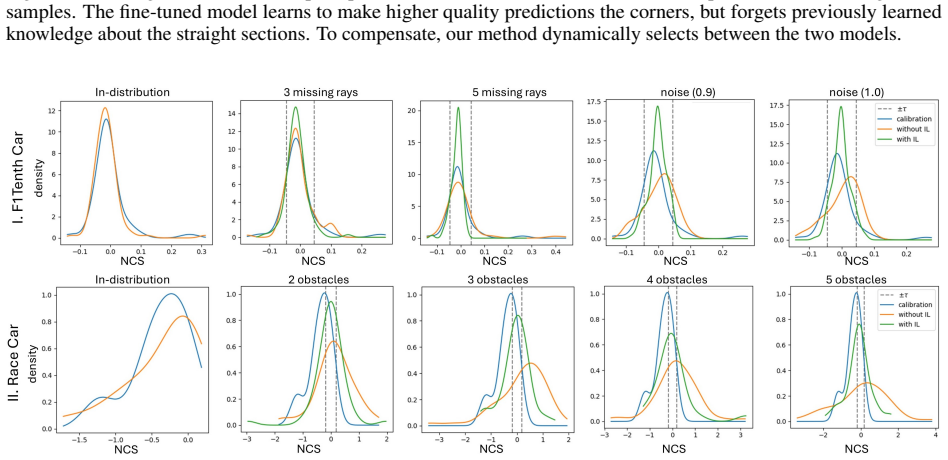
- Conformal and robust conformal prediction, applied to STL robustness residuals, are not viable substitutes in these scenarios because the estimated total variation distance between calibration and online non-conformity scores exceeds any permissible $ε$.
Reading between the lines
- A minimal repair to the in-sample calibration concern would be to lag the threshold: compute $C_t$ from residuals up to time $t-1$ and evaluate $R_t$ against that threshold; the paper does not do this, and it would cost one time step of responsiveness.
- The same adaptive-conformal-prediction-on-robustness machinery should transfer to any STL formula, such as goal-reaching or until patterns, because only the robustness computation changes; testing on until-formulas would directly exercise the generality of the claim.
- If the guarantee is confirmed, out-of-distribution detection and safety monitoring should be evaluated jointly: methods that raise alarms only on out-of-distribution inputs will be systematically over-conservative exactly where this monitor stays precise, so benchmarks built on out-of-distribution-only metrics will mis-rank approaches.
- The bound $p_1 = (\delta+\gamma)/(T\gamma)$ is weak for short deployments, so the practical safe regime is long-horizon monitoring; short-horizon deployments may still need hybrid per-run certification.
Signed reviews
Editorial analysis
A structured set of objections, weighed in public.
Referee Report
Summary. The paper proposes a safety-monitoring framework for learning-enabled cyber-physical systems (LE-CPS) in out-of-distribution (OOD) settings. Rather than detecting OOD inputs, the monitor predicts violations of a signal temporal logic (STL) safety specification from predicted future states, and raises an alarm when the predicted robustness is below an adaptive conformal prediction (ACP) threshold. The authors combine ACP with an incremental learning (IL) scheme that fine-tunes and dynamically selects from a set of trajectory predictors in order to reduce the conservatism introduced by ACP. The central theoretical claim is Theorem 1: if the ACP threshold C_t is always below the predicted robustness, then the average probability that the system satisfies the STL specification is at least 1-delta-p1, with p1 tending to zero, under no assumptions on the data distribution. The empirical evaluation uses two driving case studies (an F1Tenth car with static obstacles and a race car with dynamic obstacles), comparing ACP+IL against point prediction, conformal prediction, robust conformal prediction, and ACP alone on recall, timeliness, and precision, with 10 trials for each setting.
Significance. If the theoretical guarantee were established, this would be a valuable contribution: it directly monitors safety rather than OOD presence, and it claims distribution-free, long-run probabilistic guarantees under arbitrary, non-stationary shifts, which is stronger than prior conformal and robust-conformal runtime-verification works. The empirical study is careful in several respects: it reports 10 trials with means and standard deviations, includes ablations, provides an honest appendix on the thin-tailed NCS limitation, and ships a repeatability package with code and Docker instructions. The paper also demonstrates a genuine limitation of robust conformal prediction (RCP) by estimating total-variation distances that exceed the permissible epsilon, which is informative. However, the validity of the headline Theorem 1 depends on a lemma whose proof is a citation to a related but not identical setting, and the implementation in Algorithm 2 does not clearly match the adaptive conformal update used in the cited result. The IL gains, while plausible, are evaluated with hyperparameters tuned on the same OOD sets used for testing, which limits the strength of the empirical comparison.
major comments (3)
- [Section 6.1, Lemma 1, and Problem 2] The ACP update is not the standard Gibbs-Candes update for the algorithm as written. Line 11 appends the current time-lagged residual R_t to the NCS set R, and line 14 computes C_t as a quantile of the updated set. Line 15 then evaluates e_t = 1{R_t > C_t} against this in-sample quantile. In adaptive conformal prediction, the threshold used to evaluate the current score must be constructed before the current score is observed and added to the calibration set; otherwise e_t is a rank check within a set that already contains R_t and does not indicate out-of-sample miscoverage. Lemma 1's proof merely cites Corollary 3 of Dixit et al. [3] without demonstrating that the growing, self-inclusive calibration set of Algorithm 2 satisfies that corollary's conditions. Because Lemma 1 is the foundation of Theorem 1, the paper's central safety guarantee is not established for the implemented algorithm. The empirical coverage check in Figure 4 uses the same implementation and therefore cannot independently validate the theorem.
- [Section 6.1, Lemma 1] Lemma 1 converts the Gibbs-Candes bound on the empirical frequency of e_t into a bound on average probabilities 1/T sum Prob(rho_hat_t - rho_t <= C_t). Proposition 1 (cited from Gibbs and Candes) is an almost-sure statement about the Cesaro average of the binary indicators e_t; it does not, by itself, imply the stated bound on the average of the marginal probabilities under a non-stationary, non-ergodic data-generating process. This is a separate, unproven step in the proof of Lemma 1. The authors should either restate Lemma 1 (and hence Theorem 1) as an empirical-frequency guarantee, or supply a rigorous argument (e.g., a martingale or exchangeability argument) that justifies the probability interpretation. As written, the problem formulation in Problem 2 and the conclusion in Theorem 1 are not directly supported by the cited result.
- [Section 7, Experiments] The empirical comparison for the IL component appears to be tuned on the evaluation data. Section 7.4 reports that for each OOD setting the fine-tuning learning rate, number of epochs, loss weighting beta, and the IL cluster-selection hyperparameters are selected using the same OOD scenarios whose recall, timeliness, and precision are then reported in Tables 1-3. This circularity can inflate the ACP+IL results relative to a deployment scenario in which the IL data would be collected online from the current OOD distribution and the hyperparameters would have to be chosen before evaluation. The claim that ACP+IL "outperforms alternatives" in OOD settings should be qualified, or the evaluation should use a protocol that does not tune on the test OOD set, such as a separate validation split or a fixed hyperparameter rule.
minor comments (5)
- [Section 2] There is a typo: "The observation spaces is a continuous four-dimensional vector" should be "The observation space is a continuous four-dimensional vector."
- [Algorithm 2, line 14] The expression for C_t is not clearly specified. The notation "Ceil(t)(1-delta_t)th smallest Ri in R" is ambiguous: it should state the exact quantile definition and how ties and boundary indices are handled when the effective calibration size changes over time.
- [Section 6.1, Lemma 1] The constants p1 and p2 are printed as "p1 = delta + gamma / T gamma" and "p2 = (1-delta) + gamma / T gamma", which is mathematically ambiguous. Presumably they mean (delta + gamma)/(T gamma) and ((1-delta) + gamma)/(T gamma); please fix the notation.
- [Section 7.4] The hyperparameter search for the IL cluster-selection threshold is mentioned but not specified. Please provide the search range, the objective used, and the selected values per case study, or state that this is a limitation.
- [Figure 1b] The caption does not explain the very small magnitude of the log-likelihood values or the scale of the y-axis; the text notes this is a normalization artifact, but the figure would benefit from a note in the caption as well.
Circularity Check
The theoretical guarantees are imported from external ACP results rather than self-citation, but the IL evaluation is transductive (trained on the OOD test data it is scored on) and the ACP validation in Figure 4 uses a self-referential in-sample error definition; no load-bearing self-citation chain found.
-
fitted input called prediction
[Section 6.2 / Algorithm 1; Section 7.4; Tables 1-3]
"With W as the set of high-error prediction trajectories collected at runtime, we now describe our IL approach on W . ... Train a predictor p_i on {w∈W :w∼D_i}. ... For collecting high-error traces for fine-tuning during incremental learning, we select error threshold τ as the 80% and 50% quantile of in-distribution errors for the F1Tenth Car and Race Car case studies, respectively."
Only in-distribution trajectories are split into train/validation/test (65/15/20); the OOD settings are described as collected samples with no held-out OOD split. W is gathered from those same OOD trajectories at inference time, and Algorithm 1 trains new predictors on W. The ACP+IL rows in Tables 1-3 are then reported on these same OOD settings. The method is thus fitted to residuals from the exact trajectories on which it is scored, so the reported recall/timeliness/precision gains are partly transductive fits to the evaluation distribution rather than predictions for unseen OOD data, and the baselines are not given this adaptation.
-
self definitional
[Algorithm 2, lines 11-16; Lemma 1 proof; Figure 4]
"Append R_t to the NCS set R ... C_t =⌈(t)(1−δ_t)⌉th smallest R_i∈R ... e_t = 0 if R_t≤C_t, 1 o.t.w. ... δ_{t+1} =δ_t +γ(δ−e_t). ... The proof follows from Corollary 3 of Dixit et al. [3] ... the error (1−e_t) on one-step ahead robustness-value prediction is captured by ˆρφ_t−ρφ_t ≤C_t."
Because R_t is inserted into the NCS set before C_t is computed (line 11 before line 14), C_t is the quantile of a set containing the very score that e_t then checks. The ACP update at line 16 is a deterministic feedback law that drives the long-run frequency of e_t=0 to 1−δ regardless of the data-generating process; Proposition 1 applies to any binary e_t sequence. Hence the bound of Lemma 1, as implemented and as plotted in Figure 4, is a consequence of how C_t and e_t are defined, not an external guarantee about the future robustness error ˆρφ_t−ρφ_t.
full rationale
The paper's theoretical spine is not a self-citation loop: the ACP frequency bound is quoted from Gibbs and Candes [7], and Lemma 1 is attributed to Corollary 3 of Dixit et al. [3], both external; Theorem 1 is a direct corollary. I find no load-bearing self-citation, no imported uniqueness theorem, and no renaming of a known result. The main circularity concerns are partial. First, the empirical IL comparison is transductive: the OOD evaluation trajectories are also the source of the high-error set W used to train new predictors (Algorithms 1-2), and no OOD train/test split is reported, so the ACP+IL rows in Tables 1-3 partly measure fitting to the test distribution rather than generalization, while the baselines are not given this adaptation. Second, the ACP coverage event as implemented is self-referential: R_t is appended before C_t is computed, e_t is defined against that same C_t, and the update law forces the frequency of e_t=0 toward 1−δ for any data, making the Figure 4 'confirmation' of Lemma 1 tautological for the in-sample event. Separately, but not counted as circularity, the Lemma 1 proof has a correctness gap: the update compares R_t to C_t rather than to the threshold C_{t−H} actually used for that prediction, so the stated bound for the future error is not established. Overall, the central theorem still has independent external content, so this is partial circularity (score 4), not a derivation equivalent to its inputs.
Assumptions & free parameters
free parameters (5)
- ACP learning rate gamma =
0.005
- Error threshold tau for IL data collection =
80% quantile (F1Tenth), 50% quantile (Race Car) of in-distribution errors
- K-means cluster count and cluster-selection threshold =
Elbow method plus hyperparameter search
- Fine-tuning loss weight beta and fine-tuning learning rate/epochs =
beta in {0.2, 1.0}; lr in {5e-4, 5e-5, 1e-5}; epochs 2000-4000 or 80
- Start time t0 for ACP updates =
15 steps
assumptions (5)
- standard math Adaptive conformal prediction yields long-run miscoverage frequency delta without distribution assumptions (Gibbs and Candes 2021).
- standard math Corollary 3 of Dixit et al. [3] applies to the robustness-value prediction errors and the time-lagged NCS used in this paper.
- domain assumption The monitor has error-free knowledge of the environment map, system states, and obstacles.
- domain assumption The trajectory predictor's output can be used to compute STL robustness, and the system dynamics need not be known.
- ad hoc to paper Algorithm 2's growing, self-inclusive NCS set R satisfies the conditions of the ACP guarantee.
Cite this review
Pith. "Pith review of Safety Monitoring for Learning-Enabled Cyber-Physical Systems in Out-of-Distribution Scenarios." pith.science (2026). https://pith.science/paper/DQNTQG2X
@misc{pith2026250413478,
  author       = {Pith},
  title        = {Pith review of: Safety Monitoring for Learning-Enabled Cyber-Physical Systems in Out-of-Distribution Scenarios},
  year         = {2026},
  howpublished = {\url{https://pith.science/paper/DQNTQG2X}},
  note         = {Machine review of arXiv:2504.13478}
}
read the original abstract
The safety of learning-enabled cyber-physical systems is compromised by the well-known vulnerabilities of deep neural networks to out-of-distribution (OOD) inputs. Existing literature has sought to monitor the safety of such systems by detecting OOD data. However, such approaches have limited utility, as the presence of an OOD input does not necessarily imply the violation of a desired safety property. We instead propose to directly monitor safety in a manner that is itself robust to OOD data. To this end, we predict violations of signal temporal logic safety specifications based on predicted future trajectories. Our safety monitor additionally uses a novel combination of adaptive conformal prediction and incremental learning. The former obtains probabilistic prediction guarantees even on OOD data, and the latter prevents overly conservative predictions. We evaluate the efficacy of the proposed approach in two case studies on safety monitoring: 1) predicting collisions of an F1Tenth car with static obstacles, and 2) predicting collisions of a race car with multiple dynamic obstacles. We find that adaptive conformal prediction obtains theoretical guarantees where other uncertainty quantification methods fail to do so. Additionally, combining adaptive conformal prediction and incremental learning for safety monitoring achieves high recall and timeliness while reducing loss in precision. We achieve these results even in OOD settings and outperform alternative methods.
Figures


Figures from the paper (4 more)


Reference graph
Works this paper leans on
-
[3]
Adaptive conformal prediction for motion planning among dynamic agents
Anushri Dixit, Lars Lindemann, Skylar X Wei, Matthew Cleaveland, George J Pappas, and Joel W Burdick. Adaptive conformal prediction for motion planning among dynamic agents. InLearning for Dynamics and Control Conference, pages 300–314. PMLR, 2023
2023
-
[1]
Faruk Ahmed and Aaron Courville. Detecting semantic anomalies. In Proceedings of the AAAI Conference on Artificial Intelligence, volume 34, pages 3154–3162, 2020
work page 2020
-
[2]
Real-time out-of-distribution detection in learning-enabled cyber-physical systems
Feiyang Cai and Xenofon Koutsoukos. Real-time out-of-distribution detection in learning-enabled cyber-physical systems. In 2020 ACM/IEEE 11th International Conference on Cyber-Physical Systems (ICCPS), pages 174–183. IEEE, 2020
work page 2020
-
[4]
Robust satisfaction of temporal logic over real-valued signals
Alexandre Donzé and Oded Maler. Robust satisfaction of temporal logic over real-valued signals. In International Conference on Formal Modeling and Analysis of Timed Systems, pages 92–106. Springer, 2010
work page 2010
-
[5]
Compositional falsification of cyber-physical systems with machine learning components
Tommaso Dreossi, Alexandre Donzé, and Sanjit A Seshia. Compositional falsification of cyber-physical systems with machine learning components. Journal of Automated Reasoning, 63:1031–1053, 2019
work page 2019
-
[6]
Yeli Feng, Daniel Jun Xian Ng, and Arvind Easwaran. Improving variational autoencoder based out-of-distribution detection for embedded real-time applications. ACM Transactions on Embedded Computing Systems (TECS), 20 (5s):1–26, 2021
work page 2021
-
[7]
Adaptive conformal inference under distribution shift
Isaac Gibbs and Emmanuel Candes. Adaptive conformal inference under distribution shift. Advances in Neural Information Processing Systems, 34:1660–1672, 2021
2021
-
[8]
Incremental learning in online scenario
Jiangpeng He, Runyu Mao, Zeman Shao, and Fengqing Zhu. Incremental learning in online scenario. In Proceedings of the IEEE/CVF conference on computer vision and pattern recognition, pages 13926–13935, 2020
work page 2020
Show all 50 references
-
[9]
Benchmarking neural network robustness to common corruptions and perturbations
Dan Hendrycks and Thomas Dietterich. Benchmarking neural network robustness to common corruptions and perturbations. arXiv preprint arXiv:1903.12261, 2019
1903 arXiv
-
[10]
A baseline for detecting misclassified and out-of-distribution examples in neural networks
Dan Hendrycks and Kevin Gimpel. A baseline for detecting misclassified and out-of-distribution examples in neural networks. arXiv preprint arXiv:1610.02136, 2016
2016 arXiv
-
[11]
Using self-supervised learning can improve model robustness and uncertainty
Dan Hendrycks, Mantas Mazeika, Saurav Kadavath, and Dawn Song. Using self-supervised learning can improve model robustness and uncertainty. In Advances in Neural Information Processing Systems, pages 15663–15674, 2019
2019
-
[12]
Case study: verifying the safety of an autonomous racing car with a neural network controller
Radoslav Ivanov, Taylor J Carpenter, James Weimer, Rajeev Alur, George J Pappas, and Insup Lee. Case study: verifying the safety of an autonomous racing car with a neural network controller. In Proceedings of the 23rd International Conference on Hybrid Systems: Computation and...
2020
-
[13]
Real-time detectors for digital and physical adversarial inputs to perception systems
Yiannis Kantaros, Taylor Carpenter, Kaustubh Sridhar, Yahan Yang, Insup Lee, and James Weimer. Real-time detectors for digital and physical adversarial inputs to perception systems. In Proceedings of the ACM/IEEE 12th International Conference on Cyber-Physical Systems, pages 6...
2021
-
[14]
Detecting oods as datapoints with high uncertainty
Ramneet Kaur, Susmit Jha, Anirban Roy, Sangdon Park, Oleg Sokolsky, and Insup Lee. Detecting oods as datapoints with high uncertainty. arXiv preprint arXiv:2108.06380, 2021
2021 arXiv
-
[15]
iDECODe: In-distribution Equivariance for Conformal Out-of-distribution Detection, Association for the Ad- vancement of Artificial Intelligence, 2022
Ramneet Kaur, Susmit Jha, Anirban Roy, Sangdon Park, Edgar Dobriban, Oleg Sokolsky, and Insup Lee. iDECODe: In-distribution Equivariance for Conformal Out-of-distribution Detection, Association for the Ad- vancement of Artificial Intelligence, 2022
2022
-
[16]
Using semantic information for defining and detecting ood inputs
Ramneet Kaur, Xiayan Ji, Souradeep Dutta, Michele Caprio, Yahan Yang, Elena Bernardis, Oleg Sokolsky, and Insup Lee. Using semantic information for defining and detecting ood inputs. arXiv preprint arXiv:2302.11019, 2023
2023 arXiv
-
[17]
Detection of adversarial physical attacks in time-series image data
Ramneet Kaur, Yiannis Kantaros, Wenwen Si, James Weimer, and Insup Lee. Detection of adversarial physical attacks in time-series image data. arXiv preprint arXiv:2304.13919, 2023. 14 Safety Monitoring for Learning-Enabled Cyber-Physical Systems in Out-of-Distribution Scenarios
2023 arXiv
-
[18]
CODiT: Conformal Out-of-Distribution Detection in Time-Series Data
Ramneet Kaur, Kaustubh Sridhar, Sangdon Park, Yahan Yang, Susmit Jha, Anirban Roy, Oleg Sokolsky, and Insup Lee. CODiT: Conformal Out-of-Distribution Detection in Time-Series Data. In Proceedings of the ACM/IEEE 14th International Conference on Cyber-Physical Systems (with CPS...
2023
-
[19]
Out-of-distribution detection in dependent data for cyber-physical systems with conformal guarantees
Ramneet Kaur, Yahan Yang, Oleg Sokolsky, and Insup Lee. Out-of-distribution detection in dependent data for cyber-physical systems with conformal guarantees. ACM Transactions on Cyber-Physical Systems, 2024
2024
-
[20]
Playing fps games with deep reinforcement learning
Guillaume Lample and Devendra Singh Chaplot. Playing fps games with deep reinforcement learning. In Proceedings of the AAAI Conference on Artificial Intelligence, volume 31, 2017
2017
-
[21]
An environment for autonomous driving decision-making
Edouard Leurent. An environment for autonomous driving decision-making. https://github.com/eleurent/ highway-env, 2018
2018
-
[22]
Conformal prediction for stl runtime verification
Lars Lindemann, Xin Qin, Jyotirmoy V Deshmukh, and George J Pappas. Conformal prediction for stl runtime verification. In Proceedings of the ACM/IEEE 14th International Conference on Cyber-Physical Systems (with CPS-IoT Week 2023), pages 142–153, 2023
2023
-
[23]
M, Vikas Khullar, Amol A Bhosle, Mangesh D
Veeramanickam M.R. M, Vikas Khullar, Amol A Bhosle, Mangesh D. Salunke, Jyoti L. Bangare, and Aniket Ingavale. Streamed incremental learning for cyber attack classification using machine learning. In 2022 2nd International Conference on Innovative Sustainable Computational Tec...
2022
-
[24]
Entropic out-of- distribution detection
David Macêdo, Tsang Ing Ren, Cleber Zanchettin, Adriano LI Oliveira, and Teresa Ludermir. Entropic out-of- distribution detection. In 2021 International Joint Conference on Neural Networks (IJCNN), pages 1–8. IEEE, 2021
2021
-
[25]
Monitoring temporal properties of continuous signals
Oded Maler and Dejan Nickovic. Monitoring temporal properties of continuous signals. In International symposium on formal techniques in real-time and fault-tolerant systems, pages 152–166. Springer, 2004
2004
-
[26]
Catastrophic interference in connectionist networks: The sequential learning problem
Michael McCloskey and Neal J Cohen. Catastrophic interference in connectionist networks: The sequential learning problem. In Psychology of learning and motivation, volume 24, pages 109–165. Elsevier, 1989
1989
-
[27]
Benchmark for out-of-distribution detection in deep reinforcement learning
Aaqib Parvez Mohammed and Matias Valdenegro-Toro. Benchmark for out-of-distribution detection in deep reinforcement learning. arXiv preprint arXiv:2112.02694, 2021
2021 arXiv
-
[28]
Inductive confidence machines for regression
Harris Papadopoulos, Kostas Proedrou, V olodya V ovk, and Alex Gammerman. Inductive confidence machines for regression. In Machine learning: ECML 2002: 13th European conference on machine learning Helsinki, Finland, August 19–23, 2002 proceedings 13, pages 345–356. Springer, 2002
2002
-
[29]
An ensemble-based incremental learning approach to data fusion.IEEE Transactions on Systems, Man, and Cybernetics, Part B (Cybernetics) , 37(2):437–450, 2007
Devi Parikh and Robi Polikar. An ensemble-based incremental learning approach to data fusion.IEEE Transactions on Systems, Man, and Cybernetics, Part B (Cybernetics) , 37(2):437–450, 2007. doi: 10.1109/TSMCB.2006. 883873
2007 doi
-
[30]
Efficient out-of-distribution detection using latent space of β-vae for cyber-physical systems
Shreyas Ramakrishna, Zahra Rahiminasab, Gabor Karsai, Arvind Easwaran, and Abhishek Dubey. Efficient out-of-distribution detection using latent space of β-vae for cyber-physical systems. ACM Transactions on Cyber-Physical Systems (TCPS), 6(2):1–34, 2022
2022
-
[31]
icarl: Incremental classifier and representation learning
Sylvestre-Alvise Rebuffi, Alexander Kolesnikov, Georg Sperl, and Christoph H Lampert. icarl: Incremental classifier and representation learning. In Proceedings of the IEEE conference on Computer Vision and Pattern Recognition, pages 2001–2010, 2017
2001
-
[32]
Do imagenet classifiers generalize to imagenet? In International conference on machine learning, pages 5389–5400
Benjamin Recht, Rebecca Roelofs, Ludwig Schmidt, and Vaishaal Shankar. Do imagenet classifiers generalize to imagenet? In International conference on machine learning, pages 5389–5400. PMLR, 2019
2019
-
[33]
Unsupervised and incremental learning orchestration for cyber-physical security
Lúcio Henrik A Reis, Andres Murillo Piedrahita, Sandra Rueda, Natália C Fernandes, Dianne SV Medeiros, Marcelo Dias de Amorim, and Diogo MF Mattos. Unsupervised and incremental learning orchestration for cyber-physical security. Transactions on emerging telecommunications tech...
2020
-
[34]
Transduction with confidence and credibility
Craig Saunders, Alex Gammerman, and V olodya V ovk. Transduction with confidence and credibility. 1999
1999
-
[35]
Tesla is putting ’self-driving’ in the hands of drivers amid criticism the tech is not ready.The Washing- ton Post
Faiz Siddiqui. Tesla is putting ’self-driving’ in the hands of drivers amid criticism the tech is not ready.The Washing- ton Post. URL https://www.washingtonpost.com/technology/2020/10/21/tesla-self-driving/
2020
-
[36]
Towards alternative techniques for improving adversarial robustness: Anaflysis of adversarial training at a spectrum of perturbations
Kaustubh Sridhar, Souradeep Dutta, Ramneet Kaur, James Weimer, Oleg Sokolsky, and Insup Lee. Towards alternative techniques for improving adversarial robustness: Anaflysis of adversarial training at a spectrum of perturbations. arXiv preprint arXiv:2206.06496, 2022
2022 arXiv
-
[37]
Out- of-distribution detection in multi-label datasets using latent space ofβ-vae
Vijaya Kumar Sundar, Shreyas Ramakrishna, Zahra Rahiminasab, Arvind Easwaran, and Abhishek Dubey. Out- of-distribution detection in multi-label datasets using latent space ofβ-vae. In 2020 IEEE Security and Privacy Workshops (SPW), pages 250–255. IEEE, 2020
2020
-
[38]
Csi: Novelty detection via contrastive learning on distributionally shifted instances
Jihoon Tack, Sangwoo Mo, Jongheon Jeong, and Jinwoo Shin. Csi: Novelty detection via contrastive learning on distributionally shifted instances. Advances in Neural Information Processing Systems, 33, 2020. 15 Safety Monitoring for Learning-Enabled Cyber-Physical Systems in Out...
2020
-
[39]
Waymo’s robot taxis are almost mainstream
Eli Tan. Waymo’s robot taxis are almost mainstream. can they now turn a profit? The New York Times. URL https://www.nytimes.com/2024/09/04/technology/waymo-expansion-alphabet.html
2024
-
[40]
Galactica: A large language model for science
Ross Taylor, Marcin Kardas, Guillem Cucurull, Thomas Scialom, Anthony Hartshorn, Elvis Saravia, Andrew Poulton, Viktor Kerkez, and Robert Stojnic. Galactica: A large language model for science. arXiv preprint arXiv:2211.09085, 2022
2022 arXiv
-
[41]
Safety envelope for security
Ashish Tiwari, Bruno Dutertre, Dejan Jovanovi´c, Thomas de Candia, Patrick D Lincoln, John Rushby, Dorsa Sadigh, and Sanjit Seshia. Safety envelope for security. In Proceedings of the 3rd international conference on High confidence networked systems, pages 85–94, 2014
2014
-
[42]
Taming false positives in out-of-distribution detection with human feedback
Harit Vishwakarma, Heguang Lin, and Ramya Korlakai Vinayak. Taming false positives in out-of-distribution detection with human feedback. arXiv preprint arXiv:2404.16954, 2024
2024 arXiv
-
[43]
Machine-learning applications of algorithmic randomness
V olodya V ovk, Alexander Gammerman, and Craig Saunders. Machine-learning applications of algorithmic randomness. 1999
1999
-
[44]
Error-driven incremental learning in deep convolutional neural network for large-scale image classification
Tianjun Xiao, Jiaxing Zhang, Kuiyuan Yang, Yuxin Peng, and Zheng Zhang. Error-driven incremental learning in deep convolutional neural network for large-scale image classification. In Proceedings of the 22nd ACM International Conference on Multimedia, MM ’14, page 177–186, New...
2014
-
[45]
Interpretable detection of distribution shifts in learning enabled cyber-physical systems
Yahan Yang, Ramneet Kaur, Souradeep Dutta, and Insup Lee. Interpretable detection of distribution shifts in learning enabled cyber-physical systems. In 2022 ACM/IEEE 13th International Conference on Cyber-Physical Systems (ICCPS), pages 225–235. IEEE, 2022
2022
-
[46]
Incremental learning with memory regressors for motion prediction in autonomous racing
Yahan Yang, Souradeep Dutta, Kuk Jin Jang, Oleg Sokolsky, and Insup Lee. Incremental learning with memory regressors for motion prediction in autonomous racing. In Proceedings of the ACM/IEEE 14th International Conference on Cyber-Physical Systems (with CPS-IoT Week 2023), pag...
2023
-
[47]
Memory-based distribution shift detection for learning enabled cyber-physical systems with statistical guarantees.ACM Transactions on Cyber-Physical Systems, 8(2):1–28, 2024
Yahan Yang, Ramneet Kaur, Souradeep Dutta, and Insup Lee. Memory-based distribution shift detection for learning enabled cyber-physical systems with statistical guarantees.ACM Transactions on Cyber-Physical Systems, 8(2):1–28, 2024
2024
-
[48]
Agentformer: Agent-aware transformers for socio- temporal multi-agent forecasting
Ye Yuan, Xinshuo Weng, Yanglan Ou, and Kris M Kitani. Agentformer: Agent-aware transformers for socio- temporal multi-agent forecasting. In Proceedings of the IEEE/CVF International Conference on Computer Vision, pages 9813–9823, 2021
2021
-
[49]
Robust conformal prediction for stl runtime verification under distribution shift
Yiqi Zhao, Bardh Hoxha, Georgios Fainekos, Jyotirmoy V Deshmukh, and Lars Lindemann. Robust conformal prediction for stl runtime verification under distribution shift. In 2024 ACM/IEEE 15th International Conference on Cyber-Physical Systems (ICCPS), pages 169–179. IEEE, 2024
2024
-
[50]
in-distribution
Ev Zisselman and Aviv Tamar. Deep residual flow for out of distribution detection. In Proceedings of the IEEE/CVF Conference on Computer Vision and Pattern Recognition, pages 13994–14003, 2020. A Complete Results and Ablations Figure 5 reports the recall, precision, and timeli...
2020
Reviewed August 16, 2026 · model on record in the stance chip above.
Discussion (0). Continue with ORCID to comment.