REVIEW 5 major objections 7 minor 59 references
OBIFormer: A Fast Attentive Denoising Framework for Oracle Bone Inscriptions
T0 review · 5 major / 7 minor · reviewed 2026-08-16 · deepseek-v4-flash
Pith's one-line read OBIFormer fuses glyph skeleton features with channel-wise self-attention to reach state-of-the-art oracle bone inscription denoising at a fraction of prior compute.
desk verdict Solid engineering, but the evaluation protocol means the SOTA claim is not established; needs a real held-out test before it can be trusted. read the letter →
The pith
A machine-rendered reading of the paper's core claim, the machinery that carries it, and where it could break.
The reading
What carries the argument
The central object is the OBIFormer block (OFB), a residual unit combining two channel-wise self-attention blocks (CSABs), two glyph structural network blocks (GSNBs), and a selective kernel feature fusion (SKFF) module. Channel-wise self-attention computes a transposed attention map of size $C \times C$ instead of $HW \times HW$, so cost scales with channels rather than spatial resolution; GSNBs are small residual CNNs that pull out skeleton-like glyph features; SKFF, borrowed from selective kernel networks, applies split-fuse-select to learn dynamic softmax weights over reconstruction and glyph features before summing them. These pieces work together to keep the denoising backbone cheap while ensuring the restored image preserves the character's stroke structure. The training loss combines PSNR and VGG perceptual losses on both the denoised image and a reconstructed skeleton image.
What would settle it
A held-out test set of real OBI rubbings with clean ground-truth images would settle the claim: if OBIFormer's PSNR and SSIM gains over the next-best method shrink to within noise or reverse, the reported state-of-the-art result does not generalize beyond the training distribution.
Extended reading notes
Core claim
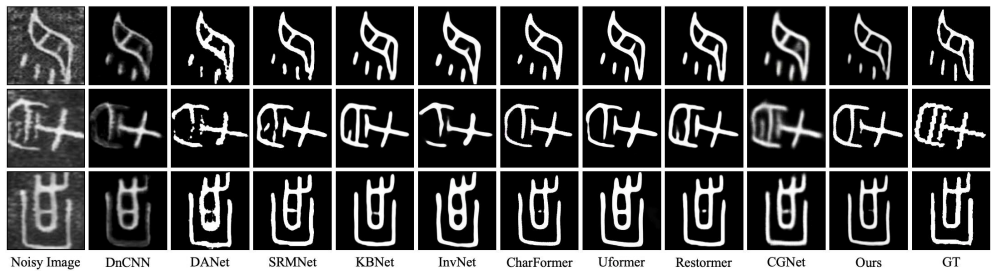
The discovery the paper argues for is that glyph information, the skeletal stroke structure of a character, can be extracted from the noisy input itself and used as a conditioning signal for denoising, and that this can be done without the quadratic cost of vanilla spatial self-attention. OBIFormer routes features through two parallel streams: residual channel-wise self-attention blocks produce reconstruction features, while glyph structural network blocks produce skeleton features; a selective kernel feature fusion module learns per-position softmax weights for the two streams and sums them. The paper claims this design reaches the best PSNR and SSIM among all compared methods on both Oracle-50K and RCRN, restores broken strokes and removes spindle-shaped noise that other methods miss, and generalizes to the unseen OBC306 rubbing dataset. It also claims the architecture is light: 8.35M parameters, 20.45 G FLOPs, and 10.35 ms inference per $256\times256$ image, roughly three times fewer parameters and 4.76 times faster than CharFormer.
Load-bearing premise
The evaluation on the RCRN dataset uses the training set for testing because the public test set is unavailable, assuming that performance on the training distribution is a valid proxy for generalization to unseen real-world character images.
Editorial extensions
If this is right
- Denoised OBI images improve downstream recognition: with OBIFormer output, ResNet-18/50/152 accuracy on Oracle-50K rises 3.65, 4.42, and 5.19 percentage points over using noisy images.
- The architecture's efficiency (8.35M parameters, 20.45 G FLOPs, 10.35 ms per image) makes it deployable on modest hardware for large rubbing collections.
- The selective kernel fusion is load-bearing: replacing SKFF by addition or concatenation drops PSNR by 1.50 and 1.23 dB on RCRN, so the dynamic feature-selection mechanism is what the gains ride on.
- Trained on only 900 RCRN pairs or on domain-adapted Oracle-50K, the model still denoises OBC306 rubbings, suggesting synthetic-to-real transfer is feasible for OBI denoising.
- The reported gap over CharFormer, the closest glyph-based transformer, implies that the combination of channel-wise attention plus kernel fusion, rather than glyph information alone, accounts for the improvement.
Reading between the lines
- A testable extension is to evaluate OBIFormer on a properly held-out split of RCRN or on OBC306 with ground-truth restoration labels; the paper's current protocol trains and tests on the same RCRN training set, so the true generalization margin is unknown.
- Because the skeleton ground truth is produced by a morphological thinning method, the glyph stream's quality is bounded by that method; pairing OBIFormer with a learned skeletonizer could yield further gains and would separate glyph-extraction error from denoising error.
- The same split-fuse-select pattern could transfer to other degraded ancient scripts, such as bronze inscriptions or Dunhuang manuscripts, where structural glyph priors are available but pixel-level noise is severe.
- The paper's own conclusion notes weak performance on bone-cracked and dense-white-region noise due to few examples; a conditional diffusion model that synthesizes a balanced noise mix is an explicit direction the authors flag, and it could be benchmarked directly against OBIFormer's failure cases.
Signed reviews
Editorial analysis
A structured set of objections, weighed in public.
Referee Report
Summary. The manuscript proposes OBIFormer, a U-shaped encoder-decoder network for denoising oracle bone inscription (OBI) images. The architecture combines channel-wise self-attention blocks (CSABs), glyph structural network blocks (GSNBs), and a selective kernel feature fusion (SKFF) module, and it is trained with a composite loss that includes PSNR and perceptual terms for both the reconstructed image and a skeleton image. The authors report state-of-the-art PSNR/SSIM results on the Oracle-50K and RCRN datasets, recognition improvements on Oracle-50K, qualitative generalization results on OBC306, and computational-efficiency comparisons. The central claim is that OBIFormer outperforms nine existing denoising methods while being faster and lighter than transformer-based alternatives. The evaluation protocol, however, uses the training set as the test set for RCRN and does not document a held-out split for Oracle-50K, which undermines the generalization claims; the recognition experiment is also potentially confounded by dataset overlap.
Significance. If the reported results were established on properly held-out data, OBIFormer would be a useful contribution to OBI denoising: the architecture is clearly described, the ablation studies isolate the effect of the SKFF module and the loss weights, and the efficiency comparison shows a favorable parameter/FLOP trade-off relative to CharFormer and Restormer. The paper also addresses a domain-relevant problem with scarce annotated real data. However, the significance is currently limited because the main comparative results do not demonstrate generalization, and the synthetic degradation protocol for Oracle-50K is not reproducible as described. The architectural ideas and the downstream recognition application are worth pursuing, but the experimental validation needs substantial revision before the claims can be accepted.
major comments (5)
- [Section 4.1, Table 2] The RCRN evaluation is conducted by training, validating, and testing on the same 900 training pairs, as stated in Section 4.1 ('we use the training set for training, validation, and testing'). The PSNR/SSIM numbers in Table 2 therefore measure how well the methods reconstruct images they were trained on, not how well they generalize to unseen images. With 8.35M parameters and only 900 pairs, OBIFormer can memorize the training pairs, so the reported 0.16 dB and 0.019 SSIM margins over the baselines are not evidence of state-of-the-art performance. The authors should re-run the comparisons on a held-out split (or use cross-validation) and report both training and validation/test results.
- [Section 4.2, Table 2] No train/validation/test split is described for the Oracle-50K denoising experiments. Section 4.2 only mentions selecting the top-100 characters and applying STSN-based domain adaptation; it does not say how many pairs are used for training and how many for evaluation, nor whether the evaluation images are disjoint from the training images. Without a clear held-out split, the 1.06 dB and 0.063 SSIM improvements on Oracle-50K in Table 2 cannot be interpreted as generalization results. The manuscript must specify the split and the exact number of training/evaluation pairs.
- [Section 4.5] The recognition experiment is confounded by potential overlap between the denoising training data and the recognition test data. OBIFormer is trained on the Oracle-50K dataset, and the recognition test set is drawn from the same dataset and further split 7:3 (Section 4.5). If the images used as recognition test data were also seen by the denoiser during training, the reported 3.65-5.19% accuracy gains may reflect memorization rather than improved generalization. The authors should clarify the exact subset used for denoising training and ensure that the recognition test images are excluded from denoising training, or re-run the experiment on a disjoint held-out set.
- [Section 4.7, Figs. 8-9] The generalization claim on the OBC306 dataset is supported only by qualitative examples. Section 4.7 shows denoising outputs but provides no quantitative metrics (e.g., PSNR/SSIM against clean references or recognition accuracy) and no comparison with baseline methods on the same images. The Introduction's assertion that OBIFormer shows 'strong generalization ability' on OBC306 is not substantiated by the presented evidence. A quantitative evaluation on a held-out subset of OBC306 is needed to support this claim.
- [Section 4.2] The synthetic degradation procedure for Oracle-50K is not reproducible as described. The text says only 'we utilize STSN to apply the domain adaptation,' without specifying the noise types, the degradation parameters, how the noisy input is generated from the clean handprint, or the number of synthetic pairs. Since Table 2's Oracle-50K results depend entirely on this procedure, the authors should provide a precise description of the synthesis pipeline, including the relationship to the four noise categories in Fig. 1 and the exact role of STSN.
minor comments (7)
- [Section 3.2, Eqs. (12)-(13)] Equations (12) and (13) are identical as written; the SKFF module should compute the softmax attention jointly over the reconstruction and glyph branches. Please correct the formulas to match the standard selective kernel formulation in Fig. 4(d).
- [Section 3.3, Eqs. (17)-(18)] The loss term L1 in Eq. (18) is defined as PSNR, which is higher-is-better, but Eq. (17) combines the terms with positive weights in a minimization objective. Please clarify the sign convention, e.g., by defining L1 as -PSNR or MSE.
- [Section 3.1, Eq. (2)] The index notation in Eq. (2) is confusing: the decoder stage index n is not defined, and 'OFB_i' with 'OFB_{2N-i+1}' is inconsistent with the description. Please rewrite the equation and surrounding text more clearly.
- [Section 3.2] In the GSNB paragraph, 'the GSNB in n-th OFB' uses an undefined variable n, and 'RSAB' appears to be a typo for 'CSAB'. Please fix these issues.
- [Table 2] The 'Raw Image' row reports an SSIM of 0.099 on Oracle-50K, which is much lower than the SSIM of the same noisy image as processed by any method. Please verify that this value is not a typo (e.g., 0.909).
- [Section 4.8, Fig. 10] The phrase 'the second two refer to the reconstructed skeleton image and its ground truth' is awkward; please use 'the next two images' for clarity.
- [Section 4.2] The sentence 'For each pair, we split it into a noisy image and a clean image' is a tautology; please rephrase to 'Each pair consists of a noisy image and a clean image.'
Circularity Check
Headline SOTA claims for RCRN are computed on the training set (explicitly admitted), and the Oracle-50K recognition validation uses a denoiser trained on the same dataset; these 'predictions' are in-sample fits, not held-out generalization.
-
fitted input called prediction
[Section 4.1 (RCRN dataset) and Section 4.4 (Table 2), with training loss in Eq. (17)]
"While the test set is not publicly available, we use the training set for training, validation, and testing, which consists of 900 noisy-clean image pairs. ... Similarly, on the RCRN dataset, OBIFormer attains 22.19 dB on PSNR and 0.969 on SSIM, outperforming all the other methods by at least 0.16 dB in PSNR and 0.019 in SSIM. ... We train the model with PSNR loss for the reconstructed OBI image I′ and perceptual loss for the reconstructed skeleton image S′."
The network is optimized with Eq. (17) on the same 900 RCRN pairs on which Table 2 reports PSNR/SSIM. The reported 'state-of-the-art' figures are therefore reconstruction scores on the training set, not predictions on unseen data. A model with 8.35M parameters can fit these exact noisy-clean pairs, so the reported margins are in-sample fits rather than demonstrated generalization. This is precisely a fitted quantity being presented as a benchmark prediction.
-
fitted input called prediction
[Section 4.5 (OBI Recognition)]
"The test set is divided into training and testing subsets in a 7:3 ratio. ... We compare the original Oracle-50K dataset with the denoising results generated by OBIFormer trained on the same dataset."
The recognition test images are a 30% subset of Oracle-50K, but the denoising model was trained on the same full Oracle-50K dataset. Thus the denoised images fed to ResNet are outputs for inputs already seen during denoiser training; the reported 3.65-5.19% accuracy gains do not establish that denoising helps on unseen oracle characters. The validation claim reduces to performance on the denoiser's training distribution.
full rationale
The architecture itself is not circular: channel-wise self-attention follows standard transposed-attention practice, GSNB/SKFF are conventional CNN components cited to external work, the skeleton ground truth comes from an external morphological thinning method [52], and the ImageNet-pretrained VGG in the perceptual loss is an independent feature extractor. There is no self-citation chain or uniqueness theorem carrying the argument. The circularity is confined to the empirical validation: the central SOTA claim on RCRN is explicitly computed on the training set (Section 4.1), and the Oracle-50K recognition experiment uses a denoiser trained on the same dataset from which the recognition test set is drawn. Those numbers are in-sample fits, not independent predictions, so the headline generalization claims are not established. The efficiency measurements and ablation comparisons on identical settings retain some independent content, which is why the score is 6 rather than higher. Note that the absence of a described held-out split for the Oracle-50K denoising table points in the same direction, although the paper does not state that split as explicitly as for RCRN.
Assumptions & free parameters
free parameters (1)
- Loss weights alpha_1..alpha_4 =
not reported
assumptions (5)
- domain assumption The four noise types (stroke-broken, bone-cracked, abnormal edges, dense white regions) adequately characterize OBI degradations.
- domain assumption STSN domain adaptation produces noisy images that are realistic enough to train a denoiser that generalizes to real rubbings.
- domain assumption PSNR and SSIM are sufficient metrics for denoising quality in this task.
- domain assumption The skeleton ground truth from the morphological method [52] is a valid supervisory signal for glyph preservation.
- ad hoc to paper Using the RCRN training set for evaluation is a valid proxy for the unavailable test set.
Cite this review
Pith. "Pith review of OBIFormer: A Fast Attentive Denoising Framework for Oracle Bone Inscriptions." pith.science (2026). https://pith.science/paper/P5RVZGRJ
@misc{pith2026250413524,
  author       = {Pith},
  title        = {Pith review of: OBIFormer: A Fast Attentive Denoising Framework for Oracle Bone Inscriptions},
  year         = {2026},
  howpublished = {\url{https://pith.science/paper/P5RVZGRJ}},
  note         = {Machine review of arXiv:2504.13524}
}
read the original abstract
Oracle bone inscriptions (OBIs) are the earliest known form of Chinese characters and serve as a valuable resource for research in anthropology and archaeology. However, most excavated fragments are severely degraded due to thousands of years of natural weathering, corrosion, and man-made destruction, making automatic OBI recognition extremely challenging. Previous methods either focus on pixel-level information or utilize vanilla transformers for glyph-based OBI denoising, which leads to tremendous computational overhead. Therefore, this paper proposes a fast attentive denoising framework for oracle bone inscriptions, i.e., OBIFormer. It leverages channel-wise self-attention, glyph extraction, and selective kernel feature fusion to reconstruct denoised images precisely while being computationally efficient. Our OBIFormer achieves state-of-the-art denoising performance for PSNR and SSIM metrics on synthetic and original OBI datasets. Furthermore, comprehensive experiments on a real oracle dataset demonstrate the great potential of our OBIFormer in assisting automatic OBI recognition. The code will be made available at https://github.com/LJHolyGround/OBIFormer.
Figures


Figures from the paper (7 more)



Reference graph
Works this paper leans on
-
[1]
Obc306:Alarge-scaleoraclebonecharacterrecognition dataset
Shuangping Huang, Haobin Wang, Yongge Liu, Xiaosong Shi, and LianwenJin. Obc306:Alarge-scaleoraclebonecharacterrecognition dataset. In2019InternationalConferenceonDocumentAnalysisand Recognition (ICDAR), pages 681–688. IEEE, 2019
work page 2019
-
[2]
Zhi-Kai Huang, Zhi-Hong Li, Han Huang, Zhi-Biao Li, and Ling- Ying Hou. Comparison of different image denoising algorithms for chinese calligraphy images.Neurocomputing, 188:102–112, 2016
work page 2016
-
[3]
ShaoTong Gu, GeFei Feng, XiaoHu Ma, and YiMing Yang. Restora- tion method of characters on jiagu rubbings based on poisson distri- bution and fractal geometry. Science China Information Sciences, 53:1296–1304, 2010
work page 2010
-
[4]
Krisda Khankasikam. Restoration of degraded historical document image: Anadaptive multilayer-informationbinarization technique.J. Inf. Sci. Eng., 30(5):1321–1338, 2014
work page 2014
-
[5]
Robust kronecker-decomposablecomponentanalysisforlow-rankmodeling
Mehdi Bahri, Yannis Panagakis, and Stefanos Zafeiriou. Robust kronecker-decomposablecomponentanalysisforlow-rankmodeling. In Proceedings of the IEEE International Conference on Computer Vision, pages 3352–3361, 2017
work page 2017
-
[6]
Robust kroneckercomponentanalysis
Mehdi Bahri, Yannis Panagakis, and Stefanos Zafeiriou. Robust kroneckercomponentanalysis. IEEEtransactionsonpatternanalysis and machine intelligence, 41(10):2365–2379, 2018
work page 2018
-
[7]
Kroneckercomponentwithrobustlow-rank dictionary for image denoising.Displays, 74:102194, 2022
LeiZhangandCongLiu. Kroneckercomponentwithrobustlow-rank dictionary for image denoising.Displays, 74:102194, 2022
work page 2022
-
[8]
Robust low-rank analysis with adaptive weighted tensor for image denoising.Displays, 73:102200, 2022
Lei Zhang and Cong Liu. Robust low-rank analysis with adaptive weighted tensor for image denoising.Displays, 73:102200, 2022
work page 2022
Show all 59 references
-
[9]
Beyond a gaussian denoiser: Residual learning of deep cnn for image denoising
Kai Zhang, Wangmeng Zuo, Yunjin Chen, Deyu Meng, and Lei Zhang. Beyond a gaussian denoiser: Residual learning of deep cnn for image denoising. IEEE transactions on image processing, 26(7):3142–3155, 2017
2017
-
[10]
Restormer: Efficient transformer for high-resolution image restoration
Syed Waqas Zamir, Aditya Arora, Salman Khan, Munawar Hayat, Fahad Shahbaz Khan, and Ming-Hsuan Yang. Restormer: Efficient transformer for high-resolution image restoration. InProceedings of the IEEE/CVF conference on computer vision and pattern recogni- tion, pages 5728–5739, 2022
2022
-
[11]
Rcrn: Real-world character image restoration network via skeleton extraction
Daqian Shi, Xiaolei Diao, Hao Tang, Xiaomin Li, Hao Xing, and Hao Xu. Rcrn: Real-world character image restoration network via skeleton extraction. In Proceedings of the 30th ACM International Conference on Multimedia, pages 1177–1185, 2022
2022
-
[12]
Charformer: A glyph fusion based attentive framework for high-precision character image denoising
DaqianShi,XiaoleiDiao,LidaShi,HaoTang,YangChi,ChuntaoLi, and Hao Xu. Charformer: A glyph fusion based attentive framework for high-precision character image denoising. In Proceedings of the 30th ACM International Conference on Multimedia, pages 1147– 1155, 2022
2022
-
[13]
Self-supervised learning of orc-bert augmentator for recog- nizing few-shot oracle characters
Wenhui Han, Xinlin Ren, Hangyu Lin, Yanwei Fu, and Xiangyang Xue. Self-supervised learning of orc-bert augmentator for recog- nizing few-shot oracle characters. In Proceedings of the Asian Conference on Computer Vision, 2020
2020
-
[14]
Unsupervised structure-texture separation network for oracle character recognition
Mei Wang, Weihong Deng, and Cheng-Lin Liu. Unsupervised structure-texture separation network for oracle character recognition. IEEE Transactions on Image Processing, 31:3137–3150, 2022
2022
-
[15]
Obi- bench:Canlmmsaidinstudyofancientscriptonoraclebones?,2025
ZijianChen,TingzhuChen,WenjunZhang,andGuangtaoZhai. Obi- bench:Canlmmsaidinstudyofancientscriptonoraclebones?,2025
2025
-
[16]
Hwobc-ahandwritingoraclebonecharacterrecognition database
Bang Li, Qianwen Dai, Feng Gao, Weiye Zhu, Qiang Li, and YonggeLiu. Hwobc-ahandwritingoraclebonecharacterrecognition database. In Journal of Physics: Conference Series, volume 1651, page 012050. IOP Publishing, 2020
2020
-
[17]
Study on the evolution of chinese characters based on few-shot learning: From oracle bone inscriptions to regular script
Mengru Wang, Yu Cai, Li Gao, Ruichen Feng, Qingju Jiao, Xiaolin Ma, and Yu Jia. Study on the evolution of chinese characters based on few-shot learning: From oracle bone inscriptions to regular script. Plos one, 17(8):e0272974, 2022
2022
-
[18]
Dy- namic dataset augmentation for deep learning-based oracle bone inscriptions recognition
Xuebin Yue, Hengyi Li, Yoshiyuki Fujikawa, and Lin Meng. Dy- namic dataset augmentation for deep learning-based oracle bone inscriptions recognition. ACM Journal on Computing and Cultural Heritage, 15(4):1–20, 2022
2022
-
[19]
An open dataset for the evolution of oracle bone characters: Evobc.arXiv preprint arXiv:2401.12467, 2024
Haisu Guan, Jinpeng Wan, Yuliang Liu, Pengjie Wang, Kaile Zhang, Zhebin Kuang, Xinyu Wang, Xiang Bai, and Lianwen Jin. An open dataset for the evolution of oracle bone characters: Evobc.arXiv preprint arXiv:2401.12467, 2024
2024 arXiv
-
[20]
Building hierarchical representations for oracle character and sketch recognition
JunGuo,ChanghuWang,EdgarRoman-Rangel,HongyangChao,and Yong Rui. Building hierarchical representations for oracle character and sketch recognition. IEEE Transactions on Image Processing, 25(1):104–118, 2015
2015
-
[21]
Accurateoracleclassificationbasedondeepconvolu- tionalneuralnetwork.In 2018IEEE18thInternationalConferenceon Communication Technology (ICCT), pages 1188–1191
ZhenYang,QiqiWang,XiuyingHe,YangLiu,FanYang,ZhijianYin, andChenYao. Accurateoracleclassificationbasedondeepconvolu- tionalneuralnetwork.In 2018IEEE18thInternationalConferenceon Communication Technology (ICCT), pages 1188–1191. IEEE, 2018
2018
-
[22]
Deep self-supervised learning for oracle bone inscriptions features representation
Bingxin Du, Guoying Liu, and Wenying Ge. Deep self-supervised learning for oracle bone inscriptions features representation. In 2021IEEE4thInternationalConferenceonInformationSystemsand Computer Aided Education (ICISCAE), pages 7–11. IEEE, 2021
2021
-
[23]
Large-scale oracle bone inscriptions dataset construc- tionandalgorithmresearch
Wang Huihui. Large-scale oracle bone inscriptions dataset construc- tionandalgorithmresearch. Master’sthesis,HenanUniversity,2020
2020
-
[24]
Oracle bone inscriptions recognition based on deep convolutional neural network
Mengting Liu, Guoying Liu, Yongge Liu, and Qingju Jiao. Oracle bone inscriptions recognition based on deep convolutional neural network. Journal of image and graphics, 8(4):114–119, 2020
2020
-
[25]
Ai-powered oracle bone inscriptions recognition and fragments rejoining
ChongshengZhang,RuixingZong,ShuangCao,YiMen,andBofeng Mo. Ai-powered oracle bone inscriptions recognition and fragments rejoining. In Proceedings of the Twenty-Ninth International Con- ference on International Joint Conferences on Artificial Intelligence, pages 5309–5311, 2021
2021
-
[26]
Recognition of oracle bone inscriptions by using two deep learning models
Yoshiyuki Fujikawa, Hengyi Li, Xuebin Yue, CV Aravinda, G Amar Prabhu, and Lin Meng. Recognition of oracle bone inscriptions by using two deep learning models. International Journal of Digital Humanities, 5(2):65–79, 2023
2023
-
[27]
Data-driven oracle bone rejoining: A dataset and practical self-supervised learning scheme
Chongsheng Zhang, Bin Wang, Ke Chen, Ruixing Zong, Bo-feng Mo, Yi Men, George Almpanidis, Shanxiong Chen, and Xiangliang Zhang. Data-driven oracle bone rejoining: A dataset and practical self-supervised learning scheme. In Proceedings of the 28th ACM SIGKDD Conference on Knowl...
2022
-
[28]
A dataset of oracle characters for benchmarking machine learning algorithms
Mei Wang and Weihong Deng. A dataset of oracle characters for benchmarking machine learning algorithms. Scientific Data, 11(1):87, 2024
2024
-
[29]
An open dataset for oracle bone script recognition and decipherment.arXiv preprint arXiv:2401.15365, 2024
Pengjie Wang, Kaile Zhang, Yuliang Liu, Jinpeng Wan, Haisu Guan, Zhebin Kuang, Xinyu Wang, Lianwen Jin, and Xiang Bai. An open dataset for oracle bone script recognition and decipherment.arXiv preprint arXiv:2401.15365, 2024
2024 arXiv
-
[30]
Mitigating long-tail distribution in oracle bone inscriptions: Dataset, model, and benchmark, 2025
Jinhao Li, Zijian Chen, Runze Jiang, Tingzhu Chen, Changbo Wang, and Guangtao Zhai. Mitigating long-tail distribution in oracle bone inscriptions: Dataset, model, and benchmark, 2025
2025
-
[31]
Oracle bone inscriptions in the collection of shanghai museum (volume i), 2009
Maozuo Pu. Oracle bone inscriptions in the collection of shanghai museum (volume i), 2009
2009
-
[32]
Gradient-based learning applied to document recognition.Proceed- ings of the IEEE, 86(11):2278–2324, 1998
Yann LeCun, Léon Bottou, Yoshua Bengio, and Patrick Haffner. Gradient-based learning applied to document recognition.Proceed- ings of the IEEE, 86(11):2278–2324, 1998
1998
-
[33]
Imagenet classification with deep convolutional neural networks.Advances in neural information processing systems, 25, 2012
Alex Krizhevsky, Ilya Sutskever, and Geoffrey E Hinton. Imagenet classification with deep convolutional neural networks.Advances in neural information processing systems, 25, 2012
2012
-
[34]
Inception-v4, inception-resnet and the impact of residual connections on learning
Christian Szegedy, Sergey Ioffe, Vincent Vanhoucke, and Alexander Alemi. Inception-v4, inception-resnet and the impact of residual connections on learning. InProceedings of the AAAI conference on artificial intelligence, volume 31, 2017
2017
-
[35]
Very deep convolu- tional networks for large-scale image recognition
Karen Simonyan and Andrew Zisserman. Very deep convolu- tional networks for large-scale image recognition. arXiv preprint arXiv:1409.1556, 2014
2014 arXiv
-
[36]
Deep residual learning for image recognition
Kaiming He, Xiangyu Zhang, Shaoqing Ren, and Jian Sun. Deep residual learning for image recognition. InProceedings of the IEEE conference on computer vision and pattern recognition, pages 770– 778, 2016
2016
-
[37]
Oracle character recognition by nearest neighbor classifica- tion with deep metric learning
Yi-Kang Zhang, Heng Zhang, Yong-Ge Liu, Qing Yang, and Cheng- Lin Liu. Oracle character recognition by nearest neighbor classifica- tion with deep metric learning. In2019 International Conference on DocumentAnalysisandRecognition(ICDAR) ,pages309–314.IEEE, 2019. Li et al.:Prep...
2019
-
[38]
Oraclecharacterrecognition using unsupervised discriminative consistency network
MeiWang,WeihongDeng,andSenSu. Oraclecharacterrecognition using unsupervised discriminative consistency network. Pattern Recognition, 148:110180, 2024
2024
-
[39]
Statistical techniques for digital pre-processing of computed tomography medi- cal images: A current review.Displays, 85:102835, 2024
Oscar Valbuena Prada, Miguel Ángel Vera, Guillermo Ramirez, Ri- cardo Barrientos Rojel, and David Mojica Maldonado. Statistical techniques for digital pre-processing of computed tomography medi- cal images: A current review.Displays, 85:102835, 2024
2024
-
[40]
Lesion-inspired denoising network: Connecting medical image denoising and lesion detection
Kecheng Chen, Kun Long, Yazhou Ren, Jiayu Sun, and Xiaorong Pu. Lesion-inspired denoising network: Connecting medical image denoising and lesion detection. In Proceedings of the 29th ACM International Conference on Multimedia, pages 3283–3292, 2021
2021
-
[41]
Indeandcoe:Aframeworkbasedonmulti-scalefeaturefusion and residual learning for interferometric sar remote sensing image denoising and coherence estimation.Displays, 79:102496, 2023
Boyu Liu, Lingda Wu, Xiaorui Song, Hongxing Hao, Ling Zou, and YuLu. Indeandcoe:Aframeworkbasedonmulti-scalefeaturefusion and residual learning for interferometric sar remote sensing image denoising and coherence estimation.Displays, 79:102496, 2023
2023
-
[42]
Selectiveresidualm-netforrealimagedenoising
Chi-Mao Fan, Tsung-Jung Liu, Kuan-Hsien Liu, and Ching-Hsiang Chiu. Selectiveresidualm-netforrealimagedenoising. In 202230th European Signal Processing Conference (EUSIPCO), pages 469–
-
[43]
U-net: Con- volutional networks for biomedical image segmentation
Olaf Ronneberger, Philipp Fischer, and Thomas Brox. U-net: Con- volutional networks for biomedical image segmentation. InMedical imagecomputingandcomputer-assistedintervention–MICCAI2015: 18thinternationalconference,Munich,Germany,October5-9,2015, proceedings, part III 18, pag...
2015
-
[44]
Kbnet: Kernel basis network for image restoration
Yi Zhang, Dasong Li, Xiaoyu Shi, Dailan He, Kangning Song, Xiao- gang Wang, Hongwei Qin, and Hongsheng Li. Kbnet: Kernel basis network for image restoration. arXiv preprint arXiv:2303.02881, 2023
2023 arXiv
-
[45]
Invertible denoising network: A light solution for real noise removal
YangLiu,ZhenyueQin,SaeedAnwar,PanJi,DongwooKim,Sabrina Caldwell, and Tom Gedeon. Invertible denoising network: A light solution for real noise removal. InProceedings of the IEEE/CVF conferenceoncomputervisionandpatternrecognition ,pages13365– 13374, 2021
2021
-
[46]
Dual adversarial network: Toward real-world noise removal and noise generation
Zongsheng Yue, Qian Zhao, Lei Zhang, and Deyu Meng. Dual adversarial network: Toward real-world noise removal and noise generation. In Computer Vision–ECCV 2020: 16th European Con- ference, Glasgow, UK, August 23–28, 2020, Proceedings, Part X 16, pages 41–58. Springer, 2020
2020
-
[47]
Animageisworth16x16words:Transformersfor image recognition at scale
Alexey Dosovitskiy, Lucas Beyer, Alexander Kolesnikov, Dirk Weis- senborn, Xiaohua Zhai, Thomas Unterthiner, Mostafa Dehghani, Matthias Minderer, Georg Heigold, Sylvain Gelly, Jakob Uszkoreit, andNeilHoulsby. Animageisworth16x16words:Transformersfor image recognition at scale....
2021
-
[48]
Uformer: A general u-shaped transformer for image restoration
Zhendong Wang, Xiaodong Cun, Jianmin Bao, Wengang Zhou, Jianzhuang Liu, and Houqiang Li. Uformer: A general u-shaped transformer for image restoration. InProceedings of the IEEE/CVF conferenceoncomputervisionandpatternrecognition ,pages17683– 17693, 2022
2022
-
[49]
Cascadedgaze: Efficiency in global context extraction for image restoration.Trans- actions on Machine Learning Research, 2024
Amirhosein Ghasemabadi, Muhammad Kamran Janjua, Mohammad Salameh, Chunhua Zhou, Fengyu Sun, and Di Niu. Cascadedgaze: Efficiency in global context extraction for image restoration.Trans- actions on Machine Learning Research, 2024
2024
-
[50]
Selectivekernel networks
XiangLi,WenhaiWang,XiaolinHu,andJianYang. Selectivekernel networks. InProceedings of the IEEE/CVF conference on computer vision and pattern recognition, pages 510–519, 2019
2019
-
[51]
Imagenet: A large-scale hierarchical image database
Jia Deng, Wei Dong, Richard Socher, Li-Jia Li, Kai Li, and Li Fei- Fei. Imagenet: A large-scale hierarchical image database. In2009 IEEE conference on computer vision and pattern recognition, pages 248–255. Ieee, 2009
2009
-
[52]
Chinesecharacters strokethinningandextractionbasedonmathematicalmorphology[j]
WJian-ping,QZi-tuo,WJin-ling,andLGuo-jun. Chinesecharacters strokethinningandextractionbasedonmathematicalmorphology[j]. Journal of Hefei University of Technology (Natural Science), 11:017, 2005
2005
-
[53]
Jiaguwen zixing biao (a list of oracle characters)
Jianhua Shen and Jinyan Cao. Jiaguwen zixing biao (a list of oracle characters). Shanghai, China: Shanghai cishuchubanshe, 2008
2008
-
[54]
Decoupled weight decay regularization.arXiv preprint arXiv:1711.05101, 2017
I Loshchilov. Decoupled weight decay regularization.arXiv preprint arXiv:1711.05101, 2017
2017 arXiv
-
[55]
Quality assessment in the era of large models: A survey.arXiv preprint arXiv:2409.00031, 2024
Zicheng Zhang, Yingjie Zhou, Chunyi Li, Baixuan Zhao, Xiaohong Liu, and Guangtao Zhai. Quality assessment in the era of large models: A survey.arXiv preprint arXiv:2409.00031, 2024
2024 arXiv
-
[56]
A-bench:Arelmmsmastersatevaluatingai-generatedimages? arXiv preprint arXiv:2406.03070, 2024
Zicheng Zhang, Haoning Wu, Chunyi Li, Yingjie Zhou, Wei Sun, XiongkuoMin,ZijianChen,XiaohongLiu,WeisiLin,andGuangtao Zhai. A-bench:Arelmmsmastersatevaluatingai-generatedimages? arXiv preprint arXiv:2406.03070, 2024
2024 arXiv
-
[57]
Q-bench-video: Benchmarking the video quality understanding of lmms.arXiv preprint arXiv:2409.20063, 2024
Zicheng Zhang, Ziheng Jia, Haoning Wu, Chunyi Li, Zijian Chen, Yingjie Zhou, Wei Sun, Xiaohong Liu, Xiongkuo Min, Weisi Lin, et al. Q-bench-video: Benchmarking the video quality understanding of lmms.arXiv preprint arXiv:2409.20063, 2024
2024 arXiv
-
[58]
Study of subjective and objective naturalness assessment of ai-generated images
Zijian Chen, Wei Sun, Haoning Wu, Zicheng Zhang, Jun Jia, RuHuang,XiongkuoMin,GuangtaoZhai,andWenjunZhang. Study of subjective and objective naturalness assessment of ai-generated images. IEEE Transactions on Circuits and Systems for Video Technology, 2024
2024
-
[59]
Image quality metrics: Psnr vs
Alain Hore and Djemel Ziou. Image quality metrics: Psnr vs. ssim. In 2010 20th international conference on pattern recognition, pages 2366–2369. IEEE, 2010. Li et al.:Preprint submitted to Elsevier Page 13 of 13
2010
Reviewed August 16, 2026 · model on record in the stance chip above.
Discussion (0). Continue with ORCID to comment.