Hybrid micromagnetic and atomistic modeling of magnetization dynamics induced by engineered defects
Pith reviewed 2026-05-22 18:29 UTC · model grok-4.3
The pith
A hybrid 3D simulation model shows how engineered defects create spin wave interference and influence skyrmions.
A machine-rendered reading of the paper's core claim, the machinery that carries it, and where it could break.
Core claim
The paper establishes that in fully three-dimensional hybrid simulations, a double-slit defect enables the observation of magnonic interference patterns analogous to electronic wave phenomena, while a tunable anisotropy tetrahedron cluster induces distinct transformations including domain wall deformations, tubular and spherical structures, skyrmion annihilation, and breathing modes, thereby demonstrating the role of defect-induced anisotropic interactions in controlling domain wall motion, skyrmion topology, and spin wave propagation.
What carries the argument
The 3D hybrid micromagnetic-atomistic simulation approach applied to engineered discontinuities such as the double-slit structure and the tetrahedron shaped cluster with tunable anisotropy.
If this is right
- Spin waves exhibit interference patterns in the magnonic double-slit setup, similar to classical wave interference.
- Local anisotropic perturbations from defects lead to domain wall pinning and deformations.
- 3D skyrmions can undergo annihilation or exhibit breathing modes due to the defects.
- These effects point to potential applications in wave-based computing using magnons.
Where Pith is reading between the lines
- Such hybrid models could guide the design of future magnonic logic devices that manipulate information via spin waves.
- Testing different cluster shapes or anisotropy values might uncover additional ways to stabilize or destroy skyrmions on demand.
- Connecting these simulations to real materials could help develop defect-engineered magnetic sensors or memory elements.
Load-bearing premise
The hybrid multiscale model in three dimensions accurately represents the real magnetization dynamics induced by the engineered defects without direct experimental validation.
What would settle it
An experiment fabricating a double-slit defect in a thin magnetic film and measuring whether spin wave interference patterns appear as predicted by the simulation would confirm or refute the claims.
Figures




read the original abstract
This study presents a 3D version of multiscale approach for investigating magnetization dynamics in multiscale, hybrid micromagnetic-atomistic simulations. The present work introduces engineered discontinuities (i) a double-slit structure, which enables the study of domain wall and spin wave interference, and (ii) a tetrahedron shaped cluster of atoms with tunable anisotropy, which provides insights into how localized anisotropic perturbations influence domain wall pinning and skyrmion stability in fully three-dimensional (3D) hybrid simulations. We considered the dynamics of spin waves, domain walls, as well as 3D skyrmions, in the presence of these defects. The magnonic double-slit experiment demonstrates interference patterns analogous to electronic wave phenomena, offering potential applications in wave-based computing. Additionally, the results reveal the impact of the local anisotropy that leads to distinct transformations, including domain wall deformations, tubular and spherical structures, skyrmion annihilation, and breathing mode. The findings underscore the critical role of defect-induced anisotropic interactions in controlling domain wall motion, skyrmion topology, and spin wave propagation.
Editorial analysis
A structured set of objections, weighed in public.
Referee Report
Summary. The manuscript presents a three-dimensional hybrid micromagnetic-atomistic simulation framework for studying magnetization dynamics induced by engineered defects. It examines spin-wave propagation and interference in a magnonic double-slit geometry and the influence of a tetrahedron-shaped atomic cluster with tunable anisotropy on domain-wall pinning, deformations, and skyrmion stability, reporting qualitative observations of interference patterns, tubular/spherical structures, annihilation events, and breathing modes.
Significance. If the hybrid coupling is shown to faithfully reproduce atomistic dynamics, the work could advance multiscale modeling of defect-engineered magnetic textures with relevance to magnonic computing and topological spintronics. The explicit demonstration of wave-interference analogies and anisotropy-driven topological changes is a strength, but the absence of quantitative benchmarks or validation currently limits the evidential weight of these observations.
major comments (2)
- Abstract and Simulation Setup: the central claim that the 3D hybrid scheme accurately captures defect-induced spin-wave interference, domain-wall pinning, and skyrmion stability rests on unverified interface coupling; no benchmarking against equivalent full-atomistic runs or experimental data is described, leaving quantitative features such as fringe spacing and critical anisotropy thresholds unconfirmed.
- Results section on double-slit and tetrahedron defects: only qualitative observations are supplied; the absence of quantitative metrics (e.g., measured interference fringe periods, pinning energy values, or error estimates on skyrmion annihilation thresholds) undermines evaluation of the reported transformations and their claimed analogy to electronic wave phenomena.
minor comments (2)
- Figure captions and methods: add explicit statements of the numerical time-step, damping parameters, and the precise spatial extent of the micromagnetic-atomistic interface region to improve reproducibility.
- Notation: define the tunable anisotropy strength parameter with its units and range of variation in a dedicated methods subsection rather than only in the abstract.
Simulated Author's Rebuttal
We thank the referee for the constructive feedback on our manuscript. We address each major comment below and outline the revisions we intend to implement.
read point-by-point responses
-
Referee: Abstract and Simulation Setup: the central claim that the 3D hybrid scheme accurately captures defect-induced spin-wave interference, domain-wall pinning, and skyrmion stability rests on unverified interface coupling; no benchmarking against equivalent full-atomistic runs or experimental data is described, leaving quantitative features such as fringe spacing and critical anisotropy thresholds unconfirmed.
Authors: We recognize that the absence of explicit benchmarking against full-atomistic simulations limits the quantitative validation of the hybrid coupling in this 3D context. While the interface coupling follows established protocols from our prior 2D work, we agree this should be demonstrated for the current setups. In the revised manuscript, we will add a validation subsection in the methods or results, presenting direct comparisons for a simplified 3D defect scenario. This will include quantitative measures such as spin-wave fringe spacing to confirm fidelity. Regarding experimental data, this computational study does not include new experiments, but we will expand the discussion on how the simulated phenomena could be tested experimentally. revision: yes
-
Referee: Results section on double-slit and tetrahedron defects: only qualitative observations are supplied; the absence of quantitative metrics (e.g., measured interference fringe periods, pinning energy values, or error estimates on skyrmion annihilation thresholds) undermines evaluation of the reported transformations and their claimed analogy to electronic wave phenomena.
Authors: We agree that incorporating quantitative metrics will improve the rigor and allow better evaluation of the results. For the revised version, we plan to extract and report specific quantitative data from the existing simulations, such as the interference fringe periods in the double-slit geometry and their comparison to expected values based on the spin-wave wavelength. For the tetrahedron-shaped cluster, we will calculate and include pinning energy barriers and critical anisotropy thresholds for the observed domain wall and skyrmion behaviors, along with any variability from simulation parameters. These additions will strengthen the analogy to electronic wave interference and provide clearer evidence for the topological changes. revision: yes
- Direct experimental validation or comparison with measured data from physical samples, as the present work is a theoretical and computational investigation focused on simulation methodology and qualitative dynamics.
Circularity Check
No significant circularity in forward hybrid simulations of defect-induced magnetization dynamics.
full rationale
The paper presents results from forward numerical simulations of a 3D hybrid micromagnetic-atomistic model applied to engineered defects (double-slit and tetrahedron cluster). Central claims about spin-wave interference patterns, domain-wall pinning, and skyrmion stability are direct simulation outputs under the chosen model parameters and geometry, not quantities derived by fitting to the target observables or by self-referential definitions. No equations reduce the reported interference fringes or annihilation thresholds to the input coupling assumptions by construction, and no load-bearing self-citations or uniqueness theorems are invoked to close the argument. The derivation chain is therefore self-contained as a modeling study.
Axiom & Free-Parameter Ledger
free parameters (1)
- tunable anisotropy strength
axioms (1)
- domain assumption Standard micromagnetic and atomistic equations remain accurate when coupled across scales in three dimensions for the chosen defect configurations.
Lean theorems connected to this paper
-
IndisputableMonolith/Foundation/AlexanderDuality.leanalexander_duality_circle_linking unclear?
unclearRelation between the paper passage and the cited Recognition theorem.
The magnonic double-slit experiment demonstrates interference patterns analogous to electronic wave phenomena... 3D skyrmion tubes... tetrahedral cluster with tunable anisotropy
-
IndisputableMonolith/Cost/FunctionalEquation.leanwashburn_uniqueness_aczel unclear?
unclearRelation between the paper passage and the cited Recognition theorem.
hybrid micromagnetic-atomistic simulations... LLG equation... exchange stiffness mapping
What do these tags mean?
- matches
- The paper's claim is directly supported by a theorem in the formal canon.
- supports
- The theorem supports part of the paper's argument, but the paper may add assumptions or extra steps.
- extends
- The paper goes beyond the formal theorem; the theorem is a base layer rather than the whole result.
- uses
- The paper appears to rely on the theorem as machinery.
- contradicts
- The paper's claim conflicts with a theorem or certificate in the canon.
- unclear
- Pith found a possible connection, but the passage is too broad, indirect, or ambiguous to say the theorem truly supports the claim.
Reference graph
Works this paper leans on
-
[1]
Spin Wave interference The primary objective of this analysis is to examine the interference pattern of spin waves as they propagate through the slits, drawing an analogy to the classical elec- tronic double-slit experiment in optics and quantum me- chanics. In conventional electronic systems, the double- slit experiment demonstrates the wave-particle dua...
-
[2]
Domain Wall scattering and acceleration Double-slit configuration enables a focused analysis on how the domain wall structure and dynamics are in- fluenced when passing through or interacting with ge- ometrically confined defects of comparable scale. The 3D domain wall under investigation is a N´ eel-type wall with a width of approximately 3 ˚A(∆ = q Ae K...
-
[3]
Domain Wall Pinning and Transformation The 3D domain wall under investigation here has a width of ∼ 3 ˚A. By application of an external magnetic field in the negative z-direction, the domain wall starts to move from the left to the right side of the simula- tion box. In this study, we systematically tuned the uniaxial anisotropy of a smaller volume in the...
-
[4]
Skyrmion-Defect Interactions A 3D skyrmion is generated in the micromagnetic re- gion, by applying a local magnetic field in the negative z-direction as an external excitation. We used a 300 T local field to tilt the direction of the local magnetic mo- ments in the opposite direction of the neighboring atoms with the aim to generate the 3D skyrmion quickl...
-
[5]
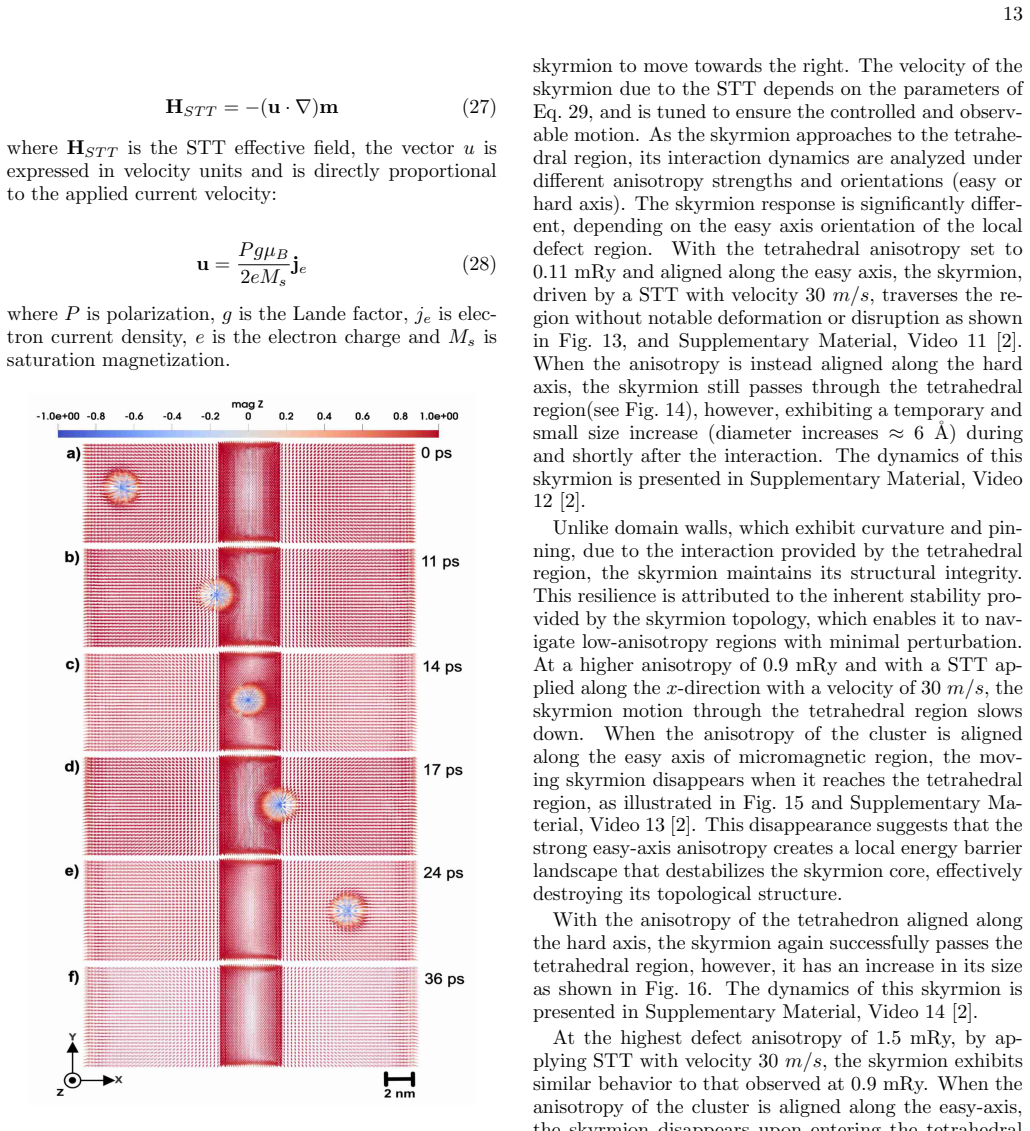
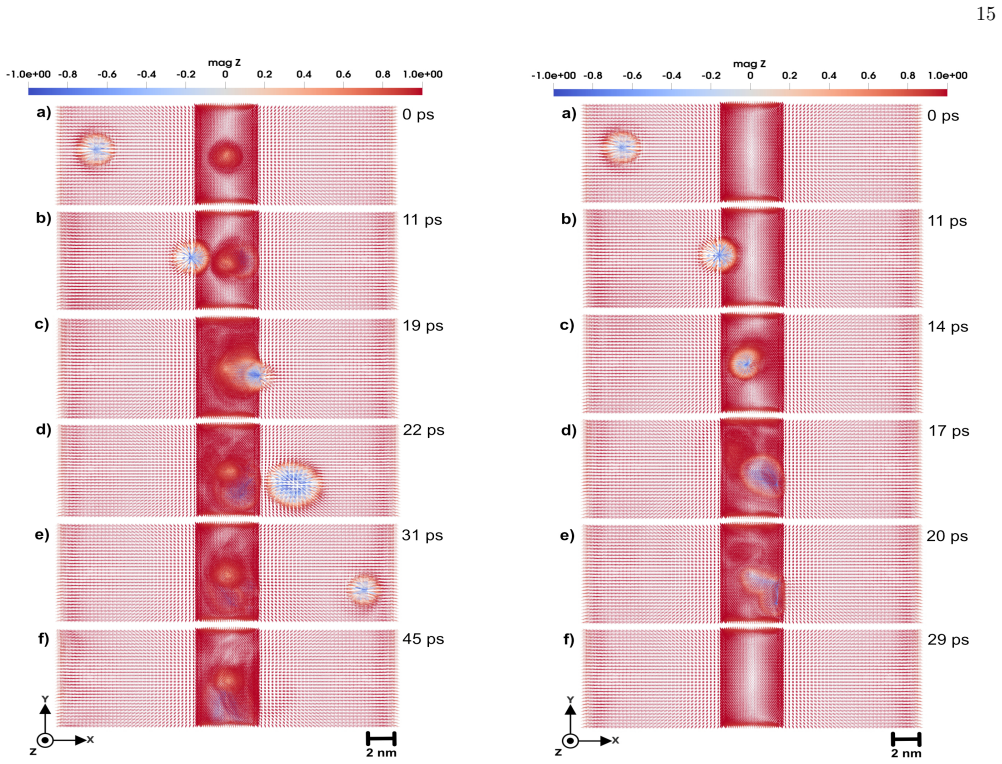
was observed, illustrating how local anisotropy gra- dients can be utilized to create magnetic textures with non-trivial shape. Furthermore, 3D skyrmion dynam- ics under spin-transfer torque exhibited sensitivity to defect-induced anisotropy. Soft easy-axis anisotropic re- gions ( K easy u ≈ 0.11 mRy) permitted smooth skyrmion motion (Fig. 13), while stro...
-
[6]
I. ˇZuti´ c, J. Fabian, and S. D. Sarma, Spintronics: Funda- mentals and applications, Rev. Mod. Phys.76, 323 (2004)
work page 2004
-
[7]
Fert, Nobel lecture: Origin, development, and future of spintronics, Rev
A. Fert, Nobel lecture: Origin, development, and future of spintronics, Rev. Mod. Phys. 80, 1517 (2008)
work page 2008
-
[8]
S. S. P. Parkin and S.-H. Yang, Memory on the racetrack, Nat. Nanotechnol. 10, 195 (2015)
work page 2015
- [9]
-
[10]
G. S. D. Beach, M. Tsoi, and J. L. Erskine, Current- induced domain wall motion, J. Magn. Magn. Mater. 320, 1272 (2008)
work page 2008
-
[11]
J. Sampaio, V. Cros, S. Rohart, A. Thiaville, and A. Fert, Nucleation, stability and current-induced motion of iso- lated magnetic skyrmions in nanostructures, Nat. Nan- otechnol. 8, 839 (2013)
work page 2013
-
[12]
N. Nagaosa and Y. Tokura, Topological properties and dynamics of magnetic skyrmions, Nat. Nanotechnol.8, 899 (2013)
work page 2013
-
[13]
R. Wiesendanger, Nanoscale magnetic skyrmions in metal- 17 lic films and multilayers: A new twist for spintronics, Nat. Rev. Mater. 1, 16044 (2016)
work page 2016
- [14]
-
[15]
A. Fert, N. Reyren, and V. Cros, Magnetic skyrmions: Advances in physics and potential applications, Nat. Rev. Mater. 2, 17031 (2017)
work page 2017
-
[16]
Kr¨ uger, The interaction of transverse domain walls, J
B. Kr¨ uger, The interaction of transverse domain walls, J. Phys.: Condens. Matter 24, 024209 (2012)
work page 2012
-
[17]
B. Hillebrands and A. Thiaville, eds., Spin dynamics in confined magnetic structures III, 1st ed., Topics in Applied Physics (Springer Berlin, Heidelberg, 2006) pp. XIV, 345
work page 2006
-
[18]
F. B¨ uttner, I. Lemesh, and G. S. D. Beach, Field-free deterministic ultrafast creation of magnetic skyrmions by spin-orbit torques, Nat. Phys. 14, 465 (2018)
work page 2018
- [19]
-
[20]
L. Gross and R. Atomically, Atomic-scale spin-polarized scanning tunneling microscopy of spin textures, Science 357, 655 (2017)
work page 2017
-
[21]
A. D. Lucia, B. Kr¨ uger, O. A. Tretiakov, and M. Kl¨ aui, Multiscale model approach for magnetization dynamics simulations, Phys. Rev. B 94, 184415 (2016)
work page 2016
- [22]
- [23]
-
[24]
E. M´ endez, M. Poluektov, G. Kreiss, O. Eriksson, and M. Pereiro, A multiscale approach for magnetization dy- namics: Unraveling exotic magnetic states of matter, Phys. Rev. Res. 2, 013092 (2020)
work page 2020
-
[25]
A. V. Chumak, A. A. Serga, and B. Hillebrands, Magnon transistor for all-magnon data processing, Nat. Commun. 5, 4700 (2015)
work page 2015
-
[26]
V. V. Kruglyak, S. O. Demokritov, and D. Grundler, Magnonics, J. Phys. D: Appl. Phys. 43, 264001 (2010)
work page 2010
-
[27]
D. M. Crum, M. Bouhassoune, J. Bouaziz, B. Schwe- flinghaus, S. Bl¨ ugel, and S. Lounis, Perpendicular reading of single confined magnetic skyrmions, Nat. Commun. 6, 8541 (2015)
work page 2015
-
[28]
M. Poluektov, O. Eriksson, and G. Kreiss, Coupling atomistic and continuum modelling of magnetism, Com- put. Methods Appl. Mech. Eng. 329, 219 (2018)
work page 2018
-
[29]
J. W. Gibbs and E. B. Wilson, Vector Analysis: A Text- Book for the Use of Students of Mathematics and Physics (C. Scribner’s Sons, New York, 1901)
work page 1901
-
[30]
V. Borisov, N. Salehi, M. Pereiro, et al., Dzyaloshinskii- moriya interactions, n´ eel skyrmions and V4 magnetic clus- ters in multiferroic lacunar spinel GaV 4S8, npj Comput. Mater. 10, 53 (2024)
work page 2024
-
[31]
L. B. Drissi, E. H. Saidi, M. Bousmina, and O. Fassi- Fehri, Magnetic skyrmions: Theory and applications, in Magnetic Skyrmions , edited by D. R. Sahu (IntechOpen, Rijeka, 2021) Chap. 1
work page 2021
-
[32]
J. M¨ uller, A. Rosch, and M. Garst, Edge instabilities and skyrmion creation in magnetic layers, New J. Phys.s 18, 065006 (2016)
work page 2016
-
[33]
F. N. Rybakov, A. B. Borisov, and A. N. Bogdanov, Three-dimensional skyrmion states in thin films of cubic helimagnets, Phys. Rev. B 87, 094424 (2013)
work page 2013
-
[34]
V. D. Stavrou, D. Kourounis, K. Dimakopoulos, I. Pana- giotopoulos, and L. N. Gergidis, Magnetic skyrmions in fept nanoparticles having reuleaux 3d geometry: a micro- magnetic simulation study, Nanoscale 11, 20102 (2019)
work page 2019
-
[35]
M. Lee, W. Kang, Y. Onose, Y. Tokura, and N. P. Ong, Unusual hall effect anomaly in MnSi under pressure, Phys. Rev. Lett. 102, 186601 (2009)
work page 2009
-
[36]
T. Taniguchi, D. Saida, Y. Nakatani, and H. Kubota, Magnetization switching by current and microwaves, Phys. Rev. B 93, 014430 (2016)
work page 2016
-
[37]
K. Zakeri, Probing of the interfacial heisenberg and dzyaloshinskii–moriya exchange interaction by magnon spectroscopy, J. Phys. Condens. Matter. 29, 013001 (2016)
work page 2016
-
[38]
Additionally, this re- source includes videos illustrating the dynamics presented in Figs
See Supplementary Material at http://example.com/ supplementary for detailed technical aspects of the multi- scale model and the material parameters used in the sim- ulations discussed in the main text. Additionally, this re- source includes videos illustrating the dynamics presented in Figs. 1, 3, 4–6, and 8–11, videos included
-
[39]
M. Andersson, Investigations of domain-wall motion us- ing atomistic spin dynamics, Master’s thesis, Uppsala Uni- versity (2015), master’s thesis, available at DiVA Portal
work page 2015
- [40]
-
[41]
K. Klyukin, G. Beach, and B. Yildiz, Hydrogen tunes magnetic anisotropy by affecting local hybridization at the interface of a ferromagnet with nonmagnetic metals, Phys. Rev. Mater. 4, 104416 (2020)
work page 2020
-
[42]
I. A. Kibalin and A. Gukasov, Local magnetic anisotropy by polarized neutron powder diffraction: Application of magnetically induced preferred crystallite orientation, Phys. Rev. Res. 1, 033100 (2019)
work page 2019
- [43]
-
[44]
A. Khitun and K. L. Wang, Nano-scale computational ar- chitectures with spin wave bus, Superlattices Microstruct. 47, 464 (2010)
work page 2010
-
[45]
A. A. Serga, A. V. Chumak, and B. Hillebrands, Yig magnonics, J. Phys. D: Appl. Phys. 43, 264002 (2010)
work page 2010
-
[46]
M. Krawczyk and D. Grundler, Review and prospects of magnonic crystals and devices with reprogrammable band structure, J. Phys. Condens. Matter. 26, 123202 (2014)
work page 2014
-
[47]
R. Streubel, P. Fischer, F. Kronast, V. P. Kravchuk, D. D. Sheka, Y. Gaididei, O. G. Schmidt, and D. Makarov, Magnetism in curved geometries, J. Phys. D: Appl. Phys. 49, 363001 (2016)
work page 2016
-
[48]
C. Schieback, M. Kl¨ aui, U. Nowak, U. R¨ udiger, and P. Nielaba, Numerical investigation of spin-torque using the heisenberg model, Eur. Phys. J. B 59, 429 (2007)
work page 2007
-
[49]
S. Zhang and Z. Li, Roles of nonequilibrium conduction electrons on the magnetization dynamics of ferromagnets, Phys. Rev. Lett. 93, 127204 (2004)
work page 2004
-
[50]
I. Makhfudz, B. Kr¨ uger, and O. Tchernyshyov, Inertia and chiral edge modes of a skyrmion magnetic bubble, Phys. Rev. Lett. 109, 217201 (2012)
work page 2012
-
[51]
J. V. Kim, F. Garcia-Sanchez, J. Sampaio, C. Moreau- Luchaire, V. Cros, and A. Fert, Breathing modes of con- 18 fined skyrmions in ultrathin magnetic dots, Phys. Rev. B 90, 064410 (2014)
work page 2014
- [52]
-
[53]
Mochizuki, Spin-wave modes and their intense exci- tation effects in skyrmion crystals, Phys
M. Mochizuki, Spin-wave modes and their intense exci- tation effects in skyrmion crystals, Phys. Rev. Lett. 108, 017601 (2012). Micromagnetic-atomistic hybrid modeling of defect-induced magnetization dynamics —Supplemental Material— Nastaran Salehi1, Olle Eriksson 1,2, Johan Hellsvik 3, and Manuel Pereiro 1 1Department of Physics and Astronomy, Uppsala Un...
work page 2012
-
[54]
A. Thiaville and Y. Nakatani, Spin dynamics in confined magnetic structures iii, in Spin Dynamics in Confined Magnetic Structures III , edited by B. Hillebrands and K. Ounadjela (Springer, Berlin, 2006) pp. 161–205
work page 2006
-
[55]
Additionally, this resource includes videos illustrating the dynamics presented in Figs
See Supplementary Material at http://example.com/supplementary for detailed technical aspects of the multiscale model and the material parameters used in the simulations discussed in the main text. Additionally, this resource includes videos illustrating the dynamics presented in Figs. 1, 3, 4–6, and 8–11, videos included
discussion (0)
Sign in with ORCID, Apple, or X to comment. Anyone can read and Pith papers without signing in.