REVIEW 2 major objections 6 minor 101 references
A thermodynamically consistent and robust four-equation model for multi-phase multi-component compressible flows using ENO-type schemes including interface regularization
T0 review · 2 major / 6 minor · reviewed 2026-08-16 · deepseek-v4-flash
Pith's one-line read A primitive-variable ENO reconstruction satisfies the interface equilibrium condition to near machine precision in the four-equation model, preventing pressure, velocity, and temperature oscillations across material interfaces.
desk verdict A genuinely useful idea—temperature-based characteristic reconstruction for the four-equation model—with a reproducible-text problem in the EOS closure that should be fixed before publication. read the letter →
The pith
A machine-rendered reading of the paper's core claim, the machinery that carries it, and where it could break.
The reading
What carries the argument
The load-bearing object is the primitive reconstruction basis $W=[T,Y^p_c,u,v,w,P]^T$. ENO-type schemes, a family of high-order interpolation and shock-capturing schemes, are applied to characteristic variables derived from this basis and then projected back to physical space; density is recovered afterward from the equation of state, and fluxes are closed with an HLLC Riemann solver. Interpolating temperature rather than density is what enforces the interface equilibrium condition, because a constant $T$, $P$, $u$ field remains constant through the nonlinear ENO interpolation. Supporting mechanisms are the closed-form Noble-Abel stiffened-gas mixture pressure and temperature inversion, the kinetic-energy and entropy-preserving (KEEP) split-form central discretization of the diffuse-interface regularization flux, and the local positivity-preserving limiter that independently limits pressure, temperature, and mass fractions.
What would settle it
Compare the pressure and temperature predicted by Eqs. 21-22 with an independent iterative solve of the equilibrium conditions for the water/air parameters of Table 1; any mismatch would show that the printed closure is not the implemented one.
Extended reading notes
Core claim
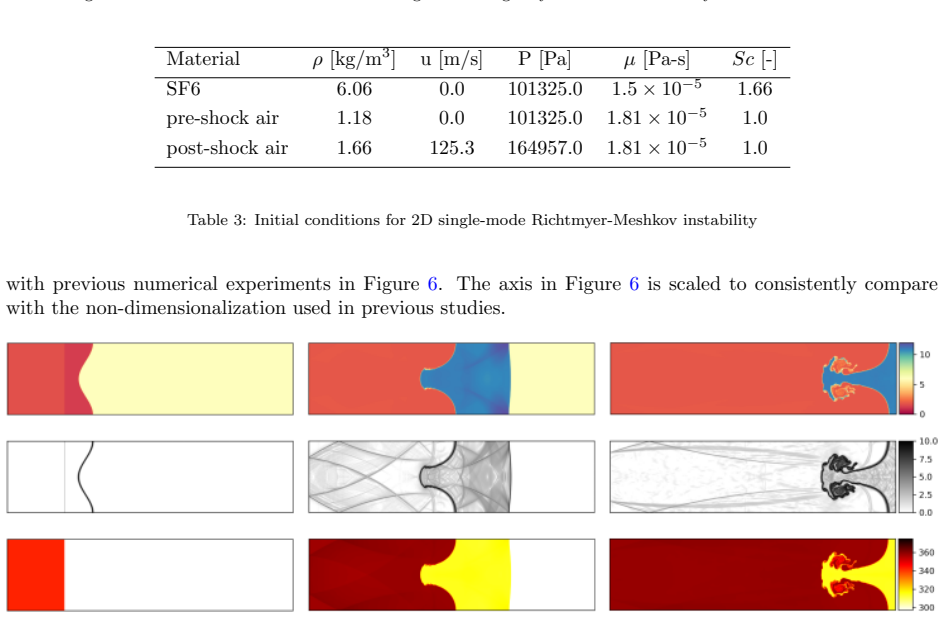
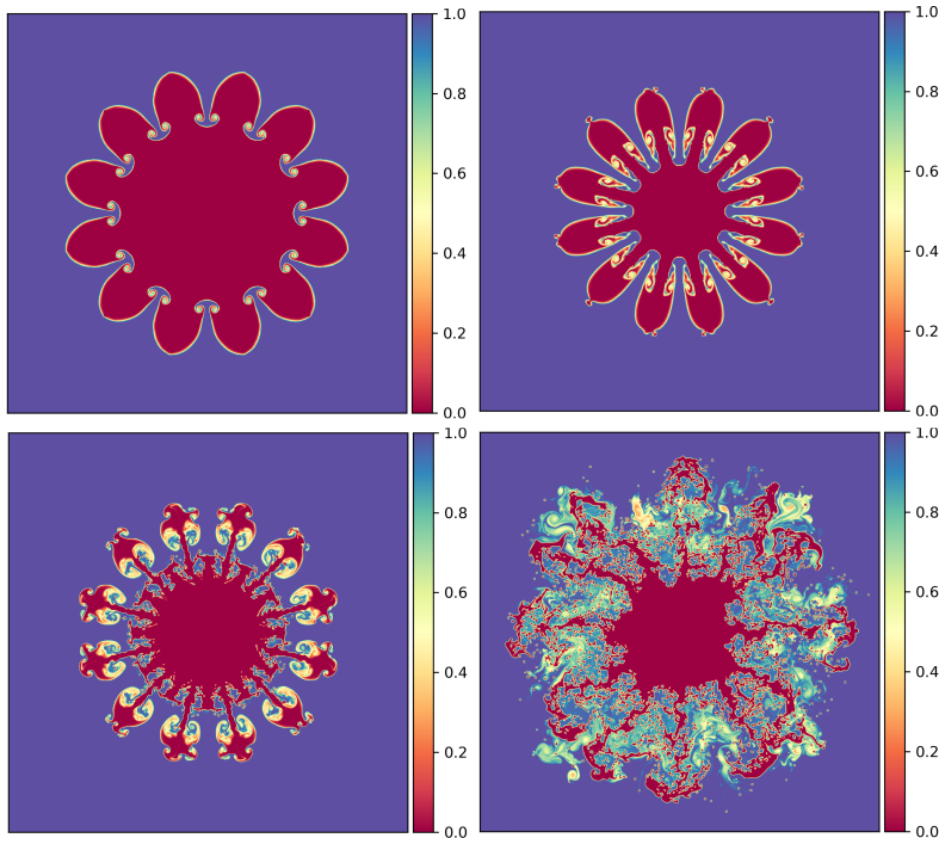
The central claim is that the four-equation model can satisfy the interface equilibrium condition without adding redundant equations. The authors achieve this by using the primitive vector $W=[T,Y^p_c,u,v,w,P]^T$, with one redundant mass fraction omitted, as the basis for characteristic projection and ENO-type interpolation, instead of the density-based basis $[\rho Y^p_c,u,v,w,P]$ used in five-equation settings. Since a well-formulated scheme preserves constant fields after interpolation, reconstructing $T$, $P$, and $u$ directly enforces the interface equilibrium condition, and the characteristic decomposition in this basis is shown analytically to keep $T$, $P$, and $u$ constant across the interface. Around this construction the paper adds a conservative positivity-preserving limiter applied locally for minimal dissipation, a multi-phase multi-component extension of the conservative diffuse interface model, and a phase-confined species diffusion model. Validation spans shock-bubble interaction, gas-liquid Riemann problems, droplet advection with error tables near machine precision, shock-droplet interaction, a Mach 100 water column, and a two-layer air-helium-SF6 Richtmyer-Meshkov implosion.
Load-bearing premise
The load-bearing premise is that the closed-form mixture pressure-temperature inversion printed in Eqs. 21-22 is exactly what the simulation code evaluates; every pressure and temperature value is reconstructed from conserved variables through this formula.
Editorial extensions
If this is right
- Four-equation models can satisfy the interface equilibrium condition with normalized pressure, temperature, and velocity errors around $10^{-11}$ for WENO-type schemes, making the minimal four-equation model viable for high-density-ratio compressible flows.
- The same numerical framework covers single-phase, multi-component, multi-phase, and multi-phase multi-component regimes without changing equilibrium assumptions or adding redundant PDEs.
- High-Mach shock-interface interactions, including a Mach 100 water column, remain stable because the positivity-preserving limiter activates on a tiny fraction of faces and does not visibly degrade the baseline scheme.
- Generalized conservative diffuse-interface regularization keeps immiscible interfaces sharp while the phase-confined diffusion model allows intraphase mixing without leakage across phases, enabling multi-layer implosion simulations.
- The framework runs high-resolution simulations on GPUs as well as CPUs, so the method scales to production-scale problems.
Reading between the lines
- A natural extension the paper does not pursue is that the same equilibrium-variable reconstruction basis should transfer to other equations of state, such as temperature-dependent specific heats or non-ideal mixing, where the mixture state is still inverted iteratively; the remaining challenge would be an efficient equilibrium solver, not a new oscillation cure.
- The phase-confined diffusion construction suggests a clean route to phase change: add interfacial mass-transfer terms that respect the same confinement, rather than letting Fickian fluxes cross the regularized interface.
- A testable consequence of the finite-thickness interface regularization is that breakup statistics in high-Weber-number simulations depend on the regularization parameters $\epsilon$ and $\Gamma$; results at under-resolved scales should report these parameters to be interpretable.
- The Table 6 error statistics provide a simple quantitative benchmark: other four-equation schemes could be compared on the same inviscid droplet-advection test by reporting max normalized $P$, $T$, and $u$ errors after one flow-through time.
Signed reviews
Editorial analysis
A structured set of objections, weighed in public.
Referee Report
Summary. The paper proposes a four-equation model for compressible multi-phase multi-component flows, combined with a primitive-variable characteristic ENO-type reconstruction that is designed to satisfy the interface equilibrium condition (IEC), positivity-preserving limiters, a multi-component extension of the conservative diffuse interface (CDI) regularization, and a phase-confined non-dilute species diffusion model. The central claim is that using W=[T,Y,u,v,w,P] as the reconstruction basis prevents pressure, temperature, and velocity oscillations across isothermal material interfaces to near machine precision without redundant equations. The numerical section includes one- and two-dimensional tests ranging from shock-bubble interaction and Richtmyer-Meshkov instability to droplet advection, shock-droplet interaction, a Mach 100 water column, and a two-layer ICF-like RMI implosion.
Significance. If the claims hold, the main contribution is practically important: a concise, conservative four-equation scheme that satisfies the IEC for general equations of state and mixing rules, avoiding the redundant equations or non-conservative corrections used by many competing methods. The paper provides a mathematical argument in Appendix C, a direct numerical IEC test in Table 6, and validation against experiments and prior computational studies. The CDI and phase-confined diffusion extensions are useful, although they build on prior work from the same group. The main barrier to accepting the central claim is not the IEC construction itself but the presentation of the equation-of-state closure, which is currently internally inconsistent and not reproducible from the text.
major comments (2)
- [Secs. 2.1 and 2.3, Eqs. (19)-(22) and Eq. (39)] The mixture EOS inversion is the load-bearing closure for every simulation in Sec. 4, but it is not reproducible from the text as printed. Section 2.1 defines e as "internal energy per unit volume," whereas Eqs. (9), (18), (19), (22), and the parameters in Table 1 are only dimensionally consistent if e and v are specific (per-unit-mass) quantities. With e per unit volume, r=(e-q)/(v-b) in Eq. (22) is dimensionally meaningless, since q has units J/kg and b has units m^3/kg, and the quadratic in Eq. (21) mixes pressure and temperature dimensions. Re-deriving Eqs. (19)-(20) with e and v specific yields a1=Cv, a2=r(CP-Cv)-Pinf*Cv-Pinf*Y1(CP1-Cv1), and a3=r*Pinf*[CP-Cv-Y1(CP1-Cv1)], so the printed coefficients appear to be the intended ones. Nevertheless, the definitional error and the absence of any derivation leave the reader unable to verify that the implemented inversion matches the paper. Please correct the definition of e and E, state the units of a1, a2, and a3, and include the derivation of Eq. (21)-(22) or a precise reference for it.
- [Sec. 3.3.2, flux limiter] The paper states that the positivity-preserving limiter guarantees admissible states, but the described algorithm only checks whether the high-order HLLC flux is admissible and, if not, replaces it with the first-order flux F_HLLC(U_i,U_{i+1}). No argument is given that this first-order flux is itself positivity-preserving for the four-equation NASG system under the stated CFL condition (Eq. (44)). Without such an argument or a citation to a proof that covers this system, the guarantee is unsubstantiated. The numerical evidence in Sec. 4.2.3 suggests the limiter works in practice, but the claimed guarantee should be proven or explicitly qualified.
minor comments (6)
- [Sec. 4.2.2, Table 6] The phrase "near machine precision" is not uniformly supported: the TENO6 normalized temperature and velocity errors are 3.99e-8 and 1.12e-8, respectively, which are several orders of magnitude above double-precision epsilon. The text partially acknowledges this, but the wording should be qualified to avoid overstating the headline result.
- [Appendix C, Eq. (C.1)] The proof that the characteristic variables w5 and w6 are constant relies on evaluating the coefficients such as a*rho at a single face-averaged state and using that same coefficient for every point in the stencil. This is implied by the Godunov algorithm in Sec. 3.1.3 but should be stated explicitly, since the overline notation can be misread as a per-cell average.
- [Table 1] The units of the co-volume b are listed as kg^{-1}; they should be m^3 kg^{-1}.
- [Sec. 3.3.1, Eqs. (41)-(42)] The blending coefficients theta_P and theta_T are used to define the positivity-preserving interpolation but are never defined; please state how they are computed.
- [Sec. 4.3.2, Fig. 15] The claim that the phase-confined diffusion model prevents leakage of air/helium into SF6 is demonstrated only qualitatively. A quantitative measure, such as the total mass of the confined species across the interface or the maximum SF6 mass fraction inside the bubble, would make the test more convincing.
- [Throughout] "Nobel-Abel" should be "Noble-Abel" (e.g., in Sec. 2.3 and the references).
Circularity Check
No material circularity: the IEC claim rests on a self-contained constant-field argument and non-fitted numerical tests; self-citations appear only in auxiliary model extensions.
full rationale
The central claim is that the four-equation scheme with primitive/characteristic reconstruction W=[T,Y,u,P] satisfies the interface equilibrium condition. This is supported by a self-contained constant-field argument (Appendix C), not by fitting: because the characteristic projection in the Godunov procedure uses a single face-averaged S^{-1}, a stencil with constant T, P, and u yields constant characteristic variables; ENO interpolation of constants returns constants, and the inverse projection recovers constant T, P, and u. The droplet advection test in Table 6 is a numerical consistency check, not a fitted prediction. The mixture EOS closure in Eqs. 19-22 is an algebraic inversion of the NASG EOS under the stated Amagat/equilibrium mixing rules, derived independently of the IEC results. Self-citations appear mainly in auxiliary model extensions: the CDI regularization cites prior boundedness/consistency work [46,47,81,84], and the confined-scalar diffusion model cites [73,74]. These citations are not the load-bearing support for the paper's central IEC result, and the extensions are exercised in Section 4.3 while the multi-phase/multi-component validations are checked against external experiments and prior computations (shock-bubble [97], RMI [7,98], droplet centroid [36,100]). No parameter is fitted to make the IEC test pass. One caveat, unrelated to circularity: Section 2.1's phrase "e is the internal energy per unit volume" conflicts with the specific-energy usage of e in Eqs. 9 and 18; under the specific-energy reading, Eqs. 21-22 are dimensionally consistent. This is a reproducibility/consistency issue, not a circular reduction. Overall, no circular step is exhibited; the score reflects only minor self-citations in auxiliary components.
Assumptions & free parameters
free parameters (5)
- Gamma (CDI velocity scale) =
chosen locally as max(|u_i,j,k|) per case
- epsilon (CDI interface thickness) =
approximately grid size Delta_x
- phi_min (volume fraction floor) =
1e-8
- Schmidt numbers for species =
0.7 (He), 1.0 (air), 1.66 (SF6) depending on test
- Prandtl number for gas mixture =
0.71
assumptions (7)
- domain assumption Four-equation thermo-mechanical equilibrium: one shared temperature, pressure, and velocity per computational cell for all phases.
- domain assumption Immiscible phases with Amagat's law and CDI regularization to keep interfaces finite.
- domain assumption All components are closed with the Noble-Abel stiffened-gas (NASG) EOS with constant heat capacities.
- standard math ENO-type reconstruction preserves constants exactly.
- standard math The HLLC approximate Riemann solver is adequate for the Godunov flux in this regime.
- domain assumption The positivity limiter's first-order fallback preserves conservation and admissibility.
- domain assumption The phase-confined species diffusion model relies on the confined-scalar transport theory of prior work [73,74].
Cite this review
Pith. "Pith review of A thermodynamically consistent and robust four-equation model for multi-phase multi-component compressible flows using ENO-type schemes including interface regularization." pith.science (2026). https://pith.science/paper/PS6SBQRI
@misc{pith2026250414063,
  author       = {Pith},
  title        = {Pith review of: A thermodynamically consistent and robust four-equation model for multi-phase multi-component compressible flows using ENO-type schemes including interface regularization},
  year         = {2026},
  howpublished = {\url{https://pith.science/paper/PS6SBQRI}},
  note         = {Machine review of arXiv:2504.14063}
}
read the original abstract
In this work, a concise and robust computational framework is proposed to simulate compressible multi-phase multi-component flows. To handle both shocks and material interfaces, a positivity-preserving ENO-type scheme is coupled with multi-phase interface regularization terms. The positivity-preserving limiter is conservative and is applied locally for minimal degradation of the baseline ENO-type scheme. The interface regularization terms are extended from the conservative diffuse interface (CDI) model to accommodate multi-phase, multi-component flows. The ENO-type scheme is designed to be consistent with the thermodynamic equilibrium assumptions of the four-equation multi-phase model, naturally enforcing the interface equilibrium condition - preventing oscillations in pressure, velocity, and temperature around isothermal material interfaces - without requiring additional equations for volume fraction or mixture equation of state parameters, as is commonly done for the five-equation model. Additionally, non-dilute species diffusion models are extended to the multi-phase, multi-component setting. We show that this consistent framework is equally applicable for regimes ranging from single-phase to multi-phase multi-component flows. The proposed models and numerical schemes are implemented in the highly parallel Hypersonic Task based Research (HTR) Solver, and high-resolution simulations are performed using both CPUs and GPUs.
Figures


Figures from the paper (15 more)




Reference graph
Works this paper leans on
-
[1]
Mirjalili, S
S. Mirjalili, S. S. Jain, M. Dodd, Interface-capturing methods for two-phase flows: An overview and recent developments, Center for Turbulence Research Annual Research Briefs 2017 (117-135) (2017) 13
2017
-
[2]
H. Luo, J. D. Baum, R. L¨ ohner, On the computation of multi-material flows using ale formulation, Journal of Compu- tational Physics 194 (1) (2004) 304–328. 35 Figure D.21: Riemann problem comparing density fields using the high-resolution Godunov method with TENO5 [32], TENO6 [32], WENO5JS [31], and WENO5Z [96] schemes
2004
-
[3]
Glimm, X
J. Glimm, X. Li, Y. Liu, Z. Xu, N. Zhao, Conservative front tracking with improved accuracy, SIAM Journal on Numerical Analysis 41 (5) (2003) 1926–1947
2003
-
[4]
Cocchi, R
J.-P. Cocchi, R. Saurel, A riemann problem based method for the resolution of compressible multimaterial flows, Journal of Computational Physics 137 (2) (1997) 265–298
1997
-
[5]
Glimm, J
J. Glimm, J. W. Grove, X. L. Li, K.-M. Shyue, Y. Zeng, Q. Zhang, Three-dimensional front tracking, SIAM Journal on Scientific Computing 19 (3) (1998) 703–727
1998
-
[6]
McKee, M
S. McKee, M. F. Tom´ e, V. G. Ferreira, J. A. Cuminato, A. Castelo, F. Sousa, N. Mangiavacchi, The mac method, Computers & Fluids 37 (8) (2008) 907–930
2008
-
[7]
Terashima, G
H. Terashima, G. Tryggvason, A front-tracking/ghost-fluid method for fluid interfaces in compressible flows, Journal of Computational Physics 228 (11) (2009) 4012–4037
2009
-
[8]
Mulder, S
W. Mulder, S. Osher, J. A. Sethian, Computing interface motion in compressible gas dynamics, Journal of computational physics 100 (2) (1992) 209–228
1992
Show all 101 references
-
[9]
R. P. Fedkiw, T. Aslam, B. Merriman, S. Osher, A non-oscillatory eulerian approach to interfaces in multimaterial flows (the ghost fluid method), Journal of computational physics 152 (2) (1999) 457–492
1999
-
[10]
T. Liu, B. Khoo, K. Yeo, Ghost fluid method for strong shock impacting on material interface, Journal of computational physics 190 (2) (2003) 651–681
2003
-
[11]
X. Y. Hu, B. C. Khoo, An interface interaction method for compressible multifluids, Journal of Computational Physics 198 (1) (2004) 35–64
2004
-
[12]
Chiodi, O
R. Chiodi, O. Desjardins, A reformulation of the conservative level set reinitialization equation for accurate and robust simulation of complex multiphase flows, Journal of Computational Physics 343 (2017) 186–200
2017
-
[13]
DeBar, Fundamentals of the kraken code, Technical Report UCIR-760
R. DeBar, Fundamentals of the kraken code, Technical Report UCIR-760
-
[14]
Scardovelli, S
R. Scardovelli, S. Zaleski, Interface reconstruction with least-square fit and split eulerian–lagrangian advection, Interna- tional Journal for Numerical Methods in Fluids 41 (3) (2003) 251–274
2003
-
[15]
Aulisa, S
E. Aulisa, S. Manservisi, R. Scardovelli, S. Zaleski, A geometrical area-preserving volume-of-fluid advection method, Journal of Computational Physics 192 (1) (2003) 355–364. 36
2003
-
[16]
Jofre, O
L. Jofre, O. Lehmkuhl, J. Castro, A. Oliva, A 3-d volume-of-fluid advection method based on cell-vertex velocities for unstructured meshes, Computers & Fluids 94 (2014) 14–29
2014
-
[17]
L´ opez, J
J. L´ opez, J. Hern´ andez, P. G´ omez, F. Faura, A volume of fluid method based on multidimensional advection and spline interface reconstruction, Journal of Computational Physics 195 (2) (2004) 718–742
2004
-
[18]
Owkes, O
M. Owkes, O. Desjardins, A computational framework for conservative, three-dimensional, unsplit, geometric transport with application to the volume-of-fluid (vof) method, Journal of Computational Physics 270 (2014) 587–612
2014
-
[19]
C. B. Ivey, P. Moin, Conservative and bounded volume-of-fluid advection on unstructured grids, Journal of Computational Physics 350 (2017) 387–419
2017
-
[20]
Mirjalili, C
S. Mirjalili, C. B. Ivey, A. Mani, Comparison between the diffuse interface and volume of fluid methods for simulating two-phase flows, International Journal of Multiphase Flow 116 (2019) 221–238
2019
-
[21]
Olsson, G
E. Olsson, G. Kreiss, A conservative level set method for two phase flow, Journal of computational physics 210 (1) (2005) 225–246
2005
-
[22]
Ubbink, R
O. Ubbink, R. Issa, A method for capturing sharp fluid interfaces on arbitrary meshes, Journal of computational physics 153 (1) (1999) 26–50
1999
-
[23]
Zhang, C
D. Zhang, C. Jiang, D. Liang, Z. Chen, Y. Yang, Y. Shi, A refined volume-of-fluid algorithm for capturing sharp fluid interfaces on arbitrary meshes, Journal of Computational Physics 274 (2014) 709–736
2014
-
[24]
B. Xie, S. Ii, F. Xiao, An efficient and accurate algebraic interface capturing method for unstructured grids in 2 and 3 dimensions: The thinc method with quadratic surface representation, International Journal for Numerical Methods in Fluids 76 (12) (2014) 1025–1042
2014
-
[25]
Van Leer, Towards the ultimate conservative difference scheme
B. Van Leer, Towards the ultimate conservative difference scheme. ii. monotonicity and conservation combined in a second-order scheme, Journal of computational physics 14 (4) (1974) 361–370
1974
-
[26]
P. L. Roe, Characteristic-based schemes for the euler equations, Annual review of fluid mechanics 18 (1) (1986) 337–365
1986
-
[27]
G. D. Van Albada, B. Van Leer, W. Roberts Jr, A comparative study of computational methods in cosmic gas dynamics, in: Upwind and high-resolution schemes, Springer, 1997, pp. 95–103
1997
-
[28]
Harten, S
A. Harten, S. Osher, Uniformly high-order accurate nonoscillatory schemes. i, SIAM Journal on Numerical Analysis 24 (2) (1987) 279–309
1987
-
[29]
C.-W. Shu, S. Osher, Efficient implementation of essentially non-oscillatory shock-capturing schemes, Journal of compu- tational physics 77 (2) (1988) 439–471
1988
-
[30]
C.-W. Shu, S. Osher, Efficient implementation of essentially non-oscillatory shock-capturing schemes, ii, Journal of computational physics 83 (1) (1989) 32–78
1989
-
[31]
Jiang, C.-W
G.-S. Jiang, C.-W. Shu, Efficient implementation of weighted eno schemes, Journal of computational physics 126 (1) (1996) 202–228
1996
-
[32]
L. Fu, X. Y. Hu, N. A. Adams, A family of high-order targeted eno schemes for compressible-fluid simulations, Journal of Computational Physics 305 (2016) 333–359
2016
-
[33]
Johnsen, T
E. Johnsen, T. Colonius, Implementation of weno schemes in compressible multicomponent flow problems, Journal of Computational Physics 219 (2) (2006) 715–732
2006
-
[34]
Coralic, T
V. Coralic, T. Colonius, Finite-volume weno scheme for viscous compressible multicomponent flows, Journal of compu- tational physics 274 (2014) 95–121
2014
-
[35]
Collis, S
H. Collis, S. Mirjalili, S. Jain, A. Mani, Assessment of weno and teno schemes for the four-equation compressible two-phase flow model with regularization terms, Center for Turbulence Research Annual Research Briefs (2022) 151–165
2022
-
[36]
M. L. Wong, J. B. Angel, C. C. Kiris, A positivity-preserving eulerian two-phase approach with thermal relaxation for compressible flows with a liquid and gases, arXiv preprint arXiv:2208.04488
-
[37]
F. Xiao, Y. Honma, T. Kono, A simple algebraic interface capturing scheme using hyperbolic tangent function, Interna- tional journal for numerical methods in fluids 48 (9) (2005) 1023–1040
2005
-
[38]
F. Xiao, S. Ii, C. Chen, Revisit to the thinc scheme: a simple algebraic vof algorithm, Journal of Computational Physics 230 (19) (2011) 7086–7092
2011
-
[39]
Shyue, F
K.-M. Shyue, F. Xiao, An eulerian interface sharpening algorithm for compressible two-phase flow: The algebraic thinc approach, Journal of Computational Physics 268 (2014) 326–354
2014
-
[40]
D. A. Bezgin, A. B. Buhendwa, N. A. Adams, Jax-fluids 2.0: Towards hpc for differentiable cfd of compressible two-phase flows, 2024, URL https://arxiv. org/abs/2402.05193
2024 arXiv
-
[41]
J. W. Cahn, J. E. Hilliard, Free energy of a nonuniform system. i. interfacial free energy, The Journal of chemical physics 28 (2) (1958) 258–267
1958
-
[42]
S. M. Allen, J. W. Cahn, A microscopic theory for antiphase boundary motion and its application to antiphase domain coarsening, Acta metallurgica 27 (6) (1979) 1085–1095
1979
-
[43]
Huang, G
Z. Huang, G. Lin, A. M. Ardekani, A consistent and conservative phase-field method for multiphase incompressible flows, Journal of Computational and Applied Mathematics 408 (2022) 114116
2022
-
[44]
Huang, E
Z. Huang, E. Johnsen, Bound preservation for the consistent and conservative phase-field method for compressible single-, two-, and n-phase flows, Journal of Computational Physics (2025) 113783
2025
-
[45]
P. H. Chiu, Y. T. Lin, A conservative phase field method for solving incompressible two-phase flows, Journal of Compu- tational Physics 230 (2011) 185–204. doi:10.1016/J.JCP.2010.09.021
2011 doi
-
[46]
Mirjalili, C
S. Mirjalili, C. B. Ivey, A. Mani, A conservative diffuse interface method for two-phase flows with provable boundedness properties, Journal of Computational Physics 401 (2020) 109006. doi:10.1016/J.JCP.2019.109006
2020
-
[47]
S. S. Jain, A. Mani, P. Moin, A conservative diffuse-interface method for compressible two-phase flows, Journal of Computational Physics 418 (2020) 109606. doi:10.1016/J.JCP.2020.109606
2020
-
[48]
Mirjalili, A
S. Mirjalili, A. Mani, A conservative second order phase field model for simulation of n-phase flows, Journal of Compu- 37 tational Physics 498 (2024) 112657
2024
-
[49]
Collis, S
H. Collis, S. Mirjalili, A. Mani, Diffuse interface treatment in generalized curvilinear coordinates with grid-adapting interface thickness, arXiv preprint arXiv:2411.18770
-
[50]
S. S. Jain, M. C. Adler, J. R. West, A. Mani, P. Moin, S. K. Lele, Assessment of diffuse-interface methods for compressible multiphase fluid flows and elastic-plastic deformation in solids, Journal of Computational Physics 475 (2023) 111866
2023
-
[51]
Kataoka, Local instant formulation of two-phase flow, International Journal of Multiphase Flow 12 (5) (1986) 745–758
I. Kataoka, Local instant formulation of two-phase flow, International Journal of Multiphase Flow 12 (5) (1986) 745–758
1986
-
[52]
Shyue, An efficient shock-capturing algorithm for compressible multicomponent problems, Journal of Computa- tional Physics 142 (1) (1998) 208–242
K.-M. Shyue, An efficient shock-capturing algorithm for compressible multicomponent problems, Journal of Computa- tional Physics 142 (1) (1998) 208–242
1998
-
[53]
A. W. Cook, Enthalpy diffusion in multicomponent flows, Physics of Fluids 21 (5)
-
[54]
Fl˚ atten, A
T. Fl˚ atten, A. Morin, T. Munkejord, On solutions to equilibrium problems for systems of stiffened gases *, Society for Industrial and Applied Mathematics 71 (2011) 41–67. doi:10.1137/100784321. URL http://www.siam.org/journals/siap/71-1/78432.html
2011 doi
-
[55]
LeMartelot, R
S. LeMartelot, R. Saurel, O. Le M´ etayer, Steady one-dimensional nozzle flow solutions of liquid–gas mixtures, Journal of fluid mechanics 737 (2013) 146–175
2013
-
[56]
Le Martelot, R
S. Le Martelot, R. Saurel, B. Nkonga, Towards the direct numerical simulation of nucleate boiling flows, International Journal of Multiphase Flow 66 (2014) 62–78
2014
-
[57]
Saurel, P
R. Saurel, P. Boivin, O. Le M´ etayer, A general formulation for cavitating, boiling and evaporating flows, Computers & Fluids 128 (2016) 53–64
2016
-
[58]
Allaire, S
G. Allaire, S. Clerc, S. Kokh, A five-equation model for the simulation of interfaces between compressible fluids, Journal of Computational Physics 181 (2) (2002) 577–616
2002
-
[59]
Yeom, K.-S
G.-S. Yeom, K.-S. Chang, A modified hllc-type riemann solver for the compressible six-equation two-fluid model, Com- puters & Fluids 76 (2013) 86–104
2013
-
[60]
Haimovich, S
O. Haimovich, S. H. Frankel, Numerical simulations of compressible multicomponent and multiphase flow using a high- order targeted eno (teno) finite-volume method, Computers & Fluids 146 (2017) 105–116
2017
-
[61]
M. R. Baer, J. W. Nunziato, A two-phase mixture theory for the deflagration-to-detonation transition (ddt) in reactive granular materials, International journal of multiphase flow 12 (6) (1986) 861–889
1986
-
[62]
S. A. Beig, E. Johnsen, Maintaining interface equilibrium conditions in compressible multiphase flows using interface capturing, Journal of Computational Physics 302 (2015) 548–566
2015
-
[63]
Abgrall, How to prevent pressure oscillations in multicomponent flow calculations: a quasi conservative approach, Journal of Computational Physics 125 (1) (1996) 150–160
R. Abgrall, How to prevent pressure oscillations in multicomponent flow calculations: a quasi conservative approach, Journal of Computational Physics 125 (1) (1996) 150–160
1996
-
[64]
Abgrall, S
R. Abgrall, S. Karni, Computations of compressible multifluids, Journal of computational physics 169 (2) (2001) 594–623
2001
-
[65]
P. C. Ma, Y. Lv, M. Ihme, An entropy-stable hybrid scheme for simulations of transcritical real-fluid flows, Journal of Computational Physics 340 (2017) 330–357
2017
-
[66]
Johnsen, F
E. Johnsen, F. Ham, Preventing numerical errors generated by interface-capturing schemes in compressible multi-material flows, Journal of Computational Physics 231 (17) (2012) 5705–5717
2012
-
[67]
Terashima, S
H. Terashima, S. Kawai, M. Koshi, Consistent numerical diffusion terms for simulating compressible multicomponent flows, Computers & Fluids 88 (2013) 484–495
2013
-
[68]
Nonomura, K
T. Nonomura, K. Fujii, Characteristic finite-difference weno scheme for multicomponent compressible fluid analysis: Overestimated quasi-conservative formulation maintaining equilibriums of velocity, pressure, and temperature, Journal of Computational Physics 340 (2017) 358–388
2017
-
[69]
Fujiwara, Y
Y. Fujiwara, Y. Tamaki, S. Kawai, Fully conservative and pressure-equilibrium preserving scheme for compressible multi- component flows, Journal of Computational Physics 478 (2023) 111973
2023
-
[70]
Terashima, N
H. Terashima, N. Ly, M. Ihme, Approximately pressure-equilibrium-preserving scheme for fully conservative simulations of compressible multi-species and real-fluid interfacial flows, Journal of Computational Physics 524 (2025) 113701
2025
-
[71]
P. Yi, S. Yang, C. Habchi, R. Lugo, A multicomponent real-fluid fully compressible four-equation model for two-phase flow with phase change, Physics of Fluids 31 (2)
-
[72]
Coffee, J
T. Coffee, J. Heimerl, Transport algorithms for premixed, laminar steady-state flames, Combustion and Flame 43 (1981) 273–289
1981
-
[73]
Mirjalili, S
S. Mirjalili, S. S. Jain, A. Mani, A computational model for interfacial heat and mass transfer in two-phase flows using a phase field method, International Journal of Heat and Mass Transfer 197 (2022) 123326
2022
-
[74]
Mirjalili, M
S. Mirjalili, M. Khanwale, A. Mani, Consistent modeling of scalar transport in multiphase flows using conservative phase field methods, 2022
2022
-
[75]
C. R. Wilke, A viscosity equation for gas mixtures, Journal of Chemical physics 18 (4) (1950) 517–519
1950
-
[76]
Chiapolino, P
A. Chiapolino, P. Boivin, R. Saurel, A simple and fast phase transition relaxation solver for compressible multicomponent two-phase flows, Computers & Fluids 150 (2017) 31–45. doi:https://doi.org/10.1016/j.compfluid.2017.03.022
2017 doi
-
[77]
Le M´ etayer, R
O. Le M´ etayer, R. Saurel, The noble-abel stiffened-gas equation of state, Physics of Fluids 28 (4)
-
[78]
E. F. Toro, Riemann solvers and numerical methods for fluid dynamics: a practical introduction, Springer Science & Business Media, 2013
2013
-
[79]
S. S. Jain, P. Moin, A kinetic energy–and entropy-preserving scheme for compressible two-phase flows, Journal of Com- putational Physics 464 (2022) 111307. doi:10.1016/J.JCP.2022.111307
2022
-
[80]
C.-W. Shu, T. A. Zang, G. Erlebacher, D. Whitaker, S. Osher, High-order eno schemes applied to two-and three- dimensional compressible flow, Applied Numerical Mathematics 9 (1) (1992) 45–71
1992
-
[81]
Mirjalili, A
S. Mirjalili, A. Mani, Consistent, energy-conserving momentum transport for simulations of two-phase flows using the phase field equations, Journal of Computational Physics 426. doi:10.1016/j.jcp.2020.109918
2020
-
[82]
R. K. Shukla, Nonlinear preconditioning for efficient and accurate interface capturing in simulation of multicomponent 38 compressible flows, Journal of Computational Physics 276 (2014) 508–540
2014
-
[83]
Wac lawczyk, A consistent solution of the re-initialization equation in the conservative level-set method, Journal of Computational Physics 299 (2015) 487–525
T. Wac lawczyk, A consistent solution of the re-initialization equation in the conservative level-set method, Journal of Computational Physics 299 (2015) 487–525
2015
-
[84]
S. S. Jain, Accurate conservative phase-field method for simulation of two-phase flows, Journal of Computational Physics 469 (2022) 111529. doi:10.1016/J.JCP.2022.111529
2022
-
[85]
Y. Kuya, S. Kawai, High-order accurate kinetic-energy and entropy preserving (keep) schemes on curvilinear grids, Journal of Computational Physics 442 (2021) 110482. doi:10.1016/J.JCP.2021.110482
2021
-
[86]
P´ eden, J
B. P´ eden, J. Carmona, P. Boivin, T. Schmitt, B. Cuenot, N. Odier, Numerical assessment of diffuse-interface method for air-assisted liquid sheet simulation, Computers & Fluids 266 (2023) 106022
2023
-
[87]
Baumgart, G
A. Baumgart, G. Blanquart, Ensuring P s Ys = 1 in transport of species mass fractions, Journal of Computational Physics 513 (2024) 113199. doi:https://doi.org/10.1016/j.jcp.2024.113199. URL https://www.sciencedirect.com/science/article/pii/S0021999124004480
2024
-
[88]
Gottlieb, C.-W
S. Gottlieb, C.-W. Shu, E. Tadmor, Strong stability-preserving high-order time discretization methods, SIAM review 43 (1) (2001) 89–112
2001
-
[89]
K. W. Thompson, Time-dependent boundary conditions for hyperbolic systems, ii, Journal of computational physics 89 (2) (1990) 439–461
1990
-
[90]
T. J. Poinsot, S. Lelef, Boundary conditions for direct simulations of compressible viscous flows, Journal of computational physics 101 (1) (1992) 104–129
1992
-
[91]
Okong’o, J
N. Okong’o, J. Bellan, Consistent boundary conditions for multicomponent real gas mixtures based on characteristic waves, Journal of Computational Physics 176 (2) (2002) 330–344
2002
-
[92]
M. D. Renzo, L. Fu, J. Urzay, Htr solver: An open-source exascale-oriented task-based multi-gpu high-order code for hypersonic aerothermodynamics, Computer Physics Communications 255 (2020) 107262. doi:10.1016/J.CPC.2020. 107262
2020 doi
-
[93]
Di Renzo, S
M. Di Renzo, S. Pirozzoli, Htr-1.2 solver: Hypersonic task-based research solver version 1.2, Computer Physics Commu- nications 261 (2021) 107733
2021
-
[94]
Di Renzo, Htr-1.3 solver: Predicting electrified combustion using the hypersonic task-based research solver, Computer Physics Communications 272 (2022) 108247
M. Di Renzo, Htr-1.3 solver: Predicting electrified combustion using the hypersonic task-based research solver, Computer Physics Communications 272 (2022) 108247
2022
-
[95]
Bauer, S
M. Bauer, S. Treichler, E. Slaughter, A. Aiken, Legion: Expressing locality and independence with logical regions, in: SC’12: Proceedings of the International Conference on High Performance Computing, Networking, Storage and Analysis, IEEE, 2012, pp. 1–11
2012
-
[96]
Borges, M
R. Borges, M. Carmona, B. Costa, W. S. Don, An improved weighted essentially non-oscillatory scheme for hyperbolic conservation laws, Journal of computational physics 227 (6) (2008) 3191–3211
2008
-
[97]
J.-F. Haas, B. Sturtevant, Interaction of weak shock waves with cylindrical and spherical gas inhomogeneities, Journal of Fluid Mechanics 181 (1987) 41–76
1987
-
[98]
Hoppe, J
N. Hoppe, J. M. Winter, S. Adami, N. A. Adams, Alpaca-a level-set based sharp-interface multiresolution solver for conservation laws, Computer Physics Communications 272 (2022) 108246
2022
-
[99]
Fleischmann, S
N. Fleischmann, S. Adami, N. A. Adams, Numerical symmetry-preserving techniques for low-dissipation shock-capturing schemes, Computers & Fluids 189 (2019) 94–107
2019
-
[100]
J. Meng, T. Colonius, Numerical simulations of the early stages of high-speed droplet breakup, Shock waves 25 (4) (2015) 399–414
2015
-
[101]
C. W. Schulz-Rinne, J. P. Collins, H. M. Glaz, Numerical solution of the riemann problem for two-dimensional gas dynamics, SIAM Journal on Scientific Computing 14 (6) (1993) 1394–1414. 39
1993
Reviewed August 16, 2026 · model on record in the stance chip above.
Discussion (0). Continue with ORCID to comment.