REVIEW 4 major objections 6 minor 100 references
Decentralization in PoS Blockchain Consensus: Quantification and Advancement
T0 review · 4 major / 6 minor · reviewed 2026-08-16 · deepseek-v4-flash
Pith's one-line read Replacing linear stake weights with square-root or logarithmic weights improves measured decentralization of PoS blockchains by 51% and 132% respectively.
desk verdict Solid empirical measurements with a real Sybil-cost arithmetic error; the decentralization improvements are only established for a fixed validator set, not for permissionless systems. read the letter →
The pith
A machine-rendered reading of the paper's core claim, the machinery that carries it, and where it could break.
The reading
What carries the argument
The load-bearing mechanism is the replacement of linear validator weight $w_i = s_i$ with concave functions of stake: $w_i^* = \sqrt{s_i}$ for SRSW and $w_i^\phi = \log(s_i)$ for LSW. These new weights enter the two-thirds quorum condition $Q \ge \frac{2}{3}\sum_i w_i$ and the per-epoch reward $r_{n_i} = \alpha w_i$. Because a concave function shrinks large stakes more than small ones, the weight distribution flattens, and by Jensen's inequality the smallest coalition able to reach one-third (for liveness) or two-thirds (for safety) of total weight must contain more validators. Thus Nakamoto coefficients rise; the same flattening lowers Gini, HHI, Zipf's coefficient, and the Gini of Shapley values.
What would settle it
Deploy SRSW or LSW on a live or testnet PoS chain and observe whether any validator rationally splits a large stake into $n$ small validators to gain extra voting weight; the model predicts no splitting when the Sybil cost $C$ exceeds the threshold derived in Section V-D, so systematic stake fragmentation across many validators would falsify the robustness claim.
Extended reading notes
Core claim
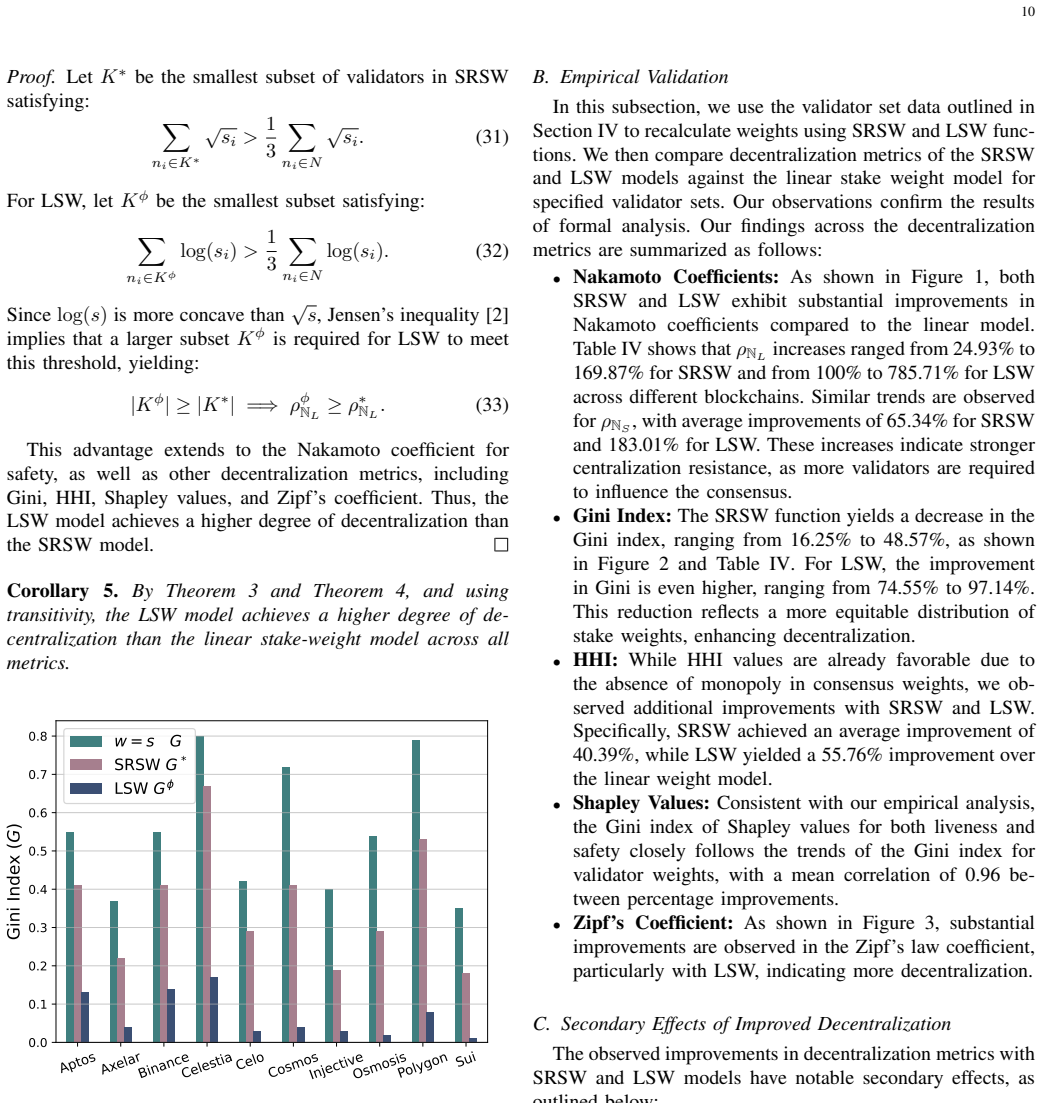
The central discovery is that the concentration of consensus influence in PoS chains is not a fixed property of having large validators; it is an artifact of the linear mapping from stake to voting power. By replacing $w_i = s_i$ with $w_i^* = \sqrt{s_i}$ or $w_i^\phi = \log(s_i)$ in the quorum-size computation, the authors show that Nakamoto coefficients (the percentage of validators needed to halt liveness or break safety) rise, while Gini, HHI, Zipf, and Shapley-value Gini all fall. Theorems 3 and 4 state the ordering: every decentralization metric under SRSW is at least as good as linear, and under LSW at least as good as SRSW, with the proofs relying on Jensen's inequality for concave functions. Empirically, across ten blockchains (Aptos, Axelar, BNB, Celestia, Celo, Cosmos, Injective, Osmosis, Polygon, Sui), the average metric improvement is 51% for SRSW and 132% for LSW.
Load-bearing premise
The paper's decentralization gains hold only if the system can enforce a Sybil cost high enough that validators do not split large stakes into many small identities, because concave weighting makes fragments collectively more powerful.
Editorial extensions
If this is right
- A PoS chain adopting SRSW or LSW only needs to change how voting weights and rewards are computed at epoch boundaries; the underlying BFT consensus remains the same.
- Liveness and safety Nakamoto coefficients increase substantially, so a would-be censoring or ledger-rewriting coalition must capture a larger fraction of the validator set.
- Reward growth flattens for large stakeholders, slowing the rich-get-richer compounding that concentrates stake over time.
- LSW consistently outperforms SRSW across all measured metrics, so protocols seeking maximum decentralization can choose LSW, while SRSW offers a computationally cheaper intermediate step.
- The measured concentration in ten existing chains (Gini 0.35–0.8, liveness Nakamoto coefficients below 16%) indicates the problem is real and current, not hypothetical.
Reading between the lines
- Concavity, not the specific square-root or log form, is what drives the improvement; any strictly concave weighting (e.g., cubic root, $\ln(1+s)$) would sit between linear and LSW, suggesting a tunable design space the paper does not explore.
- The formal theorems assume validators do not fragment their stake; if the Sybil cost $C$ is not enforceable in practice, a rational large stakeholder could split into many identities and, under a concave weighting scheme, actually increase total voting power, undermining the claimed robustness. The paper acknowledges this socio-economic hurdle.
- The near-perfect correlation between Shapley-value Gini and stake-weight Gini suggests Shapley metrics add little information, so a simpler index could monitor decentralization at lower computational cost.
- The improvement numbers are computed on the same validator sets with weights recalculated; a real deployment would change staking incentives, so the measured 51% and 132% may not persist once validators adjust their behavior.
Signed reviews
Editorial analysis
A structured set of objections, weighed in public.
Referee Report
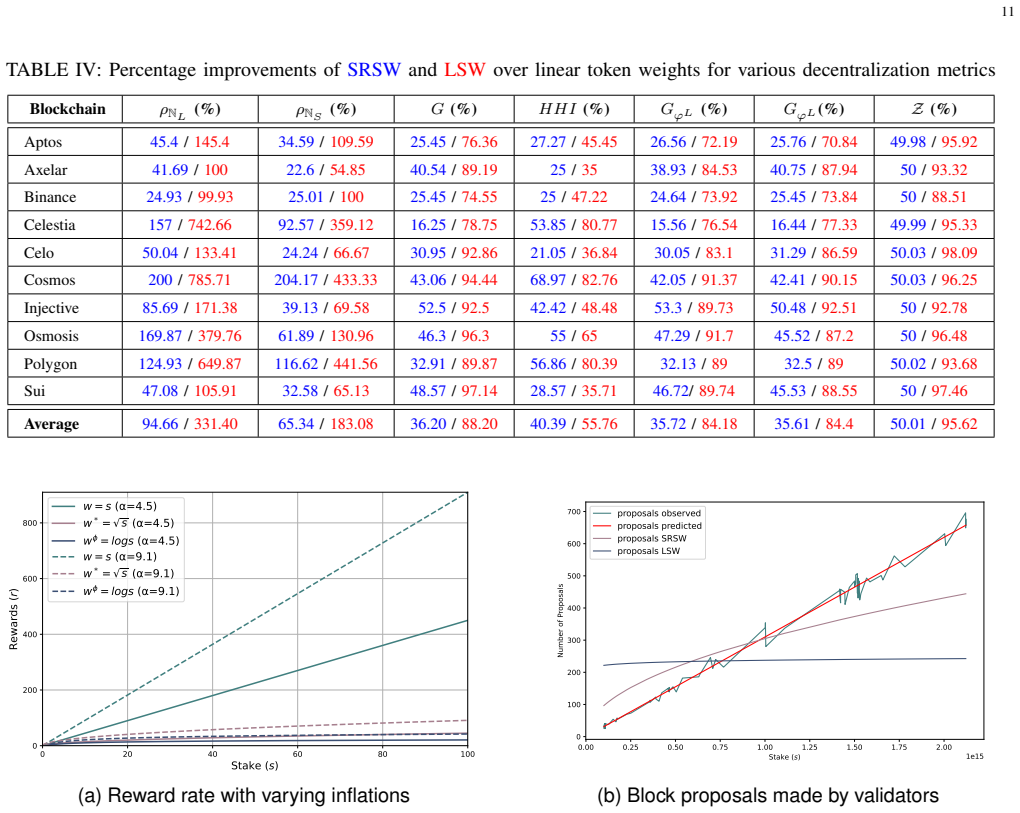
Summary. The paper studies decentralization of proof-of-stake consensus by measuring ten blockchains across several metrics (Nakamoto coefficients for liveness and safety, Gini index, HHI, Shapley-based Gini indices, and Zipf's coefficient). It reports significant stake concentration in existing systems and proposes two alternative stake-weighting schemes: Square Root Stake Weight (SRSW) and Logarithmic Stake Weight (LSW). Using the same validator sets, the paper recalculates weights and reports percentage improvements in decentralization metrics, with average improvements of 51% for SRSW and 132% for LSW across the seven metrics (Table IV). The authors also provide formal statements (Lemmas 1--2, Theorems 3--4) that these schemes improve decentralization, and discuss Sybil cost as a mechanism to prevent stake fragmentation.
Significance. If the claims are established, the paper offers a simple, protocol-level intervention that reduces stake concentration in PoS consensus and provides a reproducible empirical dataset (public GitHub repository, defined metrics, and a comparison table that can be recalculated). The proposal is easy to state and the empirical evaluation covers a diverse set of chains. However, the significance is tempered by two issues: the improvements in inequality metrics are largely mechanical consequences of applying concave transformations to weights, and the practical guarantee in permissionless settings depends on an enforceable Sybil cost, which the paper does not establish. The formal analysis, as written, does not meet the standard of rigorous proof promised in the introduction.
major comments (4)
- [Section V-D, Eqs. (21)-(22) and Sybil cost derivation] The Sybil cost bounds are arithmetically incorrect. For SRSW, the no-split condition is sqrt(S) > n*sqrt(S/n) - C, which gives C > (sqrt(n)-1)*sqrt(S), not the paper's stated C >= (sqrt(n)-1)/(n-1)*sqrt(S); for n>2 the paper underestimates the required cost by a factor of n-1. For LSW, the condition ln(1+S) > n*ln(1+S/n) - C gives C > n*ln(1+S/n) - ln(1+S), which for large S behaves as (n-1)*ln S - n*ln n and thus grows without bound, whereas the paper states C >= ln(n)/(n-1), a constant independent of S. Because both weighting functions are subadditive, a rational validator with large stake increases its total weight by splitting, and without an enforceable, correctly bounded Sybil cost the decentralization improvements in Table IV cannot be guaranteed in permissionless settings. The paper's own admission in Section V-D that establishing Sybil costs is 'a complex socio-economic challenge' beyond scope directly conflicts with the abstract's claim that the models 'support more equitable and resilient blockchain systems.'
- [Section VI-A, Lemmas 1--2 and Theorems 3--4] The formal analysis is not rigorous. Lemma 1 asserts that Jensen's inequality 'necessitates' a larger subset K* for the square-root weights, but no majorization or ordering argument is provided; the proof is a sketch. Lemma 2 is a prose paragraph asserting that the square-root transformation yields a lower Gini index, which is plausible but not proven. Theorem 3 states that HHI, Shapley-Gini, and Zipf's coefficient all improve without any derivation, and Theorem 4 asserts that LSW dominates SRSW because 'log(s) is more concave than sqrt(s)', a claim that is not true on the entire positive domain (for large s, the second derivative of sqrt(s) has larger magnitude than that of ln(1+s)). Since the introduction promises 'rigorous proofs that justify the observed results,' these gaps must be filled or the statements should be reframed as conjectures supported solely by the empirical evaluation.
- [Section IV-B / Table IV (interpretation of improvements)] The reported improvements are to a significant extent by construction rather than empirical discovery. Gini, HHI, and Shapley-based Gini are inequality measures that decrease under any concave increasing transformation of weights, and Nakamoto coefficients increase because concave transformations reduce the top-k share of total weight. The paper should explicitly acknowledge this and clarify that the contribution is the specific proposal and its quantitative evaluation on real validator sets, not a new formal theorem about decentralization. Without this clarification, the formal analysis in Section VI-A overstates the novelty of the results.
- [Section IV-B / Table III and Table IV (Zipf coefficient)] The methodology for computing the Zipf coefficient Z is not described. The paper does not state whether Z is estimated by ordinary least squares on log-log ranked weights, which rank range is used, or how the 'Z (%)' improvements in Table IV are derived. The near-uniform values (approximately 50% for SRSW and 95% for LSW across all ten chains) suggest a deterministic transformation of the fitted exponent, but the reader cannot verify this without the estimation procedure. Please provide the exact calculation and, ideally, the fitted exponents for the linear, SRSW, and LSW models.
minor comments (6)
- [Table IV] The column headers 'GφL (%)' appear twice; the second occurrence should presumably be 'GφS (%)'.
- [Section V-C and Eq. (26)] The logarithm base is inconsistent: Section V-C defines w_i^φ = log(s_i), while Eq. (26) and the Sybil analysis use ln(1+s_i). Please specify the base and clarify whether the +1 is part of the proposed LSW weighting or only used in the calculations.
- [Table I] The table header contains a typo: 'Priniciple' should be 'Principle'.
- [Figure 3] The y-axis label reads 'Zipf's Coefficient ( )' with an empty placeholder; the symbol is missing.
- [References] Reference [18] for Celestia points to https://celo.org/, which appears to be a copy-paste error; it should point to the Celestia documentation.
- [Section IV-A] The statement that all examined blockchains 'employ DPoS for Sybil resistance' is a broad generalization; Aptos and Sui are commonly described as PoS with delegated staking rather than DPoS, and this distinction should be qualified.
Circularity Check
No circularity: the decentralization improvements are derived from explicitly stated concave weight maps and externally defined metrics; the Sybil-cost caveat is an admitted robustness gap, not a circular step.
full rationale
The paper's central derivation chain is self-contained rather than circular. The decentralization metrics (Gini, Nakamoto coefficients, HHI, Shapley-Gini, Zipf) are defined externally in Section III on validator weights, and the SRSW and LSW models are fixed transformations of stake (Eqs. 18 and 23). The claimed improvements are proved as mathematical consequences of concavity (Lemmas 1-2, Theorems 3-4, Eqs. 27-33), not obtained by fitting parameters to the data. No parameter is calibrated to the ten-blockchain dataset; Section VI-B simply recomputes the same externally defined metrics under the proposed weights. The self-citations to prior work [70] for SRSW and metric adaptation are not load-bearing, because the relevant inequalities are re-derived in this paper and the metrics are standard external tools. The paper explicitly acknowledges in Section V-D that establishing Sybil costs is 'a complex socio-economic challenge' and 'beyond the scope of this work'; that is a limitation of the permissionless robustness claim, not a reduction of the claimed result to its own inputs. Theorem 4's extension from Nakamoto coefficients to Shapley-Gini and Zipf is asserted more than proved, but that is an evidentiary gap, not a circularity.
Assumptions & free parameters
free parameters (2)
- M (maximum validator set cardinality) =
not prescribed
- Sybil cost C =
no concrete implemented value
assumptions (4)
- domain assumption Validators are rational reward maximizers (Section V-A, Eq. 16).
- domain assumption Quorum thresholds remain 1/3 and 2/3 after nonlinear reweighting, with unchanged BFT fault-tolerance assumptions (Section II-B, Eq. 5; Section VI-A).
- standard math Jensen's inequality applied to concave transformations implies monotone increases in Nakamoto coefficients and monotone decreases in Gini, HHI, Shapley, and Zipf metrics (Section VI-A, Lemmas 1-2, Theorems 3-4).
- ad hoc to paper A high Sybil cost C can be enforced in practice (Section V-A, V-D).
Cite this review
Pith. "Pith review of Decentralization in PoS Blockchain Consensus: Quantification and Advancement." pith.science (2026). https://pith.science/paper/DNKPSOSW
@misc{pith2026250414351,
  author       = {Pith},
  title        = {Pith review of: Decentralization in PoS Blockchain Consensus: Quantification and Advancement},
  year         = {2026},
  howpublished = {\url{https://pith.science/paper/DNKPSOSW}},
  note         = {Machine review of arXiv:2504.14351}
}
read the original abstract
Decentralization is a foundational principle of permissionless blockchains, with consensus mechanisms serving a critical role in its realization. This study quantifies the decentralization of consensus mechanisms in proof-of-stake (PoS) blockchains using a comprehensive set of metrics, including Nakamoto coefficients, Gini, Herfindahl Hirschman Index (HHI), Shapley values, and Zipfs coefficient. Our empirical analysis across ten prominent blockchains reveals significant concentration of stake among a few validators, posing challenges to fair consensus. To address this, we introduce two alternative weighting models for PoS consensus: Square Root Stake Weight (SRSW) and Logarithmic Stake Weight (LSW), which adjust validator influence through non-linear transformations. Results demonstrate that SRSW and LSW models improve decentralization metrics by an average of 51% and 132%, respectively, supporting more equitable and resilient blockchain systems.
Figures


Figures from the paper (1 more)
Reference graph
Works this paper leans on
-
[1]
Proof-of-fee, part 2
0L. Proof-of-fee, part 2. https://0l.network/2022/10/20/proof-of-fee- part-2-a-proposal/. Accessed: 2023-12-15
2022
-
[2]
Re- fining jensen’s inequality
Shoshana Abramovich, Graham Jameson, and Gord Sinnamon. Re- fining jensen’s inequality. Bulletin math ´ematique de la Soci ´et´e des Sciences Math ´ematiques de Roumanie , pages 3–14, 2004
2004
-
[3]
Injective tendermint core: A powerful consensus engine for decentralized finance
Big Ace. Injective tendermint core: A powerful consensus engine for decentralized finance. https://medium.com/@charlesace/injective- tendermint-core-a-powerful-consensus-engine-for-decentralized- finance-a1db298b0b70. Accessed: 2023-12-14
2023
-
[4]
Lazyledger: A distributed data availability ledger with client-side smart contracts
Mustafa Al-Bassam. Lazyledger: A distributed data availability ledger with client-side smart contracts. arXiv preprint arXiv:1905.09274 , 2019
arXiv 1905
-
[5]
Emmanuelle Anceaume, Antonella Pozzo, Thibault Rieutord, and Sara Tucci-Piergiovanni. On finality in blockchains. arXiv preprint arXiv:2012.10172, 2020
work page Pith review arXiv 2012
-
[6]
https://aptosfoundation.org/
Aptos. https://aptosfoundation.org/. Accessed: 2023-10-25
2023
-
[7]
Dao decentralization: V oting-bloc entropy, bribery, and dark daos
James Austgen, Andr ´es F´abrega, Sarah Allen, Kushal Babel, Mahimna Kelkar, and Ari Juels. Dao decentralization: V oting-bloc entropy, bribery, and dark daos. arXiv preprint arXiv:2311.03530 , 2023
arXiv 2023
-
[8]
https://axelar.network/
Axelar. https://axelar.network/. Accessed: 2023-10-25
2023
Show all 100 references
-
[9]
Mysticeti: Reaching the limits of latency with uncertified dags
Kushal Babel, Andrey Chursin, George Danezis, Anastasios Kichidis, Lefteris Kokoris-Kogias, Arun Koshy, Alberto Sonnino, and Mingwei Tian. Mysticeti: Reaching the limits of latency with uncertified dags. arXiv preprint arXiv:2310.14821 , 2023
-
[10]
State machine replication in the libra blockchain
Mathieu Baudet, Avery Ching, Andrey Chursin, George Danezis, Franc ¸ois Garillot, Zekun Li, Dahlia Malkhi, Oded Naor, Dmitri Perel- man, and Alberto Sonnino. State machine replication in the libra blockchain. The Libra Assn., Tech. Rep , 7, 2019
2019
-
[11]
A survey on blockchain interoperability: Past, present, and future trends
Rafael Belchior, Andr ´e Vasconcelos, S ´ergio Guerreiro, and Miguel Correia. A survey on blockchain interoperability: Past, present, and future trends. ACM Computing Surveys (CSUR) , 54(8):1–41, 2021
2021
-
[12]
Proof-of-personhood: Rede- mocratizing permissionless cryptocurrencies
Maria Borge, Eleftherios Kokoris-Kogias, Philipp Jovanovic, Linus Gasser, Nicolas Gailly, and Bryan Ford. Proof-of-personhood: Rede- mocratizing permissionless cryptocurrencies. In 2017 IEEE European Symposium on Security and Privacy Workshops (EuroS&PW) , pages 23–26. IEEE, 2017
2017
-
[13]
Reward sharing schemes for stake pools
Lars Br ¨unjes, Aggelos Kiayias, Elias Koutsoupias, and Aikaterini- Panagiota Stouka. Reward sharing schemes for stake pools. In 2020 IEEE european symposium on security and privacy (EuroS&p) , pages 256–275. IEEE, 2020
2020
-
[14]
Tendermint: Byzantine fault tolerance in the age of blockchains
Ethan Buchman. Tendermint: Byzantine fault tolerance in the age of blockchains. PhD thesis, University of Guelph, 2016
2016
-
[15]
The latest gossip on bft consensus
Ethan Buchman, Jae Kwon, and Zarko Milosevic. The latest gossip on bft consensus. arXiv preprint arXiv:1807.04938 , 2018
2018 arXiv
-
[16]
The new merger guidelines and the herfindahl- hirschman index
Stephen Calkins. The new merger guidelines and the herfindahl- hirschman index. Calif. L. Rev., 71:402, 1983
1983
-
[17]
Practical byzantine fault toler- ance
Miguel Castro, Barbara Liskov, et al. Practical byzantine fault toler- ance. In OsDI, volume 99, pages 173–186, 1999
1999
-
[18]
https://celo.org/
Celestia. https://celo.org/. Accessed: 2023-12-14
2023
-
[19]
https://celo.org/
Celo. https://celo.org/. Accessed: 2023-12-14
2023
-
[20]
The origins of the gini index: extracts from variabilit `a e mutabilit `a (1912) by corrado gini
Lidia Ceriani and Paolo Verme. The origins of the gini index: extracts from variabilit `a e mutabilit `a (1912) by corrado gini. The Journal of Economic Inequality, 10:421–443, 2012
1912
-
[21]
https://www.bnbchain.org/
BNB Chain. https://www.bnbchain.org/. Accessed: 2023-10-25
2023
-
[22]
White paper
BNB Smart Chain. White paper. https://github.com/bnb-chain/whitep aper/blob/master/WHITEPAPER.md. Accessed: 2023-11-08
2023
-
[23]
https://coinmarketcap.com/
CoinMarketCap. https://coinmarketcap.com/. Accessed: 2023-12-14
2023
-
[24]
https://cosmos.network/
Cosmos. https://cosmos.network/. Accessed: 2023-10-25
2023
-
[25]
Flash boys 2.0: Frontrunning in decentralized exchanges, miner extractable value, and consensus instability
Philip Daian, Steven Goldfeder, Tyler Kell, Yunqi Li, Xueyuan Zhao, Iddo Bentov, Lorenz Breidenbach, and Ari Juels. Flash boys 2.0: Frontrunning in decentralized exchanges, miner extractable value, and consensus instability. In 2020 IEEE Symposium on Security and Privacy (SP),...
2020
-
[26]
Ouroboros praos: An adaptively-secure, semi-synchronous proof-of- stake blockchain
Bernardo David, Peter Ga ˇzi, Aggelos Kiayias, and Alexander Russell. Ouroboros praos: An adaptively-secure, semi-synchronous proof-of- stake blockchain. In Advances in Cryptology–EUROCRYPT 2018: 37th Annual International Conference on the Theory and Applications of Cryptograp...
2018
-
[27]
Pbft vs proof- of-authority: Applying the cap theorem to permissioned blockchain
Stefano De Angelis, Leonardo Aniello, Roberto Baldoni, Federico Lombardi, Andrea Margheri, Vladimiro Sassone, et al. Pbft vs proof- of-authority: Applying the cap theorem to permissioned blockchain. In CEUR workshop proceedings , volume 2058. CEUR-WS, 2018
2018
-
[28]
The aptos blockchain: Safe, scalable, and upgradeable web3 infrastructure
Aptos Dev. The aptos blockchain: Safe, scalable, and upgradeable web3 infrastructure. https://aptos.dev/aptos-white-paper/. Published:2022- 08-11, v1.0
2022
-
[29]
Celestia’s data availability layer
Celestia Docs. Celestia’s data availability layer. https://docs.celesti a.org/learn/how-celestia-works/data-availability-layer. Accessed: 2023-12-14
2023
-
[30]
Consensus
Celo docs. Consensus. https://docs.celo.org/protocol/consensus. Accessed: 2023-11-26
2023
-
[31]
A guide to stake-weighted quality of service on solana
Solana Docs. A guide to stake-weighted quality of service on solana. https://solana.com/developers/guides/advanced/stake-weighted-qos. Accessed: 2025-27-03
2025
-
[32]
The sybil attack
John R Douceur. The sybil attack. In International workshop on peer- to-peer systems, pages 251–260. Springer, 2002
2002
-
[33]
Foundations of dynamic bft
Sisi Duan and Haibin Zhang. Foundations of dynamic bft. In 2022 IEEE Symposium on Security and Privacy (SP) , pages 1317–1334. IEEE, 2022
2022
-
[34]
Analyzing voting power in decentralized governance: Who controls daos? arXiv preprint arXiv:2204.01176, 2022
Robin Fritsch, Marino M ¨uller, and Roger Wattenhofer. Analyzing voting power in decentralized governance: Who controls daos? arXiv preprint arXiv:2204.01176, 2022
2022 arXiv
-
[35]
The bitcoin backbone protocol: Analysis and applications
Juan Garay, Aggelos Kiayias, and Nikos Leonardos. The bitcoin backbone protocol: Analysis and applications. In Annual international conference on the theory and applications of cryptographic techniques , pages 281–310. Springer, 2015
-
[36]
The estimation of the lorenz curve and gini index
Joseph L Gastwirth. The estimation of the lorenz curve and gini index. The review of economics and statistics , pages 306–316, 1972
1972
-
[37]
Jolteon and ditto: Network-adaptive efficient consensus with asynchronous fallback
Rati Gelashvili, Lefteris Kokoris-Kogias, Alberto Sonnino, Alexander Spiegelman, and Zhuolun Xiang. Jolteon and ditto: Network-adaptive efficient consensus with asynchronous fallback. In International conference on financial cryptography and data security , pages 296–
-
[38]
Algorand: Scaling byzantine agreements for cryptocurrencies
Yossi Gilad, Rotem Hemo, Silvio Micali, Georgios Vlachos, and Nickolai Zeldovich. Algorand: Scaling byzantine agreements for cryptocurrencies. In Proceedings of the 26th symposium on operating systems principles, pages 51–68, 2017
2017
-
[39]
Measurement of inequality of incomes
Corrado Gini. Measurement of inequality of incomes. The economic journal, 31(121):124–125, 1921
1921
-
[40]
Axelar core
GitHub. Axelar core. https://github.com/axelarnetwork/axelar- core/blob/main/docs/cli/axelard tendermint version.md. Accessed: 2023-11-26
2023
-
[41]
know your customer
Damian Hodgson. “know your customer”: marketing, governmentality and the “new consumer” of financial services. Management Decision, 40(4):318–328, 2002
2002
-
[42]
https://injective.com/
Injective. https://injective.com/. Accessed: 2023-12-14
2023
-
[43]
Centralized decentralization: Does voting matter? simple economics of the dpos blockchain governance
Seungwon Eugene Jeong. Centralized decentralization: Does voting matter? simple economics of the dpos blockchain governance. Simple Economics of the DPoS Blockchain Governance (April 21, 2020), 2020
2020
-
[44]
Sok: blockchain governance
Aggelos Kiayias and Philip Lazos. Sok: blockchain governance. arXiv preprint arXiv:2201.07188, 2022. 13
2022 arXiv
-
[45]
The most pressing issue on ethereum is validator size growth
Christine Kim. The most pressing issue on ethereum is validator size growth. https://www.coindesk.com/consensus-magazine/2023/09/2 9/the-most-pressing-issue-on-ethereum-is-validator-size-growth/. Accessed: 2023-12-14
2023
-
[46]
A taxonomic hierarchy of blockchain consensus algorithms: An evolutionary phylogeny approach
Heesang Kim and Dohoon Kim. A taxonomic hierarchy of blockchain consensus algorithms: An evolutionary phylogeny approach. Sensors, 23(5):2739, 2023
2023
-
[47]
Is stellar as secure as you think? In 2019 IEEE European Symposium on Security and Privacy Workshops (EuroS&PW), pages 377–385
Minjeong Kim, Yujin Kwon, and Yongdae Kim. Is stellar as secure as you think? In 2019 IEEE European Symposium on Security and Privacy Workshops (EuroS&PW), pages 377–385. IEEE, 2019
2019
-
[48]
Impossibility of full decentralization in permissionless blockchains
Yujin Kwon, Jian Liu, Minjeong Kim, Dawn Song, and Yongdae Kim. Impossibility of full decentralization in permissionless blockchains. In Proceedings of the 1st ACM Conference on Advances in Financial Technologies, pages 110–123, 2019
2019
-
[49]
The byzantine generals problem
Leslie Lamport, Robert Shostak, and Marshall Pease. The byzantine generals problem. In Concurrency: the works of leslie lamport , pages 203–226. ACM, 2019
2019
-
[50]
Decentralized exchanges
Alfred Lehar and Christine A Parlour. Decentralized exchanges. Available at SSRN 3905316 , 2021
2021
-
[51]
How does blockchain security dictate blockchain implementation? In Proceedings of the 2021 ACM SIGSAC Conference on Computer and Communications Security, pages 1006–1019, 2021
Andrew Lewis-Pye and Tim Roughgarden. How does blockchain security dictate blockchain implementation? In Proceedings of the 2021 ACM SIGSAC Conference on Computer and Communications Security, pages 1006–1019, 2021
2021
-
[52]
Comparison of decentralization in dpos and pow blockchains
Chao Li and Balaji Palanisamy. Comparison of decentralization in dpos and pow blockchains. In Blockchain–ICBC 2020: Third International Conference, Held as Part of the Services Conference Federation, SCF 2020, Honolulu, HI, USA, September 18-20, 2020, Proceedings 3 , pages 18–...
2020
-
[53]
Cross-consensus measurement of individual-level decentralization in blockchains
Chao Li, Balaji Palanisamy, Runhua Xu, and Li Duan. Cross-consensus measurement of individual-level decentralization in blockchains. In 2023 IEEE 9th Intl Conference on Big Data Security on Cloud (BigDataSecurity), IEEE Intl Conference on High Performance and Smart Computing,(...
2023
-
[54]
How hard is takeover in dpos blockchains? understand- ing the security of coin-based voting governance
Chao Li, Balaji Palanisamy, Runhua Xu, Li Duan, Jiqiang Liu, and Wei Wang. How hard is takeover in dpos blockchains? understand- ing the security of coin-based voting governance. arXiv preprint arXiv:2310.18596, 2023
2023 arXiv
-
[55]
Liquid democracy in dpos blockchains
Chao Li, Runhua Xu, and Li Duan. Liquid democracy in dpos blockchains. In Proceedings of the 5th ACM International Symposium on Blockchain and Secure Critical Infrastructure , pages 25–33, 2023
2023
-
[56]
Measuring decentralization in bitcoin and ethereum using multiple metrics and granularities
Qinwei Lin, Chao Li, Xifeng Zhao, and Xianhai Chen. Measuring decentralization in bitcoin and ethereum using multiple metrics and granularities. In 2021 IEEE 37th International Conference on Data Engineering Workshops (ICDEW), pages 80–87. IEEE, 2021
2021
-
[57]
From decentralization to oligopoly: A data-driven analysis of decen- tralization evolution and voting behaviors on eosio
Jieli Liu, Weilin Zheng, Dingyuan Lu, Jiajing Wu, and Zibin Zheng. From decentralization to oligopoly: A data-driven analysis of decen- tralization evolution and voting behaviors on eosio. IEEE Transactions on Computational Social Systems , 2022
2022
-
[58]
Understanding the decentralization of dpos: perspectives from data- driven analysis on eosio
Jieli Liu, Weilin Zheng, Dingyuan Lu, Jiajing Wu, and Zibin Zheng. Understanding the decentralization of dpos: perspectives from data- driven analysis on eosio. arXiv preprint arXiv:2201.06187 , 2022
2022 arXiv
-
[59]
Sok: Validating bridges as a scaling solution for blockchains
Patrick McCorry, Chris Buckland, Bennet Yee, and Dawn Song. Sok: Validating bridges as a scaling solution for blockchains. Cryptology ePrint Archive, 2021
2021
-
[60]
Understanding blockchain governance: Analyzing decentralized voting to amend defi smart con- tracts
Johnnatan Messias, Vabuk Pahari, Balakrishnan Chandrasekaran, Kr- ishna P Gummadi, and Patrick Loiseau. Understanding blockchain governance: Analyzing decentralized voting to amend defi smart con- tracts. arXiv preprint arXiv:2305.17655 , 2023
2023 arXiv
-
[61]
The honey badger of bft protocols
Andrew Miller, Yu Xia, Kyle Croman, Elaine Shi, and Dawn Song. The honey badger of bft protocols. In Proceedings of the 2016 ACM SIGSAC conference on computer and communications security , pages 31–42, 2016
2016
-
[62]
Towards decen- tralization in dpos systems: election, voting and leader selection using virtual stake
Jelena Mi ˇsi´c, V ojislav B Miˇsi´c, and Xiaolin Chang. Towards decen- tralization in dpos systems: election, voting and leader selection using virtual stake. IEEE Transactions on Network and Service Management, 2023
2023
-
[63]
The istanbul bft consensus algorithm
Henrique Moniz. The istanbul bft consensus algorithm. arXiv preprint arXiv:2002.03613, 2020
2002 arXiv
-
[64]
Lido dominance prompts warnings about liquid staking derivatives
Nicholas Morgan. Lido dominance prompts warnings about liquid staking derivatives. https://decrypt.co/154804/lido-lsd-liquid-staking- decentralization. Accessed: 2023-11-29
2023
-
[65]
Sok: Decentralized sequencers for rollups
Shashank Motepalli, Luciano Freitas, and Benjamin Livshits. Sok: Decentralized sequencers for rollups. arXiv preprint arXiv:2310.03616, 2023
2023 arXiv
-
[66]
Reward mechanism for blockchains using evolutionary game theory
Shashank Motepalli and Hans-Arno Jacobsen. Reward mechanism for blockchains using evolutionary game theory. In 2021 3rd Conference on Blockchain Research & Applications for Innovative Networks and Services (BRAINS), pages 217–224. IEEE, 2021
2021
-
[67]
Decentralizing permis- sioned blockchain with delay towers
Shashank Motepalli and Hans-Arno Jacobsen. Decentralizing permis- sioned blockchain with delay towers. arXiv preprint arXiv:2203.09714, 2022
2022 arXiv
-
[68]
Analyzing geospatial distribution in blockchains
Shashank Motepalli and Hans-Arno Jacobsen. Analyzing geospatial distribution in blockchains. arXiv preprint arXiv:2305.17771 , 2023
2023 arXiv
-
[69]
Delay towers to bootstrap blockchains
Shashank Motepalli and Hans-Arno Jacobsen. Delay towers to bootstrap blockchains. In 2024 IEEE International Conference on Blockchain and Cryptocurrency (ICBC) , pages 397–399. IEEE, 2024
2024
-
[70]
How does stake dis- tribution influence consensus? analyzing blockchain decentralization
Shashank Motepalli and Hans-Arno Jacobsen. How does stake dis- tribution influence consensus? analyzing blockchain decentralization. In 2024 IEEE International Conference on Blockchain and Cryptocur- rency (ICBC), pages 343–352. IEEE, 2024
2024
-
[71]
Bitcoin: A peer-to-peer electronic cash system
Satoshi Nakamoto. Bitcoin: A peer-to-peer electronic cash system. Decentralized business review, 2008
2008
-
[72]
Power laws, pareto distributions and zipf’s law
Mark EJ Newman. Power laws, pareto distributions and zipf’s law. Contemporary physics, 46(5):323–351, 2005
2005
-
[73]
In search of an understandable consensus algorithm
Diego Ongaro and John Ousterhout. In search of an understandable consensus algorithm. In 2014 USENIX annual technical conference (USENIX ATC 14) , pages 305–319, 2014
2014
-
[74]
https://osmosis.zone/
Osmosis. https://osmosis.zone/. Accessed: 2023-10-25
2023
-
[75]
Analysis of the blockchain protocol in asynchronous networks
Rafael Pass, Lior Seeman, and Abhi Shelat. Analysis of the blockchain protocol in asynchronous networks. In Annual international conference on the theory and applications of cryptographic techniques, pages 643–
-
[76]
Zipf’s word frequency law in natural language: A critical review and future directions
Steven T Piantadosi. Zipf’s word frequency law in natural language: A critical review and future directions. Psychonomic bulletin & review , 21:1112–1130, 2014
2014
-
[77]
https://polygon.technology/
Polygon. https://polygon.technology/. Accessed: 2023-10-25
2023
-
[78]
Proof of stake
Staking Rewards. Proof of stake. https://www.stakingrewards.com/ass ets/proof-of-stake. Accessed: 2023-12-03
2023
-
[79]
Compar- ative review of the blockchain consensus algorithm between proof of stake (pos) and delegated proof of stake (dpos)
Sheikh Munir Skh Saad and Raja Zahilah Raja Mohd Radzi. Compar- ative review of the blockchain consensus algorithm between proof of stake (pos) and delegated proof of stake (dpos). International Journal of Innovative Computing , 10(2), 2020
2020
-
[80]
Decentralization: Conceptualization and measure- ment
Aaron Schneider. Decentralization: Conceptualization and measure- ment. Studies in comparative international development , 38:32–56, 2003
2003
-
[81]
Unpacking how de- centralized autonomous organizations (daos) work in practice
Tanusree Sharma, Yujin Kwon, Kornrapat Pongmala, Henry Wang, Andrew Miller, Dawn Song, and Yang Wang. Unpacking how de- centralized autonomous organizations (daos) work in practice. arXiv preprint arXiv:2304.09822, 2023
2023 arXiv
-
[82]
Fault-tolerant architectures for space and avionics applications
Daniel P Siewiorek and Priya Narasimhan. Fault-tolerant architectures for space and avionics applications. NASA Ames Research http://ic. arc. nasa. gov/projects/ishem/Papers/Siewi, 2005
2005
-
[83]
A simple method for measuring inequality
Thitithep Sitthiyot and Kanyarat Holasut. A simple method for measuring inequality. Palgrave Communications, 6(1):1–9, 2020
2020
-
[84]
A simple method for estimat- ing the lorenz curve
Thitithep Sitthiyot and Kanyarat Holasut. A simple method for estimat- ing the lorenz curve. Humanities and Social Sciences Communications, 8(1):1–9, 2021
2021
-
[85]
Better safe than sorry: Recovering after adversarial majority
Srivatsan Sridhar, Dionysis Zindros, and David Tse. Better safe than sorry: Recovering after adversarial majority. arXiv preprint arXiv:2310.06338, 2023
2023 arXiv
-
[86]
Srinivasan and Leland Lee
Balaji S. Srinivasan and Leland Lee. Quantifying decentralization. https://news.earn.com/quantifying-decentralization-e39db233c28e. Accessed: 2023-11-05
2023
-
[87]
https://sui.io/
Sui. https://sui.io/. Accessed: 2023-10-25
2023
-
[88]
Open problems in daos
Joshua Z Tan, Tara Merk, Sarah Hubbard, Eliza R Oak, Joni Pirovich, Ellie Rennie, Rolf Hoefer, Michael Zargham, Jason Potts, Chris Berg, et al. Open problems in daos. arXiv preprint arXiv:2310.19201, 2023
2023 arXiv
-
[89]
Tendermint explained — bringing bft-based pos to the public blockchain domain
Chjango Unchained. Tendermint explained — bringing bft-based pos to the public blockchain domain. https://blog.cosmos.network/tendermint- explained-bringing-bft-based-pos-to-the-public-blockchain-domain- f22e274a0fdb. Accessed: 2023-11-26
2023
-
[90]
Ethereum censorship dashboard
Toni Wahrst ¨atter. Ethereum censorship dashboard. https://censorship.p ics/. Accessed: 2023-12-17
2023
-
[91]
Ethereum smart contract security research: survey and future research opportunities
Zeli Wang, Hai Jin, Weiqi Dai, Kim-Kwang Raymond Choo, and Deqing Zou. Ethereum smart contract security research: survey and future research opportunities. Frontiers of Computer Science, 15:1–18, 2021
2021
-
[92]
Sift: Design and analysis of a fault-tolerant computer for aircraft control
John H Wensley, Leslie Lamport, Jack Goldberg, Milton W Green, Karl N Levitt, Po Mo Melliar-Smith, Robert E Shostak, and Charles B Weinstock. Sift: Design and analysis of a fault-tolerant computer for aircraft control. Proceedings of the IEEE , 66(10):1240–1255, 1978
1978
-
[93]
Peppermint
Polygon wiki. Peppermint. https://wiki.polygon.technology/docs/pos/d esign/heimdall/peppermint. Accessed: 2023-11-26. 14
2023
-
[94]
The shapley value
Eyal Winter. The shapley value. Handbook of game theory with economic applications, 3:2025–2054, 2002
2025
-
[95]
A new identity and financial network
Worldcoin. A new identity and financial network. https://whitepap er.worldcoin.org/#a-new-identity-and-financial-network. Accessed: 2023-12-16
2023
-
[96]
Hotstuff: Bft consensus with linearity and responsive- ness
Maofan Yin, Dahlia Malkhi, Michael K Reiter, Guy Golan Gueta, and Ittai Abraham. Hotstuff: Bft consensus with linearity and responsive- ness. In Proceedings of the 2019 ACM Symposium on Principles of Distributed Computing, pages 347–356, 2019
2019
-
[97]
Towards More Efficient and Scalable Consensus Algorithms
Gengrui Zhang. Towards More Efficient and Scalable Consensus Algorithms. PhD thesis, University of Toronto, 2023
2023
-
[98]
Reaching consen- sus in the byzantine empire: A comprehensive review of bft consensus algorithms
Gengrui Zhang, Fei Pan, Michael Dang’ana, Yunhao Mao, Shashank Motepalli, Shiquan Zhang, and Hans-Arno Jacobsen. Reaching consen- sus in the byzantine empire: A comprehensive review of bft consensus algorithms. arXiv preprint arXiv:2204.03181 , 2022
2022 arXiv
-
[99]
Prestigebft: Revolutionizing view changes in bft consensus algorithms with reputation mechanisms
Gengrui Zhang, Fei Pan, Sofia Tijanic, and Hans-Arno Jacobsen. Prestigebft: Revolutionizing view changes in bft consensus algorithms with reputation mechanisms. arXiv preprint arXiv:2307.08154 , 2023
2023 arXiv
-
[100]
Human behavior and the principle of least effort: An introduction to human ecology
George Kingsley Zipf. Human behavior and the principle of least effort: An introduction to human ecology . Ravenio books, 2016. Shashank Motepalli Motepalli is a PhD Candi- date at the Sr. Rogers Department of Electrical and Computer Engineering, University of Toronto. His res...
2016
Reviewed August 16, 2026 · model on record in the stance chip above.
Discussion (0). Continue with ORCID to comment.