REVIEW 3 major objections 4 minor 21 references
Optimizing SIA Development: A Case Study in User-Centered Design for Estuary, a Multimodal Socially Interactive Agent Framework
T0 review · 3 major / 4 minor · reviewed 2026-08-16 · deepseek-v4-flash
Pith's one-line read Ten researcher interviews chart what SIA frameworks must deliver
desk verdict A small, honest RAP case study on SIA framework needs; the demo-framework conflation is real and admitted, but the open methodology and the needs themes make it worth a serious read. read the letter →
The pith
A machine-rendered reading of the paper's core claim, the machinery that carries it, and where it could break.
The reading
What carries the argument
The Rapid Assessment Process (RAP) is the methodological engine: directed one-hour insider-to-insider interviews run until thematic saturation around ten participants, with transcripts coded independently by two analysts and grouped into themes. The artifact under evaluation is Estuary's event-based client-server architecture, in which asynchronous 'Stages' wrap microservices in isolated child processes and route multimodal DataPackets over Socket.IO, paired with a Unity SDK for XR clients including the Apple Vision Pro demo used in the study.
What would settle it
Run the RAP interviews again with a fully functional version of Estuary that includes natural-language understanding and off-cloud LLM support, recruiting participants from multiple institutions; if the recurring themes about Estuary's flexibility and low latency do not reproduce, or if demo-focused comments no longer align with architecture-focused ones, the paper's claim that RAP captures framework-level values and gaps would be weakened.
Extended reading notes
Core claim
The central claim is that practicing SIA researchers converge on a small set of priorities—open-source availability, off-cloud and on-cloud flexibility, interoperability of microservices, and multimodal support—and that Estuary's design principles align with those priorities. The paper also claims that the main perceived drawbacks of Estuary are the complexity of its client-server setup and the desire for more integrated sensing modalities and controllable dialogue management. These claims are grounded in thematic analysis of one-hour insider interviews, coded by two team members, with themes grouped under four research questions covering current strengths, current gaps, Estuary's perceived value, and its perceived shortcomings.
Load-bearing premise
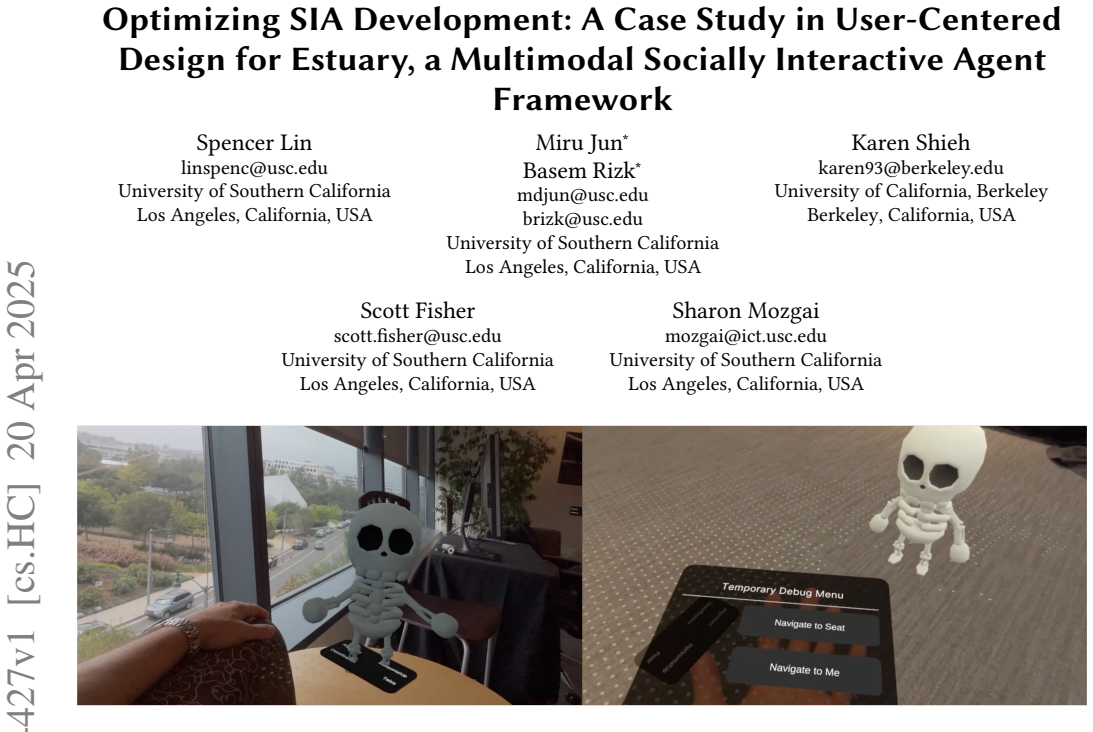
Participants' reactions to the early cartoon demo, which used a hand menu instead of natural-language understanding, are treated as valid evidence about the Estuary framework itself; the authors acknowledge that participants often commented on the demo rather than the architecture, so if the demo misrepresents the framework the conclusions about Estuary's strengths and weaknesses do not transfer.
Editorial extensions
If this is right
- Developers of future SIA frameworks should treat open-source access, off-cloud operation, and microservice interoperability as primary design targets rather than afterthoughts.
- Researchers want the ability to run the same framework fully offline or with cloud services interchangeably, so frameworks supporting both modes will fit more study contexts.
- The client-server split is a real adoption barrier; providing a standalone one-device mode and simpler networking setup would directly address a top participant concern.
- A ten-interview RAP cycle can steer iterative framework roadmaps, making it a viable alternative to large-scale surveys during early design.
Reading between the lines
- The transferability of the findings is likely limited by the single-institution convenience sample and by the fact that participants commented on an early demo without NLU; a broader sample could shift the priority ordering of the identified themes.
- If the perceived value of off-cloud and open-source capabilities holds, competitive pressure on cloud-dependent commercial platforms should increase, and objective benchmarks comparing latency and integration effort across frameworks would become valuable.
- A direct testable extension would be to run the same RAP protocol with researchers who have used Estuary in a full study rather than a demo, and check whether the RQ3/RQ4 themes persist.
- The desire for standardized message protocols across microservices suggests the field may converge on an interchange standard similar to what Estuary's DataPackets propose.
Signed reviews
Editorial analysis
A structured set of objections, weighed in public.
Referee Report
Summary. This paper presents a case study of user-centered design for Estuary, an open-source multimodal framework for building real-time socially interactive agents. Using the Rapid Assessment Process, the authors conducted one-hour interviews with ten USC ICT-affiliated researchers to (1) identify valued aspects and gaps of current SIA development tools, and (2) evaluate Estuary's design principles. Thematic analysis of interview transcripts yields four sets of themes corresponding to the stated research questions. The paper concludes with design recommendations for SIA frameworks and an Estuary roadmap.
Significance. If the findings are accepted, the paper makes a useful contribution as one of the few published empirical needs analyses of SIA framework users, with a transparent interview guide (Appendix C) and an openly acknowledged set of limitations. The needs themes (RQ1/RQ2), such as integration difficulties, LLM reliability, and sustainability, align with known community concerns and are, in principle, actionable for framework designers. The evaluation of Estuary (RQ3/RQ4) is less secure because it rests on a demo that does not exercise the framework's core architectural claims, and on an in-group sample. The paper is honest in Section 6.1 about the demo–framework conflation and the convenience sample, which strengthens its credibility as a case study, but the framework-level conclusions need to be re-examined.
major comments (3)
- [4.3, 6.1, C.3] The RQ3 and RQ4 findings are supposed to evaluate Estuary as a framework, but the evidence was gathered around the AVP demo in which the NLU path was replaced by a hand-tracked AR menu and the conversation was powered by ChatGPT 3.5 in the cloud; Section 6.1 admits that participants often provided feedback on the demo rather than the framework itself. Because interview questions C.3.1–C.3.4 were asked immediately after the demo and do not systematically separate “demo” from “framework” referents, the themes in Sections 5.3–5.4 (e.g., low-latency voice, AR navigation vs. off-cloud, modular Stages/DataPackets, platform agnosticism) conflate two different objects of evaluation. This is load-bearing for the central claim that researchers perceive Estuary as addressing research gaps, and the paper does not report how many interviews used the adjusted protocol that asked for feedback on both.
- [4.1, 6.1] The participants were all recruited from USC ICT within the past five years, and the interviewer was a fellow ICT researcher; this creates an in-group sample for evaluating a framework developed at the same institution. The paper describes the sample as “leading researchers in the field” and generalizes the RQ1–RQ4 findings to the SIA research community, but the convenience sample cannot support that scope of inference. This is acknowledged as a limitation in Section 6.1, but the Discussion still frames the findings as community-level requirements; the claims need to be scaled back to ICT-affiliated researchers, or additional evidence of representativeness is needed.
- [4.4, 6.1] The thematic analysis is described as two coders each coding five transcripts with cross-review, but the manuscript does not report how many transcripts were coded by both coders, how disagreements were resolved, or whether the coding was done before or after the interview protocol adjustment. Given the admitted ambiguity between demo and framework feedback, the absence of a per-interview breakdown makes it impossible to assess the contamination size. Please report the protocol adjustment timeline and the coding consensus process.
minor comments (4)
- [Abstract, Section 1] The term “leading researchers” overstates the sample; consider using “researchers” or “ICT-affiliated researchers” to match the actual recruitment.
- [Section 4.4] The coding description is ambiguous: please clarify whether each transcript was independently coded by two coders or by only one coder with later cross-review, and report inter-coder agreement if applicable.
- [Section 2] The scoping review is described as systematic, but no search dates, inclusion counts, or PRISMA-style flow are provided; adding this information would support reproducibility.
- [Appendix C.1, Section 6.1] The protocol adjustment mentioned in Section 6.1 is not documented in the interview guide; please add the adjusted wording and indicate which participants received the updated protocol.
Circularity Check
No circular derivation: the interview findings are reported self-perceptions, and the acknowledged demo-framework confound is a validity limitation, not an input-output equivalence.
full rationale
This paper makes no formal derivation or prediction; its claims are qualitative summaries of interview self-reports. The RQ1-RQ4 themes are emergent codes from transcripts, so the findings are the participants' stated perceptions themselves, not quantities derived from hidden fitted inputs. The only self-citations are references to the authors' own Estuary paper [10] and prior ICT work [13], but these identify the system under study and a background motivation, respectively; neither is invoked as a uniqueness theorem, ansatz, or fitted parameter that forces the interview results. The RAP saturation rule is attributed to Beebe [1], an external methodological source. The authors explicitly flag in Section 6.1 that 'Participants often provided feedback on the demo rather than the framework itself' and that the ICT convenience sample limits generalizability; these are acknowledged validity limitations of a user study, not cases where a claimed result equals its input by construction. The demo-framework conflation weakens the transfer of RQ3/RQ4 themes to Estuary as an architecture, but the paper discloses it and does not redefine the framework in terms of the feedback. Therefore no circular step is exhibited and the study is best assessed on methodological validity grounds rather than circularity.
Assumptions & free parameters
assumptions (3)
- domain assumption The RAP protocol's assumption that 8-10 interviews are sufficient for thematic saturation.
- ad hoc to paper Participants recruited from USC ICT within the past five years are representative of the broader SIA research community.
- ad hoc to paper The AVP demo of Estuary is a sufficiently representative implementation for participants to evaluate the framework.
Cite this review
Pith. "Pith review of Optimizing SIA Development: A Case Study in User-Centered Design for Estuary, a Multimodal Socially Interactive Agent Framework." pith.science (2026). https://pith.science/paper/HMER2HY3
@misc{pith2026250414427,
  author       = {Pith},
  title        = {Pith review of: Optimizing SIA Development: A Case Study in User-Centered Design for Estuary, a Multimodal Socially Interactive Agent Framework},
  year         = {2026},
  howpublished = {\url{https://pith.science/paper/HMER2HY3}},
  note         = {Machine review of arXiv:2504.14427}
}
read the original abstract
This case study presents our user-centered design model for Socially Intelligent Agent (SIA) development frameworks through our experience developing Estuary, an open source multimodal framework for building low-latency real-time socially interactive agents. We leverage the Rapid Assessment Process (RAP) to collect the thoughts of leading researchers in the field of SIAs regarding the current state of the art for SIA development as well as their evaluation of how well Estuary may potentially address current research gaps. We achieve this through a series of end-user interviews conducted by a fellow researcher in the community. We hope that the findings of our work will not only assist the continued development of Estuary but also guide the development of other future frameworks and technologies for SIAs.
Figures

Reference graph
Works this paper leans on
-
[1]
James Beebe. 2001. Rapid Assessment Process.Encyclopedia of Social Measurement (01 2001), 285–291. doi:10.1016/B0-12-369398-5/00562-4
-
[2]
Tom B. Brown, Benjamin Mann, Nick Ryder, Melanie Subbiah, Jared Kaplan, Prafulla Dhariwal, Arvind Neelakantan, Pranav Shyam, Girish Sastry, Amanda Askell, Sandhini Agarwal, Ariel Herbert-Voss, Gretchen Krueger, Tom Henighan, Rewon Child, Aditya Ramesh, Daniel M. Ziegler, Jeffrey Wu, Clemens Winter, Christopher Hesse, Mark Chen, Eric Sigler, Mateusz Litwin...
arXiv 2020
-
[3]
NVIDIA Corporation. 2024. Unified Compute Framework (UCF) | NVIDIA Devel- oper. https://developer.nvidia.com/ucf Accessed: 2024-10-07
work page 2024
-
[4]
David DeVault, Ron Artstein, Grace Benn, Teresa Dey, Ed Fast, Alesia Gainer, Kallirroi Georgila, Jon Gratch, Arno Hartholt, Margaux Lhommet, et al . 2014. SimSensei Kiosk: A virtual human interviewer for healthcare decision support. In Proceedings of the 2014 international conference on Autonomous agents and multi-agent systems. 1061–1068
work page 2014
-
[5]
Aleix Conchillo Flaqué, Moishe Lettvin, Kwindla Hultman Kramer, chadbailey59, Jon Taylor, Thomas B., Liza, James Hush, and Rahul Nair. 2024. Pipecat AI - GitHub Repository. https://github.com/pipecat-ai/pipecat. Accessed: 2024-10-07
work page 2024
-
[6]
Jonathan Gratch, Arno Hartholt, Morteza Dehghani, and Stacy Marsella. 2013. Virtual humans: a new toolkit for cognitive science research. In Proceedings of the Annual Meeting of the Cognitive Science Society , Vol. 35
work page 2013
-
[7]
Jason Gregory. 2018. Game engine architecture. AK Peters/CRC Press. 307–309 pages
work page 2018
-
[8]
Arno Hartholt, Andrew Leeds, Ed Fast, Edwin Sookiassian, Kevin Kim, Sarah Beland, Pranav Kulkarni, and Sharon Mozgai. 2024. Multidisciplinary Research & Development of Multi-Agents and Virtual Humans Leveraging Integrated Mid- dleware Platforms. Intelligent Human Systems Integration (IHSI 2024): Integrating People and Intelligent Systems 119, 119 (2024)
work page 2024
Show all 21 references
-
[9]
Arno Hartholt, David Traum, Stacy C Marsella, Ari Shapiro, Giota Stratou, An- ton Leuski, Louis-Philippe Morency, and Jonathan Gratch. 2013. All together now: Introducing the virtual human toolkit. In Intelligent Virtual Agents: 13th International Conference, IV A 2013, Edinbu...
2013
-
[10]
Spencer Lin, Basem Rizk, Miru Jun, Andy Artze, Caitlín Sullivan, Sharon Moz- gai, and Scott Fisher. 2024. Estuary: A Framework For Building Multimodal Low-Latency Real-Time Socially Interactive Agents. In Proceedings of the 24th ACM International Conference on Intelligent Virt...
2024
-
[11]
Birgit Lugrin, Catherine Pelachaud, and David Traum (Eds.). 2021. The Handbook on Socially Interactive Agents: 20 years of Research on Embodied Conversational Agents, Intelligent Virtual Agents, and Social Robotics Volume 1: Methods, Behavior, Cognition (1 ed.). Vol. 37. Assoc...
2021
-
[12]
Matthew B Miles. 1994. Qualitative data analysis: An expanded sourcebook. Thousand Oaks (1994)
1994
-
[13]
Sharon Mozgai, Cari Kaurloto, Jade Winn, Andrew Leeds, Dirk Heylen, Arno Hartholt, and Stefan Scherer. 2023. Machine learning for semi-automated scoping reviews. Intelligent Systems with Applications 19 (2023), 200249
2023
-
[14]
NVIDIA Corporation. 2024. NVIDIA ACE | Avatar Cloud Engine. https: //developer.nvidia.com/ace. Accessed: 2024-10-07
2024
-
[15]
Benjamin D Nye, Daniel Auerbach, Tirth R Mehta, and Arno Hartholt. 2017. Building a backbone for multi-agent tutoring in GIFT (Work in progress). In Proceedings of the 5th Annual Generalized Intelligent Framework for Tutoring (GIFT) Users Symposium (GIFTSym5) . Robert Sottilare, 23
2017
-
[16]
Catherine Pelachaud, Carlos Busso, and Dirk Heylen. 2021. Multimodal behavior modeling for socially interactive agents. In The Handbook on Socially Interactive Agents: 20 Years of Research on Embodied Conversational Agents, Intelligent Virtual Agents, and Social Robotics Volum...
2021
-
[17]
Alec Radford, Jong Wook Kim, Tao Xu, Greg Brockman, Christine McLeavey, and Ilya Sutskever. 2023. Robust speech recognition via large-scale weak supervision. In International Conference on Machine Learning . PMLR, 28492–28518
2023
-
[18]
Rim Rekik, Stefanie Wuhrer, Ludovic Hoyet, Katja Zibrek, and Anne-Hélène Olivier. 2024. A Survey on Realistic Virtual Human Animations: Definitions, Features and Evaluations. In Computer Graphics Forum. Wiley Online Library, e15064
2024
-
[19]
Socket.IO. 2024. Socket.IO - Real-time application framework. https://socket.io/. Accessed: 2024-10-07
2024
-
[20]
William R Swartout, Benjamin D Nye, Arno Hartholt, Adam Reilly, Arthur C Graesser, Kurt VanLehn, Jon Wetzel, Matt Liewer, Fabrizio Morbini, Brent Morgan, et al. 2016. Designing a personal assistant for life-long learning (PAL3). In The Twenty-Ninth International Flairs Conference
2016
-
[21]
Socially Interactive Agents
Unity. 2024. UnityARKitDocumentation. https://docs.unity3d.com/Packages/ com.unity.xr.arkit@5.1/manual/ A DATABASE INFORMATION A.1 Searched Databases • ACM Digital Library • IEEE Xplore CHI EA ’25, April 26-May 1, 2025, Yokohama, Japan Spencer Lin, Miru Jun, Basem Rizk, Karen ...
2024
Reviewed August 16, 2026 · model on record in the stance chip above.
Discussion (0). Continue with ORCID to comment.