REVIEW 4 major objections 5 minor 83 references
SG-Reg: Generalizable and Efficient Scene Graph Registration
T0 review · 4 major / 5 minor · reviewed 2026-08-16 · deepseek-v4-flash
Pith's one-line read SG-Reg claims that noisy, real-world semantic scene graphs can be registered without an initial guess by learning a sparse multi-modal node feature, matching image-based localization accuracy while transmitting only 52 KB per frame.
desk verdict Solid engineering contribution to scene graph registration with a real gap in the generalizability claim: every automatically built scene graph comes from the authors' own FM-Fusion front-end, so transfer across semantic mapping pipelines is untested. read the letter →
The pith
A machine-rendered reading of the paper's core claim, the machinery that carries it, and where it could break.
The reading
What carries the argument
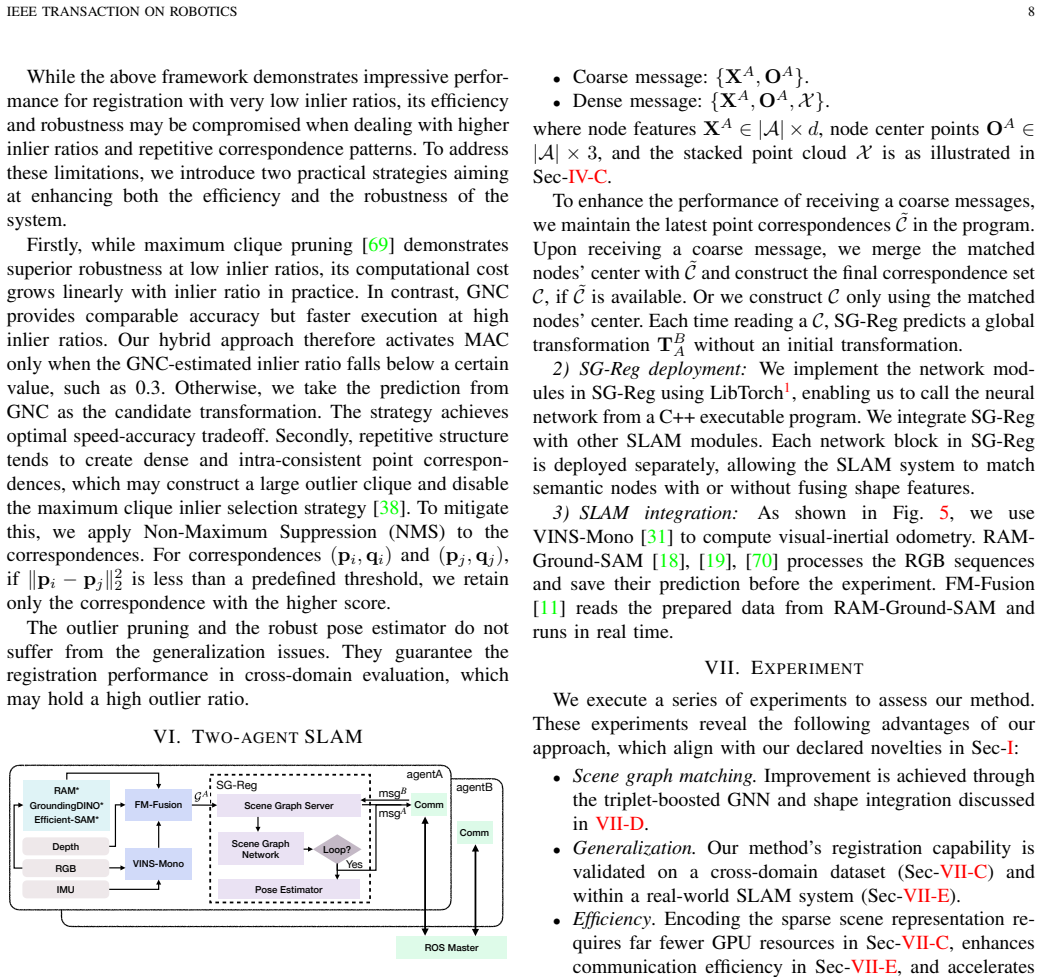
The central mechanism is the triplet-boosted GNN with late-fused shape features. For each node $v_i$, the model samples ordered triplets $(v_j, v_k)$ from its neighborhood and encodes the edge lengths $|e_{i,j}|$, $|e_{i,k}|$ and the cosine of the included angle $\hat{e}_{i,j}\cdot \hat{e}_{i,k}$ using sinusoidal embeddings; a $z$-component cross-product check enforces anti-clockwise ordering, making the triplet feature invariant to yaw rotation and translation. Attention over these triplets updates the node feature, giving the GNN spatial awareness that a vanilla graph attention network lacks. A point backbone with KPConv kernels extracts per-point features, and a shape backbone aggregates node-wise shape features that are concatenated after the GNN, so semantic topology and geometry stay separable. Node matching uses dual-normalized similarity scores with mutual top-$k$ selection; point matching uses Sinkhorn optimal transport; and the final pose comes from a robust estimator that prunes outliers with maximum clique and verifies candidate transformations geometrically.
What would settle it
Cross-mapper test: run the trained SG-Reg on scene graphs built by an independent semantic mapping system from the same RGB-D sequences and compare registration recall. A large drop would show the features are tuned to FM-Fusion's over-segmentation and label noise; a small drop would support the paper's generalization claim.
Extended reading notes
Core claim
On the paper's own terms, the central discovery is that a scene graph registration network can be trained without ground-truth semantic annotations and still register noisy, real-world semantic maps. Each node's feature fuses a frozen BERT encoding of its open-set semantic label, a triplet-boosted graph neural network feature that is invariant under 4-DoF global transformations, and a shape feature aggregated from the node's point cloud. Hierarchical matching layers first associate nodes through dual-normalized similarities and then find point correspondences inside matched node pairs using optimal transport; a robust pose estimator based on maximum-clique pruning and graduated non-convexity removes outliers and estimates the relative transformation. The system outperforms the closest learning-based baseline SG-PGM in node recall and registration recall, achieves higher overall registration recall than GeoTransformer in a cross-domain setting, and in the two-agent SLAM comparison reaches a success rate slightly above image-based HLoc before pose averaging, at 52 KB per frame.
Load-bearing premise
The load-bearing premise is that scene graphs reconstructed by FM-Fusion have the same kind and amount of noise as the scene graphs a deployed robot will actually encounter, so features learned on that data transfer to other mappers without retraining.
Editorial extensions
If this is right
- Bandwidth for cross-robot registration drops to about 52 KB per query frame, because only node features, node centers, and on-demand point clouds are transmitted instead of images.
- A robot can register against a prior map or another agent's map in a single shot without an initial guess, tolerating large viewpoint differences that break image-feature matching.
- Training scene graph registration no longer depends on ground-truth semantic annotations; posed RGB-D sequences plus foundation-model-based semantic mapping are enough to generate training pairs.
- Sparse semantic nodes keep GPU memory and FLOPS low enough to process large indoor scenes on a single RTX-3090, where dense superpoint baselines run out of memory.
- Because matching is conservative, low scene overlap produces few registrations, and the authors find success grows once scene graphs contain enough shared objects; combining SG-Reg with image constraints in a factor graph is their proposed remedy.
Reading between the lines
- Editorial inference: the cleanest untested generalization check is cross-mapper transfer—registering scene graphs produced by a semantic mapping system other than FM-Fusion. If recall drops sharply, the learned features are specialized to FM-Fusion's particular noise rather than to scene-graph noise in general.
- Editorial inference: the triplet descriptor is a portable spatial-encoding primitive; it could be reused in any graph representation where local yaw-invariant geometry is more reliable than absolute positions, such as floor-plan matching or planar-graph SLAM.
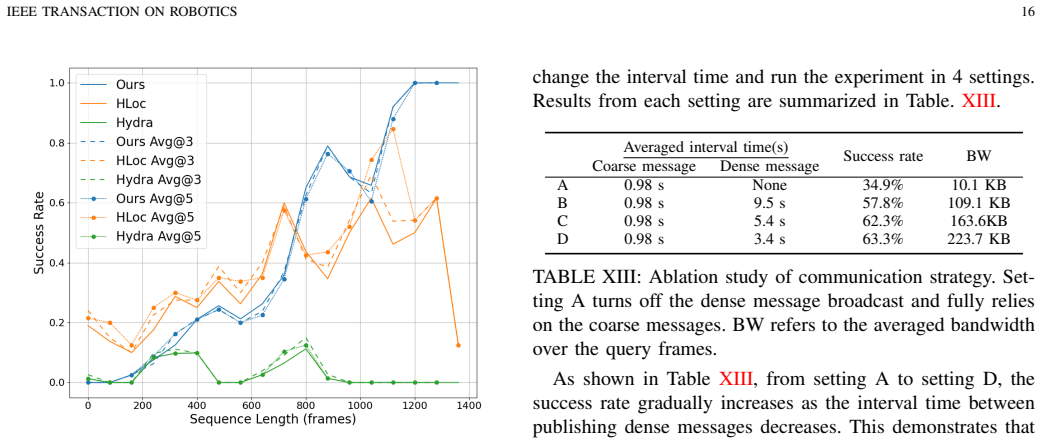
- Editorial inference: the 52 KB figure assumes the coarse-to-fine protocol with dense messages spaced about 5.4 s apart; running on coarse messages alone lowers success from 62.3% to 34.9%, so bandwidth and success should be quoted together.
- Editorial inference: the evaluation treats each agent's map as a rigid body with no odometry drift. In a full multi-session SLAM pipeline, SG-Reg would supply the initial alignment, but pose-graph optimization would still be needed to maintain global consistency over long trajectories.
Signed reviews
Editorial analysis
A structured set of objections, weighed in public.
Referee Report
Summary. The paper proposes SG-Reg, a learned method for registering two rigid semantic scene graphs without an initial guess. Scene graph nodes encode open-set semantic labels via BERT, local topology via a triplet-boosted GNN, and geometric shape via a point-cloud backbone plus a shape backbone. Matching is done hierarchically with dual-normalized assignment matrices and optimal transport, followed by a robust pose estimator built on G3Reg with GNC/MAC. A key contribution is an automatic data-generation pipeline that uses FM-Fusion and vision foundation models to build noisy scene graphs from RGB-D sequences, avoiding ground-truth semantic annotations. The method is evaluated on 3RScan-GT, ScanNet-Mapping, a cross-domain 3RScan-Mapping benchmark, and a custom two-agent SLAM benchmark, where it is compared with SG-PGM, GeoTransformer, Hydra, and HLoc.
Significance. If the claims hold, SG-Reg would be a practically valuable sparse representation for multi-agent and multi-session SLAM, offering competitive registration accuracy with a communication cost of about 52 KB per query frame, far below image-based methods. The paper has notable strengths: the ablations in Sec. VII-D support the contribution of the triplet-boosted GNN and late shape fusion; the cross-domain margin over SG-PGM in Table VI is large; the authors release code; and the two-agent benchmark is a realistic testbed. However, the headline comparisons against HLoc are statistically fragile, and the central "generalizable" claim is not directly tested across scene-graph construction front-ends, because every automatically generated graph in the paper comes from FM-Fusion.
major comments (4)
- [Sec. IV-A, VII-A(4), VII-C, VII-E] The title-level claim that SG-Reg is "generalizable" is not directly supported, because all automatically generated scene graphs used for training (ScanNet-Mapping), cross-domain evaluation (3RScan-Mapping), and the two-agent benchmark are constructed by FM-Fusion. A different semantic mapping front-end with different over-segmentation, label vocabulary, or object completeness will produce systematically different graph topology, and the learned node and point features may have adapted to FM-Fusion-specific statistics. The 3RScan-GT experiments use an annotation-based idealized domain and are not a transfer target. I recommend adding at least one evaluation in which scene graphs are built by an alternative front-end (e.g., ConceptGraphs, Kimera, or a deliberately perturbed FM-Fusion segmentation) or, if that is infeasible, narrowing the wording from "generalizable" to "cross-dataset" and explicitly stating the front-end dependence.
- [Sec. VII-E(8), Table XI] The abstract's claim of "slightly higher registration recall" over visual loop closure networks rests on a 0.7-percentage-point raw difference (32.4% vs 31.7% in Table XI), and the difference reverses after robust pose averaging: HLoc reaches 34.1% at Pose Avg@3 and 35.6% at Pose Avg@5, while SG-Reg drops to 32.0% and 31.5%. No error bars, per-sequence variance, or significance tests are reported for these numbers. Since this is one of the central advertised results, the paper should either provide statistical uncertainty across the ten sequence pairs or soften the claim to "comparable registration recall."
- [Sec. VII-B, VII-C] The SG-PGM baseline is modified by setting all relationship labels to "none" in the 3RScan-GT benchmark (Sec. VII-B), even though 3RScan-GT provides relationship labels that the original SG-PGM was designed to use. This adaptation may handicap the baseline and inflate the reported margin in Table IV. Please report the original SG-PGM with its native relationship labels on 3RScan-GT as an additional column, and clarify that the modified version is a domain-matched variant rather than the original method.
- [Sec. IV-E(2)] The "self-supervised" training still relies on geometric-overlap pseudo-labels: ground-truth node matches are obtained by IoU between FM-Fusion point clouds, and ground-truth point matches by a 0.05 m distance threshold. Because the same FM-Fusion pipeline is used for both training and evaluation, the learned features may exploit FM-Fusion-specific reconstruction artifacts. A useful additional experiment would be to train on 3RScan-GT annotation-based graphs and evaluate on 3RScan-Mapping graphs, which would test transfer from clean annotations to noisy FM-Fusion graphs rather than only ScanNet-FM-Fusion to 3RScan-FM-Fusion.
minor comments (5)
- [Sec. IV-E(2)] The text says "We compute the intersection-over-unit (IoU)"; this should be "intersection-over-union."
- [Sec. VII-D(3), Table X] The entry for late fusion reads "63.1(5.6)" while the other improvement is written as "(+3.2)"; the plus sign is missing in "(5.6)."
- [Sec. IV-C] There is a typo, "addtion," in the sentence describing the shape backbone's advantages.
- [Sec. IV-A, V] Several thresholds are named but not given numerical values: the edge-distance threshold tau_d, the GNC/MAC inlier-ratio trigger (stated as "below a certain value, such as 0.3"), and the NMS distance threshold. Please report the exact values in the implementation section or the supplementary material for reproducibility.
- [Sec. VII-F(2)] The reported runtimes exclude point-cloud pre-processing, which can take up to 900 ms per frame. This is stated in the text, but the main runtime table (Table XV) should carry a caption-level caveat so readers do not interpret the totals as end-to-end inference times.
Circularity Check
No significant circularity: the registration pipeline is evaluated on held-out external benchmarks; same-group citations (FM-Fusion, G3Reg) are components, not derivation inputs that force the results.
full rationale
This is an empirical learning system rather than an analytic derivation, so there is no equation-level reduction to check. The scene graph features are produced by trained encoders (BERT label features, triplet-boosted GNN, shape network), and correspondences are obtained from learned similarity matrices with Sinkhorn/optimal transport in Eqs. (10)-(13). The pose estimate is computed from those correspondences by the G3Reg-based estimator in Eqs. (17)-(19). None of these equations is defined in terms of the final registration output, and no fitted parameter is renamed as a prediction. The training labels are generated from IoU overlap of point clouds under random 4-DoF transformations (Sec. IV-E2 and Sec. VII-A4), while evaluation uses standard node recall/precision, inlier ratio, registration recall, and RMSE against ground-truth alignments; the network never sees the evaluation label at inference. The most legitimate concern is external validity: all automatically constructed graphs used for training, cross-domain evaluation, and the two-agent benchmark are produced by FM-Fusion, a same-group previous work, so transfer across different semantic-mapping front-ends is untested. That is a limitation of the breadth of the generalizability claim, not a circularity, because the tested scenes are held out and the reported metrics are measured against external ground truth. FM-Fusion [11] and G3Reg [28] are same-group citations, but they are used as components with independent published content, and no load-bearing argument reduces to an unverified self-citation. The abstract's slightly higher recall versus HLoc is the no-pose-average comparison, while Table XI shows HLoc improves with pose averaging; that is selective reporting rather than circular reasoning. No self-definitional, fitted-input, uniqueness-imported, ansatz-smuggled, or renamed-known-result step was identified.
Assumptions & free parameters
free parameters (6)
- Kp (sampled points per semantic node) =
256 (inferred from Table XVII matching main results)
- Node match extraction threshold and mutual top-k =
not stated
- GNC/MAC inlier-ratio trigger =
0.3
- NMS distance threshold on correspondences =
not stated
- Edge distance threshold tau_d =
depends on node shape size, formula not given
- Evaluation success thresholds (IoU 0.3, RMSE 0.2 m, RTE 0.2 m, RRE 5 deg) =
as listed
assumptions (5)
- domain assumption FM-Fusion reconstructed scene graphs are representative enough of real-world deployment graphs for training and evaluation
- domain assumption Relative roll and pitch between the two agents are known or gravity-aligned, leaving only 4-DoF uncertainty (position plus yaw)
- domain assumption RAM-Ground-SAM and FM-Fusion provide object labels and instances that, despite noise, are informative for matching across views
- standard math Sinkhorn optimal transport, maximum clique pruning, GNC, and G3Reg behave as described in their source papers
- domain assumption Training with known relative transformations from posed RGB-D sequences provides sufficient supervision without GT semantic labels
Cite this review
Pith. "Pith review of SG-Reg: Generalizable and Efficient Scene Graph Registration." pith.science (2026). https://pith.science/paper/L5ICOCI2
@misc{pith2026250414440,
  author       = {Pith},
  title        = {Pith review of: SG-Reg: Generalizable and Efficient Scene Graph Registration},
  year         = {2026},
  howpublished = {\url{https://pith.science/paper/L5ICOCI2}},
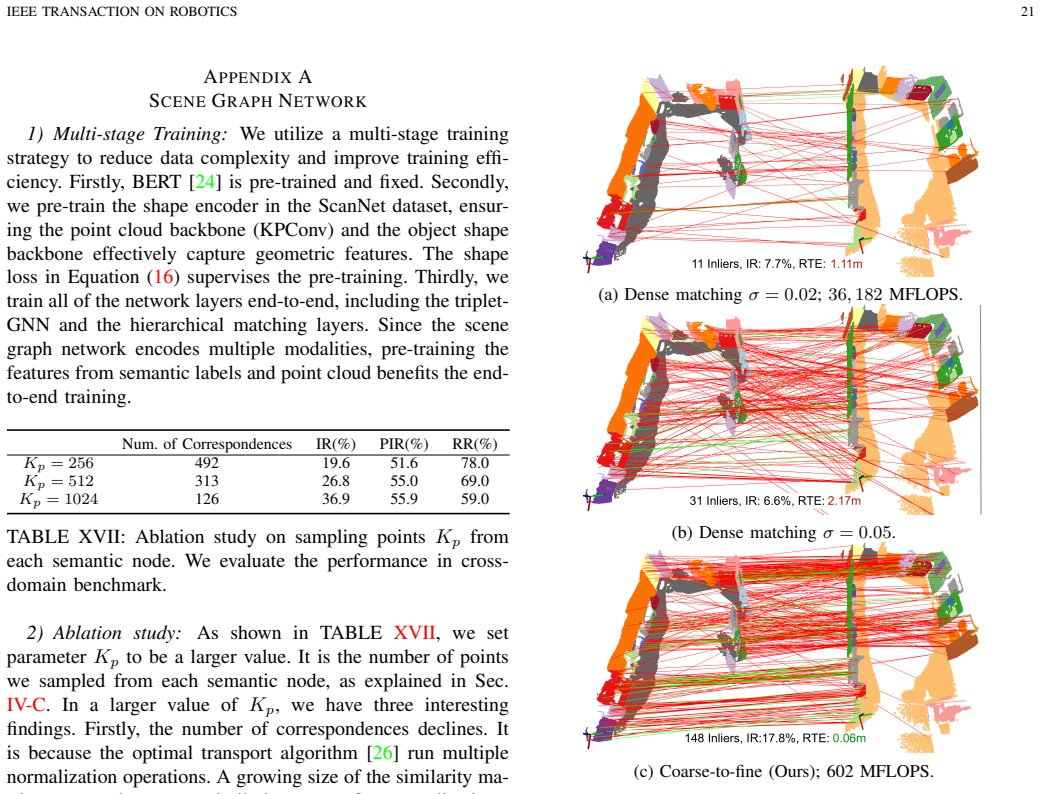
  note         = {Machine review of arXiv:2504.14440}
}
read the original abstract
This paper addresses the challenges of registering two rigid semantic scene graphs, an essential capability when an autonomous agent needs to register its map against a remote agent, or against a prior map. The hand-crafted descriptors in classical semantic-aided registration, or the ground-truth annotation reliance in learning-based scene graph registration, impede their application in practical real-world environments. To address the challenges, we design a scene graph network to encode multiple modalities of semantic nodes: open-set semantic feature, local topology with spatial awareness, and shape feature. These modalities are fused to create compact semantic node features. The matching layers then search for correspondences in a coarse-to-fine manner. In the back-end, we employ a robust pose estimator to decide transformation according to the correspondences. We manage to maintain a sparse and hierarchical scene representation. Our approach demands fewer GPU resources and fewer communication bandwidth in multi-agent tasks. Moreover, we design a new data generation approach using vision foundation models and a semantic mapping module to reconstruct semantic scene graphs. It differs significantly from previous works, which rely on ground-truth semantic annotations to generate data. We validate our method in a two-agent SLAM benchmark. It significantly outperforms the hand-crafted baseline in terms of registration success rate. Compared to visual loop closure networks, our method achieves a slightly higher registration recall while requiring only 52 KB of communication bandwidth for each query frame. Code available at: \href{http://github.com/HKUST-Aerial-Robotics/SG-Reg}{http://github.com/HKUST-Aerial-Robotics/SG-Reg}.
Figures


Figures from the paper (14 more)





Reference graph
Works this paper leans on
-
[1]
D2SLAM: Decentralized and distributed collaborative visual-inertial slam system for aerial swarm,
H. Xu, P. Liu, X. Chen, and S. Shen, “ D2SLAM: Decentralized and distributed collaborative visual-inertial slam system for aerial swarm,” IEEE Trans. Robot. (TRO) , 2024
2024
-
[2]
ORB-SLAM3: An accurate open-source library for visual, visual–inertial, and multimap slam,
C. Campos, R. Elvira, J. J. G. Rodr ´ıguez, J. M. Montiel, and J. D. Tard´os, “ORB-SLAM3: An accurate open-source library for visual, visual–inertial, and multimap slam,” IEEE Trans. Robot. (TRO), vol. 37, no. 6, pp. 1874–1890, 2021
2021
-
[3]
AutoMerge: A framework for map assembling and smoothing in city- scale environments,
P. Yin, S. Zhao, H. Lai, R. Ge, J. Zhang, H. Choset, and S. Scherer, “AutoMerge: A framework for map assembling and smoothing in city- scale environments,” IEEE Trans. Robot. (TRO) , 2023
2023
-
[4]
Long-term visual localization revisited,
C. Toft, W. Maddern, A. Torii, L. Hammarstrand, E. Stenborg, D. Safari, M. Okutomi, M. Pollefeys, J. Sivic, T. Pajdla et al., “Long-term visual localization revisited,” IEEE Trans. on Pattern Anal and Mach. Intell. (TPAMI), vol. 44, no. 4, pp. 2074–2088, 2020
work page 2020
-
[5]
NetVLAD: Cnn architecture for weakly supervised place recognition,
R. Arandjelovic, P. Gronat, A. Torii, T. Pajdla, and J. Sivic, “NetVLAD: Cnn architecture for weakly supervised place recognition,” in Proc. of the IEEE Conf. on Computer Vision and Pattern Recognition (CVPR) , 2016, pp. 5297–5307
work page 2016
-
[6]
SuperGlue: Learning feature matching with graph neural networks,
P.-E. Sarlin, D. DeTone, T. Malisiewicz, and A. Rabinovich, “SuperGlue: Learning feature matching with graph neural networks,” in Proc. of the IEEE Conf. on Computer Vision and Pattern Recognition (CVPR), 2020
work page 2020
-
[7]
LightGlue: Local Feature Matching at Light Speed,
P. Lindenberger, P.-E. Sarlin, and M. Pollefeys, “LightGlue: Local Feature Matching at Light Speed,” in Proc. of the IEEE Intl. Conf. on Computer Vision (ICCV) , 2023
work page 2023
-
[8]
CubeSLAM: Monocular 3d object slam,
S. Yang and S. Scherer, “CubeSLAM: Monocular 3d object slam,” IEEE Trans. Robot. (TRO), vol. 35, no. 4, pp. 925–938, 2019
work page 2019
Show all 83 references
-
[9]
Fusion++: V olumetric object-level slam,
J. McCormac, R. Clark, M. Bloesch, A. J. Davison, and S. Leutenegger, “Fusion++: V olumetric object-level slam,” in Proc. of the International Conference on 3D Vision (3DV) . IEEE, 2018, pp. 32–41
2018
-
[10]
Topology aware object-level semantic mapping towards more robust loop closure,
S. Lin, J. Wang, M. Xu, H. Zhao, and Z. Chen, “Topology aware object-level semantic mapping towards more robust loop closure,” IEEE Robotics and Automation Letters (RA-L) , vol. 6, pp. 7041–7048, 2021
2021
-
[11]
FM-Fusion: Instance- aware semantic mapping boosted by vision-language foundation mod- els,
C. Liu, K. Wang, J. Shi, Z. Qiao, and S. Shen, “FM-Fusion: Instance- aware semantic mapping boosted by vision-language foundation mod- els,” IEEE Robotics and Automation Letters (RA-L) , 2024
2024
-
[12]
Proba- bilistic data association for semantic SLAM,
S. L. Bowman, N. Atanasov, K. Daniilidis, and G. J. Pappas, “Proba- bilistic data association for semantic SLAM,” in Proc. of the IEEE Intl. Conf. on Robot. and Autom. (ICRA) . IEEE, 2017, pp. 1722–1729
2017
-
[13]
QuadricSLAM: Dual quadrics from object detections as landmarks in object-oriented slam,
L. Nicholson, M. Milford, and N. S ¨underhauf, “QuadricSLAM: Dual quadrics from object detections as landmarks in object-oriented slam,” IEEE Robotics and Automation Letters (RA-L) , vol. 4, no. 1, pp. 1–8, 2018
2018
-
[14]
X-View : Graph-based semantic multi-view localization,
C. D. Don, R. Siegwart, J. Nieto, C. Cadena, G. Abel, C. D. Don, R. Siegwart, J. Nieto, and C. Cadena, “X-View : Graph-based semantic multi-view localization,” IEEE Robotics and Automation Letters (RA-L), vol. 3, no. 3, pp. 1687–1694, 2018
2018
-
[15]
Hydra: A real-time spatial perception system for 3D scene graph construction and optimization,
N. Hughes, Y . Chang, and L. Carlone, “Hydra: A real-time spatial perception system for 3D scene graph construction and optimization,” in Proc. of Robotics: Science and System (RSS) , 2022
2022
-
[16]
SGAligner: 3D scene alignment with scene graphs,
S. D. Sarkar, O. Miksik, M. Pollefeys, D. Barath, and I. Armeni, “SGAligner: 3D scene alignment with scene graphs,” in Proc. of the IEEE Intl. Conf. on Computer Vision (ICCV) , 2023, pp. 21 927–21 937
2023
-
[17]
SG-PGM: Partial graph matching network with semantic geometric fusion for 3d scene graph alignment and its downstream tasks,
Y . Xie, A. Pagani, and D. Stricker, “SG-PGM: Partial graph matching network with semantic geometric fusion for 3d scene graph alignment and its downstream tasks,” in Proc. of the IEEE Conf. on Computer Vision and Pattern Recognition (CVPR) , 2024, pp. 28 401–28 411
2024
-
[18]
Recognize anything: A strong image tagging model,
Y . Zhang, X. Huang, J. Ma, Z. Li, Z. Luo, Y . Xie, Y . Qin, T. Luo, Y . Li, S. Liu et al., “Recognize anything: A strong image tagging model,” in Proc. of the IEEE Conf. on Computer Vision and Pattern Recognition (CVPR), 2023, pp. 1724–1732
2023
-
[19]
Grounding DINO: Marrying DINO with grounded pre- training for open-set object detection,
S. Liu, Z. Zeng, T. Ren, F. Li, H. Zhang, J. Yang, C. Li, J. Yang, H. Su, J. Zhu et al. , “Grounding DINO: Marrying DINO with grounded pre- training for open-set object detection,” in Proc. of European Conference on Computer Vision (ECCV) , 2024, pp. 38–55
2024
-
[20]
Segment anything,
A. Kirillov, E. Mintun, N. Ravi, H. Mao, C. Rolland, L. Gustafson, T. Xiao, S. Whitehead, A. C. Berg, W.-Y . Lo, P. Doll´ar, and R. Girshick, “Segment anything,” in Proc. of the IEEE Intl. Conf. on Computer Vision (ICCV), 2023, pp. 4015–4026
2023
-
[21]
Mask R-CNN,
K. He, G. Gkioxari, P. Doll ´ar, and R. Girshick, “Mask R-CNN,” in Proc. of the IEEE Intl. Conf. on Computer Vision (ICCV) , 2017, pp. 2961–2969
2017
-
[22]
SemanticFu- sion: Dense 3D semantic mapping with convolutional neural networks,
J. McCormac, A. Handa, A. Davison, and S. Leutenegger, “SemanticFu- sion: Dense 3D semantic mapping with convolutional neural networks,” in Proc. of the IEEE Intl. Conf. on Robot. and Autom. (ICRA) . IEEE, 2017, pp. 4628–4635
2017
-
[23]
Kimera: an open- source library for real-time metric-semantic localization and mapping,
A. Rosinol, M. Abate, Y . Chang, and L. Carlone, “Kimera: an open- source library for real-time metric-semantic localization and mapping,” in Proc. of the IEEE Intl. Conf. on Robot. and Autom. (ICRA) , 2020
2020
-
[24]
BERT: Pre-training of deep bidirectional transformers for language understanding,
J. Devlin, M.-W. Chang, K. Lee, and K. Toutanova, “BERT: Pre-training of deep bidirectional transformers for language understanding,” in Proc. of the Conference of the North American Chapter of the Association for Computational Linguistics: Human Language Technologies , Jun 20...
2019
-
[25]
How attentive are graph attention networks?
S. Brody, U. Alon, and E. Yahav, “How attentive are graph attention networks?” in Proc. of the International Conference on Learning Rep- resentations (ICLR), 2022
2022
-
[26]
Sinkhorn distances: Lightspeed computation of optimal transport,
M. Cuturi, “Sinkhorn distances: Lightspeed computation of optimal transport,” in Advances in Neural Information Processing Systems (NIPS), vol. 26, 2013
2013
-
[27]
Pairwise consistent measurement set maximization for robust multi- robot map merging,
J. G. Mangelson, D. Dominic, R. M. Eustice, and R. Vasudevan, “Pairwise consistent measurement set maximization for robust multi- robot map merging,” in Proc. of the IEEE Intl. Conf. on Robot. and Autom. (ICRA). IEEE, 2018, pp. 2916–2923
2018
-
[28]
G3Reg: Pyramid graph-based global registration using gaussian ellipsoid model,
Z. Qiao, Z. Yu, B. Jiang, H. Yin, and S. Shen, “G3Reg: Pyramid graph-based global registration using gaussian ellipsoid model,” IEEE IEEE TRANSACTION ON ROBOTICS 19 Transactions on Automation Science and Engineering (T-ASE), pp. 1–17, 2024
2024
-
[29]
RIO: 3d object instance re-localization in changing indoor environments,
J. Wald, A. Avetisyan, N. Navab, F. Tombari, and M. Nießner, “RIO: 3d object instance re-localization in changing indoor environments,” in Proc. of the IEEE Intl. Conf. on Computer Vision (ICCV) , 2019
2019
-
[30]
From coarse to fine: Robust hierarchical localization at large scale,
P.-E. Sarlin, C. Cadena, R. Siegwart, and M. Dymczyk, “From coarse to fine: Robust hierarchical localization at large scale,” in Proc. of the IEEE Conf. on Computer Vision and Pattern Recognition (CVPR), 2019
2019
-
[31]
VINS-Mono: A robust and versatile monocular visual-inertial state estimator,
T. Qin, P. Li, and S. Shen, “VINS-Mono: A robust and versatile monocular visual-inertial state estimator,” IEEE Trans. Robot. (TRO) , vol. 34, no. 4, pp. 1004–1020, 2018
2018
-
[32]
Bags of binary words for fast place recognition in image sequences,
D. G ´alvez-L´opez and J. D. Tardos, “Bags of binary words for fast place recognition in image sequences,” IEEE Trans. Robot. (TRO) , vol. 28, no. 5, pp. 1188–1197, 2012
2012
-
[33]
Dsac-differentiable ransac for camera localization,
E. Brachmann, A. Krull, S. Nowozin, J. Shotton, F. Michel, S. Gumhold, and C. Rother, “Dsac-differentiable ransac for camera localization,” in Proc. of the IEEE Conf. on Computer Vision and Pattern Recognition (CVPR), 2017, pp. 6684–6692
2017
-
[34]
Lamar: Benchmarking localization and mapping for augmented reality,
P.-E. Sarlin, M. Dusmanu, J. L. Sch ¨onberger, P. Speciale, L. Gruber, V . Larsson, O. Miksik, and M. Pollefeys, “Lamar: Benchmarking localization and mapping for augmented reality,” in Proc. of European Conference on Computer Vision (ECCV). Springer, 2022, pp. 686–704
2022
-
[35]
Bundle- fusion: Real-time globally consistent 3D reconstruction using on-the-fly surface reintegration,
A. Dai, M. Nießner, M. Zollh ¨ofer, S. Izadi, and C. Theobalt, “Bundle- fusion: Real-time globally consistent 3D reconstruction using on-the-fly surface reintegration,” ACM Transactions on Graphics (TOG) , vol. 36, no. 4, p. 1, 2017
2017
-
[36]
Fast global registration,
Q.-Y . Zhou, J. Park, and V . Koltun, “Fast global registration,” inProc. of European Conference on Computer Vision (ECCV) , 2016, pp. 766–782
2016
-
[37]
Fast point feature histograms (FPFH) for 3d registration,
R. B. Rusu, N. Blodow, and M. Beetz, “Fast point feature histograms (FPFH) for 3d registration,” in Proc. of the IEEE Intl. Conf. on Robot. and Autom. (ICRA) . IEEE, 2009, pp. 3212–3217
2009
-
[38]
Teaser: Fast and certifiable point cloud registration,
H. Yang, J. Shi, and L. Carlone, “Teaser: Fast and certifiable point cloud registration,” IEEE Trans. Robot. (TRO) , vol. 37, no. 2, pp. 314–333, 2020
2020
-
[39]
Deep closest point: Learning representa- tions for point cloud registration,
Y . Wang and J. M. Solomon, “Deep closest point: Learning representa- tions for point cloud registration,” in Proc. of the IEEE Intl. Conf. on Computer Vision (ICCV) , 2019, pp. 3523–3532
2019
-
[40]
Deep global registration,
C. Choy, W. Dong, and V . Koltun, “Deep global registration,” inProc. of the IEEE Intl. Conf. on Computer Vision (ICCV) , 2020, pp. 2514–2523
2020
-
[41]
Geometric transformer for fast and robust point cloud registration,
Z. Qin, H. Yu, C. Wang, Y . Guo, Y . Peng, and K. Xu, “Geometric transformer for fast and robust point cloud registration,” in Proc. of the IEEE Conf. on Computer Vision and Pattern Recognition (CVPR), 2022, pp. 11 143–11 152
2022
-
[42]
KPConv: Flexible and deformable convolution for point clouds,
H. Thomas, C. R. Qi, J.-E. Deschaud, B. Marcotegui, F. Goulette, and L. J. Guibas, “KPConv: Flexible and deformable convolution for point clouds,” in Proc. of the IEEE Intl. Conf. on Computer Vision (ICCV) , 2019, pp. 6411–6420
2019
-
[43]
PointNet: Deep learning on point sets for 3D classification and segmentation,
C. R. Qi, H. Su, K. Mo, and L. J. Guibas, “PointNet: Deep learning on point sets for 3D classification and segmentation,” in Proc. of the IEEE Conf. on Computer Vision and Pattern Recognition (CVPR) , 2017, pp. 652–660
2017
-
[44]
Method for registration of 3D shapes,
P. J. Besl and N. D. McKay, “Method for registration of 3D shapes,” in Sensor fusion IV: control paradigms and data structures , vol. 1611. Spie, 1992, pp. 586–606
1992
-
[45]
3DMatch: Learning local geometric descriptors from rgb-d reconstruc- tions,
A. Zeng, S. Song, M. Nießner, M. Fisher, J. Xiao, and T. Funkhouser, “3DMatch: Learning local geometric descriptors from rgb-d reconstruc- tions,” in Proc. of the IEEE Intl. Conf. on Computer Vision (ICCV) , 2017, pp. 1802–1811
2017
-
[46]
Attention is all you need,
A. Vaswani, N. Shazeer, N. Parmar, J. Uszkoreit, L. Jones, A. N. Gomez, Ł. Kaiser, and I. Polosukhin, “Attention is all you need,” Advances in Neural Information Processing Systems (NIPS) , vol. 30, 2017
2017
-
[47]
V oxblox: Incremental 3d euclidean signed distance fields for on-board mav planning,
H. Oleynikova, Z. Taylor, M. Fehr, R. Siegwart, and J. Nieto, “V oxblox: Incremental 3d euclidean signed distance fields for on-board mav planning,” Proc. of the IEEE/RSJ Intl. Conf. on Intell. Robots and Syst.(IROS), vol. 2017-Sep, pp. 1366–1373, 2017
2017
-
[48]
Situational graphs for robot navigation in structured indoor environ- ments,
H. Bavle, J. L. Sanchez-Lopez, M. Shaheer, J. Civera, and H. V oos, “Situational graphs for robot navigation in structured indoor environ- ments,” IEEE Robotics and Automation Letters (RA-L) , vol. 7, no. 4, pp. 9107–9114, 2022
2022
-
[49]
S-Graphs+: Real-time localization and mapping leveraging hierarchical representations,
H. Bavle, J. L. Sanchez-Lopez, M. Shaheer, J. Civera, and H. V oos, “S-Graphs+: Real-time localization and mapping leveraging hierarchical representations,” IEEE Robotics and Automation Letters (RA-L) , vol. 8, no. 8, pp. 4927–4934, 2023
2023
-
[50]
Foundations of spatial perception for robotics: Hierarchical representations and real-time systems,
N. Hughes, Y . Chang, S. Hu, R. Talak, R. Abdulhai, J. Strader, and L. Carlone, “Foundations of spatial perception for robotics: Hierarchical representations and real-time systems,” Intl. J. Robot. Research (IJRR) , p. 02783649241229725, 2024
2024
-
[51]
Hier- archical open-vocabulary 3D scene graphs for language-grounded robot navigation,
A. Werby, C. Huang, M. B ¨uchner, A. Valada, and W. Burgard, “Hier- archical open-vocabulary 3D scene graphs for language-grounded robot navigation,” in Proc. of Robotics: Science and System (RSS) , 2024
2024
-
[52]
Concept- Graphs: Open-vocabulary 3D scene graphs for perception and planning,
Q. Gu, A. Kuwajerwala, S. Morin, K. M. Jatavallabhula, B. Sen, A. Agarwal, C. Rivera, W. Paul, K. Ellis, R. Chellappa et al., “Concept- Graphs: Open-vocabulary 3D scene graphs for perception and planning,” in Proc. of the IEEE Intl. Conf. on Robot. and Autom. (ICRA) , 2023, pp...
2023
-
[53]
SlideSLAM: Sparse, lightweight, decen- tralized metric-semantic slam for multi-robot navigation,
X. Liu, J. Lei, A. Prabhu, Y . Tao, I. Spasojevic, P. Chaudhari, N. Atanasov, and V . Kumar, “SlideSLAM: Sparse, lightweight, decen- tralized metric-semantic slam for multi-robot navigation,” arXiv preprint arXiv:2406.17249, 2024
2024
-
[54]
Living Scenes: Multi- object relocalization and reconstruction in changing 3D environments,
L. Zhu, S. Huang, and I. A. Konrad Schindler, “Living Scenes: Multi- object relocalization and reconstruction in changing 3D environments,” in Proc. of the IEEE Conf. on Computer Vision and Pattern Recognition (CVPR), 2024
2024
-
[55]
Towards view-invariant and accurate loop detection based on scene graph,
C. Liu and S. Shen, “Towards view-invariant and accurate loop detection based on scene graph,” in Proc. of the IEEE Intl. Conf. on Robot. and Autom. (ICRA). IEEE, 2023, pp. 2127–2133
2023
-
[56]
Towards accurate loop closure detection in semantic SLAM with 3D semantic covisibility graphs,
Z. Qian, J. Fu, and J. Xiao, “Towards accurate loop closure detection in semantic SLAM with 3D semantic covisibility graphs,” IEEE Robotics and Automation Letters (RA-L) , vol. 7, no. 2, pp. 2455–2462, 2022
2022
-
[57]
Towards long-term retrieval-based visual localization in indoor envi- ronments with changes,
J. Kabalar, S.-C. Wu, J. Wald, K. Tateno, N. Navab, and F. Tombari, “Towards long-term retrieval-based visual localization in indoor envi- ronments with changes,” IEEE Robotics and Automation Letters (RA-L) , vol. 8, no. 4, pp. 1975–1982, 2023
1975
-
[58]
Neural graph matching network: Learn- ing lawler’s quadratic assignment problem with extension to hypergraph and multiple-graph matching,
R. Wang, J. Yan, and X. Yang, “Neural graph matching network: Learn- ing lawler’s quadratic assignment problem with extension to hypergraph and multiple-graph matching,” IEEE Trans. on Pattern Anal and Mach. Intell. (TPAMI), vol. 44, no. 9, pp. 5261–5279, 2021
2021
-
[59]
Marching cubes: A high resolution 3d surface construction algorithm,
W. E. Lorensen and H. E. Cline, “Marching cubes: A high resolution 3d surface construction algorithm,” ACM SIGGRAPH Computer Graphics , vol. 21, no. 4, pp. 163–169, 1987
1987
-
[60]
Finding minimal enclosing boxes,
J. O’Rourke, “Finding minimal enclosing boxes,” International journal of computer & information sciences , vol. 14, pp. 183–199, 1985
1985
-
[61]
DINO: DETR with improved denoising anchor boxes for end- to-end object detection,
H. Zhang, F. Li, S. Liu, L. Zhang, H. Su, J. Zhu, L. M. Ni, and H.-Y . Shum, “DINO: DETR with improved denoising anchor boxes for end- to-end object detection,” in Proc. of the International Conference on Learning Representations (ICLR) , 2022
2022
-
[62]
A triangle feature based map-to- map matching and loop closure for 2d graph slam,
B. Jiang, Y . Zhu, and M. Liu, “A triangle feature based map-to- map matching and loop closure for 2d graph slam,” in Proc. of the International Conference on Robotics and Biomimetics (ROBIO). IEEE, 2019, pp. 2719–2725
2019
-
[63]
STD: Stable triangle descriptor for 3D place recognition,
C. Yuan, J. Lin, Z. Zou, X. Hong, and F. Zhang, “STD: Stable triangle descriptor for 3D place recognition,” in Proc. of the IEEE Intl. Conf. on Robot. and Autom. (ICRA) . IEEE, 2023, pp. 1897–1903
2023
-
[64]
LTA- OM: Long-term association lidar–imu odometry and mapping,
Z. Zou, C. Yuan, W. Xu, H. Li, S. Zhou, K. Xue, and F. Zhang, “LTA- OM: Long-term association lidar–imu odometry and mapping,” J. Field Robot. (JFR), 2024
2024
-
[65]
BTC: A binary and triangle combined descriptor for 3d place recognition,
C. Yuan, J. Lin, Z. Liu, H. Wei, X. Hong, and F. Zhang, “BTC: A binary and triangle combined descriptor for 3d place recognition,” IEEE Trans. Robot. (TRO), 2024
2024
-
[66]
Algorithms for the assignment and transportation prob- lems,
J. Munkres, “Algorithms for the assignment and transportation prob- lems,” Journal of the society for industrial and applied mathematics , vol. 5, no. 1, pp. 32–38, 1957
1957
-
[67]
PointCon- trast: Unsupervised pre-training for 3D point cloud understanding,
S. Xie, J. Gu, D. Guo, C. R. Qi, L. Guibas, and O. Litany, “PointCon- trast: Unsupervised pre-training for 3D point cloud understanding,” in Proc. of European Conference on Computer Vision (ECCV) . Springer, 2020, pp. 574–591
2020
-
[68]
Graduated non- convexity for robust spatial perception: From non-minimal solvers to global outlier rejection,
H. Yang, P. Antonante, V . Tzoumas, and L. Carlone, “Graduated non- convexity for robust spatial perception: From non-minimal solvers to global outlier rejection,” IEEE Robotics and Automation Letters (RA-L) , vol. 5, no. 2, pp. 1127–1134, 2020
2020
-
[69]
A practical maximum clique algorithm for matching with pairwise constraints,
A. P. Bustos, T.-J. Chin, F. Neumann, T. Friedrich, and M. Katzmann, “A practical maximum clique algorithm for matching with pairwise constraints,” arXiv preprint arXiv:1902.01534 , vol. 2, 2019
1902 arXiv
-
[70]
EfficientSAM: Leveraged masked image pretraining for efficient segment anything,
Y . Xiong, B. Varadarajan, L. Wu, X. Xiang, F. Xiao, C. Zhu, X. Dai, D. Wang, F. Sun, F. Iandola et al. , “EfficientSAM: Leveraged masked image pretraining for efficient segment anything,” in Proc. of the IEEE Conf. on Computer Vision and Pattern Recognition (CVPR) , 2024, pp....
2024
-
[71]
ScanNet: Richly-annotated 3d reconstructions of indoor scenes,
A. Dai, A. X. Chang, M. Savva, M. Halber, T. Funkhouser, and M. Nießner, “ScanNet: Richly-annotated 3d reconstructions of indoor scenes,” in Proc. of the IEEE Conf. on Computer Vision and Pattern Recognition (CVPR), 2017. IEEE TRANSACTION ON ROBOTICS 20
2017
-
[72]
Generalized-ICP
A. Segal, D. Haehnel, and S. Thrun, “Generalized-ICP.” in Proc. of Robotics: Science and System (RSS) , vol. 2, no. 4. Seattle, W A, 2009, p. 435
2009
-
[73]
Neither Fast nor Slow: How to fly through narrow tunnels,
L. Wang, H. Xu, Y . Zhang, and S. Shen, “Neither Fast nor Slow: How to fly through narrow tunnels,” IEEE Robotics and Automation Letters (RA-L), vol. 7, no. 2, pp. 5489–5496, 2022
2022
-
[74]
Hydra-multi: Collabo- rative online construction of 3D scene graphs with multi-robot teams,
Y . Chang, N. Hughes, A. Ray, and L. Carlone, “Hydra-multi: Collabo- rative online construction of 3D scene graphs with multi-robot teams,” in Proc. of the IEEE/RSJ Intl. Conf. on Intell. Robots and Syst.(IROS) . IEEE, 2023, pp. 10 995–11 002
2023
-
[75]
Kimera-Multi: Robust, distributed, dense metric-semantic SLAM for multi-robot systems,
Y . Tian, Y . Chang, F. Herrera Arias, C. Nieto-Granda, J. P. How, and L. Carlone, “Kimera-Multi: Robust, distributed, dense metric-semantic SLAM for multi-robot systems,” IEEE Trans. Robot. (TRO) , vol. 38, no. 4, pp. 2022–2038, 2022. Chuhao Liu received his B.Eng degree in E...
2022
-
[76]
Firstly, BERT [24] is pre-trained and fixed
Multi-stage Training: We utilize a multi-stage training strategy to reduce data complexity and improve training effi- ciency. Firstly, BERT [24] is pre-trained and fixed. Secondly, we pre-train the shape encoder in the ScanNet dataset, ensur- ing the point cloud backbone (KPCo...
-
[77]
It is the number of points we sampled from each semantic node, as explained in Sec
Ablation study: As shown in TABLE XVII, we set parameter Kp to be a larger value. It is the number of points we sampled from each semantic node, as explained in Sec. IV-C. In a larger value of Kp, we have three interesting findings. Firstly, the number of correspondences decli...
-
[78]
VII-E(10)
Dense matching Vs Coarse-to-fine matching: We anal- ysis the advantages of coarse-to-fine matching in Sec. VII-E(10). Compared to dense matching, it requires lower computational FLOPS and result in a higher inlier ratio. As shown in Fig. 13(a), we evaluate the dense matching i...
-
[79]
As shown in Fig
How dense matching improves registration: We provide a visualization result to further support the evaluation in TABLE XIII. As shown in Fig. 14(a), SG-Reg relies on frames containing only coarse messages for registration. In (a) Dense matching σ = 0.02; 36, 182 MFLOPS. (b) De...
-
[80]
As shown in Fig
Success cases: We show two indoor scenes and highlight their semantic noise. As shown in Fig. 16, SG-Reg registers them successfully
-
[81]
Some of the limitations can be further addressed in our future works
Failed cases: We further analyze a few failure cases of SG-Reg to illustrate our upper limits. Some of the limitations can be further addressed in our future works. Fig. 17 shows three examples of failed registration. We analyze the reasons behind their failures. • Significant...
-
[82]
In each keyframe, HLoc can extract fewer than 4096 super- points
Compute HLoc bandwidth: We explain the HLoc config- uration for calculating communication bandwidth in Table XII. In each keyframe, HLoc can extract fewer than 4096 super- points. Across all keyframe sequences, we have accumulated the total superpoints to be 460, 000. Each sup...
-
[83]
We calculate the IoU of the input scene graphs at each query frame
Discuss registration: We also report our results fol- lowing the registration metrics. We calculate the IoU of the input scene graphs at each query frame. The query frames are grouped into three sets: Difficult set has IoU ∈ [0.1, 0.3); Median set has IoU∈ [0.3, 0.7); Easy set...
Reviewed August 16, 2026 · model on record in the stance chip above.
Discussion (0). Continue with ORCID to comment.