REVIEW 3 major objections 5 minor 50 references
Efficient Implicit Neural Compression of Point Clouds via Learnable Activation in Latent Space
T0 review · 3 major / 5 minor · reviewed 2026-08-16 · deepseek-v4-flash
Pith's one-line read PICO, an INR codec with learnable activations, outperforms MPEG point cloud compression by 4.92 dB on geometry.
desk verdict The 4.92 dB BD-PSNR claim is not supportable as written: the decoder is never told which cubes to evaluate, so the reported bpp omits mandatory side information. read the letter →
The pith
A machine-rendered reading of the paper's core claim, the machinery that carries it, and where it could break.
The reading
What carries the argument
LeAFNet is the central object: a coordinate network whose hidden layers use trainable activation functions of the form $\phi(x) = w_b\,\mathrm{silu}(x) + w_s \sum_i \exp(-\|x-c_i\|^2/h^2)$, replacing the B-spline kernels of Kolmogorov-Arnold Networks with radial basis functions. The argument also depends on three supporting mechanisms: a dynamic threshold $\tau_0$ chosen by golden-section search over a D1-PSNR curve that is empirically unimodal, which decides which voxels count as occupied; a reweighted sampling strategy that keeps occupied and empty voxels balanced despite severe sparsity; and parameter compression by uniform quantization followed by DeepCABAC entropy coding, with rate controlled by $\ell^1$ regularization and a dictionary of model sizes.
What would settle it
Recompute the rate-distortion curves for the four 8iVFB sequences while charging bits for the dynamic threshold (one scalar per sequence) and the model dictionary index (a few bits per rate point); if the BD-PSNR gain over G-PCC (octree) drops below the reported 7.09 dB average, the central claim fails. Alternatively, run the decoder with a fixed threshold derived only from the transmitted model and measure the resulting D1 PSNR loss.
Extended reading notes
Core claim
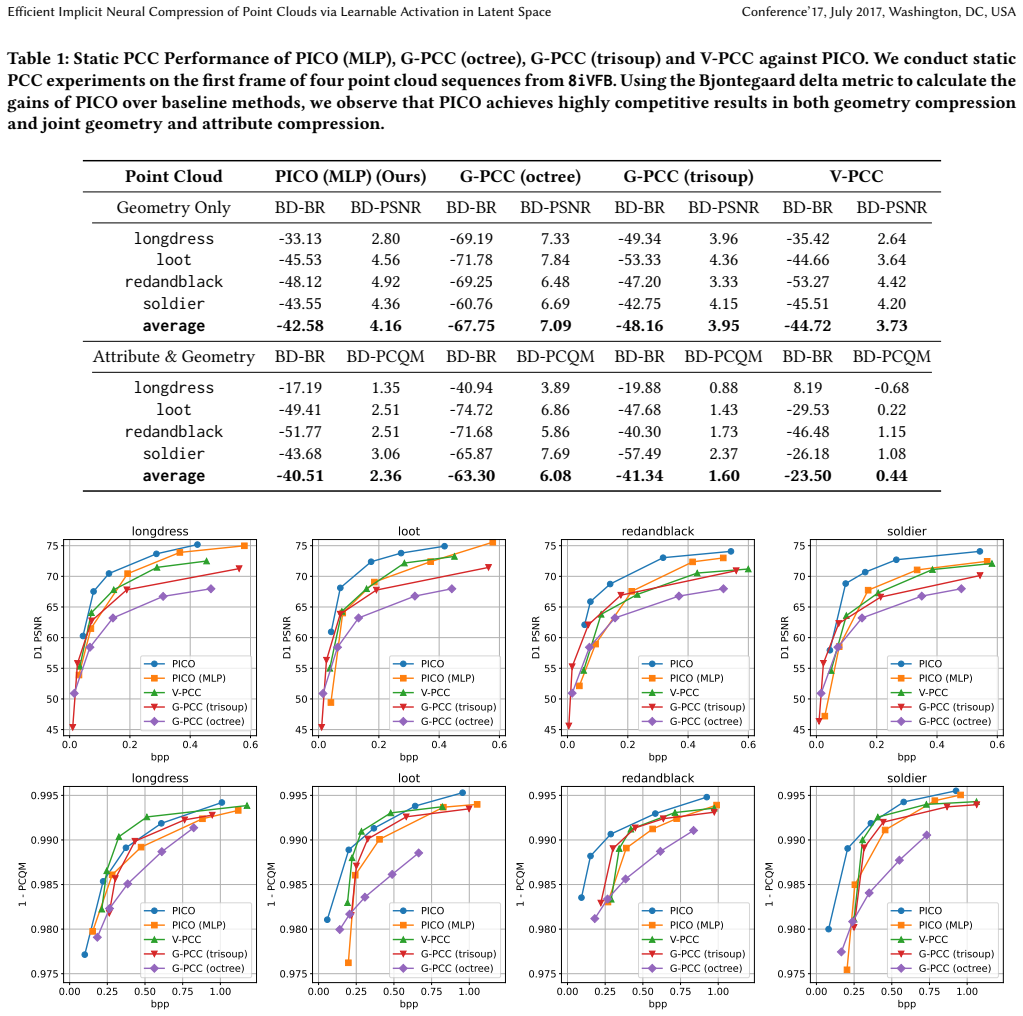
The discovery is that a per-point-cloud optimized network with learnable radial-basis activations can, after quantization and entropy coding of its parameters, reconstruct voxelized geometry at higher D1 PSNR than the standardized G-PCC and V-PCC codecs at the same bitrate on the four 8iVFB test sequences. The authors report BD-PSNR gains of 7.09 dB over G-PCC (octree), 3.95 dB over G-PCC (trisoup), and 3.73 dB over V-PCC, and an average 53.54% BD-BR reduction for geometry. For joint geometry and attribute compression they report a BD-PCQM improvement of $2.70 \times 10^{-3}$ over the same anchors, which they take as evidence that the two-stage decomposition preserves perceptual quality while keeping attributes aligned to the reconstructed geometry.
Load-bearing premise
The reported bitrate counts only the quantized and entropy-coded network parameters, and the paper does not state whether the dynamic threshold $\tau_0$ used at reconstruction and the model dictionary selection are also transmitted, so if those side bits are omitted the claimed rate-distortion gains are overstated.
Editorial extensions
If this is right
- Geometry bitstreams require roughly 44-68% fewer bits than the three MPEG anchors at matched D1 PSNR across the tested sequences.
- Because decoding is just coordinate queries through the network, a single bitstream can be evaluated at arbitrary sampling resolution without re-encoding.
- Improvements in neural network quantization and entropy coding transfer directly into point cloud compression gains, since the signal is only a set of weights.
- Splitting geometry and attribute compression means attribute quality is bounded by the reconstructed geometry, but color optimization can proceed independently once geometry is fixed.
Reading between the lines
- If the dynamic threshold $\tau_0$ and the model dictionary index are not counted in the bitrate, the reported rate-distortion gains are optimistic; a fair comparison should cost these side parameters explicitly.
- Because LeAFNet's activation is a generic replacement for fixed activations, the same quantization-and-entropy-coding pipeline could be applied to other INR tasks such as image or video compression.
- The unimodality of D1 PSNR as a function of the threshold is verified on only three trained models; testing the golden-section search on sparser and more varied LiDAR scenes would show whether the dynamic threshold remains reliable.
- Using the same codec on larger-scale block-wise scenes would test whether the per-sequence optimization cost, which is not included in the reported bitrate, remains acceptable in practice.
Signed reviews
Editorial analysis
A structured set of objections, weighed in public.
Referee Report
Summary. The paper proposes PICO, an implicit neural representation (INR) framework for static point cloud compression, decomposed into two stages: geometry compression and attribute compression. The geometry stage trains a neural network to predict voxel occupancy probabilities over a restricted sampling space, applies a dynamically optimized threshold, and the attribute stage regresses colors on the reconstructed geometry. The network architecture, LeAFNet, replaces conventional MLP activations with learnable radial-basis-function (RBF) inspired activations in the KAN style. The network parameters are quantized and entropy-coded with DeepCABAC, framing compression as neural parameter compression. Experiments on the first frames of four 8iVFB sequences report large BD-BR savings and BD-PSNR/BD-PCQM gains over G-PCC (octree), G-PCC (trisoup), and V-PCC, including the headline average 4.92 dB D1 PSNR improvement.
Significance. If the reported bitrate accounting is correct, PICO would be a noteworthy INR-based codec that beats the MPEG standards on this benchmark with a parameter-efficient KAN-inspired architecture. The paper includes a detailed algorithm, several ablations (threshold selection, sampling, positional encoding, model selection), and public baselines. The main strengths are the clean two-stage formulation, the demonstration of LeAFNet's parameter efficiency over an MLP, and the effort to control rate via L1 regularization and entropy coding. However, the central claim depends critically on the completeness of the transmitted bitstream, and the experimental validation is narrow. As written, the bitrate accounting has a load-bearing gap that must be resolved before the headline results can be accepted.
major comments (3)
- [Algorithm 1, Section 3.2.2, Eqs. (11)-(12)] The decoder in Algorithm 1 reconstructs X at lines 19-20 by querying f_g and f_a over the sampling space V, but V (and its defining cube occupancy set W) is computed from the original point cloud X in Eqs. (11)-(12) and is never included in the bitstream: line 17 entropy-encodes only the quantized network parameters. The decoder therefore cannot determine which of the 2^{3M}=32768 cubes (for M=5) contain points, so W is mandatory side information whose bitrate is absent from every bpp value in Table 1 and Figure 2. This omission can be large at low bpp and directly inflates the reported BD-BR savings and the headline 4.92 dB average D1 PSNR gain. The scalar threshold tau_0 from Algorithm 1 line 10 and the model dictionary index from SelectModel (line 3) are also not specified as transmitted. The paper must report the full bitstream including all side information, or explain how the decoder regenerates V without ground-truth geometry, and include that cost in all rate values.
- [Section 4.1.3, Section 3.5.2] The rate-distortion experiments are not reproducible as reported. Section 4.1.3 gives training steps, quantization steps, and optimizer settings, but does not give the L1 regularization strengths lambda_g and lambda_a used for each RD point, the entries of the model dictionary (hidden dimensions, number of RBF centers), the RBF bandwidth h, or the number and bpp values of the RD points in Figure 2. Section 3.5.2 states that a model dictionary M enables adaptive selection by target bpp but never lists the dictionary. Without these parameters, the RD curves in Figure 2 and the BD metrics in Table 1 cannot be verified, weakening the claim that PICO achieves precise rate control through joint tuning of lambda and Delta.
- [Section 4.2, Section 1] The experimental evaluation is limited to the first frame of each of the four 8iVFB sequences, with no error bars or repeated trials. The paper motivates the method with LiDAR-acquired large-scale point clouds in the Introduction, but all results are on a single dataset of human bodies at 1024^3 resolution. The absence of multi-frame statistics and the absence of any large-scale outdoor dataset make the broad claims of 'superior compression performance' and 'state-of-the-art' insufficiently supported, particularly since the method's complexity (training an INR per point cloud) is not evaluated for scalability.
minor comments (5)
- [Table 1 caption] The caption 'Static PCC Performance of PICO (MLP), G-PCC (octree), G-PCC (trisoup) and V-PCC against PICO' is ambiguous. It should clarify that each column pair reports the BD gains of the proposed PICO (LeAFNet) relative to the named baseline, with the first pair being the LeAFNet-versus-MLP ablation.
- [Eq. (22)] In Eq. (22), the two directional errors are both written as e(B,A); one should be e(A,B) to define the symmetric point-to-point error correctly.
- [Eqs. (13)-(14)] The sampling strategy notation in Eqs. (13)-(14) is confusing: Eq. (13) uses V-X while Eq. (14) uses U(V), and the relationship between the calibrated rate alpha-hat and the original alpha is not explained in the main text.
- [Figure 3(b)] The unimodality experiment in Figure 3(b) should specify the sequence, model configuration, and the range of thresholds used, since only the lambda values are currently identifiable.
- [Section 2.2, References] The paper cites Ruan et al. [32] as prior work on implicit neural compression of point clouds but does not compare against it in the experiments; adding this baseline (or justifying its exclusion) would strengthen the state-of-the-art claim.
Circularity Check
No circular derivation: benchmark gains are empirical comparisons, and the only author-overlapping citation is not load-bearing.
full rationale
The paper's central claims are empirical codec evaluations rather than closed-form derivations, so no predicted quantity reduces to an input by construction. The geometry INR is trained on voxel occupancy, and the dynamic threshold is selected by golden-section search on D1 PSNR; using the original point cloud at the encoder for this selection is standard rate-distortion optimization, not a self-fulfilling prediction. The BD-PSNR and BD-BR numbers in Table 1 are computed from rate-distortion curves against independent MPEG anchors using the paper's stated bitrate accounting, so the reported gains have independent empirical content. The only author-overlapping citation, reference [32], appears in a general list of multimodal INR techniques and is not used to justify LeAFNet, PICO, or the headline benchmark gains; therefore the self-citation is not load-bearing. The architecture borrows KAN, RBF, and NeRF components by acknowledged inspiration, not through a uniqueness theorem that forces the choices. A real concern is that Algorithm 1 derives the sampling space V and threshold tau_0 from the original geometry but appears to entropy-encode only the quantized network parameters, which may omit mandatory side information from the reported bitrates; that is a correctness and bitrate-accounting risk, not circularity, and does not raise the circularity score.
Assumptions & free parameters
free parameters (9)
- alpha (sampling target ratio) =
0.5
- gamma (focal loss modulation) =
2
- L (positional encoding length) =
64
- M (cube resolution bits) =
5
- Delta_g (geometry quantization step) =
1/2^10
- Delta_a (attribute quantization step) =
1/2^12
- lambda_g, lambda_a (L1 regularization strengths) =
not stated (varied)
- hidden dimensions for model dictionary =
24/36/48 in ablation; main curves unspecified
- RBF bandwidth h and center count =
not stated
assumptions (5)
- domain assumption The quality metric D(O, tau) is unimodal in the threshold tau.
- domain assumption An INR trained on voxels from non-empty cubes W generalizes to all voxels in V.
- domain assumption The decoder knows tau_0 and the model configuration with negligible or zero bitrate cost.
- domain assumption Nearest-neighbor projection of attributes from original geometry to reconstructed geometry provides valid training targets.
- standard math Kolmogorov-Arnold representation theorem supports the expressiveness of learnable activations.
Cite this review
Pith. "Pith review of Efficient Implicit Neural Compression of Point Clouds via Learnable Activation in Latent Space." pith.science (2026). https://pith.science/paper/N6Y4VX6I
@misc{pith2026250414471,
  author       = {Pith},
  title        = {Pith review of: Efficient Implicit Neural Compression of Point Clouds via Learnable Activation in Latent Space},
  year         = {2026},
  howpublished = {\url{https://pith.science/paper/N6Y4VX6I}},
  note         = {Machine review of arXiv:2504.14471}
}
abstract
Implicit Neural Representations (INRs), also known as neural fields, have emerged as a powerful paradigm in deep learning, parameterizing continuous spatial fields using coordinate-based neural networks. In this paper, we propose \textbf{PICO}, an INR-based framework for static point cloud compression. Unlike prevailing encoder-decoder paradigms, we decompose the point cloud compression task into two separate stages: geometry compression and attribute compression, each with distinct INR optimization objectives. Inspired by Kolmogorov-Arnold Networks (KANs), we introduce a novel network architecture, \textbf{LeAFNet}, which leverages learnable activation functions in the latent space to better approximate the target signal's implicit function. By reformulating point cloud compression as neural parameter compression, we further improve compression efficiency through quantization and entropy coding. Experimental results demonstrate that \textbf{LeAFNet} outperforms conventional MLPs in INR-based point cloud compression. Furthermore, \textbf{PICO} achieves superior geometry compression performance compared to the current MPEG point cloud compression standard, yielding an average improvement of $4.92$ dB in D1 PSNR. In joint geometry and attribute compression, our approach exhibits highly competitive results, with an average PCQM gain of $2.7 \times 10^{-3}$.
Figures


Reference graph
Works this paper leans on
-
[1]
Alireza Afzal Aghaei. 2025. fkan: Fractional Kolmogorov–Arnold Networks with trainable Jacobi basis functions. Neurocomputing 623 (2025), 129414
work page 2025
-
[2]
Francesco Ballerini, Pierluigi Zama Ramirez, Roberto Mirabella, Samuele Salti, and Luigi Di Stefano. 2024. Connecting NeRFs Images and Text. In Proceedings of the IEEE/CVF Conference on Computer Vision and Pattern Recognition . 866–876
work page 2024
-
[3]
Garrett Bingham and Risto Miikkulainen. 2022. Discovering parametric activation functions. Neural Networks 148 (2022), 48–65
work page 2022
-
[4]
Gisle Bjontegaard. 2001. Calculation of average PSNR differences between RD- curves. ITU SG16 Doc. VCEG-M33 (2001)
2001
-
[5]
Hao Chen, Bo He, Hanyu Wang, Yixuan Ren, Ser Nam Lim, and Abhinav Shri- vastava. 2021. Nerv: Neural representations for videos. Advances in Neural Information Processing Systems 34 (2021), 21557–21568
work page 2021
-
[6]
Yaodong Cui, Ren Chen, Wenbo Chu, Long Chen, Daxin Tian, Ying Li, and Dongpu Cao. 2021. Deep learning for image and point cloud fusion in autonomous driving: A review. IEEE Transactions on Intelligent Transportation Systems 23, 2 (2021), 722–739
work page 2021
-
[7]
Ashim Dahal, Saydul Akbar Murad, and Nick Rahimi. 2025. Efficiency Bot- tlenecks of Convolutional Kolmogorov-Arnold Networks: A Comprehensive Scrutiny with ImageNet, AlexNet, LeNet and Tabular Classification.arXiv preprint arXiv:2501.15757 (2025)
arXiv 2025
-
[8]
Ricardo L De Queiroz and Philip A Chou. 2016. Compression of 3D point clouds using a region-adaptive hierarchical transform. IEEE Transactions on Image Processing 25, 8 (2016), 3947–3956
2016
Show all 50 references
-
[9]
Emilien Dupont, Adam Goliński, Milad Alizadeh, Yee Whye Teh, and Arnaud Doucet. 2021. Coin: Compression with implicit neural representations. arXiv preprint arXiv:2103.03123 (2021)
2021 arXiv
-
[10]
Emilien Dupont, Hrushikesh Loya, Milad Alizadeh, Adam Goliński, Yee Whye Teh, and Arnaud Doucet. 2022. Coin++: Neural compression across modalities. arXiv preprint arXiv:2201.12904 (2022)
2022 arXiv
-
[11]
Mohit Goyal, Rajan Goyal, and Brejesh Lall. 2019. Learning activation functions: A new paradigm for understanding neural networks.arXiv preprint arXiv:1906.09529 (2019)
2019 arXiv
-
[12]
Danillo Graziosi, Ohji Nakagami, Shinroku Kuma, Alexandre Zaghetto, Teruhiko Suzuki, and Ali Tabatabai. 2020. An overview of ongoing point cloud compression standardization activities: Video-based (V-PCC) and geometry-based (G-PCC). APSIPA Transactions on Signal and Informatio...
2020
-
[13]
Moein Heidari, Reza Rezaeian, Reza Azad, Dorit Merhof, Hamid Soltanian-Zadeh, and Ilker Hacihaliloglu. 2024. Single-Layer Learnable Activation for Implicit Neural Representation (SL2A-INR). arXiv preprint arXiv:2409.10836 (2024)
2024
-
[14]
Tianxin Huang and Yong Liu. 2019. 3d point cloud geometry compression on deep learning. In Proceedings of the 27th ACM international conference on multimedia . 890–898
2019
-
[15]
Glenn Jocher, Alex Stoken, Jirka Borovec, Liu Changyu, Adam Hogan, Ayush Chaurasia, Laurentiu Diaconu, Francisco Ingham, Adrien Colmagro, Hu Ye, et al
-
[16]
Diederik P Kingma and Jimmy Ba. 2014. Adam: A method for stochastic opti- mization. arXiv preprint arXiv:1412.6980 (2014)
2014 arXiv
-
[17]
Ying Li, Lingfei Ma, Zilong Zhong, Fei Liu, Michael A Chapman, Dongpu Cao, and Jonathan Li. 2020. Deep learning for lidar point clouds in autonomous driving: A review. IEEE Transactions on Neural Networks and Learning Systems 32, 8 (2020), 3412–3432
2020
-
[18]
Ziyao Li. 2024. Kolmogorov-arnold networks are radial basis function networks. arXiv preprint arXiv:2405.06721 (2024)
2024 arXiv
-
[19]
Sohee Lim, Minwoo Shin, and Joonki Paik. 2022. Point cloud generation using deep adversarial local features for augmented and mixed reality contents. IEEE Transactions on Consumer Electronics 68, 1 (2022), 69–76
2022
-
[20]
Tsung-Yi Lin, Priya Goyal, Ross Girshick, Kaiming He, and Piotr Dollár. 2017. Focal loss for dense object detection. In Proceedings of the IEEE international conference on computer vision . 2980–2988
2017
-
[21]
Hou, and Max Tegmark
Ziming Liu, Yixuan Wang, Sachin Vaidya, Fabian Ruehle, James Halverson, Marin Soljacic, Thomas Y. Hou, and Max Tegmark. 2025. KAN: Kolmogorov–Arnold Networks. In The Thirteenth International Conference on Learning Representations
2025
-
[22]
Zhen Liu, Hao Zhu, Qi Zhang, Jingde Fu, Weibing Deng, Zhan Ma, Yanwen Guo, and Xun Cao. 2024. Finer: Flexible spectral-bias tuning in implicit neural representation by variable-periodic activation functions. In Proceedings of the IEEE/CVF Conference on Computer Vision and Patt...
2024
-
[23]
Gabriel Meynet, Yana Nehmé, Julie Digne, and Guillaume Lavoué. 2020. PCQM: A full-reference quality metric for colored 3D point clouds. In 2020 Twelfth International Conference on Quality of Multimedia Experience (QoMEX) . IEEE, 1–6
2020
-
[24]
Ben Mildenhall, Pratul P Srinivasan, Matthew Tancik, Jonathan T Barron, Ravi Ramamoorthi, and Ren Ng. 2021. Nerf: Representing scenes as neural radiance fields for view synthesis. Commun. ACM 65, 1 (2021), 99–106
2021
-
[25]
Charles R Qi, Hao Su, Kaichun Mo, and Leonidas J Guibas. 2017. Pointnet: Deep learning on point sets for 3d classification and segmentation. In Proceedings of the IEEE conference on computer vision and pattern recognition . 652–660
2017
-
[26]
Zekun Qi, Runpei Dong, Shaochen Zhang, Haoran Geng, Chunrui Han, Zheng Ge, Li Yi, and Kaisheng Ma. 2024. Shapellm: Universal 3d object understanding for embodied interaction. In European Conference on Computer Vision . Springer, 214–238
2024
-
[27]
Maurice Quach, Jiahao Pang, Dong Tian, Giuseppe Valenzise, and Frédéric Dufaux
-
[28]
Maurice Quach, Giuseppe Valenzise, and Frederic Dufaux. 2020. Improved deep point cloud geometry compression. In 2020 IEEE 22nd International Workshop on Multimedia Signal Processing (MMSP) . IEEE, 1–6
2020
-
[29]
Zizheng Que, Guo Lu, and Dong Xu. 2021. Voxelcontext-net: An octree based framework for point cloud compression. InProceedings of the IEEE/CVF Conference on Computer Vision and Pattern Recognition . 6042–6051
2021
-
[30]
Thinal Raj, Fazida Hanim Hashim, Aqilah Baseri Huddin, Mohd Faisal Ibrahim, and Aini Hussain. 2020. A survey on LiDAR scanning mechanisms. Electronics 9, 5 (2020), 741
2020
-
[31]
Sameera Ramasinghe and Simon Lucey. 2022. Beyond periodicity: Towards a unifying framework for activations in coordinate-mlps. In European Conference on Computer Vision. Springer, 142–158
2022
-
[32]
Hongning Ruan, Yulin Shao, Qianqian Yang, Liang Zhao, Zhaoyang Zhang, and Dusit Niyato. 2024. Implicit Neural Compression of Point Clouds. arXiv preprint arXiv:2412.10433 (2024)
2024 arXiv
-
[33]
Vishwanath Saragadam, Daniel LeJeune, Jasper Tan, Guha Balakrishnan, Ashok Veeraraghavan, and Richard G Baraniuk. 2023. Wire: Wavelet implicit neural representations. In Proceedings of the IEEE/CVF Conference on Computer Vision and Pattern Recognition. 18507–18516
2023
-
[34]
Sebastian Schwarz, Marius Preda, Vittorio Baroncini, Madhukar Budagavi, Pablo Cesar, Philip A Chou, Robert A Cohen, Maja Krivokuća, Sébastien Lasserre, Zhu Li, et al . 2018. Emerging MPEG standards for point cloud compression. IEEE Journal on Emerging and Selected Topics in Ci...
2018
-
[35]
Xihua Sheng, Li Li, Dong Liu, Zhiwei Xiong, Zhu Li, and Feng Wu. 2021. Deep- PCAC: An end-to-end deep lossy compression framework for point cloud at- tributes. IEEE Transactions on Multimedia 24 (2021), 2617–2632
2021
-
[36]
Vincent Sitzmann, Julien Martel, Alexander Bergman, David Lindell, and Gordon Wetzstein. 2020. Implicit neural representations with periodic activation func- tions. Advances in neural information processing systems 33 (2020), 7462–7473
2020
-
[37]
Yannick Strümpler, Janis Postels, Ren Yang, Luc Van Gool, and Federico Tombari
-
[38]
Gary J Sullivan, Jens-Rainer Ohm, Woo-Jin Han, and Thomas Wiegand. 2012. Overview of the high efficiency video coding (HEVC) standard.IEEE Transactions on circuits and systems for video technology 22, 12 (2012), 1649–1668
2012
-
[39]
Can Wang, Menglei Chai, Mingming He, Dongdong Chen, and Jing Liao. 2022. Clip-nerf: Text-and-image driven manipulation of neural radiance fields. In Pro- ceedings of the IEEE/CVF conference on computer vision and pattern recognition . 3835–3844
2022
-
[40]
In European Con- ference on Computer Vision
Implicit neural representations for image compression. In European Con- ference on Computer Vision . Springer, 74–91
-
[41]
Jianqiang Wang, Dandan Ding, Zhu Li, and Zhan Ma. 2021. Multiscale point cloud geometry compression. In 2021 Data Compression Conference (DCC) . IEEE, 73–82
2021
-
[42]
Jianqiang Wang, Hao Zhu, Haojie Liu, and Zhan Ma. 2021. Lossy point cloud geometry compression via end-to-end learning. IEEE Transactions on Circuits and Systems for Video Technology 31, 12 (2021), 4909–4923
2021
-
[43]
Jianqiang Wang, Dandan Ding, Zhu Li, Xiaoxing Feng, Chuntong Cao, and Zhan Ma. 2022. Sparse tensor-based multiscale representation for point cloud geometry compression. IEEE Transactions on Pattern Analysis and Machine Intelligence 45, 7 (2022), 9055–9071
2022
-
[44]
Simon Wiedemann, Heiner Kirchhoffer, Stefan Matlage, Paul Haase, Arturo Marban, Talmaj Marinc, David Neumann, Ahmed Osman, Detlev Marpe, Heiko Schwarz, et al. 2019. Deepcabac: Context-adaptive binary arithmetic coding for deep neural network compression. arXiv preprint arXiv:1...
2019 arXiv
-
[45]
Jinfeng Xu, Zheyu Chen, Jinze Li, Shuo Yang, Wei Wang, Xiping Hu, and Edith C-H Ngai. 2024. FourierKAN-GCF: Fourier Kolmogorov-Arnold Network–An Effective and Efficient Feature Transformation for Graph Collaborative Filtering. arXiv preprint arXiv:2406.01034 (2024)
2024 arXiv
-
[46]
Zeyu Wang, Cuong Nguyen, Paul Asente, and Julie Dorsey. 2023. Pointshopar: Supporting environmental design prototyping using point cloud in augmented reality. In Proceedings of the 2023 CHI Conference on Human Factors in Computing Systems. 1–15
2023
-
[47]
Yunfan Zhang, Ties Van Rozendaal, Johann Brehmer, Markus Nagel, and Taco Cohen. 2021. Implicit neural video compression. arXiv preprint arXiv:2112.11312 (2021)
2021 arXiv
-
[49]
Junzhe Zhang, Gexin Liu, Junteng Zhang, Dandan Ding, and Zhan Ma. 2024. DeepPCC: Learned lossy point cloud compression.IEEE Transactions on Emerging Topics in Computational Intelligence (2024)
2024
-
[2021]
ultralytics/yolov5: v4. 0-nn. SiLU () activations, Weights & Biases logging, PyTorch Hub integration. Zenodo (2021)
2021
-
[2022]
Frontiers in Signal Processing 2 (2022), 846972
Survey on deep learning-based point cloud compression. Frontiers in Signal Processing 2 (2022), 846972
2022
Reviewed August 16, 2026 · model on record in the stance chip above.
Discussion (0). Continue with ORCID to comment.