REVIEW 4 major objections 5 minor 1 cited by
Limitation of maximally entangled probes for single-shot distinguishability of unitaries
T0 review · 4 major / 5 minor · reviewed 2026-08-16 · deepseek-v4-flash
Pith's one-line read For single-shot discrimination of unitary channels, the paper proves that maximally entangled probe states can be strictly weaker than non-maximally entangled and even product states, with explicit unitary families in every dimension d ≥ 3.
desk verdict The examples are right in spirit, but Theorem 6 is internally inconsistent and Theorem 7's proof has a basis mismatch; fixable, worth a referee. read the letter →
The pith
A machine-rendered reading of the paper's core claim, the machinery that carries it, and where it could break.
The reading
What carries the argument
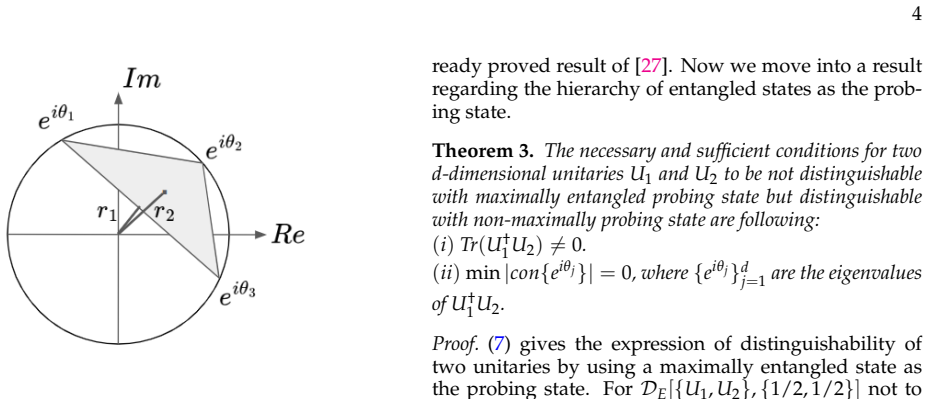
The load-bearing object is the pairwise overlap formula. For any probe $|\psi\rangle$, the optimal single-shot success probability for $U_1$ versus $U_2$ is $\frac{1}{2}\left(1+\sqrt{1-|\langle\psi|(U_1^\dagger U_2\otimes I)|\psi\rangle|^2}\right)$. A maximally entangled probe collapses the overlap to $|\operatorname{Tr}(U_1^\dagger U_2)|/d$, so a nonzero trace blocks perfect discrimination; a product probe makes the overlap a convex combination of the eigenvalues of $U_1^\dagger U_2$, so perfect discrimination is possible exactly when the eigenvalue polygon contains the origin. The constructed families are chosen so that these two indicators point in opposite directions, and the non-maximally entangled probes are tuned so that the general overlap vanishes for every pair simultaneously.
What would settle it
For the explicit $d=4$ family (14), run a semidefinite program over all maximally entangled probes: Theorem 6 predicts the optimal success probability is $\frac{1}{2}\left(1+\sqrt{1-(d-2)^2/d^2}\right)\approx 0.898$, so any maximally entangled probe achieving 1 would refute it. For the six qutrit unitaries in (18), Theorem 7 predicts that every product probe gives success probability at most $1/2$; finding a product state whose optimal measurement succeeds with probability greater than $1/2$ would refute the theorem.
Extended reading notes
Core claim
The central discovery is a strict hierarchy among probe states for single-shot unitary discrimination. Theorem 6 constructs, for every dimension $d\ge 3$, $d$ unitaries $V_l=\sum_{j=1}^d |\psi_j^{(l)}\rangle\langle j|$ (in the explicit representative family, $V_l$ swaps $|1\rangle$ with $|l\rangle$ and fixes the other basis vectors) such that the product probe $|1\rangle$ and a shared Schmidt-rank-2 non-maximally entangled probe both make all output states mutually orthogonal, while every maximally entangled probe fails because $\operatorname{Tr}(V_l^\dagger V_{l'})=d-2\neq 0$ for $l\neq l'$. Theorem 7 adds a set of $2d$ unitaries for which product probes and maximally entangled probes both fail, while the non-maximally entangled probe $|\psi_{\rm nm}\rangle=\sum_i \epsilon_i|\phi_i\rangle|i\rangle$ with $-|\epsilon_1|^2+\sum_{i=2}^d|\epsilon_i|^2=0$ produces $2d$ mutually orthogonal evolved states. Together the two theorems establish that maximally entangled probes can be strictly weaker than partially entangled probes, and even than product probes, when more than two unitary channels are on the table.
Load-bearing premise
The load-bearing premise is that the unitary families have the algebraic structure used in the proofs—in particular, that the bases in Theorem 6 make the pairwise overlap formula (13) independent of the pair $(l,l')$ so that one fixed non-maximally entangled probe zeroes them all—and that the imported two-unitary result [27] (entangled probes never beat product probes) is correct; if either fails, the constructions or the equivalence claim collapse.
Editorial extensions
If this is right
- In every dimension $d\ge 3$, there are $d$ unitaries whose single-shot discrimination is perfect with a product probe and with a non-maximally entangled probe, but impossible with any maximally entangled probe (Theorem 6).
- In every dimension $d\ge 3$, there are $2d$ unitaries that are perfectly distinguishable with a non-maximally entangled probe while both product and maximally entangled probes fail (Theorem 7).
- For two unitaries, the optimal success probability over product probes equals that over entangled probes, and all maximally entangled probes are equivalent to each other (Theorems 1 and 2 together with [27]).
- Any collection of pairwise distinguishable qubit unitaries can be perfectly discriminated with one common maximally entangled probe (Theorem 4), so the demonstrated limitation of maximally entangled probes only appears in dimension $d\ge 3$.
Reading between the lines
- Editorial inference: the same trace-pinning mechanism implies that any finite set of unitaries whose pairwise traces $\operatorname{Tr}(U_i^\dagger U_j)$ are all equal to one nonzero constant is perfectly indistinguishable with maximally entangled probes, regardless of the rest of their spectra; Theorem 6 is a special case of this more general obstruction.
- Editorial inference: the successful probes in Theorems 6 and 7 are not chosen by maximizing entanglement but by matching the probe's Schmidt coefficients to the unitary differences, which suggests a design principle for channel-discrimination experiments: tailor the probe's coefficient pattern to the channel family rather than using the maximally entangled resource.
- Editorial inference: one could test the robustness of these no-go results by adding small perturbations to the unitaries in (14) and (18) and asking whether the maximally entangled probe's failure persists; the nonzero trace gap suggests it should persist for sufficiently small perturbations, while the perfect distinguishability by the tailored probe may degrade continuously.
Signed reviews
Editorial analysis
A structured set of objections, weighed in public.
Referee Report
Summary. The paper studies single-shot discrimination of finite sets of unitary channels using product, maximally entangled, and non-maximally entangled probes. The main claims are: (i) for two unitaries, product and entangled probes have the same optimal success probability, with a criterion (Theorem 3) for when non-maximally entangled probes outperform maximally entangled ones; (ii) for every dimension d ≥ 3, there is a family of d unitaries that are perfectly distinguishable with a product or a non-maximally entangled probe but not with any maximally entangled probe (Theorem 6); (iii) there is a second family of 2d unitaries that are perfectly distinguishable only with a non-maximally entangled probe, while both product and maximally entangled probes fail (Theorem 7). The proofs combine analytic overlap calculations, trace arguments, and SDP-based numerical tables for small dimensions.
Significance. If the constructions are correct, the paper gives a crisp demonstration that maximal entanglement is not always the optimal resource for channel discrimination, contrary to the intuition that more entanglement is better. The explicit families (14) and (18) are simple and testable, and the numerical tables quantify the gap. The pairwise trace argument for the failure of maximally entangled probes is valid in both theorems. However, the proof of Theorem 7 as written contains a genuine gap that is load-bearing for the paper's central second construction, and the statement of Theorem 6 is ambiguous. The results are of interest to the quantum-information community and are likely repairable, but the current manuscript requires substantive revision.
major comments (4)
- [Section III, Theorem 7, proof, Eqs. (15)–(17)] The evolved states are computed incorrectly. The unitary W_k is defined by W_k|i> = |φ_{i+k-1}>, so W_k acts nontrivially on the computational basis |i>, not on the φ-basis. For the probe |ψ_nm> = Σ_i ε_i |φ_i>|i>, one obtains (W_k⊗I)|ψ_nm> = Σ_i ε_i (W_k|φ_i>)|i>, which equals Σ_i ε_i |φ_{i+k-1}>|i> only if |φ_i>=|i> for all i. The orthogonality relations displayed in (15)–(17) therefore do not follow from the definitions for a general orthonormal basis {|φ_i>}. This is the central gap in the proof of Theorem 7. The construction is repairable: take the probe to be Σ_i ε_i |i>|i> instead, with the same coefficient condition, and then the displayed evolved states and the orthogonality calculations are correct for the general φ-basis.
- [Section III, Theorem 6, statement and proof] The conditions defining the family {V_l} are not stated precisely enough to support the proof. The printed condition involving |ψ_j^{(l)}> is garbled, and the l-th column |ψ_l^{(l)}> is left unspecified. The proof's assertions "One can check Tr(V_1†V_2)=d−2" and the overlap formula (13) presuppose that the family has the structure V_l = V_1 P_{1l}, where P_{1l} is the transposition of |1> and |l> (or, in the example, V_1=I). Please state this construction explicitly and show that the stated conditions imply it. In addition, the existence of normalized coefficients a_t,b_t satisfying Σ_t [2Re(a_t^*b_t)+(d−2)|b_t|^2]=0 with a non-product state is asserted but not demonstrated; an explicit construction or a short argument is needed.
- [Section III, Theorem 3, proof] The sufficiency direction of the claimed necessary-and-sufficient criterion is incomplete. From condition (ii) and Theorem 2 one obtains an entangled probe with coefficients β_j = α_j, but the proof does not show that this probe is non-maximally entangled rather than maximally entangled. If all |β_j| were equal, then |Σ_j |β_j|^2 e^{iθ_j}| = |Tr(U_1†U_2)|/d, which is nonzero by condition (i), so the constructed probe cannot be maximally entangled. This argument should be included; it is needed for the claim that the conditions are necessary and sufficient for the superiority of a non-maximally entangled probe over a maximally entangled one.
- [Section III, Theorem 4, proof] The proof of Theorem 4 is not rigorous. The sentence "we always find at most one orthogonal state with respect to a qubit-qubit non-maximally entangled state and same goes for qubit product state also" does not establish the claim for sets containing more than two unitaries. The theorem asserts that any collection of distinguishable qubit-unitary sets shares a common maximally entangled probe; a proper proof (or a more careful statement, if the claim is meant to be limited) is required. This result is secondary to the main constructions but is still stated as a theorem.
minor comments (5)
- [Section III, Theorem 7, proof] The formula "Tr(W†_1 W_2)=d−2" is a typo; it should refer to W_1 and W_{d+1}, since W_2 and W_{d+2} are the second pair and the proof considers W_1 and W_{d+1}.
- [Section III, Theorem 6, proof] The probing state written as |χ>max = |1>|χ> is a product state, not a maximally entangled state; the notation is misleading and should be changed (e.g., |χ>probe).
- [Abstract and Introduction] The abstract and introduction state that the paper "provide[s] a proof that for single-shot discrimination of two unitary channels, entangled and product states are operationally equivalent," but the converse direction (entangled probes cannot outperform product probes for two unitaries) is imported from Ref. [27] rather than proved here. Please qualify the wording and clearly attribute that part.
- [Throughout] There are several typographical errors, including "Scmidt" (Theorem 6 proof), "Hellstrom" without proper diacritics, and "desribed" in the caption of Table I. These should be corrected.
- [Tables I and II] The numerical tables report SDP results but do not specify the parametrization of the probe states or the measurement optimization used. Adding a sentence describing the SDP setup would improve reproducibility.
Circularity Check
No significant circularity: the constructions are explicit and self-contained, with only a non-circular proof gap in Theorem 7.
full rationale
The paper's central claims are explicit constructions rather than fits or renamed inputs. Theorem 6 defines unitary families via bases and then computes inner products (Eq. 13) directly from those definitions; the probe coefficients are chosen to satisfy a solvable condition, not fitted to the distinguishability value being claimed. Theorem 7 similarly constructs 2d unitaries and a non-maximally entangled probe, then computes evolved-state overlaps (Eqs. 15-17); no parameter is fitted to the predicted outcome, and no 'prediction' is normalized by an input. The external result [27] (D'Ariano et al.) is used only for the converse direction of the two-unitary product/entangled equivalence; it is independent of the present authors and does not form a self-citation chain. Self-citations in the paper appear only in motivation, related-work, or future-directions contexts and are not load-bearing for Theorems 6 or 7. I also weighed the reviewed proof gap in Theorem 7: the probe is |ψ_nm⟩ = Σ_i ε_i |ϕ_i⟩|i⟩, and the proof asserts the evolved states are Σ_i ε_i |ϕ_{i+k−1}⟩|i⟩. This requires W_k |ϕ_i⟩ = |ϕ_{i+k−1}⟩, whereas W_k is defined by W_k |i⟩ = |ϕ_{i+k−1}⟩, so the asserted identity holds only when {|ϕ_i⟩} = {|i⟩}. That is a load-bearing correctness issue in the general proof, but it is not a circular reduction of the conclusion to the assumptions; it is an unproven algebraic identity. Accordingly, the circularity score remains 0.
Assumptions & free parameters
free parameters (1)
- Probe coefficients (a_t, b_t in Theorem 6; epsilon_i in Theorem 7)
assumptions (6)
- standard math Helstrom's formula gives the minimum-error distinguishability of two pure states as 1/2(1 + sqrt(1 - |<psi_1|psi_2>|^2)) for equal priors.
- standard math For two unitaries, the overlap of evolved states is a convex combination of the eigenvalues of U1^dagger U2, and the minimum over pure states of |sum p_j e^{i theta_j}| equals min|con{e^{i theta_j}}|.
- domain assumption The cited result [27] that if two unitaries are not distinguishable by a product probe, no entangled probe can distinguish them.
- standard math Schmidt decomposition and local unitary equivalence of maximally entangled states.
- ad hoc to paper Existence of nonzero probe coefficients satisfying the algebraic conditions, namely 2Re(a* b) + (d-2)|b|^2 = 0 in Theorem 6 and -|epsilon_1|^2 + sum_{i>=2}|epsilon_i|^2 = 0 in Theorem 7.
- standard math A set of more than d pure states in a d-dimensional Hilbert space cannot be perfectly distinguished.
Cite this review
Pith. "Pith review of Limitation of maximally entangled probes for single-shot distinguishability of unitaries." pith.science (2026). https://pith.science/paper/IMGEH6O5
@misc{pith2026250414499,
  author       = {Pith},
  title        = {Pith review of: Limitation of maximally entangled probes for single-shot distinguishability of unitaries},
  year         = {2026},
  howpublished = {\url{https://pith.science/paper/IMGEH6O5}},
  note         = {Machine review of arXiv:2504.14499}
}
abstract
There have been many instances where the maximally entangled state as a probe acts better than the product and the non-maximally entangled states in the task of distinguishing quantum channels. We provide a proof that for single-shot discrimination of two unitary channels, entangled and product states are operationally equivalent. But we identify pairs of unitaries that are perfectly distinguishable using a non-maximally entangled state, but not with a maximally entangled one. This contrast becomes more pronounced when the number of unitaries exceeds two. In every dimension $\geqslant 3$, we show that there exists a class of unitaries that are indistinguishable under maximally entangled probes, yet perfectly distinguishable using product or non-maximally entangled inputs. Another interesting set of unitaries in every dimension $\geqslant 3$ has been presented where only non-maximally entangled state acts as the successful probe, while product states and maximally entangled states cannot.
Figures
Forward citations
Cited by 1 Pith paper
-
Global versus Local Discrimination of Locally Implementable Multipartite Unitaries
Locally implementable product unitaries can be globally distinguishable but LOCC-indistinguishable, and vice versa, depending on whether probing states are adaptive or fixed and whether probes are separable or entangled.
Reference graph
Works this paper leans on
-
[27]
Per- fect distinguishability of quantum operations,
Runyao Duan, Yuan Feng, and Mingsheng Ying, “Per- fect distinguishability of quantum operations,” Phys. Rev. Lett. 103, 210501 (2009)
work page 2009
-
[1]
Teleporting an unknown quantum state via dual clas- sical and einstein-podolsky-rosen channels,
Charles H. Bennett, Gilles Brassard, Claude Cr ´epeau, Richard Jozsa, Asher Peres, and William K. Wootters, “Teleporting an unknown quantum state via dual clas- sical and einstein-podolsky-rosen channels,” Phys. Rev. Lett. 70, 1895–1899 (1993)
work page 1993
-
[2]
⊓ ⊔ To cite an example, consider two d-dimensional (d ⩾
In this situation, Theorem 2 asserts that there exists at least one entangled state which can do the same task of perfect distinguishability. ⊓ ⊔ To cite an example, consider two d-dimensional (d ⩾
-
[3]
unitaries such that ˜U1 = d ∑ j=1 |Ψj⟩⟨j|, ˜U2 = d ∑ j=1 |Ψ ′ j⟩⟨j|, with |Ψ1⟩ =|Ψ ′ 2⟩ and|Ψ2⟩ =|Ψ ′ 1⟩. (9) To distinguish this two unitaries non-maximally en- tangled state acts as a better probing state than maxi- mally entangled state. If we start with a non-maximally entangled state 1√ 2 (|11⟩ +|22⟩), distinguishability of two unitaries described ab...
-
[4]
With this input state, the evolved states will be {|ρk⟩ = ∑d i=1 ϵi|ϕi+k−1⟩|i⟩,|ρd+k⟩ = −ϵ1|ϕk⟩|1⟩ + ∑d i=2 ϵi|ϕi+k−1⟩|i⟩}d k=1. If we take inner product of any pair of states from this set, there will be three types of term, such as: ⟨ρk′|ρk⟩k̸=k′ = d ∑ i=1 |ϵi|2⟨ϕi+k′−1|ϕi+k−1⟩ = 0, (15) ⟨ρd+k′|ρd+k⟩k̸=k′ = −|ϵ1|2⟨ϕk′|ϕk⟩ + d ∑ i=2 |ϵi|2⟨ϕi+k′−1|ϕi+k−1⟩...
work page 2023
-
[5]
Quantum cryptography based on bell’s theorem,
Artur K. Ekert, “Quantum cryptography based on bell’s theorem,” Phys. Rev. Lett. 67, 661–663 (1991)
1991
-
[6]
Teleportation, bell’s inequalities and insep- arability,
Ryszard Horodecki, Michał Horodecki, and Paweł Horodecki, “Teleportation, bell’s inequalities and insep- arability,” Physics Letters A 222, 21–25 (1996)
work page 1996
-
[7]
Quan- tum teleportation of a polarization state with a complete bell state measurement,
Yoon-Ho Kim, Sergei P . Kulik, and Yanhua Shih, “Quan- tum teleportation of a polarization state with a complete bell state measurement,” Phys. Rev. Lett. 86, 1370–1373 (2001)
work page 2001
Show all 51 references
-
[8]
Communi- cation via one- and two-particle operators on einstein- podolsky-rosen states,
Charles H. Bennett and Stephen J. Wiesner, “Communi- cation via one- and two-particle operators on einstein- podolsky-rosen states,” Phys. Rev. Lett. 69, 2881–2884 (1992)
1992
-
[9]
Entanglement-assisted random access codes,
Marcin Pawłowski and Marek ˙Zukowski, “Entanglement-assisted random access codes,” Phys. Rev. A 81, 042326 (2010)
2010
-
[10]
Quantum error- correction codes and absolutely maximally entangled states,
Paweł Mazurek, M ´at´e Farkas, Andrzej Grudka, Michał Horodecki, and Michał Studzi ´nski, “Quantum error- correction codes and absolutely maximally entangled states,” Phys. Rev. A 101, 042305 (2020)
2020
-
[11]
Quantum metrology with maximally entangled states and parity measurements,
Christopher C. Gerry, A. Benmoussa, and R.A. Campos, “Quantum metrology with maximally entangled states and parity measurements,” in Frontiers in Optics (Optica Publishing Group, 2006) p. LThA4
2006
-
[12]
Quantum communica- tion,
Nicolas Gisin and Rob Thew, “Quantum communica- tion,” Nature photonics 1, 165–171 (2007)
2007
-
[13]
showed entanglement assisted probe-ancilla system sometimes gives the advantage in discriminating quan- tum channels. Over the years, the advantage of entan- glement with respect to product probe system in the task of distinguishing quantum channels has been studied extensivel...
2025 arXiv
-
[14]
Applying a class of gen- eral maximally entangled states in measurement-device- independent quantum secure direct communication,
Jianfeng Liu, Xiangfu Zou, Xin Wang, Ying Chen, Zhen- bang Rong, Zhiming Huang, Shenggen Zheng, Xueying Liang, and Jianxiong Wu, “Applying a class of gen- eral maximally entangled states in measurement-device- independent quantum secure direct communication,” Phys. Rev. Appl. ...
2024
-
[15]
Quantum circuits for maximally entangled states,
Alba Cervera-Lierta, Jos ´e Ignacio Latorre, and Dardo Goyeneche, “Quantum circuits for maximally entangled states,” Phys. Rev. A 100, 022342 (2019)
2019
-
[16]
Implementation and readout of maximally entangled two-qubit gates quan- tum circuits in a superconducting quantum processor,
Viviana Stasino, Pasquale Mastrovito, Carlo Cosenza, Anna Levochkina, Martina Esposito, Domenico Monte- murro, Giovanni P Pepe, Alessandro Bruno, Francesco Tafuri, Davide Massarotti, et al. , “Implementation and readout of maximally entangled two-qubit gates quan- tum circuits...
2025
-
[17]
Quantum computations: algorithms and er- ror correction,
A Yu Kitaev, “Quantum computations: algorithms and er- ror correction,” Russian Mathematical Surveys 52, 1191 (1997)
1997
-
[18]
Optimal discrimination of quan- tum operations,
Massimiliano F. Sacchi, “Optimal discrimination of quan- tum operations,” Phys. Rev. A 71, 062340 (2005). 8
2005
-
[19]
Distance measures to compare real and ideal quantum processes,
Alexei Gilchrist, Nathan K. Langford, and Michael A. Nielsen, “Distance measures to compare real and ideal quantum processes,” Phys. Rev. A 71, 062310 (2005)
2005
-
[20]
Entanglement can enhance the distinguishability of entanglement-breaking channels,
Massimiliano F. Sacchi, “Entanglement can enhance the distinguishability of entanglement-breaking channels,” Phys. Rev. A 72, 014305 (2005)
2005
-
[21]
All entangled states are useful for channel discrimination,
Marco Piani and John Watrous, “All entangled states are useful for channel discrimination,” Phys. Rev. Lett. 102, 250501 (2009)
2009
-
[22]
Separability of mixed states: necessary and sufficient conditions,
Michał Horodecki, Paweł Horodecki, and Ryszard Horodecki, “Separability of mixed states: necessary and sufficient conditions,” Physics Letters A 223, 1–8 (1996)
1996
-
[23]
Strategies for optimal single-shot discrimination of quantum measurements,
Zbigniew Puchała, Łukasz Pawela, Aleksandra Krawiec, and Ryszard Kukulski, “Strategies for optimal single-shot discrimination of quantum measurements,” Phys. Rev. A 98, 042103 (2018)
2018
-
[24]
Funda- mental limits to quantum channel discrimination,
S. Pirandola, R. Laurenza, C. Lupo, and et al., “Funda- mental limits to quantum channel discrimination,” npj Quantum Inf 5 (2019), 10.1038/s41534-019-0162-y
2019 doi
-
[25]
Single-shot distinguisha- bility and antidistinguishability of quantum measure- ments,
Satyaki Manna, Sneha Suresh, Manan Singh Kach- hawaha, and Debashis Saha, “Single-shot distinguisha- bility and antidistinguishability of quantum measure- ments,” Phys. Rev. A 111, 022221 (2025)
2025
-
[26]
Adaptive versus nonadaptive strate- gies for quantum channel discrimination,
Aram W. Harrow, Avinatan Hassidim, Debbie W. Leung, and John Watrous, “Adaptive versus nonadaptive strate- gies for quantum channel discrimination,” Phys. Rev. A 81, 032339 (2010)
2010
-
[28]
Entanglement in channel discrimination with restricted measurements,
William Matthews, Marco Piani, and John Watrous, “Entanglement in channel discrimination with restricted measurements,” Phys. Rev. A 82, 032302 (2010)
2010
-
[29]
Distinguishing quantum operations hav- ing few kraus operators,
John Watrous, “Distinguishing quantum operations hav- ing few kraus operators,” (2008), arXiv:0710.0902 [quant- ph]
2008 arXiv
-
[30]
Perfect discrimination of quantum measurements using entangled systems,
Chandan Datta, Tanmoy Biswas, Debashis Saha, and Remigiusz Augusiak, “Perfect discrimination of quantum measurements using entangled systems,” New Journal of Physics 23, 043021 (2021)
2021
-
[31]
Improved discrimination of unitary transfor- mations by entangled probes,
G Mauro D’Ariano, Paoloplacido Lo Presti, and Matteo G A Paris, “Improved discrimination of unitary transfor- mations by entangled probes,” Journal of Optics B: Quan- tum and Semiclassical Optics 4, S273 (2002)
2002
-
[32]
Statistical distinguishability between unitary operations,
A. Ac ´ın, “Statistical distinguishability between unitary operations,” Phys. Rev. Lett. 87, 177901 (2001)
2001
-
[33]
Optimal estimation of quantum dynamics,
A. Ac ´ın, E. Jan ´e, and G. Vidal, “Optimal estimation of quantum dynamics,” Phys. Rev. A 64, 050302 (2001)
2001
-
[34]
Single-shot discrimination of quantum unitary processes,
M ´ario Ziman and Michal Sedl ´ak, “Single-shot discrimination of quantum unitary processes,” Journal of Modern Optics 57, 253–259 (2010), https://doi.org/10.1080/09500340903349963
2010 doi
-
[35]
C. W. Helstrom, Quantum Detection and Estimation Theory (Academic Press, New York, 1969)
1969
-
[36]
Distinguishability of generic quantum states,
Zbigniew Puchała, Łukasz Pawela, and Karol ˙Zyczkowski, “Distinguishability of generic quantum states,” Phys. Rev. A 93, 062112 (2016)
2016
-
[37]
Distinguishing mixed quantum states: Minimum-error discrimination versus optimum unambiguous discrimination,
Ulrike Herzog and J ´anos A. Bergou, “Distinguishing mixed quantum states: Minimum-error discrimination versus optimum unambiguous discrimination,” Phys. Rev. A 70, 022302 (2004)
2004
-
[38]
Tight bounds on the distinguishability of quantum states under separable measurements,
Somshubhro Bandyopadhyay and Michael Nathanson, “Tight bounds on the distinguishability of quantum states under separable measurements,” Phys. Rev. A 88, 052313 (2013)
2013
-
[39]
ψ-epistemic models are exponentially bad at explaining the distinguishability of quantum states,
M. S. Leifer, “ ψ-epistemic models are exponentially bad at explaining the distinguishability of quantum states,” Phys. Rev. Lett. 112, 160404 (2014)
2014
-
[40]
Noψ-epistemic model can fully ex- plain the indistinguishability of quantum states,
Jonathan Barrett, Eric G. Cavalcanti, Raymond Lal, and Owen J. E. Maroney, “Noψ-epistemic model can fully ex- plain the indistinguishability of quantum states,” Phys. Rev. Lett. 112, 250403 (2014)
2014
-
[41]
Quantum pre- scriptions are more ontologically distinct than they are operationally distinguishable,
Anubhav Chaturvedi and Debashis Saha, “Quantum pre- scriptions are more ontologically distinct than they are operationally distinguishable,” Quantum 4, 345 (2020)
2020
-
[42]
How ψ-epistemic models fail at explain- ing the indistinguishability of quantum states,
Cyril Branciard, “How ψ-epistemic models fail at explain- ing the indistinguishability of quantum states,” Phys. Rev. Lett. 113, 020409 (2014)
2014
-
[43]
On the interpretation of quantum indistinguishability : a no-go theorem,
Anandamay Das Bhowmik and Preeti Parashar, “On the interpretation of quantum indistinguishability : a no-go theorem,” (2022), arXiv:2204.09736 [quant-ph]
2022 arXiv
-
[44]
No epistemic model can explain anti-distinguishability of quantum mixed preparations,
Sagnik Ray, Visweshwaran R, and Debashis Saha, “No epistemic model can explain anti-distinguishability of quantum mixed preparations,” (2024), arXiv:2401.17980 [quant-ph]
2024 arXiv
-
[45]
Quantum description of reality is empirically in- complete,
Anubhav Chaturvedi, Marcin Pawłowski, and Debashis Saha, “Quantum description of reality is empirically in- complete,” (2021), arXiv:2110.13124 [quant-ph]
2021 arXiv
-
[46]
Unbounded quantum advantage in communica- tion complexity measured by distinguishability,
Satyaki Manna, Anubhav Chaturvedi, and Debashis Saha, “Unbounded quantum advantage in communica- tion complexity measured by distinguishability,” Phys. Rev. Res. 6, 043269 (2024)
2024
-
[47]
Communication tasks with infinite quantum-classical separation,
Christopher Perry, Rahul Jain, and Jonathan Oppenheim, “Communication tasks with infinite quantum-classical separation,” Phys. Rev. Lett. 115, 030504 (2015)
2015
-
[48]
Limits of classical correlations and quantum advantages under (anti-)distinguishability constraints in multipartite com- munication,
Ankush Pandit, Soumyabrata Hazra, Satyaki Manna, Anubhav Chaturvedi, and Debashis Saha, “Limits of classical correlations and quantum advantages under (anti-)distinguishability constraints in multipartite com- munication,” (2025), arXiv:2506.07699 [quant-ph]
2025 arXiv
-
[49]
(Cambridge University Press, USA, 2018)
John Watrous, The Theory of Quantum Information , 1st ed. (Cambridge University Press, USA, 2018)
2018
-
[50]
Query complexity of unitary operation discrimination,
Xiaowei Huang and Lvzhou Li, “Query complexity of unitary operation discrimination,” Physica A: Statistical Mechanics and its Applications 604, 127863 (2022)
2022
-
[51]
Entan- glement and coherence in the bernstein-vazirani algo- rithm,
Moein Naseri, Tulja Varun Kondra, Suchetana Goswami, Marco Fellous-Asiani, and Alexander Streltsov, “Entan- glement and coherence in the bernstein-vazirani algo- rithm,” Phys. Rev. A 106, 062429 (2022)
2022
Reviewed August 16, 2026 · model on record in the stance chip above.
Discussion (0). Continue with ORCID to comment.