REVIEW 3 major objections 6 minor 81 references
Anisotropic quark propagation and Zeeman effect in an external magnetic field
T0 review · 3 major / 6 minor · reviewed 2026-08-16 · deepseek-v4-flash
Pith's one-line read A constant magnetic field makes a dressed quark anisotropic: the transverse effective mass always exceeds the longitudinal one, and the splitting grows as a power of the field strength.
desk verdict Competent, clearly written DSE study of quark propagation in a weak magnetic field; the qualitative M⊥ > M∥ result is solid, but the power-law scaling claim is not controlled by the first-order expansion used. read the letter →
The pith
A machine-rendered reading of the paper's core claim, the machinery that carries it, and where it could break.
The reading
What carries the argument
The load-bearing object is the Dirac-structure decomposition of the dressed inverse quark propagator in an external magnetic field, obtained by expanding the Landau-level representation on the eigenfunction basis that makes a free quark in a field resemble a vacuum quark. In momentum space the inverse propagator takes the form $S^{-1}(p_\parallel,p_\perp) = -\hat{S} + \hat{V}_\parallel \,/\!\!p_\parallel - \hat{V}_\perp \,/\!\!p_\perp + h\hat{A}\Sigma_3 \,/\!\!p_\parallel - 2h\hat{T}\Sigma_3$, with the five scalar functions $\hat{S}$, $\hat{V}_\parallel$, $\hat{V}_\perp$, $h\hat{A}$, and $2h\hat{T}$ reconstructed from the Landau-level dressing functions. The inequality $\hat{V}_\parallel \neq \hat{V}_\perp$ is what produces two effective masses, while the axial-vector and tensor terms carry the Zeeman effect. The numerical solution works because the authors keep only first-order terms in the field in the Landau-level summation, which reduces the propagator denominator to a manageable form that is then solved self-consistently in rainbow truncation, where the dressed quark-gluon vertex is replaced by the bare vertex.
What would settle it
Re-solve the same gap equation with a gluon propagator computed in the magnetic field, or extract the quark dressing functions from lattice QCD in a background field near $eB \approx 1\,\mathrm{GeV}^2$. If $\Delta M_{u,d}(h)$ no longer follows $0.22\,h^{1.49}$, or if $\hat{M}^{\mathrm{eff}}_\perp \leq \hat{M}^{\mathrm{eff}}_\parallel$ at any field strength in the computed range, the central claim fails.
Extended reading notes
Core claim
Working in the weak-field limit, the authors decompose the inverse dressed quark propagator as $S^{-1}(p_\parallel,p_\perp) = -\hat{S} + \hat{V}_\parallel \,/\!\!p_\parallel - \hat{V}_\perp \,/\!\!p_\perp + h\hat{A}\Sigma_3 \,/\!\!p_\parallel - 2h\hat{T}\Sigma_3$, where $\Sigma_3 = i\gamma^1\gamma^2$ projects the quark spin along the field. They then solve the corresponding gap equation numerically, using a rainbow truncation and an infrared gluon model. The results show $\hat{V}_\parallel \neq \hat{V}_\perp$, so the two effective masses defined by $\hat{M}^{\mathrm{eff}}_\parallel = \hat{S}/\hat{V}_\parallel$ and $\hat{M}^{\mathrm{eff}}_\perp = \hat{S}/\hat{V}_\perp$ are distinct, with $\hat{M}^{\mathrm{eff}}_\perp > \hat{M}^{\mathrm{eff}}_\parallel$ in all computed cases. The difference follows the power laws $\Delta M_{u,d}(h) = 0.22\,h^{1.49}$ and $\Delta M_s(h) = 0.15\,h^{1.79}$ (with $h = eB$ in GeV$^2$). The field also switches on $h\hat{A}$ and $2h\hat{T}$, which vanish at $h=0$; these split spin-up and spin-down energies within a Landau level, which the paper identifies with the Zeeman effect. The splitting is smaller for the strange quark than for up and down quarks, and the full momentum-dependent mass functions are provided as input for hadron-level calculations.
Load-bearing premise
The results assume the gluon propagator is unchanged by the magnetic field and that first-order small-field terms remain accurate up to $h = 1\,\mathrm{GeV}^2$; if the gluon feels the field or higher-order terms matter, the computed masses and power laws shift.
Editorial extensions
If this is right
- If the claim is right, any hadron built from these quarks in a magnetic field inherits directional dependence: transverse binding differs from longitudinal binding, so hadron masses and decay constants should depend on their orientation relative to the field.
- The mass splitting grows as a power of the field, with exponent approximately 1.5 for up/down quarks and 1.8 for the strange quark; heavier quarks respond less, which is a concrete flavor-dependent prediction for magnetized quark matter.
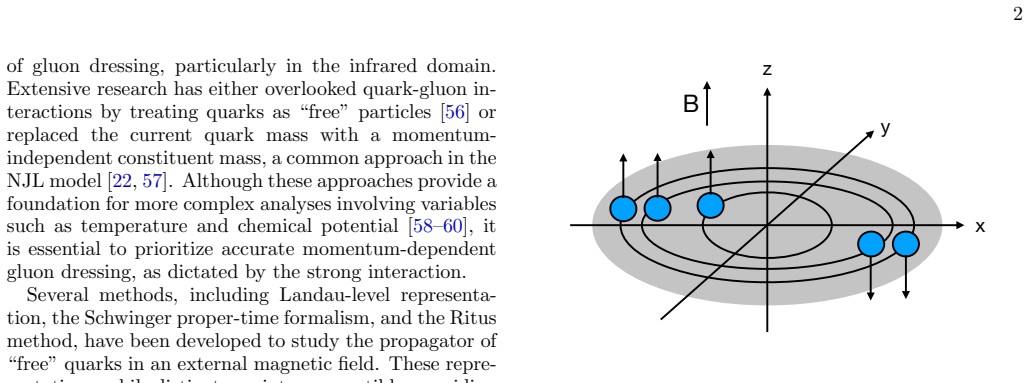
- The nonzero $h\hat{A}$ and $2h\hat{T}$ terms mean spin-up and spin-down quarks in the same Landau level have different effective masses and momenta, a nonperturbative Zeeman effect that should show up as spin polarization and possibly as quark magnetic dipole moments.
- The fully momentum-dependent dressed propagator is a direct input for bound-state calculations of mesons in magnetic fields, providing a pathway to vector-meson condensation and neutral-pion condensation phenomena.
Reading between the lines
- Editorial inference: the quoted power-law fits are extracted from first-order weak-field data but are evaluated up to $h\sim 1\,\mathrm{GeV}^2$, where $h$ is comparable to QCD scales; a full-$h$ solution or an explicitly field-dependent gluon might change the exponents, so the fits should be read as a small-field benchmark rather than a universal law.
- If the gluon were allowed to respond to the magnetic field, the near-symmetry between $p_l^2$ and $p_t^2$ noted in the paper would likely break; that asymmetry would be a sharp test of whether the anisotropy is quark-driven or gluon-driven.
- The different momentum behavior of $2h\hat{T}$ along longitudinal versus transverse directions suggests that tensor-type condensates or spin-dependent observables may be sensitive to the direction of the quark momentum, a testable consequence for phenomenological models of magnetized quark matter.
Signed reviews
Editorial analysis
A structured set of objections, weighed in public.
Referee Report
Summary. The paper studies the dressed quark propagator in a constant external magnetic field within a Dyson-Schwinger approach. Starting from the Ritus-basis / Landau-level representation of the free propagator, the authors derive the general Dirac structure of the inverse dressed propagator (S, V_parallel, V_perp, A, T), perform a weak-field expansion to obtain a momentum-space propagator, and solve the rainbow-truncated gap equation numerically for u/d and s quarks. The central results are: (i) the vector dressing splits into longitudinal and transverse components, giving anisotropic effective masses with M_perp^eff > M_parallel^eff; (ii) the mass splitting grows with h and is fitted by DeltaM_{u,d} = 0.22 h^1.49 and DeltaM_s = 0.15 h^1.79; and (iii) field-induced axial-vector and tensor terms are interpreted as a Zeeman effect. The propagator is proposed as input for studies of magnetic catalysis, vector-meson condensation, and hadron properties in magnetic fields.
Significance. The calculation is a useful and clearly specified model study. Its strengths are that the truncation and all assumptions are stated explicitly (rainbow truncation, vacuum gluon propagator, weak-field expansion), the input parameters are fixed by vacuum hadron observables rather than by the magnetic-field effect, and the qualitative anisotropy M_perp^eff > M_parallel^eff is stable across omega = 0.4-0.6 GeV. If the results hold, they provide a complete momentum-dependent quark propagator that can feed hadron bound-state calculations in magnetic fields. However, the headline quantitative claim--the power-law scaling of DeltaM--is not controlled at the field strengths used for the fit, and the B-independent gluon assumption is load-bearing for the numerical values. The paper is therefore a valuable contribution whose quantitative conclusions need revision.
major comments (3)
- [V.B, Eq. (56), Fig. 6] The power-law fit is applied to numerical data over h approximately 0.2-1.0 GeV^2, but the propagator used to generate those data is explicitly first order in the weak-field expansion: Eq. (40) drops O(Delta_2^2), Eq. (42) keeps tan(sh) approximately sh + O(h^3), and Eq. (43) retains only terms linear in h. With the zero-field mass scale M approximately 0.5 GeV from Table I, the relevant infrared expansion parameter is h/M^2, which reaches about 4 at h = 1 GeV^2. A first-order expansion evaluated in this regime cannot control the effective exponents 1.49 and 1.79, and no fit or truncation uncertainties are quoted. This is load-bearing because the abstract and conclusions present the growing splitting and its scaling as main results. I request either a next-order estimate, a fit restricted to h much less than M^2, or an explicit statement of the truncation error; without one, Eq. (56) should be presented as an interpolation rather than a predicted power law.
- [IV, Eq. (53) and surrounding text] The assumption that the gluon propagator is unaffected by the magnetic field (stated after Eq. (47)) is central to the numerical values of V_parallel, V_perp, and DeltaM: the entire anisotropy is generated by the quark propagator in the loop while the gluon remains isotropic. If the gluon dressing has a B dependence, as suggested by some DSE and FRG studies, the transverse and longitudinal quark dressings could shift substantially. Since the paper aims to provide quantitative input for hadron observables in magnetic fields, this sensitivity needs to be assessed--for example by comparing with a B-dependent gluon model or by estimating the size of the neglected contributions--rather than only flagged as a future refinement.
- [V.B, Eq. (56)] The fitted equation is not dimensionally transparent as written: if h is measured in GeV^2 and DeltaM in GeV, the coefficients 0.22 and 0.15 must carry non-trivial dimensions (GeV^{1-2p} for exponent p). The authors should state the units of these coefficients, or specify that h is normalized by a reference scale in the fit. This is a local presentation issue, but it matters because Eq. (56) is quoted as a quantitative result in the abstract and conclusions.
minor comments (6)
- [II, after Eq. (10)] There is a duplicated word: 'In the specific limit where where V_parallel = V_perp = 1...' should read 'where'.
- [V.B.1] There is a typo in 'becoming nonzero..' with a double period; it should read 'becoming nonzero.'
- [V] The phrase 'at across the entire momentum domain' should be corrected to 'over the entire momentum domain'.
- [Abstract and III.D] The abstract says a 'general momentum-space representation' is derived, but the derivation in Sec. III.D is explicitly in the weak-field limit; this should be stated as 'weak-field momentum-space representation' to avoid overstating the scope.
- [V.B.1 and Fig. 4] Equation (55) and Fig. 4 compare h = 1.0 GeV^2 with h = 0; the justification for choosing 1.0 GeV^2 as the reference point is not given, especially in view of the weak-field condition raised in the major comments.
- [VI] The statement that the scaling exponent 'gradually approaches 2' when going from light to heavy quarks is based on only two flavors; it should be phrased as a tentative observation rather than a trend.
Circularity Check
No significant circularity: the anisotropic effective masses and induced tensor/axial-vector dressings are genuine numerical outputs of a gap-equation calculation with inputs fixed independently of the magnetic-field effect.
full rationale
The derivation chain is self-contained. The dressing functions are obtained by solving the Dyson-Schwinger gap equation (Eq. C1) with a vacuum gluon model (Eqs. 49-51) whose parameters were fixed by meson properties in prior independent work, and with quark masses (Eq. 54) fixed by pion/kaon observables; none of these inputs is fitted to the magnetic-field effect. The decomposition of the vector part into V∥ and V⊥, and the nonzero axial-vector and tensor dressings hA and 2hT, emerge as numerical solutions of the coupled equations, not as imposed inputs. The inequality M⊥eff > M∥eff follows from the computed result V∥ > V⊥ (Fig. 3) via the definitions in Eq. (33), so it is not tautological. Equation (56) is a power-law parametrization of the computed ΔM(h) curves, not an input used to generate those curves; describing one's own numerical output with a fitted power law is not a circular prediction. The weak-field expansion (Eqs. 39-43) and the explicit assumption that the gluon propagator is unaffected by the magnetic field (Sec. IV) are stated approximations that limit quantitative reliability at h ≈ 1 GeV², but these are correctness and truncation concerns rather than circularity. Self-citations in the paper are contextual or fix vacuum inputs and do not carry the magnetic-field result, and the load-bearing weak-field summation and general propagator structure are attributed to the independent work in Ref. [63].
Assumptions & free parameters
free parameters (4)
- Gluon interaction width ω =
0.4, 0.5, 0.6 GeV (with Dω = (0.80 GeV)^3)
- Current quark masses m_l and m_s =
3.3 MeV and 74.6 MeV at ζ = 19 GeV
- Power-law parameters for ΔM(h) =
a_u/d = 0.22, b_u/d = 1.49; a_s = 0.15, b_s = 1.79
- UV coupling parameters Λ_QCD, m_t, γ_m, τ =
Λ_QCD = 0.36 GeV, m_t = 0.5 GeV, γ_m = 12/23, τ = e^2 - 1
assumptions (5)
- domain assumption Rainbow truncation with bare quark-gluon vertex
- domain assumption The gluon propagator is unaffected by the magnetic field
- domain assumption Weak-field expansion truncated at first order is valid up to h = 1 GeV²
- domain assumption Schwinger phase factorization (Eq. 14)
- domain assumption The Qin-Chang-Roberts-Wilson gluon model (Eqs. 49-51) represents QCD's gluon dressing
Cite this review
Pith. "Pith review of Anisotropic quark propagation and Zeeman effect in an external magnetic field." pith.science (2026). https://pith.science/paper/ONFBBBYP
@misc{pith2026250414504,
  author       = {Pith},
  title        = {Pith review of: Anisotropic quark propagation and Zeeman effect in an external magnetic field},
  year         = {2026},
  howpublished = {\url{https://pith.science/paper/ONFBBBYP}},
  note         = {Machine review of arXiv:2504.14504}
}
read the original abstract
We investigated the impact of a constant external magnetic field on the dressed propagators of up-, down-, and strange quarks. In the weak field limit, we derive a general momentum-space representation for the propagator and numerically solve the corresponding gap equation. Our analysis reveals that the vector term of the propagator can be decomposed into components parallel and perpendicular to the magnetic field, resulting in anisotropic effective masses, with the transverse mass consistently exceeding the longitudinal mass. This mass disparity exhibits a power law dependence on the magnetic field strength and is less pronounced for the strange quark compared to up and down quarks. Additionally, the magnetic field induces axial-vector and tensor terms, highlighting the Zeeman effect resulting from quark interactions with the magnetic field. These findings have important implications for (inverse) magnetic catalysis, and phenomena such as vector meson and pion condensations.
Figures


Figures from the paper (5 more)


Reference graph
Works this paper leans on
-
[1]
ˆS, ˆV∥ and ˆV⊥ We begin by analyzing the dressing functions associ- ated with the scalar and vector Dirac structures: ˆS, ˆV∥, and ˆV⊥. These functions are intrinsically linked to the characteristics of the quark propagator in vacuum and encapsulate the average-spin properties of the quark, pro- viding insights into mass and momentum dynamics in both lon...
-
[2]
ˆA and ˆT The axial-vector and tensor structures are new Dirac structures that appear in the quark propagator only in the presence of a magnetic field, where they become non- zero (i.e., ˆA̸= 0 and ˆT̸= 0). We present results for hˆA and 2hˆT, as these combinations are the actual dressing functions that appear in the quark propagator, as shown in Eq. (31)...
-
[3]
J. O. Andersen, W. R. Naylor, and A. Tranberg, Rev. Mod. Phys. 88, 025001 (2016), arXiv:1411.7176 [hep-ph]
arXiv 2016
-
[4]
R. Schutzhold, H. Gies, and G. Dunne, Phys. Rev. Lett. 101, 130404 (2008), arXiv:0807.0754 [hep-th]
arXiv 2008
-
[5]
N. Ahmadiniaz et al. , “Letter of Intent: Towards a Vacuum Birefringence Experiment at the Helmholtz International Beamline for Extreme Fields,” (2024), arXiv:2405.18063 [physics.ins-det]
arXiv 2024
-
[6]
K. Hattori, K. Itakura, and S. Ozaki, Prog. Part. Nucl. Phys. 133, 104068 (2023), arXiv:2305.03865 [hep-ph]
arXiv 2023
-
[7]
For this analysis, we use ω = 0.5 GeV as a represen- tative example. The figure demonstrates that, while the overall qualitative behavior of the mass function remains largely unchanged, variations in the infrared region are noted. Consequently, we have numerically determined the mass functions defined in Eq. (33) across the entire momentum range for up/do...
-
[8]
V. A. Miransky and I. A. Shovkovy, Phys. Rept. 576, 1 (2015), arXiv:1503.00732 [hep-ph]
arXiv 2015
Show all 81 references
-
[9]
Fukushima, Prog
K. Fukushima, Prog. Part. Nucl. Phys. 107, 167 (2019), arXiv:1812.08886 [hep-ph]
2019 arXiv
-
[10]
Grasso and H
D. Grasso and H. R. Rubinstein, Phys. Rept. 348, 163 (2001), arXiv:astro-ph/0009061
2001 arXiv
-
[11]
R. C. Duncan and C. Thompson, Astrophys. J. Lett.392, L9 (1992)
1992
-
[12]
C. A. Bertulani, S. R. Klein, and J. Nystrand, Ann. Rev. Nucl. Part. Sci. 55, 271 (2005), arXiv:nucl-ex/0502005
2005 arXiv
-
[13]
Skokov, A
V. Skokov, A. Y. Illarionov, and V. Toneev, Int. J. Mod. Phys. A 24, 5925 (2009), arXiv:0907.1396 [nucl-th]
2009 arXiv
-
[14]
V. P. Gusynin, V. A. Miransky, and I. A. Shovkovy, Phys. Rev. Lett. 73, 3499 (1994), [Erratum: Phys.Rev.Lett. 76, 1005 (1996)], arXiv:hep-ph/9405262
1994 arXiv
-
[15]
Preis, A
F. Preis, A. Rebhan, and A. Schmitt, JHEP 03, 033 (2011), arXiv:1012.4785 [hep-th]
2011 arXiv
-
[16]
D. E. Kharzeev, L. D. McLerran, and H. J. Warringa, Nucl. Phys. A 803, 227 (2008), arXiv:0711.0950 [hep-ph]
2008 arXiv
-
[17]
Fukushima, D
K. Fukushima, D. E. Kharzeev, and H. J. Warringa, Phys. Rev. D 78, 074033 (2008), arXiv:0808.3382 [hep- ph]
2008 arXiv
-
[18]
J. K. Boomsma and D. Boer, Phys. Rev. D 81, 074005 (2010), arXiv:0911.2164 [hep-ph]
2010 arXiv
-
[19]
Gatto and M
R. Gatto and M. Ruggieri, Lect. Notes Phys. 871, 87 (2013), arXiv:1207.3190 [hep-ph]
2013 arXiv
-
[20]
Ferreira, P
M. Ferreira, P. Costa, D. P. Menezes, C. Providˆ encia, and N. Scoccola, Phys. Rev. D 89, 016002 (2014), [Addendum: Phys.Rev.D 89, 019902 (2014)], arXiv:1305.4751 [hep-ph]
2014 arXiv
-
[21]
Ferreira, P
M. Ferreira, P. Costa, O. Louren¸ co, T. Frederico, and C. Providˆ encia, Phys. Rev. D 89, 116011 (2014), arXiv:1404.5577 [hep-ph]
2014 arXiv
-
[22]
P.-C. Chu, X. Wang, L.-W. Chen, and M. Huang, Phys. Rev. D 91, 023003 (2015), arXiv:1409.6154 [nucl-th]
2015 arXiv
-
[23]
L. Yu, J. Van Doorsselaere, and M. Huang, Phys. Rev. D 91, 074011 (2015), arXiv:1411.7552 [hep-ph]
2015 arXiv
-
[24]
H. Liu, X. Wang, L. Yu, and M. Huang, Phys. Rev. D 97, 076008 (2018), arXiv:1801.02174 [hep-ph]
2018 arXiv
-
[25]
K. Xu, J. Chao, and M. Huang, Phys. Rev. D 103, 076015 (2021), arXiv:2007.13122 [hep-ph]
2021 arXiv
-
[26]
Bergman, G
O. Bergman, G. Lifschytz, and M. Lippert, JHEP 05, 007 (2008), arXiv:0802.3720 [hep-th]
2008 arXiv
-
[27]
C. V. Johnson and A. Kundu, JHEP 12, 053 (2008), arXiv:0803.0038 [hep-th]
2008 arXiv
-
[28]
V. G. Filev, C. V. Johnson, and J. P. Shock, JHEP 08, 013 (2009), arXiv:0903.5345 [hep-th]
2009 arXiv
-
[29]
Preis, A
F. Preis, A. Rebhan, and A. Schmitt, Lect. Notes Phys. 871, 51 (2013), arXiv:1208.0536 [hep-ph]
2013 arXiv
-
[30]
Ballon-Bayona, JHEP 11, 168 (2013), arXiv:1307.6498 [hep-th]
A. Ballon-Bayona, JHEP 11, 168 (2013), arXiv:1307.6498 [hep-th]
2013 arXiv
-
[31]
K. A. Mamo, JHEP 05, 121 (2015), arXiv:1501.03262 [hep-th]
2015 arXiv
-
[32]
Ejiri, F
S. Ejiri, F. Karsch, E. Laermann, C. Miao, S. Mukherjee, P. Petreczky, C. Schmidt, W. Soeldner, and W. Unger, Phys. Rev. D 80, 094505 (2009), arXiv:0909.5122 [hep- lat]. 17
2009 arXiv
-
[33]
D’Elia, S
M. D’Elia, S. Mukherjee, and F. Sanfilippo, Phys. Rev. D 82, 051501 (2010), arXiv:1005.5365 [hep-lat]
2010 arXiv
-
[34]
G. S. Bali, F. Bruckmann, G. Endrodi, Z. Fodor, S. D. Katz, S. Krieg, A. Schafer, and K. K. Szabo, JHEP 02, 044 (2012), arXiv:1111.4956 [hep-lat]
2012 arXiv
-
[35]
D’Elia and F
M. D’Elia and F. Negro, Phys. Rev. D 83, 114028 (2011), arXiv:1103.2080 [hep-lat]
2011 arXiv
-
[36]
G. S. Bali, F. Bruckmann, G. Endrodi, Z. Fodor, S. D. Katz, and A. Schafer, Phys. Rev. D 86, 071502 (2012), arXiv:1206.4205 [hep-lat]
2012 arXiv
-
[37]
Bruckmann, G
F. Bruckmann, G. Endrodi, and T. G. Kovacs, JHEP 04, 112 (2013), arXiv:1303.3972 [hep-lat]
2013 arXiv
-
[38]
G. S. Bali, F. Bruckmann, G. Endrodi, F. Gruber, and A. Schaefer, JHEP 04, 130 (2013), arXiv:1303.1328 [hep- lat]
2013 arXiv
-
[39]
G. S. Bali, F. Bruckmann, G. Endr¨ odi, S. D. Katz, and A. Sch¨ afer, JHEP08, 177 (2014), arXiv:1406.0269 [hep- lat]
2014 arXiv
-
[40]
Endrodi, JHEP 07, 173 (2015), arXiv:1504.08280 [hep-lat]
G. Endrodi, JHEP 07, 173 (2015), arXiv:1504.08280 [hep-lat]
2015 arXiv
- [41]
-
[42]
J. O. Andersen and A. Tranberg, JHEP 08, 002 (2012), arXiv:1204.3360 [hep-ph]
2012 arXiv
-
[43]
J. O. Andersen, W. R. Naylor, and A. Tranberg, JHEP 04, 187 (2014), arXiv:1311.2093 [hep-ph]
2014 arXiv
-
[44]
Kamikado and T
K. Kamikado and T. Kanazawa, JHEP 03, 009 (2014), arXiv:1312.3124 [hep-ph]
2014 arXiv
-
[45]
Kamikado and T
K. Kamikado and T. Kanazawa, JHEP 01, 129 (2015), arXiv:1410.6253 [hep-ph]
2015 arXiv
-
[46]
Braun, W
J. Braun, W. A. Mian, and S. Rechenberger, Phys. Lett. B 755, 265 (2016), arXiv:1412.6025 [hep-ph]
2016 arXiv
-
[47]
V. P. Gusynin, V. A. Miransky, and I. A. Shovkovy, Nucl. Phys. B 563, 361 (1999), arXiv:hep-ph/9908320
1999 arXiv
-
[48]
C. N. Leung and S.-Y. Wang, Annals Phys. 322, 701 (2007), arXiv:hep-ph/0503298
2007 arXiv
-
[49]
C. N. Leung and S.-Y. Wang, Nucl. Phys. B 747, 266 (2006), arXiv:hep-ph/0510066
2006 arXiv
-
[50]
Rojas, A
E. Rojas, A. Ayala, A. Bashir, and A. Raya, Phys. Rev. D 77, 093004 (2008), arXiv:0803.4173 [hep-ph]
2008 arXiv
-
[51]
E. J. Ferrer and V. de la Incera, Phys. Rev. Lett. 102, 050402 (2009), arXiv:0807.4744 [hep-ph]
2009 arXiv
-
[52]
E. J. Ferrer and V. de la Incera, Nucl. Phys. B 824, 217 (2010), arXiv:0905.1733 [hep-ph]
2010 arXiv
- [53]
-
[54]
Mueller, J
N. Mueller, J. A. Bonnet, and C. S. Fischer, Phys. Rev. D 89, 094023 (2014), arXiv:1401.1647 [hep-ph]
2014 arXiv
-
[55]
Mueller and J
N. Mueller and J. M. Pawlowski, Phys. Rev. D91, 116010 (2015), arXiv:1502.08011 [hep-ph]
2015 arXiv
-
[56]
L. D. Landau, J. S. Bell, M. Kearsley, L. Pitaevskii, E. Lifshitz, and J. Sykes, Electrodynamics of continu- ous media, Vol. 8 (elsevier, 2013)
2013
-
[57]
L. D. Landau and E. M. Lifshitz, Quantum mechanics: non-relativistic theory, Vol. 3 (Elsevier, 2013)
2013
-
[58]
C. D. Roberts and A. G. Williams, Prog. Part. Nucl. Phys. 33, 477 (1994), arXiv:hep-ph/9403224
1994 arXiv
-
[59]
Ayala, C
A. Ayala, C. A. Dominguez, L. A. Hernandez, M. Loewe, and R. Zamora, Phys. Lett. B 759, 99 (2016), arXiv:1510.09134 [hep-ph]
2016 arXiv
-
[60]
Fukushima and Y
K. Fukushima and Y. Hidaka, Phys. Rev. Lett. 110, 031601 (2013), arXiv:1209.1319 [hep-ph]
2013 arXiv
-
[61]
Cao and P
G. Cao and P. Zhuang, Phys. Rev. D 92, 105030 (2015), arXiv:1505.05307 [nucl-th]
2015 arXiv
-
[62]
Ayala, C
A. Ayala, C. A. Dominguez, L. A. Hernandez, M. Loewe, A. Raya, J. C. Rojas, and C. Villavicencio, Phys. Rev. D 94, 054019 (2016), arXiv:1603.00833 [hep-ph]
2016 arXiv
-
[63]
Sheng, S.-Y
X.-L. Sheng, S.-Y. Yang, Y.-L. Zou, and D. Hou, Eur. Phys. J. C 84, 299 (2024), arXiv:2209.01872 [nucl-th]
2024 arXiv
-
[64]
V. I. Ritus, Annals Phys. 69, 555 (1972)
1972
-
[65]
V. I. Ritus, Sov. Phys. JETP 48, 788 (1978)
1978
-
[66]
Watson and H
P. Watson and H. Reinhardt, Phys. Rev. D 89, 045008 (2014), arXiv:1310.6050 [hep-ph]
2014 arXiv
-
[67]
J. S. Schwinger, Phys. Rev. 82, 664 (1951)
1951
-
[68]
F. Gao, M. Ding, Y. Liu, and S. M. Schmidt, Eur. Phys. J. C 83, 144 (2023), arXiv:2202.03191 [hep-ph]
2023 arXiv
-
[69]
S.-x. Qin, L. Chang, Y.-x. Liu, C. D. Roberts, and D. J. Wilson, Phys. Rev. C 84, 042202 (2011), arXiv:1108.0603 [nucl-th]
2011 arXiv
-
[70]
C. Chen, L. Chang, C. D. Roberts, S. Wan, and D. J. Wilson, Few Body Syst. 53, 293 (2012), arXiv:1204.2553 [nucl-th]
2012 arXiv
-
[71]
M. Ding, F. Gao, L. Chang, Y.-X. Liu, and C. D. Roberts, Phys. Lett. B753, 330 (2016), arXiv:1511.04943 [nucl-th]
2016 arXiv
-
[72]
S.-x. Qin, C. D. Roberts, and S. M. Schmidt, Few Body Syst. 60, 26 (2019), arXiv:1902.00026 [nucl-th]
2019 arXiv
-
[73]
M. Ding, C. D. Roberts, and S. M. Schmidt, Particles 6, 57 (2023), arXiv:2211.07763 [hep-ph]
2023 arXiv
-
[74]
I. A. Shushpanov and A. V. Smilga, Phys. Lett. B 402, 351 (1997), arXiv:hep-ph/9703201
1997 arXiv
-
[75]
T. D. Cohen, D. A. McGady, and E. S. Werbos, Phys. Rev. C 76, 055201 (2007), arXiv:0706.3208 [hep-ph]
2007 arXiv
-
[76]
B. L. Ioffe and A. V. Smilga, Nucl. Phys. B 232, 109 (1984)
1984
-
[77]
Gubler and D
P. Gubler and D. Satow, Prog. Part. Nucl. Phys. 106, 1 (2019), arXiv:1812.00385 [hep-ph]
2019 arXiv
-
[78]
P. V. Buividovich, M. N. Chernodub, E. V. Luschevskaya, and M. I. Polikarpov, Phys. Rev. D 81, 036007 (2010), arXiv:0909.2350 [hep-ph]
2010 arXiv
-
[79]
M. N. Chernodub, Phys. Rev. D 82, 085011 (2010), arXiv:1008.1055 [hep-ph]
2010 arXiv
-
[80]
Dittrich and H
W. Dittrich and H. Gies, Probing the quantum vac- uum. Perturbative effective action approach in quantum electrodynamics and its application , Vol. 166 (Springer Berlin, Heidelberg, 2000)
2000
-
[81]
E. J. Ferrer and V. de la Incera, Phys. Rev. D 58, 065008 (1998), arXiv:hep-th/9803226
1998 arXiv
Reviewed August 16, 2026 · model on record in the stance chip above.
Discussion (0). Continue with ORCID to comment.