REVIEW 4 major objections 5 minor 58 references
Less is More: Adaptive Coverage for Synthetic Training Data
T0 review · 4 major / 5 minor · reviewed 2026-08-16 · deepseek-v4-flash
Pith's one-line read Adaptive Coverage Sampling claims that training a classifier on a semantically diverse subset of synthetic data—often 10–30% of the corpus—matches or beats training on the full dataset.
desk verdict A sensible data-selection method whose headline claim is compromised by tuning the coverage parameter on the test set; fix that and this becomes a solid, citable result. read the letter →
The pith
A machine-rendered reading of the paper's core claim, the machinery that carries it, and where it could break.
The reading
What carries the argument
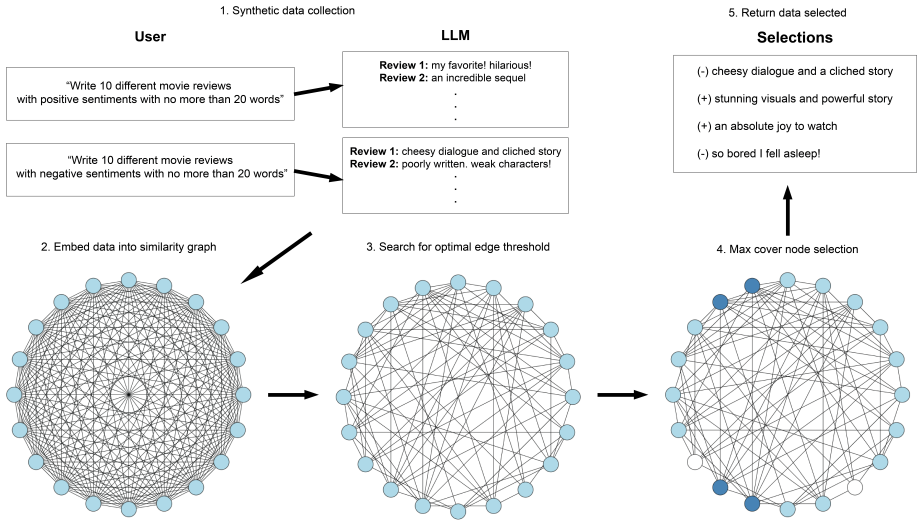
The load-bearing object is the coverage statistic on a similarity graph: a selected set H ⊆ V of k samples covers fraction c of the data when the union of the closed neighborhoods of H equals c|V|. ACS engineers this statistic with three components: a text-embedding step that turns sentences into vectors, a binary search over the cosine-similarity threshold that tunes how many edges survive pruning, and a greedy max-coverage routine that repeatedly picks the highest-degree uncovered node. A per-node degree cap d_max > cN/k keeps the graph sparse. The monotonicity theorem (coverage cannot shrink when the threshold is lowered) is what licenses the binary search; the greedy approximation is the practical stand-in whose empirical monotonicity is verified in Section 4.1.
What would settle it
Take a synthetic corpus in a new domain, compute ACS's coverage curve over a grid of similarity thresholds, and fine-tune on both the ACS subset and a random subset of equal size: if the coverage curve ever decreases when the threshold is lowered, or if the ACS subset does not beat the random subset, the central claim fails for that setting.
Extended reading notes
Core claim
ACS treats data selection as maximum coverage on a weighted similarity graph: each sample is a node, edges connect semantically similar samples, and a subset of k nodes is chosen so that the union of their neighborhoods covers a target fraction c of the corpus. Because coverage is monotone in the edge threshold for an exact max-cover solution (Theorem 3.2), a binary search can find the loosest similarity threshold that still hits the target coverage; the paper then runs a greedy approximation in practice and verifies monotonicity empirically on all three datasets. The central empirical discovery is that full coverage, c = 1, is not optimal: accuracy peaks just below full coverage, and ACS-selected subsets at roughly 90% coverage match or exceed full-corpus training with 10% of SST2, 30% of FewRel, and 20% of CrossNER. The selected subsets also show higher diversity (lower SelfBLEU), which the paper identifies as the mechanism connecting coverage sampling to better generalization.
Load-bearing premise
The binary search assumes coverage increases monotonically as the similarity threshold is lowered; the paper proves this only for an exact max-cover solution and relies on three empirical datasets to show the greedy approximation behaves the same way, so a new corpus with a non-monotone coverage curve would break the threshold search.
Editorial extensions
If this is right
- On SST2, ACS matches full-corpus fine-tuning using only about 10% of the synthetic data; on FewRel the comparable fraction is about 30%, and on CrossNER about 20%.
- Across nearly all subset sizes on all three tasks, ACS beats random selection, EL2N, forgetting scores, prototypicality, and an LLM-rater baseline (AlpaGasus).
- Subsets chosen by ACS have lower SelfBLEU scores, so the accuracy gain is tied to higher diversity rather than to hardness or proximity to class centroids.
- Because selection never uses labels and requires no repeated model training, the same pipeline applies to unlabeled synthetic pools and can be dropped next to any embedding method.
- Setting target coverage below 1.0 (the paper uses 0.9) is consistently better than full coverage, so pruning redundant samples is part of the benefit, not a compromise.
Reading between the lines
- An implication the paper leaves implicit: the same coverage search applies to human-labeled data and unlabeled corpora, since redundancy is not specific to LLM output; target coverage would become a tunable hyperparameter there.
- A caveat the paper only partially addresses: monotonicity is proven for exact max cover, so a practitioner should plot coverage versus threshold on a new embedding before trusting the binary search; a non-monotone curve would silently select the wrong threshold.
- The appendix's threshold-transfer result implies a scalable recipe the paper does not push: tune the threshold on a small random subsample and reuse it on the full graph, which combined with approximate nearest-neighbor construction should scale ACS to millions of samples.
- Since ACS optimizes breadth while difficulty-based filters optimize informativeness, the two criteria could be composed—first cover, then score within covered regions—rather than treated as competing baselines.
Signed reviews
Editorial analysis
A structured set of objections, weighed in public.
Referee Report
Summary. The paper introduces Adaptive Coverage Sampling (ACS), a graph-based data-selection method for synthetic text corpora. Synthetic samples are embedded, a similarity graph is built, a binary search sets an edge-weight threshold to hit a target coverage c, and a greedy maximum-coverage algorithm selects k nodes. The authors claim that training BERT on these ACS-selected subsets matches or outperforms training on the full synthetic dataset while using only 10–30% of the data, across SST2 sentiment classification, FewRel relation extraction, and CrossNER named entity recognition. They also provide a monotonicity theorem for the exact max-cover problem, an empirical monotonicity validation for the greedy variant, and an appendix proposing a scalable threshold-transfer procedure.
Significance. If the central claim were cleanly established, ACS would be a practically useful and inexpensive method for reducing synthetic-data fine-tuning cost, with an appealing connection to maximum coverage as a formalization of diversity. The paper has several strengths: it compares against a broad set of baselines (random, EL2N, forgetting, prototypicality, AlpaGasus), it reports both task performance and a SelfBLEU diversity measure, it provides code and hyperparameters in the supplementary material, and it explicitly acknowledges the gap between the exact max-cover monotonicity theorem and the greedy approximation. However, the headline empirical result is currently weakened by a circular choice of the key hyperparameter c on the SST2 test set, by the absence of error bars or significance tests despite the use of five seeds, and by an abstract that overstates performance at small subset sizes for two of the three benchmarks. These issues are fixable but affect the core empirical claim.
major comments (4)
- [Section 4.2 and Section A.1] The coverage target c=0.9, which is the central hyperparameter of ACS, is selected by tuning on a 'human-annotated test set' for SST2 in Section 4.2. Appendix A.1 then states that 'full coverage is non-optimal in most instances, further motivating our usages of coverage = 0.9 throughout the experimental results.' The same human-annotated SST2 test set is used to report the headline F1 scores in Figure 3. This makes the 'less is more' finding for SST2 partly circular: c was chosen by optimizing accuracy on the very test set used for evaluation. Please re-run the SST2 evaluation with c selected on a held-out validation split (or report the full accuracy-vs-c curve and evaluate at all c values), and clearly state for each benchmark whether c was tuned on a validation set or fixed a priori.
- [Abstract and Section 5.1 (Figures 4 and 5)] The abstract's unqualified claim that ACS 'achieves superior performance compared to training on the entire dataset' is contradicted by the paper's own tables at small subset sizes. On FewRel at 10% subset size, ACS achieves 0.2642 F1 versus 0.3729 for full-data training (Figure 4), and on CrossNER at 10%, ACS achieves 0.2502 versus 0.3842 (Figure 5). Even the SST2 at 10% margin (0.8280 vs 0.8176) is small. The claims in Section 5.1 are more careful ('approximately 10%' for SST2, '30%' for FewRel, '20%' for CrossNER), but the abstract and Discussion should be aligned with the actual subset sizes and should not imply superior performance at all sizes.
- [Section 3.3 and Figures 3–5] The paper states that five random seeds were used for model initialization, but all reported results are single point estimates with no standard deviations, confidence intervals, or significance tests. Several of the claimed advantages over baselines and over full-data training are small (e.g., SST2 at 10%: 0.8280 vs 0.8176; SST2 at 80%: 0.8357 vs 0.8304), and without variance information it is impossible to know whether these differences are meaningful. Please report means and standard deviations, and ideally pairwise significance tests, for the main comparisons.
- [Section 3.2, Theorem 3.2, and Section 4.1] The binary-search procedure's theoretical grounding applies to the exact maximum-coverage solution, but the implementation uses the greedy approximation, which the paper explicitly concedes is not guaranteed to be monotone in the threshold. The empirical monotonicity validation on three datasets is useful, but it does not establish a general guarantee, and on a new dataset the binary search could fail to converge to the intended coverage. This is acknowledged in the text, but it should be stated more prominently as a limitation of the method's theoretical guarantees, not as part of the positive claim that ACS 'ensures theoretical rigor.'
minor comments (5)
- [General] The text contains several typos and stylistic errors, including 'analgous', 'evalute', 'compliment', 'Hasing', 'threhsold', 'datasests', 'optimial', and 'subsample' used inconsistently. These should be corrected in a revision.
- [Appendix A, Figures 6 and 7] The captions of Figures 6 and 7 describe the right-hand plots as 'for the sentiment analysis tasks,' but the figures show FewRel and CrossNER, respectively. The captions should be corrected.
- [Appendix B, Proposition B.1] The proof of Proposition B.1 is not fully rigorous as written: S and S' are greedy selections that depend on the random subsample and on each other, so the Hoeffding bound over fixed indicator variables does not directly apply, and the step replacing the expected coverage on V' by the coverage on V needs a clearer argument. The empirical transfer results are suggestive, but the formal statement should be either repaired or removed.
- [Section 3.2] The derivation of d_max via the 'extended pigeonhole principle' is only sketched; please provide the precise statement or a citation, since this constraint affects the graph construction and hence the coverage computation.
- [Section 5.1] Figure 3 reports F1 'averaging results over five random initializations' but the table does not indicate whether the displayed numbers are averaged over those seeds or a single run. Please clarify the reporting convention.
Circularity Check
Coverage target c=0.9 is selected on the SST2 test set and then evaluated on the same test set, making the headline 'less is more' result partly constructed by test-set tuning.
-
fitted input called prediction
[Section 4.2 ('Determining the Optimal Coverage Level'); Appendix A.1; Section 5.1 (Figure 3)]
"Using these subsets, we fine-tunedBertbase models and evaluated their accuracy on a human-annotated test set. ... accuracy consistently peaks before reaching full coverage ... These results robustly support our assertion ... We further see that full coverage is non-optimal in most instances, further motivating our usages of coverage = 0.9 throughout the experimental results."
The coverage hyperparameter c is set to 0.9 in Section 4.2 by sweeping coverage values and measuring accuracy on the human-annotated SST2 test set. The same test set is then used in Section 5.1 to report the F1 scores that support the claim that ACS 'matches or outperforms full-data training with only 10% of the data.' Because the hyperparameter was tuned directly on the evaluation set, the headline comparison is not an out-of-sample evaluation: the small margins (e.g., 0.8280 vs 0.8176 at 10% subset size) can reflect test-set selection rather than a genuine property of ACS. A held-out validation split is needed to establish the 'less is more' claim.
full rationale
The core ACS derivation is not circular: coverage is defined independently of test labels, Theorem 3.2 provides a genuine monotonicity proof for the exact max-cover solution, and the paper explicitly acknowledges that the greedy approximation is not guaranteed monotone and validates it empirically on all three datasets. The self-citations present are not load-bearing. However, the central empirical claim is compromised by a test-set hyperparameter-selection loop: the coverage target 0.9 is chosen in Section 4.2 by maximizing accuracy on the same human-annotated SST2 test set used for the reported results in Section 5.1. This is a fitted-input-called-prediction evaluation loop, not merely a self-citation concern. The ACS-versus-baseline comparisons are honest external sweeps, but the headline 'less is more' result is not independently established. Accordingly, the paper receives a moderate circularity score: the derivation is self-contained, yet the central empirical claim is partially constructed by selection on the evaluation set.
Assumptions & free parameters
free parameters (2)
- coverage target c =
0.9
- max degree bound d_max =
not specified
assumptions (4)
- domain assumption Greedy max coverage coverage is monotone in the similarity threshold, enabling binary search.
- domain assumption Gecko embedding cosine similarity is a valid proxy for semantic diversity relevant to downstream classification.
- domain assumption Synthetic corpora generated by GPT-3.5 using prompts from [11] are representative of the target tasks and test distributions.
- domain assumption BERT fine-tuning hyperparameters fixed across methods give a fair comparison.
Cite this review
Pith. "Pith review of Less is More: Adaptive Coverage for Synthetic Training Data." pith.science (2026). https://pith.science/paper/4YQC72EH
@misc{pith2026250414508,
  author       = {Pith},
  title        = {Pith review of: Less is More: Adaptive Coverage for Synthetic Training Data},
  year         = {2026},
  howpublished = {\url{https://pith.science/paper/4YQC72EH}},
  note         = {Machine review of arXiv:2504.14508}
}
read the original abstract
Synthetic training data generation with Large Language Models (LLMs) like Google's Gemma and OpenAI's GPT offer a promising solution to the challenge of obtaining large, labeled datasets for training classifiers. When rapid model deployment is critical, such as in classifying emerging social media trends or combating new forms of online abuse tied to current events, the ability to generate training data is invaluable. While prior research has examined the comparability of synthetic data to human-labeled data, this study introduces a novel sampling algorithm, based on the maximum coverage problem, to select a representative subset from a synthetically generated dataset. Our results demonstrate that training a classifier on this contextually sampled subset achieves superior performance compared to training on the entire dataset. This "less is more" approach not only improves model accuracy but also reduces the volume of data required, leading to potentially more efficient model fine-tuning.
Figures


Figures from the paper (7 more)


Reference graph
Works this paper leans on
-
[57]
Coverage-centric coreset selection for high pruning rates
Zheng, H., Liu, R., Lai, F., and Prakash, A. Coverage-centric coreset selection for high pruning rates. In The Eleventh International Conference on Learning Representations
-
[1]
L., Almeida, D., Altenschmidt, J., Altman, S., Anadkat, S., et al
Achiam, J., Adler, S., Agar w al, S., Ahmad, L., Akkaya, I., Aleman, F. L., Almeida, D., Altenschmidt, J., Altman, S., Anadkat, S., et al. Gpt-4 technical report. arXiv preprint arXiv:2303.08774 (2023)
arXiv 2023
-
[2]
M., Longpre, S., Lambert, N., W ang, X., Muennighoff, N., Hou, B., Pan, L., Jeong, H., et al
Albalak, A., Elazar, Y., Xie, S. M., Longpre, S., Lambert, N., W ang, X., Muennighoff, N., Hou, B., Pan, L., Jeong, H., et al. A survey on data selection for language models.arXiv preprint arXiv:2402.16827 (2024). 11
arXiv 2024
-
[3]
Brown, T. B. Language models are few-shot learners.arXiv preprint arXiv:2005.14165(2020)
arXiv 2020
-
[4]
Why it is hard to find ai in smes: A survey from the practice and how to promote it
Bunte, A., Richter, F., and Diovisal vi, R. Why it is hard to find ai in smes: A survey from the practice and how to promote it. InICAART (2)(2021), pp. 614–620
work page 2021
-
[5]
Carey, C., Halcrow, J., Jayaram, R., Mirrokni, V., Schudy, W., and Zhong, P. Stars: Tera-scale graph building for clustering and learning.Advances in Neural Information Processing Systems 35 (2022), 21470–21481
work page 2022
-
[6]
Alpagasus: Training a better alpaca with fewer data.arXiv preprint arXiv:2307.08701 (2023)
Chen, L., Li, S., Yan, J., W ang, H., Gunaratna, K., Yada v, V., Tang, Z., Sriniv asan, V., Zhou, T., Huang, H., et al. Alpagasus: Training a better alpaca with fewer data.arXiv preprint arXiv:2307.08701 (2023)
arXiv 2023
-
[7]
Coleman, C., Yeh, C., Mussmann, S., Mirzasoleiman, B., Bailis, P., Liang, P., Leskovec, J., and Zaharia, M. Selection via proxy: Efficient data selection for deep learning.arXiv preprint arXiv:1906.11829 (2019)
arXiv 2019
Show all 58 references
-
[8]
When low resource nlp meets unsupervised language model: Meta-pretraining then meta-learning for few-shot text classification (student abstract)
Deng, S., Zhang, N., Sun, Z., Chen, J., and Chen, H. When low resource nlp meets unsupervised language model: Meta-pretraining then meta-learning for few-shot text classification (student abstract). In Proceedings of the AAAI Conference on Artificial Intelligence(2020), vol. 3...
2020
-
[9]
Bert: Pre-training of deep bidirectional transformers for language understanding.arXiv preprint arXiv:1810.04805 (2018)
Devlin, J. Bert: Pre-training of deep bidirectional transformers for language understanding.arXiv preprint arXiv:1810.04805 (2018)
2018 arXiv
-
[10]
H., Joty, S., Si, L., and Miao, C
Ding, B., Liu, L., Bing, L., Kruengkrai, C., Nguyen, T. H., Joty, S., Si, L., and Miao, C. Daga: Data augmentation with a generation approach for low-resource tagging tasks.arXiv preprint arXiv:2011.01549 (2020)
2020 arXiv
-
[11]
K., Joty, S., Li, B., and Bing, L
Ding, B., Qin, C., Liu, L., Chia, Y. K., Joty, S., Li, B., and Bing, L. Is gpt-3 a good data annotator? arXiv preprint arXiv:2212.10450(2022)
2022 arXiv
-
[12]
Fine-tuning pretrained language models: Weight initializations, data orders, and early stopping.arXiv preprint arXiv:2002.06305 (2020)
Dodge, J., Ilharco, G., Schw artz, R., F arhadi, A., Hajishirzi, H., and Smith, N. Fine-tuning pretrained language models: Weight initializations, data orders, and early stopping.arXiv preprint arXiv:2002.06305 (2020)
2020 arXiv
-
[13]
Clustering for private interest-based advertising
Epasto, A., Muñoz Medina, A., A very, S., Bai, Y., Busa-Fekete, R., Carey, C., Gao, Y., Guthrie, D., Ghosh, S., Ioannidis, J., et al. Clustering for private interest-based advertising. In Proceedings of the 27th ACM SIGKDD Conference on Knowledge Discovery & Data Mining(2021),...
2021
-
[14]
A threshold of ln n for approximating set cover.Journal of the ACM (JACM) 45, 4 (1998), 634–652
Feige, U. A threshold of ln n for approximating set cover.Journal of the ACM (JACM) 45, 4 (1998), 634–652
1998
-
[15]
Better synthetic data by retrieving and transforming existing datasets.arXiv preprint arXiv:2404.14361(2024)
Gandhi, S., Gala, R., Visw anathan, V., Wu, T., and Neubig, G. Better synthetic data by retrieving and transforming existing datasets.arXiv preprint arXiv:2404.14361(2024)
2024 arXiv
-
[16]
Chatgpt outperforms crowd workers for text-annotation tasks
Gilardi, F., Alizadeh, M., and Kubli, M. Chatgpt outperforms crowd workers for text-annotation tasks. Proceedings of the National Academy of Sciences 120, 30 (2023), e2305016120
2023
-
[17]
Domain adaptation for large-scale sentiment classification: A deep learning approach
Glorot, X., Bordes, A., and Bengio, Y. Domain adaptation for large-scale sentiment classification: A deep learning approach. InProceedings of the 28th international conference on machine learning (ICML-11) (2011), pp. 513–520
2011
-
[18]
Deepcore: A comprehensive library for coreset selection in deep learning
Guo, C., Zhao, B., and Bai, Y. Deepcore: A comprehensive library for coreset selection in deep learning. In International Conference on Database and Expert Systems Applications(2022), Springer, pp. 181–195
2022
-
[19]
Grale: Designing networks for graph learning
Halcrow, J., Mosoi, A., Ruth, S., and Perozzi, B. Grale: Designing networks for graph learning. In Proceedings of the 26th ACM SIGKDD international conference on knowledge discovery & data mining (2020), pp. 2523–2532. 12
2020
-
[20]
Fewrel: A large-scale supervised few-shot relation classification dataset with state-of-the-art evaluation.arXiv preprint arXiv:1810.10147 (2018)
Han, X., Zhu, H., Yu, P., W ang, Z., Yao, Y., Liu, Z., and Sun, M. Fewrel: A large-scale supervised few-shot relation classification dataset with state-of-the-art evaluation.arXiv preprint arXiv:1810.10147 (2018)
2018 arXiv
-
[21]
Synthetic data in ai: Challenges, applications, and ethical implications.arXiv preprint arXiv:2401.01629(2024)
Hao, S., Han, W., Jiang, T., Li, Y., Wu, H., Zhong, C., Zhou, Z., and Tang, H. Synthetic data in ai: Challenges, applications, and ethical implications.arXiv preprint arXiv:2401.01629(2024)
2024 arXiv
-
[22]
Toxigen: A large-scale machine-generated dataset for adversarial and implicit hate speech detection
Hartvigsen, T., Gabriel, S., Palangi, H., Sap, M., Ray, D., and Kamar, E. Toxigen: A large-scale machine-generated dataset for adversarial and implicit hate speech detection. InProceedings of the 60th Annual Meeting of the Association for Computational Linguistics (Volume 1: L...
2022
-
[23]
On the effectiveness of adapter-based tuning for pretrained language model adaptation.arXiv preprint arXiv:2106.03164 (2021)
He, R., Liu, L., Ye, H., Tan, Q., Ding, B., Cheng, L., Low, J.-W., Bing, L., and Si, L. On the effectiveness of adapter-based tuning for pretrained language model adaptation.arXiv preprint arXiv:2106.03164 (2021)
2021 arXiv
-
[24]
Hochbaum, D. S. Approximating covering and packing problems: set cover, vertex cover, independent set, and related problems. InApproximation algorithms for NP-hard problems. 1996, pp. 94–143
1996
-
[25]
Human feedback is not gold standard
Hosking, T., Blunsom, P., and Bartolo, M. Human feedback is not gold standard. InThe Twelfth International Conference on Learning Representations
-
[26]
W., and Liang, P
Koh, P. W., and Liang, P. Understanding black-box predictions via influence functions. In International conference on machine learning(2017), PMLR, pp. 1885–1894
2017
-
[27]
Harnessing large- language models to generate private synthetic text.arXiv preprint arXiv:2306.01684(2023)
Kurakin, A., Ponomarev a, N., Syed, U., MacDermed, L., and Terzis, A. Harnessing large- language models to generate private synthetic text.arXiv preprint arXiv:2306.01684(2023)
2023 arXiv
-
[28]
Albert: A lite bert for self-supervised learning of language representations.arXiv preprint arXiv:1909.11942 (2019)
Lan, Z. Albert: A lite bert for self-supervised learning of language representations.arXiv preprint arXiv:1909.11942 (2019)
2019 arXiv
-
[29]
R., Hui, K., Boratko, M., Kapadia, R., Ding, W., et al
Lee, J., Dai, Z., Ren, X., Chen, B., Cer, D., Cole, J. R., Hui, K., Boratko, M., Kapadia, R., Ding, W., et al. Gecko: Versatile text embeddings distilled from large language models.arXiv preprint arXiv:2403.20327 (2024)
2024 arXiv
-
[30]
Synthetic data generation with large language models for text classification: Potential and limitations.arXiv preprint arXiv:2310.07849(2023)
Li, Z., Zhu, H., Lu, Z., and Yin, M. Synthetic data generation with large language models for text classification: Potential and limitations.arXiv preprint arXiv:2310.07849(2023)
2023 arXiv
-
[31]
Best practices and lessons learned on synthetic data
Liu, R., Wei, J., Liu, F., Si, C., Zhang, Y., Rao, J., Zheng, S., Peng, D., Yang, D., Zhou, D., et al. Best practices and lessons learned on synthetic data. InFirst Conference on Language Modeling (2024)
2024
-
[32]
Roberta: A robustly optimized bert pretraining approach.arXiv preprint arXiv:1907.11692 (2019)
Liu, Y. Roberta: A robustly optimized bert pretraining approach.arXiv preprint arXiv:1907.11692 (2019)
2019 arXiv
-
[33]
Crossner: Evaluating cross-domain named entity recognition
Liu, Z., Xu, Y., Yu, T., Dai, W., Ji, Z., Cahya wijaya, S., Madotto, A., and Fung, P. Crossner: Evaluating cross-domain named entity recognition. InProceedings of the AAAI Conference on Artificial Intelligence (2021), vol. 35, pp. 13452–13460
2021
-
[34]
On llms-driven synthetic data generation, curation, and evaluation: A survey.arXiv preprint arXiv:2406.15126(2024)
Long, L., W ang, R., Xiao, R., Zhao, J., Ding, X., Chen, G., and W ang, H. On llms-driven synthetic data generation, curation, and evaluation: A survey.arXiv preprint arXiv:2406.15126(2024)
2024 arXiv
-
[35]
D2 pruning: Message passing for balancing diversity and difficulty in data pruning.arXiv preprint arXiv:2310.07931(2023)
Maharana, A., Yada v, P., and Bansal, M. D2 pruning: Message passing for balancing diversity and difficulty in data pruning.arXiv preprint arXiv:2310.07931(2023)
2023 arXiv
-
[36]
Generating training data with language models: Towards zero-shot language understanding.Advances in Neural Information Processing Systems 35 (2022), 462–477
Meng, Y., Huang, J., Zhang, Y., and Han, J. Generating training data with language models: Towards zero-shot language understanding.Advances in Neural Information Processing Systems 35 (2022), 462–477. 13
2022
-
[37]
M., and Goodfellow, I
Miyato, T., Dai, A. M., and Goodfellow, I. Adversarial training methods for semi-supervised text classification. arXiv preprint arXiv:1605.07725(2016)
2016 arXiv
-
[38]
Paul, M., Ganguli, S., and Dziugaite, G. K. Deep learning on a data diet: Finding important examples early in training.Advances in neural information processing systems 34(2021), 20596–20607
2021
-
[39]
Pleiss, G., Zhang, T., Elenberg, E., and Weinberger, K. Q. Identifying mislabeled data using the area under the margin ranking.Advances in Neural Information Processing Systems 33(2020), 17044–17056
2020
-
[40]
W., Borgeaud, S., Cai, T., Millican, K., Hoffmann, J., Song, F., Aslanides, J., Henderson, S., Ring, R., Young, S., et al
Rae, J. W., Borgeaud, S., Cai, T., Millican, K., Hoffmann, J., Song, F., Aslanides, J., Henderson, S., Ring, R., Young, S., et al. Scaling language models: Methods, analysis & insights from training gopher.arXiv preprint arXiv:2112.11446(2021)
2021 arXiv
-
[41]
Raffel, C., Shazeer, N., Roberts, A., Lee, K., Narang, S., Matena, M., Zhou, Y., Li, W., and Liu, P. J. Exploring the limits of transfer learning with a unified text-to-text transformer.Journal of machine learning research 21, 140 (2020), 1–67
2020
-
[42]
C., Yates, A., and de Rijke, M
Rajapakse, T. C., Yates, A., and de Rijke, M. Simple transformers: Open-source for all. In Proceedings of the 2024 Annual International ACM SIGIR Conference on Research and Development in Information Retrieval in the Asia Pacific Region(2024), pp. 209–215
2024
-
[43]
Data augmentation for intent classification with off-the-shelf large language models
Sahu, G., Rodriguez, P., Laradji, I., Atighehchian, P., V azquez, D., and Bahdanau, D. Data augmentation for intent classification with off-the-shelf large language models. InProceedings of the 4th Workshop on NLP for Conversational AI(2022), pp. 47–57
2022
-
[44]
Data sampling using locality sensitive hashing for large scale graph learning
Shekkizhar, S., Bulut, N., F arghal, M., Ta v akkol, S., Bateni, M., and Nandi, A. Data sampling using locality sensitive hashing for large scale graph learning
-
[45]
D., Agar w al, R., Anand, A., Patil, P., Garcia, X., Liu, P
Singh, A., Co-Reyes, J. D., Agar w al, R., Anand, A., Patil, P., Garcia, X., Liu, P. J., Harrison, J., Lee, J., Xu, K., et al. Beyond human data: Scaling self-training for problem-solving with language models.Transactions on Machine Learning Research
-
[46]
D., Ng, A
Socher, R., Perelygin, A., Wu, J., Chuang, J., Manning, C. D., Ng, A. Y., and Potts, C. Recursive deep models for semantic compositionality over a sentiment treebank. InProceedings of the 2013 conference on empirical methods in natural language processing(2013), pp. 1631–1642
2013
-
[47]
Beyond neural scaling laws: beating power law scaling via data pruning.Advances in Neural Information Processing Systems 35 (2022), 19523–19536
Sorscher, B., Geirhos, R., Shekhar, S., Ganguli, S., and Morcos, A. Beyond neural scaling laws: beating power law scaling via data pruning.Advances in Neural Information Processing Systems 35 (2022), 19523–19536
2022
-
[48]
A., and Choi, Y
Sw ayamdipta, S., Schw artz, R., Lourie, N., W ang, Y., Hajishirzi, H., Smith, N. A., and Choi, Y. Dataset cartography: Mapping and diagnosing datasets with training dynamics. InProceedings of the 2020 Conference on Empirical Methods in Natural Language Processing (EMNLP)(2020...
2020
-
[49]
Does synthetic data generation of llms help clinical text mining? arXiv preprint arXiv:2303.04360(2023)
Tang, R., Han, X., Jiang, X., and Hu, X. Does synthetic data generation of llms help clinical text mining? arXiv preprint arXiv:2303.04360(2023)
2023 arXiv
-
[50]
Galactica: A large language model for science.arXiv preprint arXiv:2211.09085 (2022)
Taylor, R., Kardas, M., Cucurull, G., Scialom, T., Hartshorn, A., Sara via, E., Poulton, A., Kerkez, V., and Stojnic, R. Galactica: A large language model for science.arXiv preprint arXiv:2211.09085 (2022)
2022 arXiv
-
[51]
S., Love, J., et al
Team, G., Mesnard, T., Hardin, C., Dadashi, R., Bhupatiraju, S., Pathak, S., Sifre, L., Rivière, M., Kale, M. S., Love, J., et al. Gemma: Open models based on gemini research and technology. arXiv preprint arXiv:2403.08295(2024)
2024 arXiv
-
[52]
Tonev a, M., Sordoni, A., Combes, R. T. d., Trischler, A., Bengio, Y., and Gordon, G. J. An empirical study of example forgetting during deep neural network learning.arXiv preprint arXiv:1812.05159 (2018). 14
2018 arXiv
-
[53]
V asw ani, A.Attention is all you need.Advances in Neural Information Processing Systems(2017)
2017
-
[54]
Eda: Easy data augmentation techniques for boosting performance on text classification tasks
Wei, J., and Zou, K. Eda: Easy data augmentation techniques for boosting performance on text classification tasks. arXiv preprint arXiv:1901.11196(2019)
2019 arXiv
-
[55]
Moderate coreset: A universal method of data selection for real-world data-efficient deep learning
Xia, X., Liu, J., Yu, J., Shen, X., Han, B., and Liu, T. Moderate coreset: A universal method of data selection for real-world data-efficient deep learning. InThe Eleventh International Conference on Learning Representations(2022)
2022
-
[56]
Zerogen: Efficient zero-shot learning via dataset generation
Ye, J., Gao, J., Li, Q., Xu, H., Feng, J., Wu, Z., Yu, T., and Kong, L. Zerogen: Efficient zero-shot learning via dataset generation. InProceedings of the 2022 Conference on Empirical Methods in Natural Language Processing(2022), pp. 11653–11669
2022
-
[58]
Texygen: A benchmarking platform for text generation models
Zhu, Y., Lu, S., Zheng, L., Guo, J., Zhang, W., W ang, J., and Yu, Y. Texygen: A benchmarking platform for text generation models. InThe 41st international ACM SIGIR conference on research & development in information retrieval(2018), pp. 1097–1100. 15 Figure 6: Empirical resu...
2018
Reviewed August 16, 2026 · model on record in the stance chip above.
Discussion (0). Continue with ORCID to comment.