REVIEW 3 major objections 5 minor 44 references
SUDO: Enhancing Text-to-Image Diffusion Models with Self-Supervised Direct Preference Optimization
T0 review · 3 major / 5 minor · reviewed 2026-08-16 · deepseek-v4-flash
Pith's one-line read SUDO lifts text-to-image diffusion models with self-made preference pairs, replacing costly human annotation.
desk verdict Useful self-supervised pair construction for diffusion DPO, but the 'downgrade' framing is misleading and the numbers lack error bars. read the letter →
The pith
A machine-rendered reading of the paper's core claim, the machinery that carries it, and where it could break.
The reading
What carries the argument
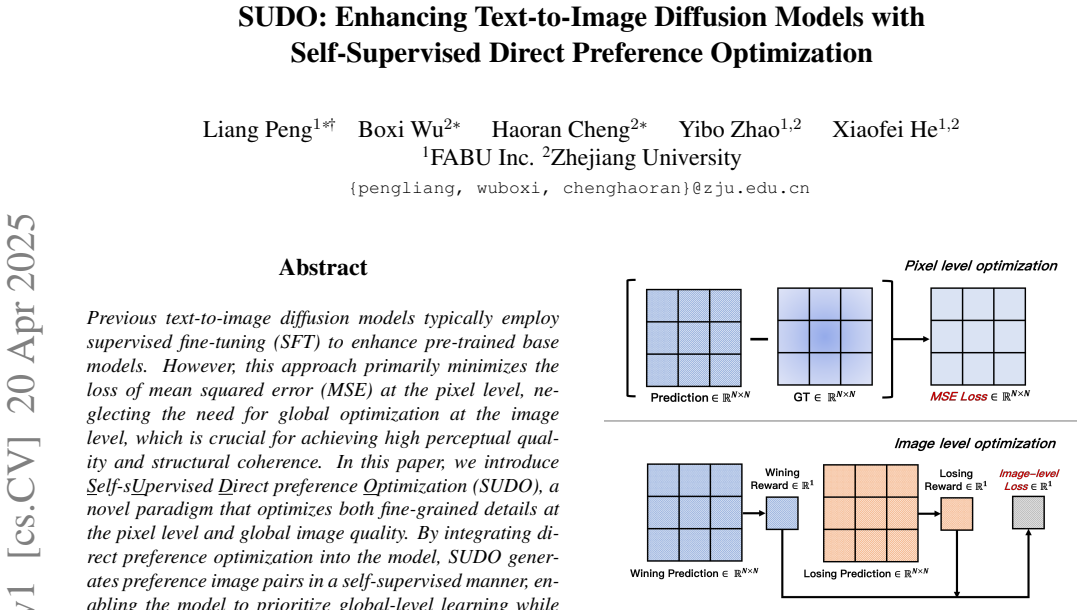
The load-bearing object is the self-supervised preference pair created by the Downgrade operation. In each iteration the correct image $x^w$ is the winner and $x^{sl} = \mathrm{Downgrade}(x^w)$ is a randomly sampled image from the training set that does not correspond to the prompt. The loss is $$L_{\mathrm{SUDO}} = -\log\$\sigma$\!\left(C\left[\|\epsilon_\$\theta$(x^w_t,t)-\epsilon^w\|$_2^{2}$ - \|\epsilon_\$\theta$($x^{{sl}}$_t,t)-\$epsilon^{{sl}}$\|$_2^{2}$ - \left(\|\epsilon_{\mathrm{ref}}(x^w_t,t)-\epsilon^w\|$_2^{2}$ - \|\epsilon_{\mathrm{ref}}($x^{{sl}}$_t,t)-\$epsilon^{{sl}}$\|$_2^{2}$\right)\right]\right),$$ with $C$ a scale factor, and the total loss is $L = \lambda_1 L_{\mathrm{MSE}} + \lambda_2 L_{\mathrm{SUDO}}$. The objective widens the gap between the model's denoising error on the matching pair and its error on the mismatched pair, relative to the reference model, and this gap is what carries the image-level learning.
What would settle it
A controlled comparison could settle it: fine-tune with SUDO but replace the random-image loser with a same-prompt image generated by the base model, a true near-miss negative; if the gains disappear or reverse, the reported improvement comes from contrastive regularization against unrelated images rather than from preference optimization.
Extended reading notes
Core claim
The central discovery is that the expensive preference labels in DPO can be replaced by a free, self-supervised signal: any image that does not match the prompt is a valid losing sample. Formally, with $x^w$ the correct text-image pair and $x^{sl} = \mathrm{Downgrade}(x^w)$ obtained by randomly drawing a mismatched image from the training set, SUDO maximizes the log-likelihood of preferring $x^w$ over $x^{sl}$ in a DPO-style objective. The paper reports that this objective, combined with the MSE loss, consistently improves the base models on Pick-a-Pic V2, PartiPrompts, and HPDv2, measured by PickScore, Aesthetics, CLIP, HPS v2, and ImageReward. It also reports that the random-image downgrade is essential: blurring or randomly swapping grid patches makes performance worse than SFT.
Load-bearing premise
The load-bearing premise is that a randomly selected training image is a valid 'losing' sample for any prompt, so widening the model's denoising-error gap between the correct pair and the mismatched pair improves generation quality; the paper offers no theoretical argument for why this particular signal helps, and its own ablations show other downgrades are harmful.
Editorial extensions
If this is right
- SUDO can be applied to any text-to-image diffusion model without collecting human preference annotations, making image-level alignment as cheap as ordinary supervised fine-tuning.
- On SD1.5, SUDO improves all five metrics over the base model on all three evaluation sets, with ImageReward rising from -14.81 to 71.00 on Pick-a-Pic V2, far above SFT's 45.03 and DPO's 4.13.
- On SDXL, where SFT degrades the base model, SUDO still improves most metrics and reaches HPS win rates above 92 percent on all three sets.
- The random-image downgrade is not interchangeable: blur and random-grid downgrades fall below SFT, so the specific choice of losing sample matters.
- Removing the MSE loss leaves SUDO's gains largely intact, indicating the image-level preference term alone carries most of the benefit.
Reading between the lines
- A testable implication the authors do not pursue: if the benefit comes from the model learning to separate matched from mismatched pairs, then harder negatives, images that are semantically related to the prompt but wrong, should give larger gains than uniformly random images.
- Since the paper notes the random-image strategy may fail on very small training sets, a natural extension is curriculum or retrieved negatives from a larger pool, which would also clarify whether the signal is pure contrastive regularization rather than preference optimization.
- The paper's framing as 'preference' optimization is one interpretation; equally consistent with the data is that SUDO acts as a form of data augmentation or regularization that prevents fine-tuning from overfitting to the pixel-level MSE loss. A comparison against a standard contrastive loss on the same pairs would separate these explanations.
Signed reviews
Editorial analysis
A structured set of objections, weighed in public.
Referee Report
Summary. The paper introduces SUDO, a self-supervised direct preference optimization method for fine-tuning text-to-image diffusion models. In each training iteration, the input image is treated as the winning sample and a randomly selected image from the training set is used as the losing sample; the DPO-style loss in Eq. (8) is then added to the standard MSE loss. Experiments on Stable Diffusion 1.5 and SDXL, evaluated on Pick-a-Pic V2, PartiPrompts, and HPDv2 with five automatic metrics, are reported to show that SUDO improves over SFT and the base models and is competitive with Diffusion-DPO, without using preference annotations.
Significance. If the reported results are robust, SUDO offers a practical alternative to SFT for improving text-to-image models with no additional human preference labels, which is a valuable contribution. The paper provides a wide range of quantitative comparisons, ablations on the downgrade operation, and qualitative examples. However, the mechanism behind the method is not clearly established, the reported gains are not consistent across all metrics and models, and the statistical basis of the claims is weak because all numbers are point estimates without error bars or significance tests.
major comments (3)
- [Section 3.2, Eq. (8) and Table 3] The only 'Downgrade' operation that improves performance is random text-image mismatch, not an image-quality degradation; blur and random grid both perform worse than SFT. This directly contradicts the paper's assertion that the losing sample is obtained by 'degrading the winner' and undermines the interpretation of SUDO as a direct preference optimization method over image quality. The authors should either provide an explicit analysis of why this operation helps (for example, as a contrastive text-image alignment regularizer) or substantially reframe the method and its claims away from 'preference optimization' and 'global image-level learning.'
- [Table 2] The claim of 'consistently enhancing model performance' and of 'significant enhancements' compared to DPO is overstated. On SDXL, SUDO's PickScore is lower than DPO on all three evaluation sets (22.34 vs 22.57 on Pick-a-Pic V2, 22.79 vs 22.90 on PartiPrompts, 22.98 vs 23.18 on HPDv2), and SUDO is below the base model on Aesthetics on Pick-a-Pic (59.97 vs 60.01). Win rates also favor DPO on several metrics (e.g., Pick-a-Pic V2 PickScore win rate 60.80 vs 72.60). The text should be revised to describe SUDO as competitive with DPO on some metrics and superior on others, not uniformly better.
- [Section 4.2 and Table 2] No error bars, multiple seeds, or significance tests are reported for any of the quantitative results. The terms 'significant', 'substantially higher', and 'far exceeds' are used throughout without statistical quantification. The authors should report standard deviations over at least three seeds or paired significance tests for the main comparisons, especially for the win rates, before claiming consistent improvements.
minor comments (5)
- [Table 1 and Section 4.1] The description of SUDO's data requirement as 'standard image-text pairs' is imprecise because the training data is the Pick-a-Pic V2 dataset, which was collected through user preferences; only the preference annotations are unused. This should be clarified to avoid implying the dataset is arbitrary image-text pairs.
- [Section 4.3] The sentence 'We provide qualitative comparisons in Figure 4 and Figure 1 for SD1.5 and SDXL' is incorrect; the SDXL qualitative results appear in Figure 5 in the main text and Appendix Figures 1 and 2, not in Figure 1. Please correct the figure cross-references.
- [Section 3.2 and Eq. (8)] Equation (8) is typeset with broken line breaks and subscripts in the submitted manuscript, which makes the loss definition hard to read. In addition, there are typographical errors such as 'wining' instead of 'winning', 'encourages' instead of 'encourages', and 'demonstraing' instead of 'demonstrating'.
- [Table 2] The 'Win rate' rows are not defined in the caption or text; please specify how a win is determined for each metric, as this is important for interpreting the pairwise comparisons.
- [Section 5] The limitation that the random-image strategy 'may prove ineffective' for very small datasets is stated without supporting evidence; a small-scale experiment varying dataset size would make this claim more concrete.
Circularity Check
No significant circularity: SUDO's self-supervised preference construction is a new training input, and the central claims are evaluated against external benchmarks.
full rationale
The paper's derivation chain is not circular. SUDO takes the Diffusion-DPO objective from prior external work [37] and replaces human-annotated losing samples with a self-supervised 'Downgrade' operation, implemented as randomly selecting images from the training dataset (Eq. 8 and Section 3.2). This is a new input to an existing framework, not a fitted quantity or a conclusion derived from the same data it predicts. The reported improvements are measured on held-out prompts using independent external metrics (PickScore, Aesthetics, CLIP, HPSv2, ImageReward), so the headline claim is not forced by construction. Hyperparameters such as C, lambda1, and lambda2 are fixed training choices, not fitted to the evaluation sets. There are no self-citations, no imported uniqueness theorems, and no prediction that is equivalent to an input by definition. The observation in Table 3 that blur and random grid downgrades hurt performance is an empirical finding, not a circular reduction; the naming of a random mismatched image as a 'downgrade' is a heuristic framing issue rather than a logical circularity. The paper's limitation statement about small training datasets is similarly a practical caveat, not evidence that the method's output is presupposed by its input. Overall, the central claim has independent empirical content and no circular step is exhibited.
Assumptions & free parameters
free parameters (3)
- lambda1 =
0.5
- lambda2 =
0.5
- C =
-2500
assumptions (3)
- domain assumption The diffusion denoising process can be treated as a multi-step MDP, and the DPO objective from Diffusion-DPO applies to diffusion models with step-wise rewards.
- ad hoc to paper A randomly selected image from the training dataset is a valid 'losing' sample for any given prompt.
- ad hoc to paper Increasing the gap between the model's denoising errors on aligned vs. mismatched pairs translates to better image quality and text alignment.
Cite this review
Pith. "Pith review of SUDO: Enhancing Text-to-Image Diffusion Models with Self-Supervised Direct Preference Optimization." pith.science (2026). https://pith.science/paper/CWLYQQUH
@misc{pith2026250414534,
  author       = {Pith},
  title        = {Pith review of: SUDO: Enhancing Text-to-Image Diffusion Models with Self-Supervised Direct Preference Optimization},
  year         = {2026},
  howpublished = {\url{https://pith.science/paper/CWLYQQUH}},
  note         = {Machine review of arXiv:2504.14534}
}
read the original abstract
Previous text-to-image diffusion models typically employ supervised fine-tuning (SFT) to enhance pre-trained base models. However, this approach primarily minimizes the loss of mean squared error (MSE) at the pixel level, neglecting the need for global optimization at the image level, which is crucial for achieving high perceptual quality and structural coherence. In this paper, we introduce Self-sUpervised Direct preference Optimization (SUDO), a novel paradigm that optimizes both fine-grained details at the pixel level and global image quality. By integrating direct preference optimization into the model, SUDO generates preference image pairs in a self-supervised manner, enabling the model to prioritize global-level learning while complementing the pixel-level MSE loss. As an effective alternative to supervised fine-tuning, SUDO can be seamlessly applied to any text-to-image diffusion model. Importantly, it eliminates the need for costly data collection and annotation efforts typically associated with traditional direct preference optimization methods. Through extensive experiments on widely-used models, including Stable Diffusion 1.5 and XL, we demonstrate that SUDO significantly enhances both global and local image quality. The codes are provided at \href{https://github.com/SPengLiang/SUDO}{this link}.
Figures


Figures from the paper (4 more)


Reference graph
Works this paper leans on
-
[1]
Con- stitutional ai: Harmlessness from ai feedback
Yuntao Bai, Saurav Kadavath, Sandipan Kundu, Amanda Askell, Jackson Kernion, Andy Jones, Anna Chen, Anna Goldie, Azalia Mirhoseini, Cameron McKinnon, et al. Con- stitutional ai: Harmlessness from ai feedback. arXiv preprint arXiv:2212.08073, 2022. 3
arXiv 2022
-
[2]
Improving image generation with better captions
James Betker, Gabriel Goh, Li Jing, Tim Brooks, Jianfeng Wang, Linjie Li, Long Ouyang, Juntang Zhuang, Joyce Lee, Yufei Guo, et al. Improving image generation with better captions. Computer Science. https://cdn. openai. com/papers/dall-e-3. pdf, 2(3):8, 2023. 3
2023
-
[3]
Training diffusion models with reinforce- ment learning
Kevin Black, Michael Janner, Yilun Du, Ilya Kostrikov, and Sergey Levine. Training diffusion models with reinforce- ment learning. arXiv preprint arXiv:2305.13301, 2023. 3
arXiv 2023
-
[4]
Rank analysis of incomplete block designs: I
Ralph Allan Bradley and Milton E Terry. Rank analysis of incomplete block designs: I. the method of paired compar- isons. Biometrika, 39(3/4):324–345, 1952. 4
1952
-
[5]
Pixart- alpha: Fast training of diffusion transformer for photorealistic text-to-image synthesis
Junsong Chen, Jincheng Yu, Chongjian Ge, Lewei Yao, Enze Xie, Yue Wu, Zhongdao Wang, James Kwok, Ping Luo, Huchuan Lu, et al. Pixart- alpha: Fast training of diffusion transformer for photorealistic text-to-image synthesis. arXiv preprint arXiv:2310.00426, 2023. 1, 3
-
[6]
A simple framework for contrastive learning of visual representations
Ting Chen, Simon Kornblith, Mohammad Norouzi, and Ge- offrey Hinton. A simple framework for contrastive learning of visual representations. In International conference on ma- chine learning, pages 1597–1607. PmLR, 2020. 3
2020
-
[7]
Directly fine-tuning diffusion models on differentiable re- wards
Kevin Clark, Paul Vicol, Kevin Swersky, and David J Fleet. Directly fine-tuning diffusion models on differentiable re- wards. arXiv preprint arXiv:2309.17400, 2023. 3
arXiv 2023
-
[8]
Emu: Enhanc- ing image generation models using photogenic needles in a haystack
Xiaoliang Dai, Ji Hou, Chih-Yao Ma, Sam Tsai, Jialiang Wang, Rui Wang, Peizhao Zhang, Simon Vandenhende, Xi- aofang Wang, Abhimanyu Dubey, et al. Emu: Enhanc- ing image generation models using photogenic needles in a haystack. arXiv preprint arXiv:2309.15807, 2023. 1, 3
arXiv 2023
Show all 44 references
-
[9]
Diffusion models beat gans on image synthesis
Prafulla Dhariwal and Alexander Nichol. Diffusion models beat gans on image synthesis. Advances in neural informa- tion processing systems, 34:8780–8794, 2021. 3
2021
-
[10]
Raft: Reward ranked finetuning for generative foundation model alignment
Hanze Dong, Wei Xiong, Deepanshu Goyal, Yihan Zhang, Winnie Chow, Rui Pan, Shizhe Diao, Jipeng Zhang, Kashun Shum, and Tong Zhang. Raft: Reward ranked finetuning for generative foundation model alignment. arXiv preprint arXiv:2304.06767, 2023. 3
2023 arXiv
-
[11]
Scaling recti- fied flow transformers for high-resolution image synthesis
Patrick Esser, Sumith Kulal, Andreas Blattmann, Rahim Entezari, Jonas Müller, Harry Saini, Yam Levi, Dominik Lorenz, Axel Sauer, Frederic Boesel, et al. Scaling recti- fied flow transformers for high-resolution image synthesis. In Forty-first international conference on machin...
-
[12]
Re- inforcement learning for fine-tuning text-to-image diffusion models
Ying Fan, Olivia Watkins, Yuqing Du, Hao Liu, Moonkyung Ryu, Craig Boutilier, Pieter Abbeel, Moham- mad Ghavamzadeh, Kangwook Lee, and Kimin Lee. Re- inforcement learning for fine-tuning text-to-image diffusion models. In Thirty-seventh Conference on Neural Informa- tion Proce...
2023
-
[13]
Generative adversarial nets
Ian Goodfellow, Jean Pouget-Abadie, Mehdi Mirza, Bing Xu, David Warde-Farley, Sherjil Ozair, Aaron Courville, and Yoshua Bengio. Generative adversarial nets. Advances in neural information processing systems, 27, 2014. 3
2014
-
[14]
Optimizing prompts for text-to-image generation
Yaru Hao, Zewen Chi, Li Dong, and Furu Wei. Optimizing prompts for text-to-image generation. Advances in Neural Information Processing Systems, 36:66923–66939, 2023. 3
2023
-
[15]
Momentum contrast for unsupervised visual rep- resentation learning
Kaiming He, Haoqi Fan, Yuxin Wu, Saining Xie, and Ross Girshick. Momentum contrast for unsupervised visual rep- resentation learning. In Proceedings of the IEEE/CVF con- ference on computer vision and pattern recognition , pages 9729–9738, 2020. 3
2020
-
[16]
Masked autoencoders are scalable vision learners
Kaiming He, Xinlei Chen, Saining Xie, Yanghao Li, Piotr Dollár, and Ross Girshick. Masked autoencoders are scalable vision learners. In Proceedings of the IEEE/CVF conference on computer vision and pattern recognition , pages 16000– 16009, 2022. 3
2022
-
[17]
Denoising dif- fusion probabilistic models
Jonathan Ho, Ajay Jain, and Pieter Abbeel. Denoising dif- fusion probabilistic models. Advances in neural information processing systems, 33:6840–6851, 2020. 3
2020
-
[18]
Auto-encoding vari- ational bayes, 2013
Diederik P Kingma, Max Welling, et al. Auto-encoding vari- ational bayes, 2013. 3
2013
-
[19]
Pick-a-pic: An open dataset of user preferences for text-to-image generation
Yuval Kirstain, Adam Polyak, Uriel Singer, Shahbuland Ma- tiana, Joe Penna, and Omer Levy. Pick-a-pic: An open dataset of user preferences for text-to-image generation. Advances in Neural Information Processing Systems , 36: 36652–36663, 2023. 6, 7, 8
2023
-
[20]
Flux, 2024
Black Forest Labs. Flux, 2024. Black Forest Labs. Flux,
2024
-
[21]
Aligning text- to-image models using human feedback
Kimin Lee, Hao Liu, Moonkyung Ryu, Olivia Watkins, Yuqing Du, Craig Boutilier, Pieter Abbeel, Mohammad Ghavamzadeh, and Shixiang Shane Gu. Aligning text- to-image models using human feedback. arXiv preprint arXiv:2302.12192, 2023. 3
2023 arXiv
-
[22]
Aligning diffusion mod- els by optimizing human utility
Shufan Li, Konstantinos Kallidromitis, Akash Gokul, Yusuke Kato, and Kazuki Kozuka. Aligning diffusion mod- els by optimizing human utility. Advances in Neural Infor- mation Processing Systems, 37:24897–24925, 2025. 3
2025
-
[23]
Hunyuan-dit: A powerful multi-resolution diffusion transformer with fine-grained chi- nese understanding
Zhimin Li, Jianwei Zhang, Qin Lin, Jiangfeng Xiong, Yanxin Long, Xinchi Deng, Yingfang Zhang, Xingchao Liu, Minbin Huang, Zedong Xiao, et al. Hunyuan-dit: A powerful multi-resolution diffusion transformer with fine-grained chi- nese understanding. arXiv preprint arXiv:2405.087...
2024 arXiv
-
[24]
Decoupled weight decay regularization
Ilya Loshchilov and Frank Hutter. Decoupled weight decay regularization. arXiv preprint arXiv:1711.05101, 2017. 6
2017 arXiv
-
[25]
Glide: Towards photorealistic image generation and editing with text-guided diffusion models.arXiv preprint arXiv:2112.10741, 2021
Alex Nichol, Prafulla Dhariwal, Aditya Ramesh, Pranav Shyam, Pamela Mishkin, Bob McGrew, Ilya Sutskever, and Mark Chen. Glide: Towards photorealistic image generation and editing with text-guided diffusion models.arXiv preprint arXiv:2112.10741, 2021. 3
2021 arXiv
-
[26]
Training language models to follow instructions with human feedback
Long Ouyang, Jeffrey Wu, Xu Jiang, Diogo Almeida, Car- roll Wainwright, Pamela Mishkin, Chong Zhang, Sandhini Agarwal, Katarina Slama, Alex Ray, et al. Training language models to follow instructions with human feedback. Ad- vances in neural information processing systems, 35:...
2022
-
[27]
Scalable diffusion models with transformers
William Peebles and Saining Xie. Scalable diffusion models with transformers. In Proceedings of the IEEE/CVF inter- national conference on computer vision , pages 4195–4205,
-
[28]
Sdxl: Improving latent diffusion mod- els for high-resolution image synthesis
Dustin Podell, Zion English, Kyle Lacey, Andreas Blattmann, Tim Dockhorn, Jonas Müller, Joe Penna, and Robin Rombach. Sdxl: Improving latent diffusion mod- els for high-resolution image synthesis. arXiv preprint arXiv:2307.01952, 2023. 1, 2, 3, 6
2023 arXiv
-
[29]
Aligning text-to-image diffusion models with reward backpropagation
Mihir Prabhudesai, Anirudh Goyal, Deepak Pathak, and Ka- terina Fragkiadaki. Aligning text-to-image diffusion models with reward backpropagation. 2023. 3
2023
-
[30]
Learning transferable visual models from natural language supervi- sion
Alec Radford, Jong Wook Kim, Chris Hallacy, Aditya Ramesh, Gabriel Goh, Sandhini Agarwal, Girish Sastry, Amanda Askell, Pamela Mishkin, Jack Clark, et al. Learning transferable visual models from natural language supervi- sion. In International conference on machine learning, ...
2021
-
[31]
Direct preference optimization: Your language model is secretly a reward model
Rafael Rafailov, Archit Sharma, Eric Mitchell, Christo- pher D Manning, Stefano Ermon, and Chelsea Finn. Direct preference optimization: Your language model is secretly a reward model. Advances in Neural Information Processing Systems, 36:53728–53741, 2023. 1, 3, 4
2023
-
[32]
High-resolution image synthesis with latent diffusion models
Robin Rombach, Andreas Blattmann, Dominik Lorenz, Patrick Esser, and Björn Ommer. High-resolution image synthesis with latent diffusion models. In Proceedings of the IEEE/CVF conference on computer vision and pattern recognition, pages 10684–10695, 2022. 1, 2, 3, 6
2022
-
[33]
Photorealistic text-to-image diffusion models with deep language understanding
Chitwan Saharia, William Chan, Saurabh Saxena, Lala Li, Jay Whang, Emily L Denton, Kamyar Ghasemipour, Raphael Gontijo Lopes, Burcu Karagol Ayan, Tim Salimans, et al. Photorealistic text-to-image diffusion models with deep language understanding. Advances in Neural Information...
2022
-
[34]
Laion-aesthetics
Christoph Schuhmann. Laion-aesthetics. https : / / laion.ai/blog/laion- aesthetics/ , 2022. Ac- cessed: 2023-11-10. 6
2022
-
[35]
Adafactor: Adaptive learning rates with sublinear memory cost
Noam Shazeer and Mitchell Stern. Adafactor: Adaptive learning rates with sublinear memory cost. In International Conference on Machine Learning, pages 4596–4604. PMLR,
-
[36]
Neural discrete representation learning
Aaron Van Den Oord, Oriol Vinyals, et al. Neural discrete representation learning. Advances in neural information pro- cessing systems, 30, 2017. 3
2017
-
[37]
Diffusion model align- ment using direct preference optimization
Bram Wallace, Meihua Dang, Rafael Rafailov, Linqi Zhou, Aaron Lou, Senthil Purushwalkam, Stefano Ermon, Caiming Xiong, Shafiq Joty, and Nikhil Naik. Diffusion model align- ment using direct preference optimization. In Proceedings of the IEEE/CVF Conference on Computer Vision a...
2024
-
[38]
Human preference score v2: A solid benchmark for evaluating human preferences of text-to-image synthesis
Xiaoshi Wu, Yiming Hao, Keqiang Sun, Yixiong Chen, Feng Zhu, Rui Zhao, and Hongsheng Li. Human preference score v2: A solid benchmark for evaluating human preferences of text-to-image synthesis. arXiv preprint arXiv:2306.09341 ,
-
[39]
Sana: Efficient high-resolution image syn- thesis with linear diffusion transformers
Enze Xie, Junsong Chen, Junyu Chen, Han Cai, Haotian Tang, Yujun Lin, Zhekai Zhang, Muyang Li, Ligeng Zhu, Yao Lu, et al. Sana: Efficient high-resolution image syn- thesis with linear diffusion transformers. arXiv preprint arXiv:2410.10629, 2024. 1
-
[40]
Imagere- ward: Learning and evaluating human preferences for text- to-image generation
Jiazheng Xu, Xiao Liu, Yuchen Wu, Yuxuan Tong, Qinkai Li, Ming Ding, Jie Tang, and Yuxiao Dong. Imagere- ward: Learning and evaluating human preferences for text- to-image generation. Advances in Neural Information Pro- cessing Systems, 36:15903–15935, 2023. 6
2023
-
[41]
Using human feedback to fine-tune diffusion models without any reward model
Kai Yang, Jian Tao, Jiafei Lyu, Chunjiang Ge, Jiaxin Chen, Weihan Shen, Xiaolong Zhu, and Xiu Li. Using human feedback to fine-tune diffusion models without any reward model. In Proceedings of the IEEE/CVF Conference on Computer Vision and Pattern Recognition , pages 8941– 895...
2024
-
[42]
Scaling autoregres- sive models for content-rich text-to-image generation
Jiahui Yu, Yuanzhong Xu, Jing Yu Koh, Thang Luong, Gun- jan Baid, Zirui Wang, Vijay Vasudevan, Alexander Ku, Yin- fei Yang, Burcu Karagol Ayan, et al. Scaling autoregres- sive models for content-rich text-to-image generation. arXiv preprint arXiv:2206.10789, 2(3):5, 2022. 6, 8
2022 arXiv
-
[43]
Self-play fine-tuning of diffusion models for text-to-image generation
Huizhuo Yuan, Zixiang Chen, Kaixuan Ji, and Quanquan Gu. Self-play fine-tuning of diffusion models for text-to-image generation. Advances in Neural Information Processing Sys- tems, 37:73366–73398, 2025. 3
2025
-
[44]
Dspo: Direct score preference optimization for diffusion model alignment
Huaisheng Zhu, Teng Xiao, and Vasant G Honavar. Dspo: Direct score preference optimization for diffusion model alignment. In The Thirteenth International Conference on Learning Representations. 3, 4 Appendix for SUDO: Enhancing Text-to-Image Diffusion Models with Self-Supervis...
Reviewed August 16, 2026 · model on record in the stance chip above.
Discussion (0). Continue with ORCID to comment.