REVIEW 5 major objections 5 minor 36 references
Two-proton correlations in the decay of 48Ni and 45Fe
T0 review · 5 major / 5 minor · reviewed 2026-08-16 · deepseek-v4-flash
Pith's one-line read The two-proton angular distributions of 48Ni and 45Fe match Gamow coupled-channel calculations with the standard proton-proton interaction strength, supporting small-angle emission and constraining valence shell structure.
desk verdict Honest experimental paper with new events and a first GCC angular comparison, but the abstract's 'confirms' claim outruns the statistics and the model-space caveat. read the letter →
The pith
A machine-rendered reading of the paper's core claim, the machinery that carries it, and where it could break.
The reading
What carries the argument
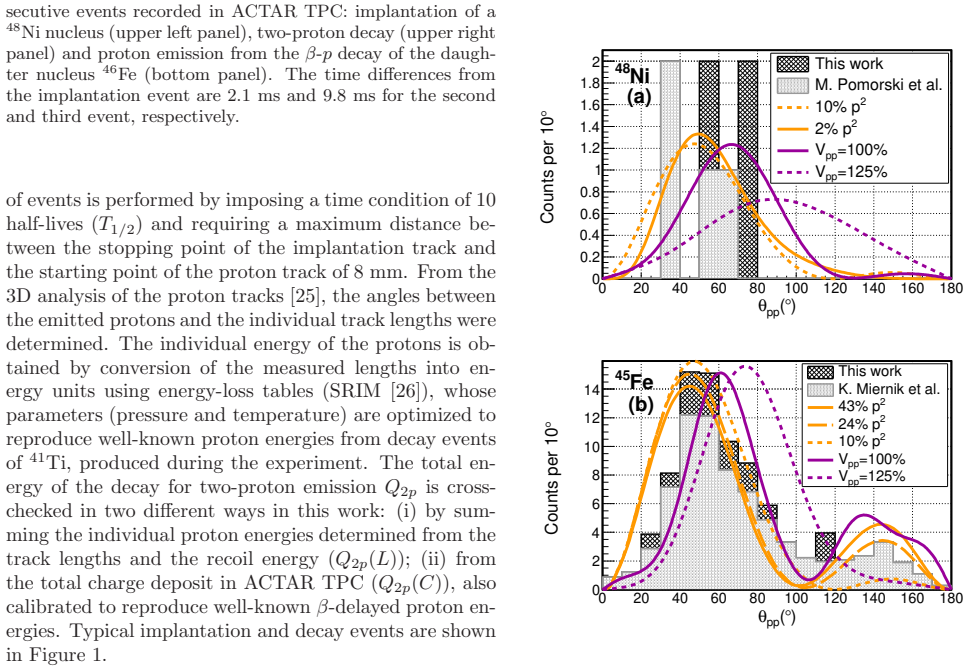
The load-bearing object is the two-proton angular distribution, i.e., the distribution of the opening angle $\theta_{pp}$ between the two emitted protons, reconstructed in three dimensions from the tracks left in a time-projection chamber. The theory side is the Gamow Coupled-Channel (GCC) framework, which treats the emitter as a spherical daughter core plus two valence protons and uses the Berggren ensemble of bound, resonant, and scattering states, together with a finite-range Furutani-Horiuchi-Tamagaki proton-proton force and a Woods-Saxon core potential. The paper varies the proton-proton interaction strength between 100% and 125% of the nominal value, and compares the predicted angular distributions with the 3-body model predictions, which are parametrized by the $p$-orbital occupancy $\omega(p)$. Agreement is quantified by likelihood probabilities and chi-square per degree of freedom.
What would settle it
Measure the 48Ni two-proton angular distribution with at least 30 events and compare the binned distribution to GCC predictions at 100% and 125% $V_{pp}$; if the small-angle peak is reproduced only by the 100% curve, the claimed interaction-strength confirmation stands, whereas a compatible fit from the 125% curve would leave the strength underdetermined.
Extended reading notes
Core claim
The paper's central claim is that the two-proton angular correlation is a discriminating observable for the decay dynamics: comparing the measured $\theta_{pp}$ distributions for 48Ni and 45Fe with new GCC calculations and with 3-body model predictions supports the standard proton-proton interaction strength ($V_{pp}=100\%$) for both nuclei and a predominantly small-angle emission geometry. For 48Ni, the comparison with 3-body predictions indicates a low $p$-orbital occupancy, consistent with the $f_{7/2}$ shell closure expected for a doubly magic nucleus; for 45Fe, the comparison requires a substantial $p$-orbital occupancy. These structural conclusions are presented as the paper's positive result, while the discrepancies among half-life, total decay energy, and energy-sharing observables are acknowledged as unresolved complexities that may involve $s$-wave continuum contributions or different decay configurations.
Load-bearing premise
The conclusion assumes that the $s$-wave continuum contribution is strongly suppressed in the GCC model space; if $s$-wave components contribute non-negligibly, the inferred proton-proton interaction strength and orbital occupancies from the angular distributions would not be reliable.
Editorial extensions
If this is right
- If the angular-distribution agreement holds, the standard proton-proton interaction strength is validated in the continuum regime for two-proton emitters, not just in bound nuclear structure.
- For 48Ni, the data support a closed $f_{7/2}$ shell, reinforcing its doubly magic character from a decay-correlation observable.
- For 45Fe, the angular distribution requires substantial $p$-orbital occupancy, implying configuration mixing in the valence system.
- The failure of the same models to reproduce half-lives, total decay energies, and energy sharing means angular correlations alone are not sufficient to pin down the decay mechanism; additional observables or model extensions, such as $s$-wave continuum contributions, are needed.
- A systematic offset between TPC-based and silicon-based total decay-energy values, if real, would affect comparisons to mass predictions and needs a dedicated tandem measurement.
Reading between the lines
- If $s$-wave continuum contributions are responsible for the half-life and total-energy discrepancies, then angular distributions alone underdetermine the proton-proton interaction strength; energy and width observables must be fitted jointly.
- The narrower-than-predicted proton energy-sharing distribution in 45Fe suggests a decay configuration with a larger centrifugal barrier; a testable extension would be to measure the same distribution in the two-proton emitter 54Zn, where the $p$-orbital occupancy is predicted to be smaller.
- A tandem time-projection chamber plus silicon detector measurement, suggested by the authors, would settle whether the total decay-energy offset is instrumental; if confirmed, previous silicon-based decay-energy values for 48Ni and 45Fe may need downward revision, with consequences for mass extrapolations.
Signed reviews
Editorial analysis
A structured set of objections, weighed in public.
Referee Report
Summary. The paper reports a new experimental study of two-proton radioactivity in 48Ni and 45Fe using ACTAR TPC at GANIL/LISE3. It presents half-lives, branching ratios, total decay energies, individual proton energies, and energy/angular correlations, and compares these observables with new Gamow Coupled-Channel (GCC) calculations and existing 3-body model predictions. The central claim is that the measured two-proton angular distributions confirm the adopted proton-proton interaction strength (100% Vpp) and the predominant small-angle emission, and that the comparisons indicate an f7/2 shell closure in 48Ni and substantial p-orbital occupancy in 45Fe. The paper also reports discrepancies for half-lives, total decay energies, and energy correlations, and explicitly discusses unresolved inconsistencies between experiment and theory.
Significance. If the main claims hold, the paper provides rare and valuable experimental constraints on two-proton continuum correlations, including the first comparison of the 48Ni angular distribution with theoretical calculations. The experimental work is careful: event identification is based on a multi-parameter analysis with cross-checks, proton energies are obtained from track lengths and cross-checked against total charge deposits, and the paper honestly exposes internal inconsistencies. The new GCC calculations for both nuclei extend the theoretical comparison to energy and angular correlations. However, the confirmatory claim is weakened by the model-space suppression of the s-wave continuum, the low event counts for 48Ni, the re-identification of 46Fe events for 45Fe, and the internal tension between the angular-distribution and half-life conclusions. The paper is therefore best read as reporting consistency under stated model assumptions rather than an independent confirmation of the proton-proton interaction strength.
major comments (5)
- [Abstract and Conclusions] The central claim that the angular distributions 'confirm the adopted strength of the proton-proton interaction' is stronger than the evidence supports. The Conclusions state that 'A contribution of the s-wave continuum, highly suppressed in the present GCC calculations, could possibly retrieve the agreement with the experimental results.' Because the s-wave continuum is precisely the channel most sensitive to the proton-proton interaction and to the centrifugal barrier, the two-point model comparison (Vpp=100% versus Vpp=125%) demonstrates consistency within a truncated model space rather than confirmation of the interaction strength. Please soften the abstract and conclusions accordingly, for example to 'is consistent with' or 'does not contradict'.
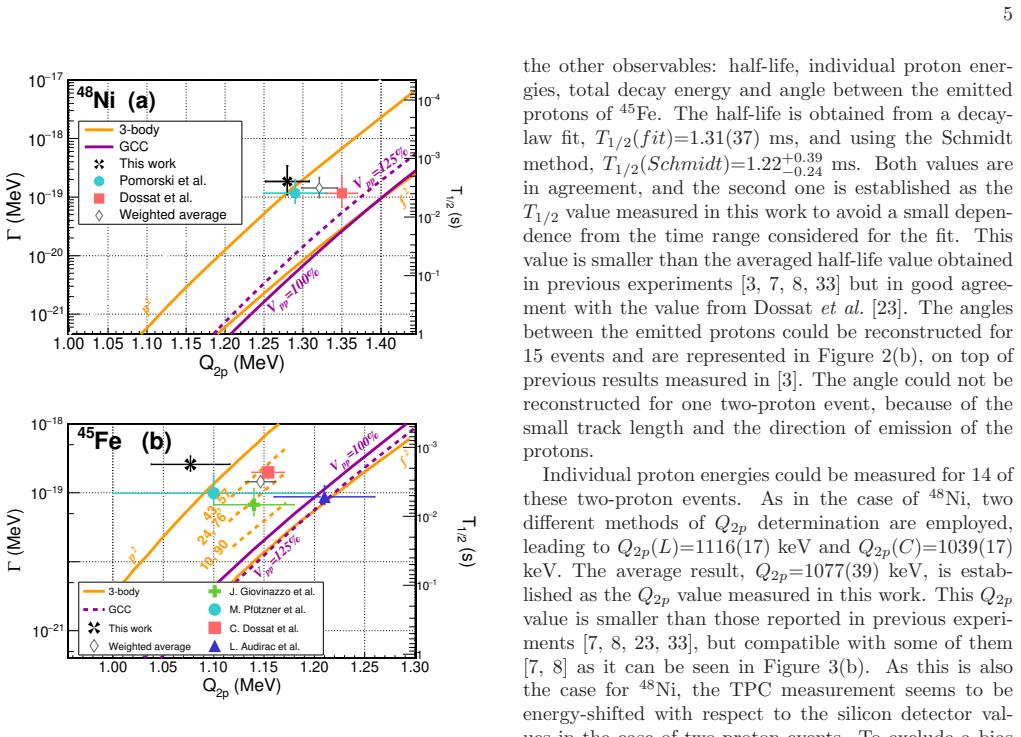
- [Results, 48Ni, Comparison with theory] For 48Ni, the GCC framework gives opposite preferred Vpp values for different observables: Table III shows that the angular distribution favours Vpp=100% (chi2/dof 0.54 versus 1.38), while the half-life comparison shown in Fig. 3(a) favours Vpp=125%. The paper acknowledges this inconsistency in the text, but the abstract's confirmatory claim does not. Before the angular-distribution result can confirm the interaction strength, the half-life discrepancy must either be resolved or explicitly treated as a model failure that limits the confirmatory power of the angular comparison.
- [Table I and Fig. 2(a)] The 48Ni angular-distribution conclusion is based on only three new events combined with previous data. With such low statistics, the difference between chi2/dof=0.54 and 1.38 is not statistically decisive, and the likelihood probabilities in Table III are extremely small for every model (e.g., 4.7e-5 for GCC 100% Vpp), indicating a poor absolute fit. The paper itself notes that 'higher statistics is certainly needed to conclude.' The word 'confirms' in the abstract is therefore not supported by the statistical weight of the data.
- [Results, 45Fe] For 45Fe, ten of the fifteen angular events are re-identified as 45Fe decays rather than 46Fe decays on the basis of the identification analysis described in the experimental set-up. The contamination study is performed with beta-delayed proton emitters (45Cr, 44Cr, 43Cr, 46Fe, 47Fe) and may not have the same selection sensitivity for two-proton events. Since these ten events carry about two-thirds of the angular distribution shown in Fig. 2(b), the paper should state explicitly how a misclassification of 46Fe events would change the extracted Vpp preference and the p2 occupancy.
- [Theoretical Approach] The GCC core-valence potential is adjusted by 'decreasing the s-channel strength by 7%' to align with the experimental two-proton decay energies. Consequently, the comparisons of Q2p between GCC and experiment shown in Table II and Fig. 3 are not independent tests of the model; the potential is fitted to the same observable. This circularity should be acknowledged wherever the Q2p agreement is discussed, or the adjusted parameter should be shown to have negligible effect on the angular correlation predictions.
minor comments (5)
- [References] Reference [34] contains a sentence ('The same analysis was also performed for 49Ni, but no two-proton events were found in this case') that is not a citation; it should be moved to the main text or a footnote.
- [Table III and Table IV] The likelihood probability L is quoted without a definition or normalization recipe. Please add a sentence specifying how L is computed and what probability it represents, so that the reader can judge the absolute quality of the fits.
- [Figure 2] The figure legend should distinguish the GCC Vpp=100% and Vpp=125% curves and the 3-body omega(p) curves more explicitly; in the current figure the orange and purple curves are difficult to separate, especially in grayscale printing.
- [Results, 45Fe] The text reports T1/2(fit)=1.31(37) ms and T1/2(Schmidt)=1.22+0.39/-0.24 ms and adopts the Schmidt value 'to avoid a small dependence from the time range considered for the fit.' Please state the range of half-lives obtained for different fit windows, since this is the justification for discarding the fit result.
- [Theoretical Approach] The symbols Vpp=100% and Vpp=125% are used without defining the reference interaction; one sentence explaining that these correspond to scaling the FHT force by those factors (as in [32]) would help non-specialist readers.
Circularity Check
No circularity: the angular-distribution comparison is an independent model test; Q2p normalization is disclosed and not presented as a prediction.
full rationale
The paper does not exhibit a circular derivation. The GCC calculations are independent of the angular-distribution data: the Woods-Saxon depth is explicitly adjusted to reproduce the measured two-proton decay energies ('the depth of the WS potential has been adjusted, decreasing the s-channel strength by 7%'), and this adjustment is disclosed in the Theoretical Approach section. Q2p is therefore a normalization input, not a prediction, and the paper does not claim GCC predicts Q2p; the Q2p comparisons in Table II are against Brown, Ormand, and Cole, not against the tuned GCC calculations. The central claim—that the measured θ_pp distributions favor Vpp=100% over Vpp=125%—is a discrete model comparison against new experimental angular correlations, not a fit of Vpp to those data. The Vpp values are pre-existing options from the FHT force (ref. [32]); the data are used once, to select between them. The same holds for the 3-body p-orbital occupancies, which are taken from literature and compared, not fitted. The conclusion about s-wave suppression is a stated model-space limitation ('A contribution of the s-wave continuum, highly suppressed in the present GCC calculations, could possibly retrieve the agreement with the experimental results'), not a hidden reuse of the target result; it weakens the inference but does not make it circular. The self-citations to Wang and Nazarewicz describe the GCC framework used here, and the calculations are performed in this work rather than being replaced by the citations. Hence there is no load-bearing circular step.
Assumptions & free parameters
free parameters (3)
- Woods-Saxon s-channel depth adjustment =
-7% relative to universal parametrization
- Proton-proton interaction strength Vpp =
100% and 125% of FHT force [32]
- SRIM stopping-power calibration parameters =
Optimized to known proton energies from 41Ti decays
assumptions (4)
- domain assumption The two-proton emitter is described as an inert spherical core plus two valence protons using Jacobi coordinates and a Berggren complex-energy basis.
- domain assumption The core-proton interaction is a Woods-Saxon potential with the universal parameter set, and the proton-proton interaction is the Furutani-Horiuchi-Tamagaki force plus point Coulomb.
- domain assumption The decay width and asymptotic correlations can be extracted from the flux current and a transition matrix.
- domain assumption The shell-model configurations (f7/2 closure for 48Ni, p-orbital occupancy for 45Fe) are the relevant structure degrees of freedom.
Cite this review
Pith. "Pith review of Two-proton correlations in the decay of 48Ni and 45Fe." pith.science (2026). https://pith.science/paper/GTG75XSD
@misc{pith2026250414607,
  author       = {Pith},
  title        = {Pith review of: Two-proton correlations in the decay of 48Ni and 45Fe},
  year         = {2026},
  howpublished = {\url{https://pith.science/paper/GTG75XSD}},
  note         = {Machine review of arXiv:2504.14607}
}
read the original abstract
The main observables of the rare two-proton emission process - half-life, total energy of the decay as well as energy and angular correlations between the emitted protons - have been measured for 48Ni and 45Fe in a recent experiment performed at the GANIL/LISE3 facility. The results, together with previous experimental work, are compared for the first time with calculations performed in the recently developed Gamow Coupled-Channel (GCC) framework and to 3-body predictions from literature. The comparison of the 48Ni and the 45Fe two-proton angular distributions with the GCC calculations confirms the adopted strength of the proton-proton interaction for both nuclei and the predominant small-angle emission. A comparison with 3-body model angular distributions indicates the shell closure of the f_7/2 orbital for 48Ni and a substantial occupancy of the p-orbital for 45Fe. Discrepancies between experimental data and theoretical predictions are found when studying the other observables: half-lives, total energy of the decay and energy correlations, showing the complexity of the description of the two-proton emission process.
Figures

Figures from the paper (1 more)

Reference graph
Works this paper leans on
- [1]
- [2]
- [3]
- [4]
-
[5]
L. V. Grigorenko et al. , Phys. Rev. Lett. 85, 22 (2000)
work page 2000
-
[6]
S. M. Wang, W. Nazarewicz, Phys. Rev. C 120, 212502 (2018)
work page 2018
- [7]
- [8]
Show all 36 references
-
[9]
Blank et al
B. Blank et al. , Nucl. Instrum. Meth. Phys, B266, 4606 (2008)
2008
-
[10]
Miernik et al
K. Miernik et al. , Nucl. Instrum. Meth. Phys. Res. A 581, 194 (2007)
2007
-
[11]
Roger et al
T. Roger et al. , Nucl. Instrum. Meth. Phys. Res. A 895 , 126 (2018)
2018
-
[12]
Mauss et al
B. Mauss et al. , Nucl. Instrum. Meth. Phys. Res. A 940 , 498 (2019)
2019
-
[13]
L. V. Grigorenko et al. , Phys. Rev. C 95, 021601 (2017)
2017
-
[14]
S. M. Wang and W. Nazarewicz, Phys. Rev. Lett. 126, 142501 (2021)
2021
-
[15]
S. M. Wang et al. , J. Phys. G 49, 10LT02 (2022)
2022
-
[16]
S. M. Wang et al. , Phys. Rev. C 96, 044307 (2017)
2017
-
[17]
S. M. Wang and W. Nazarewicz, Phys. Rev. Lett. 120, 212502 (2018)
2018
-
[18]
S. M. Wang and W. Nazarewicz, Correlations for mid- heavy two-proton emitters, in preparation (2024)
2024
-
[19]
Furutani et al
H. Furutani et al. , Prog. Theor. Phys. 62, 981 (1979)
1979
-
[20]
Cwiok et al
S. Cwiok et al. , Comput. Phys. Comm. 46, 379 (1987)
1987
-
[21]
Mueller and R
A.C. Mueller and R. Anne, Nucl. Instrum. Meth. Phys. Res. B56, 559 (1991)
1991
-
[22]
Ottini et al
S. Ottini et al. , Nucl. Instrum. Meth. Phys. Res. A 431, 476 (1999)
1999
-
[23]
Dossat et al
C. Dossat et al. , Phys. Rev. C. 72, 054315 (2005)
2005
-
[24]
Pollacco et al., Nucl
E. Pollacco et al., Nucl. Instrum. Meth. Phys. Res. A887, 81 (2018)
2018
-
[25]
Giovinazzo et al
J. Giovinazzo et al. , Nucl. Instrum. Meth. Phys. Res. A 1042, 167447 (2022)
2022
-
[26]
Ziegler et al
T. Ziegler et al. , http://www.srim.org
-
[27]
Pomorski et al
M. Pomorski et al. , Phys. Rev. C90, 014311 (2014)
2014
-
[28]
Schmidt, Zeitschrift f¨ ur Physik A, Atoms and Nu- clei 316, 19 (1984)
K.-H. Schmidt, Zeitschrift f¨ ur Physik A, Atoms and Nu- clei 316, 19 (1984)
1984
-
[29]
Brown, Phys
B.A. Brown, Phys. Rev. C 43, R1513 (1991)
1991
-
[30]
Ormand, Phys
W.E. Ormand, Phys. Rev. C 55, 2407 (1997)
1997
-
[31]
Cole, Phys
B.J. Cole, Phys. Rev. C 54, 1240 (1996)
1996
-
[32]
Thomson et al
D.R. Thomson et al. , Nucl. Phys. A 286, 53 (1977)
1977
-
[33]
Audirac et al
L. Audirac et al. , Eur. Phys. J. A 99, 12179 (2012)
2012
-
[34]
The same analysis was also performed for 49Ni, but no two-proton events were found in this case
-
[35]
M. Wang, W. Nazarewicz, private comunication (2023)
2023
-
[36]
Giovinazzo et al
J. Giovinazzo et al. , Phys. Rev. Lett. 99, 102501 (2007)
2007
Reviewed August 16, 2026 · model on record in the stance chip above.
Discussion (0). Continue with ORCID to comment.