REVIEW 4 major objections 6 minor 56 references
Reliable Multi-Modal Object Re-Identification via Modality-Aware Graph Reasoning
T0 review · 4 major / 6 minor · reviewed 2026-08-16 · deepseek-v4-flash
Pith's one-line read The paper claims that graph reasoning over RGB, NIR, and TIR patches, together with selective cross-modal patch swapping, yields state-of-the-art multi-modal object re-identification on four benchmarks.
desk verdict Solid, incremental multi-modal ReID paper with plausible SOTA numbers; the main novelty (SGNS) is under-specified and lacks a random-swap control, so the central claim is not yet testable. read the letter →
The pith
A machine-rendered reading of the paper's core claim, the machinery that carries it, and where it could break.
The reading
What carries the argument
The central object is the modality-aware graph with a learned adjacency matrix $A^m_{ij}=1-\sigma((D^m_{ij}+\alpha)\beta)$ built from Euclidean distances between patch tokens. On this graph, the Selective Graph Nodes Swap (SGNS) operation selects $k$ low-quality nodes per modality using edge magnitudes and global-local similarity $W^m=1-\phi(\psi(X^m_g,X^m_l))$, then swaps them across modalities, for example $X^R_{li}\leftarrow \tfrac{1}{2}(X^N_{li}+X^T_{li})$. The Local-aware Graph Reasoning (LGR) GCN layer propagates messages over the swapped graphs, and the Graph Reasoning on Missing Modality (GRMM) reconstructs missing tokens via learned adjacency matrices and reconstruction losses. These modules together carry the paper's claim.
What would settle it
Retrain MGRNet on RGBNT201 with the swap nodes chosen uniformly at random instead of by graph-edge magnitude and global-local similarity; if the random-swap variant keeps mAP within a small margin of the proposed selection, the selective criterion is not the source of the gain.
Extended reading notes
Core claim
A sympathetic reading of the paper is that the central discovery is the combination of two graph-based mechanisms. First, the Selective Graph Nodes Swap (SGNS) identifies 'poor' local patches in each modality using small values in a Euclidean-distance-based adjacency matrix and low similarity between the global token and local tokens, and replaces them with the average of the same patch from the other modalities, re-initializing the patch to zero if the swapped patch is itself poor. Second, the Graph Reasoning on Missing Modality (GRMM) reconstructs an absent modality by learning adjacency matrices from the present modalities and running a layer-wise GCN, supervised by feature and structure reconstruction losses. The authors claim these mechanisms, together with a local-aware graph reasoning (LGR) GCN layer, produce state-of-the-art multi-modal ReID performance on four benchmarks, and their ablations attribute most of the gain to SGNS.
Load-bearing premise
The load-bearing premise is that a patch can be identified as low-quality purely by its distances to other patches and to the overall image token, and that replacing it with the average of the same patch in the other modalities improves rather than corrupts the representation.
Editorial extensions
If this is right
- The ablation table attributes the largest single gain to the Selective Graph Nodes Swap, beyond the graph construction and reasoning layers.
- For missing-modality settings, GRMM beats zero padding, random padding, and feature-only reconstruction on RGBNT201, including when two modalities are absent.
- The number of swapped nodes is a sensitive hyperparameter: performance peaks near k=20 on RGBNT201 and falls sharply at larger k.
- The reported improvements appear on both person and vehicle datasets and with both ViT and CLIP vision encoders.
Reading between the lines
- The graph-swap idea could transfer to other paired-sensor tasks like visible-infrared person re-ID or RGB-depth recognition, where local patch quality varies by lighting or occlusion.
- The heuristic for 'poor' patches—small graph edges plus low global-local similarity—might be replaced by a learned quality or uncertainty module that also predicts which patch to keep, rather than averaging.
- The cross-modal average assumes the same patch index corresponds to the same spatial region across modalities; on datasets with misalignment or heavy occlusion, a deformable or correspondence-aware swap would be needed.
- GRMM reconstructs features, not pixels; combining it with a generative image-level reconstruction could make the missing-modality recovery visually interpretable and potentially stronger.
Signed reviews
Editorial analysis
A structured set of objections, weighed in public.
Referee Report
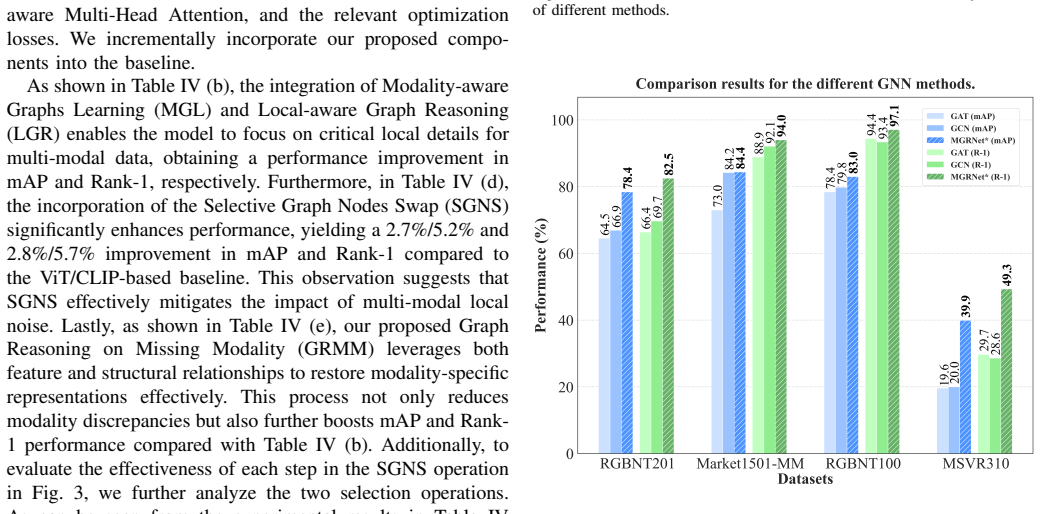
Summary. The paper proposes MGRNet, a multi-modal object Re-ID framework that combines four components: multi-branch ViT/CLIP feature extraction, modality-aware graph learning (MGL) over local patch tokens, a selective graph nodes swap (SGNS) operation intended to replace low-quality local patches with cross-modal mean features, a local-aware graph reasoning (LGR) layer, global-aware multi-head attention, and a graph reasoning on missing modality (GRMM) module that reconstructs absent modality features via GCN propagation. The central empirical claim, supported by Tables I, II, III, and IV, is that MGRNet achieves state-of-the-art results on RGBNT201, Market1501-MM, RGBNT100, and MSVR310, with the CLIP variant reaching 80.5% mAP on RGBNT201 and 87.8% mAP on RGBNT100. The ablation in Table IV attributes much of the gain to SGNS, while Table VI shows sensitivity to the number of swapped nodes k. The paper also reports missing-modality reconstruction results, comparisons with GNN baselines, Grad-CAM and t-SNE visualizations, and states that code will be released upon acceptance.
Significance. If the reported results withstand scrutiny, the work would provide a practically useful recipe for multi-modal Re-ID, particularly for cases with missing modalities, and it would introduce a novel way of using graph structure to trade information across spectral modalities. The paper is thorough in its experimental coverage: four datasets, two backbone families, missing-modality evaluation, ablations, hyperparameter analysis, and visualizations. The reconstruction branch is trained with full-modality supervision and then applied to simulated missing-modality inputs, which is standard supervised learning rather than circular reasoning; the circularity concern raised in the reader's report is not borne out. However, the novelty and the main empirical gain rest on the SGNS module, and that module is both under-specified in the text and not tested against simpler alternative operations. The core idea is defensible, but the paper currently does not allow a reader to verify what SGNS actually computes or to attribute the observed gains to the proposed low-quality-patch selection mechanism rather than to generic cross-modal averaging.
major comments (4)
- [III-C, Eqs. (2)-(7)] The SGNS operation is under-specified. The text says the Top-k method is used to select the k smallest entries of the learned adjacency A^m_l (Eq. 3) and that the resulting candidate nodes are then screened with W^m (Eq. 4), but it never states how the two scores are combined (intersection, union, or threshold), what quantitative criterion defines a "poor" patch, or whether k is the final number of swapped nodes. The Swap function in Eqs. (5)-(7) is never defined, and the re-initialization step described in prose ("set all-zero matrix and then learn the feature expression of the current patch through the local neighbors") has no corresponding equation or algorithm. Without an exact algorithmic definition, the reported SGNS gains in Table IV cannot be reproduced or even fully interpreted.
- [III-C, Eqs. (5)-(7)] The swap equations have a sequential dependency that is not discussed. If Eqs. (5)-(7) are executed in the order written, Eq. (5) overwrites X^R_li before Eq. (6) uses X^R_li as the NIR replacement source, and Eq. (7) then uses the already-updated X^R_li. This means the RGB source in Eqs. (6)-(7) is not the original RGB patch but the previously computed mean of NIR and TIR features, making the operation asymmetric across modalities. If the intended operation is simultaneous exchange, temporary variables or explicit "old" and "new" superscripts are needed; if it is sequential, the authors should justify the asymmetry and its effect on the final features.
- [IV-E, Table IV] The ablation study does not include a control condition for SGNS. The table attributes 2.7-5.2 mAP gains to SGNS, but it never compares SGNS against randomly selecting k patches for the same mean-replacement operation, nor against replacing all selected patches with the cross-modal mean unconditionally. Without such controls, the observed improvement might come from feature smoothing or from the mean-replacement mechanism itself rather than from the proposed criterion that identifies low-quality patches using graph edge values and global-local similarity. The paper should add these baselines or provide per-patch quality annotations that validate the selection mechanism.
- [IV-H, Table VI] The hyperparameter k is tuned on the full RGBNT201 test set, with no validation split described. The final reported numbers in Tables I and IV are then obtained on the same RGBNT201 test set after selecting the k value that maximizes performance on it. This procedure can inflate the reported improvement and makes the comparison with prior methods less convincing. The authors should either report validation-based selection of k or present the sensitivity analysis on a held-out validation split and state this clearly in the experimental setup.
minor comments (6)
- [Fig. 2 caption] The caption says "the overall network structure of the proposed MRGNet," but the method is consistently called MGRNet elsewhere; the typo should be corrected.
- [IV-B and III] Implementation details do not specify the number of graph reasoning layers L and hat-L, the number of attention heads H, the embedding dimension D, or the values used for the graph construction. These are needed for reproducibility and should be listed.
- [IV-D] The text says "methods based on feature reconstruction TOPReID [8]" but reference [8] is TransReID, not TOP-ReID; the citation should be updated to the TOP-ReID reference [21].
- [III-C, Eq. (4)] The symbol phi is used for the softmax in Eq. (4) and again for the softmax attention in Eq. (9), while the caption of Fig. 3 describes a different notation; the paper should use distinct notation or explicitly state that they are the same operation.
- [Abstract and Section IV] The abstract states that code will be made available upon acceptance, but no repository link or access plan is given; providing a link or a detailed pseudo-code appendix would strengthen the paper.
- [III-F] The sentence "L3m is removed for the proposed MGRNet of CLIP-based vision encoders" is ambiguous: it is unclear whether the CLIP rows in Table IV include the multi-modality margin loss or only cross-entropy and reconstruction losses, which matters for interpreting the CLIP ablation results.
Circularity Check
No circular derivation found: MGRNet's graph modules and missing-modality reconstruction are supervised, benchmark-verified components, and the paper's self-citations are not load-bearing.
full rationale
This is an empirical architecture paper, not a derivation from first principles. The closest candidate for a 'prediction' is GRMM's missing-modality reconstruction (Sec. III-E), but Eqs. 18-20 train it against the real RGB features X_R and the real adjacency A_R, so the reconstruction is a standard supervised regressor, not a quantity defined in terms of its own output. The paper itself notes a reconstruction-quality limitation in Sec. IV-I ('the associated region in the NIR modality when generating the RGB modality is less accurate than the real one', Fig. 8(g)), which is an honest empirical caveat rather than a circular step. SGNS (Sec. III-C) defines 'poor' patches procedurally via Top-k small entries of A^m (Eq. 3) screened by W^m (Eq. 4); whether that proxy correctly identifies low-quality patches is an empirical validity question, not a circular one. The SOTA claim rests on held-out benchmark comparisons (Tables I-III) and module ablations (Table IV), and the authors' own earlier methods are among the baselines they exceed, providing external falsifiable evidence. Several references are self-citations by the same group (e.g., [11], [17], [21], [22]), but they are used as baselines, standard loss components ('multi-modality margin [17]'), and related work, not as an unverified premise that forces the conclusion. The main weakness is verification-related rather than circular: SGNS lacks a random-swap control condition, and the re-initialization after Eq. 7 ('set all-zero matrix and then learn the feature expression of the current patch through the local neighbors') is described only in prose, making the module's contribution hard to isolate. That is a reproducibility and ablation-design gap, not an equation that reduces to its own input. No load-bearing self-citation chain or definitional equivalence was found.
Assumptions & free parameters
free parameters (4)
- k (number of swapped nodes) =
20 on RGBNT201
- alpha, beta =
learned during training
- t_N, t_T =
learned during training
- Graph layers L and attention heads H =
not specified
assumptions (4)
- domain assumption Euclidean distance between patch embeddings reflects meaningful structural relationships between patches.
- ad hoc to paper Low-quality patches can be detected by small adjacency weights plus low global-local similarity.
- ad hoc to paper Replacing a low-quality patch with the mean of the same patch from other modalities improves the fused representation.
- domain assumption A GCN trained with full-modality feature and structure losses will generalize to missing modalities at test time.
Cite this review
Pith. "Pith review of Reliable Multi-Modal Object Re-Identification via Modality-Aware Graph Reasoning." pith.science (2026). https://pith.science/paper/FAKM7NEV
@misc{pith2026250414847,
  author       = {Pith},
  title        = {Pith review of: Reliable Multi-Modal Object Re-Identification via Modality-Aware Graph Reasoning},
  year         = {2026},
  howpublished = {\url{https://pith.science/paper/FAKM7NEV}},
  note         = {Machine review of arXiv:2504.14847}
}
read the original abstract
Multi-modal data provides abundant and diverse object information, crucial for effective modal interactions in Re-Identification (ReID) tasks. However, existing approaches often overlook the quality variations in local features and fail to fully leverage the complementary information across modalities, particularly in the case of low-quality features. In this paper, we propose to address this issue by leveraging a novel graph reasoning model, termed the Modality-aware Graph Reasoning Network (MGRNet). Specifically, we first construct modality-aware graphs to enhance the extraction of fine-grained local details by effectively capturing and modeling the relationships between patches. Subsequently, the selective graph nodes swap operation is employed to alleviate the adverse effects of low-quality local features by considering both local and global information, enhancing the representation of discriminative information. Finally, the swapped modality-aware graphs are fed into the local-aware graph reasoning module, which propagates multi-modal information to yield a reliable feature representation. Another advantage of the proposed graph reasoning approach is its ability to reconstruct missing modal information by exploiting inherent structural relationships, thereby minimizing disparities between different modalities. Experimental results on four benchmarks (RGBNT201, Market1501-MM, RGBNT100, MSVR310) indicate that the proposed method achieves state-of-the-art performance in multi-modal object ReID. The code for our method will be available upon acceptance.
Figures


Figures from the paper (7 more)




Reference graph
Works this paper leans on
-
[1]
Deep learning for person re-identification: A survey and outlook,
M. Ye, J. Shen, G. Lin, T. Xiang, L. Shao, and S. C. H. Hoi, “Deep learning for person re-identification: A survey and outlook,” IEEE Transactions on Pattern Analysis and Machine Intelligence , vol. 44, no. 6, pp. 2872–2893, 2022
work page 2022
-
[2]
R. Sun, L. Chen, L. Zhang, R. Xie, and J. Gao, “Robust visible-infrared person re-identification based on polymorphic mask and wavelet graph convolutional network,” IEEE Transactions on Information Forensics and Security, vol. 19, pp. 2800–2813, 2024
work page 2024
-
[3]
Mam- bapro: Multi-modal object re-identification with mamba aggregation and synergistic prompt,
Y . Wang, X. Liu, T. Yan, Y . Liu, A. Zheng, P. Zhang, and H. Lu, “Mam- bapro: Multi-modal object re-identification with mamba aggregation and synergistic prompt,” in Proceedings of the AAAI Conference on Artificial Intelligence, 2025
work page 2025
-
[4]
Modality and camera factors bi- disentanglement for nir-vis object re-identification,
Z. Lu, R. Lin, and H. Hu, “Modality and camera factors bi- disentanglement for nir-vis object re-identification,” IEEE Transactions on Information Forensics and Security , vol. 18, pp. 1989–2004, 2023
work page 1989
-
[5]
Cross-modality person re-identification with generative adversarial training,
P. Dai, R. Ji, H. Wang, Q. Wu, and Y . Huang, “Cross-modality person re-identification with generative adversarial training,” in International Joint Conference on Artificial Intelligence , 2018, pp. 677–683
work page 2018
-
[6]
Omni-scale feature learning for person re-identification,
K. Zhou, Y . Yang, A. Cavallaro, and T. Xiang, “Omni-scale feature learning for person re-identification,” in Proceedings of the IEEE/CVF International Conference on Computer Vision , 2019, pp. 3701–3711
work page 2019
-
[7]
Dual-alignment feature embedding for cross-modality person re-identification,
Y . Hao, N. Wang, X. Gao, J. Li, and X. Wang, “Dual-alignment feature embedding for cross-modality person re-identification,” in Proceedings of the 27th ACM International Conference on Multimedia , 2019, pp. 57–65
2019
-
[8]
Tran- sreid: Transformer-based object re-identification,
S. He, H. Luo, P. Wang, F. Wang, H. Li, and W. Jiang, “Tran- sreid: Transformer-based object re-identification,” in Proceedings of the IEEE/CVF International Conference on Computer Vision , 2021, pp. 15 013–15 022
2021
Show all 56 references
-
[9]
Drformer: A discriminable and reliable feature transformer for person re-identification,
P. Wang, X. Zheng, L. Qing, B. Li, F. Su, Z. Zhao, and H. Chen, “Drformer: A discriminable and reliable feature transformer for person re-identification,” IEEE Transactions on Information Forensics and Security, vol. 20, pp. 980–995, 2025
2025
-
[10]
Infrared-visible cross-modal person re-identification with an x modality,
D. Li, X. Wei, X. Hong, and Y . Gong, “Infrared-visible cross-modal person re-identification with an x modality,” in Proceedings of the AAAI Conference on Artificial Intelligence , 2020, pp. 4610–4617
2020
-
[11]
Robust multi- modality person re-identification,
A. Zheng, Z. Wang, Z.-H. Chen, C. Li, and J. Tang, “Robust multi- modality person re-identification,” in Proceedings of the AAAI Confer- ence on Artificial Intelligence , 2021, pp. 3529–3537
2021
-
[12]
Demo: Decoupled feature- based mixture of experts for multi-modal object re-identification,
Y . Wang, Y . Liu, A. Zheng, and P. Zhang, “Demo: Decoupled feature- based mixture of experts for multi-modal object re-identification,” in Proceedings of the AAAI Conference on Artificial Intelligence , 2025
2025
-
[13]
Idea: Inverted text with cooper- ative deformable aggregation for multi-modal object re-identification,
Y . Wang, Y . Lv, P. Zhang, and H. Lu, “Idea: Inverted text with cooper- ative deformable aggregation for multi-modal object re-identification,” arXiv preprint arXiv:2503.10324 , 2025
2025 arXiv
-
[14]
Dual-adversarial representation disentanglement for visible infrared person re-identification,
Z. Wei, X. Yang, N. Wang, and X. Gao, “Dual-adversarial representation disentanglement for visible infrared person re-identification,” IEEE Transactions on Information Forensics and Security , vol. 19, pp. 2186– 2200, 2024
2024
-
[15]
Multi-spectral vehicle re-identification: A challenge,
H. Li, C. Li, X. Zhu, A. Zheng, and B. Luo, “Multi-spectral vehicle re-identification: A challenge,” in Proceedings of the AAAI Conference on Artificial Intelligence , 2020, pp. 11 345–11 353
2020
-
[16]
Dynamic dual-attentive aggregation learning for visible-infrared person re- identification,
M. Ye, J. Shen, D. J. Crandall, L. Shao, and J. Luo, “Dynamic dual-attentive aggregation learning for visible-infrared person re- identification,” in Proceedings of the European Conference on Computer Vision, 2020, pp. 229–247
2020
-
[17]
Interact, embed, and enlarge: Boosting modality-specific representations for multi-modal person re-identification,
Z. Wang, C. Li, A. Zheng, R. He, and J. Tang, “Interact, embed, and enlarge: Boosting modality-specific representations for multi-modal person re-identification,” in Proceedings of the AAAI Conference on Artificial Intelligence, 2022, pp. 2633–2641
2022
-
[18]
Unicat: Crafting a stronger fusion baseline for multimodal re-identification,
J. Crawford, H. Yin, L. McDermott, and D. Cummings, “Unicat: Crafting a stronger fusion baseline for multimodal re-identification,” arXiv preprint arXiv:2310.18812 , 2023
2023 arXiv
-
[19]
Dynamic enhance- ment network for partial multi-modality person re-identification,
A. Zheng, Z. He, Z. Wang, C. Li, and J. Tang, “Dynamic enhance- ment network for partial multi-modality person re-identification,” arXiv preprint arXiv:2305.15762, 2023
2023 arXiv
-
[20]
Cross-directional consistency network with adaptive layer normalization for multi-spectral vehicle re-identification and a high-quality benchmark,
A. Zheng, X. Zhu, Z. Ma, C. Li, J. Tang, and J. Ma, “Cross-directional consistency network with adaptive layer normalization for multi-spectral vehicle re-identification and a high-quality benchmark,” Information Fusion, vol. 100, p. 101901, 2023
2023
-
[21]
Top-reid: Multi- spectral object re-identification with token permutation,
Y . Wang, X. Liu, P. Zhang, H. Lu, Z. Tu, and H. Lu, “Top-reid: Multi- spectral object re-identification with token permutation,” in Proceedings of the AAAI Conference on Artificial Intelligence , 2023, pp. 5758–5766
2023
-
[22]
Heterogeneous test-time training for multi-modal person re-identification,
Z. Wang, H. Huang, A. Zheng, and R. He, “Heterogeneous test-time training for multi-modal person re-identification,” in Proceedings of the AAAI Conference on Artificial Intelligence , 2024, pp. 5850–5858
2024
-
[23]
Magic tokens: Select di- verse tokens for multi-modal object re-identification,
P. Zhang, Y . Wang, Y . Liu, Z. Tu, and H. Lu, “Magic tokens: Select di- verse tokens for multi-modal object re-identification,” in Proceedings of the IEEE/CVF Conference on Computer Vision and Pattern Recognition, 2024, pp. 17 117–17 126
2024
-
[24]
Representation selective coupling via token sparsification for multi- spectral object re-identification,
Z. Yu, Z. Huang, M. Hou, J. Pei, Y . Yan, Y . Liu, and D. Sun, “Representation selective coupling via token sparsification for multi- spectral object re-identification,” IEEE Transactions on Circuits and Systems for Video Technology, vol. 35, no. 4, pp. 3633–3648, 2025
2025
-
[25]
Unpaired image-to-image translation using cycle-consistent adversarial networks,
J.-Y . Zhu, T. Park, P. Isola, and A. A. Efros, “Unpaired image-to-image translation using cycle-consistent adversarial networks,” in Proceedings of the IEEE/CVF International Conference on Computer Vision , 2017, pp. 2242–2251. JOURNAL OF LATEX CLASS FILES, VOL. 14, NO. 8, AU...
2017
-
[26]
Cross-modal pattern-propagation for rgb-t tracking,
C. Wang, C. Xu, Z. Cui, L. Zhou, T. Zhang, X. Zhang, and J. Yang, “Cross-modal pattern-propagation for rgb-t tracking,” in Proceedings of the IEEE/CVF Conference on Computer Vision and Pattern Recognition, 2020, pp. 7062–7071
2020
-
[27]
Towards homogeneous modality learning and multi-granularity information exploration for visible-infrared person re-identification,
H. Liu, D. Xia, and W. Jiang, “Towards homogeneous modality learning and multi-granularity information exploration for visible-infrared person re-identification,” IEEE Journal of Selected Topics in Signal Processing, vol. 17, no. 3, pp. 545–559, 2023
2023
-
[28]
Beyond the parts: Learn- ing multi-view cross-part correlation for vehicle re-identification,
X. Liu, W. Liu, J. Zheng, C. Yan, and T. Mei, “Beyond the parts: Learn- ing multi-view cross-part correlation for vehicle re-identification,” in Proceedings of the 28th ACM International Conference on Multimedia , 2020, pp. 907–915
2020
-
[29]
Hsgm: A hierarchical similarity graph module for object re-identification,
F. Shen, X. Peng, L. Wang, X. Hao, M. Shu, and Y . Wang, “Hsgm: A hierarchical similarity graph module for object re-identification,” in IEEE International Conference on Multimedia and Expo (ICME) , 2022, pp. 1–6
2022
-
[30]
Graph-based person signature for person re-identifications,
B. X. Nguyen, B. D. Nguyen, T. Do, E. Tjiputra, Q. D. Tran, and A. Nguyen, “Graph-based person signature for person re-identifications,” in Proceedings of the IEEE/CVF Conference on Computer Vision and Pattern Recognition Workshops, 2021, pp. 3487–3496
2021
-
[31]
Prgcn: Probability prediction with graph convolutional network for person re- identification,
H. Liu, X. Zhenzhen, B. Fan, H. Zeng, Y . Zhang, and G. Jiang, “Prgcn: Probability prediction with graph convolutional network for person re- identification,” Neurocomputing, vol. 423, pp. 57–70, 2021
2021
-
[32]
Neighbor con- sistency and global-local interaction: A novel pseudo-label refinement approach for unsupervised person re-identification,
D. Cheng, H. Tai, N. Wang, C. Fang, and X. Gao, “Neighbor con- sistency and global-local interaction: A novel pseudo-label refinement approach for unsupervised person re-identification,” IEEE Transactions on Information Forensics and Security , vol. 19, pp. 9070–9084, 2024
2024
-
[33]
Ph-gcn: Person retrieval with part-based hierarchical graph convolutional network,
B. Jiang, X. Wang, A. Zheng, J. Tang, and B. Luo, “Ph-gcn: Person retrieval with part-based hierarchical graph convolutional network,” IEEE Transactions on Multimedia , vol. 24, pp. 3218–3228, 2022
2022
-
[34]
Pgganet: Pose guided graph attention network for person re-identification,
Z.-F. He, H. Zhao, and W. Feng, “Pgganet: Pose guided graph attention network for person re-identification,” arXiv preprint arXiv:2111.14411 , 2021
2021 arXiv
-
[35]
Edge-weight- embedding graph convolutional network for person reidentification,
Y . Lv, G. Wang, W. Zhao, W. Zhao, and Z. Guan, “Edge-weight- embedding graph convolutional network for person reidentification,” IEEE Intelligent Systems , vol. 39, no. 4, pp. 74–82, 2024
2024
-
[36]
Graph embedding based on euclidean distance matrix and its applications,
Z. Liu, H. Li, R. Li, Y . Zeng, and J. Ma, “Graph embedding based on euclidean distance matrix and its applications,” in In Proceedings of the 30th ACM International Conference on Information & Knowledge Management, 2021, pp. 1140–1149
2021
-
[37]
Rethinking the inception architecture for computer vision,
C. Szegedy, V . Vanhoucke, S. Ioffe, J. Shlens, and Z. Wojna, “Rethinking the inception architecture for computer vision,” in Proceedings of the IEEE/CVF Conference on Computer Vision and Pattern Recognition , 2016, pp. 2818–2826
2016
-
[38]
Harmonious attention network for person re-identification,
W. Li, X. Zhu, and S. Gong, “Harmonious attention network for person re-identification,” in Proceedings of the IEEE/CVF Conference on Computer Vision and Pattern Recognition, June 2018, pp. 2285–2294
2018
-
[39]
Multi-level factorisation net for person re-identification,
X. Chang, T. M. Hospedales, and T. Xiang, “Multi-level factorisation net for person re-identification,” in Proceedings of the IEEE/CVF Conference on Computer Vision and Pattern Recognition , 2018, pp. 2109–2118
2018
-
[40]
Scalable person re-identification: A benchmark,
L. Zheng, L. Shen, L. Tian, S. Wang, J. Wang, and Q. Tian, “Scalable person re-identification: A benchmark,” in Proceedings of the IEEE/CVF International Conference on Computer Vision , 2015, pp. 1116–1124
2015
-
[41]
Multi-scale deep learning architectures for person re-identification,
X. Qian, Y . Fu, Y .-G. Jiang, T. Xiang, and X. Xue, “Multi-scale deep learning architectures for person re-identification,” in Proceedings of the IEEE/CVF International Conference on Computer Vision , 2017, pp. 5409–5418
2017
-
[42]
Counterfactual attention learning for fine-grained visual categorization and re-identification,
Y . Rao, G. Chen, J. Lu, and J. Zhou, “Counterfactual attention learning for fine-grained visual categorization and re-identification,” in Proceed- ings of the IEEE/CVF International Conference on Computer Vision , 2021, pp. 1005–1014
2021
-
[43]
Beyond part models: Person retrieval with refined part pooling,
Y . Sun, L. Zheng, Y . Yang, Q. Tian, and S. Wang, “Beyond part models: Person retrieval with refined part pooling,” in Proceedings of the European Conference on Computer Vision , 2017, p. 501–518
2017
-
[44]
Learning discrimi- native features with multiple granularities for person re-identification,
G. Wang, Y . Yuan, X. Chen, J. Li, and X. Zhou, “Learning discrimi- native features with multiple granularities for person re-identification,” Proceedings of the 26th ACM international conference on Multimedia , p. 274–282, 2018
2018
-
[45]
Deep meta metric learning,
G. Chen, T. Zhang, J. Lu, and J. Zhou, “Deep meta metric learning,” in Proceedings of the IEEE/CVF International Conference on Computer Vision, 2019, pp. 9546–9555
2019
-
[46]
Heterogeneous rela- tional complement for vehicle re-identification,
J. Zhao, Y . Zhao, J. Li, K. Yan, and Y . Tian, “Heterogeneous rela- tional complement for vehicle re-identification,” in Proceedings of the IEEE/CVF International Conference on Computer Vision , 2021, pp. 205–214
2021
-
[47]
Bag of tricks and a strong baseline for deep person re-identification,
H. Luo, Y . Gu, X. Liao, S. Lai, and W. Jiang, “Bag of tricks and a strong baseline for deep person re-identification,” in Proceedings of the IEEE/CVF Conference on Computer Vision and Pattern Recognition Workshops, 2019, pp. 1487–1495
2019
-
[48]
Generative and attentive fusion for multi-spectral vehicle re-identification,
J. Guo, X. Zhang, Z. Liu, and Y . Wang, “Generative and attentive fusion for multi-spectral vehicle re-identification,” in 2022 7th International Conference on Intelligent Computing and Signal Processing , 2022, pp. 1565–1572
2022
-
[49]
Graft: Gradual fusion transformer for multimodal re-identification,
H. Yin, J. Li, E. Schiller, L. McDermott, and D. Cummings, “Graft: Gradual fusion transformer for multimodal re-identification,” ArXiv, vol. abs/2310.16856, 2023
2023 arXiv
-
[50]
Flare- aware cross-modal enhancement network for multi-spectral vehicle re- identification,
A. Zheng, Z. Ma, Y . Sun, Z. Wang, C. Li, and J. Tang, “Flare- aware cross-modal enhancement network for multi-spectral vehicle re- identification,” Information Fusion, vol. 116, p. 102800, 2025
2025
-
[51]
Adam: A method for stochastic optimization,
D. P. Kingma and J. Ba, “Adam: A method for stochastic optimization,” in 3rd International Conference on Learning Representations, Y . Bengio and Y . LeCun, Eds., 2015
2015
-
[52]
Graph attention networks,
P. Veli ˇckovi´c, G. Cucurull, A. Casanova, A. Romero, P. Li `o, and Y . Bengio, “Graph attention networks,” in International Conference on Learning Representations, 2018
2018
-
[53]
Semi-supervised classification with graph con- volutional networks,
T. Kipf and M. Welling, “Semi-supervised classification with graph con- volutional networks,” in Proceedings of the 5th International Conference on Learning Representations , 2017
2017
-
[54]
Grad-cam: Visual explanations from deep networks via gradient-based localization,
R. R. Selvaraju, M. Cogswell, A. Das, R. Vedantam, D. Parikh, and D. Batra, “Grad-cam: Visual explanations from deep networks via gradient-based localization,” in Proceedings of the IEEE/CVF Interna- tional Conference on Computer Vision , 2017, pp. 618–626
2017
-
[55]
A multi-model fusion framework for nir-to-rgb translation,
L. Yan, X. Wang, M. Zhao, S. Liu, and J. Chen, “A multi-model fusion framework for nir-to-rgb translation,” in IEEE International Conference on Visual Communications and Image Processing (VCIP) , 2020, pp. 459–462
2020
-
[56]
Initialization is critical for preserving global data structure in both t-sne and umap,
D. Kobak and G. C. Linderman, “Initialization is critical for preserving global data structure in both t-sne and umap,” Nature Biotechnology., vol. 39, pp. 156–157, 2021
2021
Reviewed August 16, 2026 · model on record in the stance chip above.
Discussion (0). Continue with ORCID to comment.