REVIEW 4 major objections 6 minor 54 references
"I Know It When I See It": Mood Spaces for Connecting and Expressing Visual Concepts
T0 review · 4 major / 6 minor · reviewed 2026-08-16 · deepseek-v4-flash
Pith's one-line read A Mood Space compressing pretrained image features 50-100x turns interpolation and visual analogy into vector arithmetic.
desk verdict The paper's core claim—that straight lines in Mood Space decode into smooth semantic paths—is not actually tested, because the path lifting is done in CLIP with a single decoded difference vector rather than by decoding points along the Mood Space path. read the letter →
The pith
A machine-rendered reading of the paper's core claim, the machinery that carries it, and where it could break.
The reading
What carries the argument
The load-bearing mechanism is the spectral graph embedding loss: from all $N\times 256$ image-patch tokens, the paper builds a row-normalized RBF affinity matrix, computes its top eigenvectors, and forces the projected Mood Space tokens to reproduce the same eigenspace structure, compared via the projection matrices $E_i E_i^T$ at scales $i = 4, 8, 16, 32$. This preserves the coarse-to-fine hierarchical part-whole relations that DINO affinity encodes. The compression map $\pi_V: V \to M$ is described as an effective fiber bundle or fibration whose base $M$ parametrizes the controllable variation, while the decoder $\sigma_W: M \to W$ lifts paths back into CLIP space for rendering; curvature, repulsion, reconstruction, and variance regularizers jointly make $M$ locally linear and compact.
What would settle it
Take a pair of images that differ only by a global property DINO patch affinity barely changes, such as overall color temperature, and build a two-image Mood Board; if the learned straight-line path fails to shift that property while the CLIP-space baseline does, the spectral loss is preserving the wrong axes for that concept.
Extended reading notes
Core claim
The central claim is that a compact Mood Space $M$, learned by matching the top-eigenvector structure of row-normalized RBF affinity matrices between DINO token embeddings and their projections, is locally linear enough that ordinary vector operations become semantic image operations. The paper defines a 'connect' operation as straight-line interpolation in $M$, which decodes to a nonlinear curve in image space and supports object averaging, and a 'lift' operation that seeds the same curve at a different reference sample, supporting visual analogy and pose transfer. With as few as two curated context images, the learned space factors out irrelevant features and brings relevant foreground concepts closer, yielding smoother interpolations and more consistent swapped analogies than linear interpolation in CLIP space. The authors also show the same construction extends to text-token interpolation in prompt embeddings.
Load-bearing premise
The method assumes that the visual attribute the user wants to change is visible in the top eigenvectors of the DINO patch-token affinity matrix, so that preserving that eigenstructure in a small space also preserves the direction of change.
Editorial extensions
If this is right
- Users can express abstract visual concepts by curating a handful of example images and receive a working latent space in under a minute, with no fine-tuning of the pretrained models.
- Interpolation in Mood Space produces more gradual transitions than linear interpolation in CLIP space, with lower maximum LPIPS and higher minimum CLIP similarity between consecutive frames.
- Visual analogies completed by lifting a path to a different reference are more consistent when the analogy pair is swapped, approaching path integrability in the Mood Space.
- The same spectral compression idea transfers from image tokens to text tokens, enabling smoother interpolation between natural-language prompts.
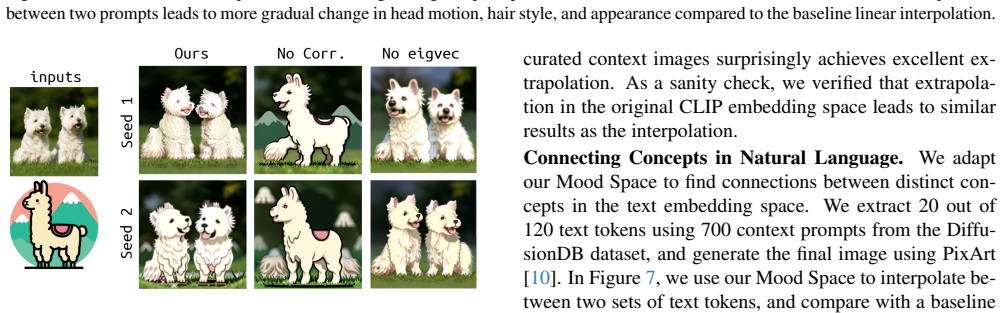
- DINO-based token correspondence and the spectral loss are each necessary: correspondence preserves object count and structure, while the spectral loss connects the two concepts instead of leaving the output as a head from one object and a body from another.
Reading between the lines
- The spectral loss can be read as aligning the low-dimensional space to the dominant eigenvectors of a spectral embedding; if that reading is right, straight-line interpolation in Mood Space approximates geodesic interpolation on the affinity manifold, which would explain the smoothness gain over naive CLIP interpolation.
- Because DINO patch affinity encodes part-whole structure rather than global statistics, the method will likely fail for mood changes that are global (color grading, lighting, texture style) unless the affinity kernel is augmented with a global descriptor; this is a testable boundary of the method.
- The consistency of swapped analogies suggests the learned space behaves like a local coordinate chart; testing whether the section $\sigma_W$ is approximately a bundle section on held-out tokens could turn the fiber-bundle intuition into a quantitative check.
- The method's requirement of only 2-20 well-curated exemplars implies that the quality of the Mood Space depends on the user's curation skill; an automated exemplar-selection procedure that maximizes spectral distance between the intended attributes could make the approach more robust.
Signed reviews
Editorial analysis
A structured set of objections, weighed in public.
Referee Report
Summary. This paper presents 'Mood Space', a low-dimensional latent representation learned from a small set of context images. A 4-layer MLP encoder maps DINO patch tokens to a space of dimension G (estimated via MLE), and a second MLP decodes back to CLIP tokens. The training objective combines a spectral loss that matches the top-eigenvector structure of a row-normalized RBF affinity matrix in the Mood Space to that in DINO space, a reconstruction loss, and several regularizers (curvature, repulsion, covariance). The authors claim that the resulting space is locally linear and compact, and that straight-line interpolation and 'path lifting' in it produce smoother visual transitions and more consistent visual analogies than linear interpolation in CLIP. Experiments include interpolation between ImageNet pairs, a visual analogy consistency task, ablations, an entropy analysis, and a small user study.
Significance. If the central claim held, the paper would offer a lightweight alternative to diffusion-based editing: training takes under a minute, requires no fine-tuning of the generative model, and uses only 2–20 exemplars. The authors' decision to evaluate with an analogy swap test (Section 4.2) is a genuine strength, as it tests generalization to combinations not directly seen in training. The ablations in Section 4.3, showing that DINO correspondence and the spectral loss affect the output, are informative. However, the paper's own supplementary (Section A.1) concedes that the fibration/lifting construction is used only 'as guidance', and the actual experiments use a single difference vector in CLIP space rather than pointwise decoding of the Mood Space path. This gap between the claimed mechanism and the executed experiments is the main reason the paper needs revision.
major comments (4)
- [Section 3.4] The definition γ̂(t)=wA1+t·σW(mA2−mA1) is not a pointwise lift of the path γ(t)=mA1+t·(mA2−mA1) in Mood Space. A pointwise lift would evaluate σW(γ(t)) at intermediate t, but the paper never computes σW(γ(t)) for any t outside the endpoints; instead, Section 3.5 moves each token by adding a per-cluster difference vector in W. Consequently, the smoothness numbers in Table 1 and the consistency numbers in Table 2 evaluate the decoder's behavior on a single difference direction, not the local linearity of M or the shape of the eigenvector-preserving embedding along the path. The supplementary Section A.1 explicitly notes that a segment-wise lifting 'could have' been used and that the fibration is only 'guidance'. To substantiate the abstract's claim that straight lines in Mood Space decode into meaningful semantic paths, the experiments must compute and render σW(γ(t)) at multiple t and compare those images against linear interpolation in W under the same renderer.
- [Section 3.3] The curvature loss Lcurv(Θ)=Σ_i ||R(i,Θ)||² is not defined. No formula, discretization, or estimation procedure is given for the 'Riemannian curvature tensor R' on the finite point cloud {m_Θ,i}. Since local linearity is a core property of the proposed space, this is a load-bearing gap rather than a minor omission. In addition, Table 5 sets λ1=1×10^-5 while the reconstruction weight λ3=1, so it is unclear whether the curvature term has any meaningful effect. The authors should either define R precisely, describe how it is computed from the point cloud, and ablate λ1, or remove the curvature term and argue local linearity from the spectral loss alone.
- [Section 3.3] The RBF width h in (S_V)_{i,j}=κ e^{−||v_i−v_j||²/h} is never specified. Because the spectral loss compares top eigenvectors of S_V and S_M, the value of h, and how it is chosen (per pair, global, scaled by dimension), directly controls the loss. Without specifying h and κ, the method is not reproducible. Please report the exact construction, including any normalization of distances before applying the RBF, and the values used in all experiments.
- [Section 4.2] The consistency test compares B2 = wA2 + σW(mB1−mA1) and B2' = wB1 + σW(mA2−mA1), both of which are straight-line additions in W of a single difference vector. This is a meaningful test of compositional consistency of difference vectors under σW, but it does not measure 'path integrability' or 'integrability of paths in the Mood Space' as claimed. Path integrability would require comparing two different lifts of the same curve, or comparing the endpoint of a pointwise lift of γ to the difference-vector result. As written, the quantitative evidence in Table 2 supports a weaker statement about the decoder's linearity over difference vectors, not about the geometric structure of M.
minor comments (6)
- [Section 3.2] There is a typo in the definition of the CLIP embedding: 'Let vi=TV(ui), and wi=TW(wi)' should be 'wi=TW(ui)'.
- [Algorithm 1] The loop variable 'i' over i∈{4,8,16,32,...,k} conflicts with the sample index i used throughout Section 3; rename the loop variable to avoid confusion.
- [Section 4.4] The entropy metric, especially 'Entropy (PCA eigvals)', is not defined precisely. It appears to be Shannon entropy over normalized eigenvalues of the PCA covariance, but the relationship between eigenvalue entropy and sampling uniformity should be stated explicitly.
- [Section 4.4] The comparison in Table 4 is not apples-to-apples because the Mood Space dimension G=22 is used while CLIP and DINO are projected to 250 dimensions for 'Entropy (PCA-ed)'. Report the entropy at matched dimensions or justify the difference.
- [Section 4.1] Please specify how the baseline linear interpolation is rendered—whether the same IP-Adapter [49] is used for both baseline and the proposed method—so that the smoothness comparison does not reflect renderer differences.
- [Abstract and Section 1] The phrase 'we invent a fibration computation' is informal and, as shown by the supplementary's caveat, potentially misleading; suggest 'we propose a compression/decompression scheme inspired by fibrations'.
Circularity Check
Interpolation metrics are computed on the very pair used to fit the Mood Space, and the implemented path-lifting equation decodes only a difference vector rather than points along the Mood Space path.
-
fitted input called prediction
[Section 4.1 (Quantitative Results) and Section 3.3 (Learning Mood Space and Maps)]
"We train a separate Mood Space M for each pair of input images, and interpolate between the two input images."
The two input images are the training set for that Mood Space: Section 3.3 minimizes Lrecon(Theta, Theta') = ||W - sigma_W,Theta'(M_Theta)||^2 with lambda_3 = 1 on the CLIP token matrix W of exactly those images, and Lspec matches the DINO affinity eigenstructure E(S_V) of the same tokens. Table 1 then reports Max/Min CLIP and LPIPS along the interpolation of those images, so the measured smoothness is in part a reconstruction consistency of the fitted decoder rather than a held-out prediction of a discovered manifold. The claim that the Mood Space 'finds the connections' is thus evaluated on the data used to define the connection. The analogy swap test provides some independent evidence, which limits the severity.
-
other
[Section 3.4 (Token Path Lifting) and Supplementary Section A.1]
"lift each point on the path in M back to the CLIP space W via sigma_w: gamma_hat(t) = w_A1 + t * sigma_w(m_A2 - m_A1). ... We note that we could have taken a sequence of points ... and lift each segment of gamma between t_k and t_{k+1} via sigma_W to achieve path in W that more closely follows gamma([0,1]) subset M."
The text says the purpose of sigma_W is 'lifting paths' and claims to lift 'each point' of gamma, but the displayed formula computes an affine line in W defined by one decoded difference vector, sigma_W(m_A2 - m_A1); it never evaluates sigma_W(gamma(t)) for intermediate t. The supplement explicitly concedes that a segment-wise lift that would more closely follow gamma([0,1]) subset M 'could have' been taken and was not, using the fibration only 'as guidance.' Therefore the smoothness and consistency results do not test local linearity or the geometry of M along the path; the operation reduces to applying the decoder to a single tangent vector. If sigma_W were approximately linear and endpoint-reconstructing, this is CLIP linear interpolation under another name.
full rationale
The paper is not a case of wholesale circularity: the spectral-loss objective is a real optimization on DINO affinity eigenvectors, the decoder is not directly trained to produce the intermediate interpolation points, and the analogy swap test in Section 4.2 compares two different paths and thereby checks a nontrivial consistency property. The normalized-cuts citations (Refs. 39 and 50) overlap with the authors but are standard, externally published results used as computational tools, not unverified uniqueness premises, so they do not raise the score under the self-citation rules. However, two load-bearing reductions keep the score in the middle range. First, the interpolation experiment fits a fresh Mood Space on the very pair of images whose interpolation is then measured; with the reconstruction loss at weight 1, the decoder is trained to reproduce the CLIP tokens of the endpoints, so the smoothness metrics partly measure self-consistency of the fitted mapping rather than a generalizable property. Second, the implemented path lifting does not decode points along the straight Mood Space path; it adds a single decoded difference vector in CLIP, and the supplement concedes that the pointwise segment lift was not used. Thus the central claim that straight lines in Mood Space decode into meaningful semantic paths is not actually exercised by the equations used in the experiments; the evidence depends on the decoder's action on one direction, not on the local linearity of M. These are structural issues rather than evidence of authorial intent, and the independent analogy consistency test prevents a higher score.
Assumptions & free parameters
free parameters (6)
- Mood Space dimension G =
6-22 (MLE estimate on mood board tokens)
- RBF kernel width h =
not specified
- Spectral loss eigenvector count k =
32 (sliding sizes 4, 8, 16, 32)
- Loss weights lambda1, lambda2, lambda3, lambda4 =
1e-5, 1e-5, 1, 1e-5
- Token cluster count H =
10
- MLP architecture and training hyperparameters =
4 layers x 512 hidden, Adam lr 1e-3, 1000-10000 steps
assumptions (6)
- domain assumption DINO token embeddings capture semantic correspondence and part-whole hierarchy.
- standard math Top eigenvectors of the row-normalized affinity matrix (Ncut) reveal relevant versus irrelevant structure.
- domain assumption CLIP features provide a space aligned with text semantics and can drive conditional diffusion rendering.
- domain assumption The intrinsic dimension MLE (Levina and Bickel 2004) gives a reliable estimate of the number of relevant degrees of freedom in DINO token clouds.
- ad hoc to paper A straight line in the compressed Mood Space corresponds to a semantically meaningful path when decoded.
- ad hoc to paper The undefined curvature regularizer encourages local linearity.
invented entities (1)
-
Mood Space (compressed latent representation)
independent evidence
Cite this review
Pith. "Pith review of "I Know It When I See It": Mood Spaces for Connecting and Expressing Visual Concepts." pith.science (2026). https://pith.science/paper/HSQEJ6BV
@misc{pith2026250415145,
  author       = {Pith},
  title        = {Pith review of: "I Know It When I See It": Mood Spaces for Connecting and Expressing Visual Concepts},
  year         = {2026},
  howpublished = {\url{https://pith.science/paper/HSQEJ6BV}},
  note         = {Machine review of arXiv:2504.15145}
}
read the original abstract
Expressing complex concepts is easy when they can be labeled or quantified, but many ideas are hard to define yet instantly recognizable. We propose a Mood Board, where users convey abstract concepts with examples that hint at the intended direction of attribute changes. We compute an underlying Mood Space that 1) factors out irrelevant features and 2) finds the connections between images, thus bringing relevant concepts closer. We invent a fibration computation to compress/decompress pre-trained features into/from a compact space, 50-100x smaller. The main innovation is learning to mimic the pairwise affinity relationship of the image tokens across exemplars. To focus on the coarse-to-fine hierarchical structures in the Mood Space, we compute the top eigenvector structure from the affinity matrix and define a loss in the eigenvector space. The resulting Mood Space is locally linear and compact, allowing image-level operations, such as object averaging, visual analogy, and pose transfer, to be performed as a simple vector operation in Mood Space. Our learning is efficient in computation without any fine-tuning, needs only a few (2-20) exemplars, and takes less than a minute to learn.
Figures


Figures from the paper (24 more)




Reference graph
Works this paper leans on
-
[1]
Image morphing techniques: A re- view
Alyaa Qusay Aloraibi. Image morphing techniques: A re- view. Technium, 9, 2023. 2
work page 2023
-
[2]
ediff-i: Text-to-image dif- fusion models with an ensemble of expert denoisers
Yogesh Balaji, Seungjun Nah, Xun Huang, Arash Vahdat, Ji- aming Song, Qinsheng Zhang, Karsten Kreis, Miika Aittala, Timo Aila, Samuli Laine, et al. ediff-i: Text-to-image dif- fusion models with an ensemble of expert denoisers. arXiv preprint arXiv:2211.01324, 2022. 2
arXiv 2022
-
[3]
Continu- ous, subject-specific attribute control in t2i models by identi- fying semantic directions
Stefan Andreas Baumann, Felix Krause, Michael Neumayr, Nick Stracke, Vincent Tao Hu, and Bj¨orn Ommer. Continu- ous, subject-specific attribute control in t2i models by identi- fying semantic directions. arXiv preprint arXiv:2403.17064,
-
[4]
Improving image generation with better captions
James Betker, Gabriel Goh, Li Jing, Tim Brooks, Jianfeng Wang, Linjie Li, Long Ouyang, Juntang Zhuang, Joyce Lee, Yufei Guo, et al. Improving image generation with better captions. Computer Science. https://cdn. openai. com/papers/dall-e-3. pdf, 2(3):8, 2023. 2
2023
-
[5]
Sega: Instructing text-to-image models using semantic guidance
Manuel Brack, Felix Friedrich, Dominik Hintersdorf, Lukas Struppek, Patrick Schramowski, and Kristian Kersting. Sega: Instructing text-to-image models using semantic guidance. Advances in Neural Information Processing Systems , 36: 25365–25389, 2023. 2
2023
-
[6]
In- structpix2pix: Learning to follow image editing instructions
Tim Brooks, Aleksander Holynski, and Alexei A Efros. In- structpix2pix: Learning to follow image editing instructions. In Proceedings of the IEEE/CVF conference on computer vi- sion and pattern recognition, pages 18392–18402, 2023. 2
work page 2023
-
[7]
Masactrl: Tuning-free mu- tual self-attention control for consistent image synthesis and editing
Mingdeng Cao, Xintao Wang, Zhongang Qi, Ying Shan, Xi- aohu Qie, and Yinqiang Zheng. Masactrl: Tuning-free mu- tual self-attention control for consistent image synthesis and editing. In Proceedings of the IEEE/CVF International Con- ference on Computer Vision, pages 22560–22570, 2023. 2
work page 2023
-
[8]
Emerg- ing properties in self-supervised vision transformers
Mathilde Caron, Hugo Touvron, Ishan Misra, Herv ´e J´egou, Julien Mairal, Piotr Bojanowski, and Armand Joulin. Emerg- ing properties in self-supervised vision transformers. In Pro- ceedings of the International Conference on Computer Vi- sion (ICCV), 2021. 3
2021
Show all 54 references
-
[9]
The mood board process modeled and under- stood as a qualitative design research tool
Tracy Cassidy. The mood board process modeled and under- stood as a qualitative design research tool. Fashion Practice, 3(2):225–251, 2011. 2
2011
-
[10]
Pixart- α: Fast training of diffusion transformer for photorealistic text-to-image synthesis
Junsong Chen, Jincheng Yu, Chongjian Ge, Lewei Yao, Enze Xie, Yue Wu, Zhongdao Wang, James Kwok, Ping Luo, Huchuan Lu, et al. Pixart- α: Fast training of diffusion transformer for photorealistic text-to-image synthesis. arXiv preprint arXiv:2310.00426, 2023. 2, 6, 8
-
[11]
Imagenet: A large-scale hierarchical image database
Jia Deng, Wei Dong, Richard Socher, Li-Jia Li, Kai Li, and Li Fei-Fei. Imagenet: A large-scale hierarchical image database. In 2009 IEEE conference on computer vision and pattern recognition, pages 248–255. Ieee, 2009. 5
2009
-
[12]
Drea- martist: Towards controllable one-shot text-to-image gen- eration via positive-negative prompt-tuning
Ziyi Dong, Pengxu Wei, and Liang Lin. Drea- martist: Towards controllable one-shot text-to-image gen- eration via positive-negative prompt-tuning. arXiv preprint arXiv:2211.11337, 2022. 2
2022 arXiv
-
[13]
Interpreting the weight space of customized dif- fusion models
Amil Dravid, Yossi Gandelsman, Kuan-Chieh Wang, Rameen Abdal, Gordon Wetzstein, Alexei A Efros, and Kfir Aberman. Interpreting the weight space of customized dif- fusion models. arXiv preprint arXiv:2406.09413, 2024. 2
2024 arXiv
-
[14]
Scaling recti- fied flow transformers for high-resolution image synthesis
Patrick Esser, Sumith Kulal, Andreas Blattmann, Rahim Entezari, Jonas M ¨uller, Harry Saini, Yam Levi, Dominik Lorenz, Axel Sauer, Frederic Boesel, et al. Scaling recti- fied flow transformers for high-resolution image synthesis. In Forty-first international conference on mach...
-
[15]
Dit4edit: Diffusion transformer for image editing
Kunyu Feng, Yue Ma, Bingyuan Wang, Chenyang Qi, Haozhe Chen, Qifeng Chen, and Zeyu Wang. Dit4edit: Diffusion transformer for image editing. arXiv preprint arXiv:2411.03286, 2024. 2
2024 arXiv
-
[16]
An image is worth one word: Personalizing text-to- image generation using textual inversion
Rinon Gal, Yuval Alaluf, Yuval Atzmon, Or Patash- nik, Amit H Bermano, Gal Chechik, and Daniel Cohen- Or. An image is worth one word: Personalizing text-to- image generation using textual inversion. arXiv preprint arXiv:2208.01618, 2022. 2
2022 arXiv
-
[17]
Encoder-based domain tuning for fast personalization of text-to-image models.ACM Transactions on Graphics (TOG), 42(4):1–13, 2023
Rinon Gal, Moab Arar, Yuval Atzmon, Amit H Bermano, Gal Chechik, and Daniel Cohen-Or. Encoder-based domain tuning for fast personalization of text-to-image models.ACM Transactions on Graphics (TOG), 42(4):1–13, 2023. 2
2023
-
[18]
Concept sliders: Lora adaptors for precise control in diffusion models
Rohit Gandikota, Joanna Materzy ´nska, Tingrui Zhou, Anto- nio Torralba, and David Bau. Concept sliders: Lora adaptors for precise control in diffusion models. In European Con- ference on Computer Vision, pages 172–188. Springer, 2024. 2
2024
-
[19]
Svdiff: Compact param- eter space for diffusion fine-tuning
Ligong Han, Yinxiao Li, Han Zhang, Peyman Milanfar, Dimitris Metaxas, and Feng Yang. Svdiff: Compact param- eter space for diffusion fine-tuning. In Proceedings of the IEEE/CVF International Conference on Computer Vision , pages 7323–7334, 2023. 2
2023
-
[20]
Aid: Attention interpolation of text-to-image diffusion
Qiyuan He, Jinghao Wang, Ziwei Liu, and Angela Yao. Aid: Attention interpolation of text-to-image diffusion. arXiv preprint arXiv:2403.17924, 2024. 2
2024 arXiv
-
[21]
Prompt-to-prompt im- age editing with cross attention control
Amir Hertz, Ron Mokady, Jay Tenenbaum, Kfir Aberman, Yael Pritch, and Daniel Cohen-Or. Prompt-to-prompt im- age editing with cross attention control. arXiv preprint arXiv:2208.01626, 2022. 2
2022 arXiv
-
[22]
Multi-concept customization of text-to-image diffusion
Nupur Kumari, Bingliang Zhang, Richard Zhang, Eli Shechtman, and Jun-Yan Zhu. Multi-concept customization of text-to-image diffusion. In Proceedings of the IEEE/CVF conference on computer vision and pattern recognition , pages 1931–1941, 2023. 2
1931
-
[23]
Diffusion models already have a semantic latent space
Mingi Kwon, Jaeseok Jeong, and Youngjung Uh. Diffusion models already have a semantic latent space. arXiv preprint arXiv:2210.10960, 2022. 2
2022 arXiv
-
[24]
Maximum likelihood es- timation of intrinsic dimension
Elizaveta Levina and Peter Bickel. Maximum likelihood es- timation of intrinsic dimension. In Advances in Neural In- formation Processing Systems. MIT Press, 2004. 3
2004
-
[25]
Latent consistency models: Synthesizing high- resolution images with few-step inference
Simian Luo, Yiqin Tan, Longbo Huang, Jian Li, and Hang Zhao. Latent consistency models: Synthesizing high- resolution images with few-step inference. arXiv preprint arXiv:2310.04378, 2023. 2
2023 arXiv
-
[26]
Mood boards as a design catalyst and resource: Researching an under-researched area
Deana McDonagh and Ian Storer. Mood boards as a design catalyst and resource: Researching an under-researched area. The Design Journal, 7(3):16–31, 2004. 2
2004
-
[27]
Umap: Uniform manifold approximation and projection for dimen- sion reduction
Leland McInnes, John Healy, and James Melville. Umap: Uniform manifold approximation and projection for dimen- sion reduction. arXiv preprint arXiv:1802.03426, 2018. 2
2018 arXiv
-
[28]
Exploiting deep generative prior for versatile image restoration and manipulation
Xingang Pan, Xiaohang Zhan, Bo Dai, Dahua Lin, Chen Change Loy, and Ping Luo. Exploiting deep generative prior for versatile image restoration and manipulation. IEEE Transactions on Pattern Analysis and Machine Intelligence, 44(11):7474–7489, 2021. 2
2021
-
[29]
Understanding the latent space of diffusion models through the lens of riemannian geometry
Yong-Hyun Park, Mingi Kwon, Jaewoong Choi, Junghyo Jo, and Youngjung Uh. Understanding the latent space of diffusion models through the lens of riemannian geometry. Advances in Neural Information Processing Systems , 36: 24129–24142, 2023. 2
2023
-
[30]
W ¨urstchen: An efficient architecture for large-scale text-to-image diffusion models
Pablo Pernias, Dominic Rampas, Mats L Richter, Christo- pher J Pal, and Marc Aubreville. W ¨urstchen: An efficient architecture for large-scale text-to-image diffusion models. arXiv preprint arXiv:2306.00637, 2023. 2
2023 arXiv
-
[31]
Sdxl: Improving latent diffusion mod- els for high-resolution image synthesis
Dustin Podell, Zion English, Kyle Lacey, Andreas Blattmann, Tim Dockhorn, Jonas M ¨uller, Joe Penna, and Robin Rombach. Sdxl: Improving latent diffusion mod- els for high-resolution image synthesis. arXiv preprint arXiv:2307.01952, 2023. 2
2023 arXiv
-
[32]
Learning transferable visual models from natural language supervi- sion
Alec Radford, Jong Wook Kim, Chris Hallacy, Aditya Ramesh, Gabriel Goh, Sandhini Agarwal, Girish Sastry, Amanda Askell, Pamela Mishkin, Jack Clark, et al. Learning transferable visual models from natural language supervi- sion. In International conference on machine learning, ...
2021
-
[33]
Hierarchical text-conditional image gener- ation with clip latents, 2022
Aditya Ramesh, Prafulla Dhariwal, Alex Nichol, Casey Chu, and Mark Chen. Hierarchical text-conditional image gener- ation with clip latents, 2022. 2
2022
-
[34]
Kandinsky: an improved text-to-image syn- thesis with image prior and latent diffusion
Anton Razzhigaev, Arseniy Shakhmatov, Anastasia Malt- seva, Vladimir Arkhipkin, Igor Pavlov, Ilya Ryabov, An- gelina Kuts, Alexander Panchenko, Andrey Kuznetsov, and Denis Dimitrov. Kandinsky: an improved text-to-image syn- thesis with image prior and latent diffusion. arXiv p...
-
[35]
High-resolution image synthesis with latent diffusion models
Robin Rombach, Andreas Blattmann, Dominik Lorenz, Patrick Esser, and Bj ¨orn Ommer. High-resolution image synthesis with latent diffusion models. In Proceedings of the IEEE/CVF conference on computer vision and pattern recognition, pages 10684–10695, 2022. 2
2022
-
[36]
Dreambooth: Fine tuning text-to-image diffusion models for subject-driven generation
Nataniel Ruiz, Yuanzhen Li, Varun Jampani, Yael Pritch, Michael Rubinstein, and Kfir Aberman. Dreambooth: Fine tuning text-to-image diffusion models for subject-driven generation. In Proceedings of the IEEE/CVF conference on computer vision and pattern recognition , pages 2250...
2023
-
[37]
Norm-guided latent space exploration for text-to-image generation
Dvir Samuel, Rami Ben-Ari, Nir Darshan, Haggai Maron, and Gal Chechik. Norm-guided latent space exploration for text-to-image generation. Advances in Neural Information Processing Systems, 36:57863–57875, 2023. 2
2023
-
[38]
Adversarial diffusion distillation
Axel Sauer, Dominik Lorenz, Andreas Blattmann, and Robin Rombach. Adversarial diffusion distillation. In European Conference on Computer Vision , pages 87–103. Springer,
-
[39]
Normalized cuts and image segmentation
Jianbo Shi and Jitendra Malik. Normalized cuts and image segmentation. IEEE Transactions on pattern analysis and machine intelligence, 22(8):888–905, 2000. 2, 5
2000
-
[40]
In- stantbooth: Personalized text-to-image generation without test-time finetuning
Jing Shi, Wei Xiong, Zhe Lin, and Hyun Joon Jung. In- stantbooth: Personalized text-to-image generation without test-time finetuning. In Proceedings of the IEEE/CVF con- ference on computer vision and pattern recognition , pages 8543–8552, 2024. 2
2024
-
[41]
Brickify: Enabling expressive design intent specification through direct manipulation on design tokens, 2025
Xinyu Shi, Yinghou Wang, Ryan Rossi, and Jian Zhao. Brickify: Enabling expressive design intent specification through direct manipulation on design tokens, 2025. 2
2025
-
[42]
Plug-and-play diffusion features for text-driven image-to-image translation
Narek Tumanyan, Michal Geyer, Shai Bagon, and Tali Dekel. Plug-and-play diffusion features for text-driven image-to-image translation. InProceedings of the IEEE/CVF Conference on Computer Vision and Pattern Recognition , pages 1921–1930, 2023. 2
1921
-
[43]
Visualizing data using t-sne
Laurens van der Maaten and Geoffrey Hinton. Visualizing data using t-sne. Journal of Machine Learning Research, 9 (86):2579–2605, 2008. 2
2008
-
[44]
Interpolating between im- ages with diffusion models
Clinton Wang and Polina Golland. Interpolating between im- ages with diffusion models. 2023. 2
2023
-
[45]
Stableidentity: Insert- ing anybody into anywhere at first sight
Qinghe Wang, Xu Jia, Xiaomin Li, Taiqing Li, Liqian Ma, Yunzhi Zhuge, and Huchuan Lu. Stableidentity: Insert- ing anybody into anywhere at first sight. arXiv preprint arXiv:2401.15975, 2024. 2
2024 arXiv
-
[46]
Image morphing: a survey
George Wolberg. Image morphing: a survey. The visual computer, 14(8-9):360–372, 1998. 2
1998
-
[47]
A latent space of stochastic diffusion models for zero-shot image editing and guidance
Chen Henry Wu and Fernando De la Torre. A latent space of stochastic diffusion models for zero-shot image editing and guidance. In Proceedings of the IEEE/CVF International Conference on Computer Vision, pages 7378–7387, 2023. 2
2023
-
[48]
Impus: Image morphing with perceptually- uniform sampling using diffusion models
Zhaoyuan Yang, Zhengyang Yu, Zhiwei Xu, Jaskirat Singh, Jing Zhang, Dylan Campbell, Peter Tu, and Richard Hartley. Impus: Image morphing with perceptually- uniform sampling using diffusion models. arXiv preprint arXiv:2311.06792, 2023. 2
2023 arXiv
-
[49]
Ip- adapter: Text compatible image prompt adapter for text-to- image diffusion models
Hu Ye, Jun Zhang, Sibo Liu, Xiao Han, and Wei Yang. Ip- adapter: Text compatible image prompt adapter for text-to- image diffusion models. arXiv preprint arXiv:2308.06721,
-
[50]
Multiclass spectral clustering
Yu and Shi. Multiclass spectral clustering. In Proceedings Ninth IEEE International Conference on Computer Vision , pages 313–319 vol.1, 2003. 1
2003
-
[51]
Scaling autoregres- sive models for content-rich text-to-image generation
Jiahui Yu, Yuanzhong Xu, Jing Yu Koh, Thang Luong, Gun- jan Baid, Zirui Wang, Vijay Vasudevan, Alexander Ku, Yin- fei Yang, Burcu Karagol Ayan, et al. Scaling autoregres- sive models for content-rich text-to-image generation. arXiv preprint arXiv:2206.10789, 2(3):5, 2022. 2
2022 arXiv
-
[52]
Diffmorpher: Unleashing the capability of dif- fusion models for image morphing
Kaiwen Zhang, Yifan Zhou, Xudong Xu, Bo Dai, and Xin- gang Pan. Diffmorpher: Unleashing the capability of dif- fusion models for image morphing. In Proceedings of the IEEE/CVF Conference on Computer Vision and Pattern Recognition, pages 7912–7921, 2024. 2
2024
-
[53]
The unreasonable effectiveness of deep features as a perceptual metric
Richard Zhang, Phillip Isola, Alexei A Efros, Eli Shecht- man, and Oliver Wang. The unreasonable effectiveness of deep features as a perceptual metric. In Proceedings of the IEEE conference on computer vision and pattern recogni- tion, pages 586–595, 2018. 6
2018
-
[54]
I Know It When I See It
Bhushan Zope and Soniya B Zope. A survey of morphing techniques. International Journal of Advanced Engineering, Management and Science, 3(2):239773, 2017. 2 “I Know It When I See It ”: Mood Spaces for Connecting and Expressing Visual Concepts Supplementary Material A. Addition...
2017
Reviewed August 16, 2026 · model on record in the stance chip above.
Discussion (0). Continue with ORCID to comment.