REVIEW 2 major objections 6 minor 2 cited by
Minimal effective theory for leptogenesis, dark matter, and neutrino masses
T0 review · 2 major / 6 minor · reviewed 2026-08-16 · deepseek-v4-flash
Pith's one-line read Two particles can explain dark matter, neutrinos, and matter asymmetry
desk verdict A genuinely minimal two-particle EFT with a sharp hierarchy prediction, but the central CP asymmetry is inherited from prior work and the benchmarks are tuned; worth refereeing with a request for derivations. read the letter →
The pith
A machine-rendered reading of the paper's core claim, the machinery that carries it, and where it could break.
The reading
What carries the argument
The load-bearing object is the single dimension-five portal operator $S \bar{f} P_L l H$, together with the Weinberg operator $H \bar{l}^c P_L l H$. The portal operator is the only bridge between the Standard Model and the dark sector; its interference with the Weinberg operator produces the CP asymmetry through forward-scattering and vacuum-diagram cuts, while the $\mathbb{Z}_2$ charges of $f$ and $S$ make the light scalar stable dark matter. The identity doing the work is Eq. (17), which converts the measured baryon-to-dark-matter density ratio into the mass ratio $m/m'$ through the tiny neutrino mass.
What would settle it
Compute the one-loop correction to neutrino masses in the model of Eq. (6): if the portal operator contributes an amount comparable to $v^2|\lambda'|/\Lambda$, then Eq. (17) and the requirement $m/m'\gtrsim 10^{16}$ no longer follow.
Extended reading notes
Core claim
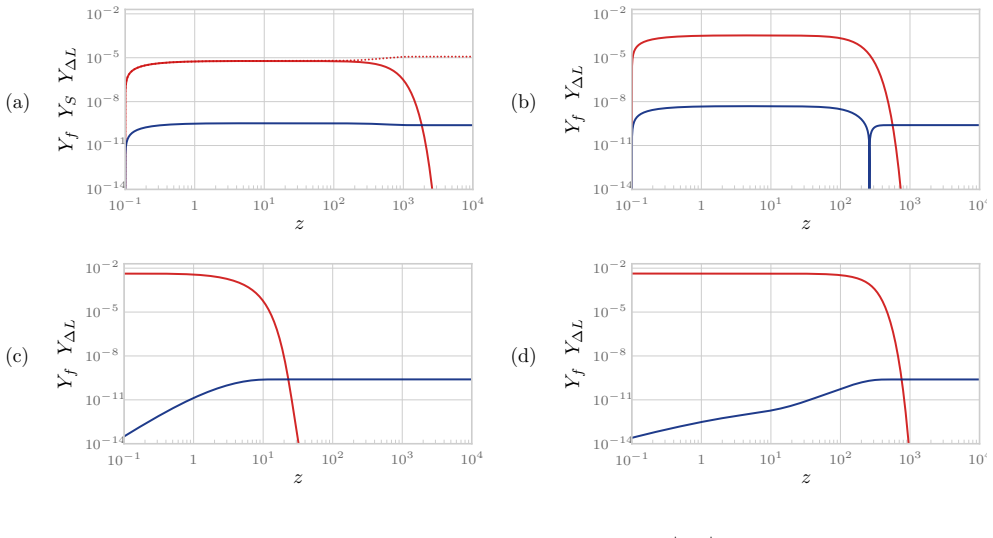
The central claim is that the effective Lagrangian $\mathcal{L}_{\rm eff} = \frac{\lambda}{\Lambda} S \bar{f} P_L l H + \frac{\lambda'}{\Lambda} H \bar{l}^c P_L l H + \mathrm{H.c.}$, containing only a heavy Majorana fermion $f$, a light real scalar $S$, and Standard Model fields, generates neutrino masses, a lepton asymmetry, and a dark matter relic abundance simultaneously. CP violation arises from interference of the two dimension-five operators, computed by cutting a single vacuum diagram; the asymmetry scales as $m T^6/\Lambda^3$, so the fermion mass is essential. In the freeze-in limit the analytic solution reduces to Eq. (17), $\Omega_b/\Omega_{\rm dm} = \frac{63}{632}\frac{\theta}{\pi}\frac{m_p m_\nu}{v^2}\frac{m}{m'} \approx 0.19$, with $|\theta|\le 1$ the rescaled CP-violating phase, reproducing the observed value and requiring $m/m' \gtrsim 10^{16}$. Numerical solutions of the Boltzmann equations show the same two operators work in freeze-out and mixed scenarios, where the dark matter mass either sits near $m'\simeq 40$ keV or decouples from the fermion mass.
Load-bearing premise
The argument assumes neutrino masses are set entirely by the Weinberg operator, with no comparable loop correction from the new portal interaction shifting the relation $m_\nu = v^2|\lambda'|/\Lambda$ that feeds Eq. (17).
Editorial extensions
If this is right
- If the paper is right, the observed baryon-to-dark-matter ratio fixes a huge mass hierarchy, $m/m' \gtrsim 10^{16}$, so any ultraviolet completion must produce a heavy fermion alongside a much lighter scalar.
- Only two dimension-five operators are needed; right-handed neutrinos need not appear as propagating states below the scale where they are integrated out.
- In the freeze-in benchmark the dark matter mass is predicted around $m'\simeq 40$ keV for the chosen parameters, placing the scalar in a range that could be probed by X-ray or structure-formation observations.
- The full numerical treatment shows the analytic freeze-in estimate is accurate to about 8%, so the simple formula captures the physics in that regime.
- The same two operators can accommodate freeze-out and mixed scenarios, with the dark matter mass no longer tied to the fermion mass once the scalar is initially thermalized.
Reading between the lines
- Beyond the paper's claims, a one-loop calculation of neutrino masses from the portal operator would test whether the Weinberg operator can carry the relation $m_\nu = v^2|\lambda'|/\Lambda$ alone; a comparable correction would shift the inferred $m/m'$ hierarchy.
- Beyond the paper's claims, any ultraviolet completion that generates exactly these two operators must suppress every other higher-dimensional operator, a constraint that could identify which high-energy models can match this minimal effective description.
- Beyond the paper's claims, the same ratio-symmetric structure could be applied to other $B-L$-violating portals, replacing $lH$ with another Standard-Model singlet combination and possibly changing the predicted dark matter mass range.
Signed reviews
Editorial analysis
A structured set of objections, weighed in public.
Referee Report
Summary. The paper constructs a minimal effective field theory that simultaneously generates neutrino masses, the baryon asymmetry via leptogenesis, and the dark matter relic density. The field content adds two new particles to the Standard Model: a heavy Majorana fermion f and a light real scalar S, charged under a dark Z2. The Lagrangian, Eq. (6), contains the Weinberg operator and a single d=5 portal operator S fbar P_L l H. Working in an ultraviolet freeze-in scenario, the authors derive an analytic relation, Eq. (17), for the ratio of baryon to dark matter densities, obtaining m/m' ≳ 10^16. They then solve the full Boltzmann equations (18)-(20) numerically for freeze-in and freeze-out benchmarks and reproduce the observed densities, with the numerical freeze-in result differing from the analytic estimate by about 8%.
Significance. If the calculation is correct, this is a conceptually attractive minimal setup that unifies three major cosmological puzzles with only two new particles and a single portal operator. The paper makes a concrete, falsifiable prediction for the baryon-to-dark-matter ratio in Eq. (17), and it provides explicit Boltzmann equations and analytic reaction-rate formulas. The numerical work appears to confirm the analytic approximation. However, the central asymmetry formulas in Appendix A are quoted from the authors' previous work rather than derived, and several washout rates entering the Boltzmann equations are not listed, so the numerical results are not independently reproducible. These gaps are significant but fixable with additional derivations and rate expressions.
major comments (2)
- [Appendix A, Eqs. (A4)-(A5)] The CP asymmetry formulas are quoted from Ref. [22] without derivation. These formulas are load-bearing: the analytic density ratio (17) is directly proportional to the ratio A/S obtained from Eqs. (11) and (A4), and an incorrect coefficient or Bessel-function structure would change the predicted hierarchy m/m' ≳ 10^16. The manuscript should reproduce the calculation leading to (A4) and (A5), or at least present the intermediate steps and unitarity checks, so that the central result does not rest on an unverifiable external reference.
- [Section IV and Appendix A] The Boltzmann equation (20) contains washout rates γ_{S f→lH}, γ_{bar l bar H→lH}, γ_{bar H bar H→ll}, γ_{f bar H→S l}, and γ_{S bar H→f l}, but Appendix A lists only γ^{eq}_{lH→S f}, γ^{eq}_{f l→S bar H}, and γ^{eq}_{f→lHS}. The statement that all reaction rates entering Eqs. (18)-(20) are listed in Appendix A is therefore incorrect. Without explicit expressions for these washout rates, or a clear description of how they are related to the listed rates through crossing and detailed balance, the numerical results in Fig. 3 cannot be independently reproduced.
minor comments (6)
- [Section III B, Eq. (14)] The notation mν for the quantity sqrt(∑ mνa²) is non-standard and could be confused with the lightest neutrino mass; consider defining it explicitly as the active-neutrino mass scale.
- [Section III B, after Eq. (15)] The statement that f→lHS decays double the scalar abundance and reduce the asymmetry to -3/4 A is made without derivation; a brief step-by-step explanation of the factors 2 and 3/4 would help the reader follow the analytic estimate.
- [Figure 3 caption] The caption lists masses and couplings for each panel but does not give the value of λ' or the corresponding neutrino mass mν; providing these values would make it easier to verify consistency with Eq. (14).
- [Eq. (20)] The factors 4/3 and 1/3 in the washout and asymmetry terms are not explained; a short comment on the flavour approximation underlying these factors would improve clarity.
- [Section III, Eq. (6)] The paper does not mention possible loop corrections to the neutrino mass from the portal operator in Eq. (6); although these are numerically negligible in the benchmark shown (δmν/mν ~ 10^-6), an explicit statement would reassure the reader that the use of Eq. (14) in Eq. (17) is safe.
- [Eqs. (18)-(20)] The product 'sHz' in these equations should be typeset as 's H z' (with a multiplication dot or space) to avoid confusing the Hubble parameter H with the Higgs field.
Circularity Check
No significant circularity: Eq. (17) is a derived constraint on m/m' from independently chosen inputs; the sole self-citation [22] supplies standard unitarity/cutting formalism, not the target result.
full rationale
The paper's central relation, Eq. (17), follows from the analytic Boltzmann solutions in Eqs. (15)-(16) combined with the rates in Eqs. (11)-(12) and the neutrino-mass relation Eq. (14). The ratio Ω_b/Ω_dm is obtained as (21/79)(3/4)A divided by 2S, with A/S proportional to θ mν m/v²; matching the observed value 0.19 fixes the mass hierarchy m/m' ≳ 10^16 rather than fitting the relation itself. The inputs θ, mν, m, m' are free parameters of the EFT, so the relation is a constraint/prediction, not a tautology. The cited Ref. [22] is used for the unitarity expansion in Eq. (2) and the forward-scattering/cut technique; it is an external published derivation of a general formalism, not a prior statement of the specific asymmetry formulas A4-A5 or of Eq. (17), which are computed in this paper via Eq. (2). Thus the self-citation does not smuggle in the target result. The numerical benchmarks in Fig. 3 are explicitly 'tuned to reproduce the observed values', so they are consistency checks, not circular predictions. Some auxiliary formulas (A4-A5, washout rates) are asserted rather than derived in detail, but that is a reproducibility/correctness concern, not circularity. The 'minimality' of the two-particle content is a model-building choice justified by the suppression argument for the Z(3) alternative; it is not obtained by defining the conclusion into the premise. No circular step can be exhibited from the paper's equations.
Assumptions & free parameters
free parameters (6)
- m (heavy fermion mass) =
5e11 GeV (freeze-in benchmark); 1e10 GeV (freeze-out)
- m' (dark matter scalar mass) =
about 40 keV in freeze-in scenario
- |λ|^2 (portal coupling squared) =
1.8e-3, 7e-3, 0.1, 1e-4 across benchmarks
- θ (CP phase invariant) =
0.8, 0.25, 0.12 in benchmarks
- Λ (EFT cutoff) =
1e14 GeV (freeze-in); 1e12 GeV (freeze-out)
- T_R (reheating temperature) =
5e12 GeV in freeze-in scenario
assumptions (7)
- standard math The S-matrix is unitary and CPT invariant, so the CP asymmetry follows from cutting vacuum diagrams as in Eq. (2).
- standard math Sakharov's three conditions are sufficient for baryogenesis.
- ad hoc to paper At low energies the only relevant operators are the two d=5 operators in Eq. (6); all other operators are negligible.
- domain assumption The dark-sector Z(2) parity is exact, keeping S stable, while f decays via the portal operator.
- domain assumption Neutrino masses come solely from the Weinberg operator (second term in Eq. (6)), with m_ν = v^2 |λ'|/Λ (Eq. (14)).
- domain assumption Maxwell-Boltzmann statistics and neglect of spectator processes do not change the final densities qualitatively.
- domain assumption The universe is radiation-dominated with standard SM degrees of freedom from T_R down to low temperatures, and f and S have negligible initial abundances in the freeze-in scenario.
invented entities (2)
-
Heavy Majorana fermion f
-
Light real scalar S
Cite this review
Pith. "Pith review of Minimal effective theory for leptogenesis, dark matter, and neutrino masses." pith.science (2026). https://pith.science/paper/VS5KGZFV
@misc{pith2026250415164,
  author       = {Pith},
  title        = {Pith review of: Minimal effective theory for leptogenesis, dark matter, and neutrino masses},
  year         = {2026},
  howpublished = {\url{https://pith.science/paper/VS5KGZFV}},
  note         = {Machine review of arXiv:2504.15164}
}
read the original abstract
We study the phenomenology of choosing a minimal set of effective operators simultaneously generating the dark matter relic density and matter-antimatter asymmetry of the universe. Neutrino masses are obtained in a specific case of baryogenesis via leptogenesis. We find that only two new particles -- a heavy unstable fermion and a light dark matter scalar -- need to be included in addition to the Standard Model particle content.
Figures


Forward citations
Cited by 2 Pith papers
-
Constraints on the mass of the dark antibaryon using $B_d\rightarrow \Lambda \psi_{DS}$ channel in light cone QCD
The mass ranges for the dark antibaryon ψ_DS are determined by deriving the B_d → Λ ψ_DS branching fraction via light-cone QCD sum rules and comparing it to BaBar and Belle experimental bounds.
-
FIMPs in a two-component dark matter model with $Z_2 \times Z_4$ symmetry
In this two-component dark matter model, freeze-in works with masses up to 3 TeV only if the scalar portal coupling is as small as 10^-25, far below usual FIMP values.
Reference graph
Works this paper leans on
- [22]
- [1]
-
[2]
S. Bhattacharya, A. Sil, R. Roshan, and D. Vatsyayan, Phys. Rev. D 106, 075005 (2022)
work page 2022
-
[3]
A. Goudelis, P. Papachristou, and V . C. Spanos, Phys. Rev. D 105, 043521 (2022)
work page 2022
- [4]
-
[5]
L. J. Hall, J. March-Russell, and S. M. West, (2010), 10.48550/arXiv.1010.0245, arXiv:1010.0245 [hep-ph]
- [6]
-
[7]
A. Goudelis, D. Karamitros, P. Papachristou, and V . C. Spanos, Phys. Rev. D 106, 023515 (2022)
work page 2022
Show all 50 references
-
[8]
Barman, D
B. Barman, D. Borah, and R. Roshan, Phys. Rev. D 104, 035022 (2021)
2021
-
[9]
Davoudiasl, D
H. Davoudiasl, D. E. Morrissey, K. Sigurdson, and S. Tulin, Phys. Rev. Lett. 105, 211304 (2010)
2010
-
[10]
Baldes, N
I. Baldes, N. F. Bell, K. Petraki, and R. R. V olkas, Phys. Rev. Lett. 113, 181601 (2014)
2014
-
[11]
Baldes, N
I. Baldes, N. F. Bell, A. Millar, K. Petraki, and R. R. V olkas, Journal of Cosmology and Astroparticle Physics 2014, 041 (2014)
2014
-
[12]
C ´ıscar-Monsalvatje, A
M. C ´ıscar-Monsalvatje, A. Ibarra, and J. Vandecasteele, Journal of Cosmology and Astroparticle Physics 2024, 028 (2024)
2024
-
[13]
Falkowski, J
A. Falkowski, J. T. Ruderman, and T. V olansky, Journal of High Energy Physics 2011, 106 (2011)
2011
-
[14]
E. J. Chun, Journal of High Energy Physics 2011, 98 (2011)
2011
-
[15]
Y . Cui, L. Randall, and B. Shuve, Journal of High Energy Physics 2012, 75 (2012)
2012
-
[16]
Cui and R
Y . Cui and R. Sundrum, Phys. Rev. D87, 116013 (2013)
2013
-
[17]
Baldes, N
I. Baldes, N. F. Bell, A. J. Millar, and R. R. V olkas, Journal of Cosmology and Astroparticle Physics 2015, 048 (2015)
2015
-
[18]
X. Chu, Y . Cui, J. Pradler, and M. Shamma, Journal of High Energy Physics 2022, 31 (2022). 12
2022
-
[19]
Heisig, Phys
J. Heisig, Phys. Rev. Lett. 133, 191803 (2024)
2024
-
[20]
Maleknejad, Journal of High Energy Physics 2021, 113 (2021)
A. Maleknejad, Journal of High Energy Physics 2021, 113 (2021)
2021
-
[21]
A. D. Sakharov, Soviet Physics Uspekhi 34, 392 (1991)
1991
-
[23]
Coster and H
J. Coster and H. P. Stapp, J. Math. Phys. 11, 2743 (1970)
1970
-
[24]
J. L. Bourjaily, H. Hannesdottir, A. J. McLeod, M. D. Schwartz, and C. Vergu, J. High Energy Phys. 2021, 205 (2021), arXiv:2007.13747
2021 arXiv
-
[25]
H. S. Hannesdottir and S. Mizera, What is the iε for the S-matrix?, SpringerBriefs in Physics (Springer,
-
[26]
Roulet, L
E. Roulet, L. Covi, and F. Vissani, Physics Letters B 424, 101 (1998)
1998
-
[27]
F. J. Botella, M. Nebot, and O. Vives, Journal of High Energy Physics 2006, 106 (2006), arXiv:hep- ph/0407349
2006
-
[28]
H. P. Nilles, M. Ratz, A. Trautner, and P. K. Vaudrevange, Physics Letters B 786, 283 (2018)
2018
-
[29]
M. P. Bento, J. P. Silva, and A. Trautner, Journal of High Energy Physics 2024, 24 (2024)
2024
-
[30]
Fukugita and T
M. Fukugita and T. Yanagida, Physics Letters B 174, 45 (1986)
1986
-
[31]
E. W. Kolb and S. Wolfram, Nuclear Physics B 172, 224 (1980)
1980
-
[32]
A. D. Dolgov, Pisma Zh. Eksp. Teor. Fiz. 29, 254 (1979)
1979
-
[33]
2e from Fig
in Fig. 2e from Fig. 2f, and ∆γeq lHS→¯l ¯HS + ∆γeq lHS→ f = 0. (10) Note that omitting the lHS→ ¯l ¯HS peculiar reaction results in the violation of Sakharov’s condi- tions [21], as the lepton number will be produced in the inverse decays even in thermal equilibrium. B. Appro...
2022
-
[34]
Elahi, C
F. Elahi, C. Kolda, and J. Unwin, Journal of High Energy Physics 2015, 48 (2015)
2015
-
[35]
Hochberg, SciPost Phys
Y . Hochberg, SciPost Phys. Lect. Notes , 59 (2022)
2022
-
[36]
ˇSimkovic, Phys
F. ˇSimkovic, Phys. Usp. 64, 1238 (2021)
2021
-
[37]
Navas et al
S. Navas et al. (Particle Data Group), Phys. Rev. D 110, 030001 (2024)
2024
-
[38]
Kuzmin, V
V . Kuzmin, V . Rubakov, and M. Shaposhnikov, Physics Letters B155, 36 (1985)
1985
-
[39]
ˇSimkovic, private communication (2025)
F. ˇSimkovic, private communication (2025)
2025
-
[40]
Buchm ¨uller and M
W. Buchm ¨uller and M. Pl¨umacher, Physics Letters B 511, 74 (2001)
2001
-
[41]
J. A. Harvey and M. S. Turner, Phys. Rev. D 42, 3344 (1990)
1990
-
[42]
Burgess, M
C. Burgess, M. Pospelov, and T. ter Veldhuis, Nuclear Physics B 619, 709 (2001)
2001
-
[43]
Silveira and A
V . Silveira and A. Zee, Physics Letters B 161, 136 (1985)
1985
-
[44]
Falkowski, E
A. Falkowski, E. Kuflik, N. Levi, and T. V olansky, Phys. Rev. D99, 015022 (2019)
2019
-
[45]
Bernal and X
N. Bernal and X. Chu, Journal of Cosmology and Astroparticle Physics 2016, 006 (2016)
2016
-
[46]
Herrero-Garcia, G
J. Herrero-Garcia, G. Landini, and T. T. Yanagida, Phys. Rev. D 111, 075033 (2025). 13
2025
-
[47]
Barman, P
B. Barman, P. S. B. Dev, and A. Ghoshal, Phys. Rev. D 108, 035037 (2023)
2023
-
[48]
(7a) in Ref
See the discussion above Eq. (7a) in Ref. [1]. 14
-
[49]
[22, 27] for more details
See Refs. [22, 27] for more details
-
[2023]
arXiv:2204.02988 [hep-th]
Reviewed August 16, 2026 · model on record in the stance chip above.
Discussion (0). Continue with ORCID to comment.