REVIEW 5 major objections 6 minor 1 cited by
DRAWER: Digital Reconstruction and Articulation With Environment Realism
T0 review · 5 major / 6 minor · reviewed 2026-08-16 · deepseek-v4-flash
Pith's one-line read DRAWER claims that a single static video of an indoor scene can be turned automatically into a photorealistic, interactive digital twin whose drawers and doors open with physically correct motion.
desk verdict A serious systems paper with a genuinely new dual representation and a static-video articulation pipeline, but the articulation evaluation is too thin and Table 4 is internally inconsistent as printed. read the letter →
The pith
A machine-rendered reading of the paper's core claim, the machinery that carries it, and where it could break.
The reading
What carries the argument
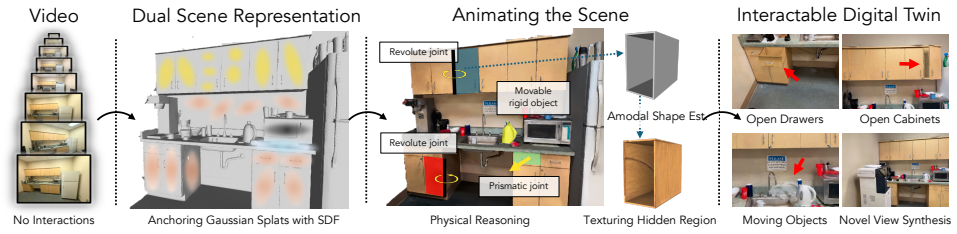
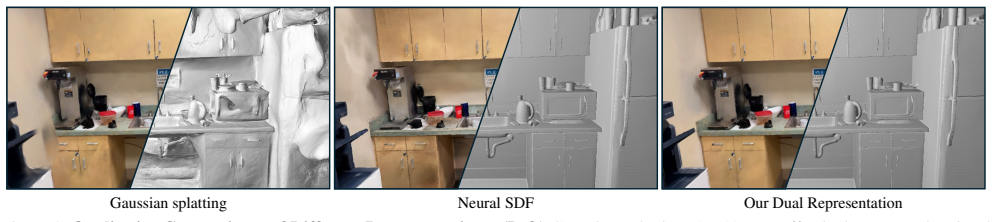
The load-bearing object is the dual scene representation: a neural signed distance field (a function mapping each 3D point to a signed distance from the nearest surface) that is extracted as a mesh to provide collision geometry, plus a set of 3D Gaussian splats spawned at mesh-face centroids, initialized in scale and rotation to the face, and constrained to move only within that face and a limited distance along the normal. A straight-through estimator makes the resulting clipping operation differentiable, so the splats can be trained with the usual photometric loss. The second mechanism is the articulation pipeline: object masks from open-vocabulary segmentation are fused onto the mesh, a foundation model proposes joint types and axes, a vision-language model re-estimates and arbitrates, and differentiable rendering of compositional shape templates aligns the completed objects with the observed partial geometry; hidden interior regions receive plausible material texture from a conditional diffusion model.
What would settle it
Take a held-out set of furniture with articulation mechanisms that are not visually obvious from a closed state, such as push-to-open drawers, one-way swing cabinets with hidden dampers, or bifold doors, run DRAWER on a static video, and check whether the predicted joint type and axis let the simulated opening follow the real motion within the paper's trajectory-EMD threshold.
Extended reading notes
Core claim
The paper reports that DRAWER converts a single static video into an interactable digital twin by coupling a neural signed distance field with 3D Gaussian splatting in a dual scene representation, and it identifies this coupling as the reason the reconstruction is simultaneously geometry-accurate and photorealistic. Anchoring Gaussians to the SDF's zero level-set, while allowing them limited motion on their parent faces and using a straight-through estimator to keep training differentiable, suppresses floating splats and keeps rendered appearance aligned with collision geometry. On top of that geometry, the articulation module infers joint types and revolute axes from foundation-model predictions and multi-view mask fusion, then fits compositional shape templates to complete hidden interior shapes and textures them with a conditional diffusion model. The paper demonstrates the result by importing the twins into a game engine and by training a drawer-opening policy in simulation that transfers to a real robot, reporting articulation precision of 97.2 percent and a rotation-axis accuracy metric of 0.994 on six captured kitchens.
Load-bearing premise
The paper's central bet is that a closed drawer or cabinet's articulation type and hinge axis can be inferred correctly from static appearance plus common-sense priors, without ever seeing the object move; if that inference is wrong, the simulated joint is wrong and the interactive twin is inaccurate.
Editorial extensions
If this is right
- A static video alone becomes sufficient input for building an editable, physically interactive environment, removing the need to capture scenes before and after every interaction or to hand-specify joints.
- Rendering quality stays close to the best splatting baseline (PSNR 27.80, SSIM 0.912, LPIPS 0.159) while the SDF mesh provides a collision-ready geometry, so what the agent sees and what it can touch remain aligned.
- Simulated articulated trajectories match real ground-truth motion with an EMD of $1.41 \times 10^{-5}$, an order of magnitude lower than a video-diffusion baseline's $17.7 \times 10^{-5}$.
- The exported twins plug into standard game-engine and robot-simulator pipelines, so game levels and robot training environments could be produced from casual video capture rather than manual 3D modeling.
Reading between the lines
- The same static-video-to-interactive-twin recipe should extend to historical interiors, architectural scans, or museum exhibits where physically opening the original is impossible, turning still documentation into walkable, openable virtual spaces.
- Because the coupling constraint is generic, the dual representation could be reused for other sensor modalities or for editable scene editing after object removal, where appearance must follow geometry changes.
- The reported evaluation covers six kitchens; a direct next experiment is to run the pipeline on furniture with non-standard mechanisms such as push-to-open latches, sliding shelves, or two-door cabinets with hidden center pivots, to see where foundation-model articulation priors break.
- A quantitative real-to-sim-to-real study with measured success rates across multiple scenes and object categories would strengthen the robotics claim beyond the reported qualitative demonstration.
Signed reviews
Editorial analysis
A structured set of objections, weighed in public.
Referee Report
Summary. The paper presents DRAWER, a framework that takes a video of a static indoor scene and produces an interactive digital twin. It combines a neural SDF for geometry with Gaussian splatting anchored to the SDF's zero level set for appearance, and then uses foundation models (3DOI, GPT4o) to infer articulation types and hinge axes, fits category-level shape templates to complete hidden regions, and composes the articulated objects back into the scene. The authors evaluate rendering quality, articulation inference, and motion simulation on six kitchen scenes, and demonstrate an Unreal Engine game and a real-to-sim-to-real robot drawer-opening task.
Significance. If validated, DRAWER would be a useful step toward automatic creation of photorealistic, physically interactive digital twins from casual video, with clear applications in gaming and robot learning. The dual representation with face-anchored Gaussians and a straight-through estimator is a sensible way to couple appearance with geometry, and the paper attempts to evaluate articulation inference and motion simulation rather than only novel-view synthesis. The main weaknesses are the small evaluation set, internally inconsistent result tables, and the unverified reliance on static-appearance articulation inference, all of which currently prevent the central claims from being accepted as demonstrated. The paper also ships no code, data, or supplementary material, limiting reproducibility.
major comments (5)
- [Table 4, Sec. 4.2] Table 4 is internally inconsistent: the 3DOI row has five entries (80, 78, 59, 57, 0.861) while the Ours row has three (78, 58, 0.994), so it is impossible to determine the correct articulation count for DRAWER. Under the most natural column alignment, Ours correctly identifies only 58 of 78 articulation types (74%), which would contradict the claim of accurate articulation; under an alternative alignment the table cannot be checked because code and data are not released. Please provide a corrected table with the full column set, per-scene and per-mechanism breakdowns, and error bars or confidence intervals for the 78-object evaluation.
- [Table 3, Sec. 4.2] Table 3 is also malformed: the Digital Cousin row contains only four numeric entries (160, 75, 46.9, 60.0) under a five-column header, and the reported precision/recall values are inconsistent with an integer correct count. Moreover, the asterisk notes that URDFormer and Digital Cousin were evaluated by taking the best result over multiple runs per scene, while no such handicap is reported for DRAWER; this makes the comparison unfair. Please supply the corrected table and state whether DRAWER also used multiple predictions.
- [Sec. 1, Table 1] The Introduction claims DRAWER 'significantly outperforms prior art across all metrics,' but Table 1 shows 3DGS achieves higher PSNR (30.42 vs 27.80), SSIM (0.954 vs 0.912), and LPIPS (0.126 vs 0.159). The claim is therefore contradicted by the paper's own results unless 'metrics' is restricted to interactive compatibility. Please qualify the claim and discuss the trade-off explicitly.
- [Sec. 3.3, Table 4] The articulation module infers articulation types and hinge axes from static observations of closed furniture using 3DOI, GPT4o, and a VLM arbiter. Many real mechanisms (sliding doors, double doors, push-to-open, hidden hinges) are underdetermined from static appearance, and the manuscript reports no per-mechanism accuracy, no failure analysis, and no robustness test on unusual furniture. Since the downstream game and real-to-sim-to-real demos presuppose correct joints, this omission is load-bearing for the central contribution. Please add a confusion matrix or per-mechanism breakdown and a discussion of failure modes.
- [Sec. 4.1, Sec. 4.2] The empirical evaluation rests on six manually captured kitchen scenes with no error bars or variance estimates, and the code, data, and trained models are not released. Single-run results on six scenes cannot support the broad claims of generalization in Sections 1 and 4. Please add run-to-run variance (e.g., across random seeds or scene subsamples) and, at minimum, release the evaluation data and annotations.
minor comments (6)
- [Title and running header] The title appears as 'DRA WER' in the running header and in the abstract title; please correct the spacing throughout.
- [Table 1 caption] The asterisks on BakedSDF* and 2DGS* are not explained in the caption or text; please define them.
- [Figure 6 caption] The caption states that for URDFormer and Digital Cousin 'we select the best results from multiple image runs,' but no equivalent selection is documented for DRAWER; please clarify whether DRAWER also used multiple runs.
- [Sec. 4.2, EMD comparison] The reported EMD values (1.41e-5 vs 17.7e-5) lack units and normalization details; please specify the trajectory length, scale, and the number of points used in the Earth Mover's Distance computation.
- [General] The paper repeatedly refers to the supplementary material for details of the SDF losses, Gaussian parameterization, rigid-object pipeline, and additional experiments, but no supplementary document is included in the arXiv submission; please include it.
- [Sec. 4.4] The real-to-sim-to-real experiment reports no quantitative success rates or comparison to a manual-articulation baseline, so the claim that DRAWER 'eliminates the need for tedious manual effort' is supported only by qualitative videos; please provide quantitative metrics.
Circularity Check
No significant circularity: external benchmarks carry the central claims; the only self-overlap is a non-load-bearing Video2Game baseline and pipeline citation.
full rationale
No circular step is exhibited in the paper's derivation chain. The reconstruction quality claims are benchmarked against external methods (Nerfacto, BakedSDF, 3DGS, 2DGS, Video2Game) using standard PSNR/SSIM/LPIPS, and the simulated-motion claim is compared with KlingAI via EMD; these metrics are not defined in terms of DRAWER's own outputs. DRAWER's articulation module does use 3DOI [69] as one of two prongs plus GPT4o and a VLM arbitrator, so the Table 4 comparison with 3DOI is a system-versus-component comparison rather than an external baseline; nevertheless, the final prediction is not equal to 3DOI's output by construction, so this is not circularity. The only self-citation is Video2Game [89], a prior work by the first author, used as a baseline and cited for the gaming-agent pipeline and for optionally setting physical parameters manually; none of these citations carries the paper's novel dual-representation or articulation claims, which are independently evaluated. One correctness caveat, flagged separately from circularity: Table 4 as printed is internally inconsistent, with the Ours row reading '78 58 0.994' and a missing column, so the asserted higher accuracy over 3DOI cannot be verified from the table as typeset; this is an evidence-reporting problem, not a definitional reduction of the claimed result to its inputs.
Assumptions & free parameters
free parameters (6)
- Loss weights for SDF, depth, normal, and Gaussian regularization
- Mask IoU discard threshold
- Structure consistency distance threshold
- Gaussian splitting scale divisor =
1.6
- Mass and friction coefficients
- Template part shapes and layer counts
assumptions (6)
- standard math Volume rendering alpha-compositing correctly converts SDF predictions to images
- domain assumption The input scene is static during capture and every change is caused by the articulation simulation after reconstruction
- domain assumption 2D foundation model outputs (normal, depth, SAM masks, GPT4o/3DOI articulation labels) are sufficiently reliable after the described filtering
- ad hoc to paper The category-level compositional templates cover all articulated objects encountered
- domain assumption MatFuse generates plausible physical materials for hidden interior regions
- domain assumption Manually set or VLM-estimated mass and friction values do not need per-object calibration for the demonstrated tasks
Cite this review
Pith. "Pith review of DRAWER: Digital Reconstruction and Articulation With Environment Realism." pith.science (2026). https://pith.science/paper/VVGOCINK
@misc{pith2026250415278,
  author       = {Pith},
  title        = {Pith review of: DRAWER: Digital Reconstruction and Articulation With Environment Realism},
  year         = {2026},
  howpublished = {\url{https://pith.science/paper/VVGOCINK}},
  note         = {Machine review of arXiv:2504.15278}
}
read the original abstract
Creating virtual digital replicas from real-world data unlocks significant potential across domains like gaming and robotics. In this paper, we present DRAWER, a novel framework that converts a video of a static indoor scene into a photorealistic and interactive digital environment. Our approach centers on two main contributions: (i) a reconstruction module based on a dual scene representation that reconstructs the scene with fine-grained geometric details, and (ii) an articulation module that identifies articulation types and hinge positions, reconstructs simulatable shapes and appearances and integrates them into the scene. The resulting virtual environment is photorealistic, interactive, and runs in real time, with compatibility for game engines and robotic simulation platforms. We demonstrate the potential of DRAWER by using it to automatically create an interactive game in Unreal Engine and to enable real-to-sim-to-real transfer for robotics applications.
Figures

Figures from the paper (10 more)


Forward citations
Cited by 1 Pith paper
-
LodeStar: Long-horizon Dexterity via Synthetic Data Augmentation from Human Demonstrations
LodeStar combines automatic skill segmentation with simulation-based reinforcement learning augmentation and a learned routing transformer to let a robotic hand complete long-horizon dexterous tasks from a few human demos.
Reference graph
Works this paper leans on
-
[1]
Neural point-based graphics,
Kara-Ali Aliev, Artem Sevastopolsky, Maria Kolos, Dmitry Ulyanov, and Victor Lempitsky. Neural point-based graphics,
-
[2]
Vista 2.0: An open, data-driven simulator for multimodal sensing and policy learning for autonomous vehicles
Alexander Amini, Tsun-Hsuan Wang, Igor Gilitschenski, Wilko Schwarting, Zhijian Liu, Song Han, Sertac Karaman, and Daniela Rus. Vista 2.0: An open, data-driven simulator for multimodal sensing and policy learning for autonomous vehicles. In ICRA, 2022. 2
2022
-
[3]
Gwangbin Bae and Andrew J. Davison. Rethinking inductive biases for surface normal estimation. In CVPR, 2024. 4
2024
-
[4]
Mip-nerf: A multiscale representation for anti-aliasing neu- ral radiance fields
Jonathan T Barron, Ben Mildenhall, Matthew Tancik, Peter Hedman, Ricardo Martin-Brualla, and Pratul P Srinivasan. Mip-nerf: A multiscale representation for anti-aliasing neu- ral radiance fields. In ICCV, 2021. 2, 4
2021
-
[5]
Mip-nerf 360: Unbounded anti-aliased neural radiance fields
Jonathan T Barron, Ben Mildenhall, Dor Verbin, Pratul P Srinivasan, and Peter Hedman. Mip-nerf 360: Unbounded anti-aliased neural radiance fields. In CVPR, 2022. 2
2022
-
[6]
Es- timating or propagating gradients through stochastic neurons for conditional computation
Yoshua Bengio, Nicholas L´eonard, and Aaron Courville. Es- timating or propagating gradients through stochastic neurons for conditional computation. arXiv, 2013. 5
2013
-
[7]
View inter- polation for image synthesis
Shenchang Eric Chen and Lance Williams. View inter- polation for image synthesis. In Proceedings of the 20th annual conference on Computer graphics and interactive techniques, 1993. 2
1993
-
[8]
Geosim: Realistic video simu- lation via geometry-aware composition for self-driving
Yun Chen, Frieda Rong, Shivam Duggal, Shenlong Wang, Xinchen Yan, Sivabalan Manivasagam, Shangjie Xue, Ersin Yumer, and Raquel Urtasun. Geosim: Realistic video simu- lation via geometry-aware composition for self-driving. In CVPR, 2021. 2
2021
Show all 114 references
-
[9]
Mobilenerf: Exploiting the polygon raster- ization pipeline for efficient neural field rendering on mobile architectures
Zhiqin Chen, Thomas Funkhouser, Peter Hedman, and An- drea Tagliasacchi. Mobilenerf: Exploiting the polygon raster- ization pipeline for efficient neural field rendering on mobile architectures. CVPR, 2023. 2
2023
-
[10]
Urdformer: A pipeline for constructing articulated simulation environments from real-world images
Zoey Chen, Aaron Walsman, Marius Memmel, Kaichun Mo, Alex Fang, Karthikeya Vemuri, Alan Wu, Dieter Fox, and Abhishek Gupta. Urdformer: A pipeline for constructing articulated simulation environments from real-world images. arXiv, 2024. 2, 3, 5, 8, 9
2024
-
[11]
Acdc: Automated creation of digital cousins for robust policy learn- ing
Tianyuan Dai, Josiah Wong, Yunfan Jiang, Chen Wang, Cem Gokmen, Ruohan Zhang, Jiajun Wu, and Li Fei-Fei. Acdc: Automated creation of digital cousins for robust policy learn- ing. arXiv, 2024. 2, 3, 5, 8, 9
2024
-
[12]
Improving neural implicit surfaces geometry with patch warping
Franc ¸ois Darmon, B´en´edicte Bascle, Jean-Cl´ement Devaux, Pascal Monasse, and Mathieu Aubry. Improving neural implicit surfaces geometry with patch warping. In Proceed- ings of the IEEE/CVF Conference on Computer Vision and Pattern Recognition, pages 6260–6269, 2022. 2
2022
-
[13]
Proc- thor: Large-scale embodied ai using procedural generation
Matt Deitke, Eli VanderBilt, Alvaro Herrasti, Luca Weihs, Kiana Ehsani, Jordi Salvador, Winson Han, Eric Kolve, Aniruddha Kembhavi, and Roozbeh Mottaghi. Proc- thor: Large-scale embodied ai using procedural generation. NeurIPS, 2022. 3 10
2022
-
[14]
Carla: An open urban driving simulator, 2017
Alexey Dosovitskiy, German Ros, Felipe Codevilla, Antonio Lopez, and Vladlen Koltun. Carla: An open urban driving simulator, 2017. 1, 3
2017
-
[15]
Unreal engine
Epic Games. Unreal engine. 7
-
[16]
Grand theft auto v, 2014
Rockstar Games. Grand theft auto v, 2014. 1
2014
-
[17]
Mesh-based gaussian splatting for real-time large-scale deformation
Lin Gao, Jie Yang, Bo-Tao Zhang, Jia-Mu Sun, Yu-Jie Yuan, Hongbo Fu, and Yu-Kun Lai. Mesh-based gaussian splatting for real-time large-scale deformation. arXiv, 2024. 5
2024
-
[18]
Fine-tuning image-conditional diffusion models is easier than you think
Gonzalo Martin Garcia, Karim Abou Zeid, Christian Schmidt, Daan de Geus, Alexander Hermans, and Bastian Leibe. Fine-tuning image-conditional diffusion models is easier than you think. arXiv, 2024. 4
2024
-
[19]
Layered depth images
Jonathan Shade Steven Gortler, Li-wei He, Richard Szeliski, et al. Layered depth images. In SIGGRAPH, pages 231–242,
-
[20]
Animatediff: Animate your personalized text-to- image diffusion models without specific tuning, 2023
Yuwei Guo, Ceyuan Yang, Anyi Rao, Zhengyang Liang, Yaohui Wang, Yu Qiao, Maneesh Agrawala, Dahua Lin, and Bo Dai. Animatediff: Animate your personalized text-to- image diffusion models without specific tuning, 2023. 3
2023
-
[21]
Sugar: Surface- aligned gaussian splatting for efficient 3d mesh reconstruc- tion and high-quality mesh rendering, 2023
Antoine Gu ´edon and Vincent Lepetit. Sugar: Surface- aligned gaussian splatting for efficient 3d mesh reconstruc- tion and high-quality mesh rendering, 2023. 4, 5
2023
-
[22]
Controllable video generation with sparse trajectories
Zekun Hao, Xun Huang, and Serge Belongie. Controllable video generation with sparse trajectories. In CVPR, 2018. 3
2018
-
[23]
Non- parametric object and parts modeling with lie group dynam- ics
David S Hayden, Jason Pacheco, and John W Fisher. Non- parametric object and parts modeling with lie group dynam- ics. In CVPR, 2020. 3
2020
-
[24]
Plenoptic modeling and rendering from image sequences taken by a hand-held camera
Benno Heigl, Reinhard Koch, Marc Pollefeys, Joachim Den- zler, and Luc Van Gool. Plenoptic modeling and rendering from image sequences taken by a hand-held camera. In DAGM-Symposium, 1999. 2
1999
-
[25]
Ditto in the house: Building articulation models of indoor scenes through interactive perception
Cheng-Chun Hsu, Zhenyu Jiang, and Yuke Zhu. Ditto in the house: Building articulation models of indoor scenes through interactive perception. In ICRA, 2023. 3
2023
-
[26]
Autovfx: Physically realistic video editing from natural language instructions, 2024
Hao-Yu Hsu, Zhi-Hao Lin, Albert Zhai, Hongchi Xia, and Shenlong Wang. Autovfx: Physically realistic video editing from natural language instructions, 2024. 2, 5
2024
-
[27]
2d gaussian splatting for geometrically accurate radiance fields
Binbin Huang, Zehao Yu, Anpei Chen, Andreas Geiger, and Shenghua Gao. 2d gaussian splatting for geometrically accurate radiance fields. In SIGGRAPH. Association for Computing Machinery, 2024. 3, 4, 8
2024
-
[28]
Multi- bodysync: Multi-body segmentation and motion estimation via 3d scan synchronization
Jiahui Huang, He Wang, Tolga Birdal, Minhyuk Sung, Fed- erica Arrigoni, Shi-Min Hu, and Leonidas J Guibas. Multi- bodysync: Multi-body segmentation and motion estimation via 3d scan synchronization. In CVPR, 2021. 3
2021
-
[29]
S2o: Static to openable enhancement for articulated 3d objects
Denys Iliash, Hanxiao Jiang, Yiming Zhang, Manolis Savva, and Angel X Chang. S2o: Static to openable enhancement for articulated 3d objects. arXiv, 2024. 3
2024
-
[30]
Ditto: Build- ing digital twins of articulated objects from interaction
Zhenyu Jiang, Cheng-Chun Hsu, and Yuke Zhu. Ditto: Build- ing digital twins of articulated objects from interaction. In CVPR, 2022. 3, 7
2022
-
[31]
Co- tracker3: Simpler and better point tracking by pseudo- labelling real videos
Nikita Karaev, Iurii Makarov, Jianyuan Wang, Natalia Neverova, Andrea Vedaldi, and Christian Rupprecht. Co- tracker3: Simpler and better point tracking by pseudo- labelling real videos. arXiv, 2024. 8, 9
2024
-
[32]
3d gaussian splatting for real-time radiance field rendering
Bernhard Kerbl, Georgios Kopanas, Thomas Leimk ¨uhler, and George Drettakis. 3d gaussian splatting for real-time radiance field rendering. TOG, 2023. 2, 3, 4, 8
2023
-
[33]
Robot see robot do: Imitating articulated object manipu- lation with monocular 4d reconstruction
Justin Kerr, Chung Min Kim, Mingxuan Wu, Brent Yi, Qianqian Wang, Ken Goldberg, and Angjoo Kanazawa. Robot see robot do: Imitating articulated object manipu- lation with monocular 4d reconstruction. arXiv preprint arXiv:2409.18121, 2024. 3
2024 arXiv
-
[34]
Segment any- thing
Alexander Kirillov, Eric Mintun, Nikhila Ravi, Hanzi Mao, Chloe Rolland, Laura Gustafson, Tete Xiao, Spencer White- head, Alexander C Berg, Wan-Yen Lo, et al. Segment any- thing. In ICCV, 2023. 6
2023
-
[36]
Articulate-anything: Auto- matic modeling of articulated objects via a vision-language foundation model
Long Le, Jason Xie, William Liang, Hung-Ju Wang, Yue Yang, Yecheng Jason Ma, Kyle Vedder, Arjun Krishna, Di- nesh Jayaraman, and Eric Eaton. Articulate-anything: Auto- matic modeling of articulated objects via a vision-language foundation model. arXiv, 2024. 3
2024
-
[37]
Nap: Neural 3d articulated object prior
Jiahui Lei, Congyue Deng, William B Shen, Leonidas J Guibas, and Kostas Daniilidis. Nap: Neural 3d articulated object prior. NeurIPS, 2023. 3
2023
-
[38]
Light field rendering
Marc Levoy and Pat Hanrahan. Light field rendering. In Proceedings of the 23rd annual conference on Computer graphics and interactive techniques, 1996. 2
1996
-
[39]
Climatenerf: Physically-based neural ren- dering for extreme climate synthesis
Yuan Li, Zhi-Hao Lin, David Forsyth, Jia-Bin Huang, and Shenlong Wang. Climatenerf: Physically-based neural ren- dering for extreme climate synthesis. arXiv, 2022. 2
2022
-
[40]
Neuralangelo: High-fidelity neural surface reconstruction
Zhaoshuo Li, Thomas M¨uller, Alex Evans, Russell H Tay- lor, Mathias Unberath, Ming-Yu Liu, and Chen-Hsuan Lin. Neuralangelo: High-fidelity neural surface reconstruction. In Proceedings of the IEEE/CVF Conference on Computer Vision and Pattern Recognition, pages 8456–8465, 2023. 2
2023
-
[41]
Generative image dynamics
Zhengqi Li, Richard Tucker, Noah Snavely, and Aleksander Holynski. Generative image dynamics. In CVPR, 2024. 3
2024
-
[42]
Neurmips: Neural mixture of planar experts for view synthesis
Zhi-Hao Lin, Wei-Chiu Ma, Hao-Yu Hsu, Yu-Chiang Frank Wang, and Shenlong Wang. Neurmips: Neural mixture of planar experts for view synthesis. In CVPR, 2022. 2
2022
-
[43]
Urbanir: Large-scale urban scene inverse rendering from a single video, 2023
Zhi-Hao Lin, Bohan Liu, Yi-Ting Chen, David Forsyth, Jia- Bin Huang, Anand Bhattad, and Shenlong Wang. Urbanir: Large-scale urban scene inverse rendering from a single video, 2023. 2
2023
-
[44]
Singapo: Single image controlled generation of articulated parts in object
Jiayi Liu, Denys Iliash, Angel X Chang, Manolis Savva, and Ali Mahdavi-Amiri. Singapo: Single image controlled generation of articulated parts in object. arXiv, 2024. 3
2024
-
[45]
Real-time neural rasterization for large scenes
Jeffrey Yunfan Liu, Yun Chen, Ze Yang, Jingkang Wang, Sivabalan Manivasagam, and Raquel Urtasun. Real-time neural rasterization for large scenes. In Proceedings of the IEEE/CVF International Conference on Computer Vision, pages 8416–8427, 2023. 2
2023
-
[46]
Building rearticulable models for arbitrary 3d objects from 4d point clouds
Shaowei Liu, Saurabh Gupta, and Shenlong Wang. Building rearticulable models for arbitrary 3d objects from 4d point clouds. In Proceedings of the IEEE/CVF Conference on Computer Vision and Pattern Recognition , pages 21138– 21147, 2023. 3
2023
-
[47]
Grounding dino: Marrying dino with grounded pre-training for open-set object detection
Shilong Liu, Zhaoyang Zeng, Tianhe Ren, Feng Li, Hao Zhang, Jie Yang, Chunyuan Li, Jianwei Yang, Hang Su, Jun Zhu, et al. Grounding dino: Marrying dino with grounded pre-training for open-set object detection. arXiv, 2023. 6
2023
-
[48]
Physgen: Rigid-body physics-grounded image- to-video generation, 2024
Shaowei Liu, Zhongzheng Ren, Saurabh Gupta, and Shen- long Wang. Physgen: Rigid-body physics-grounded image- to-video generation, 2024. 2 11
2024
-
[49]
Building interactable replicas of complex articulated objects via gaussian splatting
Yu Liu, Baoxiong Jia, Ruijie Lu, Junfeng Ni, Song-Chun Zhu, and Siyuan Huang. Building interactable replicas of complex articulated objects via gaussian splatting. arXiv preprint arXiv:2502.19459, 2025. 3
2025 arXiv
-
[50]
Model-based control with sparse neural dynamics, 2023
Ziang Liu, Genggeng Zhou, Jeff He, Tobia Marcucci, Li Fei-Fei, Jiajun Wu, and Yunzhu Li. Model-based control with sparse neural dynamics, 2023. 2
2023
-
[51]
Urban radiance field representation with deformable neural mesh primitives, 2023
Fan Lu, Yan Xu, Guang Chen, Hongsheng Li, Kwan-Yee Lin, and Changjun Jiang. Urban radiance field representation with deformable neural mesh primitives, 2023. 2
2023
-
[52]
Dynamic 3d gaussians: Tracking by persis- tent dynamic view synthesis
Jonathon Luiten, Georgios Kopanas, Bastian Leibe, and Deva Ramanan. Dynamic 3d gaussians: Tracking by persis- tent dynamic view synthesis. In 3DV, 2024. 4
2024
-
[53]
Luma unreal engine plugin
Luma AI. Luma unreal engine plugin. 7
-
[54]
Real2code: Reconstruct articulated objects via code genera- tion
Zhao Mandi, Yijia Weng, Dominik Bauer, and Shuran Song. Real2code: Reconstruct articulated objects via code genera- tion. arXiv, 2024. 3
2024
-
[55]
Real2code: Reconstruct articulated objects via code genera- tion
Zhao Mandi, Yijia Weng, Dominik Bauer, and Shuran Song. Real2code: Reconstruct articulated objects via code genera- tion. CoRR, abs/2406.08474, 2024. 7
2024 arXiv
-
[56]
Lidarsim: Realistic lidar simulation by leveraging the real world
Sivabalan Manivasagam, Shenlong Wang, Kelvin Wong, Wenyuan Zeng, Mikita Sazanovich, Shuhan Tan, Bin Yang, Wei-Chiu Ma, and Raquel Urtasun. Lidarsim: Realistic lidar simulation by leveraging the real world. In CVPR, 2020. 2
2020
-
[57]
Optical models for direct volume rendering
Nelson Max. Optical models for direct volume rendering. TOG, 1995. 4
1995
-
[58]
Srinivasan, Matthew Tancik, Jonathan T
Ben Mildenhall, Pratul P. Srinivasan, Matthew Tancik, Jonathan T. Barron, Ravi Ramamoorthi, and Ren Ng. Nerf: Representing scenes as neural radiance fields for view syn- thesis. In ECCV, 2020. 1, 2, 3
2020
-
[59]
Nerf: Representing scenes as neural radiance fields for view syn- thesis
Ben Mildenhall, Pratul P Srinivasan, Matthew Tancik, Jonathan T Barron, Ravi Ramamoorthi, and Ren Ng. Nerf: Representing scenes as neural radiance fields for view syn- thesis. ACM Communications, 2021. 4
2021
-
[60]
Nerf in the dark: High dynamic range view synthesis from noisy raw images
Ben Mildenhall, Peter Hedman, Ricardo Martin-Brualla, Pratul P Srinivasan, and Jonathan T Barron. Nerf in the dark: High dynamic range view synthesis from noisy raw images. In Proceedings of the IEEE/CVF Conference on Computer Vision and Pattern Recognition, pages 16190–16199, 2022. 2
2022
-
[61]
Orbit: A unified simulation framework for interactive robot learning environments
Mayank Mittal, Calvin Yu, Qinxi Yu, Jingzhou Liu, Nikita Rudin, David Hoeller, Jia Lin Yuan, Ritvik Singh, Yun- rong Guo, Hammad Mazhar, Ajay Mandlekar, Buck Babich, Gavriel State, Marco Hutter, and Animesh Garg. Orbit: A unified simulation framework for interactive robot lear...
2023
-
[62]
On self-contact and human pose
Lea Muller, Ahmed AA Osman, Siyu Tang, Chun-Hao P Huang, and Michael J Black. On self-contact and human pose. In CVPR, 2021. 7
2021
-
[63]
Instant neural graphics primitives with a mul- tiresolution hash encoding
Thomas M¨uller, Alex Evans, Christoph Schied, and Alexan- der Keller. Instant neural graphics primitives with a mul- tiresolution hash encoding. ACM Transactions on Graphics, 41(4):1–15, 2022. 2
2022
-
[64]
Watch it move: Unsupervised discovery of 3d joints for re-posing of articulated objects
Atsuhiro Noguchi, Umar Iqbal, Jonathan Tremblay, Tatsuya Harada, and Orazio Gallo. Watch it move: Unsupervised discovery of 3d joints for re-posing of articulated objects. In CVPR, 2022. 3
2022
-
[65]
Unisurf: Unifying neural implicit surfaces and radiance fields for multi-view reconstruction
Michael Oechsle, Songyou Peng, and Andreas Geiger. Unisurf: Unifying neural implicit surfaces and radiance fields for multi-view reconstruction. In Proceedings of the IEEE/CVF International Conference on Computer Vision, pages 5589–5599, 2021. 2
2021
-
[66]
ihuman: Instant animatable digital humans from monocular videos
Pramish Paudel, Anubhav Khanal, Ajad Chhatkuli, Danda Pani Paudel, and Jyoti Tandukar. ihuman: Instant animatable digital humans from monocular videos. arXiv,
-
[67]
Lightsim: Neural lighting simulation for urban scenes, 2023
Ava Pun, Gary Sun, Jingkang Wang, Yun Chen, Ze Yang, Sivabalan Manivasagam, Wei-Chiu Ma, and Raquel Urtasun. Lightsim: Neural lighting simulation for urban scenes, 2023. 2
2023
-
[68]
Neural lighting simulation for urban scenes
Ava Pun, Gary Sun, Jingkang Wang, Yun Chen, Ze Yang, Sivabalan Manivasagam, Wei-Chiu Ma, and Raquel Urtasun. Neural lighting simulation for urban scenes. NeurIPS, 2024. 2
2024
-
[69]
Understanding 3d object interaction from a single image
Shengyi Qian and David F Fouhey. Understanding 3d object interaction from a single image. In ICCV, 2023. 3, 6, 8
2023
-
[70]
Understanding 3d object articulation in internet videos
Shengyi Qian, Linyi Jin, Chris Rockwell, Siyi Chen, and David F Fouhey. Understanding 3d object articulation in internet videos. In CVPR, 2022. 8
2022
-
[71]
Gaus- sianavatars: Photorealistic head avatars with rigged 3d gaus- sians
Shenhan Qian, Tobias Kirschstein, Liam Schoneveld, Davide Davoli, Simon Giebenhain, and Matthias Nießner. Gaus- sianavatars: Photorealistic head avatars with rigged 3d gaus- sians. arXiv, 2024. 5
2024
-
[72]
Infinigen indoors: Photorealistic indoor scenes using procedural generation, 2024
Alexander Raistrick, Lingjie Mei, Karhan Kayan, David Yan, Yiming Zuo, Beining Han, Hongyu Wen, Meenal Parakh, Stamatis Alexandropoulos, Lahav Lipson, Zeyu Ma, and Jia Deng. Infinigen indoors: Photorealistic indoor scenes using procedural generation, 2024. 3
2024
-
[73]
Grounded sam: Assembling open-world models for diverse visual tasks,
Tianhe Ren, Shilong Liu, Ailing Zeng, Jing Lin, Kun- chang Li, He Cao, Jiayu Chen, Xinyu Huang, Yukang Chen, Feng Yan, Zhaoyang Zeng, Hao Zhang, Feng Li, Jie Yang, Hongyang Li, Qing Jiang, and Lei Zhang. Grounded sam: Assembling open-world models for diverse visual tasks,
-
[74]
Differentiable hybrid traffic simulation
Sanghyun Son, Yi-Ling Qiao, Jason Sewall, and Ming C Lin. Differentiable hybrid traffic simulation. TOG, 2022. 2
2022
-
[75]
Curobo: Parallelized collision-free robot mo- tion generation
Balakumar Sundaralingam, Siva Kumar Sastry Hari, Adam Fishman, Caelan Garrett, Karl Van Wyk, Valts Blukis, Alexander Millane, Helen Oleynikova, Ankur Handa, Fabio Ramos, et al. Curobo: Parallelized collision-free robot mo- tion generation. In 2023 IEEE International Conference...
2023
-
[76]
Stereo matching with transparency and matting
Richard Szeliski and Polina Golland. Stereo matching with transparency and matting. In Sixth International Conference on Computer Vision, 1998. 2
1998
-
[77]
Nerfstudio: A modular framework for neural radiance field development
Matthew Tancik, Ethan Weber, Evonne Ng, Ruilong Li, Brent Yi, Justin Kerr, Terrance Wang, Alexander Kristof- fersen, Jake Austin, Kamyar Salahi, et al. Nerfstudio: A modular framework for neural radiance field development. in arXiv, 2023. 4, 8
2023
-
[78]
Delicate textured mesh recovery from nerf via adaptive surface refinement
Jiaxiang Tang, Hang Zhou, Xiaokang Chen, Tianshu Hu, Er- rui Ding, Jingdong Wang, and Gang Zeng. Delicate textured mesh recovery from nerf via adaptive surface refinement. arXiv preprint arXiv:2303.02091, 2023. 2 12
2023 arXiv
-
[79]
Mujoco: A physics engine for model-based control
Emanuel Todorov, Tom Erez, and Yuval Tassa. Mujoco: A physics engine for model-based control. In IROS, 2012. 3
2012
-
[80]
Reconciling reality through simulation: A real-to-sim-to-real approach for robust manipulation
Marcel Torne, Anthony Simeonov, Zechu Li, April Chan, Tao Chen, Abhishek Gupta, and Pulkit Agrawal. Reconciling reality through simulation: A real-to-sim-to-real approach for robust manipulation. arXiv, 2024. 3, 7, 10
2024
-
[81]
From louvain to leiden: guaranteeing well-connected com- munities
Vincent A Traag, Ludo Waltman, and Nees Jan Van Eck. From louvain to leiden: guaranteeing well-connected com- munities. Scientific reports. 6
-
[82]
Matfuse: controllable material gener- ation with diffusion models
Giuseppe Vecchio, Renato Sortino, Simone Palazzo, and Concetto Spampinato. Matfuse: controllable material gener- ation with diffusion models. In CVPR, 2024. 7
2024
-
[83]
Ref-nerf: Struc- tured view-dependent appearance for neural radiance fields
Dor Verbin, Peter Hedman, Ben Mildenhall, Todd Zickler, Jonathan T Barron, and Pratul P Srinivasan. Ref-nerf: Struc- tured view-dependent appearance for neural radiance fields. In 2022 IEEE/CVF Conference on Computer Vision and Pattern Recognition (CVPR), pages 5481–5490. IEEE...
2022
-
[84]
Neus: Learning neural implicit surfaces by volume rendering for multi-view reconstruction
Peng Wang, Lingjie Liu, Yuan Liu, Christian Theobalt, Taku Komura, and Wenping Wang. Neus: Learning neural implicit surfaces by volume rendering for multi-view reconstruction. arXiv, 2021. 1, 2, 4
2021
-
[85]
Videocomposer: Compositional video synthesis with motion controllability
Xiang Wang, Hangjie Yuan, Shiwei Zhang, Dayou Chen, Jiuniu Wang, Yingya Zhang, Yujun Shen, Deli Zhao, and Jin- gren Zhou. Videocomposer: Compositional video synthesis with motion controllability. NeurIPS, 2024. 3
2024
-
[86]
Neus2: Fast learning of neural implicit surfaces for multi-view recon- struction, 2023
Yiming Wang, Qin Han, Marc Habermann, Kostas Dani- ilidis, Christian Theobalt, and Lingjie Liu. Neus2: Fast learning of neural implicit surfaces for multi-view recon- struction, 2023. 2
2023
-
[87]
Schwing, and Shenlong Wang
Jing Wen, Xiaoming Zhao, Zhongzheng Ren, Alexander G. Schwing, and Shenlong Wang. Gomavatar: Efficient an- imatable human modeling from monocular video using gaussians-on-mesh. arXiv, 2024. 5
2024
-
[88]
V oxurf: V oxel-based efficient and accurate neural surface reconstruction
Tong Wu, Jiaqi Wang, Xingang Pan, Xudong Xu, Christian Theobalt, Ziwei Liu, and Dahua Lin. V oxurf: V oxel-based efficient and accurate neural surface reconstruction. arXiv preprint arXiv:2208.12697, 2022. 2
2022 arXiv
-
[89]
Video2game: Real-time interactive realistic and browser-compatible environment from a single video
Hongchi Xia, Zhi-Hao Lin, Wei-Chiu Ma, and Shenlong Wang. Video2game: Real-time interactive realistic and browser-compatible environment from a single video. In CVPR, 2024. 2, 3, 4, 6, 7, 8
2024
-
[90]
Physgaussian: Physics- integrated 3d gaussians for generative dynamics, 2024
Tianyi Xie, Zeshun Zong, Yuxing Qiu, Xuan Li, Yutao Feng, Yin Yang, and Chenfanfu Jiang. Physgaussian: Physics- integrated 3d gaussians for generative dynamics, 2024. 2, 4, 5
2024
-
[91]
Ultralidar: Learning compact representations for lidar completion and generation
Yuwen Xiong, Jingkang Ma, Wei-Chiu Wang, and Raquel Urtasun. Ultralidar: Learning compact representations for lidar completion and generation. CVPR, 2023. 2
2023
-
[92]
Set-of-mark prompting unleashes extraordinary visual grounding in gpt-4v
Jianwei Yang, Hao Zhang, Feng Li, Xueyan Zou, Chunyuan Li, and Jianfeng Gao. Set-of-mark prompting unleashes extraordinary visual grounding in gpt-4v. arXiv, 2023. 6
2023
-
[93]
Emernerf: Emergent spatial- temporal scene decomposition via self-supervision
Jiawei Yang, Boris Ivanovic, Or Litany, Xinshuo Weng, Se- ung Wook Kim, Boyi Li, Tong Che, Danfei Xu, Sanja Fidler, Marco Pavone, and Yue Wang. Emernerf: Emergent spatial- temporal scene decomposition via self-supervision. In ICLR,
-
[94]
Learning interactive real-world simulators
Mengjiao Yang, Yilun Du, Kamyar Ghasemipour, Jonathan Tompson, Dale Schuurmans, and Pieter Abbeel. Learning interactive real-world simulators. arXiv, 2023. 3
2023
-
[95]
Surfelgan: Synthesizing realistic sensor data for autonomous driving
Zhenpei Yang, Yuning Chai, Dragomir Anguelov, Yin Zhou, Pei Sun, Dumitru Erhan, Sean Rafferty, and Henrik Kret- zschmar. Surfelgan: Synthesizing realistic sensor data for autonomous driving. In CVPR, 2020. 2
2020
-
[96]
Surfelgan: Synthesizing realistic sensor data for autonomous driving, 2020
Zhenpei Yang, Yuning Chai, Dragomir Anguelov, Yin Zhou, Pei Sun, Dumitru Erhan, Sean Rafferty, and Henrik Kret- zschmar. Surfelgan: Synthesizing realistic sensor data for autonomous driving, 2020. 2
2020
-
[97]
Unisim: A neural closed-loop sensor simulator
Ze Yang, Yun Chen, Jingkang Wang, Sivabalan Mani- vasagam, Wei-Chiu Ma, Anqi Joyce Yang, and Raquel Urta- sun. Unisim: A neural closed-loop sensor simulator. CVPR,
-
[98]
V ol- ume rendering of neural implicit surfaces
Lior Yariv, Jiatao Gu, Yoni Kasten, and Yaron Lipman. V ol- ume rendering of neural implicit surfaces. NeurIPS, 2021. 2, 4
2021
-
[99]
Bakedsdf: Meshing neural sdfs for real-time view synthesis
Lior Yariv, Peter Hedman, Christian Reiser, Dor Verbin, Pratul P Srinivasan, Richard Szeliski, Jonathan T Barron, and Ben Mildenhall. Bakedsdf: Meshing neural sdfs for real-time view synthesis. In SIGGRAPH Conference, 2023. 2, 4, 8
2023
-
[100]
Deep part induction from articulated object pairs
Li Yi, Haibin Huang, Difan Liu, Evangelos Kalogerakis, Hao Su, and Leonidas Guibas. Deep part induction from articulated object pairs. arXiv, 2018. 3
2018
-
[101]
Sdfstudio: A unified framework for surface reconstruction, 2022
Zehao Yu, Anpei Chen, Bozidar Antic, Songyou Peng, Apra- tim Bhattacharyya, Michael Niemeyer, Siyu Tang, Torsten Sattler, and Andreas Geiger. Sdfstudio: A unified framework for surface reconstruction, 2022. 2
2022
-
[102]
Monosdf: Exploring monocular geometric cues for neural implicit surface reconstruction
Zehao Yu, Songyou Peng, Michael Niemeyer, Torsten Sat- tler, and Andreas Geiger. Monosdf: Exploring monocular geometric cues for neural implicit surface reconstruction. arXiv, 2022. 2, 4
2022
-
[103]
Gaussian opacity fields: Efficient and compact surface reconstruction in unbounded scenes
Zehao Yu, Torsten Sattler, and Andreas Geiger. Gaussian opacity fields: Efficient and compact surface reconstruction in unbounded scenes. arXiv, 2024. 4
2024
-
[104]
M2t2: Multi-task masked transformer for object-centric pick and place
Wentao Yuan, Adithyavairavan Murali, Arsalan Mousavian, and Dieter Fox. M2t2: Multi-task masked transformer for object-centric pick and place. In 7th Annual Conference on Robot Learning. 10
-
[105]
3d diffusion policy
Yanjie Ze, Gu Zhang, Kangning Zhang, Chenyuan Hu, Muhan Wang, and Huazhe Xu. 3d diffusion policy. arXiv preprint arXiv:2403.03954, 2024. 10
2024 arXiv
-
[106]
Physical property understanding from language-embedded feature fields
Albert J Zhai, Yuan Shen, Emily Y Chen, Gloria X Wang, Xinlei Wang, Sheng Wang, Kaiyu Guan, and Shenlong Wang. Physical property understanding from language-embedded feature fields. In CVPR, 2024. 6
2024
-
[107]
An improved louvain algorithm for community detection
Jicun Zhang, Jiyou Fei, Xueping Song, and Jiawei Feng. An improved louvain algorithm for community detection. Mathematical Problems in Engineering, 2021. 6
2021
-
[108]
The unreasonable effectiveness of deep features as a perceptual metric
Richard Zhang, Phillip Isola, Alexei A Efros, Eli Shechtman, and Oliver Wang. The unreasonable effectiveness of deep features as a perceptual metric. In CVPR, 2018. 8
2018
-
[109]
Feng, Changxi Zheng, Noah Snavely, Jiajun Wu, and 13 William T
Tianyuan Zhang, Hong-Xing Yu, Rundi Wu, Brandon Y . Feng, Changxi Zheng, Noah Snavely, Jiajun Wu, and 13 William T. Freeman. PhysDreamer: Physics-based inter- action with 3d objects via video generation. In ECCV, 2024. 3
2024
-
[110]
Controlvideo: Training-free controllable text-to-video generation
Yabo Zhang, Yuxiang Wei, Dongsheng Jiang, Xiaopeng Zhang, Wangmeng Zuo, and Qi Tian. Controlvideo: Training-free controllable text-to-video generation. arXiv,
-
[111]
Deep hough transform for semantic line detec- tion
Kai Zhao, Qi Han, Chang-Bin Zhang, Jun Xu, and Ming- Ming Cheng. Deep hough transform for semantic line detec- tion. IEEE Transactions on Pattern Analysis and Machine Intelligence, 44(9):4793–4806, 2021. 8
2021
-
[112]
Surfel-based gaussian inverse rendering for fast and relightable dynamic human reconstruction from monocular video
Yiqun Zhao, Chenming Wu, Binbin Huang, Yihao Zhi, Chen Zhao, Jingdong Wang, and Shenghua Gao. Surfel-based gaussian inverse rendering for fast and relightable dynamic human reconstruction from monocular video. arXiv preprint arXiv:2407.15212, 2024. 2
2024
-
[113]
Open-sora: Democratizing efficient video production for all, 2024
Zangwei Zheng, Xiangyu Peng, Tianji Yang, Chenhui Shen, Shenggui Li, Hongxin Liu, Yukun Zhou, Tianyi Li, and Yang You. Open-sora: Democratizing efficient video production for all, 2024. 3
2024
-
[114]
Learning to generate realistic lidar point clouds
Vlas Zyrianov, Xiyue Zhu, and Shenlong Wang. Learning to generate realistic lidar point clouds. In ECCV, 2022. 2
2022
-
[115]
Lidardm: Generative lidar simulation in a generated world,
Vlas Zyrianov, Henry Che, Zhijian Liu, and Shenlong Wang. Lidardm: Generative lidar simulation in a generated world,
Reviewed August 16, 2026 · model on record in the stance chip above.
Discussion (0). Continue with ORCID to comment.