REVIEW 3 major objections 5 minor 49 references
Multi-Target Rydberg Gates via Spatial Blockade Engineering
T0 review · 3 major / 5 minor · reviewed 2026-08-16 · deepseek-v4-flash
Pith's one-line read A single global laser pulse on one-species neutral-atom hardware can implement two- and three-target controlled-Z gates, with simulated fidelities up to 99.55% under Rydberg decay and atom-position disorder.
desk verdict A solid numerical proposal for single-pulse multi-target Rydberg gates, but the 'negligible target-target' regime is overstated and the headline fidelities are in-sample. read the letter →
The pith
A machine-rendered reading of the paper's core claim, the machinery that carries it, and where it could break.
The reading
What carries the argument
The load-bearing object is an asymmetric van der Waals blockade engineered purely by geometry. With $V_{ij}=C_6/d_{ij}^6$, the circular arrangement—control at the center, $N$ targets evenly spaced on the perimeter—makes control–target interactions strong ($V_{CT}\gg\Omega$) while keeping target–target interactions weak ($V_{TT}\ll\Omega$); this lets the control atom blockade all targets at once while two targets can still be excited together. The asymmetry is what allows one global pulse to attach distinct phases to different multi-qubit states, which a symmetric all-blockaded arrangement cannot do. The second piece of machinery is the pulse-synthesis routine: a gradient-based optimizer with trotterized time evolution, local Kraus amplitude-damping maps for Rydberg decay, mini-batch sampling of random atomic displacements, and a smoothness penalty that pushes the discovered pulses toward experimentally implementable waveforms.
What would settle it
Run the designed CZZ pulse on a single-species neutral-atom array with the control at the center and two targets at $R=3.5$ µm, and measure the process fidelity under the same decay and position-error conditions; the claim is refuted if the per-target infidelity is not below the roughly 0.5% error of two sequential standard CZ gates. A sharper check is to sweep $R$ across the 3.25–3.75 µm band and verify the predicted peak-and-falloff shape in fidelity rather than a flat response.
Extended reading notes
Core claim
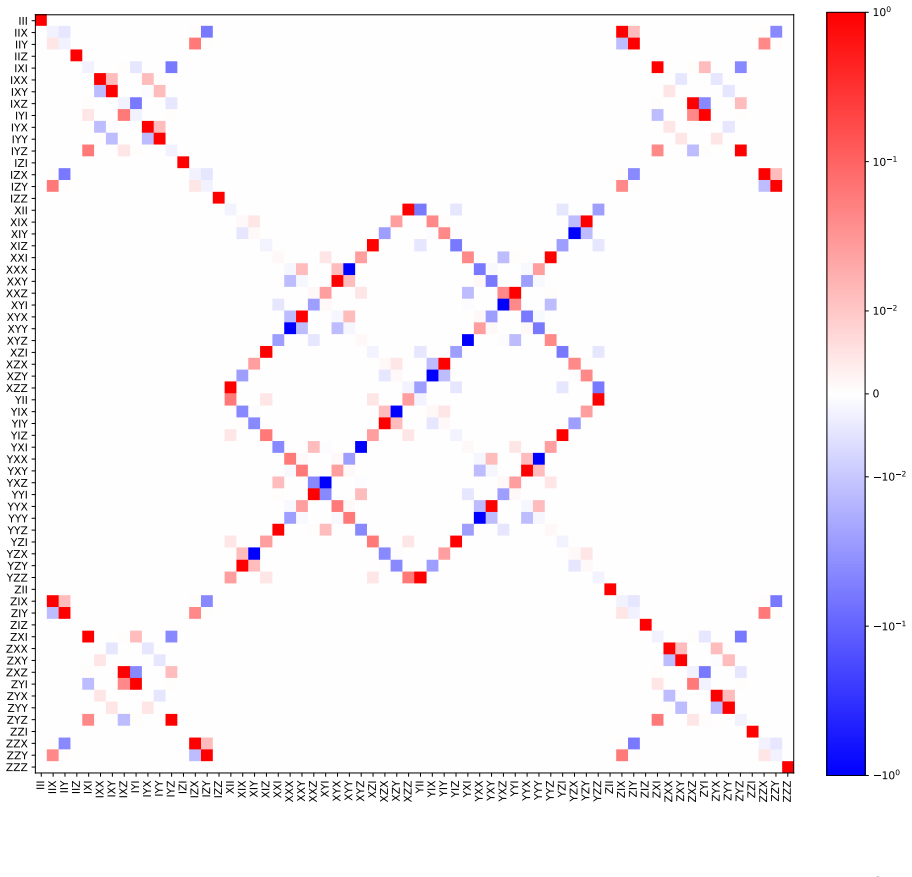
The central claim is that deliberately breaking the spatial symmetry of the Rydberg blockade turns an all-to-all interaction into a directional one. With the control at the origin and $N$ targets at radius $R$, the control–target interaction is $V_{CT}=C_6/R^6$, while neighboring targets sit at $d_{TT}=2R\sin(\pi/N)$, giving $V_{TT}=C_6/d_{TT}^6$. For $R\approx 3.5$ µm (CZZ) and $R\approx 4.0$ µm (CZZZ), this places $V_{CT}$ far above the global Rabi frequency $\Omega$ and $V_{TT}$ near or below it, creating the asymmetry needed for $C(Z^{\otimes 2})$ and $C(Z^{\otimes 3})$ phase patterns. The authors synthesize smooth global Rabi pulses by gradient-based optimization that averages over Rydberg decay and Gaussian atom displacements, reaching fidelities up to 99.55% (CZZ) and 99.24% (CZZZ); their error analysis attributes the remaining infidelity mainly to $X\leftrightarrow Y$ crosstalk on the control qubit and to $Z\leftrightarrow I$ leakage from residual Rydberg population. The geometry does not extend to larger $N$: once target–target spacing shrinks toward the control–target distance, the required blockade hierarchy breaks down, so the method is presented as a practical primitive for $N=2,3$.
Load-bearing premise
The whole scheme rests on the asymmetric-blockade hierarchy being reliable: the control–target interaction must stay much stronger than the Rabi drive while the target–target interaction stays much weaker, and at the chosen radii the target–target interaction is only marginally below the drive, so the optimized pulse must compensate for that residual coupling.
Editorial extensions
If this is right
- A $C(Z^{\otimes 2})$ or $C(Z^{\otimes 3})$ gate can be executed in one global pulse lasting hundreds of nanoseconds, so two or three controlled-Z operations take roughly the time of a single standard CZ gate.
- The reported fidelities—99.55% for CZZ and 99.24% for CZZZ—correspond to per-target errors of 0.225% and 0.253%, below the roughly 0.5% error reported for current two-qubit gates.
- Used in syndrome extraction, these gates cut the number of entangling layers; the companion work shows they enable depth-optimal readout of surface-code and color-code stabilizers.
- The circular geometry supports high fidelity only for $N=2$ and $N=3$ targets at current noise levels; $N=4$ or $N=5$ may become feasible with tighter atom positioning, and larger $N$ is excluded by the geometry.
- The optimized pulses are smooth and use control hardware already present in state-of-the-art neutral-atom experiments, so no additional laser or microwave fields are required.
Reading between the lines
- If the simulated fidelities survive an experimental test, the per-target error rates would make these gates immediately useful in error-correction circuits, since they dip below the per-CZ error of current two-qubit gates.
- The predicted dependence on radius $R$ is sharp enough to be a clean experimental signature: re-optimizing at radii outside the 3.25–3.75 µm band should yield noticeably lower CZZ fidelity, and observing no such falloff would suggest the pulses are compensating rather than using the blockade hierarchy.
- The same asymmetric-geometry idea could transfer to other Rydberg-interacting platforms, such as trapped ions or silicon donors, but the pulse shapes would need to be re-derived for each interaction potential and trap geometry.
- An analytic reduction of the optimized phase profiles might reveal a closed-form pulse family, which would make calibration simpler and transferable across hardware.
Signed reviews
Editorial analysis
A structured set of objections, weighed in public.
Referee Report
Summary. The paper proposes a scheme for single-control multi-target controlled-Z gates C(Z^⊗N) for N=2 and N=3 on a single-species neutral-atom platform using one global Rydberg pulse. The control atom is placed at the center of a circle and the targets on the perimeter, creating strong control-target blockade and weaker target-target interactions. The authors use a GPU-accelerated pulse optimization with a smoothness penalty to design pulses, reporting fidelities up to 99.55% for CZZ and 99.24% for CZZZ under simulated Rydberg decay and atom-position disorder. They argue that such gates can reduce syndrome-extraction depth in error correction and compare the per-CZ error rate favorably with current two-qubit gates.
Significance. If the numerical results are reliable, the proposed multi-target gates would be a useful primitive for neutral-atom quantum computing, potentially reducing circuit depth for stabilizer readout. The geometric configuration is concrete, the pulse-optimization methodology is standard, and the use of experimentally motivated parameters (Rydberg lifetime, C6 coefficient, trap-position spreads) is a strength. The work includes numerical evidence and a qualitative Pauli-transfer-map analysis of error channels. However, the central physical claim of a 'negligible' target-target interaction is not consistent with the operating parameters, and the reported robustness figures are in-sample optimization results rather than independent predictions, so the significance as stated is overstated.
major comments (3)
- [§3.1, Fig. 1, Table 2] The paper states that target-target interactions are negligible, but the operating points in Table 2 give V_TT ≈ 2π × 7.33 MHz for CZZ at R = 3.5 μm (d_TT = 7.0 μm) and V_TT ≈ 2π × 7.80 MHz for CZZZ at R = 4.0 μm (d_TT = 6.93 μm), i.e., 0.73–0.78 of Ω = 2π × 10 MHz. This is not negligible under the standard blockade criterion |V| >> Ω; it is a finite interaction comparable to the drive. The high-fidelity gates therefore rely on the optimizer compensating for a significant target-target coupling rather than on the 'negligible' regime described in §3.2. The paper should either (a) choose R such that V_TT << Ω and demonstrate that high fidelity is still achievable, or (b) explicitly reframe the mechanism as 'finite target-target coupling with optimized compensation' and analyze sensitivity to the C6 coefficient and Rydberg-state choice. This is load-bearing because the abstract and conclusion attribute the gate to 'asymmetric blockade' with 'minimal target-target interactions'.
- [§4.3, Table 1, Table 2] The reported fidelities are in-sample optimization results: the optimizer is trained on the same Gaussian displacement distributions and decay model used for evaluation, and the reported numbers are the average fidelity over these training samples. This does not demonstrate robustness beyond the modeled noise. The paper should state this explicitly and provide an out-of-sample test, e.g., evaluating the optimized pulses on a different noise realization, a different displacement width, or an additional noise channel such as laser intensity noise or Doppler shifts, to quantify generalization. As written, the abstract's claim 'even in the presence of simulated atom placement errors and Rydberg-state decay' is weaker than it appears.
- [§4.4] The 'per-CZ error rate' defined as (1 - F)/N is not a meaningful comparison with the error rate of a single two-qubit CZ gate, because a multi-target gate has a different error structure and a single pulse can fail in ways that affect multiple targets coherently. The claim that the gates have 'error per CZ below the 0.5% level' should be justified by a metric relevant for the actual use case (e.g., logical error rate after syndrome extraction) or by a comparison of the full process fidelity with the equivalent sequence of N two-qubit gates. Without this, the comparison to current two-qubit gates is misleading.
minor comments (5)
- [§3.3] The description of the Kraus map for Rydberg decay is confusing: the text says 'Modeling the |r>→|e> transition comprises omitting the p2 kraus channel', but the decay probabilities p0, p1, p2 are defined and the Kraus operators E0, E1, E2 are given. Please clarify how p2 is used and ensure the map is trace-preserving if p2 is omitted.
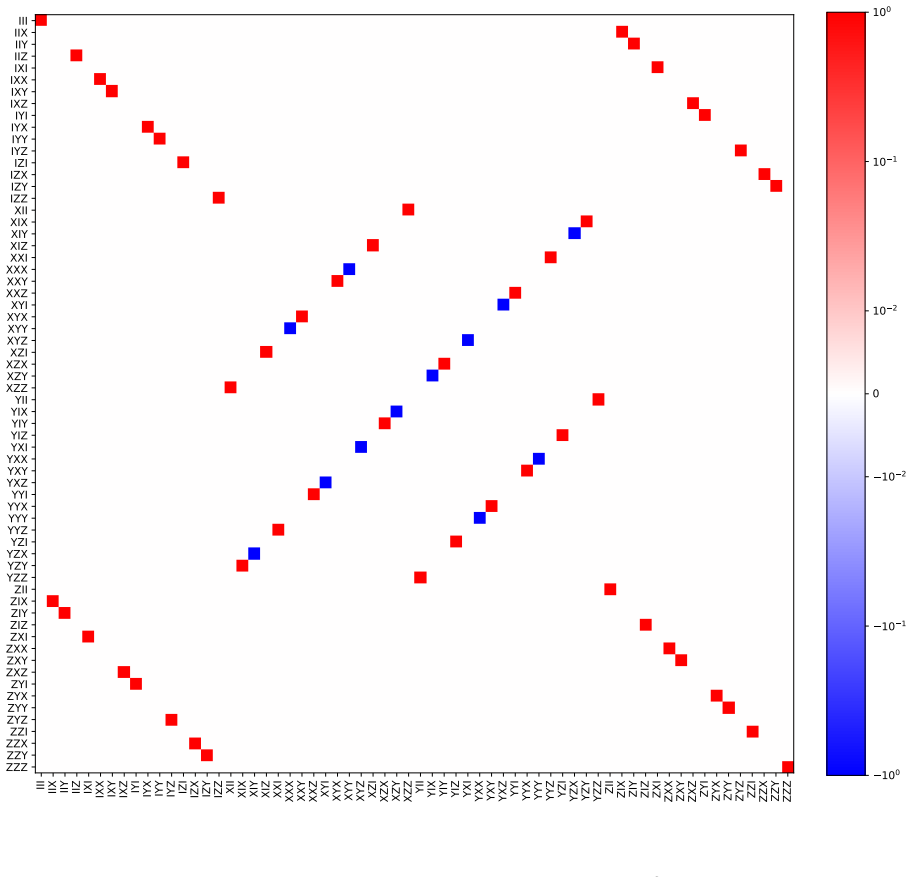
- [§4.2, Appendix A] The PTM analysis is qualitative; please provide the explicit values of the dominant off-diagonal elements or a quantitative decomposition of the infidelity contributions, so the reader can verify the claim that X↔Y and Z↔I errors dominate.
- [Fig. 3] The y-axis is on a logarithmic scale; please ensure the legend and axis labels are fully readable, and clarify in the caption that the 'Control-Target Interatomic Distance' in the legend refers to the radius R.
- [§5, Ref. [22]] The companion work [22] is referenced as 'in a companion work'; the claim that this scheme 'enables a depth-optimal readout' is speculative and should be phrased as a potential rather than an established result, or supported by the companion paper.
- [§4.5] The paper acknowledges laser intensity and phase uniformity as an experimental concern, but no quantitative analysis is provided; given that the gate relies on precise phase control, a discussion of the acceptable intensity inhomogeneity would strengthen the experimental-feasibility section.
Circularity Check
No significant circularity: target gates are external benchmarks, pulses are free optimization parameters, and no equation-level reduction is present; score reflects one minor same-author citation and an in-sample robustness evaluation.
full rationale
The central claim is a numerical construction, not a derivation from the claimed conclusion. The target C(Z⊗N) gates are externally defined benchmarks; the Hamiltonian in Eq. (1) is the standard Rydberg-blockade model; and the Adam optimization varies the pulse parameters {Ω_k, φ_k} to minimize 1 − F(U_target, E_real). The reported fidelities are the values of that external metric after optimization, so the direction of fit is from the pulse to the target, not from the target back into the input. There is no equation in the paper that defines an input in terms of the output, and no fitted parameter is renamed as a predicted observable. The robust-fidelity numbers are, however, in-sample: Section 4.3 trains on sampled displacements and decay, Fig. 5 states 'Each pulse is trained and evaluated with thermal noise and atom motion', and Table 2 says 'The reported fidelity is the average over random displacements described in Table 1.' This means the reported robustness is an estimate of the optimized loss, so the 'robust against atom placement errors' claim is not a held-out prediction; this is a validation caveat but not a definitional circularity. The only same-author citation, Ref. [22], supports the motivation that CZZ and CZZZ gates reduce syndrome-extraction depth ('In a companion work [22], we show that CZZ and CZZZ multi-qubit gates achieve the optimal depth for readout of the surface code and color code stabilizers'), but that depth claim is not load-bearing for the gate derivation itself, which is self-contained numerical simulation. Finally, the reported operating points (R = 3.5 and 4.0 µm) give V_TT ≈ 0.73–0.78 Ω, below |Ω| but not truly negligible by the |V| ≫ Ω blockade criterion; this is a physics and correctness concern about the claimed 'negligible target-target blockade' regime, not a circularity. Overall, no equation-level or definitional circularity is present, so the circularity score is low.
Assumptions & free parameters
free parameters (4)
- Control-target radius R =
3.5 µm for CZZ, 3.5 to 4.0 µm for CZZZ
- Total gate duration T =
250 to 600 ns, best examples at 575 ns
- Pulse phase schedule Phi_k =
Optimized arrays, one phase per 100 time segments
- Smoothness penalty coefficients =
lambda_s = 0.01 decreasing to 0, lambda_b = 1.0, B = 2.0
assumptions (4)
- domain assumption The Rydberg interaction is captured by an isotropic van der Waals potential Vjk = C6 / |rj - rk|^6 with a single C6 coefficient for all pairs.
- standard math The discretized Trotterized evolution with 100 time segments reproduces the continuous pulse to the reported fidelity.
- domain assumption Rydberg decay is modeled by local amplitude-damping Kraus channels with branching probabilities p0, p1, p2 taken from Ref. [12].
- domain assumption Atom positions are independent random variables drawn from zero-mean Gaussians with widths sigma_x = sigma_y = 0.014 µm and sigma_z = 0.16 µm, applied statically during the pulse.
Cite this review
Pith. "Pith review of Multi-Target Rydberg Gates via Spatial Blockade Engineering." pith.science (2026). https://pith.science/paper/AEX6GJ36
@misc{pith2026250415282,
  author       = {Pith},
  title        = {Pith review of: Multi-Target Rydberg Gates via Spatial Blockade Engineering},
  year         = {2026},
  howpublished = {\url{https://pith.science/paper/AEX6GJ36}},
  note         = {Machine review of arXiv:2504.15282}
}
read the original abstract
Multi-target gates offer the potential to reduce gate depth in syndrome extraction for quantum error correction. Although neutral-atom quantum computers have demonstrated native multi-qubit gates, existing approaches that avoid additional control or multiple atomic species have been limited to single-target gates. We propose single-control-multi-target CZ^{\otimes N}) gates on a single-species neutral-atom platform that require no extra control and have gate durations comparable to standard CZ gates. Our approach leverages tailored interatomic distances to create an asymmetric blockade between the control and target atoms. Using a GPU-accelerated pulse synthesis protocol, we design smooth control pulses for CZZ and CZZZ gates, achieving fidelities of up to 99.55% and 99.24%, respectively, even in the presence of simulated atom placement errors and Rydberg-state decay. This work presents a practical path to implementing multi-target gates in neutral-atom systems, significantly reducing the resource overhead for syndrome extraction.
Figures


Figures from the paper (5 more)


Reference graph
Works this paper leans on
-
[1]
Suppressing quantum errors by scaling a surface code log- ical qubit
Google Quantum AI et al. “Suppressing quantum errors by scaling a surface code log- ical qubit”. Nature614, 676–681 (2023)
work page 2023
-
[2]
Quantum error correction below the surface code threshold
Google Quantum AI et al. “Quantum error correction below the surface code threshold”. Nature 638, 920 (2024)
work page 2024
-
[3]
Demonstration of quantum compu- tation and error correction with a tesseract code
Ben W Reichardt, David Aasen, Rui Chao, Alex Chernoguzov, Wim van Dam, 11 John P Gaebler, Dan Gresh, Dominic Luc- chetti, Michael Mills, Steven A Moses, et al. “Demonstration of quantum compu- tation and error correction with a tesseract code” (2024). arxiv:2409.04628
arXiv 2024
-
[4]
Experimental demonstration of continuous quantum er- ror correction
William P Livingston, Machiel S Blok, Em- manuel Flurin, Justin Dressel, Andrew N Jordan, and Irfan Siddiqi. “Experimental demonstration of continuous quantum er- ror correction”. Nature communications13, 2307 (2022)
work page 2022
-
[5]
Logical computation demonstrated with a neutral atom quantum processor
Ben W Reichardt, Adam Paetznick, David Aasen, Ivan Basov, Juan M Bello-Rivas, Parsa Bonderson, Rui Chao, Wim van Dam, Matthew B Hastings, Andres Paz, et al. “Logical computation demonstrated with a neutral atom quantum processor” (2024). arXiv:2411.11822
arXiv 2024
-
[6]
Logical quantum processor based on reconfigurable atom arrays
Dolev Bluvstein, Simon J. Evered, Alexan- dra A. Geim, Sophie H. Li, Hengyun Zhou, Tom Manovitz, Sepehr Ebadi, Made- lyn Cain, Marcin Kalinowski, Dominik Hangleiter, J. Pablo Bonilla Ataides, Nishad Maskara, Iris Cong, Xun Gao, Pedro Sales Rodriguez, Thomas Karolyshyn, Giu- lia Semeghini, Michael J. Gullans, Markus Greiner, Vladan Vuletić, and Mikhail D. ...
work page 2024
-
[7]
Ex- perimental demonstration of logical magic state distillation
Pedro Sales Rodriguez, John M. Robin- son, Paul Niklas Jepsen, Zhiyang He, Casey Duckering, Chen Zhao, Kai-Hsin Wu, Joseph Campo, Kevin Bagnall, Minho Kwon, Thomas Karolyshyn, Phillip Wein- berg, Madelyn Cain, Simon J. Evered, Alexandra A. Geim, Marcin Kalinowski, So- phie H. Li, Tom Manovitz, Jesse Amato- Grill, James I. Basham, Liane Bernstein, Boris Br...
arXiv 2024
-
[8]
Quantum computing with neutral atoms
Loïc Henriet, Lucas Beguin, Adrien Sig- noles, Thierry Lahaye, Antoine Browaeys, Georges-Olivier Reymond, and Christophe Jurczak. “Quantum computing with neutral atoms”. Quantum4, 327 (2020)
work page 2020
Show all 49 references
-
[9]
Constant-overhead fault-tolerant quantum computation with reconfigurable atom arrays
Qian Xu, J Pablo Bonilla Ataides, Christo- pher A Pattison, Nithin Raveendran, Dolev Bluvstein, Jonathan Wurtz, Bane Vasić, Mikhail D Lukin, Liang Jiang, and Hengyun Zhou. “Constant-overhead fault-tolerant quantum computation with reconfigurable atom arrays”. Nature Physics 20...
2024
-
[10]
Qubit mapping for reconfigurable atom arrays
Bochen Tan, Dolev Bluvstein, Mikhail D Lukin, and Jason Cong. “Qubit mapping for reconfigurable atom arrays”. In Proceedings of the 41st IEEE/ACM International Con- ference on Computer-Aided Design. Pages 1–9. (2022)
2022
-
[11]
Multi-qubit entanglement and algorithms on a neutral- atom quantum computer
TM Graham, Y Song, J Scott, C Poole, L Phuttitarn, K Jooya, P Eichler, X Jiang, A Marra, B Grinkemeyer, et al. “Multi-qubit entanglement and algorithms on a neutral- atom quantum computer”. Nature604, 457– 462 (2022)
2022
-
[12]
High-fidelity parallel entangling gates on a neutral-atom quantum computer
Simon J Evered, Dolev Bluvstein, Marcin Kalinowski, Sepehr Ebadi, Tom Manovitz, Hengyun Zhou, Sophie H Li, Alexandra A Geim, Tout T Wang, Nishad Maskara, et al. “High-fidelity parallel entangling gates on a neutral-atom quantum computer”. Nature 622, 268–272 (2023)
2023
-
[13]
Leveraging atom loss errors in fault tolerant quantum algorithms
Gefen Baranes, Madelyn Cain, J Ataides, Dolev Bluvstein, Josiah Sinclair, Vladan Vuletic, Hengyun Zhou, and Mikhail D Lukin. “Leveraging atom loss errors in fault tolerant quantum algorithms” (2025). arxiv:2502.20558. 12
2025
-
[14]
Quantum error correction for be- ginners
Simon J Devitt, William J Munro, and Kae Nemoto. “Quantum error correction for be- ginners”. Reports on Progress in Physics76, 076001 (2013)
2013
-
[15]
Dipole blockade and quan- tum information processing in mesoscopic atomic ensembles
M. D. Lukin, M. Fleischhauer, R. Cote, L. M. Duan, D. Jaksch, J. I. Cirac, and P. Zoller. “Dipole blockade and quan- tum information processing in mesoscopic atomic ensembles”. Phys. Rev. Lett. 87, 037901 (2001)
2001
-
[16]
Time- optimal two-and three-qubit gates for ryd- berg atoms
Sven Jandura and Guido Pupillo. “Time- optimal two-and three-qubit gates for ryd- berg atoms”. Quantum6, 712 (2022)
2022
-
[17]
Implementation of a multiqubit quantum phase gate in a neutral atomic en- semble via the asymmetric rydberg block- ade
Huai-Zhi Wu, Zhen-Biao Yang, and Shi-Biao Zheng. “Implementation of a multiqubit quantum phase gate in a neutral atomic en- semble via the asymmetric rydberg block- ade”. Physical Review A—Atomic, Molecu- lar, and Optical Physics82, 034307 (2010)
2010
-
[18]
Rydberg quantum controlled- phase gate with one control and multi- ple target qubits
SL Su. “Rydberg quantum controlled- phase gate with one control and multi- ple target qubits”. Chinese Physics B 27, 110304 (2018)
2018
-
[19]
Fast rydberg antiblockade regime and its applications in quantum logic gates
Shi-Lei Su, Ya Gao, Erjun Liang, and Shou Zhang. “Fast rydberg antiblockade regime and its applications in quantum logic gates”. Physical Review A95, 022319 (2017)
2017
-
[20]
Mesoscopic ry- dberg gate based on electromagnetically in- duced transparency
M Müller, I Lesanovsky, H Weimer, HP Büchler, and P Zoller. “Mesoscopic ry- dberg gate based on electromagnetically in- duced transparency”. Physical Review Let- ters 102, 170502 (2009)
2009
-
[21]
Asymmetric block- ade and multiqubit gates via dipole-dipole interactions
Jeremy T. Young, Przemyslaw Bienias, Ron Belyansky, Adam M. Kaufman, and Alexey V. Gorshkov. “Asymmetric block- ade and multiqubit gates via dipole-dipole interactions”. Phys. Rev. Lett. 127, 120501 (2021)
2021
-
[22]
Reduced depth syndrome extraction for neutral atom quantum error correc- tion
Samuel Stein, Chenxu Liu, Shuwen Kan, Ying Mao, Alexander Schuckert, and Ang Li. “Reduced depth syndrome extraction for neutral atom quantum error correc- tion” (2025)
2025
-
[23]
Entanglement of two individual neutral atoms using ryd- berg blockade
Tatjana Wilk, A Gaëtan, C Evellin, J Wolters, Y Miroshnychenko, P Grang- ier, and Antoine Browaeys. “Entanglement of two individual neutral atoms using ryd- berg blockade”. Physical review letters104, 010502 (2010)
2010
-
[24]
Quantum information with ryd- berg atoms
Mark Saffman, Thad G Walker, and Klaus Mølmer. “Quantum information with ryd- berg atoms”. Reviews of modern physics82, 2313–2363 (2010)
2010
-
[25]
Quantum computing with atomic qubits and rydberg interactions: progress and challenges
Mark Saffman. “Quantum computing with atomic qubits and rydberg interactions: progress and challenges”. Journal of Physics B: Atomic, Molecular and Optical Physics 49, 202001 (2016)
2016
-
[26]
Aquila: Quera’s 256-qubit neutral-atom quantum computer
Jonathan Wurtz, Alexei Bylinskii, Boris Braverman, Jesse Amato-Grill, Sergio H Cantu, Florian Huber, Alexander Lukin, Fangli Liu, Phillip Weinberg, John Long, et al. “Aquila: Quera’s 256-qubit neutral-atom quantum computer” (2023). arxiv:2306.11727
2023 arXiv
-
[27]
Blueprint for fault-tolerant quantum computation with rydberg atoms
James M Auger, Silvia Bergamini, and Dan E Browne. “Blueprint for fault-tolerant quantum computation with rydberg atoms”. Physical Review A96, 052320 (2017)
2017
-
[28]
Observation of rydberg block- ade between two atoms
E Urban, Todd A Johnson, T Henage, L Isenhower, DD Yavuz, TG Walker, and M Saffman. “Observation of rydberg block- ade between two atoms”. Nature Physics5, 110–114 (2009)
2009
-
[29]
Atomique: A quantum compiler for recon- figurable neutral atom arrays
Hanrui Wang, Pengyu Liu, Daniel Bochen Tan, Yilian Liu, Jiaqi Gu, David Z Pan, Ja- son Cong, Umut A Acar, and Song Han. “Atomique: A quantum compiler for recon- figurable neutral atom arrays”. In 2024 ACM/IEEE 51st Annual International Sym- posium on Computer Architecture (ISC...
2024
-
[30]
Quantum phases of matter on a 256-atom programmable quantum simula- tor
Sepehr Ebadi, Tout T Wang, Harry Levine, Alexander Keesling, Giulia Semegh- ini, Ahmed Omran, Dolev Bluvstein, Rhine Samajdar, Hannes Pichler, Wen Wei Ho, et al. “Quantum phases of matter on a 256-atom programmable quantum simula- tor”. Nature595, 227–232 (2021)
2021
-
[31]
Quantum computation and quantum in- formation
Michael A Nielsen and Isaac L Chuang. “Quantum computation and quantum in- formation”. Cambridge university press. (2010)
2010
-
[32]
Surface codes: Towards practical large-scale quantum computation
Austin G Fowler, Matteo Mariantoni, John M Martinis, and Andrew N Cleland. “Surface codes: Towards practical large-scale quantum computation”. Physical Review 13 A—Atomic, Molecular, and Optical Physics 86, 032324 (2012)
2012
-
[33]
Topological quantum distillation
Hector Bombin and Miguel Angel Martin- Delgado. “Topological quantum distillation”. Physical review letters97, 180501 (2006)
2006
-
[34]
Error budgeting for a controlled-phase gate with strontium-88 rydberg atoms
Alice Pagano, Sebastian Weber, Daniel Jaschke, Tilman Pfau, Florian Meinert, Si- mone Montangero, and Hans Peter Büchler. “Error budgeting for a controlled-phase gate with strontium-88 rydberg atoms”. Physical Review Research4, 033019 (2022)
2022
-
[35]
Optimiz- ing quantum control pulses with complex constraints and few variables through au- todifferentiation
Yao Song, Junning Li, Yong-Ju Hai, Qi- hao Guo, and Xiu-Hao Deng. “Optimiz- ing quantum control pulses with complex constraints and few variables through au- todifferentiation”. Physical Review A 105, 012616 (2022)
2022
-
[36]
Efficient al- gorithms for high-dimensional quantum op- timal control of a transmon qubit
Zhaoqi Leng, Pranav Mundada, Saeed Ghadimi, and Andrew Houck. “Efficient al- gorithms for high-dimensional quantum op- timal control of a transmon qubit”. Physical Review Applied19, 044034 (2023)
2023
-
[37]
Adam: A method for stochastic optimization
Diederik P Kingma. “Adam: A method for stochastic optimization” (2014). arxiv:1412.6980
2014 arXiv
-
[38]
Ultrafast energy exchange between two single rydberg atoms on a nanosecond timescale
Yeelai Chew, Takafumi Tomita, Tiru- malasetty Panduranga Mahesh, Seiji Sug- awa, Sylvain de Léséleuc, and Kenji Ohmori. “Ultrafast energy exchange between two single rydberg atoms on a nanosecond timescale”. Nature Photonics 16, 724– 729 (2022)
2022
-
[39]
Introduction to quantum gate set tomography
Daniel Greenbaum. “Introduction to quantum gate set tomography” (2015). arxiv:1509.02921
2015 arXiv
-
[40]
Pauli transfer matri- ces
Lukas Hantzko, Lennart Binkowski, and Sabhyata Gupta. “Pauli transfer matri- ces” (2024). arxiv:2411.00526
2024 arXiv
-
[41]
Quantum simulation of 2D antiferromagnets with hundreds of Ryd- berg atoms
Pascal Scholl, Michael Schuler, Hannah J. Williams, Alexander A. Eberharter, Daniel Barredo, Kai-Niklas Schymik, Vincent Lien- hard, Louis-Paul Henry, Thomas C. Lang, Thierry Lahaye, Andreas M. Läuchli, and Antoine Browaeys. “Quantum simulation of 2D antiferromagnets with hund...
2021
-
[42]
Many-body physics with individually con- trolled Rydberg atoms
Antoine Browaeys and Thierry Lahaye. “Many-body physics with individually con- trolled Rydberg atoms”. Nature Physics16, 132–142 (2020)
2020
-
[43]
Optically controlled entangling gates in ran- domly doped silicon
Eleanor Crane, Thomas Crane, Alexander Schuckert, Nguyen H. Le, Kristian Stock- bridge, Steven Chick, and Andrew J. Fisher. “Optically controlled entangling gates in ran- domly doped silicon”. Phys. Rev. B 100, 064201 (2019)
2019
-
[44]
Rydberg entangling gates in silicon
E. Crane, A. Schuckert, N. H. Le, and A. J. Fisher. “Rydberg entangling gates in silicon”. Physical Review Research3, 033086 (2021)
2021
-
[45]
Submi- crosecond entangling gate between trapped ions via Rydberg interaction
Chi Zhang, Fabian Pokorny, Weibin Li, Gerard Higgins, Andreas Pöschl, Igor Lesanovsky, and Markus Hennrich. “Submi- crosecond entangling gate between trapped ions via Rydberg interaction”. Nature580, 345–349 (2020)
2020
-
[46]
Fermionic quantum pro- cessing with programmable neutral atom ar- rays
D. González-Cuadra, D. Bluvstein, M. Kali- nowski, R. Kaubruegger, N. Maskara, P. Naldesi, T. V. Zache, A. M. Kaufman, M. D. Lukin, H. Pichler, B. Vermersch, Jun Ye, and P. Zoller. “Fermionic quantum pro- cessing with programmable neutral atom ar- rays”. Proceedings of the Nat...
2023
-
[47]
Fermion-qubit fault-tolerant quantum computing
Alexander Schuckert, Eleanor Crane, Alexey V. Gorshkov, Mohammad Hafezi, and Michael J. Gullans. “Fermion-qubit fault-tolerant quantum computing” (2024). arXiv:2411.08955
2024 arXiv
-
[48]
Measur- ing the loschmidt amplitude for finite-energy properties of the fermi-hubbard model on an ion-trap quantum computer
Kévin Hémery, Khaldoon Ghanem, Eleanor Crane, Sara L. Campbell, Joan M. Dreiling, Caroline Figgatt, Cameron Foltz, John P. Gaebler, Jacob Johansen, Michael Mills, Steven A. Moses, Juan M. Pino, Anthony Ransford, Mary Rowe, Peter Siegfried, Rus- sell P. Stutz, Henrik Dreyer, Al...
2024
-
[49]
Demonstration of three- and four-body in- teractions between trapped-ion spins
Or Katz, Lei Feng, Andrew Risinger, Christopher Monroe, and Marko Cetina. “Demonstration of three- and four-body in- teractions between trapped-ion spins”. Na- ture Physics19, 1452–1458 (2023). 14 A Pauli Transfer Maps Here we provide the Pauli Transfer Maps (PTMs) discussed i...
2023
Reviewed August 16, 2026 · model on record in the stance chip above.
Discussion (0). Continue with ORCID to comment.