REVIEW 4 major objections 5 minor 64 references
Manifold Induced Biases for Zero-shot and Few-shot Detection of Generated Images
T0 review · 4 major / 5 minor · reviewed 2026-08-16 · deepseek-v4-flash
Pith's one-line read Generated images can be told from real ones, with no training on fake data, by scoring the local curvature and bias of a pre-trained diffusion model's probability manifold.
desk verdict Strong empirical zero-shot detector with a load-bearing gap between the manifold theory and the CLIP-space implementation; worth rigorous review. read the letter →
The pith
A machine-rendered reading of the paper's core claim, the machinery that carries it, and where it could break.
The reading
What carries the argument
The load-bearing object is the score function $\nabla \log p_\alpha(x)$, approximated by a pretrained diffusion model through the MMSE-denoiser identity $h(\tilde{x}) = \frac{1}{\alpha}(\sqrt{1-\alpha} f(\tilde{x},t;\theta) - \tilde{x})$. The paper defines total-variation curvature $\kappa(x_0)$ as the negative divergence of the normalized score integrated over a ball, and uses Gauss's divergence theorem to rewrite it as a spherical expectation over uniformly sampled directions $u_d$; concentration of measure justifies sampling a sphere instead of the full Gaussian because the norm of high-dimensional Gaussian noise concentrates at $\sqrt{d}$. The final criterion $C(x_0)$ is an average over $s$ spherical perturbations of the cosine similarity between the normalized noise prediction and a linear combination of perturbation, noise prediction, and image, computed after embedding in CLIP space. This machinery converts an unobservable manifold quantity into a finite statistic computable from one image plus a pretrained model.
What would settle it
Compute $C(x_0)$ directly on pixels, with no CLIP mapping and the diffusion model applied to spherical perturbations of the raw image, and compare AUC with the CLIP-space version on the same 200,000-image benchmark. If native-space AUC drops to the baseline level, the CLIP embedding, not the manifold geometry, is carrying the detection signal.
Extended reading notes
Core claim
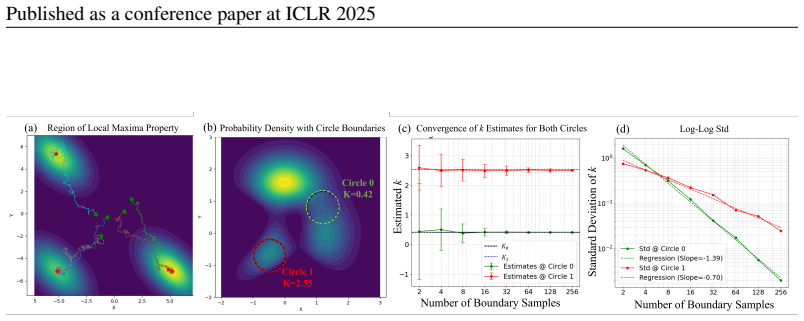
The central claim is that real images do not sit at stable local maxima of a diffusion model's learned log-probability manifold, whereas generated images do, and this difference can be measured using the score function $\nabla \log p_\alpha(x)$. For a candidate image $x_0$, the paper samples perturbations on the sphere $\partial B_0$ and proves, via the divergence theorem and the MMSE-denoiser form of the score, that an expectation over those samples equals a combination of local curvature $\kappa(x_0)$, gradient magnitude $D(x_0)$, and a bias term $\langle b_0, x_0\rangle$. The implemented criterion $C(x_0)$ is a normalized inner-product average over perturbed noise predictions, computed in CLIP space, and the paper reports that it approximates manifold-bias criteria and simultaneously measures similarity between the predictions of noise and data. Evaluated on an aggregate of 20 generative techniques, it reaches average AUC 0.835 against 0.439 for RIGID and 0.444 for AEROBLADE, and improves a CLIP-based few-shot detector when combined as a mixture of experts.
Load-bearing premise
The load-bearing premise is that the CLIP embedding, used to compute the actual detection score, preserves the curvature, gradient, and bias quantities derived for the diffusion model's native image space; the paper does not show that the embedding preserves these score-function geometries.
Editorial extensions
If this is right
- A detector can be deployed against new generative models without collecting fake images from them; only a small set of real images is needed to calibrate the threshold.
- The criterion keeps most of its accuracy when the diffusion backbone is swapped, so the approach is not locked to one model architecture.
- Combining the criterion with a CLIP-based few-shot detector in a mixture-of-experts setup improves detection beyond either method alone.
- The method degrades gracefully under JPEG compression and Gaussian blur, so it applies to images that have passed through common post-processing.
- Detection of images from the exact diffusion model used for scoring is expected by construction; the cross-model results are presented as empirical rather than explained by theory.
Reading between the lines
- If the CLIP embedding is carrying the signal, the diffusion model might be replaceable by another learned denoiser or even a different self-supervised feature space; a native-space versus CLIP-space comparison would settle this.
- The cross-model generalization may reflect shared training-data biases among generators rather than shared score geometry; a test would be whether generators trained on disjoint image collections are detected less reliably.
- The signed bias term suggests an extension from detection to attribution: estimating which training distribution a generated image is biased toward, not just labeling it fake.
- The paper's own limitation note says there is no comprehensive theory for the cross-model capability, so the safest reading is an empirical criterion with a motivating geometric derivation rather than a closed theory.
Signed reviews
Editorial analysis
A structured set of objections, weighed in public.
Referee Report
Summary. The paper proposes a zero-shot and few-shot framework for detecting AI-generated images, grounded in the geometry of the probability manifold learned by a pre-trained diffusion model. The authors derive criteria that approximate the curvature, gradient magnitude, and statistical bias of the learned log-probability surface near a candidate image, using spherical perturbations and the diffusion score function. The resulting criterion C(x0) is evaluated with a Stable Diffusion backbone and CLIP embeddings, and the method is tested on roughly 200,000 images from 20 generative techniques. The headline empirical result is an average zero-shot AUC of 0.835, compared with 0.439 for RIGID and 0.444 for AEROBLADE, and the few-shot mixture-of-experts extension also outperforms the baselines. The paper includes sensitivity and ablation studies over perturbation counts, noise levels, base models, and image corruptions, as well as toy experiments supporting the local-maxima intuition for diffusion trajectories.
Significance. If the theoretical derivation connects to the deployed criterion, this is a meaningful contribution: it would be the first theoretically motivated zero-shot analysis of a diffusion model for generated-image detection, with strong empirical results, an unusually broad evaluation across 20 generators, and reproducible code. The explicit sensitivity analysis and the careful calibration protocol (thresholds set on real images only) are strengths, as is the honest limitation statement in Section 6 that the cross-model generalization is not fully explained. However, the significance currently depends on whether the CLIP-space implementation and the native-space manifold derivation are actually the same object; the manuscript does not yet establish this, so the central theoretical claim remains unconnected to the reported numbers.
major comments (4)
- [4.1, Eq. (9)-(15) and Appendix D] There is a ball-radius inconsistency in the proof of Claim 1. The ball B0 is defined in Eq. (9) as {x : ||sqrt(1-alpha)x0 - x||_2 < sqrt(d alpha)}, while the boundary samples in Eq. (10) have radius sqrt(alpha)||u_d|| = sqrt(alpha d), which is consistent. However, the proof then uses the volume-to-surface ratio d/radii with 'radii = sqrt(d)', ignoring the factor sqrt(alpha). For a d-ball of radius r, |∂B0|/|B0| = d/r; with r = sqrt(d alpha), the ratio |∂B0|/(sqrt(d)|B0|) equals 1/sqrt(alpha), not 1. Consequently Eq. (15) should yield a factor of 1/sqrt(alpha) multiplying the curvature term, and Eq. (12) as stated is not a direct consequence of the preceding equations. This is load-bearing because the coefficients in C(x0) and the interpretation of the criterion depend on the correct geometric constant.
- [4.3 and Section 3-4] The implemented criterion is computed in CLIP embedding space, while the derivation of C(x0) as an approximation of curvature, gradient, and bias uses Euclidean inner products, the Gauss divergence theorem, and concentration of measure in the diffusion model's native data space (or latent space for Stable Diffusion). The paper states in Section 4.3 that u_d, h, and x0 are mapped to CLIP and that cosine similarity is used for multiplication, but gives no argument that the score geometry, the uniform-sphere normal directions, or the interchange between ilde{x} and x_t survive a nonlinear, data-dependent CLIP embedding. Without such an argument, or an empirical test that the CLIP-space quantity tracks its native-space counterpart, the theoretical framework in Eqs. (12)-(18) does not currently explain the numbers in Table 1; the reported 0.835 AUC could be driven by CLIP feature statistics. This gap affects the paper's central generalization claim.
- [4.2, Corollary 2, Eq. (17)] The zero-mean approximation in Eq. (17) is stated as following from 'integration of normals over the sphere is zero' together with the score approximating uniform spherical noise. The first of these facts applies to the geometric normal u_d/||u_d||, not to the normalized score function at an arbitrary point x on the sphere; the vanishing of the expectation of the normalized score is itself the spherical-noise assumption, not an independent consequence. Since this approximation is what eliminates the x0 term in Corollary 2 and leads to Eq. (16), its status as an assumption should be stated explicitly, and ideally validated on a real diffusion model, rather than presented as a derivation.
- [4.3, C(x0) formula] The claim that the factor sqrt(1-alpha)/alpha is 'common across terms and can be absorbed' appears inconsistent with the stated Corollary 3 expression, where the bias term carries an additional factor 1/(alpha sqrt(d)) and the curvature term in Corollary 2 carries a factor 1/sqrt(alpha). The three terms in C(x0) therefore have different constants, and absorbing a common factor does not reduce them all to the same scale. The authors should specify the exact constants c1, c2, c3 after implementing the CLIP-space normalization, or state explicitly that a=b=c=1 is a heuristic reweighting rather than a consequence of the derivation.
minor comments (5)
- [Table 1] The column headers 'RIGID Top 10 Accuracy', 'AEROBLADE Top 10 Accuracy', and 'Ours Top 10 Accuracy' are confusing because the row labels also repeat the method names; a cleaner layout would separate the method rows from the metric columns.
- [4.3] There are small textual typos: 'selection of of a,b,c' should read 'selection of a,b,c', and the sentence describing the dynamic-range adjustment would benefit from a clearer statement of the exact formula used.
- [Section 5.1 and Table 2] The text says 'Perturbation strength α√d = 1.28, determining B0 radii', but with the stated α=0.01 this is ten times smaller than the radius sqrt(dα) from Eq. (9) for the d values typical of the image/latent space used here; the authors should clarify which radius is actually implemented and reconcile the notation.
- [4.3] It is not specified in which space the perturbation vectors u_d are sampled before being mapped to CLIP, nor which dimension d enters Eqs. (9)-(10); this matters for interpreting the sensitivity analysis over α and for reproducing the method.
- [Appendix D, Corollary 3 proof] In the denominator of the second displayed equation, '1/α√(αd)' is a typographical mix of the numerator term and the norm approximation; the final result is correct, but the intermediate expression should be revised for clarity.
Circularity Check
No significant circularity: the manifold-bias criterion is derived from score-function definitions and evaluated on external labels, with no parameters fit to generated-image labels.
full rationale
The central derivation (Claim 1 and Corollaries 2-3) is self-contained: the criterion C(x0) is related to the curvature, gradient-magnitude, and bias terms through Gauss's divergence theorem, the score approximation of Eq. (11), and concentration-of-measure arguments, and these are mathematical/approximation steps rather than fitted parameters. The detection threshold is calibrated using only real images, and the reported AUC numbers are computed against held-out generated and real images from 20 generative models, so the benchmark success is not built into the criterion. The only self-citations (Brokman & Gilboa 2021; Brokman et al. 2024) support the TV-curvature background and are not load-bearing. The CLIP-space implementation of Sec. 4.3 introduces a possible gap between the Euclidean-space derivation and the cosine-similarity computation, but that is a correctness/generalization concern, not a circular reduction: the empirical scores still depend on external test labels rather than on the derivation's assumptions. Accordingly, no circular step satisfies the bar of Eq. X = Eq. Y by construction or of a fitted parameter renamed as a prediction.
Assumptions & free parameters
free parameters (4)
- perturbation radius alpha*sqrt(d) =
1.28 (alpha=0.01)
- number of perturbations s =
64
- weighting scalars a, b, c =
a=b=c=1
- CLIP embedding choice =
CLIP ViT-L/14
assumptions (5)
- domain assumption Generated images lie near stable local maxima (positive curvature, low gradient) of the learned log-probability manifold.
- domain assumption The diffusion model's noise predictor approximates the score function at fixed t for perturbed inputs (Eq. 5).
- domain assumption High-dimensional concentration makes the spherical perturbation x_tilde and the true noised sample x_t interchangeable.
- ad hoc to paper The expected normalized score against x0 is approximately zero because the score approximates uniform spherical noise.
- ad hoc to paper Manifold curvature, gradient, and bias quantities survive the mapping to CLIP space.
Cite this review
Pith. "Pith review of Manifold Induced Biases for Zero-shot and Few-shot Detection of Generated Images." pith.science (2026). https://pith.science/paper/WQ5BTMF2
@misc{pith2026250415470,
  author       = {Pith},
  title        = {Pith review of: Manifold Induced Biases for Zero-shot and Few-shot Detection of Generated Images},
  year         = {2026},
  howpublished = {\url{https://pith.science/paper/WQ5BTMF2}},
  note         = {Machine review of arXiv:2504.15470}
}
read the original abstract
Distinguishing between real and AI-generated images, commonly referred to as 'image detection', presents a timely and significant challenge. Despite extensive research in the (semi-)supervised regime, zero-shot and few-shot solutions have only recently emerged as promising alternatives. Their main advantage is in alleviating the ongoing data maintenance, which quickly becomes outdated due to advances in generative technologies. We identify two main gaps: (1) a lack of theoretical grounding for the methods, and (2) significant room for performance improvements in zero-shot and few-shot regimes. Our approach is founded on understanding and quantifying the biases inherent in generated content, where we use these quantities as criteria for characterizing generated images. Specifically, we explore the biases of the implicit probability manifold, captured by a pre-trained diffusion model. Through score-function analysis, we approximate the curvature, gradient, and bias towards points on the probability manifold, establishing criteria for detection in the zero-shot regime. We further extend our contribution to the few-shot setting by employing a mixture-of-experts methodology. Empirical results across 20 generative models demonstrate that our method outperforms current approaches in both zero-shot and few-shot settings. This work advances the theoretical understanding and practical usage of generated content biases through the lens of manifold analysis.
Figures


Figures from the paper (10 more)


Reference graph
Works this paper leans on
-
[1]
Variational autoencoder based anomaly detection using reconstruction probability
Jinwon An and Sungzoon Cho. Variational autoencoder based anomaly detection using reconstruction probability. Special lecture on IE, 2 0 (1): 0 1--18, 2015
work page 2015
-
[2]
Gilles Aubert, Pierre Kornprobst, and Giles Aubert. Mathematical problems in image processing: partial differential equations and the calculus of variations, volume 147. Springer, 2006
work page 2006
-
[3]
Synthbuster: Towards detection of diffusion model generated images
Quentin Bammey. Synthbuster: Towards detection of diffusion model generated images. IEEE Open Journal of Signal Processing, 2023
work page 2023
-
[4]
Samah S Baraheem and Tam V Nguyen. Ai vs. ai: Can ai detect ai-generated images? Journal of Imaging, 9 0 (10): 0 199, 2023
work page 2023
-
[5]
Cifake: Image classification and explainable identification of ai-generated synthetic images
Jordan J Bird and Ahmad Lotfi. Cifake: Image classification and explainable identification of ai-generated synthetic images. IEEE Access, 2024
work page 2024
-
[6]
Generative ai and disinformation: Recent advances, challenges, and opportunities
Kalina Bontcheva, Symeon Papadopoulous, Filareti Tsalakanidou, Riccardo Gallotti, No \'e mie Krack, Denis Teyssou, Agent France-Presse, Luca Cuccovillo, and Luisa Verdoliva. Generative ai and disinformation: Recent advances, challenges, and opportunities. European Digital Media Observatory, 2024
work page 2024
-
[7]
Large scale gan training for high fidelity natural image synthesis
Andrew Brock, Jeff Donahue, and Karen Simonyan. Large scale gan training for high fidelity natural image synthesis. arXiv preprint arXiv:1809.11096, 2018
arXiv 2018
-
[8]
Nonlinear spectral processing of shapes via zero-homogeneous flows
Jonathan Brokman and Guy Gilboa. Nonlinear spectral processing of shapes via zero-homogeneous flows. In International Conference on Scale Space and Variational Methods in Computer Vision, pp.\ 40--51. Springer, 2021
work page 2021
Show all 64 references
-
[9]
Spectral total-variation processing of shapes—theory and applications
Jonathan Brokman, Martin Burger, and Guy Gilboa. Spectral total-variation processing of shapes—theory and applications. ACM Transactions on Graphics, 43 0 (2): 0 1--20, 2024
2024
-
[10]
Learning to see in the dark
Chen Chen, Qifeng Chen, Jia Xu, and Vladlen Koltun. Learning to see in the dark. In Proceedings of the IEEE conference on computer vision and pattern recognition, pp.\ 3291--3300, 2018
2018
-
[11]
A single simple patch is all you need for ai-generated image detection
Jiaxuan Chen, Jieteng Yao, and Li Niu. A single simple patch is all you need for ai-generated image detection. arXiv preprint arXiv:2402.01123, 2024
2024 arXiv
-
[12]
Photographic image synthesis with cascaded refinement networks
Qifeng Chen and Vladlen Koltun. Photographic image synthesis with cascaded refinement networks. In Proceedings of the IEEE international conference on computer vision, pp.\ 1511--1520, 2017
2017
-
[13]
Stargan: Unified generative adversarial networks for multi-domain image-to-image translation
Yunjey Choi, Minje Choi, Munyoung Kim, Jung-Woo Ha, Sunghun Kim, and Jaegul Choo. Stargan: Unified generative adversarial networks for multi-domain image-to-image translation. In Proceedings of the IEEE conference on computer vision and pattern recognition, pp.\ 8789--8797, 2018
2018
-
[14]
Are clip features all you need for universal synthetic image origin attribution? arXiv preprint arXiv:2408.09153, 2024
Dario Cioni, Christos Tzelepis, Lorenzo Seidenari, and Ioannis Patras. Are clip features all you need for universal synthetic image origin attribution? arXiv preprint arXiv:2408.09153, 2024
2024 arXiv
-
[15]
Raising the bar of ai-generated image detection with clip
Davide Cozzolino, Giovanni Poggi, Riccardo Corvi, Matthias Nie ner, and Luisa Verdoliva. Raising the bar of ai-generated image detection with clip. In Proceedings of the IEEE/CVF Conference on Computer Vision and Pattern Recognition, pp.\ 4356--4366, 2024 a
2024
-
[16]
Zero-shot detection of ai-generated images
Davide Cozzolino, Giovanni Poggi, Matthias Nie ner, and Luisa Verdoliva. Zero-shot detection of ai-generated images. In European Conference on Computer Vision, pp.\ 54--72. Springer, 2024 b
2024
-
[17]
Second-order attention network for single image super-resolution
Tao Dai, Jianrui Cai, Yongbing Zhang, Shu-Tao Xia, and Lei Zhang. Second-order attention network for single image super-resolution. In Proceedings of the IEEE/CVF conference on computer vision and pattern recognition, pp.\ 11065--11074, 2019
2019
-
[18]
Diffusion models beat gans on image synthesis
Prafulla Dhariwal and Alexander Nichol. Diffusion models beat gans on image synthesis. Advances in neural information processing systems, 34: 0 8780--8794, 2021
2021
-
[19]
Epstein, Ishan Jain, Oliver Wang, and Richard Zhang
David C. Epstein, Ishan Jain, Oliver Wang, and Richard Zhang. Online detection of ai-generated images. In Proceedings of the IEEE/CVF International Conference on Computer Vision (ICCV) Workshops, pp.\ 382--392, October 2023
2023
-
[20]
Concentration property on probability spaces
Apostolos A Giannopoulos and Vitali D Milman. Concentration property on probability spaces. Technical report, SCAN-0005095, 2000
2000
-
[21]
Vector quantized diffusion model for text-to-image synthesis
Shuyang Gu, Dong Chen, Jianmin Bao, Fang Wen, Bo Zhang, Dongdong Chen, Lu Yuan, and Baining Guo. Vector quantized diffusion model for text-to-image synthesis. In Proceedings of the IEEE/CVF Conference on Computer Vision and Pattern Recognition, pp.\ 10696--10706, 2022
2022
-
[22]
Rigid: A training-free and model-agnostic framework for robust ai-generated image detection
Zhiyuan He, Pin-Yu Chen, and Tsung-Yi Ho. Rigid: A training-free and model-agnostic framework for robust ai-generated image detection. arXiv preprint arXiv:2405.20112, 2024
2024 arXiv
-
[23]
On stochastic differential equations, volume 4
Kiyosi Ito, Kiyosi It \^o , Kiyosi It \^o , Japon Math \'e maticien, Kiyosi It \^o , and Japan Mathematician. On stochastic differential equations, volume 4. American Mathematical Society New York, 1951
1951
-
[24]
Stochastic solutions for linear inverse problems using the prior implicit in a denoiser
Zahra Kadkhodaie and Eero Simoncelli. Stochastic solutions for linear inverse problems using the prior implicit in a denoiser. Advances in Neural Information Processing Systems, 34: 0 13242--13254, 2021
2021
-
[25]
Generalization in diffusion models arises from geometry-adaptive harmonic representations
Zahra Kadkhodaie, Florentin Guth, Eero P Simoncelli, and St \'e phane Mallat. Generalization in diffusion models arises from geometry-adaptive harmonic representations. In The Twelfth International Conference on Learning Representations, 2024. URL https://openreview.net/forum?...
2024
-
[26]
Progressive growing of gans for improved quality, stability, and variation
Tero Karras, Timo Aila, Samuli Laine, and Jaakko Lehtinen. Progressive growing of gans for improved quality, stability, and variation. arXiv preprint arXiv:1710.10196, 2017
2017 arXiv
-
[27]
A style-based generator architecture for generative adversarial networks
Tero Karras, Samuli Laine, and Timo Aila. A style-based generator architecture for generative adversarial networks. In Proceedings of the IEEE/CVF conference on computer vision and pattern recognition, pp.\ 4401--4410, 2019
2019
-
[28]
From high energy physics to low level vision
Kimmel, Sochen, and Malladi. From high energy physics to low level vision. In International Conference on Scale-Space Theories in Computer Vision, pp.\ 236--247. Springer, 1997
1997
-
[29]
Similarity of neural network representations revisited
Simon Kornblith, Mohammad Norouzi, Honglak Lee, and Geoffrey Hinton. Similarity of neural network representations revisited. In International conference on machine learning, pp.\ 3519--3529. PMLR, 2019
2019
-
[30]
Adaptive estimation of a quadratic functional by model selection
Beatrice Laurent and Pascal Massart. Adaptive estimation of a quadratic functional by model selection. Annals of statistics, pp.\ 1302--1338, 2000
2000
-
[31]
Diverse image synthesis from semantic layouts via conditional imle
Ke Li, Tianhao Zhang, and Jitendra Malik. Diverse image synthesis from semantic layouts via conditional imle. 2019 ieee. In CVF International Conference on Computer Vision (ICCV), pp.\ 4219--4228, 2019
2019
-
[32]
Improved baselines with visual instruction tuning
Haotian Liu, Chunyuan Li, Yuheng Li, and Yong Jae Lee. Improved baselines with visual instruction tuning. arXiv preprint arXiv:2310.03744, 2023
2023 arXiv
-
[33]
Detection of ai-created images using pixel-wise feature extraction and convolutional neural networks
Fernando Martin-Rodriguez, Rocio Garcia-Mojon, and Monica Fernandez-Barciela. Detection of ai-created images using pixel-wise feature extraction and convolutional neural networks. Sensors, 23 0 (22): 0 9037, 2023
2023
-
[34]
Midjourney: An independent research lab exploring new mediums of thought
Midjourney . Midjourney: An independent research lab exploring new mediums of thought. https://www.midjourney.com/, 2024. Accessed: 2024-05-18
2024
-
[35]
Wukong: A pre-trained model for chinese text-to-image generation
MindSpore . Wukong: A pre-trained model for chinese text-to-image generation. https://xihe.mindspore.cn/modelzoo/wukong, 2024. Accessed: 2024-05-18
2024
-
[36]
Detectgpt: Zero-shot machine-generated text detection using probability curvature
Eric Mitchell, Yoonho Lee, Alexander Khazatsky, Christopher D Manning, and Chelsea Finn. Detectgpt: Zero-shot machine-generated text detection using probability curvature. In International Conference on Machine Learning, pp.\ 24950--24962. PMLR, 2023
2023
-
[37]
An empirical bayes estimator of the mean of a normal population
Koichi Miyasawa et al. An empirical bayes estimator of the mean of a normal population. Bull. Inst. Internat. Statist, 38 0 (181-188): 0 1--2, 1961
1961
-
[38]
Do deep generative models know what they don't know? arXiv preprint arXiv:1810.09136, 2018
Eric Nalisnick, Akihiro Matsukawa, Yee Whye Teh, Dilan Gorur, and Balaji Lakshminarayanan. Do deep generative models know what they don't know? arXiv preprint arXiv:1810.09136, 2018
2018 arXiv
-
[39]
Glide: Towards photorealistic image generation and editing with text-guided diffusion models
Alex Nichol, Prafulla Dhariwal, Aditya Ramesh, Pranav Shyam, Pamela Mishkin, Bob McGrew, Ilya Sutskever, and Mark Chen. Glide: Towards photorealistic image generation and editing with text-guided diffusion models. arXiv preprint arXiv:2112.10741, 2021
2021 arXiv
-
[40]
Towards universal fake image detectors that generalize across generative models
Utkarsh Ojha, Yuheng Li, and Yong Jae Lee. Towards universal fake image detectors that generalize across generative models. In Proceedings of the IEEE/CVF Conference on Computer Vision and Pattern Recognition, pp.\ 24480--24489, 2023
2023
-
[41]
Semantic image synthesis with spatially-adaptive normalization
Taesung Park, Ming-Yu Liu, Ting-Chun Wang, and Jun-Yan Zhu. Semantic image synthesis with spatially-adaptive normalization. In Proceedings of the IEEE/CVF conference on computer vision and pattern recognition, pp.\ 2337--2346, 2019
2019
-
[42]
Pedregosa, G
F. Pedregosa, G. Varoquaux, A. Gramfort, V. Michel, B. Thirion, O. Grisel, M. Blondel, P. Prettenhofer, R. Weiss, V. Dubourg, J. Vanderplas, A. Passos, D. Cournapeau, M. Brucher, M. Perrot, and E. Duchesnay. Scikit-learn: Machine learning in P ython. Journal of Machine Learnin...
2011
-
[43]
Unsupervised generative fake image detector
Tong Qiao, Hang Shao, Shichuang Xie, and Ran Shi. Unsupervised generative fake image detector. IEEE Transactions on Circuits and Systems for Video Technology, 2024
2024
-
[44]
Learning transferable visual models from natural language supervision
Alec Radford, Jong Wook Kim, Chris Hallacy, Aditya Ramesh, Gabriel Goh, Sandhini Agarwal, Girish Sastry, Amanda Askell, Pamela Mishkin, Jack Clark, et al. Learning transferable visual models from natural language supervision. In International conference on machine learning, pp...
2021
-
[45]
Zero-shot text-to-image generation
Aditya Ramesh, Mikhail Pavlov, Gabriel Goh, Scott Gray, Chelsea Voss, Alec Radford, Mark Chen, and Ilya Sutskever. Zero-shot text-to-image generation. In International conference on machine learning, pp.\ 8821--8831. Pmlr, 2021
2021
-
[46]
Aeroblade: Training-free detection of latent diffusion images using autoencoder reconstruction error
Jonas Ricker, Denis Lukovnikov, and Asja Fischer. Aeroblade: Training-free detection of latent diffusion images using autoencoder reconstruction error. In Proceedings of the IEEE/CVF Conference on Computer Vision and Pattern Recognition, pp.\ 9130--9140, 2024
2024
-
[47]
High-resolution image synthesis with latent diffusion models
Robin Rombach, Andreas Blattmann, Dominik Lorenz, Patrick Esser, and Bj \"o rn Ommer. High-resolution image synthesis with latent diffusion models. In Proceedings of the IEEE/CVF conference on computer vision and pattern recognition, pp.\ 10684--10695, 2022
2022
-
[48]
Faceforensics++: Learning to detect manipulated facial images
Andreas Rossler, Davide Cozzolino, Luisa Verdoliva, Christian Riess, Justus Thies, and Matthias Nie ner. Faceforensics++: Learning to detect manipulated facial images. In Proceedings of the IEEE/CVF international conference on computer vision, pp.\ 1--11, 2019
2019
-
[49]
De-fake: Detection and attribution of fake images generated by text-to-image generation models
Zeyang Sha, Zheng Li, Ning Yu, and Yang Zhang. De-fake: Detection and attribution of fake images generated by text-to-image generation models. In Proceedings of the 2023 ACM SIGSAC Conference on Computer and Communications Security, pp.\ 3418--3432, 2023
2023
-
[50]
Generative modeling by estimating gradients of the data distribution
Yang Song and Stefano Ermon. Generative modeling by estimating gradients of the data distribution. Advances in neural information processing systems, 32, 2019
2019
-
[51]
Improved techniques for training score-based generative models
Yang Song and Stefano Ermon. Improved techniques for training score-based generative models. Advances in neural information processing systems, 33: 0 12438--12448, 2020
2020
-
[52]
Data-independent operator: A training-free artifact representation extractor for generalizable deepfake detection
Chuangchuang Tan, Ping Liu, RenShuai Tao, Huan Liu, Yao Zhao, Baoyuan Wu, and Yunchao Wei. Data-independent operator: A training-free artifact representation extractor for generalizable deepfake detection. arXiv preprint arXiv:2403.06803, 2024
2024 arXiv
-
[53]
Cnn-generated images are surprisingly easy to spot
Sheng-Yu Wang, Oliver Wang, Richard Zhang, Andrew Owens, and Alexei A Efros. Cnn-generated images are surprisingly easy to spot... for now. In Proceedings of the IEEE/CVF conference on computer vision and pattern recognition, pp.\ 8695--8704, 2020
2020
-
[54]
Dire for diffusion-generated image detection
Zhendong Wang, Jianmin Bao, Wengang Zhou, Weilun Wang, Hezhen Hu, Hong Chen, and Houqiang Li. Dire for diffusion-generated image detection. In Proceedings of the IEEE/CVF International Conference on Computer Vision, pp.\ 22445--22455, 2023
2023
-
[55]
Lsun: Construction of a large-scale image dataset using deep learning with humans in the loop
Fisher Yu, Ari Seff, Yinda Zhang, Shuran Song, Thomas Funkhouser, and Jianxiong Xiao. Lsun: Construction of a large-scale image dataset using deep learning with humans in the loop. arXiv preprint arXiv:1506.03365, 2015
2015 arXiv
-
[56]
Exposing unseen gan-generated image using unsupervised domain adaptation
Mingxu Zhang, Hongxia Wang, Peisong He, Asad Malik, and Hanqing Liu. Exposing unseen gan-generated image using unsupervised domain adaptation. Knowledge-Based Systems, 257: 0 109905, 2022 a
2022
-
[57]
Improving gan-generated image detection generalization using unsupervised domain adaptation
Mingxu Zhang, Hongxia Wang, Peisong He, Asad Malik, and Hanqing Liu. Improving gan-generated image detection generalization using unsupervised domain adaptation. In 2022 IEEE International Conference on Multimedia and Expo (ICME), pp.\ 1--6. IEEE, 2022 b
2022
-
[58]
Rich and poor texture contrast: A simple yet effective approach for ai-generated image detection
Nan Zhong, Yiran Xu, Zhenxing Qian, and Xinpeng Zhang. Rich and poor texture contrast: A simple yet effective approach for ai-generated image detection. arXiv preprint arXiv:2311.12397, 2023
2023 arXiv
-
[59]
Unpaired image-to-image translation using cycle-consistent adversarial networks
Jun-Yan Zhu, Taesung Park, Phillip Isola, and Alexei A Efros. Unpaired image-to-image translation using cycle-consistent adversarial networks. In Proceedings of the IEEE international conference on computer vision, pp.\ 2223--2232, 2017
2017
-
[60]
Genimage: A million-scale benchmark for detecting ai-generated image
Mingjian Zhu, Hanting Chen, Qiangyu YAN, Xudong Huang, Guanyu Lin, Wei Li, Zhijun Tu, Hailin Hu, Jie Hu, and Yunhe Wang. Genimage: A million-scale benchmark for detecting ai-generated image. In A. Oh, T. Naumann, A. Globerson, K. Saenko, M. Hardt, and S. Levine (eds.), Advance...
2023
-
[61]
write newline
" write newline "" before.all 'output.state := FUNCTION n.dashify 't := "" t empty not t #1 #1 substring "-" = t #1 #2 substring "--" = not "--" * t #2 global.max substring 't := t #1 #1 substring "-" = "-" * t #2 global.max substring 't := while if t #1 #1 substring * t #2 gl...
-
[62]
@esa (Ref
\@ifxundefined[1] #1\@undefined \@firstoftwo \@secondoftwo \@ifnum[1] #1 \@firstoftwo \@secondoftwo \@ifx[1] #1 \@firstoftwo \@secondoftwo [2] @ #1 \@temptokena #2 #1 @ \@temptokena \@ifclassloaded agu2001 natbib The agu2001 class already includes natbib coding, so you should ...
-
[63]
\@lbibitem[] @bibitem@first@sw\@secondoftwo \@lbibitem[#1]#2 \@extra@b@citeb \@ifundefined br@#2\@extra@b@citeb \@namedef br@#2 \@nameuse br@#2\@extra@b@citeb \@ifundefined b@#2\@extra@b@citeb @num @parse #2 @tmp #1 NAT@b@open@#2 NAT@b@shut@#2 \@ifnum @merge>\@ne @bibitem@firs...
-
[64]
@open @close @open @close and [1] URL: #1 \@ifundefined chapter * \@mkboth \@ifxundefined @sectionbib * \@mkboth * \@mkboth\@gobbletwo \@ifclassloaded amsart * \@ifclassloaded amsbook * \@ifxundefined @heading @heading NAT@ctr thebibliography [1] @ \@biblabel @NAT@ctr \@bibset...
Reviewed August 16, 2026 · model on record in the stance chip above.
Discussion (0). Continue with ORCID to comment.