REVIEW 3 major objections 5 minor 1 cited by
The Impact of Plasma Angular Momentum on Magnetically Arrested Flows and Relativistic Jets in Hot Accretion Flows Around Black Holes
T0 review · 3 major / 5 minor · reviewed 2026-08-16 · deepseek-v4-flash
Pith's one-line read A rapidly spinning black hole fails to sustain a magnetically arrested disk or a relativistic jet when the inflowing plasma carries too little angular momentum; instead, magnetic flux is expelled in giant asymmetric bubbles.
desk verdict Clean GRMHD parameter study showing low angular momentum tori make only transient MAD/jets; the f=0.1 episodic case is the real new bit, but the f-axis is not a clean control and the authors admit they cannot isolate the mechanism. read the letter →
The pith
A machine-rendered reading of the paper's core claim, the machinery that carries it, and where it could break.
The reading
What carries the argument
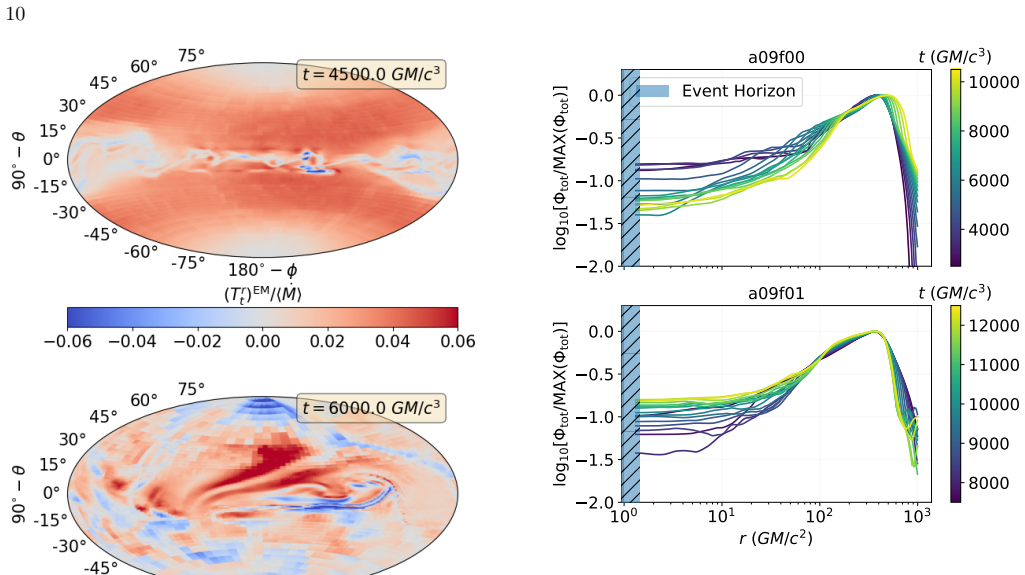
The control parameter is the fraction $f$ that scales the angular velocity of a Fishbone-Moncrief torus, which sets how much centrifugal support the plasma has as it approaches the black hole. The diagnostic that carries the argument is the dimensionless horizon magnetic flux $\phi_{\rm BH} = \Phi_{\rm BH}/(2\sqrt{\langle \dot{M}\rangle})$, whose saturation near 50 marks the magnetically arrested state and whose drop to $\lesssim 10$ tracks the death of the jet. The central mechanism is the competition between prompt free-fall of low-angular-momentum gas, which drags poloidal flux inward and over-saturates the horizon, and the buoyant, asymmetric expulsion of that flux in magnetized bubbles; in higher-angular-momentum flows, azimuthal velocity shear tears the bubbles apart and mixes their field back into the inflowing plasma, recycling the flux so that the arrested state can be sustained.
What would settle it
Perform a GRMHD run with $f = 0$ and $f = 0.1$ but replace the initial single-loop field with a large-scale vertical magnetic field spanning the domain (or with a flux loop anchored close to the horizon), and check whether $\phi_{\rm BH}$ remains at or above about 50 for more than a few thousand $GM/c^3$ and whether a jet persists; a configuration that sustains the arrested state at low $f$ would falsify the inference that low angular momentum itself prevents MAD maintenance.
Extended reading notes
Core claim
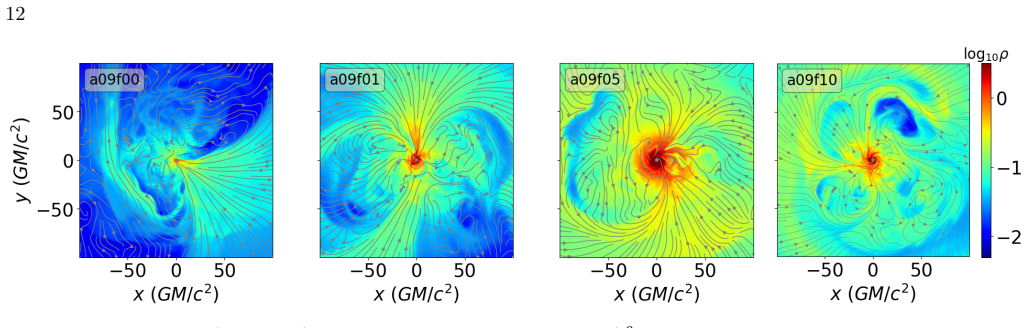
For a rapidly spinning black hole ($a = +0.9$), the dimensionless magnetic flux threading the event horizon, $\phi_{\rm BH}$, rises to the magnetically arrested value of about 50 and drives a jet with outflow efficiency $\eta$ near 100% when the initial torus has very low angular momentum, but this state is not maintained. In the $f = 0$ model the horizon flux drops to $\lesssim 10$ within a few thousand $GM/c^3$ because free-falling plasma penetrates the magnetic barrier, disorganizes the poloidal field, and the excess flux is carried away in gigantic, asymmetric, buoyant magnetic bubbles that show no tendency to return. In the $f = 0.1$ model the same processes run as a quasi-periodic cycle, with $\phi_{\rm BH}$ oscillating between $\lesssim 10$ and 50 and the jet being destroyed and revived in step. For $f \ge 0.3$ the flows retain enough centrifugal support that magnetic flux builds slowly and is recycled through azimuthal shear, and the jet-disk structure survives; the paper concludes that the angular momentum content of accreted plasma is an important parameter governing MAD maintenance and jet launching.
Load-bearing premise
The claim that angular momentum content controls the outcome rests on the assumption that the difference between the models is caused by the angular momentum itself, not by the specific initial magnetic field configuration, which is a single flux loop contained entirely inside the torus with a fixed strength ($C_B = 0.5$); if a different field geometry could keep flux on the horizon even when $f$ is small, the general conclusion would not follow.
Editorial extensions
If this is right
- If the claim is right, a rapidly spinning black hole supplied with zero-angular-momentum gas will not remain magnetically arrested: the MAD phase is inherently short-lived and the jet shuts off.
- The quasi-periodic $f = 0.1$ case predicts episodic jet activity, with the horizon gas outflow efficiency cycling between roughly 1% and 100% on timescales of thousands of $GM/c^3$.
- Low angular momentum breaks the ordered poloidal field needed for the Blandford-Znajek process, so even while mass continues to fall in, the electromagnetic energy extraction drops drastically.
- The difference between sustained and destroyed jets reduces to magnetic flux transport: inward flux transport revives the jet, outward transport through asymmetric bubbles kills it.
- For Sagittarius A*, the absence of a detected radio jet could be explained not only by slow spin or kink dissipation, but by the accreted gas carrying too little angular momentum to maintain a jet.
Reading between the lines
- A natural next test is to fix $f$ at 0 or 0.1 and vary the initial magnetic field geometry, for example placing a flux loop closer to the horizon or using a vertical field filling the domain; if some geometry sustains $\phi_{\rm BH}$ near 50 even at low $f$, then angular momentum alone is not the governing parameter, and the present result is specific to the single-loop configuration.
- The quasi-periodic oscillations in the $f = 0.1$ model resemble the flux eruption cycles seen in MAD simulations, but with a much larger amplitude and a clear asymmetry; comparing the period to the free-fall time of the outer torus could turn this into a scaling relation usable for interpreting quasi-periodic oscillations in low-luminosity active galactic nuclei.
- The paper's argument that shear recycles magnetic flux suggests a testable prediction: in a high-angular-momentum run with artificially suppressed azimuthal shear, flux should fail to return and the MAD state should be lost, mirroring the low-$f$ behavior.
Signed reviews
Editorial analysis
A structured set of objections, weighed in public.
Referee Report
Summary. The paper presents 3D GRMHD simulations of accretion onto a rapidly spinning black hole (a = +0.9), using a Fishbone-Moncrief torus whose initial angular velocity is scaled by a fraction f (0.0, 0.1, 0.3, 0.5, 0.7, 1.0). The torus is threaded with a single poloidal magnetic loop. For f = 0, the flow becomes magnetically arrested and launches a powerful jet for only a few thousand GM/c^3, after which free-falling plasma breaks through the magnetic barrier, destroys the jet-disk structure, and magnetic flux is lost via large asymmetric bubbles. For f = 0.1, the dimensionless horizon flux and jet efficiency oscillate quasi-periodically, with repeated jet destruction and revival. For f >= 0.3, the dynamics approaches that of a standard MAD accretion flow. The authors conclude that accreted plasma angular momentum is an important parameter governing the maintenance of MAD states and relativistic jet launching, and they discuss implications for Sagittarius A*.
Significance. If the result holds, it is an interesting and potentially important contribution: it identifies a possible resolution to the apparent paradox that Sgr A* has a dynamically important magnetic field but no observed relativistic jet, and it complements earlier work on low-angular-momentum accretion (e.g., Lalakos et al. 2024, Ressler et al. 2021, Galishnikova et al. 2024). The paper uses standard, externally benchmarked diagnostics (phi_BH, eta, the MAD criterion phi_BH ~ 50), the simulations are evolved in time rather than fitted, and the authors are explicit about several limitations. However, the scope of the claim is broader than the evidence: only one initial magnetic field geometry and strength are used, each f is represented by a single run with no convergence study, and the f < 1 initial conditions are out of equilibrium.
major comments (3)
- [Section 2.1 and Table 1] The design varies f by multiplying u_phi by a fraction of the standard FM value, so for f = 0.0, 0.1, and 0.3 the initial torus is not a dynamical-equilibrium solution; Table 1 itself lists no circularization radius for these models. The early-time high Mdot, prompt flux saturation, and subsequent asymmetric bubble ejection in a09f00 and a09f01 could therefore be a response to the initial force imbalance rather than a property of quasi-steady low-angular-momentum accretion. The central claim that angular momentum content 'governs' MAD maintenance needs either a control run that removes the transient (e.g., initializing with a quasi-equilibrium low-angular-momentum profile) or a clear quantitative argument that the transient does not set the late-time behavior.
- [Section 2.1 (Eq. 4) and Section 4] The initial magnetic field is a single poloidal loop fully contained in the torus with CB = 0.5 and volume-averaged beta ~30; this geometry and strength are held fixed while f varies. The Discussion states that the assertion 'should be quite general across different initial conditions' and also that the authors 'are unable to identify the primary governing parameters responsible for the observed differences.' These statements are in tension: without varying field geometry, field strength, or torus scale, the data do not exclude the possibility that the f-dependence is specific to this initial field/torus setup. A more limited conclusion, or targeted additional simulations, is required.
- [Section 3, Figures 2 and 3] Each f value is represented by a single simulation, and there is no resolution or convergence study. Given that the simulations use ideal GRMHD with numerical floors and ceilings (Eq. 5 and the sigma <= 100, beta >= 0.001 limits), quantitative statements such as the lifetime of the phi_BH ~ 50 plateau ('a few thousand GM/c^3') and the quasi-period of a09f01 should be treated as approximate; the authors should either provide convergence evidence or explicitly qualify the quantitative results.
minor comments (5)
- [Section 2.1] There is a typo on the line introducing Table 1: 'T able 1' should read 'Table 1'.
- [Section 3.2] The sentence 'the outflow velocity is lower compared to model models a09f05 and a09f10' contains a doubled word; it should read 'compared to models a09f05 and a09f10'.
- [Figure 6 caption] The caption contains the typo 'polodial'; it should be 'poloidal'.
- [Figure 9 caption] The caption contains the typo 'presnet'; it should be 'present'.
- [References] The entries White et al. 2019a and White et al. 2019b are identical (same journal, volume, page, and DOI); if two distinct papers are intended, the references need correction, otherwise one citation should be removed.
Circularity Check
No circularity: the claimed angular-momentum dependence emerges from GRMHD time evolution and standard external diagnostics, not from a fitted or self-referential derivation.
full rationale
The paper's central claim is that accreted angular momentum content governs the maintenance of the magnetically arrested state and relativistic jet launching. This claim is supported by direct numerical time evolution of the GRMHD equations, not by a derivation that assumes the conclusion. The independent variable f is a simulation control parameter, and the outcomes (phi_BH, eta, flow morphology, flux transport) are computed from the evolved state. There is no fitted parameter renamed as a prediction, and no quantity used in the analysis is defined in terms of the target conclusion. The MAD criterion phi_BH ~ 50 and the efficiencies eta and eta_EM^j are standard external benchmarks from Tchekhovskoy et al. (2011) and Narayan et al. (2012). Self-citations to Dhang et al. (2023, 2025) appear only for flux definitions, sign conventions, and diagnostic integrals; these are conventional and not load-bearing for the physical conclusion. The comparison to Lalakos et al. (2024) is an external benchmark, not a self-citation. The paper explicitly acknowledges a limitation in Section 4, stating that a limited parameter space was explored and that the authors 'are unable to identify the primary governing parameters responsible for the observed differences.' This is an honest caveat about controlled variables, not circularity: varying f changes both angular momentum content and the degree of initial force balance, and the single-loop field geometry is not varied independently. That confound is a correctness or robustness concern, but it does not make the result equivalent to its inputs by construction. The dynamical outcomes are not logically forced by the definition of f; they emerge from the nonlinear evolution. Therefore no circular step can be exhibited, and the appropriate score is 0.
Assumptions & free parameters
free parameters (4)
- f (initial angular velocity fraction) =
0.0, 0.1, 0.3, 0.5, 0.7, 1.0 (scanned, not fitted)
- CB (initial magnetic flux amplitude) =
0.5
- Magnetic field geometry parameters =
qp=0.5, qr=2.0, nr=n_theta=1, rB,min=8.5, rB,max=2000, thetaB,min=0.6
- Numerical floors and ceilings =
Pfloor=max(1e-6 r^-2.5, 1e-10), rho_floor=max(1e-4 r^-1.5, 1e-8), sigma<=100, Gamma<=50, beta>=0.001
assumptions (5)
- domain assumption Ideal GRMHD equations with no resistivity, viscosity, or radiative cooling describe the hot accretion flow.
- domain assumption Kerr metric with spin a=+0.9 and the Kerr-Schild coordinate setup are used throughout.
- domain assumption The Fishbone-Moncrief torus is an equilibrium solution for f=1, and scaling u_phi by f is a physically meaningful way to lower angular momentum.
- domain assumption A 'MAD state' and a 'relativistic jet' are identified through the empirical criteria phi_BH ~ 50 and eta ~ 100% from prior simulations.
- domain assumption The simulation duration of 20000 GM/c3 is sufficient to judge jet sustainability and to characterize oscillations as quasi-periodic.
Cite this review
Pith. "Pith review of The Impact of Plasma Angular Momentum on Magnetically Arrested Flows and Relativistic Jets in Hot Accretion Flows Around Black Holes." pith.science (2026). https://pith.science/paper/FWITGCOT
@misc{pith2026250415489,
  author       = {Pith},
  title        = {Pith review of: The Impact of Plasma Angular Momentum on Magnetically Arrested Flows and Relativistic Jets in Hot Accretion Flows Around Black Holes},
  year         = {2026},
  howpublished = {\url{https://pith.science/paper/FWITGCOT}},
  note         = {Machine review of arXiv:2504.15489}
}
abstract
In certain scenarios, the accreted angular momentum of plasma onto a black hole could be low; however, how the accretion dynamics depend on the angular momentum content of the plasma is still not fully understood. We present three-dimensional, general relativistic magnetohydrodynamic simulations of low angular momentum accretion flows around rapidly spinning black holes (with spin $a = +0.9$). The initial condition is a Fishbone-Moncrief (FM) torus threaded by a large amount of poloidal magnetic flux, where the angular velocity is a fraction $f$ of the standard value. For $f = 0$, the accretion flow becomes magnetically arrested and launches relativistic jets but only for a very short duration. After that, free-falling plasma breaks through the magnetic barrier, loading the jet with mass and destroying the jet-disk structure. Meanwhile, magnetic flux is lost via giant, asymmetrical magnetic bubbles that float away from the black hole. The accretion then exits the magnetically arrested state. For $f = 0.1$, the dimensionless magnetic flux threading the black hole oscillates quasi-periodically. The jet-disk structure shows concurrent revival and destruction while the gas outflow efficiency at the event horizon changes accordingly. For $f \geq 0.3$, we find that the dynamical behavior of the system starts to approach that of a standard accreting FM torus. Our results thus suggest that the accreted angular momentum is an important parameter that governs the maintenance of a magnetically arrested flow and launching of relativistic jets around black holes.
Figures


Figures from the paper (9 more)




Forward citations
Cited by 1 Pith paper
-
On regular black string spacetimes in nonlinear electrodynamics
No regular purely electric black strings exist in NED recovering the Maxwell limit, but regular cylindrical Bardeen and Hayward analogues are constructed with finite curvature.
Reference graph
Works this paper leans on
-
[1]
Begelman, M. C., Scepi, N., & Dexter, J. 2022, MNRAS, 511, 2040, doi: 10.1093/mnras/stab3790
-
[2]
Blandford, R. D., & Znajek, R. L. 1977, MNRAS, 179, 433, doi: 10.1093/mnras/179.3.433
-
[3]
2024, arXiv preprint arXiv:2408.04132
Chan, H.-S., & Chan, C.-k. 2024, arXiv preprint arXiv:2408.04132
arXiv 2024
-
[4]
2024, ApJ, 964, 17, doi: 10.3847/1538-4357/ad2454
Gammie, C. 2024, ApJ, 964, 17, doi: 10.3847/1538-4357/ad2454
-
[5]
2020, MNRAS, 497, 4999, doi: 10.1093/mnras/staa2288
Dexter, J., Tchekhovskoy, A., Jim´ enez-Rosales, A., et al. 2020, MNRAS, 497, 4999, doi: 10.1093/mnras/staa2288
-
[6]
Dhang, P., Bai, X.-N., & White, C. J. 2023, ApJ, 944, 182, doi: 10.3847/1538-4357/acb534
-
[7]
Dhang, P., Dexter, J., & Begelman, M. C. 2025, The Astrophysical Journal, 980, 203, doi: 10.3847/1538-4357/ada76e Event Horizon Telescope Collaboration, Akiyama, K.,
-
[8]
2022a, ApJL, 930, L16, doi: 10.3847/2041-8213/ac6672 —
Alberdi, A., et al. 2022a, ApJL, 930, L16, doi: 10.3847/2041-8213/ac6672 —. 2022b, ApJL, 930, L15, doi: 10.3847/2041-8213/ac6736 —. 2024, ApJL, 964, L26, doi: 10.3847/2041-8213/ad2df1 15
Show all 28 references
- [9]
-
[10]
2024, Strongly magnetized accretion with low angular momentum produces a weak jet
Galishnikova, A., Philippov, A., Quataert, E., Chatterjee, K., & Liska, M. 2024, Strongly magnetized accretion with low angular momentum produces a weak jet. https://arxiv.org/abs/2409.11486
2024 arXiv
-
[11]
V., & Narayan, R
Igumenshchev, I. V., & Narayan, R. 2002, ApJ, 566, 137, doi: 10.1086/338077
2002 doi
-
[12]
D., Akiyama, K., Baturin, R., et al
Johnson, M. D., Akiyama, K., Baturin, R., et al. 2024, in Society of Photo-Optical Instrumentation Engineers (SPIE) Conference Series, Vol. 13092, Space Telescopes and Instrumentation 2024: Optical, Infrared, and Millimeter Wave, ed. L. E. Coyle, S. Matsuura, & M. D. Perrin, 1...
2024 doi
-
[13]
M., Dai, L., & Tchekhovskoy, A
Kwan, T. M., Dai, L., & Tchekhovskoy, A. 2023, The Astrophysical Journal Letters, 946, L42, doi: 10.3847/2041-8213/acc334
2023 doi
-
[14]
2024, ApJ, 964, 79, doi: 10.3847/1538-4357/ad0974
Lalakos, A., Tchekhovskoy, A., Bromberg, O., et al. 2024, ApJ, 964, 79, doi: 10.3847/1538-4357/ad0974
2024 doi
-
[15]
J., & Ressler, S
Murchikova, L., White, C. J., & Ressler, S. M. 2022, ApJL, 932, L21, doi: 10.3847/2041-8213/ac75c3
2022 doi
-
[16]
2022, MNRAS, 511, 3795, doi: 10.1093/mnras/stac285
Curd, B. 2022, MNRAS, 511, 3795, doi: 10.1093/mnras/stac285
2022 doi
-
[17]
F., & Kulkarni, A
Narayan, R., Sadowski, A., Penna, R. F., & Kulkarni, A. K. 2012, MNRAS, 426, 3241, doi: 10.1111/j.1365-2966.2012.22002.x
2012
-
[18]
D., Green, S
Pang, B., Pen, U.-L., Matzner, C. D., Green, S. R., & Liebend¨ orfer, M. 2011, MNRAS, 415, 1228, doi: 10.1111/j.1365-2966.2011.18748.x
2011
-
[19]
D., & Wong, S
Pen, U.-L., Matzner, C. D., & Wong, S. 2003, ApJL, 596, L207, doi: 10.1086/379339
2003 doi
-
[20]
Porth, O., Mizuno, Y., Younsi, Z., & Fromm, C. M. 2021, MNRAS, 502, 2023, doi: 10.1093/mnras/stab163
2021 doi
-
[21]
Proga, D., & Begelman, M. C. 2003, ApJ, 592, 767, doi: 10.1086/375773
2003 doi
-
[22]
M., Quataert, E., & Stone, J
Ressler, S. M., Quataert, E., & Stone, J. M. 2018, MNRAS, 478, 3544, doi: 10.1093/mnras/sty1146 —. 2020, MNRAS, 492, 3272, doi: 10.1093/mnras/stz3605
2018 doi
-
[23]
M., Quataert, E., White, C
Ressler, S. M., Quataert, E., White, C. J., & Blaes, O. 2021, MNRAS, 504, 6076, doi: 10.1093/mnras/stab311
2021 doi
-
[24]
C., & Dexter, J
Scepi, N., Begelman, M. C., & Dexter, J. 2024, MNRAS, 527, 1424, doi: 10.1093/mnras/stad3299
2024 doi
-
[25]
M., Tomida, K., White, C
Stone, J. M., Tomida, K., White, C. J., & Felker, K. G. 2020, ApJS, 249, 4, doi: 10.3847/1538-4365/ab929b
2020 doi
-
[26]
Tchekhovskoy, A., Narayan, R., & McKinney, J. C. 2011, MNRAS, 418, L79, doi: 10.1111/j.1745-3933.2011.01147.x
2011
-
[27]
J., Stone, J
White, C. J., Stone, J. M., & Quataert, E. 2019a, ApJ, 874, 168, doi: 10.3847/1538-4357/ab0c0c —. 2019b, ApJ, 874, 168, doi: 10.3847/1538-4357/ab0c0c
-
[28]
S., & Colbert, E
Wilson, A. S., & Colbert, E. J. M. 1995, ApJ, 438, 62, doi: 10.1086/175054
1995 doi
Reviewed August 16, 2026 · model on record in the stance chip above.
Discussion (0). Continue with ORCID to comment.