REVIEW 5 major objections 5 minor 28 references
Mean Field Games of Control and Cryptocurrency Mining
T0 review · 5 major / 5 minor · reviewed 2026-08-16 · deepseek-v4-flash
Pith's one-line read This paper proves that mean field games of controlled jump intensity admit equilibria, obtained as limits of discrete-time games, and that the result yields existence for a cryptocurrency mining competition.
desk verdict Real contribution on discrete-time MFGs with control interaction, but Theorem 3.8 has an undefined discretization-scheme identification that should be fixed before the proof is accepted. read the letter →
The pith
A machine-rendered reading of the paper's core claim, the machinery that carries it, and where it could break.
The reading
What carries the argument
The argument runs on two machines. In discrete time, a set-valued operator is built from the Bellman optimality condition and the consistency, or Kolmogorov, condition, and a fixed-point theorem for set-valued maps supplies an equilibrium. In continuous time, the central object is the relaxed control, a random measure on the product of the action space and the time interval, together with the bilinear intensity formed by integrating the intensity kernel against the agent's relaxed control and the population's control measure. The proof interpolates discrete-time equilibria into cadlag processes, extracts weak limits via tightness, verifies that the limit has the correct stochastic intensity and satisfies the consistency condition, then proves optimality by a chattering lemma that approximates any relaxed control by piecewise-constant controls. Strict concavity of the intensity in the agent's control converts the relaxed equilibrium into one with sharp controls.
What would settle it
For a small case, such as a compact action space, intensity function equal to a divided by a plus ten times the background hash-rate, and linear terminal utility, compute the discrete-time equilibrium under Scheme 2. If running the resulting interpolated controls against the Scheme 1 parameter sequence given by point masses at the population control laws yields a different expected terminal reward than the Scheme 2 value function, the convergence proof's identification of the schemes is broken and the limit is not guaranteed to be a mean field game equilibrium.
Extended reading notes
Core claim
The central claim is Theorem 3.8: under continuity, compact support, Lipschitz intensity, and boundedness assumptions, the continuous-time mean field game of controlled jump intensity has an equilibrium in relaxed controls, and if the terminal utility is strictly increasing and the intensity is strictly concave in the agent's control, the equilibrium uses sharp, non-randomized controls. The proof obtains this equilibrium as a weak limit of discrete-time mean field equilibria arising from Bernoulli-chain discretizations, using tightness of relaxed controls and a chattering lemma to rule out any gain from randomization. Along the way, a general existence theorem for finite-horizon discrete-time mean field games is proved through a set-valued fixed-point argument whose fixed points are exactly mean field equilibria. The same machinery yields existence for the cryptocurrency mining model motivating the paper, including the singular limit where the regularizing parameter is removed.
Load-bearing premise
The proof assumes that a discrete-time equilibrium stated in terms of population control distributions can be repackaged as a sequence of point-mass parameters in the intensity function without losing optimality of the resampled controls, but the paper never defines the insertion rule.
Editorial extensions
If this is right
- Continuous-time mean field games of controlled jump intensity can be solved by computing discrete-time mean field equilibria directly, without solving coupled Hamilton-Jacobi-Bellman and Kolmogorov equations.
- The cryptocurrency mining mean field game, previously treated numerically, now carries an existence guarantee in both its regularized and singular forms.
- When the intensity is strictly concave in the agent's control and terminal utility is strictly increasing, randomized controls are unnecessary: some deterministic, sharp equilibrium exists.
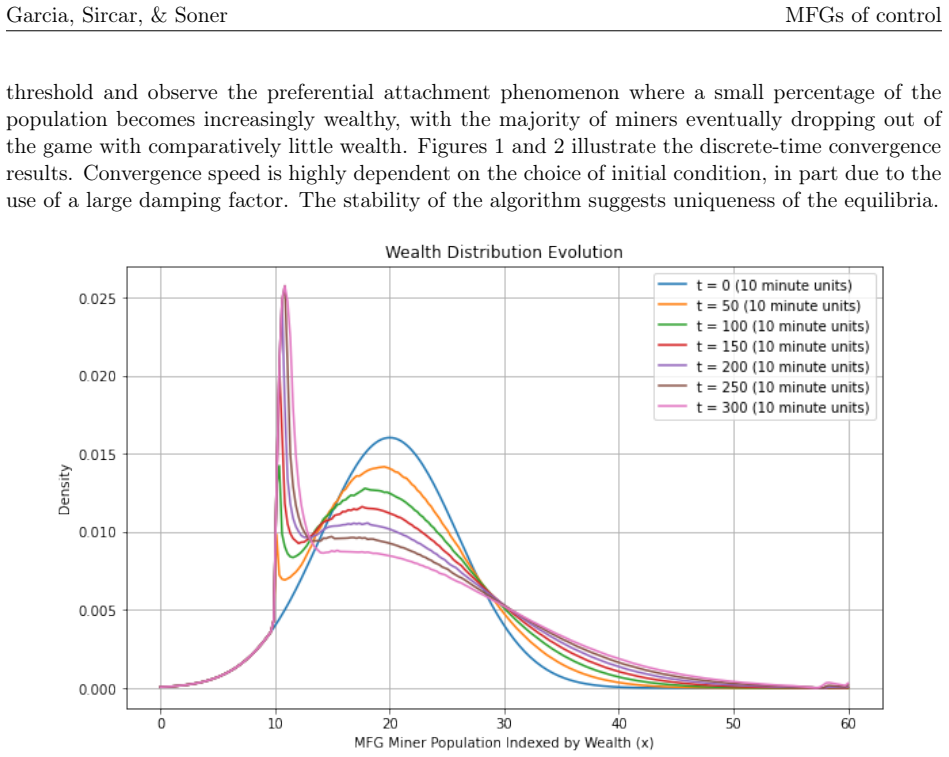
- The discrete-time algorithm reproduces the qualitative equilibrium behavior, including wealth-dependent dropout and preferential attachment, seen in the PDE-based numerical solutions.
Reading between the lines
- The proof's identification of Scheme 2 equilibria with Scheme 1 parameters is only as strong as an implicit rule for inserting a population control measure into the intensity function; making that rule explicit would let the continuity of equilibria in the population law be checked directly.
- The same interpolation-compactness route should extend to state-dependent drift and intensity, since the chattering lemma and tightness criteria do not use state-independence except to simplify the dynamics; testing the method on a jump-diffusion with state-dependent coefficients would delimit the true boundary.
- If the equilibrium hash-rate stays bounded away from zero uniformly, as the paper suggests, the uniqueness argument sketched near the end could be completed by verifying that the best-response map is a contraction in the sup norm; numerical continuation in the damping factor could expose any non-uniqueness.
Signed reviews
Editorial analysis
A structured set of objections, weighed in public.
Referee Report
Summary. This paper develops existence theory for mean field games of control with jump-process dynamics and mean-field interaction through the controls. Section 2 formulates a finite-horizon discrete-time MFG with Polish state/action/control spaces and transition kernels depending on the joint law of controls and states, and states a Kakutani-based existence theorem (Theorem 2.4). Section 3 introduces a continuous-time model in which agents control the intensity of a unit-jump process, with the jump intensity depending on the agent's control and on a flow of population control measures; the main result (Theorem 3.8) claims existence of a relaxed MFG equilibrium as the limit of discrete-time MFG equilibria, with sharpness under concavity. Section 4 applies these results to a cryptocurrency mining model: existence is claimed for the discrete-time and continuous-time versions, including a zero-epsilon limit, and a damped fixed-point algorithm is implemented, reproducing qualitative features of [23]. The paper's central contribution is Theorem 3.8 and its consequences for the cryptocurrency model.
Significance. If the gaps identified below are closed, the paper would establish a general existence result for a class of MFGs of controlled jump intensity with mean-field interaction via controls, a setting for which the authors state no general existence result is available. The discrete-to-continuous convergence result would also provide a rigorous justification for solving continuous-time MFGs by discrete-time algorithms, and the cryptocurrency application gives a concrete, economically motivated testbed with qualitative agreement with existing PDE-based numerics. The paper's use of relaxed controls and its explicit statements of assumptions are appropriate strengths. However, the significance is currently conditional: the central proof contains an undefined identification between the two discretization schemes, and several technical steps are asserted rather than proved.
major comments (5)
- [Section 3.2, Definition 3.6 and Theorem 3.8, Step 1] The paper never defines λ(a,η) when the second argument is a probability measure, although Scheme 2 uses λ(a^{(n)}_k, η^{(n)}_k) with η^{(n)}_k ∈ P(U). The proof then sets the Scheme 1 parameter sequence to η^{(n)}_k := δ_{ζ^{(n)}_k}, where ζ^{(n)}_k ∈ P(U); δ_{ζ^{(n)}_k} belongs to P(P(U)), not P(U), so the interpolated flow η^{(n)}_t is not a measure flow on U and the consistency condition E[m_t]=η_t in Definition 3.5 is not well-typed. In addition, the equilibrium control a^{(n)}_k is optimal in Scheme 2 for the flow ζ^{(n)}, not in Scheme 1 for the flow δ_{ζ^{(n)}}; Step 4's contradiction relies on this transfer of optimality. The proof must either define λ(a,η)=∫λ(a,h)η(dh) and replace δ_{ζ^{(n)}_k} by ζ^{(n)}_k, or provide a separate argument establishing that the two schemes describe the same control problem.
- [Section 2.4, proof of Theorem 2.4] The proof concludes with 'We omit the remaining details here' for the compactness of Ξ and the closedness of the graph of Γ, referring to [27, Propositions 3.9 and 3.10]. Since the present model allows mean-field interaction through the controls and uses weaker growth assumptions than [27], the reduction is not automatic; these are exactly the properties needed for the Kakutani–Fan–Glicksberg fixed-point theorem. Because Theorem 2.4 is the foundation for Step 1 of Theorem 3.8 and for the discrete-time cryptocurrency model, these details must be supplied rather than deferred.
- [Section 3.2, Step 2 of Theorem 3.8] The verification that the limiting jump process N has the stated stochastic intensity is incomplete. The displayed computation conditions on the limit σ-field F_s, but the discrete-time martingale property is with respect to F^{(n)}_s, and the assertion that the limit 'can be seen to equal zero from the construction' is not a proof. The paper should provide a standard martingale-problem convergence argument, for example by establishing uniform integrability and the Aldous–Robin condition, before concluding that (X,m,N) satisfies the dynamics of Definition 3.2.
- [Section 3.2, Lemma 3.10 (Chattering Lemma)] The proof asserts that the delayed block construction satisfies L(m^{ρ,∆})=L(m) 'by construction', but the randomization from the previous block is used in the current block, so the laws are not identical; no quantitative estimate on |W(t,x,m)-W(t,x,u^γ_m)| is given. Since Step 4 uses this lemma to produce a piecewise constant control that strictly outperforms the putative limit control m, the optimality assertion of Theorem 3.8 depends on this gap.
- [Section 4, equations (4.1)–(4.2) and Propositions 4.2–4.6] The intensity map λ^{(ϵ)} is defined on U×U, but it is evaluated at ζ^{(n,ϵ)}_k ∈ P([0,L]) in (4.2), and Proposition 4.2 treats η_k as a scalar first moment (writing η_k = 0 and comparing intensities via Jensen's inequality). The paper never states the convention λ(a,η)=∫λ(a,h)η(dh) nor distinguishes between the measure flow and its first moment. This ambiguity affects the verification of Assumption 3.7 and the limiting arguments in Propositions 4.3–4.6, so the cryptocurrency existence claims are not rigorously grounded as written.
minor comments (5)
- [Definition 3.5] The optimality clause compares the tuple with 'any other tuple' whose flow η may differ; the proofs compare controls only under a fixed η. The definition should explicitly restrict the comparison to tuples with the same flow.
- [Definition 3.5] The phrase 'for almost every ω∈F' should be 'for P-almost every ω'.
- [Assumption 2.3(vi)] The displayed assumption contains '∀∈X' instead of 'for all x∈X'.
- [Section 3.2, Lemma 3.11] Lemma 3.11 is not used in the final proof of Theorem 3.8, and its proof only shows convergence of the objective for a fixed control, not the claimed convergence of the value function; either add a uniformity argument or remove the lemma.
- [Section 4.4] The statement that uniqueness of the discrete-time equilibrium 'allows one to conclude' sharpness of the continuous-time equilibrium is not justified; at most it is consistent with sharpness, not a proof.
Circularity Check
No significant circularity; the existence theorems are derived from fixed-point, compactness, and weak-convergence arguments rather than from their conclusions.
full rationale
The paper's central derivation is self-contained in the relevant sense. Theorem 2.4 establishes discrete-time MFG existence via Kakutani-Fan-Glicksberg with the Bellman operator and continuity-compactness arguments; the fixed-point equation is not assumed to be the equilibrium. Theorem 3.8 obtains continuous-time existence by taking weak limits of discrete-time equilibria and proving optimality of the limit by contradiction through the chattering lemma and approximation lemmas; no fitted parameter is relabeled as a prediction. The only self-citation, [23] (Sircar is a coauthor), supplies the motivating cryptocurrency model and a qualitative numerical comparison, but no theorem in this paper uses [23]'s existence or uniqueness results as a premise. Two non-circular weaknesses should be noted: in Section 2.4 the paper says 'We omit the remaining details here' and refers to [27] for compactness, and in Section 3.2 Step 1 the identification eta(n)_k := delta{zeta(n)_k} is type-inconsistent with Definition 3.6's requirement that the parameterizing sequence lie in P(U); this is a correctness gap in the proof of Theorem 3.8, not a reduction of the conclusion to its inputs. The paper also explicitly leaves uniqueness and sharpness conditions for future work in Section 4.4, which is a limitation statement rather than a circular move. Therefore no pattern of self-definitional, fitted-input, or self-citation-load-bearing circularity is exhibited.
Assumptions & free parameters
free parameters (1)
- damping factor =
0.9
assumptions (7)
- standard math Kakutani-Fan-Glicksberg fixed point theorem
- standard math Bellman operator preserves continuity for continuous transition kernels on compact action spaces
- standard math Prokhorov tightness and Skorokhod representation for D[0,T] and relaxed control spaces
- standard math Watanabe martingale characterization of doubly stochastic Poisson processes
- domain assumption Assumption 2.3 structural conditions: A compact, X locally compact, weak continuity and growth conditions on the transition kernel and costs
- domain assumption Assumption 3.7: compact action interval U, compactly supported initial law, continuous bounded terminal reward phi, Lipschitz and concavity conditions on lambda
- domain assumption Assumption 4.1: phi is non-decreasing and the initial wealth distribution is not supported on the maximizers of phi
Cite this review
Pith. "Pith review of Mean Field Games of Control and Cryptocurrency Mining." pith.science (2026). https://pith.science/paper/6I3YUWGG
@misc{pith2026250415526,
  author       = {Pith},
  title        = {Pith review of: Mean Field Games of Control and Cryptocurrency Mining},
  year         = {2026},
  howpublished = {\url{https://pith.science/paper/6I3YUWGG}},
  note         = {Machine review of arXiv:2504.15526}
}
read the original abstract
This paper studies Mean Field Games (MFGs) in which agent dynamics are given by jump processes of controlled intensity, with mean-field interaction via the controls and affecting the jump intensities. We establish the existence of MFG equilibria in a general discrete-time setting, and prove a limit theorem as the time discretization goes to zero, establishing equilibria in the continuous-time setting for a class of MFGs of intensity control. This motivates numerical schemes that involve directly solving discrete-time games as opposed to coupled Hamilton-Jacobi-Bellman and Kolmogorov equations. As an example of the general theory, we consider cryptocurrency mining competition, modeled as an MFG both in continuous and discrete time, and illustrate the effectiveness of the discrete-time algorithm to solve it.
Figures

Reference graph
Works this paper leans on
- [27]
-
[23]
Z. Li, A. M. Reppen, and R. Sircar. A mean field games model for cryptocurrency mining. Management Science, 70:2188–2208, 2024
work page 2024
-
[1]
S. Adlakha, R. Johari, and G. Y. Weintraub. Equilibria of dynamic games with many players: Existence, approximation, and market structure.Journal of Economic Theory, 156:269–316, 2015
work page 2015
-
[2]
C. D. Aliprantis and K. C. Border.Infinite dimensional analysis: a hitchhiker’s guide. Springer Science & Business Media, 2006
2006
-
[3]
E. Bayraktar and A. Cohen. Analysis of a finite state many player game using its master equation. SIAM Journal on Control and Optimization, 56(5):3538–3568, 2018. 24 Garcia, Sircar, & Soner MFGs of control
work page 2018
-
[4]
C. Benazzoli, L. Campi, and L. Di Persio. Mean field games with controlled jump–diffusion dynamics: Existence results and an illiquid interbank market model.Stochastic Processes and their Applications, 130(11):6927–6964, 2020
work page 2020
-
[5]
D. Bertsekas and S. E. Shreve.Stochastic optimal control: the discrete-time case, volume 5. Athena Scientific, 1996
work page 1996
-
[6]
C. Bertucci, L. Bertucci, J.-M. Lasry, and P.-L. Lions. A mean field game approach to bitcoin mining. SIAM Journal on Financial Mathematics, 15(3):960–987, 2024
work page 2024
Show all 28 references
-
[7]
A. Biswas. Mean field games with ergodic cost for discrete time Markov processes. arXiv preprint arXiv:1510.08968, 2015
2015 arXiv
-
[8]
Brémaud.Point processes and queues
P. Brémaud.Point processes and queues. Springer, 1981
1981
-
[9]
Carmona, F
R. Carmona, F. Delarue, et al.Probabilistic theory of mean field games with applications I-II. Springer, 2018
2018
-
[10]
M. F. Djete. Mean field games of controls: on the convergence of Nash equilibria.The Annals of Applied Probability, 33(4):2824–2862, 2023
2023
-
[11]
S. N. Ethier and T. G. Kurtz.Markov processes: characterization and convergence. John Wiley & Sons, 2009
2009
-
[12]
L. C. Florescu and C. Godet-Thobie.Young measures and compactness in measure spaces. de Gruyter Berlin, 2012
2012
-
[13]
D. A. Gomes, J. Mohr, and R. R. Souza. Discrete time, finite state space mean field games. Journal de mathématiques pures et appliquées, 93(3):308–328, 2010
2010
-
[14]
D. A. Gomes et al. Continuous time finite state mean field games.Applied Mathematics & Optimization, 68(1):99–143, 2013
2013
-
[15]
Hinderer
K. Hinderer. Foundations of Non-stationary Dynamic Programming with Discrete Time Pa- rameter. Springer-Verlag, 1970
1970
-
[16]
Huang, R
M. Huang, R. P. Malhamé, and P. E. Caines. Large population stochastic dynamic games: closed-loop Mckean-Vlasov systems and the Nash certainty equivalence principle.Communi- cations in Informations and Systems, 6(3):221–251, 2006
2006
-
[17]
Jovanovic and R
B. Jovanovic and R. W. Rosenthal. Anonymous sequential games.Journal of Mathematical Economics, 17(1):77–87, 1988
1988
-
[18]
Kushner.Weak convergence methods and singularly perturbed stochastic control and filtering problems
H. Kushner.Weak convergence methods and singularly perturbed stochastic control and filtering problems. Springer Science & Business Media, 2012
2012
-
[19]
H. J. Kushner and P. G. Dupuis.Numerical methods for stochastic control problems in contin- uous time, volume 24. Springer Science & Business Media, 2001
2001
-
[20]
D. Lacker. Mean field games via controlled martingale problems: existence of Markovian equilibria. Stochastic Processes and their Applications, 125(7):2856–2894, 2015
2015
-
[21]
Lasry and P.-L
J.-M. Lasry and P.-L. Lions. Mean field games.Japanese journal of mathematics, 2(1):229–260, 2007. 25 Garcia, Sircar, & Soner MFGs of control
2007
-
[22]
J. Levin. Supermodular games.Lectures Notes, Department of Economics, Stanford University, 2003
2003
-
[24]
Moon and T
J. Moon and T. Başar. Discrete-time decentralized control using the risk-sensitive performance criterion in the large population regime: a mean field approach. In2015 American Control Conference (ACC), pages 4779–4784. IEEE, 2015
2015
-
[25]
Y.-H. Ni, R. Elliott, and X. Li. Discrete-time mean-field stochastic linear–quadratic optimal control problems, ii: Infinite horizon case.Automatica, 57:65–77, 2015
2015
-
[26]
Nourian and G
M. Nourian and G. N. Nair. Linear-quadratic-gaussian mean field games under high rate quantization. In 52nd IEEE Conference on Decision and Control, pages 1898–1903. IEEE, 2013
1903
-
[28]
Taghizadeh, H
A. Taghizadeh, H. Kebriaei, and D. Niyato. Mean field game for equilibrium analysis of mining computational power in blockchains.IEEE Internet of Things Journal, 7(8):7625–7635, 2020. 26
2020
Reviewed August 16, 2026 · model on record in the stance chip above.
Discussion (0). Continue with ORCID to comment.