REVIEW 6 major objections 7 minor 45 references
HS-Mamba: Full-Field Interaction Multi-Groups Mamba for Hyperspectral Image Classification
T0 review · 6 major / 7 minor · reviewed 2026-08-16 · deepseek-v4-flash
Pith's one-line read HS-Mamba fuses local patches with whole-image attention and reports state-of-the-art accuracy on four hyperspectral benchmarks.
desk verdict Solid incremental architecture with a serious data-count inconsistency on the HanChuan benchmark that must be fixed before the SOTA numbers are credible. read the letter →
The pith
A machine-rendered reading of the paper's core claim, the machinery that carries it, and where it could break.
The reading
What carries the argument
The central object is the HS-Mamba block, composed of a DCSS-Encoder and a LGI-Att branch. The DCSS-Encoder flattens non-overlapping patches into spatial-priority and spectral-priority 1D sequences, splits them into groups, processes each group with a parallel S6 (selective state-space) block, and adaptively combines the groups with learned weights and an adaptive concatenation, adding cosine positional encoding to retain location. The LGI-Att branch applies a compressed attention on the spectral dimension and a dilated-convolution extended attention on the spatial dimension of the whole image. A gated fusion layer then weights the two branches.
What would settle it
Run HS-Mamba's DCSS-Encoder with the same hyperparameters but with bidirectional or four-way (cross-scan) scanning on Indian Pines, using the same 30-train/10-validation split; if the multi-directional version's mean OA exceeds 94.65% or closes the gap to MambaHSI by more than the reported margin, the claim that unidirectional scanning is the best choice would be refuted.
Extended reading notes
Core claim
This paper establishes that a Mamba network can achieve the best published classification accuracy on four hyperspectral image benchmarks by fusing dual-domain local features and global attention. The framework, HS-Mamba, uses a dual-channel spatial-spectral encoder (DCSS-Encoder) to model non-overlapping patches with multi-group Mamba blocks and cosine positional encoding, and a lightweight global inline attention (LGI-Att) branch to capture whole-image spectral and spatial context. Gated fusion combines the two streams. Against eight state-of-the-art baselines, HS-Mamba reports OA/AA/Kappa of 94.65/96.86/93.87 on Indian Pines, 96.43/97.14/95.29 on Pavia University, 96.64/96.13/95.72 on HanChuan, and 96.10/96.00/95.08 on HongHu, surpassing the second-best MambaHSI on all four.
Load-bearing premise
The design assumes that reading each local feature sequence in a single fixed direction is sufficient; no experiment in the paper compares this against bidirectional or multi-directional scanning, so if direction order discards important spectral-spatial correlations, the reported accuracy would drop.
Editorial extensions
If this is right
- On the four tested benchmarks, fusing local patch modelling with whole-image global attention beats both pure pixel-patch and pure whole-image strategies, as HS-Mamba outscores MambaHSI, a whole-image approach, and all pixel-patch baselines.
- The reported efficiency numbers, about 52% faster inference and 26% lower FLOPs than MambaHSI on medium-high resolution datasets, imply the full-field strategy is usable on large HSI scenes without GPU-memory overflow.
- The ablation results indicate that gated fusion, rather than sum, adaptive sum, or concatenation, is the most robust way to combine the two branches across datasets.
- Positional encoding contributes 2% to 7% OA across datasets, so explicit location information is load-bearing for non-overlapping patch scanning.
- The design suggests a general template: local fine-grained sequence modeling plus lightweight global attention, which could extend to other dense prediction tasks.
- The multi-group Mamba composition with adaptive concatenation preserves long-range dependency modelling at linear complexity, a direct consequence of the S6 design.
Reading between the lines
- The unidirectional scanning decision in Section IV-B1 is not backed by a controlled comparison against bidirectional or four-way scanning, so the reported gains may depend partly on that choice; a test swapping the scanning direction could separate the contribution.
- The largest margins appear on the wide-resolution HanChuan dataset (+3.86% OA), hinting that the fusion is most valuable where local detail and global layout both matter; this could be tested on other high-resolution remote sensing images.
- Since the method's efficiency claims rely on a fixed train/validation split and specific GPU, reproducing the FLOPs and inference comparisons on other hardware and splits would test the practicality.
Signed reviews
Editorial analysis
A structured set of objections, weighed in public.
Referee Report
Summary. The paper proposes HS-Mamba, a hyperspectral image classification architecture that combines a dual-channel spatial-spectral encoder (DCSS-Encoder) processing non-overlapping patches with multi-group Mamba blocks and a lightweight global inline attention (LGI-Att) branch processing the full image. The two branches are fused with a learned gated fusion and a three-stage hierarchical up/down-sampling scheme. The authors evaluate on Indian Pines, Pavia University, WHU-Hi-HanChuan, and WHU-Hi-HongHu, reporting OA/AA/Kappa over 10 runs against eight prior methods, and claim state-of-the-art results with margins over MambaHSI of 0.96-3.86% OA. Ablations examine dual-domain design, positional encoding, the LGI-Att branch, fusion strategy, patch size, and number of Mamba groups.
Significance. The local/global fusion idea is a sensible middle ground between pixel-patch and whole-image strategies, and the multi-group Mamba design with grouped adaptive weighting is interesting. Strengths include the 10-run mean±std protocol, ablation coverage of the main components, and comparison against eight baselines on four standard datasets. If the SOTA margins survive a correctly specified split and statistical testing, HS-Mamba would be a competitive contribution to Mamba-based HSI classification. The main claims as stated are not fully supported by the manuscript's own data: the dataset-size contradictions and the contradicted efficiency claim prevent the paper from being accepted in current form.
major comments (6)
- [V-A3, V-A4, Table I] Section V-A3 states that WHU-Hi-HanChuan includes 123,797 annotated samples, but Table I sums to 480 train + 160 val + 256,890 test = 257,530, disagreeing by more than a factor of two. Section V-A4 states that WHU-Hi-HongHu has approximately 120,000 labeled samples, but Table I sums to 660 + 220 + 385,813 = 386,693. Since Tables IV and V report the headline SOTA results on these two datasets, the authors must state which numbers are correct and confirm that the train/val/test splits are exactly derived from the public ground truth; as written, the test sets on HC and HH exceed the label budgets described in the prose.
- [V-F, Table X] The claimed computational superiority in Section V-F is contradicted by Table X. The text says HS-Mamba achieves '52% faster inference and 26% lower FLOPs than MambaHSI on medium-high resolution datasets,' but the reported inference times are 0.11 vs 0.03 s (IP), 0.50 vs 0.35 s (PU), 0.85 vs 0.65 s (HC), and only 0.65 vs 0.77 s on HH. Thus HS-Mamba is slower than MambaHSI on three of four datasets, and the efficiency conclusion in Section VI ('maintaining high computational efficiency') is not supported by the paper's own table.
- [V-C, Tables II-V] No significance testing is reported for the SOTA margins. Several claimed improvements are smaller than the reported standard deviations: on PU, HS-Mamba OA is 96.43±1.35 versus MambaHSI 95.47±0.84 (Table III), and on IP the OA margin is 1.8 points with stds of 0.91 and 0.81 (Table II). Without paired significance tests or confidence intervals, the claim of 'best performance' is not statistically established for the smaller margins, and the qualitative statement in Section V-C should be qualified accordingly.
- [V-E, V-B3] The hyperparameter analysis in Section V-E selects patch size and the number of Mamba groups per dataset (e.g., groups = 16 for IP, PU, HC and 8 for HH), but the paper does not state whether these curves were computed on the validation or test set, and Section V-B3 lists neither the default patch size nor the final M/N values used to produce Tables II-V. If the test set was used for model selection, the reported results are not held-out and the SOTA margins are inflated; the authors must state the selection procedure and the final hyperparameter values for full reproducibility.
- [IV-B1, V-D] Section IV-B1 asserts that 'the unidirectional scanning strategy becomes the best choice' for HSI sequences and justifies it by citing redundancy and computational inefficiency of multi-directional scanning, but the ablation study in Section V-D contains no comparison of unidirectional against bidirectional or multi-directional scanning within the DCSS-Encoder. Since every local feature in the encoder is read in a single direction, this unvalidated premise is load-bearing: either add a controlled scanning-direction ablation or state the claim as an assumption rather than a finding.
- [V-B3, Table I] The split protocol stated in Section V-B3 ('30 pixel samples are allocated for training, 10 for validation, and the remaining for testing') is not followed for the small classes in Table I: Indian Pines class 7 has 15 train + 5 val + 8 test = 28 samples, and class 9 has 10 + 5 + 5 = 20 samples. The manuscript must specify the actual rule for classes with fewer than 40 labeled pixels; otherwise the experimental setup is not reproducible.
minor comments (7)
- [IV-B1, Eqs. (7)-(8)] The mathematical notation is incomplete: L is introduced as the patch count, then reused as sequence length; the split operations in Eq. (8) use U and V without definition, and the sequence shapes in Eq. (7) do not match the later grouping dimensions. Please provide precise tensor shapes for the scanning and splitting steps.
- [Fig. 9] The axis labels in Figure 9 are corrupted by glyph-escape text ('/uni0000001a/uni0000001c/...'), making the patch-size and group-count curves unreadable; the figure must be regenerated with normal text labels.
- [Tables VI and VIII] The same configuration (DCSS-Encoder without LGI-Attention) is reported with HC OA 95.93 in Table VI and 95.73 in Table VIII; please reconcile these numbers or state the differences in configuration.
- [V-D3] The claim that LGI-Attention reduces standard deviations by approximately 0.3% is not supported by Table VIII for HC, where the std increases from 0.74 to 0.79; the summary sentence should be revised.
- [V-F] The sentence 'pixel-patch methods achieve 36% faster training times' is not derived from Table X and is too vague; give the calculation or remove the statistic.
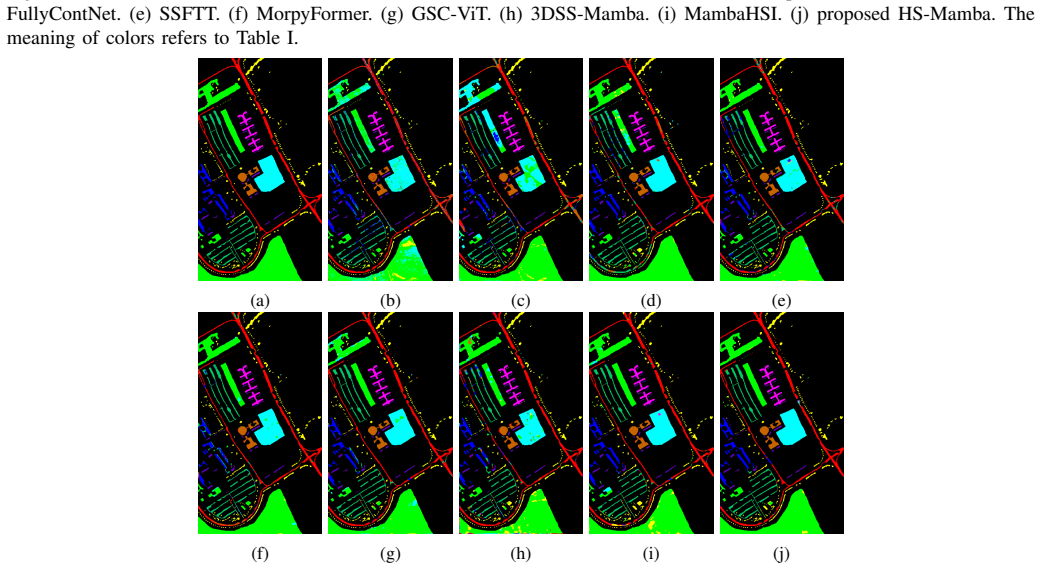
- [Abstract and figure captions] There are several typos: 'an full-field' in the abstract, 'MorpyFormer' in Figure 5 caption, and the incomplete sentence 'The division details for training, validation and test sets are provided in.' in Section V-A.
- [Table I] The header 'Abbreviated Category Colors, Names and Sample Numbers' mentions colors, but the table lists names and numbers only; clarify or remove 'Colors'.
Circularity Check
No circular derivation: the SOTA claims are measured against external ground truth, and no equation or fitted parameter is re-presented as a prediction.
full rationale
The paper is an empirical architecture study: HS-Mamba's reported OA/AA/Kappa values in Tables II-V are obtained by running a fixed model on public benchmark labels, not by substituting the model's assumptions back into the derivation. The DCSS-Encoder equations (Eqs. 4-11) define a processing pipeline from HSI cube to prediction; none defines an input in terms of the target accuracy, and no fitted constant is renamed as a prediction. The only external citations are standard Mamba/S4 references and baseline methods, and there is no same-author uniqueness theorem or self-citation chain forcing the architecture choice. Two concerns are noted but they are not circularity. First, Section V-A3 states WHU-Hi-HanChuan 'includes 123797 annotated samples' while Table I sums to 480+160+256,890 = 257,530, and Section V-A4 states HongHu has 'approximately 120,000 labeled samples' while Table I sums to 660+220+385,813 = 386,693; this internal contradiction makes the HC and HH rows of Tables IV-V irreproducible from the described data, a serious correctness issue that does not, however, make the accuracy numbers equivalent to the model's inputs. Second, Section IV-B1 asserts 'the unidirectional scanning strategy becomes the best choice' with no controlled comparison against multi-directional scanning, and Section V-E selects patch sizes and group counts per dataset from accuracy curves; these are experimental-validity limitations (possible overfitting to test sets), not definitional circularity, because the final numbers are still measured against fixed ground-truth maps.
Assumptions & free parameters
free parameters (6)
- patch_size P =
9 for IP/PU/HC, 11 for HH (chosen by test-set peak); default not stated
- number of Mamba groups M/N =
16 for IP/PU/HC, 8 for HH (chosen by test-set peak); default not stated
- embedding dimension D =
128
- attention reduction ratio tau =
4
- dilation rate for spa-extended attention =
2
- group norm groups =
8
assumptions (4)
- domain assumption The S6 selective state-space model from Mamba [21] can be applied directly to 1D-flattened HSI sequences with inherited default parameters.
- ad hoc to paper Unidirectional scanning is sufficient and superior to multi-directional scanning for HSI classification.
- domain assumption The four benchmark datasets provide reliable ground truth and the fixed 30/10 train/test split protocol yields comparable results.
- domain assumption The lightweight attention branch (pooling plus dilated convolution) adequately represents global context without full self-attention.
Cite this review
Pith. "Pith review of HS-Mamba: Full-Field Interaction Multi-Groups Mamba for Hyperspectral Image Classification." pith.science (2026). https://pith.science/paper/FUONPBFP
@misc{pith2026250415612,
  author       = {Pith},
  title        = {Pith review of: HS-Mamba: Full-Field Interaction Multi-Groups Mamba for Hyperspectral Image Classification},
  year         = {2026},
  howpublished = {\url{https://pith.science/paper/FUONPBFP}},
  note         = {Machine review of arXiv:2504.15612}
}
read the original abstract
Hyperspectral image (HSI) classification has been one of the hot topics in remote sensing fields. Recently, the Mamba architecture based on selective state-space models (S6) has demonstrated great advantages in long sequence modeling. However, the unique properties of hyperspectral data, such as high dimensionality and feature inlining, pose challenges to the application of Mamba to HSI classification. To compensate for these shortcomings, we propose an full-field interaction multi-groups Mamba framework (HS-Mamba), which adopts a strategy different from pixel-patch based or whole-image based, but combines the advantages of both. The patches cut from the whole image are sent to multi-groups Mamba, combined with positional information to perceive local inline features in the spatial and spectral domains, and the whole image is sent to a lightweight attention module to enhance the global feature representation ability. Specifically, HS-Mamba consists of a dual-channel spatial-spectral encoder (DCSS-encoder) module and a lightweight global inline attention (LGI-Att) branch. The DCSS-encoder module uses multiple groups of Mamba to decouple and model the local features of dual-channel sequences with non-overlapping patches. The LGI-Att branch uses a lightweight compressed and extended attention module to perceive the global features of the spatial and spectral domains of the unsegmented whole image. By fusing local and global features, high-precision classification of hyperspectral images is achieved. Extensive experiments demonstrate the superiority of the proposed HS-Mamba, outperforming state-of-the-art methods on four benchmark HSI datasets.
Figures


Figures from the paper (6 more)




Reference graph
Works this paper leans on
-
[1]
Hyperspectral image data analysis
D. Landgrebe. “Hyperspectral image data analysis”. In: IEEE Signal Processing Magazine 19.1 (2002), pp. 17– 28
work page 2002
-
[2]
Runyu Fan et al. “Fine-Scale Urban Informal Settle- ments Mapping by Fusing Remote Sensing Images and Building Data via a Transformer-Based Multimodal Fusion Network”. In: IEEE Transactions on Geoscience and Remote Sensing 60 (2022), pp. 1–16
work page 2022
-
[3]
Sima Peyghambari and Yun Zhang. “Hyperspectral re- mote sensing in lithological mapping, mineral explo- ration, and environmental geology: an updated review”. In: Journal of Applied Remote Sensing 3 (2021), p. 15
work page 2021
-
[4]
NCGLF2: Network combining global and local features for fusion of multisource remote sensing data
Bing Tu et al. “NCGLF2: Network combining global and local features for fusion of multisource remote sensing data”. In: Information Fusion 104 (2024), p. 17
work page 2024
-
[5]
Advanced Spectral Classifiers for Hyperspectral Images: A review
Pedram Ghamisi et al. “Advanced Spectral Classifiers for Hyperspectral Images: A review”. In: IEEE Geo- science and Remote Sensing Magazine (2017)
work page 2017
-
[6]
Classification of hy- perspectral remote sensing images with support vector machines
F. Melgani and L. Bruzzone. “Classification of hy- perspectral remote sensing images with support vector machines”. In: IEEE Transactions on Geoscience and Remote Sensing 42.8 (2004), pp. 1778–1790
work page 2004
-
[7]
Zhi Liu et al. “Class-Specific Random Forest With Cross-Correlation Constraints for Spectral–Spatial Hy- perspectral Image Classification”. In: IEEE Geoscience and Remote Sensing Letters 14.2 (2017), pp. 257–261. 13
work page 2017
-
[8]
Jiang Junjun et al. “SuperPCA: A Superpixelwise PCA Approach for Unsupervised Feature Extraction of Hy- perspectral Imagery”. In: IEEE Transactions on Geo- science and Remote Sensing (2018), pp. 1–13
work page 2018
Show all 45 references
-
[9]
Folded LDA: Extending the Linear Discriminant Analysis Algorithm for Feature Extraction and Data Reduction in Hyperspectral Remote Sensing
Samson Damilola Fabiyi et al. “Folded LDA: Extending the Linear Discriminant Analysis Algorithm for Feature Extraction and Data Reduction in Hyperspectral Remote Sensing”. In: IEEE Journal of Selected Topics in Ap- plied Earth Observations and Remote Sensing (2021)
2021
-
[10]
Marginalized Graph Self- Representation for Unsupervised Hyperspectral Band Selection
Yongshan Zhang et al. “Marginalized Graph Self- Representation for Unsupervised Hyperspectral Band Selection”. In: IEEE Transactions on Geoscience and Remote Sensing 60 (2022), pp. 1–12
2022
-
[11]
Extended profiles with mor- phological attribute filters for the analysis of hyperspec- tral data
Mauro Dalla Mura et al. “Extended profiles with mor- phological attribute filters for the analysis of hyperspec- tral data”. In: International Journal of Remote Sensing 31.22 (2010), pp. 5975–5991
2010
-
[12]
Semisuper- vised Feature Extraction of Hyperspectral Image Using Nonlinear Geodesic Sparse Hypergraphs
Yule Duan, Hong Huang, and Tao Wang. “Semisuper- vised Feature Extraction of Hyperspectral Image Using Nonlinear Geodesic Sparse Hypergraphs”. In: IEEE Transactions on Geoscience and Remote Sensing 60 (2022), pp. 1–15
2022
-
[13]
Spatial-Aware Network for Hyperspectral Image Classification
Yantao Wei and Yicong Zhou. “Spatial-Aware Network for Hyperspectral Image Classification”. In: Remote Sensing 13.16 (2021)
2021
-
[14]
Fully Con- textual Network for Hyperspectral Scene Parsing
Di Wang, Bo Du, and Liangpei Zhang. “Fully Con- textual Network for Hyperspectral Scene Parsing”. In: IEEE Transactions on Geoscience and Remote Sensing PP.99 (2021), pp. 1–16
2021
-
[15]
Hy- perspectral Image Classification Using Attention-Only Spatial-Spectral Network Based on Transformer
Weiyi Liao, Fengshan Wang, and Huachen Zhao. “Hy- perspectral Image Classification Using Attention-Only Spatial-Spectral Network Based on Transformer”. In: IEEE Access 12 (2024), p. 12
2024
-
[16]
Deep Convolutional Neural Networks for Hyperspectral Image Classification
Wei Hu et al. “Deep Convolutional Neural Networks for Hyperspectral Image Classification”. In: Journal of Sensors 2015.1 (2015), p. 258619
2015
-
[17]
Hyperspectral Image Transformer Classification Networks
Xiaofei Yang et al. “Hyperspectral Image Transformer Classification Networks”. In: IEEE Transactions on Geoscience and Remote Sensing 60 (2022), pp. 1–15
2022
-
[18]
VM-UNet: Vision Mamba UNet for Medical Im- age Segmentation
Jiacheng Ruan, Jincheng Li, and Suncheng Xiang. “VM-UNet: Vision Mamba UNet for Medical Im- age Segmentation”. In: arXiv e-prints (Feb. 2024), arXiv:2402.02491
2024 arXiv
-
[19]
Attention Is All You Need
Ashish Vaswani et al. “Attention Is All You Need”. In: arXiv (2017)
2017
-
[20]
Ef- ficiently Modeling Long Sequences with Struc- tured State Spaces
Albert Gu, Karan Goel, and Christopher R ´e. “Ef- ficiently Modeling Long Sequences with Struc- tured State Spaces”. In: arXiv e-prints (Oct. 2021), arXiv:2111.00396
2021 arXiv
-
[21]
Mamba: Linear-Time Se- quence Modeling with Selective State Spaces
Albert Gu and Tri Dao. “Mamba: Linear-Time Se- quence Modeling with Selective State Spaces”. In: arXiv e-prints (Dec. 2023), arXiv:2312.00752
2023 arXiv
-
[22]
Vision Mamba: Efficient Vi- sual Representation Learning with Bidirectional State Space Model
Lianghui Zhu et al. “Vision Mamba: Efficient Vi- sual Representation Learning with Bidirectional State Space Model”. In: arXiv e-prints (Jan. 2024), arXiv:2401.09417
2024 arXiv
-
[23]
VMamba: Visual State Space Model
Yue Liu et al. “VMamba: Visual State Space Model”. In: arXiv e-prints (Jan. 2024), arXiv:2401.10166
2024 arXiv
-
[24]
MambaHSI: Spatial–Spectral Mamba for Hyperspectral Image Classification
Yapeng Li et al. “MambaHSI: Spatial–Spectral Mamba for Hyperspectral Image Classification”. In: IEEE Transactions on Geoscience and Remote Sensing 62 (2024), pp. 1–16
2024
-
[25]
DualMamba: A Lightweight Spec- tral–Spatial Mamba-Convolution Network for Hyper- spectral Image Classification
Jiamu Sheng et al. “DualMamba: A Lightweight Spec- tral–Spatial Mamba-Convolution Network for Hyper- spectral Image Classification”. In: IEEE Transactions on Geoscience and Remote Sensing 63 (2025), pp. 1–15
2025
-
[26]
Going Deeper With Contextual CNN for Hyperspectral Image Classifica- tion
Hyungtae Lee and Heesung Kwon. “Going Deeper With Contextual CNN for Hyperspectral Image Classifica- tion”. In: IEEE Transactions on Image Processing26.10 (2017), pp. 4843–4855
2017
-
[27]
HybridSN: Exploring 3- D–2-D CNN Feature Hierarchy for Hyperspectral Im- age Classification
Swalpa Kumar Roy et al. “HybridSN: Exploring 3- D–2-D CNN Feature Hierarchy for Hyperspectral Im- age Classification”. In: IEEE Geoscience and Remote Sensing Letters 17.2 (2020), pp. 277–281
2020
-
[28]
Channel-Layer-Oriented Lightweight Spectral–Spatial Network for Hyperspectral Image Classification
Chunchao Li et al. “Channel-Layer-Oriented Lightweight Spectral–Spatial Network for Hyperspectral Image Classification”. In: IEEE Transactions on Geoscience and Remote Sensing 62 (2024), pp. 1–14
2024
-
[29]
Beyond the Patchwise Classification: Spectral-Spatial Fully Convo- lutional Networks for Hyperspectral Image Classifica- tion
Yonghao Xu, Bo Du, and Liangpei Zhang. “Beyond the Patchwise Classification: Spectral-Spatial Fully Convo- lutional Networks for Hyperspectral Image Classifica- tion”. In: IEEE Transactions on Big Data (2019)
2019
-
[30]
Fully Con- textual Network for Hyperspectral Scene Parsing
Di Wang, Bo Du, and Liangpei Zhang. “Fully Con- textual Network for Hyperspectral Scene Parsing”. In: IEEE Transactions on Geoscience and Remote Sensing 60 (2022), pp. 1–16
2022
-
[31]
SpectralFormer: Rethinking Hy- perspectral Image Classification With Transformers
Danfeng Hong et al. “SpectralFormer: Rethinking Hy- perspectral Image Classification With Transformers”. In: IEEE Transactions on Geoscience and Remote Sens- ing 60 (2022), pp. 1–15. ISSN : 1558-0644
2022
-
[32]
Spectral–Spatial Feature Tokenization Transformer for Hyperspectral Image Classification
Le Sun et al. “Spectral–Spatial Feature Tokenization Transformer for Hyperspectral Image Classification”. In: IEEE Transactions on Geoscience and Remote Sens- ing 60 (2022)
2022
-
[33]
Spatial–Spectral Transformer With Cross-Attention for Hyperspectral Image Classifica- tion
Yishu Peng et al. “Spatial–Spectral Transformer With Cross-Attention for Hyperspectral Image Classifica- tion”. In: IEEE Transactions on Geoscience and Remote Sensing 60 (2022), pp. 1–15
2022
-
[34]
Spectral Query Spatial: Revisiting the Role of Center Pixel in Transformer for Hyperspectral Image Classification
Ning Chen et al. “Spectral Query Spatial: Revisiting the Role of Center Pixel in Transformer for Hyperspectral Image Classification”. In: IEEE Transactions on Geo- science and Remote Sensing 62 (2024), pp. 1–14
2024
-
[35]
Hyperspectral Image Classifica- tion Using Groupwise Separable Convolutional Vision Transformer Network
Zhuoyi Zhao et al. “Hyperspectral Image Classifica- tion Using Groupwise Separable Convolutional Vision Transformer Network”. In: IEEE Transactions on Geo- science and Remote Sensing 62 (2024), pp. 1–17
2024
-
[36]
Combining Recurrent, Convo- lutional, and Continuous-time Models with Linear State-Space Layers
Albert Gu et al. “Combining Recurrent, Convo- lutional, and Continuous-time Models with Linear State-Space Layers”. In: arXiv e-prints (Oct. 2021), arXiv:2110.13985
2021 arXiv
-
[37]
Simplified State Space Layers for Sequence Modeling
Jimmy T. H. Smith, Andrew Warrington, and Scott W. Linderman. “Simplified State Space Layers for Sequence Modeling”. In: arXiv e-prints (Aug. 2022), arXiv:2208.04933. 14
2022 arXiv
-
[38]
Multi-resolution visual Mamba with multi-directional selective mechanism for retinal disease detection
Qiankun Zuo et al. “Multi-resolution visual Mamba with multi-directional selective mechanism for retinal disease detection”. In: Frontiers in Cell and Develop- mental Biology 12 (2024). ISSN : 2296-634X
2024
-
[39]
A Hierarchical Feature-Aware Model for Accurate Tomato Blight Disease Spot Detec- tion: Unet with Vision Mamba and ConvNeXt Perspec- tive
Dongyuan Shi et al. “A Hierarchical Feature-Aware Model for Accurate Tomato Blight Disease Spot Detec- tion: Unet with Vision Mamba and ConvNeXt Perspec- tive”. In: Agronomy 14.10 (2024). ISSN : 2073-4395
2024
-
[40]
RS3Mamba: Visual State Space Model for Remote Sensing Image Semantic Segmentation
Xianping Ma, Xiaokang Zhang, and Man-On Pun. “RS3Mamba: Visual State Space Model for Remote Sensing Image Semantic Segmentation”. In: IEEE Geo- science and Remote Sensing Letters 21 (2024), pp. 1–5
2024
-
[41]
Spectral- Spatial Mamba for Hyperspectral Image Classification
Lingbo Huang, Yushi Chen, and Xin He. “Spectral- Spatial Mamba for Hyperspectral Image Classification”. In: Remote Sensing 16.13 (2024). ISSN : 2072-4292
2024
-
[42]
3DSS-Mamba: 3D-Spectral-Spatial Mamba for Hyperspectral Image Classification
Yan He et al. “3DSS-Mamba: 3D-Spectral-Spatial Mamba for Hyperspectral Image Classification”. In: IEEE Transactions on Geoscience and Remote Sensing 62 (2024), pp. 1–16
2024
-
[43]
Mamba-in-Mamba: Centralized Mamba-Cross-Scan in Tokenized Mamba Model for Hyperspectral image classification
Weilian Zhou et al. “Mamba-in-Mamba: Centralized Mamba-Cross-Scan in Tokenized Mamba Model for Hyperspectral image classification”. In: Neurocomput- ing 613 (2025), p. 128751. ISSN : 0925-2312
2025
-
[44]
IGroupSS-Mamba: Interval Group Spa- tial–Spectral Mamba for Hyperspectral Image Classi- fication
Yan He et al. “IGroupSS-Mamba: Interval Group Spa- tial–Spectral Mamba for Hyperspectral Image Classi- fication”. In: IEEE Transactions on Geoscience and Remote Sensing 62 (2024), pp. 1–17. ISSN : 1558-0644
2024
-
[45]
Spectral–Spatial Morpho- logical Attention Transformer for Hyperspectral Image Classification
Swalpa Kumar Roy et al. “Spectral–Spatial Morpho- logical Attention Transformer for Hyperspectral Image Classification”. In: IEEE Transactions on Geoscience and Remote Sensing 61 (2023), pp. 1–15
2023
Reviewed August 16, 2026 · model on record in the stance chip above.
Discussion (0). Continue with ORCID to comment.