REVIEW 4 major objections 5 minor 47 references
Making Neural Networks More Suitable for Approximate Clifford+T Circuit Synthesis
T0 review · 4 major / 5 minor · reviewed 2026-08-16 · deepseek-v4-flash
Pith's one-line read Neural value networks can synthesize two- and three-qubit Clifford+T circuits with far fewer T gates than analytic decomposition, at about one second per unitary.
desk verdict Useful architectural ideas with an honest write-up, but the headline T-count reductions are not yet attributable to the proposed modifications. read the letter →
The pith
A machine-rendered reading of the paper's core claim, the machinery that carries it, and where it could break.
The reading
What carries the argument
The central object is the learned value function $V_\theta$ of the Deep Value Network for Unitaries (DVNU), an agent that scores unitary states and chooses the gate $a$ that maximizes $V_\theta(a \times U)$ under exact, deterministic state dynamics. Three mechanisms carry the argument. First, a global phase invariance layer canonicalizes any input unitary $U$ by squaring its entries, extracting the normalized mean phase, and multiplying back with a conditional $\pi$ correction, so unitaries equal up to a global phase map to one representation. Second, training-time unitary perturbations $U_\epsilon$ drawn within distance $\epsilon$ of the identity teach the network values over entire $\epsilon$-neighborhoods instead of single matrices. Third, a high-frequency positional encoding $\gamma(x) = (\sin(2^j\pi x), \cos(2^j\pi x))$ up to $2^{L-1}$ makes small numerical differences in tensor entries visible to the network. For the benchmark experiments, the agent is trained toward a diagonalization objective, so its score measures progress toward diagonalizing a unitary rather than exactly inverting it.
What would settle it
Take the paper's diagonalization pipeline, keep the same gate set, target distance $\epsilon = 10^{-6}$, and benchmark unitaries, but replace the DVNU value function with gate selection based on Hilbert-Schmidt distance or a simple greedy search. If that non-neural version reaches success rates and T-count reductions close to the reported 42.9% and 27.9% success and 83.5% and 95.1% T-count reductions, the claim that the neural modifications are responsible is falsified; the paper reports no such comparison.
Extended reading notes
Core claim
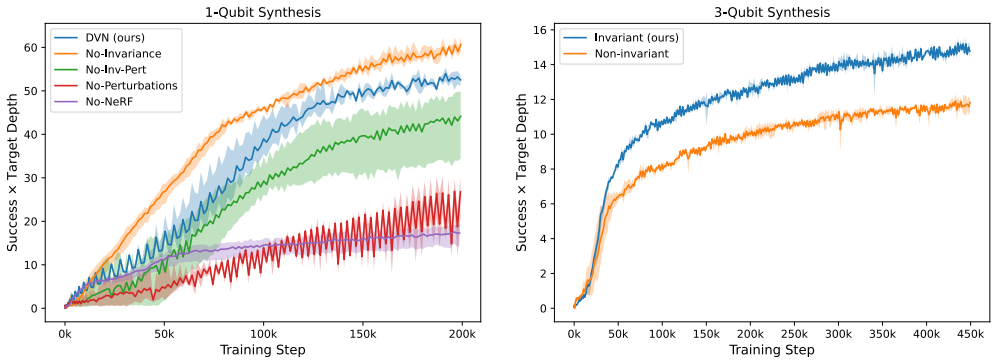
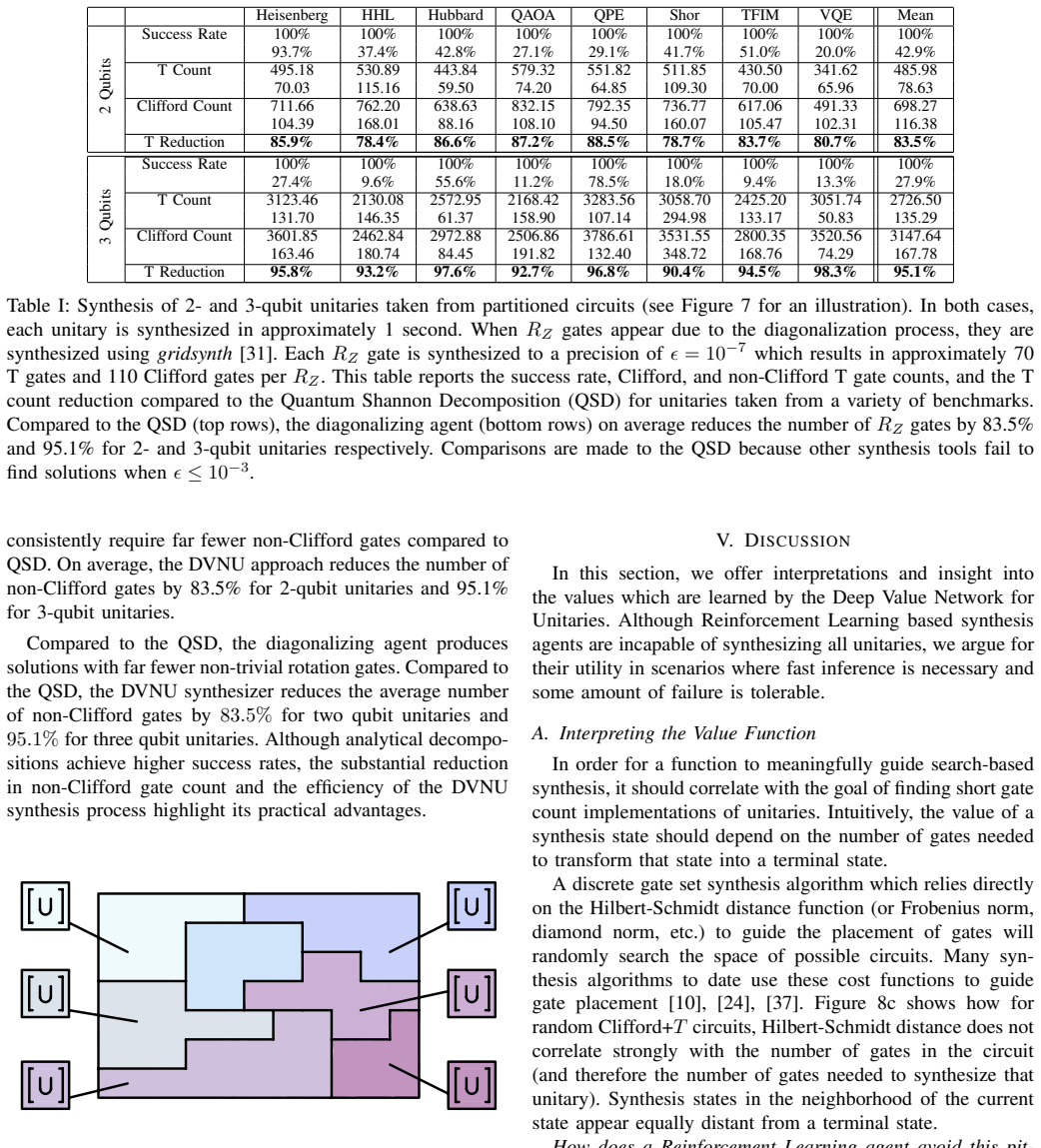
On the paper's own terms, the central discovery is that a model-based value-iteration agent with three domain-specific input transformations learns synthesis policies that previous deep-learning unitary synthesizers miss. After the same 150-iteration training budget, the single-qubit DVNU synthesizes random Clifford+T circuits of depth 80 with 54% success, while a Deep Q-Network without the modifications only reaches depth 15–20 at 35% success. For multi-qubit work, the paper changes the synthesis objective from inverting a unitary to diagonalizing it, following its earlier work, and reports that the DVNU diagonalizer produces a valid circuit for 42.9% of 2-qubit and 27.9% of 3-qubit benchmark unitaries at Hilbert–Schmidt distance $10^{-6}$, averaging 83.5% and 95.1% fewer T gates than Quantum Shannon Decomposition. The paper presents these results as evidence that the neural modifications, rather than simply the RL formulation, drive the improvement.
Load-bearing premise
The reported benchmark compares the full DVNU diagonalizer only against Quantum Shannon Decomposition and never against the same diagonalization approach without the learned value guidance, so the large T-count reductions could in principle come from the diagonalization framing itself rather than from the three neural modifications.
Editorial extensions
If this is right
- If the DVNU diagonalizer's benchmark numbers hold, partitioning a large circuit and synthesizing each block with the learned value function could cut the fault-tolerant overhead from T gates by an order of magnitude relative to analytic decomposition, because T gates are the expensive non-Clifford resource.
- The single-qubit depth-80 success of DVNU over a Deep Q-Network indicates that model-based value iteration plus these architectural changes extends learned synthesis to significantly deeper targets under the same training budget.
- Because the modifications are architectural rather than gate-set-specific, they apply to any discrete universal set, such as Clifford+V, not only Clifford+T.
- Synthesis frameworks that already use learned value or policy networks, including Monte Carlo tree search, can absorb these changes without changing their search procedure.
Reading between the lines
- Inference: The headline benchmark compares the full learned diagonalizer only with an analytic baseline, not with the same diagonalization pipeline driven by a distance-based or random search; a direct ablation would reveal how much of the 83.5% and 95.1% T-count reductions belongs to the neural value guidance rather than to the diagonalization objective.
- Inference: The paper's evidence that the learned value function tracks gates-to-go suggests the network could serve as a plug-in heuristic inside classical search algorithms, not only as a standalone policy; this use is mentioned but not measured.
- Inference: The global phase invariance construction works for any complex matrix defined up to a scalar phase, so testing it on other complex-valued machine-learning inputs could clarify where phase canonicalization helps; the paper's own ansatz-classification experiment shows it does not help everywhere.
- Inference: Since synthesis takes about one second per unitary, an end-to-end test that partitions complete algorithm circuits, diagonalizes each block with DVNU, and reassembles the result would show whether block-level T-count reductions survive compilation of a whole program.
Signed reviews
Editorial analysis
A structured set of objections, weighed in public.
Referee Report
Summary. The paper proposes three architectural modifications for neural networks used in reinforcement-learning-guided quantum circuit synthesis: a global-phase-invariance preprocessing layer, a unitary-perturbation data augmentation scheme, and a NeRF-style positional encoding. These are embedded in a Deep Value Network for Unitaries (DVNU) trained with value iteration. The paper evaluates the approach on a gate-classification task, on single-qubit random Clifford+T circuit synthesis against a DQN baseline, and on 2- and 3-qubit synthesis from partitioned benchmark circuits using a unitary-diagonalization objective, reporting large T-count reductions relative to the analytical Quantum Shannon Decomposition and success rates of 42.9% and 27.9% on the benchmark suites.
Significance. If the attribution of the reported gains to the proposed neural modifications were convincingly established, the work would be a useful contribution to ML-guided quantum circuit synthesis. The architectural ideas are clearly motivated, the experiments cover realistic benchmark circuits, and the paper is honest about the negative result for ansatz classification in Section V-B. The reported approximately one-second synthesis time per unitary is practically attractive. However, the central attribution is not established by the current experiments: the headline comparison in Section IV-C does not isolate the neural modifications from the diagonalization paradigm of prior work [42], and the DQN comparison in Section IV-B conflates algorithmic choice with the proposed changes. The technical soundness of the phase-invariance construction and perturbation proof also needs attention.
major comments (4)
- [Section IV-C, Table I] The 83.5% and 95.1% T-count reductions are computed only against the Quantum Shannon Decomposition. Since the diagonalization objective and pipeline are taken from the authors' earlier work [42], and no version of that pipeline without the learned value guidance is evaluated at epsilon=1e-6, these numbers cannot distinguish gains from the proposed neural modifications from gains due to the diagonalization formulation alone. In addition, the success rates in Table I are 42.9% (2-qubit) and 27.9% (3-qubit), so the reported T-count means are conditional on the subset of unitaries the agent happened to synthesize and may be biased toward easier instances. Please add an ablation that uses the same diagonalization pipeline with the learned value network replaced by random or greedy action selection, and report success-rate-adjusted or per-percentile statistics.
- [Section IV-B, Figure 6] The DVNU agent differs from the DQN baseline in two ways simultaneously: it uses value iteration rather than Q-learning, and it includes all three proposed architectural modifications. The caption's claim that the architectural modifications improve upon prior deep-learning-based synthesis is therefore not supported by this comparison, because the performance gap could be due to the value-iteration algorithm or the model-based formulation. Please run controlled comparisons with matched algorithms and network capacities, such as DQN with all three modifications enabled, or DVNU with the modifications disabled, under the same training budget.
- [Section III-B] The global-phase-invariance construction is not well-defined for all unitaries. If the mean of the element-wise squared matrix U^{⊙2} vanishes, as for U = diag(1,i), the normalized mean used in the construction is undefined, so the claimed canonicalization does not apply to this case. The proof also appears to drop the complex phase of the normalized squared mean: for U = e^{iθ}W one obtains a residual factor e^{-i arg(x)/2} W, where x is the mean of W^{⊙2}, unless arg(x) is assumed to be a multiple of 2π. The conditional π correction can only fix a residual sign, not an arbitrary residual phase. Please state the exact domain on which the map is defined and give a correct invariant construction, or prove that the π correction handles all residual phases.
- [Section III-C] The proof of the perturbation bound is incorrect as written. The Hilbert-Schmidt distance in Eq. (1) includes the normalization 1/4^n, but the proof uses unnormalized traces in expressions such as sqrt(1 - tr(U_epsilon V V^†)^2); the stated inequality is dimensionally inconsistent and does not follow from the cited trace inequality. The desired statement is much simpler: for unitary V, dHS(U_epsilon V, V) = dHS(U_epsilon, I), since V V^† = I. Please replace the proof with the direct calculation.
minor comments (5)
- [Section IV-C] The paragraph following Table I repeats the sentence about reducing non-Clifford gates twice; one occurrence should be removed.
- [Section IV-A, Figure 4] The caption of Figure 4 does not define what the y-axis means by 'difficulty' or specify exactly which modification is removed in each ablation curve. Please add a precise description of the ablation conditions.
- [Section IV-B] There is a typo, 'propsed' instead of 'proposed', in the sentence describing the DQN training.
- [Section II-A, Eq. (1)] The Hilbert-Schmidt distance formula would benefit from an explicit statement that A and B are elements of U(2^n), so that the normalization 1/4^n is understood.
- [Section V-B] The discussion of ansatz classification correctly reports that the modifications offer no benefit there; this is useful context but should be made more prominent in the abstract or introduction to temper the scope of the claims.
Circularity Check
No significant circularity: the core claims are supported by controlled ablations and external benchmarks, not by self-referential definitions.
full rationale
The paper's main claims concern the three architectural modifications (global phase invariance, unitary-perturbation augmentation, and NeRF encoding). These are evaluated in Section IV-A and Figure 4 via an ablation study, and in Section IV-B by training a DQN without the modifications; the outcomes are empirical measurements rather than consequences of the definitions. The global-phase invariance construction in Section III-B is a self-contained canonicalization with a proof, and the perturbation bound is a direct consequence of unitary invariance of the Hilbert-Schmidt distance. The NeRF encoding is explicitly adopted from external work [19]. Section IV-C compares the full DVNU diagonalizer to the analytical Quantum Shannon Decomposition on out-of-distribution benchmark unitaries; the 83.5% and 95.1% T-count reductions are measured, not fitted, and QSD is an external baseline. The diagonalization objective is imported from the authors' prior work [42], but the paper does not use [42] to justify the architectural modifications, and no equation in the paper reduces by construction to its own input. The absence of a DVNU-without-modifications baseline in Section IV-B and the lack of a non-learned diagonalization control in Section IV-C are experimental-design limitations, not circular reasoning. The paper's own Section V-B caveat that the modifications offered no benefit for ansatz classification further indicates the results are not forced by the architecture's definitions. Accordingly, no circular step is identified.
Assumptions & free parameters
free parameters (4)
- NeRF encoding bandwidth L =
15
- Target synthesis precision epsilon =
1e-6
- Gridsynth RZ precision =
1e-7
- Unitary perturbation radius =
dHS(U_epsilon, I) < epsilon; sampling distribution unspecified
assumptions (4)
- domain assumption Unitaries differing only by a global phase are physically indistinguishable, so a phase-invariant representation loses no information.
- ad hoc to paper The global phase canonicalization in Section III-B is well-defined for every input unitary, including cases where the mean of the element-wise squared matrix is zero.
- domain assumption The unitary diagonalization objective from [42] permits successful synthesis at epsilon = 1e-6 where search-based algorithms fail.
- domain assumption The learned value function, trained with binary rewards, correlates with the number of gates remaining; otherwise greedy action selection in Eq. 10 is not valid.
Cite this review
Pith. "Pith review of Making Neural Networks More Suitable for Approximate Clifford+T Circuit Synthesis." pith.science (2026). https://pith.science/paper/UDPCAPEA
@misc{pith2026250415990,
  author       = {Pith},
  title        = {Pith review of: Making Neural Networks More Suitable for Approximate Clifford+T Circuit Synthesis},
  year         = {2026},
  howpublished = {\url{https://pith.science/paper/UDPCAPEA}},
  note         = {Machine review of arXiv:2504.15990}
}
read the original abstract
Machine Learning with deep neural networks has transformed computational approaches to scientific and engineering problems. Central to many of these advancements are precisely tuned neural architectures that are tailored to the domains in which they are used. In this work, we develop deep learning techniques and architectural modifications that improve performance on reinforcement learning guided quantum circuit synthesis-the task of constructing a circuit that implements a given unitary matrix. First, we propose a global phase invariance operation which makes our architecture resilient to complex global phase shifts. Second, we demonstrate how augmenting data with small random unitary perturbations during training enables more robust learning. Finally, we show how encoding numerical data with techniques from image processing allow networks to better detect small but significant changes in data. Our work enables deep learning approaches to better synthesize quantum circuits that implement unitary matrices.
Figures


Figures from the paper (7 more)





Reference graph
Works this paper leans on
-
[42]
High- precision multi-qubit clifford+t synthesis by unitary diagonalization,
M. Weiden, J. Kalloor, E. Younis, J. Kubiatowicz, and C. Iancu, “High- precision multi-qubit clifford+t synthesis by unitary diagonalization,”
-
[1]
Quantum logic gate synthesis as a markov decision process,
M. S. Alam, N. F. Berthusen, and P. P. Orth, “Quantum logic gate synthesis as a markov decision process,” npj Quantum Information , vol. 9, no. 1, 10 2023. [Online]. Available: https://www.osti.gov/biblio/ 2287671
work page 2023
-
[2]
Artificial intelligence for quantum computing,
Y . Alexeev, M. H. Farag, T. L. Patti, M. E. Wolf, N. Ares, A. Aspuru- Guzik, S. C. Benjamin, Z. Cai, Z. Chandani, F. Fedele, N. Harrigan, J.-S. Kim, E. Kyoseva, J. G. Lietz, T. Lubowe, A. McCaskey, R. G. Melko, K. Nakaji, A. Peruzzo, S. Stanwyck, N. M. Tubman, H. Wang, and T. Costa, “Artificial intelligence for quantum computing,” 2024. [Online]. Availab...
arXiv 2024
-
[3]
Arqtic: A full-stack software package for simulating materials on quantum computers,
L. Bassman, C. Powers, and W. A. De Jong, “Arqtic: A full-stack software package for simulating materials on quantum computers,” ACM Transactions on Quantum Computing , vol. 3, no. 3, jul 2022. [Online]. Available: https://doi.org/10.1145/3511715
doi:10.1145/3511715 2022
-
[4]
Learning high-accuracy error decoding for quantum processors,
J. Bausch, A. W. Senior, F. J. H. Heras, T. Edlich, A. Davies, M. Newman, C. Jones, K. Satzinger, M. Y . Niu, S. Blackwell, G. Holland, D. Kafri, J. Atalaya, C. Gidney, D. Hassabis, S. Boixo, H. Neven, and P. Kohli, “Learning high-accuracy error decoding for quantum processors,” Nature, vol. 635, no. 8040, pp. 834–840, Nov. 2024, publisher: Nature Publish...
work page 2024
-
[5]
Bellman, Dynamic Programming , 1st ed
R. Bellman, Dynamic Programming , 1st ed. Princeton, NJ, USA: Princeton University Press, 1957
work page 1957
-
[6]
Efficient synthesis of probabilistic quantum circuits with fallback,
A. Bocharov, M. Roetteler, and K. M. Svore, “Efficient synthesis of probabilistic quantum circuits with fallback,” Physical Review A , vol. 91, no. 5, p. 052317, May 2015, arXiv:1409.3552 [quant-ph]. [Online]. Available: http://arxiv.org/abs/1409.3552
arXiv 2015
-
[7]
Efficient synthesis of universal Repeat-Until-Success circuits,
A. Bocharov, M. Roetteler, and K. M. Svore, “Efficient synthesis of universal Repeat-Until-Success circuits,” Physical Review Letters , vol. 114, no. 8, p. 080502, Feb. 2015, arXiv:1404.5320 [quant-ph]. [Online]. Available: http://arxiv.org/abs/1404.5320
arXiv 2015
Show all 47 references
-
[8]
Efficient and practical quantum compiler towards multi-qubit systems with deep reinforcement learning,
Q. Chen, Y . Du, Q. Zhao, Y . Jiao, X. Lu, and X. Wu, “Efficient and practical quantum compiler towards multi-qubit systems with deep reinforcement learning,” 2022
2022
-
[9]
Program synthesis using deduction-guided reinforcement learning,
Y . Chen, C. Wang, O. Bastani, I. Dillig, and Y . Feng, “Program synthesis using deduction-guided reinforcement learning,” in Computer Aided Verification: 32nd International Conference, CAV 2020, Los Angeles, CA, USA, July 21–24, 2020, Proceedings, Part II . Berlin, Heidelberg...
2020 doi
-
[10]
Towards optimal topology aware quantum circuit synthesis,
M. G. Davis, E. Smith, A. Tudor, K. Sen, I. Siddiqi, and C. Iancu, “Towards optimal topology aware quantum circuit synthesis,” in 2020 IEEE International Conference on Quantum Computing and Engineer- ing (QCE), 2020, pp. 223–234
2020
-
[11]
A quantum approximate optimization algorithm,
E. Farhi, J. Goldstone, and S. Gutmann, “A quantum approximate optimization algorithm,” 2014. [Online]. Available: https://arxiv.org/abs/ 1411.4028
2014 arXiv
-
[12]
An algorithm for the T-count,
D. Gosset, V . Kliuchnikov, M. Mosca, and V . Russo, “An algorithm for the T-count,” Aug. 2013, arXiv:1308.4134 [quant-ph]. [Online]. Available: http://arxiv.org/abs/1308.4134
2013 arXiv
-
[13]
Quantum measurements and the abelian stabilizer problem,
A. Y . Kitaev, “Quantum measurements and the abelian stabilizer problem,” 1995. [Online]. Available: https://arxiv.org/abs/quant-ph/ 9511026
1995
-
[14]
Quantum computations: algorithms and error correction,
A. Y . Kitaev, “Quantum computations: algorithms and error correction,” Russian Mathematical Surveys , vol. 52, no. 6, p. 1191, dec 1997
1997
-
[15]
Fast and efficient exact synthesis of single qubit unitaries generated by Clifford and T gates,
V . Kliuchnikov, D. Maslov, and M. Mosca, “Fast and efficient exact synthesis of single qubit unitaries generated by Clifford and T gates,” Jun. 2012. [Online]. Available: https://arxiv.org/abs/1206.5236v4
2012 arXiv
-
[16]
Deep Neural Network Probabilistic Decoder for Stabilizer Codes,
S. Krastanov and L. Jiang, “Deep Neural Network Probabilistic Decoder for Stabilizer Codes,” Scientific Reports , vol. 7, no. 1, p. 11003, Sep. 2017, arXiv:1705.09334 [quant-ph]. [Online]. Available: http://arxiv.org/abs/1705.09334
2017 arXiv
-
[17]
Ai methods for approximate compiling of unitaries,
D. Kremer, V . Villar, S. Vishwakarma, I. Faro, and J. Cruz-Benito, “Ai methods for approximate compiling of unitaries,” 2024. [Online]. Available: https://arxiv.org/abs/2407.21225
2024 arXiv
-
[18]
Quarl: A learning-based quantum circuit optimizer,
Z. Li, J. Peng, Y . Mei, S. Lin, Y . Wu, O. Padon, and Z. Jia, “Quarl: A learning-based quantum circuit optimizer,” Proc. ACM Program. Lang., vol. 8, no. OOPSLA1, Apr. 2024. [Online]. Available: https://doi.org/10.1145/3649831
2024 doi
-
[19]
Nerf: Representing scenes as neural radiance fields for view synthesis,
B. Mildenhall, P. P. Srinivasan, M. Tancik, J. T. Barron, R. Ramamoorthi, and R. Ng, “Nerf: Representing scenes as neural radiance fields for view synthesis,” in ECCV, 2020
2020
-
[20]
Playing atari with deep reinforcement learn- ing,
V . Mnih, K. Kavukcuoglu, D. Silver, A. Graves, I. Antonoglou, D. Wier- stra, and M. Riedmiller, “Playing atari with deep reinforcement learn- ing,” 2013
2013
-
[21]
Quantum compiling by deep reinforcement learning,
L. Moro, M. G. A. Paris, M. Restelli, and E. Prati, “Quantum compiling by deep reinforcement learning,” Communications Physics, vol. 4, no. 1, p. 178, Aug. 2021. [Online]. Available: https://doi.org/10.1038/s42005- 021-00684-3
2021 doi
-
[22]
Learning to Decode Linear Codes Using Deep Learning,
E. Nachmani, Y . Beery, and D. Burshtein, “Learning to Decode Linear Codes Using Deep Learning,” Sep. 2016, arXiv:1607.04793 [cs, math]. [Online]. Available: http://arxiv.org/abs/1607.04793
2016 arXiv
-
[23]
M. A. Nielsen and I. L. Chuang, Quantum Computation and Quantum Information: 10th Anniversary Edition . Cambridge University Press, 2011
2011
-
[24]
Synthetiq: Fast and versatile quantum circuit synthesis,
A. Paradis, J. Dekoninck, B. Bichsel, and M. Vechev, “Synthetiq: Fast and versatile quantum circuit synthesis,” 2024. 9
2024
-
[25]
A variational eigenvalue solver on a photonic quantum processor,
A. Peruzzo, J. McClean, P. Shadbolt, M.-H. Yung, X.-Q. Zhou, P. J. Love, A. Aspuru-Guzik, and J. L. O’Brien, “A variational eigenvalue solver on a photonic quantum processor,” Nature Communications , vol. 5, no. 1, Jul. 2014. [Online]. Available: http://dx.doi.org/10.1038/ ncomms5213
2014
-
[26]
Compiler Optimization for Quantum Computing Using Reinforcement Learning,
N. Quetschlich, L. Burgholzer, and R. Wille, “Compiler Optimization for Quantum Computing Using Reinforcement Learning,” 12 2022
2022
-
[27]
MQT Bench: Benchmark- ing Software and Design Automation Tools for Quantum Computing,
N. Quetschlich, L. Burgholzer, and R. Wille, “MQT Bench: Benchmark- ing Software and Design Automation Tools for Quantum Computing,” Quantum, 2023, MQT Bench is available at https://www.cda.cit.tum.de/ mqtbench/
2023
-
[28]
On the spectral bias of neural networks,
N. Rahaman, A. Baratin, D. Arpit, F. Draxler, M. Lin, F. A. Hamprecht, Y . Bengio, and A. Courville, “On the spectral bias of neural networks,” 2019
2019
-
[29]
Unitary synthesis of clifford+t circuits with reinforcement learning,
S. Rietsch, A. Y . Dubey, C. Ufrecht, M. Periyasamy, A. Plinge, C. Mutschler, and D. D. Scherer, “Unitary synthesis of clifford+t circuits with reinforcement learning,” 2024
2024
-
[30]
The perceptron: A probabilistic model for information storage and organization in the brain,
F. Rosenblatt, “The perceptron: A probabilistic model for information storage and organization in the brain,” Psychological Review, vol. 65, no. 6, pp. 386–408, 1958, place: US Publisher: American Psychological Association
1958
-
[31]
Optimal ancilla-free clifford+t approxima- tion of z-rotations,
N. J. Ross and P. Selinger, “Optimal ancilla-free clifford+t approxima- tion of z-rotations,” 2016
2016
-
[32]
Benchmarking language models for code syntax understanding,
D. Shen, X. Chen, C. Wang, K. Sen, and D. Song, “Benchmarking language models for code syntax understanding,” 2022. [Online]. Available: https://arxiv.org/abs/2210.14473
2022 arXiv
-
[33]
Synthesis of quantum- logic circuits,
V . V . Shende, S. S. Bullock, and I. L. Markov, “Synthesis of quantum- logic circuits,” IEEE Transactions on Computer-Aided Design of Inte- grated Circuits and Systems , vol. 25, no. 6, pp. 1000–1010, 2006
2006
-
[34]
Polynomial-time algorithms for prime factorization and discrete logarithms on a quantum computer,
P. W. Shor, “Polynomial-time algorithms for prime factorization and discrete logarithms on a quantum computer,” SIAM Journal on Computing , vol. 26, no. 5, p. 1484–1509, Oct. 1997. [Online]. Available: http://dx.doi.org/10.1137/S0097539795293172
1997 doi
-
[35]
Co-domain symmetry for complex- valued deep learning,
U. Singhal, Y . Xing, and S. X. Yu, “Co-domain symmetry for complex- valued deep learning,” 2021
2021
-
[36]
Multi-spectral image classification with ultra-lean complex-valued models,
U. Singhal, S. X. Yu, Z. Steck, S. Kangas, and A. A. Reite, “Multi-spectral image classification with ultra-lean complex-valued models,” 2022. [Online]. Available: https://arxiv.org/abs/2211.11797
2022 arXiv
-
[37]
Leap: Scaling numerical optimization based synthesis using an incremental approach,
E. Smith, M. G. Davis, J. Larson, E. Younis, L. B. Oftelie, W. Lavrijsen, and C. Iancu, “Leap: Scaling numerical optimization based synthesis using an incremental approach,” ACM Transactions on Quantum Computing , vol. 4, no. 1, feb 2023. [Online]. Available: https://doi.org/1...
2023 doi
-
[38]
R. S. Sutton and A. G. Barto, Reinforcement Learning: An Introduction, 2nd ed. The MIT Press, 2018
2018
-
[39]
Complex-valued deep learning with applications to magnetic resonance image synthesis,
P. Virtue, “Complex-valued deep learning with applications to magnetic resonance image synthesis,” Ph.D. dissertation, University of California, Berkeley, 2019
2019
-
[40]
A trace inequality for unitary matrices,
B.-Y . Wang and F. Zhang, “A trace inequality for unitary matrices,” The American Mathematical Monthly , vol. 101, no. 5, pp. 453–455,
-
[41]
Improving quantum circuit synthesis with machine learning,
M. Weiden, E. Younis, J. Kalloor, J. Kubiatowicz, and C. Iancu, “Improving quantum circuit synthesis with machine learning,” in 2023 IEEE International Conference on Quantum Computing and Engineering (QCE). Los Alamitos, CA, USA: IEEE Computer Society, sep 2023, pp. 1–11. [Onl...
2023
-
[43]
Frequency principle: Fourier analysis sheds light on deep neural networks,
Z.-Q. J. Xu, “Frequency principle: Fourier analysis sheds light on deep neural networks,” Communications in Computational Physics , vol. 28, no. 5, p. 1746–1767, Jun. 2020. [Online]. Available: http://dx.doi.org/10.4208/cicp.OA-2020-0085
2020 doi
-
[44]
Berkeley quantum synthesis toolkit (bqskit) v1,
E. Younis, C. C. Iancu, W. Lavrijsen, M. Davis, E. Smith, and USDOE, “Berkeley quantum synthesis toolkit (bqskit) v1,” 04 2021. [Online]. Available: https://www.osti.gov/biblio/1785933
2021
-
[45]
Topological quantum compiling with reinforcement learning,
Y .-H. Zhang, P.-L. Zheng, Y . Zhang, and D.-L. Deng, “Topological quantum compiling with reinforcement learning,” Physical Review Letters, vol. 125, no. 17, Oct. 2020. [Online]. Available: http: //dx.doi.org/10.1103/PhysRevLett.125.170501 10
2020 doi
-
[1994]
Available: http://www.jstor.org/stable/2974909
[Online]. Available: http://www.jstor.org/stable/2974909
-
[2025]
Available: https://arxiv.org/abs/2409.00433
[Online]. Available: https://arxiv.org/abs/2409.00433
Reviewed August 16, 2026 · model on record in the stance chip above.
Discussion (0). Continue with ORCID to comment.