REVIEW 3 major objections 4 minor 87 references
Bracketing the soliton-halo relation of ultralight dark matter
T0 review · 3 major / 4 minor · reviewed 2026-08-16 · deepseek-v4-flash
Pith's one-line read The paper argues that the soliton–halo relation in ultralight dark matter is a band: solitons form near the equal-energy-per-mass line and grow without crossing the equal-total-energy line.
desk verdict A useful synthesis that turns the soliton-halo relation into a bracketing band, with the main remaining worry being an under-disclosed selection cut. read the letter →
The pith
A machine-rendered reading of the paper's core claim, the machinery that carries it, and where it could break.
The reading
What carries the argument
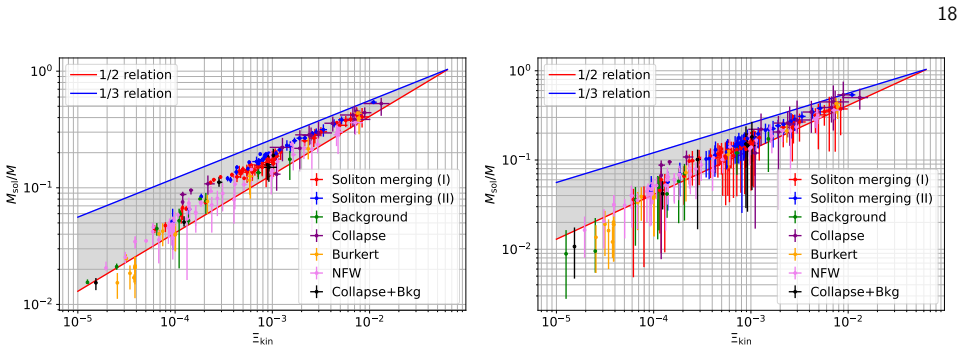
The load-bearing objects are two energy equalities plus virial relations. For any soliton solution of the Schrödinger–Poisson equations, the scaling identity $M_{\rm sol} \approx 4.2 \,(|E_{\rm sol}|/M_{\rm sol})^{1/2}/(G m)$ makes the 2014 mass–energy fit equivalent to equal energy per mass, while $M_{\rm sol} \approx 2.6 \,(|E_{\rm sol}|/(G^2 m^2))^{1/3}$ makes the 2017 fit equivalent to equal total energy. The paper frames both through the Schrödinger–Poisson invariant $\Xi = |E|/(M^3 G^2 m^2)$, writing a general soliton-halo relation as $M_{\rm sol}/M = \alpha \, \Xi^\beta$, with $\beta=1/2$ and $\beta=1/3$ as the two cases. Because $\Xi$ is sensitive to box size, the paper instead plots kinetic-energy ratios, using the virial theorem to connect them to the energy equalities.
What would settle it
Run a flat-box simulation with the same initial conditions but inject a population of positive-energy unbound particles after the soliton forms; if the soliton mass can be pushed above the $E_{\rm sol} = E_{\rm halo}$ line while the bound halo is unchanged, the 1/3 upper bound holds only with a bound-particle definition of halo energy. Alternatively, reanalyse the 2017-relation simulations using kinetic energy only: if the points stay above the 1/3 line instead of moving into the band, the central claim fails.
Extended reading notes
Core claim
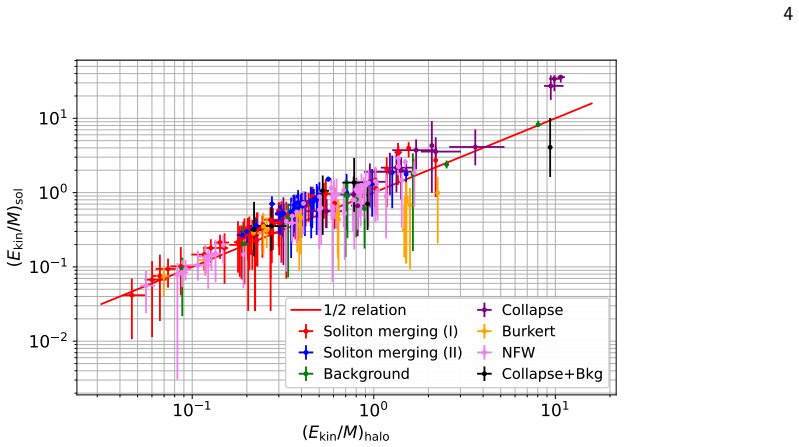
The central claim is that solitons form near the 1/2 relation, $(E/M)_{\rm sol} = (E/M)_{\rm halo}$, and then grow by accreting halo mass without ever surpassing the 1/3 relation, $E_{\rm sol} = E_{\rm halo}$. The former is a lower bound because a soliton more than about a factor of 3.5 lighter would sit below the evaporation threshold set by scattering with background particles; the latter is an upper bound because a soliton with more energy than the whole halo cannot exist in a bound virialized system. The upper-bound statement requires that the halo energy be evaluated on bound material: unbound positive-energy debris in a finite box would raise $E_{\rm halo}$ and could mimic a violation. Across all initial conditions, the simulated solitons lie in the band between the two relations, and published results are consistent with the same band once the arbitrary additive constant in the finite-box potential energy is handled properly.
Load-bearing premise
The whole argument depends on the halo being gravitationally settled (virialized) and nearly free of unbound, escaping matter, so that its kinetic energy per mass can stand in for its total energy per mass; halos still collapsing or full of debris would shift both the lower and upper bounds.
Editorial extensions
If this is right
- Observational limits that assume the 1/2 relation are conservative: if real solitons lie anywhere in the band, the inner rotation-curve peak is at least as strong as the 1/2-line prediction, strengthening lower bounds on the ultralight particle mass.
- Published scatter in soliton-halo measurements should largely collapse once the data are reanalysed with kinetic energy or an infinite-volume-corrected potential energy, and the paper invites other groups to do that reanalysis.
- Soliton growth in a fixed halo is self-limiting: the 1/3 upper bound sets a terminal soliton mass set by the halo's total energy, so accretion slows as the system approaches that line.
- Solitons more than about 3.5 times lighter than the 1/2 line should evaporate, so newly formed solitons should appear within a finite factor of the 1/2 relation rather than at arbitrarily low mass.
Reading between the lines
- If the band picture carries over to structure formation, soliton mass may be nearly independent of halo merger history once the halo virializes; tracking the soliton trajectory in cosmological simulations should show it entering the band from below and only slowly approaching the 1/3 line.
- The finite-volume potential-energy ambiguity identified here suggests a cheap test: recomputing published soliton-halo data with kinetic energy alone should bring all points into the band without any new simulations.
- Because the bracket relies only on Schrödinger–Poisson scaling, the same band may apply to other self-gravitating wave dark matter structures such as axion miniclusters and dark photon stars, a direction the paper mentions as future work.
- Real halos undergoing mergers or feedback may contain transient unbound material, so observational tests of the 1/3 upper bound should use only bound mass; otherwise an apparent violation could be an artifact of including escaping particles.
Signed reviews
Editorial analysis
A structured set of objections, weighed in public.
Referee Report
Summary. This paper studies the relation between the mass of solitons and their host halos in ultralight dark matter (ULDM). The authors point out that the Schive et al. 2014 core-halo relation is algebraically equivalent to (E/M)_sol = (E/M)_halo, while the Mocz et al. 2017 relation is equivalent to E_sol = E_halo. They argue that the latter is an upper bound for bound, virialized systems, and that the former is parametrically close to the evaporation/growth threshold of Chan et al. 2022, giving a rough lower bound. They support this picture with flat-space Schrödinger-Poisson simulations using several types of initial conditions (soliton mergers, NFW/Burkert halos, Gaussian noise backgrounds, and collapses). Their main figures show that simulated solitons form near the 1/2 relation and grow without crossing the 1/3 relation, forming a 'soliton-halo band.' They also argue that apparent discrepancies with previous flat-space and cosmological simulations can be explained by the finite-volume additive constant in the potential energy, and they advocate using kinetic energy to avoid this ambiguity.
Significance. The analytic reinterpretation of the two standard soliton-halo relations as energy equalities is clean and, if correct, constitutes a useful conceptual advance: it turns the 1/3 relation into a rigorous upper bound for bound configurations and gives a simple parametric argument for why the 1/2 relation acts as a rough lower bound. The use of kinetic energy in the main plots is a sensible way to sidestep one finite-volume ambiguity, and the diversity of initial conditions probed is a strength. The paper is also unusually candid about its own limitations, explicitly labeling the potential-energy constant estimate as rough and acknowledging the formation-time and fitting uncertainties. However, the numerical evidence for the band is not yet fully robust: the virialization cut that selects the plotted runs uses the same approximate potential-energy convention whose ambiguity the paper emphasizes, and the paper does not quantify the sensitivity of its conclusions to that cut. The central analytic claim is sound, but the simulation-based central claim needs additional robustness checks before the band can be regarded as established.
major comments (3)
- [Section III and Appendix A, Eq. (A16)] The virialization cut that determines which runs enter Figs. 1 and 3 is evaluated with E_pot whose additive constant is fixed by the approximate prescription in Eq. (A15), which the authors themselves describe as 'just a rough estimate.' Because the plotted variables use E_kin as a proxy for |E_tot|, the cut is not an independent physical selection: an error in the constant c changes both |E_pot| in Eq. (A16) and the inferred position in the Ξ plane, as Fig. 12 demonstrates. The paper does not state how many runs are discarded, nor how the band in Figs. 1 and 3 changes when c is varied within the range of plausible conventions (e.g., c=0 versus Eq. (A15), or R chosen at different grid radii) or when the 0.2 threshold is varied. Without such a robustness check, the reported clustering between the 1/2 and 1/3 lines could be a selection effect driven by the same finite-volume convention that the paper identifies as the main ambiguity.
- [Section IV.B and Appendix E] The 1/3 upper bound applies only to the energy of bound material, and the paper's simulation points are interpreted as respecting this bound. The statement that 'our simulations have a negligible quantity of positive energy debris' is asserted but not quantified; the energy-spectrum diagnostic in Appendix E is illustrated for one run in Fig. 14, with no threshold, mass fraction, or run-by-run summary. Since unbound debris would contribute positive kinetic energy to the proxy used in Figs. 3 and 4, the claim that the points lie below the 1/3 line for the bound halo needs a quantitative bound on the unbound mass/energy fraction across all initial-condition types.
- [Section IV.D.1 and Figs. 9 and 12] The reconciliation with Mocz et al. (2017) rests entirely on the choice of the additive potential-energy constant. With the unadjusted total energy the points cluster on the 1/3 line (Fig. 9), while with the Eq. (A15) constant many points shift substantially (Fig. 12). The conclusion that the literature is 'fully consistent' with the band therefore requires a sensitivity study of the constant c and preferably a re-analysis of Ref. [25]'s data with E_kin-based variables; otherwise the agreement may be an artifact of one particular convention among several.
minor comments (4)
- [Section I, Eq. (1) and footnote 3] The relation between M_sol and M_c and the prefactor 4.2 is confusing as written ('the prefactor ... is α=4.2 Mc/Msol≈1'); please clarify which mass the fit coefficient refers to.
- [Section II.B, Fig. 2] The caption and text describe the soliton-formation criterion via a goodness-of-fit threshold, but the paper does not report the fraction of runs for which the criterion is never satisfied; please give this number, as it bears on the interpretation of Figs. 1 and 3.
- [Section IV.D.2, Eq. (16)] The intermediate algebra leading to B_h(β)=1−4β/3 is omitted; a short derivation or a reference to the original derivation would help the reader verify the cosmological translation.
- [Appendix A, last paragraph] The sentence 'we discard a few runs' should be replaced by the exact number of discarded runs and their initial-condition types, especially given the role of Eq. (A16) in the main analysis.
Circularity Check
No significant circularity: the 1/2 and 1/3 equivalences are rederived from the soliton solution, and the simulation comparisons are independent of the plotted relations.
full rationale
Walked the derivation chain. The two key equivalences (Eq. (2) and Eq. (4)) are not assumed from the literature as black boxes: Appendix B rederives the isolated-soliton properties, including the fixed point α(0.054)^β ≈ 1, from which (E/M)_sol=(E/M)_halo and E_sol=E_tot follow algebraically. The simulation data in Figs. 1 and 3 are original measurements of E_kin,sol, M_sol and E_kin, compared to analytically fixed lines rather than fitted to those lines. The lower-bound claim imports the Chan et al. evaporation threshold as an external benchmark, while the upper-bound claim is a logical consequence of E_tot containing E_sol and the boundness of the remaining halo components. The finite-volume potential energy ambiguity is handled by presenting E_kin in the main plots, and the paper openly shows in Fig. 12 that the alternative E_tot convention shifts points. The virialization cut in Eq. (A16) is a data-quality selection based on an approximate potential constant, which is a robustness concern rather than a reduction of the output band to the input selection. The self-citations to Ref. [33] are not load-bearing because the same mathematical content is independently rederived in Appendix B and checked against the paper's own simulations. No circular step can be exhibited.
Assumptions & free parameters
free parameters (5)
- alpha_1/2 (prefactor of 1/2 relation) =
4.2 (from Schive et al. 2014 fit, Eq. 1)
- alpha_1/3 (prefactor of 1/3 relation) =
2.6 (from Mocz et al. 2017 fit, Eq. 3)
- Formation-time threshold in Eq. (D3) =
0.5 (chosen, tested in Appendix D)
- Virialization selection threshold in Eq. (A16) =
0.2 (chosen)
- Potential-energy constant c in Eqs. (A13)-(A15) =
set via c = -M/(4 pi R) - Phi_code(R) with R = L/2
assumptions (4)
- domain assumption Schrodinger-Poisson equations are the correct non-relativistic description of ULDM with huge occupation number.
- domain assumption The simulated halo is approximately virialized so that E_kin/M can stand in for |E_tot|/M.
- domain assumption Flat-space periodic-box evolution with zero net angular momentum captures the physics of cosmological ULDM halos.
- domain assumption Chan et al. 2022 evaporation threshold applies beyond the Maxwellian homogeneous background for which it was derived.
Cite this review
Pith. "Pith review of Bracketing the soliton-halo relation of ultralight dark matter." pith.science (2026). https://pith.science/paper/DULZIN5K
@misc{pith2026250416202,
  author       = {Pith},
  title        = {Pith review of: Bracketing the soliton-halo relation of ultralight dark matter},
  year         = {2026},
  howpublished = {\url{https://pith.science/paper/DULZIN5K}},
  note         = {Machine review of arXiv:2504.16202}
}
abstract
In theories of ultralight dark matter, solitons form in the inner regions of galactic halos. The observational implications of these depend on the soliton mass. Various relations between the mass of the soliton and properties of the halo have been proposed. We analyze the implications of these relations, and test them with a suite of numerical simulations. The relation of Schive et al. 2014 is equivalent to $(E/M)_{\rm sol}=(E/M)_{\rm halo}$ where $E_{\rm sol (halo)}$ and $M_{\rm sol (halo)}$ are the energy and mass of the soliton (halo). If the halo is approximately virialized, this relation is parametrically similar to the evaporation/growth threshold of Chan et al. 2022, and it thus gives a rough lower bound on the soliton mass. A different relation has been proposed by Mocz et al. 2017, which is equivalent to $E_{\rm sol}=E_{\rm halo}$, so is an upper bound on the soliton mass provided the halo energy can be estimated reliably. Our simulations provide evidence for this picture, and are in broad consistency with the literature, in particular after accounting for ambiguities in the definition of $E_{\rm halo}$ at finite volume.
Figures


Figures from the paper (11 more)



Reference graph
Works this paper leans on
-
[25]
L. Hui, “Wave Dark Matter,”Ann. Rev. Astron. Astrophys.59(2021) 247–289,arXiv:2101.11735 [astro-ph.CO]
arXiv 2021
-
[1]
Comparison with flat space-time simulations 11
-
[2]
Summary 14 Acknowledgments 14 A
Comparison with cosmological simulations 12 V. Summary 14 Acknowledgments 14 A. Solving the Schr¨ odinger–Poisson equations14 B. Soliton solution 16 C. More details on the initial conditions17 D. The criterion for soliton formation18 E. The energy spectrum 18 References 20 ∗Electronic address: luca.teodori@weizmann.ac.il (corresponding author) arXiv:2504....
arXiv 2025
-
[3]
[25] and examine the consistency of our results with their claimed1/3relation
Comparison with flat space-time simulations We now compare with Ref. [25] and examine the consistency of our results with their claimed1/3relation. Our numerical methods (i.e. our algorithm to solve the Schr¨ odinger–Poisson equations) and the setting (flat space-time with periodic boundary) are similar to this reference. Moreover, as far as we could tell...
2017
-
[4]
soliton-halo band
Comparison with cosmological simulations In a cosmological context, the soliton-halo relation is usually written as a1/2Msol =A h s ζ(a) ζ(1)M !Bh ,(13) whereM sol andMare the mass of a soliton and halo respectively, andA h andB h are parameters of the relation. Here, ais the cosmological scale factor, andζ(a)is the cosmology-dependent factor that relates...
-
[5]
Call this point the origin of coordinatesr= 0, with densityρ(0)
At each time step in the simulation we identify the point in the box that contains the highest mass density. Call this point the origin of coordinatesr= 0, with densityρ(0). Using the soliton profile approximation [21] ρfit(r) = λ4 (1 +a 2λ2r2)b , a≈0.228, b≈4.071,(D1) we obtain a first estimate of the soliton core radiusr c from the value ofρ(0)
-
[6]
We fit a soliton profile to the grid region surroundingr= 0, treatingr c as a fit parameter, and including in the fit grid points withinr<3r c
Next, we compute the radial-averaged density profile aroundr= 0. We fit a soliton profile to the grid region surroundingr= 0, treatingr c as a fit parameter, and including in the fit grid points withinr<3r c. At the same time, to constrain the halo, we also fit an NFW profile to grid points satisfyingr>4r c, with the NFW scale radiusr s and densityρ 0 as ...
-
[7]
As we show in Fig
The earliest timet form that satisfies 1 N NX i∈fit points log2 ρsim(ri,t form) ρfit(ri) <0.5,(D3) is where we begin to report results in the context of a soliton-halo relation. As we show in Fig. 13, changing the threshold in Eq. (D3) does not significantly change the results we obtain. A more restrictive criterion selects later formation times, making p...
Show all 87 references
-
[8]
Cosmology of the Invisible Axion,
J. Preskill, M. B. Wise, and F. Wilczek, “Cosmology of the Invisible Axion,”Phys. Lett. B120(1983) 127–132
1983
-
[9]
A Cosmological Bound on the Invisible Axion,
L. F. Abbott and P. Sikivie, “A Cosmological Bound on the Invisible Axion,”Phys. Lett. B120(1983) 133–136
1983
-
[10]
The Not So Harmless Axion,
M. Dine and W. Fischler, “The Not So Harmless Axion,”Phys. Lett. B120(1983) 137–141
1983
-
[11]
Axions In String Theory,
P. Svrcek and E. Witten, “Axions In String Theory,”JHEP06(2006) 051,arXiv:hep-th/0605206 [hep-th]
2006 arXiv
-
[12]
String Axiverse,
A. Arvanitaki, S. Dimopoulos, S. Dubovsky, N. Kaloper, and J. March-Russell, “String Axiverse,”Phys. Rev.D81 (2010) 123530,arXiv:0905.4720 [hep-th]
2010 arXiv
-
[13]
Axion Cosmology,
D. J. E. Marsh, “Axion Cosmology,”Phys. Rept.643(2016) 1–79,arXiv:1510.07633 [astro-ph.CO]
2016 arXiv
-
[14]
Ultralight scalars as cosmological dark matter,
L. Hui, J. P. Ostriker, S. Tremaine, and E. Witten, “Ultralight scalars as cosmological dark matter,”Phys. Rev.D95 no. 4, (2017) 043541,arXiv:1610.08297 [astro-ph.CO]
2017 arXiv
-
[15]
Constraining ultralight axions with galaxy surveys,
A. Lagu¨ e, J. R. Bond, R. Hloˇ zek, K. K. Rogers, D. J. E. Marsh, and D. Grin, “Constraining ultralight axions with galaxy surveys,”JCAP01no. 01, (2022) 049,arXiv:2104.07802 [astro-ph.CO]
2022 arXiv
-
[16]
First constraints on fuzzy dark matter from Lyman-α forest data and hydrodynamical simulations,
V. Irˇ siˇ c, M. Viel, M. G. Haehnelt, J. S. Bolton, and G. D. Becker, “First constraints on fuzzy dark matter from Lyman-α forest data and hydrodynamical simulations,”Phys. Rev. Lett.119no. 3, (2017) 031302,arXiv:1703.04683 [astro-ph.CO]
2017 arXiv
-
[17]
Constraining the mass of light bosonic dark matter using SDSS Lyman-αforest,
E. Armengaud, N. Palanque-Delabrouille, D. J. E. Marsh, J. Baur, and C. Y ¨ ı¿œche, “Constraining the mass of light bosonic dark matter using SDSS Lyman-αforest,”Mon. Not. Roy. Astron. Soc.471no. 4, (2017) 4606–4614, arXiv:1703.09126 [astro-ph.CO]
2017 arXiv
-
[18]
Lyman-αconstraints on ultralight scalar dark matter: Implications for the early and late universe,
T. Kobayashi, R. Murgia, A. De Simone, V. Irˇ siˇ c, and M. Viel, “Lyman-αconstraints on ultralight scalar dark matter: Implications for the early and late universe,”Phys. Rev. D96no. 12, (2017) 123514,arXiv:1708.00015 [astro-ph.CO]
2017 arXiv
-
[19]
Testing extreme-axion wave dark matter using the BOSS Lyman-Alpha forest data,
K.-H. Leong, H.-Y. Schive, U.-H. Zhang, and T. Chiueh, “Testing extreme-axion wave dark matter using the BOSS Lyman-Alpha forest data,”Mon. Not. Roy. Astron. Soc.484(2019) 4273,arXiv:1810.05930 [astro-ph.CO]
2019 arXiv
-
[20]
Dynamical Friction in a Fuzzy Dark Matter Universe,
L. Lancaster, C. Giovanetti, P. Mocz, Y. Kahn, M. Lisanti, and D. N. Spergel, “Dynamical Friction in a Fuzzy Dark Matter Universe,”JCAP01(2020) 001,arXiv:1909.06381 [astro-ph.CO]. 21 5 4 3 2 0 2000 4000 6000 8000F t = 0.0 Gyr 20 10 0 0 200 400 600 800 1000F t = 0.5 Gyr 20 10 0...
2020 arXiv
-
[21]
On the Dynamical Heating of Dwarf Galaxies in a Fuzzy Dark Matter Halo,
D. Dutta Chowdhury, F. C. van den Bosch, P. van Dokkum, V. H. Robles, H.-Y. Schive, and T. Chiueh, “On the Dynamical Heating of Dwarf Galaxies in a Fuzzy Dark Matter Halo,”Astrophys. J.949no. 2, (2023) 68, arXiv:2303.08846 [astro-ph.GA]
2023 arXiv
-
[22]
Dwarf galaxies imply dark matter is heavier than2.2×10 −21 eV,
T. Zimmermann, J. Alvey, D. J. E. Marsh, M. Fairbairn, and J. I. Read, “Dwarf galaxies imply dark matter is heavier than2.2×10 −21 eV,”arXiv:2405.20374 [astro-ph.CO]
-
[23]
Ultra-Light Dark Matter Simulations and Stellar Dynamics: Tension in Dwarf Galaxies form<5×10 −21 eV,
L. Teodori, A. Caputo, and K. Blum, “Ultra-Light Dark Matter Simulations and Stellar Dynamics: Tension in Dwarf Galaxies form<5×10 −21 eV,”arXiv:2501.07631 [astro-ph.GA]
-
[24]
Excluding fuzzy dark matter with sizes and stellar kinematics of ultrafaint dwarf galaxies,
N. Dalal and A. Kravtsov, “Excluding fuzzy dark matter with sizes and stellar kinematics of ultrafaint dwarf galaxies,” Phys. Rev. D106no. 6, (2022) 063517,arXiv:2203.05750 [astro-ph.CO]
2022 arXiv
-
[26]
Ultra-light dark matter,
E. G. M. Ferreira, “Ultra-light dark matter,”Astron. Astrophys. Rev.29no. 1, (2021) 7,arXiv:2005.03254 [astro-ph.CO]
2021 arXiv
-
[27]
Evolution of the Schrodinger-Newton system for a selfgravitating scalar field,
F. S. Guzman and L. A. Urena-Lopez, “Evolution of the Schrodinger-Newton system for a selfgravitating scalar field,” Phys. Rev.D69(2004) 124033,arXiv:gr-qc/0404014 [gr-qc]
2004 arXiv
-
[28]
Cosmic Structure as the Quantum Interference of a Coherent Dark Wave,
H.-Y. Schive, T. Chiueh, and T. Broadhurst, “Cosmic Structure as the Quantum Interference of a Coherent Dark Wave,”Nature Phys.10(2014) 496–499,arXiv:1406.6586 [astro-ph.GA]
2014 arXiv
-
[29]
Understanding the Core-Halo Relation of Quantum Wave Dark Matter from 3D Simulations,
H.-Y. Schive, M.-H. Liao, T.-P. Woo, S.-K. Wong, T. Chiueh, T. Broadhurst, and W. Y. P. Hwang, “Understanding the Core-Halo Relation of Quantum Wave Dark Matter from 3D Simulations,”Phys. Rev. Lett.113no. 26, (2014) 261302, arXiv:1407.7762 [astro-ph.GA]
2014 arXiv
-
[30]
Simulations of solitonic core mergers in ultralight axion dark matter cosmologies,
B. Schwabe, J. C. Niemeyer, and J. F. Engels, “Simulations of solitonic core mergers in ultralight axion dark matter cosmologies,”Phys. Rev.D94no. 4, (2016) 043513,arXiv:1606.05151 [astro-ph.CO]
2016 arXiv
-
[31]
Cosmological particle-in-cell simulations with ultralight axion dark matter,
J. Veltmaat and J. C. Niemeyer, “Cosmological particle-in-cell simulations with ultralight axion dark matter,”Phys. Rev. D94no. 12, (2016) 123523,arXiv:1608.00802 [astro-ph.CO]
2016 arXiv
-
[32]
Galaxy formation 22 with BECDM: I. Turbulence and relaxation of idealized haloes,
P. Mocz, M. Vogelsberger, V. H. Robles, J. Zavala, M. Boylan-Kolchin, A. Fialkov, and L. Hernquist, “Galaxy formation 22 with BECDM: I. Turbulence and relaxation of idealized haloes,”Mon. Not. Roy. Astron. Soc.471no. 4, (2017) 4559–4570,arXiv:1705.05845 [astro-ph.CO]
2017 arXiv
-
[33]
Formation and structure of ultralight bosonic dark matter halos,
J. Veltmaat, J. C. Niemeyer, and B. Schwabe, “Formation and structure of ultralight bosonic dark matter halos,”Phys. Rev. D98no. 4, (2018) 043509,arXiv:1804.09647 [astro-ph.CO]
2018 arXiv
-
[34]
Gravitational Bose-Einstein condensation in the kinetic regime,
D. G. Levkov, A. G. Panin, and I. I. Tkachev, “Gravitational Bose-Einstein condensation in the kinetic regime,”Phys. Rev. Lett.121no. 15, (2018) 151301,arXiv:1804.05857 [astro-ph.CO]
2018 arXiv
-
[35]
Formation and mass growth of axion stars in axion miniclusters,
B. Eggemeier and J. C. Niemeyer, “Formation and mass growth of axion stars in axion miniclusters,”Phys. Rev. D100 no. 6, (2019) 063528,arXiv:1906.01348 [astro-ph.CO]
2019 arXiv
-
[36]
New insights into the formation and growth of boson stars in dark matter halos,
J. Chen, X. Du, E. W. Lentz, D. J. E. Marsh, and J. C. Niemeyer, “New insights into the formation and growth of boson stars in dark matter halos,”Phys. Rev. D104no. 8, (2021) 083022,arXiv:2011.01333 [astro-ph.CO]
2021 arXiv
-
[37]
Simulating mixed fuzzy and cold dark matter,
B. Schwabe, M. Gosenca, C. Behrens, J. C. Niemeyer, and R. Easther, “Simulating mixed fuzzy and cold dark matter,” Phys. Rev. D102no. 8, (2020) 083518,arXiv:2007.08256 [astro-ph.CO]
2020 arXiv
-
[38]
Cosmological Simulation for Fuzzy Dark Matter Model,
J. Zhang, H. Liu, and M.-C. Chu, “Cosmological Simulation for Fuzzy Dark Matter Model,”Front. Astron. Space Sci.5 (2019) 48,arXiv:1809.09848 [astro-ph.CO]
2019 arXiv
-
[39]
Deep Zoom-In Simulation of a Fuzzy Dark Matter Galactic Halo,
B. Schwabe and J. C. Niemeyer, “Deep Zoom-In Simulation of a Fuzzy Dark Matter Galactic Halo,”Phys. Rev. Lett. 128no. 18, (2022) 181301,arXiv:2110.09145 [astro-ph.CO]
2022 arXiv
-
[40]
Galactic rotation curves versus ultralight dark matter: Implications of the soliton-host halo relation,
N. Bar, D. Blas, K. Blum, and S. Sibiryakov, “Galactic rotation curves versus ultralight dark matter: Implications of the soliton-host halo relation,”Phys. Rev.D98no. 8, (2018) 083027,arXiv:1805.00122 [astro-ph.CO]
2018 arXiv
-
[41]
Galactic rotation curves versus ultralight dark matter: A systematic comparison with SPARC data,
N. Bar, K. Blum, and C. Sun, “Galactic rotation curves versus ultralight dark matter: A systematic comparison with SPARC data,”Phys. Rev. D105no. 8, (2022) 083015,arXiv:2111.03070 [hep-ph]
2022 arXiv
-
[42]
Confronting fuzzy dark matter with the rotation curves of nearby dwarf irregular galaxies,
A. Ba˜ nares Hern´ andez, A. Castillo, J. Martin Camalich, and G. Iorio, “Confronting fuzzy dark matter with the rotation curves of nearby dwarf irregular galaxies,”Astron. Astrophys.676(2023) A63,arXiv:2304.05793 [astro-ph.GA]
2023 arXiv
-
[43]
Axion dark matter, solitons and the cusp-core problem,
D. J. E. Marsh and A.-R. Pop, “Axion dark matter, solitons and the cusp-core problem,”Mon. Not. Roy. Astron. Soc. 451no. 3, (2015) 2479–2492,arXiv:1502.03456 [astro-ph.CO]
2015 arXiv
-
[44]
Gravitational lensing H0 tension from ultralight axion galactic cores,
K. Blum and L. Teodori, “Gravitational lensing H0 tension from ultralight axion galactic cores,”Phys. Rev. D104 no. 12, (2021) 123011,arXiv:2105.10873 [astro-ph.CO]
2021 arXiv
-
[45]
Hunting for ultralight dark matter with cosmographic H0 signal,
K. Blum and L. Teodori, “Hunting for ultralight dark matter with cosmographic H0 signal,”Phys. Rev. D111no. 4, (2025) 043509,arXiv:2409.04134 [astro-ph.CO]
2025 arXiv
-
[46]
Oscillations and Random Walk of the Soliton Core in a Fuzzy Dark Matter Halo,
X. Li, L. Hui, and T. D. Yavetz, “Oscillations and Random Walk of the Soliton Core in a Fuzzy Dark Matter Halo,” Phys. Rev. D103no. 2, (2021) 023508,arXiv:2011.11416 [astro-ph.CO]
2021 arXiv
-
[47]
On the Random Motion of Nuclear Objects in a Fuzzy Dark Matter Halo,
D. D. Chowdhury, F. C. van den Bosch, V. H. Robles, P. van Dokkum, H.-Y. Schive, T. Chiueh, and T. Broadhurst, “On the Random Motion of Nuclear Objects in a Fuzzy Dark Matter Halo,”Astrophys. J.916no. 1, (2021) 27, arXiv:2105.05268 [astro-ph.GA]
2021 arXiv
-
[48]
Boson star normal modes,
J. H.-H. Chan, S. Sibiryakov, and W. Xue, “Boson star normal modes,”JHEP08(2023) 045,arXiv:2304.13054 [astro-ph.CO]
2023 arXiv
-
[49]
Pulsar timing signal from ultralight scalar dark matter,
A. Khmelnitsky and V. Rubakov, “Pulsar timing signal from ultralight scalar dark matter,”JCAP1402(2014) 019, arXiv:1309.5888 [astro-ph.CO]
2014 arXiv
-
[50]
Subhalo mass function and ultralight bosonic dark matter,
K. Schutz, “Subhalo mass function and ultralight bosonic dark matter,”Phys. Rev. D101no. 12, (2020) 123026, arXiv:2001.05503 [astro-ph.CO]
2020 arXiv
-
[51]
Quantum fluctuations masquerade as halos: Bounds on ultra-light dark matter from quadruply-imaged quasars,
A. Laroche, D. Gilman, X. Li, J. Bovy, and X. Du, “Quantum fluctuations masquerade as halos: Bounds on ultra-light dark matter from quadruply-imaged quasars,”arXiv:2206.11269 [astro-ph.CO]
-
[52]
A lensed radio jet at milli-arcsecond resolution II: Constraints on fuzzy dark matter from an extended gravitational arc,
D. M. Powell, S. Vegetti, J. P. McKean, S. D. M. White, E. G. M. Ferreira, S. May, and C. Spingola, “A lensed radio jet at milli-arcsecond resolution II: Constraints on fuzzy dark matter from an extended gravitational arc,” arXiv:2302.10941 [astro-ph.CO]
-
[53]
Searching for ultra-light dark matter through frequency modulation of gravitational waves,
D. Blas, S. Gasparotto, and R. Vicente, “Searching for ultra-light dark matter through frequency modulation of gravitational waves,”arXiv:2410.07330 [hep-ph]
-
[54]
Quantum tunneling of ultralight dark matter out of satellite galaxies,
M. P. Hertzberg and A. Loeb, “Quantum tunneling of ultralight dark matter out of satellite galaxies,”JCAP02(2023) 059,arXiv:2212.07386 [astro-ph.CO]
2023 arXiv
-
[55]
The Core-Cusp Problem Revisited: ULDM vs. CDM,
E. Kendall and R. Easther, “The Core-Cusp Problem Revisited: ULDM vs. CDM,”Publ. Astron. Soc. Austral.37 (2020) e009,arXiv:1908.02508 [astro-ph.CO]
2020 arXiv
-
[56]
A Universal density profile from hierarchical clustering,
J. F. Navarro, C. S. Frenk, and S. D. M. White, “A Universal density profile from hierarchical clustering,”Astrophys. J. 490(1997) 493–508,arXiv:astro-ph/9611107 [astro-ph]
1997 arXiv
-
[57]
Evidence against dissipationless dark matter from observations of galaxy haloes,
B. Moore, “Evidence against dissipationless dark matter from observations of galaxy haloes,”Nature370(1994) 629
1994
-
[58]
Relaxation in a Fuzzy Dark Matter Halo,
B. Bar-Or, J.-B. Fouvry, and S. Tremaine, “Relaxation in a Fuzzy Dark Matter Halo,”Astrophys. J.871(2019) 28, arXiv:1809.07673 [astro-ph.GA]
2019 arXiv
-
[59]
Relaxation in a Fuzzy Dark Matter Halo. II. Self-consistent Kinetic Equations,
B. Bar-Or, J.-B. Fouvry, and S. Tremaine, “Relaxation in a Fuzzy Dark Matter Halo. II. Self-consistent Kinetic Equations,”Astrophys. J.915no. 1, (2021) 27,arXiv:2010.10212 [astro-ph.GA]
2021 arXiv
-
[60]
Self-Similar Growth of Bose Stars,
A. S. Dmitriev, D. G. Levkov, A. G. Panin, and I. I. Tkachev, “Self-Similar Growth of Bose Stars,”Phys. Rev. Lett.132 no. 9, (2024) 091001,arXiv:2305.01005 [astro-ph.CO]
2024 arXiv
-
[61]
Landau equation for self-gravitating classical and quantum particles: application to dark matter,
P.-H. Chavanis, “Landau equation for self-gravitating classical and quantum particles: application to dark matter,”Eur. Phys. J. Plus136no. 6, (2021) 703,arXiv:2012.12858 [astro-ph.GA]
2021 arXiv
-
[62]
Structure formation in large-volume cosmological simulations of fuzzy dark matter: impact of the non-linear dynamics,
S. May and V. Springel, “Structure formation in large-volume cosmological simulations of fuzzy dark matter: impact of the non-linear dynamics,”Mon. Not. Roy. Astron. Soc.506no. 2, (2021) 2603–2618,arXiv:2101.01828 [astro-ph.CO]
2021 arXiv
-
[63]
Baryon-driven growth of solitonic cores in fuzzy dark matter halos,
J. Veltmaat, B. Schwabe, and J. C. Niemeyer, “Baryon-driven growth of solitonic cores in fuzzy dark matter halos,” Phys. Rev. D101no. 8, (2020) 083518,arXiv:1911.09614 [astro-ph.CO]
2020 arXiv
-
[64]
Deciphering the Soliton-Halo Relation in Fuzzy Dark Matter,
P.-Y. Liao, G.-M. Su, H.-Y. Schive, A. Kunkel, H. Huang, and T. Chiueh, “Deciphering the Soliton-Halo Relation in Fuzzy Dark Matter,”arXiv:2412.09908 [astro-ph.CO]
-
[65]
Core-halo mass relation of ultralight axion dark matter from 23 merger history,
X. Du, C. Behrens, J. C. Niemeyer, and B. Schwabe, “Core-halo mass relation of ultralight axion dark matter from 23 merger history,”Phys. Rev.D95no. 4, (2017) 043519,arXiv:1609.09414 [astro-ph.GA]
2017 arXiv
-
[66]
The diversity of core–halo structure in the fuzzy dark matter model,
H. Y. J. Chan, E. G. M. Ferreira, S. May, K. Hayashi, and M. Chiba, “The diversity of core–halo structure in the fuzzy dark matter model,”Mon. Not. Roy. Astron. Soc.511no. 1, (2022) 943–952,arXiv:2110.11882 [astro-ph.CO]
2022 arXiv
-
[67]
Soliton formation and the core-halo mass relation: An eigenstate perspective,
J. L. Zagorac, E. Kendall, N. Padmanabhan, and R. Easther, “Soliton formation and the core-halo mass relation: An eigenstate perspective,”Phys. Rev. D107no. 8, (2023) 083513,arXiv:2212.09349 [astro-ph.CO]
2023 arXiv
-
[68]
Cosmological simulations of mixed ultralight dark matter,
A. Lagu¨ e, B. Schwabe, R. Hloˇ zek, D. J. E. Marsh, and K. K. Rogers, “Cosmological simulations of mixed ultralight dark matter,”Phys. Rev. D109no. 4, (2024) 043507,arXiv:2310.20000 [astro-ph.CO]
2024 arXiv
-
[69]
Soliton self-gravity and core-halo relation in fuzzy dark matter halos,
Y. Manita, T. Takahashi, and A. Taruya, “Soliton self-gravity and core-halo relation in fuzzy dark matter halos,” arXiv:2411.14614 [astro-ph.CO]
-
[70]
Construction of wave dark matter halos: Numerical algorithm and analytical constraints,
T. D. Yavetz, X. Li, and L. Hui, “Construction of wave dark matter halos: Numerical algorithm and analytical constraints,”Phys. Rev. D105no. 2, (2022) 023512,arXiv:2109.06125 [astro-ph.CO]
2022 arXiv
-
[71]
Derivation of the core mass – halo mass relation of fermionic and bosonic dark matter halos from an effective thermodynamical model,
P.-H. Chavanis, “Derivation of the core mass – halo mass relation of fermionic and bosonic dark matter halos from an effective thermodynamical model,”Phys. Rev. D100no. 12, (2019) 123506,arXiv:1905.08137 [astro-ph.CO]
2019 arXiv
-
[72]
Condensation and evaporation of boson stars,
J. H.-H. Chan, S. Sibiryakov, and W. Xue, “Condensation and evaporation of boson stars,”JHEP01(2024) 071, arXiv:2207.04057 [astro-ph.CO]
2024 arXiv
-
[73]
Dark matter scaling relations,
P. Salucci and A. Burkert, “Dark matter scaling relations,”Astrophys. J. Lett.537(2000) L9–L12, arXiv:astro-ph/0004397
2000 arXiv
-
[74]
The Structure and Dark Halo Core Properties of Dwarf Spheroidal Galaxies,
A. Burkert, “The Structure and Dark Halo Core Properties of Dwarf Spheroidal Galaxies,”Astrophys. J.808no. 2, (2015) 158,arXiv:1501.06604 [astro-ph.GA]
2015 arXiv
-
[75]
Stellar Velocities in the Carina, Fornax, Sculptor and Sextans dSph Galaxies: Data from the Magellan/MMFS Survey,
M. G. Walker, M. Mateo, and E. Olszewski, “Stellar Velocities in the Carina, Fornax, Sculptor and Sextans dSph Galaxies: Data from the Magellan/MMFS Survey,”Astron. J.137(2009) 3100,arXiv:0811.0118 [astro-ph]
2009 arXiv
-
[76]
A Universal Mass Profile for Dwarf Spheroidal Galaxies,
M. G. Walker, M. Mateo, E. W. Olszewski, J. Penarrubia, N. W. Evans, and G. Gilmore, “A Universal Mass Profile for Dwarf Spheroidal Galaxies,”Astrophys. J.704(2009) 1274–1287,arXiv:0906.0341 [astro-ph.CO]. [Erratum: Astrophys.J. 710, 886–890 (2010)]
2009 arXiv
-
[77]
Ultra-light dark matter in disk galaxies,
N. Bar, K. Blum, J. Eby, and R. Sato, “Ultra-light dark matter in disk galaxies,”arXiv:1903.03402 [astro-ph.CO]
1903 arXiv
-
[78]
Statistical properties of x-ray clusters: Analytic and numerical comparisons,
G. L. Bryan and M. L. Norman, “Statistical properties of x-ray clusters: Analytic and numerical comparisons,”The Astrophysical Journal495no. 1, (1998) 80
1998
-
[79]
Scaling relations of fuzzy dark matter haloes – I. Individual systems in their cosmological environment,
M. Nori and M. Baldi, “Scaling relations of fuzzy dark matter haloes – I. Individual systems in their cosmological environment,”Mon. Not. Roy. Astron. Soc.501no. 1, (2021) 1539–1556,arXiv:2007.01316 [astro-ph.CO]
2021 arXiv
-
[80]
Solitons in the dark: First approach to non-linear structure formation with fuzzy dark matter,
M. Mina, D. F. Mota, and H. A. Winther, “Solitons in the dark: First approach to non-linear structure formation with fuzzy dark matter,”Astron. Astrophys.662(2022) A29,arXiv:2007.04119 [astro-ph.CO]
2022 arXiv
-
[81]
First star-forming structures in fuzzy cosmic filaments,
P. Moczet al., “First star-forming structures in fuzzy cosmic filaments,”Phys. Rev. Lett.123no. 14, (2019) 141301, arXiv:1910.01653 [astro-ph.GA]
2019 arXiv
-
[82]
Axion miniclusters and Bose stars,
E. W. Kolb and I. I. Tkachev, “Axion miniclusters and Bose stars,”Phys. Rev. Lett.71(1993) 3051–3054, arXiv:hep-ph/9303313
1993 arXiv
-
[83]
More axion stars from strings,
M. Gorghetto, E. Hardy, and G. Villadoro, “More axion stars from strings,”JHEP08(2024) 126,arXiv:2405.19389 [hep-ph]
2024 arXiv
-
[84]
Dark photon stars: formation and role as dark matter substructure,
M. Gorghetto, E. Hardy, J. March-Russell, N. Song, and S. M. West, “Dark photon stars: formation and role as dark matter substructure,”JCAP08no. 08, (2022) 018,arXiv:2203.10100 [hep-ph]
2022 arXiv
-
[85]
Small-scale structure in vector dark matter,
M. A. Amin, M. Jain, R. Karur, and P. Mocz, “Small-scale structure in vector dark matter,”JCAP08no. 08, (2022) 014,arXiv:2203.11935 [astro-ph.CO]
2022 arXiv
-
[86]
A fast fourier transform compiler,
M. Frigo, “A fast fourier transform compiler,”SIGPLAN Not.34no. 5, (May, 1999) 169–180. https://doi.org/10.1145/301631.301661
1999
-
[87]
Using the Schrodinger equation to simulate collisionless matter,
L. M. Widrow and N. Kaiser, “Using the Schrodinger equation to simulate collisionless matter,”Astrophys. J. Lett.416 (1993) L71–L74
1993
Reviewed August 16, 2026 · model on record in the stance chip above.
Discussion (0). Continue with ORCID to comment.