REVIEW 4 major objections 6 minor 2 cited by
Flexion: Adaptive In-Situ Encoding for On-Demand QEC in Ion Trap Systems
T0 review · 4 major / 6 minor · reviewed 2026-08-16 · deepseek-v4-flash
Pith's one-line read Selective encoding—bare qubits for 1Q gates, surface-code patches for 2Q gates—cuts early fault-tolerance overhead on trapped-ion systems.
desk verdict Flexion has a genuinely interesting selective-QEC idea and a coherent compiler/protocol stack, but the headline 15.5x-vs-FTQC number does not survive scrutiny because the large-scale baseline is charged a magic-state factory it does not need. read the letter →
The pith
A machine-rendered reading of the paper's core claim, the machinery that carries it, and where it could break.
The reading
What carries the argument
The load-bearing object is the in-situ encoding-switch protocol built on gauge fixing: it initializes ancillas around a central bare qubit so that the largest possible number of stabilizers are deterministic (+1), measures the remaining random stabilizers and tracks them as gauge, then runs $d$ rounds of QEC to produce a distance-$d$ logical patch; shrinking measures the ancillas along $X_L$ and $Z_L$ and applies a single-qubit correction. This conversion makes the hybrid ISA possible, with Encode_Boundary and Shrink_Boundary restricted to a boundary region, LogicMove instructions shuttling entire patches across the 2D grid, and transversal physical CNOTs between co-located patches. The compiler treats logical patches as a register file and bare qubits as memory, using a greedy linear-scan allocation for encoding conversions and a SABRE-style routing pass for patch movement, minimizing conversion count because each conversion costs roughly $4\times$ a 2Q gate error.
What would settle it
Run the same VQA benchmarks with a noise model that includes per-junction ion-shuttling error and parallel-gate crosstalk, and compare final VQA energies; if moving a distance-9 logical patch through a 4-way junction adds error comparable to a 2Q gate or time comparable to a QEC cycle, the reported 8.0x and 15.5x gaps shrink or disappear.
Extended reading notes
Core claim
Flexion's central claim is that selective QEC—bare qubits for 1Q gates, logical patches for 2Q gates—is enough to meet early fault tolerance LER targets while eliminating the three dominant overheads of standard FTQC: full encoding, T-gate synthesis, and magic state distillation. The paper's runtime encoding switch treats a bare qubit as a degenerate encoding and grows a full surface-code patch around it by initializing ancillas in a gauge-aware pattern, measuring stabilizers, and running $d$ QEC cycles; the reverse shrinks the patch by measuring ancillas along the logical operators. The protocol is designed so that conversion-induced logical error is independent of code distance, set by a few critical qubit locations, and the paper estimates conversion error $p_c \approx 4 \, p_2$ (about $4.3 \times 10^{-3}$ at a 2Q error of $10^{-3}$), giving a net gain whenever the CNOT count exceeds the conversion count by more than about 4. Flexion then claims 8.0x energy-gap improvement over bare NISQ execution and 15.5x improvement over an MSD-based fully logical baseline under equal qubit budgets.
Load-bearing premise
The architecture assumes whole logical surface-code patches can be shuttled across the QCCD junction grid and aligned for transversal CNOTs with negligible additional error and time, while the evaluation noise model omits shuttling, movement, and parallel-gate crosstalk.
Editorial extensions
If this is right
- On circuits whose two-qubit gate count exceeds the conversion count by roughly $4\times$ or more, Flexion's selective encoding beats fully bare NISQ execution; VQE and fermionic simulation circuits satisfy this condition.
- Because non-Clifford 1Q rotations execute directly on bare qubits, Flexion avoids the Clifford+T depth blowup (measured average 14.9x) and the idling and memory error of waiting for distilled magic states.
- Under an equal physical qubit budget, a full-FT baseline must reserve thousands of qubits for T factories, forcing lower-distance encoding for program qubits; Flexion instead uses the budget for program qubits, yielding lower logical error and better VQA energy.
- Conversion error is independent of surface-code distance, so raising $d$ to lower the logical error rate does not make switches more expensive, only the QEC rounds after conversion.
- The scheme targets the megaquop regime directly: roughly $20$–$50$ logical qubits and $10^4$–$10^6$ gates, where full FTQC overhead is prohibitive but selective QEC fits within thousands of physical qubits.
Reading between the lines
- If shuttling noise is added to the evaluation model, the optimal encoding ratio could drop and LogicMove cost would become a first-class objective; a natural test is to recompute the 8.0x and 15.5x numbers with per-junction error rates from ion-transport measurements.
- The same bare/logical split should transfer to other platforms with very high 1Q fidelity and modular 2D connectivity, such as neutral-atom arrays, as long as whole logical patches can be moved and aligned; the conversion protocol itself is platform-neutral.
- The gauge-fixing switch could be generalized from bare-to-logical to distance $d_1$-to-$d_2$ switching, letting a program raise protection only for critical subcircuits—an adaptive-QEC knob the paper does not explore.
- Because only about four qubit locations are critical during a switch, choosing which qubit carries the bare state could be folded into scheduling as a first-class fidelity decision, reducing conversion error further than the compiler currently does.
Signed reviews
Editorial analysis
A structured set of objections, weighed in public.
Referee Report
Summary. The paper proposes Flexion, a hybrid encoding architecture for trapped-ion QCCD systems in which qubits remain bare for single-qubit operations and are dynamically encoded into surface-code patches only for two-qubit gates. It contributes an in-situ bare-to-logical conversion protocol inspired by gauge fixing, a hybrid ISA with bare, logical, and boundary regions plus LogicMove/Encode_Boundary instructions, and a compiler that schedules encoding conversions and routing. Evaluation uses VQA/UCCSD benchmarks with density-matrix simulation up to 10 qubits and Clifford-restricted Stim simulation for 20-30 qubits, together with Stim+Pymatching surface-code LER estimation. The paper reports an 8.0x improvement over NISQ-Bare execution and a 15.5x improvement over a fully logical MSD-Logical baseline under the same qubit budget.
Significance. The central idea of selective spatial and temporal QEC, with bare qubits for high-fidelity 1Q gates and encoded qubits only for noisy 2Q gates, is timely and potentially valuable for early fault tolerance on trapped-ion hardware. The paper contains several strong components: an in-situ conversion protocol that avoids post-selection, a concrete hybrid ISA, a compiler formulation as register allocation, and an end-to-end simulation pipeline using Stim and Pymatching. If the quantitative claims held, the paper would make a significant systems contribution. However, the headline comparison against standard FTQC is undermined by a baseline mismatch: the large-scale benchmarks are Clifford-only, yet the MSD-Logical baseline is charged a full magic-state factory. Omissions of shuttling and patch-movement errors, an optimistic SPAM rate, and an under-supported distance-independence claim for conversion error further reduce confidence in the reported numbers. The core idea remains defensible, but the evidence as presented does not yet support the central claims.
major comments (4)
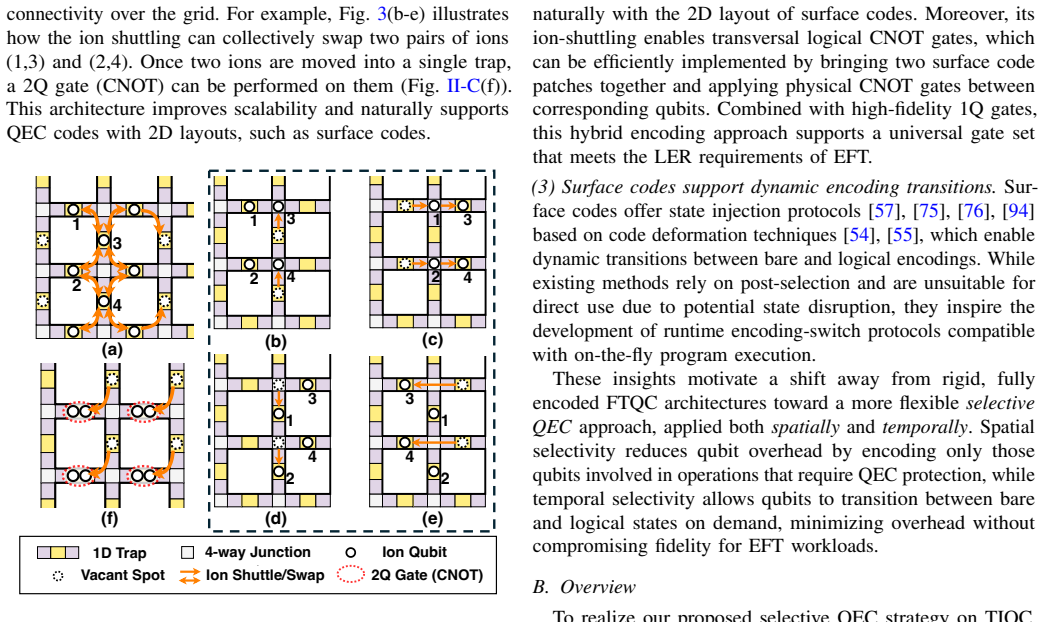
- [Sec. VII-A and Sec. VII-B] The headline comparison against MSD-Logical is not supported by the reported experiments. Section VII-A states that for circuits above 10 qubits the ansatz is restricted to Clifford circuits so that Stim can be used. A Clifford circuit contains no non-Clifford RZ(theta) rotations and hence no T gates, so the MSD-Logical baseline needs no magic-state factory. Nevertheless, Section VII-B computes the qubit budget as 30 x 2d^2 with d=9, subtracts a 2,594-qubit factory, and then gives MSD-Logical only distance-6 encoding of the 30 program qubits, while Flexion is effectively charged distance-9 patches. The reported 7.16x energy improvement for Heisenberg n=30 and the abstract's 15.5x improvement over standard FTQC are therefore largely artifacts of reserving factory qubits for a workload that, as restricted, contains no T gates. Figure 10(c)'s depth-overhead metric from Clifford+T decomposition is likewise inapplicable if the large-scale workloads are Clifford-only. Please rerun the comparison with MSD-Logical allowed to use all 4,860 qubits for distance-9 logical encoding (or an equivalently fairly resourced baseline), and report the resulting ratios and the aggregation rule behind the 15.5x number.
- [Sec. II-C, Sec. V-B, Sec. VII-A] The end-to-end evaluation omits the very operations that make the architecture distinctive. The ISA relies on LogicMove_Vertical and LogicMove_Horizontal instructions that move entire distance-9 surface-code patches across a junction grid, and transversal CNOTs require aligning patches in shared traps. Section II-C asserts that ion shuttling has negligible decoherence, but Section VII-A's noise model contains only 1Q, 2Q, and measurement/reset error terms; no shuttling time, junction-crossing error, or parallel-gate crosstalk is simulated. If moving a distance-9 patch through a 4-way junction is not effectively noiseless, then the conversion counts, routing schedules, and the Flexion-vs-NISQ comparison all change. Please add a sensitivity analysis with nonzero shuttling/junction errors, or justify quantitatively why these terms can be dropped at the reported accuracy.
- [Sec. II-C and Sec. VII-A] The SPAM assumption in the noise model is inconsistent with the hardware numbers cited in the paper. Section II-C reports SPAM fidelities exceeding 99.99%, i.e., an error rate around 1e-4, while Section VII-A sets measurement and reset error rates at order 1e-6. The encoding-shrink step in Section IV-A consists of single-qubit measurements, so the SPAM rate directly enters the conversion error pc used throughout the analysis. Please either use SPAM = 1e-4, or explicitly justify the 1e-6 choice and report how the results shift under 1e-4 SPAM.
- [Sec. IV-B and Sec. IV-C] The claim that conversion-induced logical error is independent of code distance is load-bearing and currently under-supported. Section IV-B states that only a constant number of critical qubit locations cause logical failure, so pc does not decrease with d, and Section IV-C uses a single measured ratio pc/p2 approximately 4 in the analytic comparison. The comparison is not circular, because the threshold pc/p2 < n2/nc is derived and then confirmed by compiler counts, but the numerical value of pc requires broader validation. If distance-independence fails, larger patches reduce conversion error and the trade-off between Flexion and full encoding shifts. Please provide the syndrome-level argument for distance independence in full, or a quantitative decoder simulation across d = 3,5,7,9 and at several physical error rates, rather than relying on Fig. 11 as the sole evidence.
minor comments (6)
- [Fig. 9] The legend lists 'iSwitch' alongside 'NISQ-Bare' and 'Ideal', but 'iSwitch' is never defined in the text; please clarify whether it denotes Flexion and distinguish it from the NISQ-Bare curve.
- [Sec. VI-B] The text describes Swap_Intra and Swap_Inter instructions, but Table I and the surrounding text define BareMove_Vertical and BareMove_Horizontal; please reconcile the naming.
- [Sec. II-C] Reference [81] is cited twice in the same sentence, and the Fig. 7 caption says '(1) Mapping surface codes...' while the subfigures are labeled (a)-(d); please fix the numbering.
- [Sec. IV-C] The ratio pc/p2 approximately 4 is stated without reporting the underlying measured values or simulation conditions; please add the numerical pc and p2 used.
- [Sec. VII-A] The text says the ansatz is restricted to Clifford circuits above 10 qubits, yet the benchmarks are described as approximating ground-state energies of non-Clifford Hamiltonians; please state explicitly that the reported energies are for the Clifford-restricted ansatz and may not correspond to the true ground state.
- [Sec. VII-B] The derivation of the aggregate 15.5x improvement over standard FTQC is not shown; please define how the per-benchmark ratios are aggregated into a single number.
Circularity Check
The analytic selective-QEC threshold is self-contained, but the 15.5x-vs-FTQC headline is forced by charging the Clifford-only baseline a magic-state factory it cannot need.
-
other
[Sec. VII-A (Experiment Setup) and Sec. VII-B (Flexion vs. MSD-Logical), Fig. 10]
"To enable scalable evaluation, we restrict the ansatz to Clifford circuits, which can be efficiently simulated [101] while still approximating ground-state energies in many practical settings [102], [103]. ... Assuming a T-factory of size 2594 as derived in Sec. IV-C, the remaining qubits can only encode surface codes with distance 6 for MSD-Logical."
For the large-scale benchmarks the paper itself restricts the ansatz to Clifford circuits, which by definition contain no RZ(theta) or T gates. A standard FTQC baseline for those circuits therefore needs no magic-state factory. Nevertheless, MSD-Logical is charged a 2,594-physical-qubit factory, leaving only enough qubits for distance-6 encoding of the 30 program qubits, while Flexion is effectively modeled with distance-9 patches under the same 4,860-qubit budget. The reported 7.16x energy improvement on Heisenberg n=30, and the aggregate 15.5x improvement over standard FTQC, are thus manufactured by the baseline's resource allocation rather than derived from workload properties.
full rationale
The paper's core analytic claim is not circular: the condition pc/p2 < n2/nc follows algebraically from pConv ~ n2*pL + nc*pc versus pNISQ ~ n2*p2, with pc measured from the authors' own conversion simulation and pL obtained from Stim/Pymatching. The compiler's conversion counts are then checked against this threshold, so the advantage is not assumed as an input. Self-citations, notably to code-deformation work [55] and SABRE [97], are peripheral; the encoding protocol rests on independent gauge-fixing literature and is separately benchmarked. However, the headline comparison against MSD-Logical contains a by-construction element: the large-scale evaluation uses Clifford-only circuits, for which no T-factory is needed, yet the baseline is allocated a 2,594-qubit factory. This forces MSD-Logical to distance-6 encoding while Flexion uses distance-9 patches, making the reported 7.16x / 15.5x improvements largely an artifact of the baseline setup. This is a partial circularity in a central quantitative claim, though the underlying selective-QEC derivation retains independent content.
Assumptions & free parameters
free parameters (1)
- Conversion error pc =
~4.3e-3 (pc/p2 ≈ 4)
assumptions (4)
- domain assumption Gauge-fixing theory guarantees state-preserving transfer from a bare qubit to the surface code patch (Sec. IV-A, Step 1).
- ad hoc to paper The number of critical, syndrome-ambiguous qubit locations in the encoding switch is constant as code distance grows (Sec. IV-B).
- domain assumption QCCD shuttling of ions, including whole logical patches, has negligible decoherence and negligible time cost for the results (Sec. II-C, Sec. V-B).
- domain assumption 1Q gate fidelity of 1e-6 and SPAM error rate of 1e-6 are maintained for bare qubits in the operational settings of the EFT workloads (Sec. II-C, Sec. VII-A).
invented entities (2)
-
Bare-logical boundary region
-
Encode_Boundary and Shrink_Boundary instructions
Cite this review
Pith. "Pith review of Flexion: Adaptive In-Situ Encoding for On-Demand QEC in Ion Trap Systems." pith.science (2026). https://pith.science/paper/YUOHXRC6
@misc{pith2026250416303,
  author       = {Pith},
  title        = {Pith review of: Flexion: Adaptive In-Situ Encoding for On-Demand QEC in Ion Trap Systems},
  year         = {2026},
  howpublished = {\url{https://pith.science/paper/YUOHXRC6}},
  note         = {Machine review of arXiv:2504.16303}
}
read the original abstract
Recent advances in quantum hardware and quantum error correction (QEC) have set the stage for early demonstrations of fault-tolerant quantum computing (FTQC). A key near-term goal is to build a system capable of executing millions of logical operations reliably -- referred to as a megaquop quantum computer (MQC). In this work, we propose a novel system architecture targeting MQC on trapped-ion quantum computers (TIQC), leveraging their ultra-high-fidelity single-qubit gates (1Q) and efficient two-qubit (2Q) logical CNOT gates enabled by the quantum charge-coupled device (QCCD) architecture with the ion shuttling feature. We propose Flexion, a hybrid encoding scheme that uses bare qubits for 1Q gates and QEC-encoded logical qubits for 2Q gates. This approach avoids fully encoding all qubits, eliminating the overhead of gate synthesis, teleportation, and magic state distillation for non-Clifford gates. To support this, we design (1) a low-noise conversion protocol between bare and logical qubits, (2) a bare-logical hybrid instruction set architecture tailored for 2D grid-based TIQC, and (3) a compiler that minimizes conversion cost and optimizes the scheduling efficiency. We evaluate our approach on VQA and small-scale FTQC benchmarks, showing that it achieves superior performance improvements with significantly reduced resource overhead, offering a practical path toward early FTQC on TIQC.
Figures


Figures from the paper (8 more)


Forward citations
Cited by 2 Pith papers
-
Transversal architecture for megaquop-scale quantum simulation with neutral atoms
A neutral-atom co-designed 'transversal STAR' architecture could reach megaquop-scale Hamiltonian simulation with about 10,000 physical qubits at 1e-3 error rates, corresponding to over 1e6 to 1e7 T gates.
-
Quantum Compiler Design for Qubit Mapping and Routing: A Cross-Architectural Survey of Superconducting, Trapped-Ion, and Neutral Atom Systems
A cross-architectural survey that categorizes qubit mapping and routing compilers for superconducting, trapped-ion, and neutral atom quantum hardware.
Reference graph
Works this paper leans on
-
[1]
Quantum computing in the nisq era and beyond
John Preskill. Quantum computing in the nisq era and beyond. Quantum, 2:79, 2018. 12
2018
-
[2]
Quantum supremacy using a programmable superconducting processor
Frank Arute, Kunal Arya, Ryan Babbush, Dave Bacon, Joseph C Bardin, Rami Barends, Rupak Biswas, Sergio Boixo, Fernando GSL Brandao, David A Buell, et al. Quantum supremacy using a programmable superconducting processor. Nature, 574(7779):505–510, 2019
2019
-
[3]
Super- conducting quantum computing: a review
He-Liang Huang, Dachao Wu, Daojin Fan, and Xiaobo Zhu. Super- conducting quantum computing: a review. Science China Information Sciences, 63:1–32, 2020
2020
-
[4]
The future of quantum computing with superconducting qubits
Sergey Bravyi, Oliver Dial, Jay M Gambetta, Dar ´ıo Gil, and Zaira Nazario. The future of quantum computing with superconducting qubits. Journal of Applied Physics , 132(16), 2022
2022
-
[5]
Trapped-ion quantum computing: Progress and challenges
Colin D Bruzewicz, John Chiaverini, Robert McConnell, and Jeremy M Sage. Trapped-ion quantum computing: Progress and challenges. Applied physics reviews , 6(2), 2019
2019
-
[6]
Benchmarking a trapped-ion quantum computer with 29 algorithmic qubits
Jwo-Sy Chen, Erik Nielsen, Matthew Ebert, V olkan Inlek, Kenneth Wright, Vandiver Chaplin, Andrii Maksymov, Eduardo P ´aez, Amrit Poudel, Peter Maunz, et al. Benchmarking a trapped-ion quantum computer with 29 algorithmic qubits. arXiv preprint arXiv:2308.05071 , 2023
arXiv 2023
-
[7]
Aquila: Quera’s 256-qubit neutral-atom quantum computer
Jonathan Wurtz, Alexei Bylinskii, Boris Braverman, Jesse Amato-Grill, Sergio H Cantu, Florian Huber, Alexander Lukin, Fangli Liu, Phillip Weinberg, John Long, et al. Aquila: Quera’s 256-qubit neutral-atom quantum computer. arXiv preprint arXiv:2306.11727 , 2023
arXiv 2023
-
[8]
Variational quantum algorithms
Marco Cerezo, Andrew Arrasmith, Ryan Babbush, Simon C Benjamin, Suguru Endo, Keisuke Fujii, Jarrod R McClean, Kosuke Mitarai, Xiao Yuan, Lukasz Cincio, et al. Variational quantum algorithms. Nature Reviews Physics, 3(9):625–644, 2021
2021
Show all 105 references
-
[9]
A variational eigenvalue solver on a photonic quantum processor
Alberto Peruzzo, Jarrod McClean, Peter Shadbolt, Man-Hong Yung, Xiao-Qi Zhou, Peter J Love, Al ´an Aspuru-Guzik, and Jeremy L O’brien. A variational eigenvalue solver on a photonic quantum processor. Nature communications, 5(1):4213, 2014
2014
-
[10]
A quantum approximate optimization algorithm
Edward Farhi, Jeffrey Goldstone, and Sam Gutmann. A quantum approximate optimization algorithm. arXiv preprint arXiv:1411.4028 , 2014
2014 arXiv
-
[11]
Good quantum error-correcting codes exist
A Robert Calderbank and Peter W Shor. Good quantum error-correcting codes exist. Physical Review A , 54(2):1098, 1996
1996
-
[12]
Topological quantum distillation
Hector Bombin and Miguel Angel Martin-Delgado. Topological quantum distillation. Physical review letters, 97(18):180501, 2006
2006
-
[13]
Fault-tolerant quantum computation by anyons
A Yu Kitaev. Fault-tolerant quantum computation by anyons. Annals of physics, 303(1):2–30, 2003
2003
-
[14]
Surface codes: Towards practical large-scale quantum compu- tation
Austin G Fowler, Matteo Mariantoni, John M Martinis, and Andrew N Cleland. Surface codes: Towards practical large-scale quantum compu- tation. Physical Review A , 86(3):032324, 2012
2012
-
[15]
High-threshold and low-overhead fault-tolerant quantum memory
Sergey Bravyi, Andrew W Cross, Jay M Gambetta, Dmitri Maslov, Patrick Rall, and Theodore J Yoder. High-threshold and low-overhead fault-tolerant quantum memory. Nature, 627(8005):778–782, 2024
2024
-
[16]
Quantum computation and quantum information
Michael A Nielsen and Isaac L Chuang. Quantum computation and quantum information. Cambridge university press, 2010
2010
-
[17]
Theory of fault-tolerant quantum computation
Daniel Gottesman. Theory of fault-tolerant quantum computation. Physical Review A , 57(1):127, 1998
1998
-
[18]
Fault-tolerant quantum computation
Peter W Shor. Fault-tolerant quantum computation. In Proceedings of 37th conference on foundations of computer science , pages 56–65. IEEE, 1996
1996
-
[19]
Polynomial-time algorithms for prime factorization and discrete logarithms on a quantum computer
Peter W Shor. Polynomial-time algorithms for prime factorization and discrete logarithms on a quantum computer. SIAM review, 41(2):303– 332, 1999
1999
-
[20]
A fast quantum mechanical algorithm for database search
Lov K Grover. A fast quantum mechanical algorithm for database search. In Proceedings of the twenty-eighth annual ACM symposium on Theory of computing , pages 212–219, 1996
1996
-
[21]
Quantum chemistry in the age of quantum computing
Yudong Cao, Jonathan Romero, Jonathan P Olson, Matthias Degroote, Peter D Johnson, M ´aria Kieferov´a, Ian D Kivlichan, Tim Menke, Borja Peropadre, Nicolas PD Sawaya, et al. Quantum chemistry in the age of quantum computing. Chemical reviews, 119(19):10856–10915, 2019
2019
-
[22]
Practical quantum advantage in quantum simulation
Andrew J Daley, Immanuel Bloch, Christian Kokail, Stuart Flannigan, Natalie Pearson, Matthias Troyer, and Peter Zoller. Practical quantum advantage in quantum simulation. Nature, 607(7920):667–676, 2022
2022
-
[23]
Quantum codes on a lattice with boundary
Sergey B Bravyi and A Yu Kitaev. Quantum codes on a lattice with boundary. arXiv preprint quant-ph/9811052 , 1998
1998 arXiv
-
[24]
Topological quantum memory
Eric Dennis, Alexei Kitaev, Andrew Landahl, and John Preskill. Topological quantum memory. Journal of Mathematical Physics , 43(9):4452–4505, 2002
2002
-
[25]
A game of surface codes: Large-scale quantum computing with lattice surgery
Daniel Litinski. A game of surface codes: Large-scale quantum computing with lattice surgery. Quantum, 3:128, 2019
2019
-
[26]
Surface code compilation via edge-disjoint paths
Michael Beverland, Vadym Kliuchnikov, and Eddie Schoute. Surface code compilation via edge-disjoint paths. PRX Quantum, 3(2):020342, 2022
2022
-
[27]
An- dersen, Markus Ansmann, Frank Arute, Kunal Arya, Abraham Asfaw, Nikita Astrakhantsev, Juan Atalaya, Ryan Babbush, Dave Bacon, Brian Ballard, Joseph C
Rajeev Acharya, Laleh Aghababaie-Beni, Igor Aleiner, Trond I. An- dersen, Markus Ansmann, Frank Arute, Kunal Arya, Abraham Asfaw, Nikita Astrakhantsev, Juan Atalaya, Ryan Babbush, Dave Bacon, Brian Ballard, Joseph C. Bardin, Johannes Bausch, Andreas Bengtsson, Alexander Bilmes...
2024
-
[28]
Nature, 614(7949):676–681, 2023
Suppressing quantum errors by scaling a surface code logical qubit. Nature, 614(7949):676–681, 2023
2023
-
[29]
Realization of an error-correcting surface code with superconducting qubits
Youwei Zhao, Yangsen Ye, He-Liang Huang, Yiming Zhang, Dachao Wu, Huijie Guan, Qingling Zhu, Zuolin Wei, Tan He, Sirui Cao, Fusheng Chen, Tung-Hsun Chung, Hui Deng, Daojin Fan, Ming Gong, Cheng Guo, Shaojun Guo, Lianchen Han, Na Li, Shaowei Li, Yuan Li, Futian Liang, Jin Lin, ...
2022
-
[30]
Evered, Alexandra A
Dolev Bluvstein, Simon J. Evered, Alexandra A. Geim, Sophie H. Li, Hengyun Zhou, Tom Manovitz, Sepehr Ebadi, Madelyn Cain, Marcin Kalinowski, Dominik Hangleiter, J. Pablo Bonilla Ataides, Nishad Maskara, Iris Cong, Xun Gao, Pedro Sales Rodriguez, Thomas Karolyshyn, Giulia Seme...
2024
-
[31]
Variational quan- tum algorithms in the era of early fault tolerance
Siddharth Dangwal, Suhas Vittal, Lennart Maximillian Seifert, Fred- eric T Chong, and Gokul Subramanian Ravi. Variational quan- tum algorithms in the era of early fault tolerance. arXiv preprint arXiv:2503.20963, 2025
2025 arXiv
-
[32]
Early fault-tolerant quantum computing
Amara Katabarwa, Katerina Gratsea, Athena Caesura, and Peter D Johnson. Early fault-tolerant quantum computing. PRX quantum , 5(2):020101, 2024
2024
-
[33]
Beyond nisq: The megaquop machine, 2025
John Preskill. Beyond nisq: The megaquop machine, 2025
2025
-
[34]
Performance of quantum approximate optimization with quantum error detection
Zichang He, David Amaro, Ruslan Shaydulin, and Marco Pistoia. Performance of quantum approximate optimization with quantum error detection. arXiv preprint arXiv:2409.12104 , 2024
2024
-
[35]
Limitations of optimiza- tion algorithms on noisy quantum devices
Daniel Stilck Fran c ¸a and Raul Garcia-Patron. Limitations of optimiza- tion algorithms on noisy quantum devices. Nature Physics, 17(11):1221– 1227, 2021
2021
-
[36]
Limitations of variational quantum algorithms: a quantum optimal transport approach
Giacomo De Palma, Milad Marvian, Cambyse Rouz ´e, and Daniel Stilck Franc ¸a. Limitations of variational quantum algorithms: a quantum optimal transport approach. PRX Quantum, 4(1):010309, 2023
2023
-
[37]
Simulating Many-Body Quantum Systems: Quantum Algorithms and Experimental Realisation
Natalie J Pearson. Simulating Many-Body Quantum Systems: Quantum Algorithms and Experimental Realisation . PhD thesis, ETH Zurich, 2020
2020
-
[38]
Quantum algorithms for quantum chemistry and quantum materials science
Bela Bauer, Sergey Bravyi, Mario Motta, and Garnet Kin-Lic Chan. Quantum algorithms for quantum chemistry and quantum materials science. Chemical reviews, 120(22):12685–12717, 2020
2020
-
[39]
Assessing requirements to scale to practical quantum advantage
Michael E Beverland, Prakash Murali, Matthias Troyer, Krysta M Svore, Torsten Hoefler, Vadym Kliuchnikov, Guang Hao Low, Mathias Soeken, Aarthi Sundaram, and Alexander Vaschillo. Assessing requirements to scale to practical quantum advantage. arXiv preprint arXiv:2211.07629, 2022
2022 arXiv
-
[40]
Optimal ancilla-free clifford+ t approximation of z-rotations
Neil J Ross and Peter Selinger. Optimal ancilla-free clifford+ t approximation of z-rotations. arXiv preprint arXiv:1403.2975 , 2014
2014 arXiv
-
[41]
The heisenberg representation of quantum computers
Daniel Gottesman. The heisenberg representation of quantum computers. arXiv preprint quant-ph/9807006 , 1998
1998 arXiv
-
[42]
Both toffoli and controlled-not need little help to do universal quantum computation
Yaoyun Shi. Both toffoli and controlled-not need little help to do universal quantum computation. arXiv preprint quant-ph/0205115 , 2002
2002 arXiv
-
[43]
Universal quantum computation with ideal clifford gates and noisy ancillas
Sergey Bravyi and Alexei Kitaev. Universal quantum computation with ideal clifford gates and noisy ancillas. Physical Review A—Atomic, Molecular, and Optical Physics , 71(2):022316, 2005
2005
-
[44]
Magic-state distillation with low overhead
Sergey Bravyi and Jeongwan Haah. Magic-state distillation with low overhead. Physical Review A—Atomic, Molecular, and Optical Physics , 86(5):052329, 2012
2012
-
[45]
Codes and protocols for distilling t, controlled-s, and toffoli gates
Jeongwan Haah and Matthew B Hastings. Codes and protocols for distilling t, controlled-s, and toffoli gates. Quantum, 2:71, 2018
2018
-
[46]
Ion-based quantum computing hardware: Performance and end-user perspective
Thomas Strohm, Karen Wintersperger, Florian Dommert, Daniel Basile- witsch, Georg Reuber, Andrey Hoursanov, Thomas Ehmer, Davide V odola, and Sebastian Luber. Ion-based quantum computing hardware: Performance and end-user perspective. arXiv preprint arXiv:2405.11450, 2024
2024 arXiv
-
[47]
A race-track trapped-ion quantum processor
Steven A Moses, Charles H Baldwin, Michael S Allman, R Ancona, L Ascarrunz, C Barnes, J Bartolotta, B Bjork, P Blanchard, M Bohn, et al. A race-track trapped-ion quantum processor. Physical Review X , 13(4):041052, 2023
2023
-
[48]
High-fidelity preparation, gates, memory, and readout of a trapped-ion quantum bit
TP Harty, DTC Allcock, C J Ballance, L Guidoni, HA Janacek, NM Linke, DN Stacey, and DM Lucas. High-fidelity preparation, gates, memory, and readout of a trapped-ion quantum bit. Physical review letters, 113(22):220501, 2014
2014
-
[49]
Demonstration of the trapped-ion quantum ccd computer architecture
Juan M Pino, Jennifer M Dreiling, Caroline Figgatt, John P Gaebler, Steven A Moses, MS Allman, CH Baldwin, Michael Foss-Feig, David Hayes, Karl Mayer, et al. Demonstration of the trapped-ion quantum ccd computer architecture. Nature, 592(7853):209–213, 2021
2021
-
[50]
Scalable, high-fidelity all-electronic control of trapped-ion qubits
CM L ¨oschnauer, J Mosca Toba, AC Hughes, SA King, MA Weber, R Srinivas, R Matt, R Nourshargh, DTC Allcock, CJ Ballance, et al. Scalable, high-fidelity all-electronic control of trapped-ion qubits. arXiv preprint arXiv:2407.07694, 2024
2024
-
[51]
Scalable multispecies ion transport in a grid-based surface-electrode trap
Robert D Delaney, Lucas R Sletten, Matthew J Cich, Brian Estey, Maya I Fabrikant, David Hayes, Ian M Hoffman, James Hostetter, Christopher Langer, Steven A Moses, et al. Scalable multispecies ion transport in a grid-based surface-electrode trap. Physical Review X , 14(4):041028, 2024
2024
-
[52]
Tiscc: A surface code compiler and resource estimator for trapped-ion processors
Tyler LeBlond, Ryan S Bennink, Justin G Lietz, and Christopher M Seck. Tiscc: A surface code compiler and resource estimator for trapped-ion processors. In Proceedings of the SC’23 Workshops of The International Conference on High Performance Computing, Network, Storage, and A...
2023
-
[53]
Quantum mea- surements and gates by code deformation
H´ector Bomb ´ın and Miguel Angel Martin-Delgado. Quantum mea- surements and gates by code deformation. Journal of Physics A: Mathematical and Theoretical , 42(9):095302, 2009
2009
-
[54]
Code deformation and lattice surgery are gauge fixing
Christophe Vuillot, Lingling Lao, Ben Criger, Carmen Garc ´ıa Al- mud´ever, Koen Bertels, and Barbara M Terhal. Code deformation and lattice surgery are gauge fixing. New Journal of Physics , 21(3):033028, 2019
2019
-
[55]
Surf-deformer: Mitigating dynamic defects on surface code via adaptive deformation
Keyi Yin, Xiang Fang, Travis S Humble, Ang Li, Yunong Shi, and Yufei Ding. Surf-deformer: Mitigating dynamic defects on surface code via adaptive deformation. 2024
2024
-
[56]
Stabilizer formalism for operator quantum error correction
David Poulin. Stabilizer formalism for operator quantum error correction. Physical review letters, 95(23):230504, 2005
2005
-
[57]
Magic state cultivation: growing t states as cheap as cnot gates
Craig Gidney, Noah Shutty, and Cody Jones. Magic state cultivation: growing t states as cheap as cnot gates. arXiv preprint arXiv:2409.17595, 2024
2024 arXiv
-
[58]
Logical computation demonstrated with a neutral atom quantum processor
Ben W Reichardt, Adam Paetznick, David Aasen, Ivan Basov, Juan M Bello-Rivas, Parsa Bonderson, Rui Chao, Wim van Dam, Matthew B Hastings, Andres Paz, et al. Logical computation demonstrated with a neutral atom quantum processor. arXiv preprint arXiv:2411.11822 , 2024
2024 arXiv
-
[59]
Demonstration of fault-tolerant universal quantum gate operations
Lukas Postler, Sascha Heuβen, Ivan Pogorelov, Manuel Rispler, Thomas Feldker, Michael Meth, Christian D Marciniak, Roman Stricker, Martin Ringbauer, Rainer Blatt, et al. Demonstration of fault-tolerant universal quantum gate operations. Nature, 605(7911):675–680, 2022
2022
-
[60]
Demonstration of quantum computation and error correction with a tesseract code
Ben W Reichardt, David Aasen, Rui Chao, Alex Chernoguzov, Wim van Dam, John P Gaebler, Dan Gresh, Dominic Lucchetti, Michael Mills, Steven A Moses, et al. Demonstration of quantum computation and error correction with a tesseract code. arXiv preprint arXiv:2409.04628, 2024
2024 arXiv
-
[61]
Quantum error correction with metastable states of trapped ions using erasure conversion
Mingyu Kang, Wesley C Campbell, and Kenneth R Brown. Quantum error correction with metastable states of trapped ions using erasure conversion. PRX Quantum, 4(2):020358, 2023
2023
-
[62]
Experimental demonstration of logical magic state distillation
Pedro Sales Rodriguez, John M Robinson, Paul Niklas Jepsen, Zhiyang He, Casey Duckering, Chen Zhao, Kai-Hsin Wu, Joseph Campo, Kevin Bagnall, Minho Kwon, et al. Experimental demonstration of logical magic state distillation. arXiv preprint arXiv:2412.15165 , 2024
2024
-
[63]
Evidence of scaling advantage for the quantum approximate optimization algorithm on a classically intractable problem
Ruslan Shaydulin, Changhao Li, Shouvanik Chakrabarti, Matthew DeCross, Dylan Herman, Niraj Kumar, Jeffrey Larson, Danylo Lykov, Pierre Minssen, Yue Sun, et al. Evidence of scaling advantage for the quantum approximate optimization algorithm on a classically intractable problem...
2024
-
[64]
Solving boolean satisfiability problems with the quantum approximate optimization algorithm
Sami Boulebnane and Ashley Montanaro. Solving boolean satisfiability problems with the quantum approximate optimization algorithm. PRX Quantum, 5(3):030348, 2024
2024
-
[65]
Threshold for fault- tolerant quantum advantage with the quantum approximate optimization algorithm
Sivaprasad Omanakuttan, Zichang He, Zhiwei Zhang, Tianyi Hao, Arman Babakhani, Sami Boulebnane, Shouvanik Chakrabarti, Dylan Herman, Joseph Sullivan, Michael A Perlin, et al. Threshold for fault- tolerant quantum advantage with the quantum approximate optimization algorithm. a...
2025 arXiv
-
[66]
End-to-end protocol for high-quality qaoa parameters with few shots
Tianyi Hao, Zichang He, Ruslan Shaydulin, Jeffrey Larson, and Marco Pistoia. End-to-end protocol for high-quality qaoa parameters with few shots. arXiv preprint arXiv:2408.00557 , 2024
2024
-
[67]
Alignment between initial state and mixer improves qaoa performance for constrained optimization
Zichang He, Ruslan Shaydulin, Shouvanik Chakrabarti, Dylan Herman, Changhao Li, Yue Sun, and Marco Pistoia. Alignment between initial state and mixer improves qaoa performance for constrained optimization. npj Quantum Information , 9(1):121, 2023
2023
-
[68]
Vqe using qiskit
Ketan More. Vqe using qiskit. https://github.com/ketan-more-github/ VQE-Using-Qiskit, 2021. Accessed: 2025-04-09
2021
-
[69]
The ising model: Brief introduction and its application
Satya Pal Singh. The ising model: Brief introduction and its application. In Solid state physics-metastable, spintronics materials and mechanics of deformable bodies-recent progress . IntechOpen, 2020
2020
-
[70]
Heisenberg xxz model and quantum galilei group
F Bonechi, E Celeghini, Riccardo Giachetti, E Sorace, and M Tarlini. Heisenberg xxz model and quantum galilei group. Journal of Physics A: Mathematical and General , 25(15):L939, 1992. 14
1992
-
[71]
Surface code quantum computing by lattice surgery
Dominic Horsman, Austin G Fowler, Simon Devitt, and Rodney Van Meter. Surface code quantum computing by lattice surgery. New Journal of Physics , 14(12):123011, 2012
2012
-
[72]
Pymatching: A python package for decoding quantum codes with minimum-weight perfect matching
Oscar Higgott. Pymatching: A python package for decoding quantum codes with minimum-weight perfect matching. ACM Transactions on Quantum Computing, 3(3):1–16, 2022
2022
-
[73]
Low overhead quantum computation using lattice surgery
Austin G Fowler and Craig Gidney. Low overhead quantum computation using lattice surgery. arXiv preprint arXiv:1808.06709 , 2018
2018 arXiv
-
[74]
Fault-tolerant postselected quantum computation: Threshold analysis
Emanuel Knill. Fault-tolerant postselected quantum computation: Threshold analysis. arXiv preprint quant-ph/0404104 , 2004
2004 arXiv
-
[75]
Magic state injection on the rotated surface code
Lingling Lao and Ben Criger. Magic state injection on the rotated surface code. In Proceedings of the 19th ACM International Conference on Computing Frontiers, pages 113–120, 2022
2022
-
[76]
A magic state’s fidelity can be superior to the operations that created it
Ying Li. A magic state’s fidelity can be superior to the operations that created it. New Journal of Physics , 17(2):023037, 2015
2015
-
[77]
Magic state distillation: Not as costly as you think
Daniel Litinski. Magic state distillation: Not as costly as you think. Quantum, 3:205, 2019
2019
-
[78]
Quantum computations with cold trapped ions
Juan I Cirac and Peter Zoller. Quantum computations with cold trapped ions. Physical review letters, 74(20):4091, 1995
1995
-
[79]
Electromagnetic traps for charged and neutral particles
Wolfgang Paul. Electromagnetic traps for charged and neutral particles. Reviews of modern physics , 62(3):531, 1990
1990
-
[80]
Scalable loading of a two-dimensional trapped-ion array
Colin D Bruzewicz, Robert McConnell, John Chiaverini, and Jeremy M Sage. Scalable loading of a two-dimensional trapped-ion array. Nature communications, 7(1):13005, 2016
2016
-
[81]
Multiparticle entanglement of hot trapped ions
Klaus Mølmer and Anders Sørensen. Multiparticle entanglement of hot trapped ions. Physical Review Letters , 82(9):1835, 1999
1999
-
[82]
Robust m {\o} lmer-s{\o} rensen gate against symmetric and asymmetric errors
Wenhao Zhang, Gaoxiang Tang, Kecheng Liu, Xiao Yuan, Yangchao Shen, Yukai Wu, and Xiao-Ming Zhang. Robust m {\o} lmer-s{\o} rensen gate against symmetric and asymmetric errors. arXiv preprint arXiv:2501.02847, 2025
2025 arXiv
-
[83]
High-fidelity two- qubit quantum logic gates using trapped calcium-43 ions
CJ Ballance, TP Harty, NM Linke, and DM Lucas. High-fidelity two- qubit quantum logic gates using trapped calcium-43 ions. arXiv preprint arXiv:1406.5473, 2014
2014 arXiv
-
[84]
Nature, 597(7875):209–213, 2021
Raghavendra Srinivas, SC Burd, HM Knaack, RT Sutherland, Alex Kwiatkowski, Scott Glancy, Emanuel Knill, DJ Wineland, Dietrich Leibfried, Andrew C Wilson, et al. Nature, 597(7875):209–213, 2021
2021
-
[85]
High-fidelity bell- state preparation with ca+ 40 optical qubits
Craig R Clark, Holly N Tinkey, Brian C Sawyer, Adam M Meier, Karl A Burkhardt, Christopher M Seck, Christopher M Shappert, Nicholas D Guise, Curtis E V olin, Spencer D Fallek, et al. High-fidelity bell- state preparation with ca+ 40 optical qubits. Physical Review Letters , 12...
2021
-
[86]
High-fidelity readout of trapped-ion qubits
AH Myerson, DJ Szwer, SC Webster, DTC Allcock, MJ Curtis, G Imreh, JA Sherman, DN Stacey, AM Steane, and DM Lucas. High-fidelity readout of trapped-ion qubits. Physical Review Letters, 100(20):200502, 2008
2008
-
[87]
Experimental issues in coherent quantum-state manipulation of trapped atomic ions
David J Wineland, Christopher Monroe, Wayne M Itano, Dietrich Leibfried, Brian E King, and Dawn M Meekhof. Experimental issues in coherent quantum-state manipulation of trapped atomic ions. Journal of research of the National Institute of Standards and Technology , 103(3):259, 1998
1998
-
[88]
Architecture for a large-scale ion-trap quantum computer
David Kielpinski, Chris Monroe, and David J Wineland. Architecture for a large-scale ion-trap quantum computer. Nature, 417(6890):709–711, 2002
2002
-
[89]
Entangled states of trapped atomic ions
Rainer Blatt and David Wineland. Entangled states of trapped atomic ions. Nature, 453(7198):1008–1015, 2008
2008
-
[90]
Architecting noisy intermediate-scale trapped ion quantum computers
Prakash Murali, Dripto M Debroy, Kenneth R Brown, and Margaret Martonosi. Architecting noisy intermediate-scale trapped ion quantum computers. In 2020 ACM/IEEE 47th Annual International Symposium on Computer Architecture (ISCA) , pages 529–542. IEEE, 2020
2020
-
[91]
Scaling and assigning resources on ion trap qccd architectures
Anabel Ovide, Daniele Cuomo, and Carmen G Almudever. Scaling and assigning resources on ion trap qccd architectures. In 2024 IEEE International Conference on Quantum Computing and Engineering (QCE), volume 1, pages 959–970. IEEE, 2024
2024
-
[92]
Progress in trapped-ion quantum simulation
Michael Foss-Feig, Guido Pagano, Andrew C Potter, and Norman Y Yao. Progress in trapped-ion quantum simulation. Annual Review of Condensed Matter Physics , 16, 2024
2024
-
[93]
Quantinuum accelerates the path to Universal Fully Fault-Tolerant Quantum Computing. 2024
2024
-
[94]
Fault tolerant non-clifford state preparation for arbitrary rotations
Hyeongrak Choi, Frederic T Chong, Dirk Englund, and Yongshan Ding. Fault tolerant non-clifford state preparation for arbitrary rotations. arXiv preprint arXiv:2303.17380, 2023
2023 arXiv
-
[95]
Subsystem codes with high thresholds by gauge fixing and reduced qubit overhead
Oscar Higgott and Nikolas P Breuckmann. Subsystem codes with high thresholds by gauge fixing and reduced qubit overhead. Physical Review X, 11(3):031039, 2021
2021
-
[96]
Decoding algorithms for surface codes
Antonio deMarti iOlius, Patricio Fuentes, Rom ´an Or´us, Pedro M Crespo, and Josu Etxezarreta Martinez. Decoding algorithms for surface codes. Quantum, 8:1498, 2024
2024
-
[97]
Tackling the qubit mapping prob- lem for nisq-era quantum devices
Gushu Li, Yufei Ding, and Yuan Xie. Tackling the qubit mapping prob- lem for nisq-era quantum devices. In Proceedings of the twenty-fourth international conference on architectural support for programming languages and operating systems , pages 1001–1014, 2019
2019
-
[98]
A modular quantum-classical framework for simulating chemical reaction pathways accurately
Shampa Sarkar, Manoj Nambiar, Sriram Goverapet Srinivasan, et al. A modular quantum-classical framework for simulating chemical reaction pathways accurately. arXiv preprint arXiv:2210.08930 , 2022
2022 arXiv
-
[99]
Qiskit aer: High performance simulator for quantum circuits, 2025
Qiskit Development Team. Qiskit aer: High performance simulator for quantum circuits, 2025. Accessed: 2025-02-25
2025
-
[100]
A simplex method for function minimization
John A Nelder and Roger Mead. A simplex method for function minimization. The computer journal , 7(4):308–313, 1965
1965
-
[101]
Improved simulation of stabilizer circuits
Scott Aaronson and Daniel Gottesman. Improved simulation of stabilizer circuits. Physical Review A—Atomic, Molecular, and Optical Physics , 70(5):052328, 2004
2004
-
[102]
Evidence for the utility of quantum computing before fault tolerance
Youngseok Kim, Andrew Eddins, Sajant Anand, Ken Xuan Wei, Ewout Van Den Berg, Sami Rosenblatt, Hasan Nayfeh, Yantao Wu, Michael Zaletel, Kristan Temme, et al. Evidence for the utility of quantum computing before fault tolerance. Nature, 618(7965):500–505, 2023
2023
-
[103]
Clapton: Clifford-assisted problem transformation for error mitigation in variational quantum algorithms
Lennart Maximilian Seifert, Siddharth Dangwal, Frederic T Chong, and Gokul Subramanian Ravi. Clapton: Clifford-assisted problem transformation for error mitigation in variational quantum algorithms. arXiv preprint arXiv:2406.15721 , 2024
2024 arXiv
-
[104]
Stim: a fast stabilizer circuit simulator
Craig Gidney. Stim: a fast stabilizer circuit simulator. Quantum, 5:497, 2021
2021
-
[105]
The theory of variational hybrid quantum-classical algorithms
Jarrod R McClean, Jonathan Romero, Ryan Babbush, and Al ´an Aspuru- Guzik. The theory of variational hybrid quantum-classical algorithms. New Journal of Physics , 18(2):023023, 2016. 15
2016
Reviewed August 16, 2026 · model on record in the stance chip above.
Discussion (0). Continue with ORCID to comment.