REVIEW 3 major objections 4 minor 44 references
Disentangling and Generating Modalities for Recommendation in Missing Modality Scenarios
T0 review · 3 major / 4 minor · reviewed 2026-08-16 · deepseek-v4-flash
Pith's one-line read DGMRec claims that missing modality features in recommender systems should be generated, not injected, and that disentangling each modality into shared and unique parts makes this generation accurate enough to beat existing multimodal…
desk verdict DGMRec is a genuinely integrated method for missing-modality recommendation, but the new-item experiments are unexplained by the mechanism as written and need clarification before the headline claim holds. read the letter →
The pith
A machine-rendered reading of the paper's core claim, the machinery that carries it, and where it could break.
The reading
What carries the argument
The central object is the disentangled modality representation: each modality $m$ is passed through a shared general encoder $f_g$ and a modality-specific encoder $f^s_m$ to yield general features $E^g_m$ and specific features $E^s_m$. Two information-based losses drive the separation: the Contrastive Log-ratio Upper Bound (CLUB) minimizes mutual information between general and specific features within the same modality, while InfoNCE maximizes mutual information between general features across modalities. For missing modalities, a general generator $G^g_m$ maps concatenated aligned general features from other modalities to the missing general feature, and a specific generator $G^s_m$ maps the item's user-modality preference embedding $P_{i,m}$ (the average of preference embeddings of users who interacted with the item) to the missing specific feature; a per-modality decoder then reconstructs the raw feature, and the generated features refine the item-item graph with an adaptive blend of old and new adjacency matrices.
What would settle it
Take items whose modalities are fully available, artificially mask their image and text features entirely, and compare DGMRec's generated features for those items against the true held-out features using cosine similarity or MSE, against a baseline that uses the global mean or nearest-neighbor features; if the generated features are no closer to the truth than the baseline, the mechanism behind the reported gains does not work as described. A second check is to replace the user-modality preference embedding $P_{i,m}$ in Eq. (13) with random vectors of the same dimension; if recommendation performance does not drop substantially, then the specific-feature generator is not actually using item content information.
Extended reading notes
Core claim
On its own terms, the paper establishes that a recommender that explicitly separates modality features into general and specific components, and generates missing components rather than injecting average or nearest-neighbor features, outperforms state-of-the-art multimodal recommenders and missing-modality-aware recommenders in missing-modality settings, new-item settings, varying missing ratios, and extreme cases where no modality remains. The key result is that specific features can be generated from user modality preference embeddings alone, so even an item with every modality missing can still receive a useful modality representation. The paper reports consistent improvements over the best baseline across four datasets in both evaluation settings, with relative Recall@20 gains ranging from roughly 4.7% to 14.1%, and it shows the model can retrieve similar items through generated features when all modalities are absent.
Load-bearing premise
The load-bearing premise is that the average of the modality-preference embeddings of the users who interacted with an item contains enough item-specific information to regenerate that item's unique modality attributes, so that even an item with no available modalities can receive a faithful modality representation.
Editorial extensions
If this is right
- Recommenders that generate missing modalities retain more ranking quality as the missing ratio grows; the paper reports a relative performance drop of 10.2% at 80% missing modality, compared with 15.1% for the best baseline.
- New items with partial or no modality data can still be represented through generated features, directly addressing the cold-start item recommendation problem.
- Cross-modal retrieval becomes possible: given a query item with a missing modality, generated features allow retrieving similar items even when every modality is absent.
- Disentangling modality features into shared and unique parts improves the quality of item representations for ranking, beyond the benefit of generation alone.
- Modality knowledge and collaborative knowledge reinforce each other through alignment losses, so the generated features contribute to the recommendation score rather than remaining isolated content representations.
Reading between the lines
- If the preference-embedding generation works as claimed, the same user-modality preference embeddings could serve as a portable representation for cold-start users, transferring modality preferences across domains without retraining.
- The directed-edge graph refinement strategy, which only adds edges from available modalities to missing ones, suggests a general recipe for any graph-based recommender to ingest generated features without contaminating original signals.
- A direct testable extension is to hide an available modality at test time and check whether DGMRec's generated feature for that modality approximates the true feature better than nearest-neighbor injection; if it does not, the ranking gains must come from the alignment or disentanglement losses rather than from faithful generation.
- The disentanglement losses could transfer to other multimodal tasks, such as retrieval with mixed text-and-image queries, wherever modality-specific detail matters.
Signed reviews
Editorial analysis
A structured set of objections, weighed in public.
Referee Report
Summary. The paper proposes DGMRec, a multimodal recommender system designed for missing-modality scenarios. The model splits each modality feature into a general component shared across modalities and a specific component unique to the modality, using CLUB and InfoNCE losses to enforce disentanglement and cross-modal alignment. Missing modality features are generated by a reconstruction-based module: general features are produced from other available modalities, while specific features are generated from an item-level aggregation of user modality preference embeddings (Eq. 13). The generated features are used to refine an item-item graph, and two alignment losses connect modality representations with collaborative filtering. Experiments on Baby, Sports, Clothing, and TikTok compare DGMRec with CF, MRS, and MMA-RS baselines in two settings (missing modality and missing modality plus new items), together with ablations, missing-ratio analysis, sensitivity analysis, time complexity, and cross-modal retrieval.
Significance. If the empirical claims are reliable, the paper makes a useful contribution: it offers a generation-based alternative to injection-based and robustness-based handling of missing modalities, reports directionally consistent gains over a wide set of baselines, and enables a cross-modal retrieval task that injection methods cannot support. The release of code, the broad baseline coverage, and the inclusion of ablations and sensitivity analyses are strengths. The main caveats are that the reported numbers carry no variance information and that the mechanism underlying the new-item results is under-specified; as written, the claimed new-item gains cannot be traced to the generation module without additional clarification.
major comments (3)
- [§3.1, Eq. (2); §3.3.2, Eq. (13); §4.1] For the "Missing Modality + New Items" setting, p_{i,m} is undefined for new items. New items are defined in Section 4.1 as appearing only in the test set, so their neighbor set N_i is empty when the training split is used, and the manuscript does not specify any default for P_{i,m} in this case. If P_{i,m} is computed from test interactions, that would be label leakage; if it is replaced by a constant or omitted, the specific-feature generator G^s_m(P_{i,m}) produces an item-independent vector, and the generation mechanism cannot explain the large new-item gains in Table 2 (e.g., Baby R@20 +14.06%). Please clarify how P_{i,m} is obtained for new items and report results on the new-item subset separately, because the current text makes the central new-item claim untestable.
- [§3.3.2; §4.2.2] The claim that specific features generated via the preference-based approach remain effective when no modality is available is not supported for items with no interactions. When all modalities are missing, the general-feature generator in Eq. (12) receives only mean-imputed inputs and outputs a constant; when the item is also new, the specific-feature generator in Eq. (13) is constant by the argument above. The only item-dependent signal left is a randomly initialized ID embedding that was not trained for new items. The paper should either show that P_{i,m} is well-defined and trained for such items or provide an analysis restricted to items that are simultaneously new and have zero available modalities; otherwise the reported gains in this cell cannot be attributed to the proposed generation module.
- [Tables 2-4; Figures 3-4] No standard deviations, confidence intervals, or significance tests are reported. The central claim is an empirical superiority claim (Section 4.2.1), and several reported improvements are small (e.g., TikTok R@20 +4.69% in the missing-modality setting). Without any uncertainty quantification, the reader cannot distinguish a systematic advantage from run-to-run variation. Please add multiple-seed results with standard deviations and, where appropriate, paired significance tests.
minor comments (4)
- [§4.2.3] The text says "Across all missing ratios, DGMRec consistently outperformed all baselines, except for the 0% baseline," which is internally contradictory; please rephrase and discuss the 0% case explicitly.
- [Table 3] The cross-modal retrieval setup is under-specified: Hit@10 and Hit@20 are not defined for the retrieval task, and the NN baseline is absent for the two-missing-modalities case, so the comparison is incomplete.
- [Abstract and §1] There are several typographical issues, including "Disentangling and Generating Modality Recommender" without spacing, "TikTook" instead of "TikTok", and an unusual denominator symbol in Eq. (8) that should be a summation sign.
- [§4.1] The TikTok dataset's raw features are not publicly available; this is disclosed, but the resulting reproducibility limitation should be addressed explicitly in the experimental section, for example by noting which downloaded feature files are required to run the released code.
Circularity Check
No significant circularity: DGMRec's central claims are empirical benchmark comparisons, not derived predictions.
full rationale
The paper's strongest claim is an empirical performance comparison in Table 2: DGMRec consistently outperforms existing MRSs and MMA-RSs on standard benchmarks under missing-modality and new-item settings. No fitted constant, learned parameter, or calibration curve is presented as a theoretically predicted quantity, so the core evaluation is not a derivation from its own inputs. The generation mechanism (Eqs. 12-15) is trained with reconstruction and generation losses on items whose modalities are available, and its effect is then measured on held-out ranking performance; this is a standard train/predict loop, not a self-definitional reduction. The only same-group citation is reference [10], used for the generic statement that modality features lack collaborative knowledge. That claim is used to motivate the alignment losses, but the paper independently demonstrates via ablation (Table 4, 'w/o Alignment') that these losses contribute to performance, so the self-citation is not load-bearing. No uniqueness theorem from the authors' prior work is invoked, and no ansatz is smuggled in solely through a citation. The most concerning potential issue, that Eq. 13 generates specific features from P_{i,m} computed over N_i while new items may have empty N_i, is a correctness or possible label-leak question rather than a circularity: the paper does not state that test interactions are used to compute P_{i,m}, and under the no-speculation rule this cannot be scored as circular from the text alone. Overall, the derivation chain is self-contained with respect to the empirical claims, and no circular step is exhibited.
Assumptions & free parameters
free parameters (5)
- lambda_1 =
0.01 (best on Baby/Clothing)
- lambda_2 =
0.01
- alpha =
moderate values, not extremes
- modality_generation_interval =
5 epochs
- temperature_tau =
not reported
assumptions (6)
- standard math CLUB loss (Eq 7) upper-bounds mutual information and minimizing it reduces dependence between general and specific features.
- standard math InfoNCE loss (Eq 8) provides a lower bound on mutual information whose maximization aligns general features across modalities.
- domain assumption General features of different modalities lie in a shared semantic space, so concatenating available ones and passing through a 2-layer MLP can generate a missing modality's general features (Eq 12).
- domain assumption The average of interacting users' modality preference embeddings represents an item's modality-specific content (Eqs 2 and 13).
- domain assumption Synthetic missingness, with uniform random selection of which modality is missing and an even split over missing counts, approximates real missing-modality patterns.
- domain assumption Pretrained modality features (CNN, SBERT, TikTok model) are valid fixed inputs.
invented entities (3)
-
General modality feature (E^g_m)
-
Specific modality feature (E^s_m)
-
User modality preference embedding (P_{u,m})
Cite this review
Pith. "Pith review of Disentangling and Generating Modalities for Recommendation in Missing Modality Scenarios." pith.science (2026). https://pith.science/paper/K2S3IDZA
@misc{pith2026250416352,
  author       = {Pith},
  title        = {Pith review of: Disentangling and Generating Modalities for Recommendation in Missing Modality Scenarios},
  year         = {2026},
  howpublished = {\url{https://pith.science/paper/K2S3IDZA}},
  note         = {Machine review of arXiv:2504.16352}
}
read the original abstract
Multi-modal recommender systems (MRSs) have achieved notable success in improving personalization by leveraging diverse modalities such as images, text, and audio. However, two key challenges remain insufficiently addressed: (1) Insufficient consideration of missing modality scenarios and (2) the overlooking of unique characteristics of modality features. These challenges result in significant performance degradation in realistic situations where modalities are missing. To address these issues, we propose Disentangling and Generating Modality Recommender (DGMRec), a novel framework tailored for missing modality scenarios. DGMRec disentangles modality features into general and specific modality features from an information-based perspective, enabling richer representations for recommendation. Building on this, it generates missing modality features by integrating aligned features from other modalities and leveraging user modality preferences. Extensive experiments show that DGMRec consistently outperforms state-of-the-art MRSs in challenging scenarios, including missing modalities and new item settings as well as diverse missing ratios and varying levels of missing modalities. Moreover, DGMRec's generation-based approach enables cross-modal retrieval, a task inapplicable for existing MRSs, highlighting its adaptability and potential for real-world applications. Our code is available at https://github.com/ptkjw1997/DGMRec.
Figures
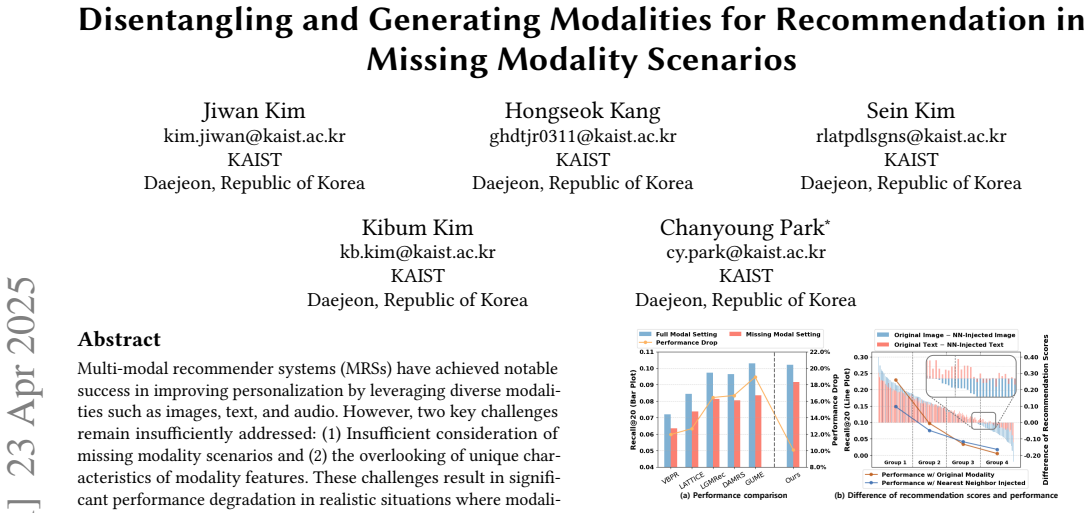


Figures from the paper (2 more)


Reference graph
Works this paper leans on
-
[1]
Haoyue Bai, Le Wu, Min Hou, Miaomiao Cai, Zhuangzhuang He, Yuyang Zhou, Richang Hong, and Meng Wang. 2024. Multimodality invariant learning for multimedia-based new item recommendation. In Proceedings of the 47th Inter- national ACM SIGIR Conference on Research and Development in Information Retrieval. 677–686
work page 2024
-
[2]
Pengyu Cheng, Weituo Hao, Shuyang Dai, Jiachang Liu, Zhe Gan, and Lawrence Carin. 2020. Club: A contrastive log-ratio upper bound of mutual information. In International conference on machine learning . PMLR, 1779–1788
2020
-
[3]
Jae Won Cho, Dong-Jin Kim, Jinsoo Choi, Yunjae Jung, and In So Kweon. 2021. Dealing with missing modalities in the visual question answer-difference predic- tion task through knowledge distillation. In Proceedings of the IEEE/CVF Confer- ence on Computer Vision and Pattern Recognition . 1592–1601
work page 2021
-
[4]
P Kingma Diederik. 2014. Adam: A method for stochastic optimization. (No Title) (2014)
2014
-
[5]
Christian Ganhör, Marta Moscati, Anna Hausberger, Shah Nawaz, and Markus Schedl. 2024. A Multimodal Single-Branch Embedding Network for Recommen- dation in Cold-Start and Missing Modality Scenarios. In Proceedings of the 18th ACM Conference on Recommender Systems . 380–390
work page 2024
-
[6]
Zhiqiang Guo, Jianjun Li, Guohui Li, Chaoyang Wang, Si Shi, and Bin Ruan. 2024. LGMRec: Local and Global Graph Learning for Multimodal Recommendation. In Proceedings of the AAAI Conference on Artificial Intelligence , Vol. 38. 8454–8462
2024
-
[7]
Ruining He and Julian McAuley. 2016. Ups and downs: Modeling the visual evolution of fashion trends with one-class collaborative filtering. In proceedings of the 25th international conference on world wide web . 507–517
2016
-
[8]
Ruining He and Julian McAuley. 2016. VBPR: visual bayesian personalized ranking from implicit feedback. In Proceedings of the AAAI conference on artificial intelligence, Vol. 30
2016
Show all 44 references
-
[9]
Xiangnan He, Kuan Deng, Xiang Wang, Yan Li, Yongdong Zhang, and Meng Wang. 2020. Lightgcn: Simplifying and powering graph convolution network for recommendation. In Proceedings of the 43rd International ACM SIGIR conference on research and development in Information Retrieval ...
2020
-
[10]
Sein Kim, Hongseok Kang, Seungyoon Choi, Donghyun Kim, Minchul Yang, and Chanyoung Park. 2024. Large language models meet collaborative filtering: An efficient all-round llm-based recommender system. In Proceedings of the 30th ACM SIGKDD Conference on Knowledge Discovery and D...
2024
-
[11]
Guojiao Lin, Meng Zhen, Dongjie Wang, Qingqing Long, Yuanchun Zhou, and Meng Xiao. 2024. GUME: Graphs and User Modalities Enhancement for Long- Tail Multimodal Recommendation. In Proceedings of the 33rd ACM International Conference on Information and Knowledge Management . 1400–1409
2024
-
[12]
Zhenghong Lin, Yanchao Tan, Yunfei Zhan, Weiming Liu, Fan Wang, Chaochao Chen, Shiping Wang, and Carl Yang. 2023. Contrastive intra-and inter-modality generation for enhancing incomplete multimedia recommendation. InProceedings of the 31st ACM International Conference on Multi...
2023
-
[13]
Daniele Malitesta, Emanuele Rossi, Claudio Pomo, Tommaso Di Noia, and Fragkiskos D Malliaros. 2024. Do We Really Need to Drop Items with Miss- ing Modalities in Multimodal Recommendation?. In Proceedings of the 33rd ACM International Conference on Information and Knowledge Man...
2024
-
[14]
Daniele Malitesta, Emanuele Rossi, Claudio Pomo, Fragkiskos D Malliaros, and Tommaso Di Noia. 2024. Dealing with Missing Modalities in Multi- modal Recommendation: a Feature Propagation-based Approach. arXiv preprint arXiv:2403.19841 (2024)
2024 arXiv
-
[15]
Aaron van den Oord, Yazhe Li, and Oriol Vinyals. 2018. Representation learning with contrastive predictive coding. arXiv preprint arXiv:1807.03748 (2018)
2018 arXiv
-
[16]
Adam Paszke, Sam Gross, Francisco Massa, Adam Lerer, James Bradbury, Gregory Chanan, Trevor Killeen, Zeming Lin, Natalia Gimelshein, Luca Antiga, et al. 2019. Pytorch: An imperative style, high-performance deep learning library. Advances in neural information processing system...
2019
-
[17]
N Reimers. 2019. Sentence-BERT: Sentence Embeddings using Siamese BERT- Networks. arXiv preprint arXiv:1908.10084 (2019)
2019 arXiv
-
[18]
Steffen Rendle, Christoph Freudenthaler, Zeno Gantner, and Lars Schmidt-Thieme
-
[19]
Zhulin Tao, Xiaohao Liu, Yewei Xia, Xiang Wang, Lifang Yang, Xianglin Huang, and Tat-Seng Chua. 2022. Self-supervised learning for multimedia recommenda- tion. IEEE Transactions on Multimedia 25 (2022), 5107–5116
2022
-
[20]
Laurens Van der Maaten and Geoffrey Hinton. 2008. Visualizing data using t-SNE. Journal of machine learning research 9, 11 (2008)
2008
-
[21]
Cheng Wang, Mathias Niepert, and Hui Li. 2018. LRMM: Learning to recommend with missing modalities. arXiv preprint arXiv:1808.06791 (2018)
2018 arXiv
-
[22]
Xiang Wang, Xiangnan He, Meng Wang, Fuli Feng, and Tat-Seng Chua. 2019. Neural graph collaborative filtering. In Proceedings of the 42nd international ACM SIGIR conference on Research and development in Information Retrieval . 165–174
2019
-
[23]
Wei Wei, Chao Huang, Lianghao Xia, and Chuxu Zhang. 2023. Multi-modal self-supervised learning for recommendation. In Proceedings of the ACM Web Conference 2023. 790–800
2023
-
[24]
Yinwei Wei, Xiang Wang, Liqiang Nie, Xiangnan He, and Tat-Seng Chua. 2020. Graph-refined convolutional network for multimedia recommendation with implicit feedback. In Proceedings of the 28th ACM international conference on multimedia. 3541–3549. Disentangling and Generating M...
2020
-
[25]
Yinwei Wei, Xiang Wang, Liqiang Nie, Xiangnan He, Richang Hong, and Tat-Seng Chua. 2019. MMGCN: Multi-modal graph convolution network for personalized recommendation of micro-video. In Proceedings of the 27th ACM international conference on multimedia. 1437–1445
2019
-
[26]
Jiancan Wu, Xiang Wang, Fuli Feng, Xiangnan He, Liang Chen, Jianxun Lian, and Xing Xie. 2021. Self-supervised graph learning for recommendation. In Proceed- ings of the 44th international ACM SIGIR conference on research and development in information retrieval. 726–735
2021
-
[27]
Le Wu, Yonghui Yang, Kun Zhang, Richang Hong, Yanjie Fu, and Meng Wang
-
[28]
Renjie Wu, Hu Wang, Hsiang-Ting Chen, and Gustavo Carneiro. 2024. Deep mul- timodal learning with missing modality: A survey.arXiv preprint arXiv:2409.07825 (2024)
2024 arXiv
-
[29]
Guipeng Xv, Xinyu Li, Ruobing Xie, Chen Lin, Chong Liu, Feng Xia, Zhanhui Kang, and Leyu Lin. 2024. Improving Multi-modal Recommender Systems by Denoising and Aligning Multi-modal Content and User Feedback. In Proceedings of the 30th ACM SIGKDD Conference on Knowledge Discover...
2024
-
[30]
Junliang Yu, Hongzhi Yin, Xin Xia, Tong Chen, Lizhen Cui, and Quoc Viet Hung Nguyen. 2022. Are graph augmentations necessary? simple graph contrastive learning for recommendation. In Proceedings of the 45th international ACM SIGIR conference on research and development in info...
2022
-
[31]
Penghang Yu, Zhiyi Tan, Guanming Lu, and Bing-Kun Bao. 2023. Multi-view graph convolutional network for multimedia recommendation. In Proceedings of the 31st ACM International Conference on Multimedia . 6576–6585
2023
-
[32]
Wenmeng Yu, Hua Xu, Ziqi Yuan, and Jiele Wu. 2021. Learning modality-specific representations with self-supervised multi-task learning for multimodal senti- ment analysis. In Proceedings of the AAAI conference on artificial intelligence , Vol. 35. 10790–10797
2021
-
[33]
Zheng Yuan, Fajie Yuan, Yu Song, Youhua Li, Junchen Fu, Fei Yang, Yunzhu Pan, and Yongxin Ni. 2023. Where to go next for recommender systems? id- vs. modality-based recommender models revisited. In Proceedings of the 46th International ACM SIGIR Conference on Research and Deve...
2023
-
[34]
Jinghao Zhang, Yanqiao Zhu, Qiang Liu, Shu Wu, Shuhui Wang, and Liang Wang
-
[35]
Jinghao Zhang, Yanqiao Zhu, Qiang Liu, Mengqi Zhang, Shu Wu, and Liang Wang
-
[36]
Hongyu Zhou, Xin Zhou, Zhiwei Zeng, Lingzi Zhang, and Zhiqi Shen. 2023. A comprehensive survey on multimodal recommender systems: Taxonomy, evalua- tion, and future directions. arXiv preprint arXiv:2302.04473 (2023)
2023 arXiv
-
[37]
Xin Zhou. 2023. Mmrec: Simplifying multimodal recommendation. InProceedings of the 5th ACM International Conference on Multimedia in Asia Workshops . 1–2
2023
-
[38]
Xin Zhou and Zhiqi Shen. 2023. A tale of two graphs: Freezing and denoising graph structures for multimodal recommendation. In Proceedings of the 31st ACM International Conference on Multimedia . 935–943
2023
-
[39]
Xin Zhou, Hongyu Zhou, Yong Liu, Zhiwei Zeng, Chunyan Miao, Pengwei Wang, Yuan You, and Feijun Jiang. 2023. Bootstrap latent representations for multi-modal recommendation. In Proceedings of the ACM Web Conference 2023 . 845–854
2023
-
[40]
Lipeng Zhu and David J Hill. 2021. Data/model jointly driven high-quality case generation for power system dynamic stability assessment. IEEE Transactions on Industrial Informatics 18, 8 (2021), 5055–5066
2021
-
[2012]
arXiv preprint arXiv:1205.2618 (2012)
BPR: Bayesian personalized ranking from implicit feedback. arXiv preprint arXiv:1205.2618 (2012)
2012 arXiv
-
[2020]
In Proceedings of the 43rd International ACM SIGIR conference on research and development in Information Retrieval
Joint item recommendation and attribute inference: An adaptive graph convolutional network approach. In Proceedings of the 43rd International ACM SIGIR conference on research and development in Information Retrieval . 679–688
-
[2021]
In Proceedings of the 29th ACM international conference on multimedia
Mining latent structures for multimedia recommendation. In Proceedings of the 29th ACM international conference on multimedia . 3872–3880
-
[2022]
IEEE Transactions on Knowledge and Data Engineering 35, 9 (2022), 9154–9167
Latent structure mining with contrastive modality fusion for multimedia recommendation. IEEE Transactions on Knowledge and Data Engineering 35, 9 (2022), 9154–9167
2022
Reviewed August 16, 2026 · model on record in the stance chip above.
Discussion (0). Continue with ORCID to comment.