REVIEW 2 major objections 5 minor 1 cited by
SaENeRF: Suppressing Artifacts in Event-based Neural Radiance Fields
T0 review · 2 major / 5 minor · reviewed 2026-08-16 · deepseek-v4-flash
Pith's one-line read Two new losses let event streams alone train clean, photorealistic neural radiance fields.
desk verdict A modest, clearly specified loss-design contribution for event-based NeRF that deserves a real referee, but the objective has a scale-invariance gap the paper never acknowledges and the empirical support is thin. read the letter →
The pith
A machine-rendered reading of the paper's core claim, the machinery that carries it, and where it could break.
The reading
What carries the argument
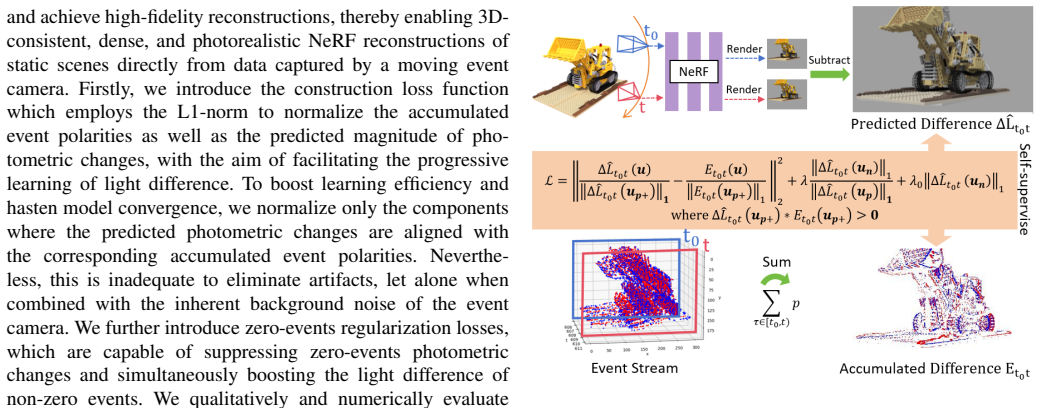
The load-bearing mechanism is the loss family built on the Event Generation Model, where accumulated event polarities over a time window, scaled by a fixed threshold, act as the supervision signal for rendered brightness change. The first component is positive-only normalization: both the predicted radiance difference and the accumulated polarity are divided by their magnitudes computed only over pixels whose predicted sign matches the event polarity, so zero-event pixels cannot inject noise into the normalization and geometry is learned before large brightness variations. The second component is zero-event regularization: one term penalizes predicted brightness change at zero-event pixels, and a second term divides that penalty by the positive-pixel variation so artifact suppression does not wash out image contrast. Two monitoring quantities, the Temporal Average of Predicted Event Thresholds and the Proportion of Appropriate Pixels, select the consistent pixels used in the normalized loss.
What would settle it
Record a static scene with a real event camera and a synchronized high-frame-rate intensity camera, then compare per-pixel accumulated event polarity times the fixed threshold against the actual log-intensity difference over the same window. If the mismatch is large precisely where SaENeRF still renders artifacts, or if training on synthetic events that satisfy Eq. (3) exactly removes all artifacts while training on real events does not, the paper's linear event model is the simplification that fails.
Extended reading notes
Core claim
The paper's central claim is that event-only NeRF training can be made artifact-resistant by reshaping the supervision signal. Instead of matching raw rendered brightness changes to raw accumulated event polarity, SaENeRF normalizes both quantities by their magnitude computed only over positive, photometrically consistent pixels, then adds penalties that drive predicted brightness change toward zero on zero-event pixels while dividing that penalty by the variation on positive pixels to preserve contrast. The authors report that this removes the aggressive early brightness learning that distorts geometry and suppresses the background artifacts caused by event noise, yielding higher PSNR and SSIM and lower LPIPS than EventNeRF and E-NeRF on synthetic scenes and visibly cleaner reconstructions on real low-light sequences.
Load-bearing premise
The whole training signal assumes that each pixel's accumulated event polarity times one fixed threshold equals the true log-brightness change, while real event sensors add per-event threshold noise, refractory behavior, and asynchronous triggering.
Editorial extensions
If this is right
- If the paper is right, event-only NeRF training no longer needs RGB frames to suppress background artifacts, so the low latency and high dynamic range of event cameras can be used directly for photorealistic novel view synthesis.
- The reported real-time variant converges in about one minute on a single 3090 GPU, suggesting event-based scene reconstruction could become an interactive capture-and-model tool rather than an offline process.
- Because the losses work at a low zero-event sampling ratio, they reduce artifact counts and sampling cost at the same time.
- The normalization changes the order of learning: geometry converges before large brightness variations are fitted, which is the mechanism the paper credits for suppressing early-training artifacts.
Reading between the lines
- The linear event model in Eq. (3) is the obvious stress point; if per-event threshold noise matters, a natural extension is to estimate a per-pixel or time-varying threshold (the paper's Temporal Average of Predicted Event Thresholds could seed such an estimate) instead of treating the threshold as a fixed constant.
- The same normalization and zero-event penalties should transfer to other event-supervised inverse rendering losses, such as event-based 3D Gaussian Splatting or event-based SLAM, since those also supervise from accumulated polarities and should inherit the artifact suppression.
- A stronger test than the reported low-light static scenes would be fast camera motion or high scene contrast, where longer windows accumulate more polarity and the linear approximation in Eq. (3) is most strained; artifacts in those regimes would show where the method's premise ends.
- A confidence-weighted version of the positive-only normalization, replacing the hard sign-consistency mask, might recover signal from small noisy polarities that the current selection discards.
Signed reviews
Editorial analysis
A structured set of objections, weighed in public.
Referee Report
Summary. The paper proposes SaENeRF, a self-supervised method for training a Neural Radiance Field (NeRF) from event streams alone. The core ideas are a normalization loss (Eq. 8) that restricts the L1 normalization to pixels with non-zero accumulated event polarity, and two zero-events regularization losses (Eqs. 9-10) that suppress photometric changes in no-event regions while promoting contrast in event regions. The method is evaluated on the EventNeRF dataset for novel view synthesis, reporting PSNR/SSIM/LPIPS improvements over EventNeRF and an E-NeRF reimplementation, together with a real-time Instant-NGP variant. The code is publicly available.
Significance. The proposed losses are simple, clearly motivated, and easy to implement; the paper also ships code, which is a strength. If the identifiability concern discussed below were resolved, the method would constitute an incremental but potentially useful improvement for event-based NeRF training. However, the central quantitative claim of 'photorealistic' reconstruction is undermined by the scale-invariance of the loss, and the reported gains over the strongest baseline are small and lack statistical backing. As it stands, the evidence does not support the abstract's claim of 'significantly reduces artifacts'.
major comments (2)
- [Sec. III-C/D, Eqs. (8)-(12)] The loss function is invariant under a global per-channel multiplicative rescaling of the rendered radiance I_c -> s_c I_c, because every loss term depends only on log-intensity differences ΔL_hat(u) = log I(u,t) - log I(u,t0), and the normalization in Eqs. (8) and (10) divides by L1 norms that also scale. Consequently, the absolute brightness and color of the reconstruction are unconstrained by the event supervision. The reported PSNR/SSIM/LPIPS values against target views therefore do not measure the method's ability to recover photometry; they reflect the MLP's initialization, bias, and activation range. This directly affects the central claim of 'photorealistic' reconstruction in the Abstract and Sec. I, and it limits the interpretation of Tables I and II. Please (i) acknowledge this identifiability issue explicitly, (ii) demonstrate that the metrics are stable under changes to the color MLP's initialization/biasing (e.g., multiple seeds, adding a constant offset to the output color, or including a scale parameter), or (iii) add a constraint that fixes the absolute scale (e.g., a gray-world prior or a penalty on the mean rendered color). Without such evidence, the quantitative comparison is not well grounded.
- [Sec. IV-A, Tables I and II] The claim that SaENeRF 'significantly reduces artifacts and achieves superior reconstruction quality' is not supported by the reported statistics. The comparison is based on a single run per method with no error bars or multiple seeds. The average PSNR gain over E-NeRF† is only 0.24 dB (30.39 vs 30.15), and SaENeRF is worse than E-NeRF† on three of the seven synthetic scenes (Lego, Ficus, Materials). The ablation study in Table III is performed on a single scene (Drums, misspelled as 'Drams' in Sec. IV-C), and the difference between norm+&zero+ and norm-&zero+ is 0.02 dB PSNR, which is well within typical run-to-run variation for NeRF training. I recommend reporting multiple seeds with standard deviations, or at least softening the language from 'significantly' to 'marginally' or 'on the tested sequence'.
minor comments (5)
- [Abstract and Sec. I] There are typos: 'changes in logarithmic brightness changes' should be 'changes in logarithmic brightness'; 'threshould' in Sec. I should be 'threshold'.
- [Sec. III-B, Eq. (2)] The equation 'pC = log I(u,t) - log I(u,tprev)' is confusing because p is defined as the polarity in {+1,-1}; it would be clearer to write 'ΔL = pC' or 'each event contributes pC to the log-intensity difference'.
- [Sec. III-E] λ0 is set to 0 for SaENeRF, so the main model does not use Lzero-; the paper should justify this choice and state whether the results in Table I rely on Lzero+ alone. A sensitivity analysis for λ and λ0 would strengthen the claims.
- [Sec. IV-A] The comparison with EventNeRF NGP uses different negative sampling ratios (0.1 for EventNeRF NGP vs. 0.05 for the other methods), which the text acknowledges but still constitutes a confound. Please at least run EventNeRF NGP with the same ratio for a fairer comparison.
- [Sec. III-C/D, Eqs. (8) and (10)] The paper does not discuss the case where the positive-sample set is empty (i.e., no non-zero accumulated polarities in an event window), which would make the denominators in Eqs. (8) and (10) zero. Please clarify how this is handled in practice.
Circularity Check
No significant circularity: SaENeRF's losses are training-time heuristics evaluated on held-out novel views, not quantities fitted to the evaluation targets.
full rationale
The paper's central claim is that its normalization (Eq. 8) and zero-events regularization losses (Eqs. 9-10) suppress artifacts in event-based NeRF reconstruction. These losses are training objectives for a NeRF and are not derived from, or fitted to, the held-out target views used in the quantitative evaluations (Tables I and II). Equation (3) is a standard event generation model cited to external sources [1], [15], and the event-window formulation follows [11]; none of these citations are self-citations by the present authors. The L1 normalization removes the event threshold C from the supervision, so the method does not constrain absolute brightness from the event data; this is an identifiability or optimization concern, not a circularity, because the training objective is not equivalent to the evaluation metrics and no fitted parameter is renamed as a prediction. The ablations on the same dataset and hand-set hyperparameters are standard empirical tuning rather than circular derivation. The paper itself acknowledges limitations (artifacts are not completely eliminated and known poses are required), which further indicates the claims are not forced by construction. No circular step can be quoted from the paper's equations or cited results.
Assumptions & free parameters
free parameters (3)
- lambda (weight of Lzero+) =
0.5 for SaENeRF, 1.0 for SaENeRF NGP
- lambda0 (weight of Lzero-) =
0 for SaENeRF, 0.5 for SaENeRF NGP
- negative sampling ratio =
0.05 for SaENeRF NGP and reimplemented baselines; 0.1 for EventNeRF NGP
assumptions (4)
- domain assumption Event Generation Model: accumulated event polarities times threshold equal log-light differences (Eq. 3)
- domain assumption Known camera intrinsics and poses
- domain assumption Static scene assumption
- domain assumption Event window aggregation
Cite this review
Pith. "Pith review of SaENeRF: Suppressing Artifacts in Event-based Neural Radiance Fields." pith.science (2026). https://pith.science/paper/V4PODQOY
@misc{pith2026250416389,
  author       = {Pith},
  title        = {Pith review of: SaENeRF: Suppressing Artifacts in Event-based Neural Radiance Fields},
  year         = {2026},
  howpublished = {\url{https://pith.science/paper/V4PODQOY}},
  note         = {Machine review of arXiv:2504.16389}
}
read the original abstract
Event cameras are neuromorphic vision sensors that asynchronously capture changes in logarithmic brightness changes, offering significant advantages such as low latency, low power consumption, low bandwidth, and high dynamic range. While these characteristics make them ideal for high-speed scenarios, reconstructing geometrically consistent and photometrically accurate 3D representations from event data remains fundamentally challenging. Current event-based Neural Radiance Fields (NeRF) methods partially address these challenges but suffer from persistent artifacts caused by aggressive network learning in early stages and the inherent noise of event cameras. To overcome these limitations, we present SaENeRF, a novel self-supervised framework that effectively suppresses artifacts and enables 3D-consistent, dense, and photorealistic NeRF reconstruction of static scenes solely from event streams. Our approach normalizes predicted radiance variations based on accumulated event polarities, facilitating progressive and rapid learning for scene representation construction. Additionally, we introduce regularization losses specifically designed to suppress artifacts in regions where photometric changes fall below the event threshold and simultaneously enhance the light intensity difference of non-zero events, thereby improving the visual fidelity of the reconstructed scene. Extensive qualitative and quantitative experiments demonstrate that our method significantly reduces artifacts and achieves superior reconstruction quality compared to existing methods. The code is available at https://github.com/Mr-firework/SaENeRF.
Figures


Figures from the paper (3 more)


Forward citations
Cited by 1 Pith paper
-
A Survey of 3D Reconstruction with Event Cameras
A dedicated survey categorizes event-based 3D reconstruction methods by input setup and reconstruction strategy, and catalogs datasets, metrics, and open challenges.
Reference graph
Works this paper leans on
-
[1]
Event- based vision: A survey,
G. Gallego, T. Delbr ¨uck, G. Orchard, C. Bartolozzi, B. Taba, A. Censi, S. Leutenegger, A. J. Davison, J. Conradt, K. Daniilidis et al., “Event- based vision: A survey,” IEEE transactions on pattern analysis and machine intelligence, vol. 44, no. 1, pp. 154–180, 2020
2020
-
[2]
Spikenerf: Learning neural radiance fields from continuous spike stream,
L. Zhu, K. Jia, Y . Zhao, Y . Qi, L. Wang, and H. Huang, “Spikenerf: Learning neural radiance fields from continuous spike stream,” in Proceedings of the IEEE/CVF Conference on Computer Vision and Pattern Recognition, 2024, pp. 6285–6295
work page 2024
-
[3]
Spike-NeRF: Neural Radiance Field Based On Spike Camera
Y . Guo, Y . Bai, L. Hu, M. Liu, Z. Guo, L. Ma, and T. Huang, “Spike- nerf: Neural radiance field based on spike camera,” arXiv preprint arXiv:2403.16410, 2024
work page Pith review arXiv 2024
-
[4]
Real-time 3d reconstruction and 6-dof tracking with an event camera,
H. Kim, S. Leutenegger, and A. J. Davison, “Real-time 3d reconstruction and 6-dof tracking with an event camera,” in Computer Vision–ECCV 2016: 14th European Conference, Amsterdam, The Netherlands, October 11-14, 2016, Proceedings, Part VI 14 . Springer, 2016, pp. 349–364
work page 2016
-
[5]
Semi-dense 3d reconstruction with a stereo event camera,
Y . Zhou, G. Gallego, H. Rebecq, L. Kneip, H. Li, and D. Scaramuzza, “Semi-dense 3d reconstruction with a stereo event camera,” in European Conference on Computer Vision (ECCV) , 2018, pp. 235–251
work page 2018
-
[6]
Event-based stereo visual odometry,
Y . Zhou, G. Gallego, and S. Shen, “Event-based stereo visual odometry,” IEEE Transactions on Robotics , vol. 37, no. 5, pp. 1433–1450, 2021
work page 2021
-
[7]
A multi-state constraint kalman filter for vision-aided inertial navigation,
A. I. Mourikis and S. I. Roumeliotis, “A multi-state constraint kalman filter for vision-aided inertial navigation,” in Proceedings 2007 IEEE international conference on robotics and automation . IEEE, 2007, pp. 3565–3572
2007
-
[8]
High speed and high dynamic range video with an event camera,
H. Rebecq, R. Ranftl, V . Koltun, and D. Scaramuzza, “High speed and high dynamic range video with an event camera,” IEEE Trans. Pattern Anal. Mach. Intell. (T-PAMI), 2019
work page 2019
Show all 38 references
-
[9]
Esim: an open event camera simulator,
H. Rebecq, D. Gehrig, and D. Scaramuzza, “Esim: an open event camera simulator,” in Conference on robot learning . PMLR, 2018, pp. 969– 982
2018
-
[10]
Nerf: Representing scenes as neural radiance fields for view synthesis,
B. Mildenhall, P. P. Srinivasan, M. Tancik, J. T. Barron, R. Ramamoorthi, and R. Ng, “Nerf: Representing scenes as neural radiance fields for view synthesis,” in ECCV, 2020
2020
-
[11]
Eventnerf: Neural radiance fields from a single colour event camera,
V . Rudnev, M. Elgharib, C. Theobalt, and V . Golyanik, “Eventnerf: Neural radiance fields from a single colour event camera,” in Computer Vision and Pattern Recognition (CVPR) , 2023
2023
-
[12]
E-nerf: Neural radiance fields from a moving event camera,
S. Klenk, L. Koestler, D. Scaramuzza, and D. Cremers, “E-nerf: Neural radiance fields from a moving event camera,” IEEE Robotics and Automation Letters, vol. 8, no. 3, pp. 1587–1594, 2023
2023
-
[13]
Robust e-nerf: Nerf from sparse and noisy events under non-uniform motion,
W. F. Low and G. H. Lee, “Robust e-nerf: Nerf from sparse and noisy events under non-uniform motion,” in Proceedings of the IEEE/CVF International Conference on Computer Vision (ICCV) , 2023
2023
-
[14]
Ev-nerf: Event based neural radiance field,
I. Hwang, J. Kim, and Y . M. Kim, “Ev-nerf: Event based neural radiance field,” in Proceedings of the IEEE/CVF Winter Conference on Applications of Computer Vision (WACV) , January 2023, pp. 837–847
2023
-
[15]
Event-aided direct sparse odometry,
J. Hidalgo-Carri ´o, G. Gallego, and D. Scaramuzza, “Event-aided direct sparse odometry,” in Proceedings of the IEEE/CVF Conference on Computer Vision and Pattern Recognition , 2022, pp. 5781–5790
2022
-
[16]
Physical priors augmented event- based 3d reconstruction,
J. Wang, J. He, Z. Zhang, and R. Xu, “Physical priors augmented event- based 3d reconstruction,” arXiv preprint arXiv:2401.17121 , 2024
2024 arXiv
-
[17]
Devo: Depth-event camera visual odometry in challenging conditions,
Y .-F. Zuo, J. Yang, J. Chen, X. Wang, Y . Wang, and L. Kneip, “Devo: Depth-event camera visual odometry in challenging conditions,” in 2022 International Conference on Robotics and Automation (ICRA) . IEEE, 2022, pp. 2179–2185
2022
-
[18]
Low-latency visual odometry using event-based feature tracks,
B. Kueng, E. Mueggler, G. Gallego, and D. Scaramuzza, “Low-latency visual odometry using event-based feature tracks,” in 2016 IEEE/RSJ International Conference on Intelligent Robots and Systems (IROS) . IEEE, 2016, pp. 16–23
2016
-
[19]
Event-image fusion stereo using cross-modality feature propagation,
H. Cho and K.-J. Yoon, “Event-image fusion stereo using cross-modality feature propagation,” in Proceedings of the AAAI Conference on Artifi- cial Intelligence, vol. 36(1), 2022, pp. 454–462
2022
-
[20]
Dsec: A stereo event camera dataset for driving scenarios,
M. Gehrig, W. Aarents, D. Gehrig, and D. Scaramuzza, “Dsec: A stereo event camera dataset for driving scenarios,” IEEE Robotics and Automation Letters, vol. 6, no. 3, pp. 4947–4954, 2021
2021
-
[21]
Dense depth- map estimation based on fusion of event camera and sparse lidar,
M. Cui, Y . Zhu, Y . Liu, Y . Liu, G. Chen, and K. Huang, “Dense depth- map estimation based on fusion of event camera and sparse lidar,” IEEE Transactions on Instrumentation and Measurement , vol. 71, pp. 1–11, 2022
2022
-
[22]
Ultimate slam? combining events, images, and imu for robust visual slam in hdr and high-speed scenarios,
A. R. Vidal, H. Rebecq, T. Horstschaefer, and D. Scaramuzza, “Ultimate slam? combining events, images, and imu for robust visual slam in hdr and high-speed scenarios,” IEEE Robotics and Automation Letters , vol. 3, no. 2, pp. 994–1001, 2018
2018
-
[23]
How to cal- ibrate your event camera,
M. Muglikar, M. Gehrig, D. Gehrig, and D. Scaramuzza, “How to cal- ibrate your event camera,” in Proceedings of the IEEE/CVF conference on computer vision and pattern recognition , 2021, pp. 1403–1409
2021
-
[24]
Event-based dense re- construction pipeline,
K. Xiao, G. Wang, Y . Chen, J. Nan, and Y . Xie, “Event-based dense re- construction pipeline,” in 2022 6th International Conference on Robotics and Automation Sciences (ICRAS) . IEEE, 2022, pp. 172–177
2022
-
[25]
E2nerf: Event enhanced neural radiance fields from blurry images,
Y . Qi, L. Zhu, Y . Zhang, and J. Li, “E2nerf: Event enhanced neural radiance fields from blurry images,” in Proceedings of the IEEE/CVF International Conference on Computer Vision, 2023, pp. 13 254–13 264
2023
-
[26]
Mitigating motion blur in neural radiance fields with events and frames,
M. Cannici and D. Scaramuzza, “Mitigating motion blur in neural radiance fields with events and frames,” in Proceedings of the IEEE/CVF Conference on Computer Vision and Pattern Recognition , 2024, pp. 9286–9296
2024
-
[27]
Deformable neural radiance fields using rgb and event cameras,
Q. Ma, D. P. Paudel, A. Chhatkuli, and L. Van Gool, “Deformable neural radiance fields using rgb and event cameras,” in Proceedings of the IEEE/CVF International Conference on Computer Vision , 2023, pp. 3590–3600
2023
-
[28]
Evd- nerf: Reconstructing event data with dynamic neural radiance fields,
A. Bhattacharya, R. Madaan, F. Cladera, S. Vemprala, R. Bonatti, K. Daniilidis, A. Kapoor, V . Kumar, N. Matni, and J. K. Gupta, “Evd- nerf: Reconstructing event data with dynamic neural radiance fields,” in Proceedings of the IEEE/CVF Winter Conference on Applications of Comp...
2024
-
[29]
Implicit event-rgbd neural slam,
D. Qu, C. Yan, D. Wang, J. Yin, D. Xu, B. Zhao, and X. Li, “Implicit event-rgbd neural slam,” arXiv preprint arXiv:2311.11013 , 2023
2023 arXiv
-
[30]
3d gaussian splatting for real-time radiance field rendering
B. Kerbl, G. Kopanas, T. Leimk ¨uhler, and G. Drettakis, “3d gaussian splatting for real-time radiance field rendering.” ACM Trans. Graph. , vol. 42, no. 4, pp. 139–1, 2023
2023
-
[31]
Event3dgs: Event-based 3d gaussian splatting for fast egomotion,
T. Xiong, J. Wu, B. He, C. Fermuller, Y . Aloimonos, H. Huang, and C. A. Metzler, “Event3dgs: Event-based 3d gaussian splatting for fast egomotion,” arXiv preprint arXiv:2406.02972 , 2024
2024 arXiv
-
[32]
Optical models for direct volume rendering,
N. Max, “Optical models for direct volume rendering,” IEEE Transac- tions on Visualization and Computer Graphics, vol. 1, no. 2, pp. 99–108, 1995
1995
-
[33]
Ray tracing volume densities,
J. T. Kajiya and B. P. V on Herzen, “Ray tracing volume densities,” ACM SIGGRAPH computer graphics , vol. 18, no. 3, pp. 165–174, 1984
1984
-
[34]
Instant neural graphics primitives with a multiresolution hash encoding,
T. M ¨uller, A. Evans, C. Schied, and A. Keller, “Instant neural graphics primitives with a multiresolution hash encoding,” ACM Transactions on Graphics (ToG), vol. 41, no. 4, pp. 1–15, 2022
2022
-
[35]
Nerfstudio: A modular framework for neural radiance field development,
M. Tancik, E. Weber, E. Ng, R. Li, B. Yi, T. Wang, A. Kristoffersen, J. Austin, K. Salahi, A. Ahuja et al., “Nerfstudio: A modular framework for neural radiance field development,” in ACM SIGGRAPH 2023 Conference Proceedings, 2023, pp. 1–12
2023
-
[36]
Nerf++: Analyzing and improving neural radiance fields,
K. Zhang, G. Riegler, N. Snavely, and V . Koltun, “Nerf++: Analyzing and improving neural radiance fields,” arXiv preprint arXiv:2010.07492, 2020
2010 arXiv
-
[37]
Image quality assess- ment: from error visibility to structural similarity,
Z. Wang, A. Bovik, H. Sheikh, and E. Simoncelli, “Image quality assess- ment: from error visibility to structural similarity,” IEEE Transactions on Image Processing , vol. 13, no. 4, pp. 600–612, 2004
2004
-
[38]
The unreasonable effectiveness of deep features as a perceptual metric,
R. Zhang, P. Isola, A. A. Efros, E. Shechtman, and O. Wang, “The unreasonable effectiveness of deep features as a perceptual metric,” in Proceedings of the IEEE Conference on Computer Vision and Pattern Recognition (CVPR), June 2018
2018
Reviewed August 16, 2026 · model on record in the stance chip above.
Discussion (0). Continue with ORCID to comment.