REVIEW 4 major objections 4 minor 17 references
LLMSR@XLLM25: Less is More: Enhancing Structured Multi-Agent Reasoning via Quality-Guided Distillation
T0 review · 4 major / 4 minor · reviewed 2026-08-16 · deepseek-v4-flash
Pith's one-line read The paper claims that reward-guided filtering—especially averaging few-shot and zero-shot reward scores—improves structured reasoning under 24-example supervision, and that data quality, not scale, drives the gain.
desk verdict A competent shared-task system with a clean ablation, but the 'quality not quantity' claim is overreached: the reward proxy is unvalidated, the comparison is confounded by dataset size, and the appendix shows the reward model passing a logically wrong label. read the letter →
The pith
A machine-rendered reading of the paper's core claim, the machinery that carries it, and where it could break.
The reading
What carries the argument
The load-bearing mechanism is a two-stage data filter. First, structural pruning removes malformed JSON, traces with fewer than two reasoning steps, and parsing failures. Second, a publicly available LLaMA-3 reward model scores each remaining trace under a few-shot prompt, a zero-shot prompt, and both averaged, and a trace is kept only when the chosen score $S(x)>0$. This filter is what turns 7,376 unlabeled LogiQA questions into 1,346 training traces for the average-reward condition, and it is the only component varied across the main comparison, so it isolates data quality as the driver of the reported gains.
What would settle it
Compare the average-reward-filtered set of 1,346 traces against 1,346 traces sampled uniformly at random from the structure-filtered pool and fine-tune identical models on each. If the random sample matches or exceeds the reward-filtered set on Reasoning F1 and Statement-Evidence F1, the paper's quality-over-quantity explanation is falsified. A second check: measure trace length and lexical complexity before and after filtering; systematic shortening would indicate the reward model selects for simplicity.
Extended reading notes
Core claim
On the paper's own terms, the discovery is that high-quality supervision, not scale, drives generalizable structured reasoning in low-resource settings. The authors generate training annotations via reverse-prompt induction and retrieval-augmented synthesis, then keep only traces whose reward score exceeds zero under one of three scoring configurations: few-shot reward, zero-shot reward, or their average. The average-based configuration performs best: the paper reports gains of 3.78 percentage points on Reasoning F1, 4.76 on Statement-Evidence F1, and 3.41 on Statement Macro F1, alongside a rise in Question Macro F1 from 56.87 to 66.71 even though question parsing was never directly rewarded. The paper reads this as evidence that accurate intermediate supervision improves even modules outside the reward loop, via better latent structure alignment.
Load-bearing premise
The load-bearing premise is that the reward model's score faithfully measures reasoning quality; if the reward model is biased toward shorter, simpler, or more fluent traces, then the filtered set is easier rather than better, and the performance gap would not show that quality caused the gain.
Editorial extensions
If this is right
- If quality-guided filtering is the active ingredient, then low-resource reasoning systems can spend compute on distillation and filtering rather than on collecting more human labels.
- Because question parsing improved even though its outputs never entered the reward computation, better intermediate supervision appears to propagate structure improvements to downstream modules in the multi-agent pipeline.
- Averaging few-shot and zero-shot reward scores is more robust than either signal alone, suggesting that multi-perspective quality estimates should be used when constructing training sets.
- Each specialist agent—parser, decomposer, verifier—can be fine-tuned independently from the same distilled pool, so the framework scales to new subtasks without retraining the whole system.
Reading between the lines
- My inference: a random-subset control would sharpen the claim—if 1,346 randomly chosen structure-filtered traces match the reward-filtered set's F1, the reported gains are about subset size, not quality.
- My inference: the quality signal may be partly a simplicity signal. Checking whether retained traces are shorter or use less complex syntax than rejected ones would tell whether the reward model selects for clarity or for ease.
- My inference: the same pipeline should transfer to other structured domains with scarce labels, such as legal or medical reasoning, provided a preference-scoring model exists; the paper does not test this.
- My inference: iterative self-distillation could compound the effect, where the fine-tuned agents generate new traces, filter them with the same reward model, and retrain.
Signed reviews
Editorial analysis
A structured set of objections, weighed in public.
Referee Report
Summary. The paper describes Less is More, the authors' third-place approach to the LLMSR@XLLM25 shared task. Given only 24 labeled examples, the method induces task prompts through reverse thinking, synthesizes reasoning traces for unlabeled LogiQA questions via retrieval-augmented in-context learning with GPT-4o, and then filters these traces using a two-stage process: structural pruning followed by reward-model scoring under few-shot, zero-shot, and averaged configurations. Three task-specific LLaMA-3-8B-Instruct models (question parser, CoT decomposer, verifier) are fine-tuned with LoRA+ on the filtered data. The central empirical claim, made in Section 4.2, is that reward-guided filtering improves structured reasoning metrics over structure-only filtering, and that this demonstrates quality rather than quantity drives performance in low-resource reasoning. The paper includes internal ablations across filtering strategies and reports gains in Question F1, Statement F1, Evidence F1, and Reasoning F1.
Significance. If the central claim holds, the paper makes a useful practical contribution: it shows a concrete, reproducible recipe for turning a very small labeled seed into a larger but carefully filtered training set for structured reasoning, with code released. The modular multi-agent design and the unified LoRA+ fine-tuning setup are clean, and the comparison across reward-filtering configurations is a sensible ablation idea. The claim that data quality matters more than scale is consistent with a growing body of work on data selection, and the low-resource setting (24 labeled examples) is practically relevant. The paper is also transparent about training-set sizes and provides an illustrative example, which is helpful for understanding the data format. However, the empirical support for the headline claim is currently incomplete: the main comparison confounds filtering with dataset size, there are no variance or significance estimates, and the single illustrative example in Appendix A contains a verification label that contradicts its own evidence while receiving high reward scores.
major comments (4)
- [Appendix A, Table 3; Sec. 2.3] The illustrative example that the authors chose to showcase contains a direct internal contradiction. The statement 'The group leader knows the most in the group, and the others know each other less' is labeled 'Verification: True', yet its own evidence reads 'The leader's acquaintanceship count is not detailed; no inference about hierarchy can be conclusively formed.' If no inference can be formed, the appropriate label is False or Unknown, not True. This trace receives high reward scores (5-shot 1.87, 0-shot 2.28, average 2.08) and survives the filtering described by Eqs. (8)-(11). Since reward-based filtering is the mechanism that the paper credits for the quality gains in Table 2, this example undercuts the assumption that the reward model is a faithful proxy for reasoning correctness. The authors should either correct the example, provide evidence that such contradictions are rare, or validate the reward model against human judgments of logical correctness.
- [Sec. 4.2, Tables 1 and 2] The central comparison in Table 2 does not isolate quality from quantity. The structure-filtered condition retains 1,940 traces, while the reward-filtered conditions retain 1,309-1,377 traces (Table 1). The performance differences could therefore reflect not higher-quality supervision but the removal of hard or out-of-distribution examples from the training set, making the remaining data easier to learn. The sentence in Sec. 4.2 stating that the setup 'isolates the impact of training data quality alone' is not supported by the design. A size-matched baseline (e.g., random or difficulty-matched subsets of the structure-filtered data at the same sizes) and ideally multiple random seeds with error bars would be needed to support the 'quality, not scale' claim.
- [Sec. 4, Tables 1 and 2] The paper reports several F1 metrics (Question F1, Statement F1, Evidence F1, Reasoning F1) but does not define them. Since the entire quantitative claim rests on these numbers, the authors should state the exact computation: at which granularity (question-level, step-level, or span-level) each metric is computed, how the shared task defines them, and whether macro-averaging or micro-averaging is used. Without these definitions, the reader cannot assess whether the reported gains are meaningful or whether the metrics are computed consistently across conditions.
- [Sec. 2.3, Eq. (11)] The reward threshold S(x) > 0 is introduced without any sensitivity analysis. The paper reports results for three filtering strategies based on different definitions of S(x), but never varies the threshold itself. Since the threshold determines the size and composition of the filtered set, the claim that the average configuration is best would be stronger if the authors showed that the relative ordering of strategies is stable across reasonable thresholds (e.g., S(x) > 0, S(x) > 0.5, or percentiles of the reward distribution).
minor comments (4)
- [Introduction] There are several typos: 'diffrent' should be 'different' and 'stratgies' should be 'strategies' in the final paragraph of Section 1.
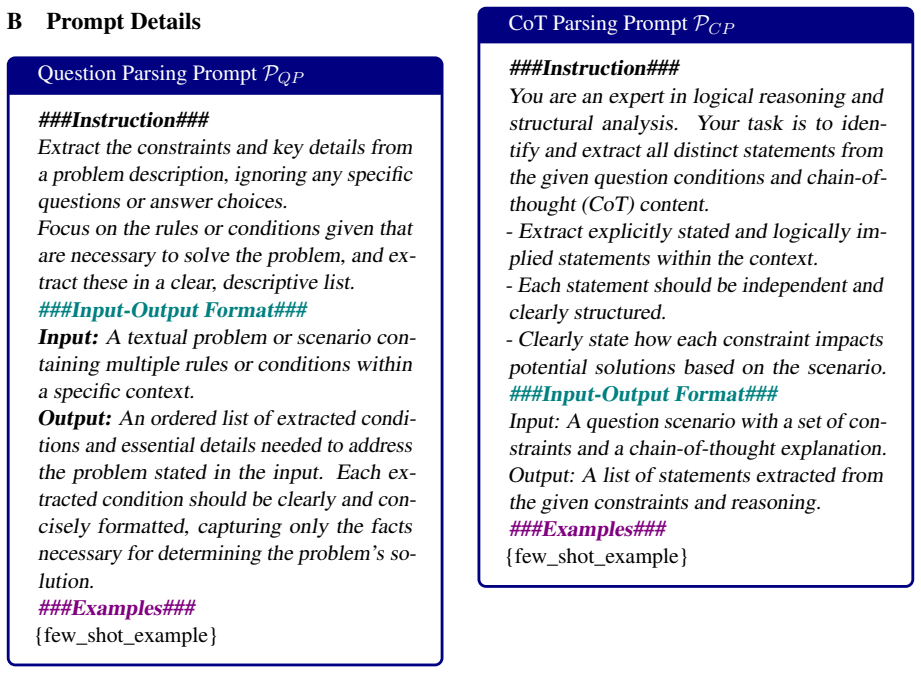
- [Figure 1] The figure labels contain typos: 'Question Paring' should be 'Question Parsing' and 'CoT Paring' should be 'CoT Parsing'.
- [Sec. 2.2] The model version used for synthesis is given as 'gpt-4o-2024-08-06' in a footnote, but the body text refers only to 'GPT-4o'. It would be helpful to state the temperature and any other decoding parameters in the main text, since they affect the quality of the synthesized data.
- [Sec. 4.1] The paper states that all models are trained for 5 epochs with a batch size of 4 and gradient accumulation of 4, but does not report the total number of training steps or the actual batch size per model. Since the training sets differ in size, the number of optimizer steps differs across conditions, which is another potential confound; reporting the number of steps would help the reader assess this.
Circularity Check
No circular derivation: the pipeline's filtering, fine-tuning, and evaluation are empirically self-contained, with self-citations used only as methodological inspiration.
full rationale
The paper makes no formal derivation claim that reduces to its inputs. Prompt induction selects task prompts from the 24-example seed set (Eqs. 1-4), synthesis uses GPT-4o with retrieval-augmented in-context learning (Eqs. 5-7), and filtering uses an external LLaMA3 reward model trained on Reward-Bench (Eqs. 8-11), followed by thresholding on S(x) > 0. Each filtered dataset is used to fine-tune Meta-Llama-3-8B-Instruct under identical LoRA+ settings, and the comparison in Table 2 is evaluated on the public LLMSR test set. No test labels or target metrics enter the filtering or training objective, so the central comparison (reward-filtered versus structure-filtered data) is not a fitted-input-called-prediction construction. The self-citation to RoT (Yuan et al., 2024) in Sec. 2.1 is used as an adopted prompting strategy, not as a load-bearing proof or uniqueness theorem, and the other 'less is more' citations are related-work support only. The skeptical concern that the reward model may reward fluency over logical correctness (see Appendix A, where a statement is labeled 'True' with evidence saying no inference can be formed) is a validity or correctness issue about the quality proxy, not a circularity of the derivation; the paper's conclusion is conditional on that proxy. No circular step is present.
Assumptions & free parameters
free parameters (4)
- reward threshold S(x) > 0 =
0
- top-k retrieval count =
not stated
- GPT-4o temperature =
0.1
- LoRA+ hyperparameters =
rank 16, alpha 32, lorap_lr_ratio 16
assumptions (4)
- domain assumption The reward model (GRM-Llama3.2-3B-rewardmodel-ft) scores correlate with actual reasoning quality.
- domain assumption GPT-4o synthesized annotations are treated as reliable ground truth for fine-tuning.
- domain assumption LogiQA is a suitable source domain for the LLMSR target task.
- domain assumption The shared task metrics (Ques F1, Stmt F1, etc.) are accurate and comparable across runs.
Cite this review
Pith. "Pith review of LLMSR@XLLM25: Less is More: Enhancing Structured Multi-Agent Reasoning via Quality-Guided Distillation." pith.science (2026). https://pith.science/paper/2ROLDLKG
@misc{pith2026250416408,
  author       = {Pith},
  title        = {Pith review of: LLMSR@XLLM25: Less is More: Enhancing Structured Multi-Agent Reasoning via Quality-Guided Distillation},
  year         = {2026},
  howpublished = {\url{https://pith.science/paper/2ROLDLKG}},
  note         = {Machine review of arXiv:2504.16408}
}
read the original abstract
The LLMSR@XLLM25 formulates a low-resource structural reasoning task that challenges LLMs to generate interpretable, step-by-step rationales with minimal labeled data. We present Less is More, the third-place winning approach in the LLMSR@XLLM25, which focuses on structured reasoning from only 24 labeled examples. Our approach leverages a multi-agent framework with reverse-prompt induction, retrieval-augmented reasoning synthesis via GPT-4o, and dual-stage reward-guided filtering to distill high-quality supervision across three subtasks: question parsing, CoT parsing, and step-level verification. All modules are fine-tuned from Meta-Llama-3-8B-Instruct under a unified LoRA+ setup. By combining structure validation with reward filtering across few-shot and zero-shot prompts, our pipeline consistently improves structure reasoning quality. These results underscore the value of controllable data distillation in enhancing structured inference under low-resource constraints. Our code is available at https://github.com/JhCircle/Less-is-More.
Figures


Figures from the paper (1 more)

Reference graph
Works this paper leans on
-
[1]
online" 'onlinestring :=
ENTRY address archivePrefix author booktitle chapter edition editor eid eprint eprinttype howpublished institution journal key month note number organization pages publisher school series title type volume year doi pubmed url lastchecked label extra.label sort.label short.list INTEGERS output.state before.all mid.sentence after.sentence after.block STRING...
-
[2]
write newline
" write newline "" before.all 'output.state := FUNCTION n.dashify 't := "" t empty not t #1 #1 substring "-" = t #1 #2 substring "--" = not "--" * t #2 global.max substring 't := t #1 #1 substring "-" = "-" * t #2 global.max substring 't := while if t #1 #1 substring * t #2 global.max substring 't := if while FUNCTION word.in bbl.in capitalize " " * FUNCT...
-
[3]
Jinhe Bi, Yifan Wang, Danqi Yan, Xun Xiao, Artur Hecker, Volker Tresp, and Yunpu Ma. 2025. Prism: Self-pruning intrinsic selection method for training-free multimodal data selection. arXiv preprint arXiv:2502.12119
arXiv 2025
-
[4]
Xun Deng, Han Zhong, Rui Ai, Fuli Feng, Zheng Wang, and Xiangnan He. 2025. Less is more: Improving llm alignment via preference data selection. arXiv preprint arXiv:2502.14560
arXiv 2025
-
[5]
Soufiane Hayou, Nikhil Ghosh, and Bin Yu. 2024. Lora+ efficient low rank adaptation of large models. In Proceedings of the 41st International Conference on Machine Learning, pages 17783--17806
work page 2024
-
[6]
Ming Li, Yong Zhang, Shwai He, Zhitao Li, Hongyu Zhao, Jianzong Wang, Ning Cheng, and Tianyi Zhou. 2024 a . Superfiltering: Weak-to-strong data filtering for fast instruction-tuning. In Proceedings of the 62nd Annual Meeting of the Association for Computational Linguistics (Volume 1: Long Papers), pages 14255--14273
2024
-
[7]
Yiwei Li, Peiwen Yuan, Shaoxiong Feng, Boyuan Pan, Bin Sun, Xinglin Wang, Heda Wang, and Kan Li. 2024 b . Turning dust into gold: Distilling complex reasoning capabilities from llms by leveraging negative data. In Proceedings of the AAAI Conference on Artificial Intelligence, volume 38, pages 18591--18599
work page 2024
-
[8]
Jian Liu, Leyang Cui, Hanmeng Liu, Dandan Huang, Yile Wang, and Yue Zhang. 2021. Logiqa: a challenge dataset for machine reading comprehension with logical reasoning. In Proceedings of the Twenty-Ninth International Conference on International Joint Conferences on Artificial Intelligence, pages 3622--3628
2021
Show all 17 references
-
[9]
Ori Ram, Yoav Levine, Itay Dalmedigos, Dor Muhlgay, Amnon Shashua, Kevin Leyton-Brown, and Yoav Shoham. 2023. In-context retrieval-augmented language models. Transactions of the Association for Computational Linguistics, 11:1316--1331
2023
-
[10]
Jason Wei, Xuezhi Wang, Dale Schuurmans, Maarten Bosma, Fei Xia, Ed Chi, Quoc V Le, Denny Zhou, and 1 others. 2022. Chain-of-thought prompting elicits reasoning in large language models. Advances in neural information processing systems, 35:24824--24837
2022
-
[11]
Jiahao Yuan, Dehui Du, Hao Zhang, Zixiang Di, and Usman Naseem. 2024. Reversal of thought: Enhancing large language models with preference-guided reverse reasoning warm-up. arXiv preprint arXiv:2410.12323
2024 arXiv
-
[12]
Jiahuan Zhang, Tianheng Wang, Hanqing Wu, Ziyi Huang, Yulong Wu, Dongbai Chen, Linfeng Song, Yue Zhang, Guozheng Rao, and Kaicheng Yu. 2025. Sr-llm: Rethinking the structured representation in large language model. arXiv preprint arXiv:2502.14352
2025 arXiv
-
[13]
Wenting Zhao, Ye Liu, Yao Wan, Yibo Wang, Qingyang Wu, Zhongfen Deng, Jiangshu Du, Shuaiqi Liu, Yunlong Xu, and S Yu Philip. 2024. knn-icl: Compositional task-oriented parsing generalization with nearest neighbor in-context learning. In Proceedings of the 2024 Conference of th...
2024
-
[14]
Chunting Zhou, Pengfei Liu, Puxin Xu, Srinivasan Iyer, Jiao Sun, Yuning Mao, Xuezhe Ma, Avia Efrat, Ping Yu, Lili Yu, and 1 others. 2023 a . Lima: Less is more for alignment. Advances in Neural Information Processing Systems, 36:55006--55021
2023
-
[15]
Yongchao Zhou, Andrei Ioan Muresanu, Ziwen Han, Keiran Paster, Silviu Pitis, Harris Chan, and Jimmy Ba. 2022. Large language models are human-level prompt engineers. In The Eleventh International Conference on Learning Representations
2022
-
[16]
Yucheng Zhou, Xiubo Geng, Tao Shen, Chongyang Tao, Guodong Long, Jian-Guang Lou, and Jianbing Shen. 2023 b . Thread of thought unraveling chaotic contexts. arXiv preprint arXiv:2311.08734
2023 arXiv
-
[17]
Yucheng Zhou, Jihai Zhang, Guanjie Chen, Jianbing Shen, and Yu Cheng. 2024. Less is more: Vision representation compression for efficient video generation with large language models
2024
Reviewed August 16, 2026 · model on record in the stance chip above.
Discussion (0). Continue with ORCID to comment.