REVIEW 3 major objections 5 minor 57 references
The Dodecacopter: a Versatile Multirotor System of Dodecahedron-Shaped Modules
T0 review · 3 major / 5 minor · reviewed 2026-08-16 · deepseek-v4-flash
Pith's one-line read A dodecahedron-shaped module can assemble into flat arrays, stiff tetrahedra, and fully actuated six-degree-of-freedom aircraft; up to sixteen modules have flown.
desk verdict Genuinely new modular rotorcraft geometry with working prototypes; the geometric core is solid, but the convexity appendix is wrong and the efficiency data cannot support the 3D scaling claim. read the letter →
The pith
A machine-rendered reading of the paper's core claim, the machinery that carries it, and where it could break.
The reading
What carries the argument
The load-bearing mechanism is the restricted connection: two modules are joined by choosing, in each module, a pair of non-adjacent vertices that lie on a common face, and aligning those pairs so the two faces are coplanar. When the eight vertices used for connections are chosen to form an inscribed cube, the resulting translation vectors generate the three-dimensional lattice $\mathcal{P}$ of Fact II.4, with basis $(1,1,0)$, $(1,0,1)$, $(0,1,1)$. This lattice does three jobs: it guarantees that frames of different modules never intersect, it makes every compatible module position representable by integer coordinates, and it reduces the configuration space to a discrete set when combined with the finite set $H$ of feasible rotor orientations. That discreteness is what turns vehicle design into a mixed-integer program with linear and second-order-conic constraints, and it is why the same module can be optimized into a stiff tetrahedron or a high-yaw-authority 12-rotor 6-DOF vehicle.
What would settle it
Run hover or thrust-stand tests on 1-, 2-, 3-, and 4-layer Dodecacopter configurations with several repeated trials per configuration, keeping rotor overlap geometry fixed; if the average per-module power penalty grows substantially with each added layer beyond the first, the assumption that distant wake interactions are small is false. A more direct check is to measure rotor thrust with a second rotor placed one, two, and three layers away at fixed spacing and test whether the induced loss decays with separation.
Extended reading notes
Core claim
The central claim is that the dodecahedron's rotational symmetry, combined with a connection rule based on pairs of vertices lying on a common face but not adjacent, gives a modular rotorcraft design whose configuration space is both rich and computationally tractable. Restricted to the eight vertices of an inscribed cube, the connection translations generate a lattice whose basis includes the vectors $(1,1,0)$, $(1,0,1)$, and $(0,1,1)$; any compatible module position lies on this lattice, and any orientation is a rotation from the 60-element symmetry group of the dodecahedron. Because positions are discrete and orientations finite, a configuration can be written with binary variables, and the paper uses this to formulate mixed-integer programs that optimize control authority and structural stiffness. The paper then verifies the concept experimentally: six configurations with 4 to 16 modules were hovered, including a 6-DOF hexarotor and layered tetrahedra, showing that the same hardware physically realizes flat, three-dimensional, and fully actuated vehicles.
Load-bearing premise
The load-bearing premise is that wake losses come mainly from rotors in adjacent layers, so adding farther layers costs little efficiency; the paper's own evidence is a single hover comparison with no repeated trials.
Editorial extensions
If this is right
- A single kit of identical modules can replace several monolithic aircraft, since the same module recreates quadrotor and hexarotor layouts directly.
- Three-dimensional assemblies are stiffer than flat arrays with the same module count; for four modules, the tetrahedral quadrotor's worst-case compliance is about a quarter of the flat quadrotor's.
- Fully actuated hovering is achievable without tilting mechanisms by choosing module orientations from the dodecahedron's rotational symmetries, as in the optimized 12-rotor example.
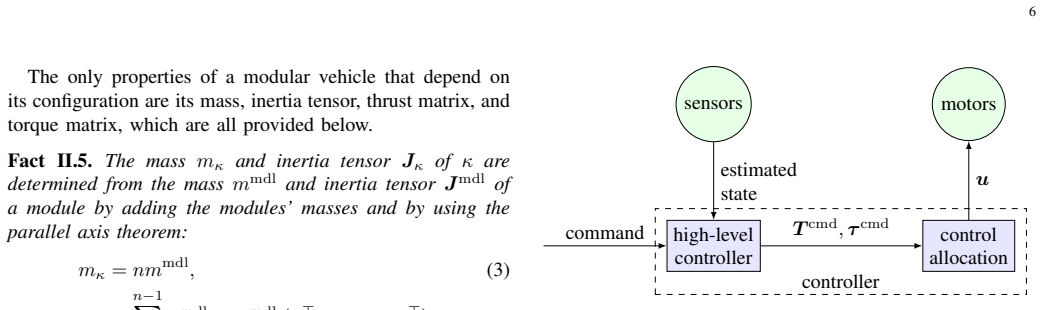
- Because overactuated configurations admit many control allocation matrices, the paper's convex programs let a designer trade reachable thrust and torque authority against expected power consumption.
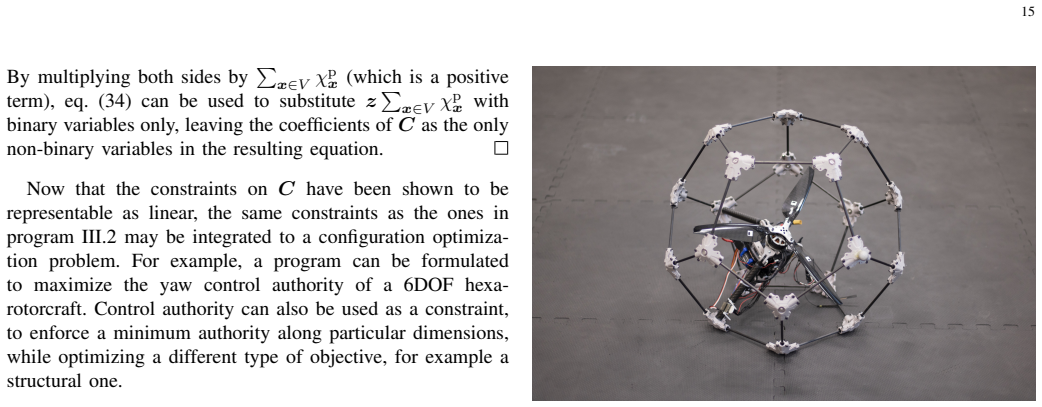
- The prototype flights of up to sixteen modules, including layered tetrahedral shapes, indicate the concept is practically flyable, not only theoretically valid.
Reading between the lines
- If the hover data generalize, then very tall stacks of Dodecacopter modules may stay close to flat-array efficiency, making large 3D vehicles practical; this is an inference from the paper's one-dataset observation, not a proven result.
- The lattice formulation is tied to connections through the eight cube vertices; allowing all 3600 possible face-pair connections would likely yield different position sets with different rigidity and actuation properties that the paper does not explore.
- The control-allocation and stiffness formulations are stated for arbitrary rotor positions, so they should transfer to any overactuated multirotor, modular or not.
- Because configuration data produce both stiffness and actuation matrices, one could extend the pipeline to compute control gains automatically, removing the manual per-configuration tuning that the paper reports as the main practical bottleneck.
Signed reviews
Editorial analysis
A structured set of objections, weighed in public.
Referee Report
Summary. The paper introduces the Dodecacopter, a modular rotorcraft system in which each module is a regular dodecahedron with a fixed-pitch propeller mounted along an axis through two opposite vertices. The proposed connection rule, based on joining two non-adjacent vertices of a face and restricted to a cube subset of dodecahedron vertices, is shown to generate a three-dimensional lattice of admissible module positions and a finite set of rotor orientations. On this basis the authors derive the thrust and torque matrices of arbitrary configurations, propose convex programs for control allocation (maximizing a reachable actuation set and minimizing average power consumption), define structural stiffness indicators via space-frame analysis, and formulate mixed-integer programs for configuration optimization under connectivity, wake-avoidance, and actuation constraints. The paper also reports a prototype and hover tests of six configurations, including flat quadrotors/hexarotors, tetrahedral three-dimensional assemblies, and a six-DOF hexarotor.
Significance. If the results hold, this is a meaningful step beyond two-dimensional modular flight arrays: the same module can form flat arrays, stiff three-dimensional tetrahedral structures, and fully actuated vehicles, and the lattice description makes configuration optimization amenable to mixed-integer programming. The clean geometric characterizations (Fact II.3 and Fact II.4), the structural performance indicators, and the six flown configurations are genuine strengths. The central geometric derivation appears sound. However, the paper's practical-viability argument relies on a wake-interaction inference that is not statistically supported, and the convexity proof for one of the proposed allocation programs contains an algebraic error. Neither issue appears fatal to the core module concept, but both need to be corrected or substantially qualified before the paper can be accepted.
major comments (3)
- [Appendix A; Program III.4] The claimed convexity proof for Eq. (46) is not valid as written. Kummer's transformation applied with a = -3/4, b = 1/2, and z = -x gives f(x) = x^{-3/4} e^{-x} 1F1(5/4,1/2,x), not the expression with e^x in Eq. (50). The subsequent second-derivative expression mixes e^{-x} factors with terms that appear inconsistent with either version of f, and the final positivity assertion is stated after 'grouping terms' without a verifiable intermediate derivation. Since Program III.4 relies on convexity of Eq. (15) through this lemma, the power-allocation contribution is not supported as written. I am not asserting the result is false; I am asking for a corrected proof, a reliable citation, or explicit removal of the convexity claim from the main contribution list.
- [VI.C; Table II] The conclusion that wake-induced losses are dominated by adjacent-layer interactions, and that non-adjacent interactions are small, is not established by the presented data. Table II reports one normalized motor-input value per configuration, with no repeat trials, error bars, or significance tests. The three tetrahedron configurations differ simultaneously in module count, number of layers, and rotor-overlap geometry, so the 14% penalty relative to flat configurations and the monotone increase from 0.34 to 0.35 to 0.37 cannot be cleanly attributed to adjacent-layer wake. Non-adjacent-layer interactions are never measured in isolation. Because the practical case for larger multi-layer Dodecacopter vehicles rests on this inference, the claim should either be supported by controlled experiments (for example, varying layer separation at constant module count) or explicitly reduced to a speculative observation.
- [V.E, Fact V.2] The claim that M_tt C = H can be linearized with the big-M method is incomplete. Big-M linearization of products of binary variables with a continuous variable C requires a priori bounds on C. The programs in Section V do not impose explicit bounds on C; the norm constraints in Program V.1 bound certain combinations of the rows of C, but not the full matrix C unless additional assumptions are stated. Without a bounded feasible set or an explicit bound, the equivalence asserted in Fact V.2 is not established, which weakens the mixed-integer formulation underlying Program V.1. Please add explicit bounds (for example, derived from actuator limits and a chosen M) or prove that the feasible set is bounded.
minor comments (5)
- [Section V.G, Program V.1] The displayed Program V.1 is under-specified: the objective minimizes lambda, but no constraint involves lambda, and the inequality uses s without defining it as a variable or as a fixed parameter. Please state the objective and the role of s explicitly.
- [Section II.B, Definition II.5] The concatenation operation in Definition II.5 is described as composition, but translations are applied in the original coordinate frame, which is nonstandard. Calling it a concatenation operation rather than composition would prevent confusion.
- [Section III.B.3] There are several small typos: 'Moore-Pensore' in Fact III.2, 'an other method' in Section III.B.3, 'CRFP' in Section VI.A (likely CFRP), and 'an arbitrary a 6DOF configuration' in Section V.G. These should be corrected in a revision.
- [Section III.C, Figures 9 and 10] The comparison of allocation matrices would be easier to interpret if Figure 9 included error bars or a statement of the number of simulations, and if Figure 10 had labeled axes and visible scale information for both the per-matrix sets and the global reachable set.
- [Section VI.B, Eq. (45)] The displayed control allocation matrix for the tetrahedron quadrotor is said to show that the top motor receives three-times-larger yaw commands, but the matrix is shown up to scale; please state explicitly how the matrix is normalized.
Circularity Check
No significant circularity: the dodecahedron connection lattice, actuation models, optimization programs, and flight tests are self-contained; self-citations are background only and are not load-bearing.
full rationale
The derivation chain is self-contained. The lattice of reachable module positions is constructed from the dodecahedron vertex coordinates, as in Fact II.4 where the vectors (1,1,0), (1,0,1), and (0,1,1) are shown to generate the three-dimensional lattice P, and Fact II.3 characterizes compatibility from the definition of connections and the group structure of S_D and P rather than assuming it. The actuation model in Fact II.6 is the standard thrust/torque proportionality model, and the control-allocation programs are convex reformulations of that model; no parameter is fitted to later flight data and then renamed a prediction. The structural indicators in Section IV are derived from the textbook space-frame elastic stiffness matrix, not from the paper's own conclusions. The MIP formulation in Section V encodes the connection graph, contiguity constraints, wake-exclusion constraints, and stiffness constraints using standard graph and big-M techniques, so the example configurations are outputs of the stated programs rather than inputs. The only self-citations, [8], [25], and [49], are background references about wake interactions and continuing work; they do not carry the central claims that dodecahedron modules generate three-dimensional and fully actuated configurations. The flight-test section is empirical and explicitly hedged: "Although no definitive conclusion can be made based solely on this observation..." That caveat concerns statistical strength, not circularity, and the paper's central geometric and actuation claims do not depend on that inference. No fitted input is relabeled as a prediction, no uniqueness theorem is imported from the authors' prior work, and no result reduces by definition to its own input.
Assumptions & free parameters
free parameters (4)
- Thrust and torque coefficients kth and kto
- Hover control vector uh
- Covariance Sigma of command vector distribution
- Structural member properties (beam cross-section, material)
assumptions (9)
- standard math Finite subgroups of SO(3) are exactly cyclic, dihedral, tetrahedral, octahedral, or icosahedral.
- standard math The regular dodecahedron has rotational symmetry group of order 60.
- domain assumption Each rotor produces thrust and counter-torque proportional to the square of its rotation speed, with constant coefficients.
- domain assumption Power consumption of a rotor is proportional to u_i^{3/2}.
- ad hoc to paper The high-level actuation commands t are multivariate normal with covariance Sigma.
- domain assumption Frame joints are perfectly rigid and displacements are small.
- standard math The graph contiguity MIP formulation from [42] enforces connectivity.
- domain assumption Unmodeled aerodynamic forces and moments scale benignly with module count.
- domain assumption Distinct lattice points from the restricted connection set place dodecahedra without unintended frame collisions.
invented entities (1)
-
Dodecacopter module
independent evidence
Cite this review
Pith. "Pith review of The Dodecacopter: a Versatile Multirotor System of Dodecahedron-Shaped Modules." pith.science (2026). https://pith.science/paper/WOZBDU7Y
@misc{pith2026250416475,
  author       = {Pith},
  title        = {Pith review of: The Dodecacopter: a Versatile Multirotor System of Dodecahedron-Shaped Modules},
  year         = {2026},
  howpublished = {\url{https://pith.science/paper/WOZBDU7Y}},
  note         = {Machine review of arXiv:2504.16475}
}
read the original abstract
With the promise of greater safety and adaptability, modular reconfigurable uncrewed air vehicles have been proposed as unique, versatile platforms holding the potential to replace multiple types of monolithic vehicles at once. State-of-the-art rigidly assembled modular vehicles are generally two-dimensional configurations in which the rotors are coplanar and assume the shape of a "flight array". We introduce the Dodecacopter, a new type of modular rotorcraft where all modules take the shape of a regular dodecahedron, allowing the creation of richer sets of configurations beyond flight arrays. In particular, we show how the chosen module design can be used to create three-dimensional and fully actuated configurations. We justify the relevance of these types of configurations in terms of their structural and actuation properties with various performance indicators. Given the broad range of configurations and capabilities that can be achieved with our proposed design, we formulate tractable optimization programs to find optimal configurations given structural and actuation constraints. Finally, a prototype of such a vehicle is presented along with results of performed flights in multiple configurations.
Figures


Figures from the paper (12 more)




Reference graph
Works this paper leans on
-
[1]
Modular reconfigurable robotics,
J. Seo, J. Paik, and M. Yim, “Modular reconfigurable robotics,” Annual Review of Control, Robotics, and Autonomous Systems , vol. 2, no. 1, pp. 63–88, 2019. DOI: 10.1146/annurev-control-053018-023834
-
[2]
R. Oung and R. D’Andrea, “The distributed flight array,” Mechatronics, vol. 21, no. 6, pp. 908–917, 2011. DOI: 10.1016/j.mechatronics.2010.08.003
-
[3]
A class of mod- ular aerial robots,
R. Naldi, F. Forte, and L. Marconi, “A class of mod- ular aerial robots,” in 50th IEEE CDC & ECC , 2011, pp. 3584–3589. DOI: 10.1109/CDC.2011.6161298
arXiv 2011
-
[4]
The LIFT! project – modular, electric vertical lift system with ground power tether,
M. J. Duffy and A. Samaritano, “The LIFT! project – modular, electric vertical lift system with ground power tether,” in 33rd AIAA AAC, 2015, pp. 3013–3032. DOI: doi/10.2514/6.2015-3013
-
[5]
ModQuad: The flying modular structure that self- assembles in midair,
D. Saldana, B. Gabrich, G. Li, M. Yim, and V . Kumar, “ModQuad: The flying modular structure that self- assembles in midair,” in IEEE ICRA , 2018, pp. 691–
work page 2018
-
[6]
Universal flying objects: Modular multirotor system for flight of rigid objects,
B. Mu and P. Chirarattananon, “Universal flying objects: Modular multirotor system for flight of rigid objects,” IEEE Transactions on Robotics, vol. 36, no. 2, pp. 458– 471, 2019. DOI: 10.1109/TRO.2019.2954679
arXiv 2019
-
[7]
Self-reconfiguration in response to faults in modular aerial systems,
N. Gandhi, D. Saldana, V . Kumar, and L. T. X. Phan, “Self-reconfiguration in response to faults in modular aerial systems,” IEEE Robotics and Automation Letters, vol. 5, no. 2, pp. 2522–2529, 2020. DOI: 10.1109/LRA. 2020.2970685
arXiv 2020
-
[8]
Modeling and experimental validation of a fractal tetrahedron UAS assembly,
K. Garanger, J. Epps, and E. Feron, “Modeling and experimental validation of a fractal tetrahedron UAS assembly,” in IEEE AeroConf, Big Sky, MT, USA, 2020, pp. 1–11. DOI: 10.1109/AERO47225.2020.9172614
arXiv 2020
Show all 57 references
-
[9]
The reconfig- urable aerial robotic chain: Shape and motion planning,
M. Kulkarni, H. Nguyen, and K. Alexis, “The reconfig- urable aerial robotic chain: Shape and motion planning,” IFAC-PapersOnLine, vol. 53, no. 2, pp. 9295–9302,
-
[10]
Reconfigurable drone system for transportation of parcels with variable mass and size,
F. Schiano, P. M. Kornatowski, L. Cencetti, and D. Flo- reano, “Reconfigurable drone system for transportation of parcels with variable mass and size,” IEEE Robotics and Automation Letters , vol. 7, no. 4, pp. 12 150– 12 157, 2022. DOI: 10.1109/LRA.2022.3208716
2022
-
[11]
Mod- ular reconfigurable rotorcraft for autonomous cargo delivery,
J. Davis, M. Park, I. Shapiro, and M. Costello, “Mod- ular reconfigurable rotorcraft for autonomous cargo delivery,” Proceedings of the Institution of Mechanical Engineers, Part G: Journal of Aerospace Engineering , vol. 238, no. 14, pp. 1419–1439, 2024. DOI: 10.1177/ 09544100...
2024
-
[12]
Modular, teth- ered, reconfigurable hybrid robotic vehicles for aerial grasping and package delivery,
M. Kobayashi, G. Huang, J. Buzzatto, A. Lynch, K. Kyriakopoulos, and M. Liarokapis, “Modular, teth- ered, reconfigurable hybrid robotic vehicles for aerial grasping and package delivery,” in IEEE SSRR , 2024, pp. 131–135. DOI: 10 . 1109 / SSRR62954 . 2024 . 10770002
2024
-
[13]
Modeling and switched control of modular reconfigurable flight array for faulty redundancy,
B. Ren, C. Yang, X. Zhang, and W. Mao, “Modeling and switched control of modular reconfigurable flight array for faulty redundancy,” Processes, vol. 12, no. 4,
-
[14]
Fundamental actuation properties of multirotors: Force–moment de- coupling and fail–safe robustness,
G. Michieletto, M. Ryll, and A. Franchi, “Fundamental actuation properties of multirotors: Force–moment de- coupling and fail–safe robustness,” IEEE Transactions on Robotics , vol. 34, no. 3, pp. 702–715, 2018. DOI: 10.1109/TRO.2018.2821155
2018
-
[15]
Modeling, control and design optimization for a fully- actuated hexarotor aerial vehicle with tilted propellers,
S. Rajappa, M. Ryll, H. H. B ¨ulthoff, and A. Franchi, “Modeling, control and design optimization for a fully- actuated hexarotor aerial vehicle with tilted propellers,” in IEEE ICRA , 2015, pp. 4006–4013. DOI: 10.1109/ ICRA.2015.7139759
2015
-
[16]
Design, modeling and control of an omni-directional aerial vehicle,
D. Brescianini and R. D’Andrea, “Design, modeling and control of an omni-directional aerial vehicle,” in IEEE ICRA, 2016, pp. 3261–3266
2016
-
[17]
A maneuverability analysis of a novel hexarotor UA V concept,
H. Mehmood, T. Nakamura, and E. N. Johnson, “A maneuverability analysis of a novel hexarotor UA V concept,” in IEEE ICUAS , 2016, pp. 437–446. DOI: 10.1109/ICUAS48674.2020.9214004
2016
-
[18]
Maneuver- ability analysis of a fully-actuated hexrotor UA V con- sidering tilt angles and arrangement of rotors,
Y . Tadokoro, T. Ibuki, and M. Sampei, “Maneuver- ability analysis of a fully-actuated hexrotor UA V con- sidering tilt angles and arrangement of rotors,” IFAC- PapersOnLine, vol. 50, no. 1, pp. 8981–8986, 2017. DOI: 10.1016/j.ifacol.2017.08.1325
2017 doi
-
[19]
Past, present, and future of aerial robotic manipulators,
A. Ollero, M. Tognon, A. Suarez, D. Lee, and A. Franchi, “Past, present, and future of aerial robotic manipulators,” IEEE Transactions on Robotics, vol. 38, no. 1, pp. 626–645, 2021. DOI: 10.1109/TRO.2021. 3084395
2021 doi
-
[20]
Design, modeling and control of omni-directional aerial robot,
S. Park, J. Her, J. Kim, and D. Lee, “Design, modeling and control of omni-directional aerial robot,” in IEEE IROS, 2016, pp. 1570–1575. DOI: 10.1109/IROS.2016. 7759254
2016 doi
-
[21]
The V oliro omniorientational hexacopter: An agile and maneuver- able tiltable-rotor aerial vehicle,
M. Kamel, S. Verling, O. Elkhatib, et al. , “The V oliro omniorientational hexacopter: An agile and maneuver- able tiltable-rotor aerial vehicle,” IEEE Robotics & Automation Magazine, vol. 25, no. 4, pp. 34–44, 2018. DOI: 10.1109/MRA.2018.2866758. 20
2018
-
[22]
A novel robotic platform for aerial manipulation using quadro- tors as rotating thrust generators,
H.-N. Nguyen, S. Park, J. Park, and D. Lee, “A novel robotic platform for aerial manipulation using quadro- tors as rotating thrust generators,” IEEE Transactions on Robotics , vol. 34, no. 2, pp. 353–369, 2018. DOI: 10.1109/TRO.2018.2791604
2018
-
[23]
Design and optimal control of a tiltrotor micro-aerial vehicle for efficient omnidirectional flight,
M. Allenspach, K. Bodie, M. Brunner, et al. , “Design and optimal control of a tiltrotor micro-aerial vehicle for efficient omnidirectional flight,” The International Jour- nal of Robotics Research, vol. 39, no. 10-11, pp. 1305– 1325, 2020. DOI: 10.1177/0278364920943654
2020 doi
-
[24]
ModQuad-DoF: A novel yaw actuation for modular quadrotors,
B. Gabrich, G. Li, and M. Yim, “ModQuad-DoF: A novel yaw actuation for modular quadrotors,” in IEEE ICRA, 2020, pp. 8267–8273. DOI: 10.1109/ICRA40945. 2020.9196735
2020
-
[25]
Wake interactions of a tetrahedron quadcopter,
J. Epps, K. Garanger, and E. Feron, “Wake interactions of a tetrahedron quadcopter,” in IEEE ICUAS , 2020, pp. 1852–1859
2020
-
[26]
Classifying the finite subgroups of so (3)
H. T. A. Bui. “Classifying the finite subgroups of so (3).” (2020), [Online]. Available: https://math.uchicago. edu/%7Emay/REU2020/REUPapers/Bui,An.pdf
2020
-
[27]
H. S. M. Coxeter, Regular Polytopes, 3rd. Mineola, NY , USA: Dover Publications, 1973
1973
-
[28]
Modelling and control of quadcopter,
T. Luukkonen, “Modelling and control of quadcopter,” School of Science, Aalto University, Tech. Rep., 2011. [Online]. Available: https://sal.aalto.fi/publications/pdf- files/eluu11 public.pdf
2011
-
[29]
Accurate tracking of aggres- sive quadrotor trajectories using incremental nonlin- ear dynamic inversion and differential flatness,
E. Tal and S. Karaman, “Accurate tracking of aggres- sive quadrotor trajectories using incremental nonlin- ear dynamic inversion and differential flatness,” IEEE Transactions on Control Systems Technology , vol. 29, no. 3, pp. 1203–1218, 2020. DOI: 10.1109/TCST.2020. 3001117
2020 doi
-
[30]
Differ- ential flatness of quadrotor dynamics subject to rotor drag for accurate tracking of high-speed trajectories,
M. Faessler, A. Franchi, and D. Scaramuzza, “Differ- ential flatness of quadrotor dynamics subject to rotor drag for accurate tracking of high-speed trajectories,” IEEE Robotics and Automation Letters , vol. 3, no. 2, pp. 620–626, 2017. DOI: 10.1109/LRA.2017.2776353
2017
-
[31]
Boyd and L
S. Boyd and L. Vandenberghe, Convex Optimization . Cambridge, United Kingdom: Cambridge University Press, 2004. [Online]. Available: https://web.stanford. edu/∼boyd/cvxbook
2004
-
[32]
Computing the maximum volume inscribed ellipsoid of a polytopic projection,
J. Zhen and D. Den Hertog, “Computing the maximum volume inscribed ellipsoid of a polytopic projection,” INFORMS Journal on Computing , vol. 30, no. 1, pp. 31–42, 2018. DOI: 10.5555/3215359.3215362
2018
-
[33]
Solving control allocation problems using semidefinite programming,
J.-H. Oh, M. B. Jamoom, M. W. McConley, and E. Feron, “Solving control allocation problems using semidefinite programming,” Journal of Guidance, Con- trol, and Dynamics , vol. 22, no. 3, pp. 494–497, 1999. DOI: 10.2514/2.7633
1999 doi
-
[34]
G. J. Leishman, Principles of Helicopter Aerodynamics, 2nd. Cambridge University Press, 2016
2016
-
[35]
Blade element mo- mentum modeling of low-Re small UAS electric propul- sion systems,
M. McCrink and J. W. Gregory, “Blade element mo- mentum modeling of low-Re small UAS electric propul- sion systems,” in 33rd AIAA AAC, 2015, pp. 3296–3318. DOI: 10.2514/6.2015-3296
2015 doi
-
[36]
Moments and absolute moments of the normal distribution
A. Winkelbauer. “Moments and absolute moments of the normal distribution.” version 2. (2012), [Online]. Available: https://arxiv.org/abs/1209.4340
2012 arXiv
-
[37]
Discussion and practical as- pects on control allocation for a multi-rotor helicopter,
G. Ducard and M.-D. Hua, “Discussion and practical as- pects on control allocation for a multi-rotor helicopter,” in ISPRS UAV-g, vol. 38, 2011, pp. 95–100. DOI: 10. 5194/isprsarchives-XXXVIII-1-C22-95-2011
2011
-
[38]
Dynamic control allocation using con- strained quadratic programming,
O. H ¨arkeg˚ard, “Dynamic control allocation using con- strained quadratic programming,” Journal of Guidance, Control, and Dynamics , vol. 27, no. 6, pp. 1028–1034,
-
[39]
Energy optimal control allocation in a redundantly actuated omnidirectional UA V,
E. Dyer, S. Sirouspour, and M. Jafarinasab, “Energy optimal control allocation in a redundantly actuated omnidirectional UA V,” inIEEE ICRA, 2019, pp. 5316–
2019
-
[40]
Kassimali, Matrix Analysis of Structures , 2nd
A. Kassimali, Matrix Analysis of Structures , 2nd. Boston, MA, USA: Cengage Learning, 2012
2012
-
[41]
Weaver and J
W. Weaver and J. M. Gere, Matrix Analysis of Framed Structures, 3rd. Berlin, Germany: Springer, 1990, ISBN : 978-1-4684-7487-9
1990
-
[42]
A model of contiguity for spatial unit allo- cation,
T. Shirabe, “A model of contiguity for spatial unit allo- cation,” Geographical Analysis, vol. 37, no. 1, pp. 2–16,
-
[43]
F. S. Hillier and G. J. Lieberman, Introduction to Operations Research, 7th ed. McGraw-Hill, 2022
2022
-
[44]
Diestel, Graph Theory , 6th ed
R. Diestel, Graph Theory , 6th ed. Springer Berlin, Heidelberg, 2025
2025
-
[45]
Y ALMIP : A Toolbox for Modeling and Optimization in MATLAB,
J. L ¨ofberg, “Y ALMIP : A Toolbox for Modeling and Optimization in MATLAB,” in CACSD, 2004, pp. 284–
2004
-
[46]
[Online]
Gurobi Optimization, LLC, Gurobi optimizer reference manual, 2022. [Online]. Available: https://www.gurobi. com
2022
-
[47]
[Online]
ArduPilot Dev Team, ArduPilot documentation , 2022. [Online]. Available: https://ardupilot.org/ardupilot
2022
-
[48]
Controlling an assembly of aerial vehicles under uncertainty using an adaptive switching approach,
M. T. Shahab, K. Garanger, and E. Feron, “Controlling an assembly of aerial vehicles under uncertainty using an adaptive switching approach,” in AACC ACC, 2022, pp. 514–519. DOI: 10.23919/ACC53348.2022.9867535
2022
-
[49]
An empirical analysis of the wake interactions of a novel multi-agent UAS,
J. T. Epps, K. Garanger, T. Khamvilai, and E. Feron, “An empirical analysis of the wake interactions of a novel multi-agent UAS,” in AIAA SCITECH, 2022. DOI: 10.2514/6.2022-0280
2022 doi
-
[50]
[Online]
NIST Digital Library of Mathematical Functions, Olver, F W J and Olde Daalhuis, A B and Lozier D W and Schneider, B I and Boisvert, R F and Clark, C W and Miller, B R and Saunders, B V and Cohl, H S and McClain, M A. [Online]. Available: https://dlmf.nist. gov/
-
[289]
DOI: 10.1109/CACSD.2004.1393890
2004 arXiv
-
[698]
DOI: 10.1109/ICRA.2018.8461014
2018
-
[2004]
DOI: 10.2514/1.11607
-
[2005]
DOI: 10.1111/j.1538-4632.2005.00605.x
2005
-
[2020]
DOI: doi.org/10.1016/j.ifacol.2020.12.2383
2020 doi
-
[2024]
DOI: 10.3390/pr12040646
-
[5322]
DOI: 10.1109/ICRA.2019.8793549
2019
Reviewed August 16, 2026 · model on record in the stance chip above.
Discussion (0). Continue with ORCID to comment.