REVIEW 4 major objections 5 minor 49 references
Neuro-Evolutionary Approach to Physics-Aware Symbolic Regression
T0 review · 4 major / 5 minor · reviewed 2026-08-16 · deepseek-v4-flash
Pith's one-line read EN4SR combines evolutionary topology search with gradient tuning to beat pure NN symbolic regression on physics-aware benchmarks.
desk verdict EN4SR is a solid incremental extension of N4SR with a useful weight-memory trick, but the compute-parity claim needs real measurements before the efficiency contribution can be believed. read the letter →
The pith
A machine-rendered reading of the paper's core claim, the machinery that carries it, and where it could break.
The reading
What carries the argument
The load-bearing components are the master-topology/subtopology scheme, the weight memory, and the staged perturbation. The master topology is a fixed heterogeneous feedforward network whose units are elementary functions and whose layers include copy units connected by skip connections; a subtopology is any sparse subnetwork derived by enabling and disabling units and links. The weight memory stores the z-node weight vectors of recent well-performing, non-dominated subtopologies, organized per unit, and crossover and mutation draw from that memory with probability $p_h$, so freshly created topologies start from parameter values that have already worked. Each stage begins by perturbing every population member, enabling all units and reinitializing their weights from memory or at random, which the paper argues prevents irreversible stagnation. Candidate subtopologies receive few backprop steps ($N_n=10$), survivors are tuned more ($N_t=100$), and non-dominated solutions are fine-tuned ($N_f=50$) with progressively richer loss functions that combine training, singularity, constraint, and sparsity terms.
What would settle it
Log the total wall-clock time and the true number of gradient evaluations per run for EN4SR and N4SR-ACYE on the three benchmark problems, instead of relying only on the 90,000-iteration cap; if EN4SR consistently consumes substantially more compute per run, the claim of comparable computational demand is not supported. A secondary check would compare EN4SR against EN4SR-base across many more runs to see whether the weight memory's contribution, which is significant only on magman in the paper, appears on the other problems as well.
Extended reading notes
Core claim
EN4SR's central claim is that a neuro-evolutionary hybrid, evolutionary search over network topologies combined with gradient-based weight tuning and supported by a weight memory plus periodic population perturbation, can discover physics-aware symbolic models of higher quality than a pure neural-network symbolic regressor under the same backpropagation budget. The paper defines higher quality as lower root-mean-square error on held-out data covering both interpolation and extrapolation regions, at comparable or slightly higher model complexity. This result is reported on all three proof-of-concept problems with statistical significance against N4SR-ACYE, and the method is further demonstrated on a quadcopter dynamics identification task where most runs converge to the same linear model.
Load-bearing premise
The budget-parity premise: capping both methods at the same number of backprop iterations makes their total computational costs comparable, even though EN4SR's evolutionary operations add overhead that is never measured in wall-clock time.
Editorial extensions
If this is right
- Under the same 90,000-iteration backprop budget, EN4SR reports lower median $\mathrm{RMSE}_{\mathrm{int+ext}}$ than N4SR-ACYE on all three benchmark problems, with the differences reaching statistical significance.
- EN4SR matches or beats the GP-based mSNGP-LS on magic and magman and significantly outperforms it on resistors.
- The memory component's contribution is not uniform: EN4SR-base without memory is statistically indistinguishable from EN4SR on resistors and magic but significantly worse on magman ($p=0.015$).
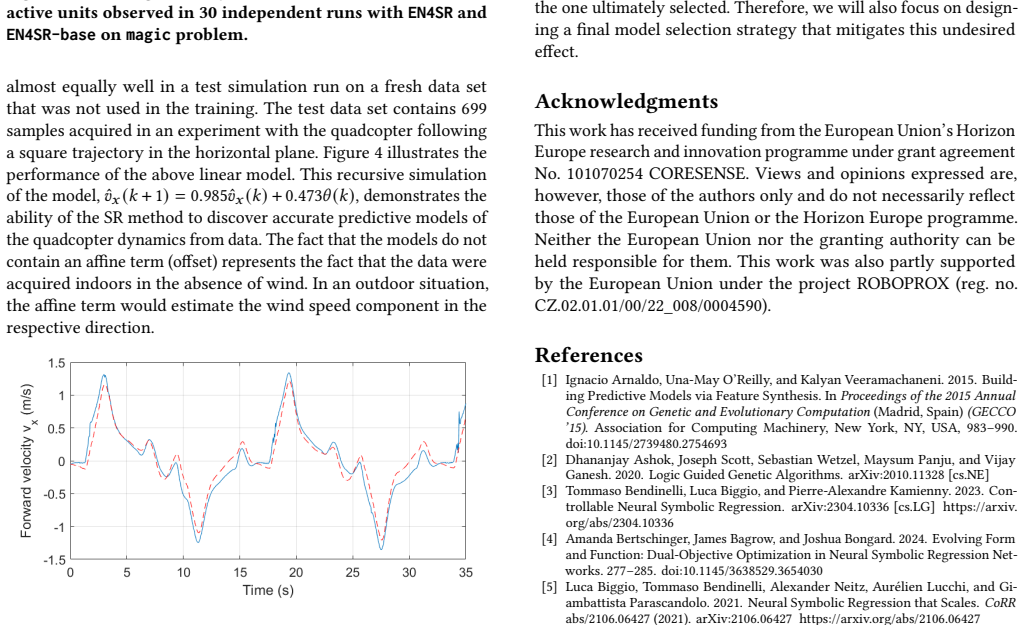
- On the quadcopter task, 24 of 30 runs converge to the same linear model $v_x(k+1)=0.985\,v_x(k)+0.473\,\theta(k)$, which tracks an unseen square-trajectory test set in recursive simulation.
- EN4SR's models are slightly more complex than N4SR-ACYE's on the benchmarks, trading a small complexity increase for accuracy.
Reading between the lines
- Beyond the paper, the weight-memory design could be borrowed by any evolutionary-neural system: storing parameter vectors of useful subgraphs and re-injecting them after crossover or mutation is a general way to cut retraining cost, not a trick specific to symbolic regression.
- Beyond the paper, the final-model selection rule is a bottleneck the paper itself flags: the algorithm returns the least-complex model below median performance, so the best non-dominated model in the population may be systematically under-reported, and a selection rule that searches the whole front more carefully could improve reported accuracy without changing evolution.
- Beyond the paper, the quadcopter result suggests a testable prediction: on outdoor flights with wind, the same method should recover the same linear model plus an affine offset estimating the wind-velocity component; if it does not, the zero-offset outcome simply reflects the indoor dataset rather than a modeling principle.
Signed reviews
Editorial analysis
A structured set of objections, weighed in public.
Referee Report
Summary. The paper proposes EN4SR, a neuro-evolutionary symbolic regression method that wraps the N4SR neural-network architecture in an evolutionary search over network topologies, using a weight memory and periodic perturbations to allow short backpropagation runs for each candidate. The method is evaluated on three physics-aware benchmark problems (resistors, magic, magman) against N4SR-ACYE, EQL-divide, and mSNGP-LS, plus a real-world quadcopter system-identification case study. The central claim is that EN4SR matches or exceeds pure NN-based symbolic regression in model accuracy and computational demand, and significantly outperforms GP-based regression on model quality. Table 1 reports median RMSE values and Wilcoxon p-values that support the accuracy advantage on the three benchmarks, but the computational-cost claim is not backed by any runtime or actual-iteration measurement, and the quadcopter section contains no quantitative error metric.
Significance. If the main claims hold, EN4SR is a practically useful extension of NN-based symbolic regression: the evolutionary wrapper appears to improve final model accuracy without requiring full training of each candidate topology, and the memory mechanism is a sensible way to reuse weight information across generations. Strengths of the paper are that the source code is publicly available, the evaluation uses external benchmark problems rather than fitted examples, and the statistical testing via Wilcoxon rank-sum tests is appropriate for the reported medians. However, the significance of the contribution is currently limited by the lack of measured compute budgets, by the absence of any distributional information beyond medians, and by the qualitative nature of the quadcopter demonstration; these issues prevent the reader from verifying the headline claim that EN4SR is better than NN-based approaches 'with a similar computing budget.'
major comments (4)
- [Section 5.3 and Algorithm 1]
- [Table 1]
- [Section 5.5]
- [Section 6]
minor comments (5)
- [Section 4.1]
- [Table 1 caption and Section 5.4]
- [Figure 3 and Section 5.4]
- [Section 5.3]
- [Section 5.5]
Circularity Check
No circularity: EN4SR is validated on external benchmark data, and its borrowings from the authors' earlier N4SR work are method components, not predicted outcomes.
full rationale
The central claim of the paper is empirical: EN4SR produces models whose interpolation and extrapolation RMSE is compared with N4SR-ACYE, EQL-divide, and mSNGP-LS on the resistors, magic, magman, and quadcopter problems. These benchmark results come from held-out data and statistical tests (Wilcoxon rank-sum), so the claimed superiority is not encoded in the algorithm's definition. The paper does adopt its master topology, loss functions, constraint representation, and N4SR baseline from the authors' prior work [23], but those are inputs to the method, not the results being predicted; no equation in the paper derives the reported performance from these adopted components by construction, and no fitted parameter is renamed as a prediction. The statement in Section 5.3 that 'the maximum number of backprop iterations was set to 90000 for a fair comparison with N4SR' is a budget assumption; whether the budgets are truly comparable is an open measurement concern, not a circularity. Accordingly, no specific circular reduction can be quoted, and the analysis is self-contained against external benchmarks.
Assumptions & free parameters
free parameters (3)
- EN4SR algorithm hyperparameters =
POP_SIZE=10, R=3, GR=20, Nn=10, Nt=100, Nf=50
- Genetic operator and memory parameters =
not reported
- Per-problem master topology variant =
master-A for resistors and magman, master-B for magic
assumptions (5)
- domain assumption The master topology with the selected elementary functions can express the ground-truth models for all test problems.
- domain assumption The prior-knowledge loss terms and constraint sampling from N4SR remain effective when embedded in an evolutionary loop.
- domain assumption Capping backpropagation iterations at 90,000 gives a fair computational budget for comparison with N4SR.
- ad hoc to paper The memory update rules preserve useful weight information for future generations.
- domain assumption Short backpropagation runs on newly generated subtopologies are sufficient to evaluate their potential.
Cite this review
Pith. "Pith review of Neuro-Evolutionary Approach to Physics-Aware Symbolic Regression." pith.science (2026). https://pith.science/paper/EEPKMONA
@misc{pith2026250416503,
  author       = {Pith},
  title        = {Pith review of: Neuro-Evolutionary Approach to Physics-Aware Symbolic Regression},
  year         = {2026},
  howpublished = {\url{https://pith.science/paper/EEPKMONA}},
  note         = {Machine review of arXiv:2504.16503}
}
read the original abstract
Symbolic regression is a technique that can automatically derive analytic models from data. Traditionally, symbolic regression has been implemented primarily through genetic programming that evolves populations of candidate solutions sampled by genetic operators, crossover and mutation. More recently, neural networks have been employed to learn the entire analytical model, i.e., its structure and coefficients, using regularized gradient-based optimization. Although this approach tunes the model's coefficients better, it is prone to premature convergence to suboptimal model structures. Here, we propose a neuro-evolutionary symbolic regression method that combines the strengths of evolutionary-based search for optimal neural network (NN) topologies with gradient-based tuning of the network's parameters. Due to the inherent high computational demand of evolutionary algorithms, it is not feasible to learn the parameters of every candidate NN topology to full convergence. Thus, our method employs a memory-based strategy and population perturbations to enhance exploitation and reduce the risk of being trapped in suboptimal NNs. In this way, each NN topology can be trained using only a short sequence of backpropagation iterations. The proposed method was experimentally evaluated on three real-world test problems and has been shown to outperform other NN-based approaches regarding the quality of the models obtained.
Figures


Figures from the paper (1 more)
Reference graph
Works this paper leans on
-
[1]
Ignacio Arnaldo, Una-May O’Reilly, and Kalyan Veeramachaneni. 2015. Build- ing Predictive Models via Feature Synthesis. In Proceedings of the 2015 Annual Conference on Genetic and Evolutionary Computation (Madrid, Spain) (GECCO ’15). Association for Computing Machinery, New York, NY, USA, 983–990. doi:10.1145/2739480.2754693
arXiv 2015
-
[2]
Dhananjay Ashok, Joseph Scott, Sebastian Wetzel, Maysum Panju, and Vijay Ganesh. 2020. Logic Guided Genetic Algorithms. arXiv:2010.11328 [cs.NE]
work page Pith review arXiv 2020
-
[3]
Tommaso Bendinelli, Luca Biggio, and Pierre-Alexandre Kamienny. 2023. Con- trollable Neural Symbolic Regression. arXiv:2304.10336 [cs.LG] https://arxiv. org/abs/2304.10336
work page Pith review arXiv 2023
-
[4]
Amanda Bertschinger, James Bagrow, and Joshua Bongard. 2024. Evolving Form and Function: Dual-Objective Optimization in Neural Symbolic Regression Net- works. 277–285. doi:10.1145/3638529.3654030
arXiv 2024
-
[5]
Luca Biggio, Tommaso Bendinelli, Alexander Neitz, Aurélien Lucchi, and Gi- ambattista Parascandolo. 2021. Neural Symbolic Regression that Scales. CoRR abs/2106.06427 (2021). arXiv:2106.06427 https://arxiv.org/abs/2106.06427
arXiv 2021
-
[6]
Iwo Bladek and Krzysztof Krawiec. 2019. Solving Symbolic Regression Problems with Formal Constraints. In Proceedings of the Genetic and Evolutionary Compu- tation Conference (Prague, Czech Republic) (GECCO ’19). ACM, New York, NY, USA, 977–984. doi:10.1145/3321707.3321743 Neuro-Evolutionary Approach to Physics-Aware Symbolic Regression GECCO ’25, July 14–...
arXiv 2019
-
[7]
Bogdan Burlacu, Gabriel Kronberger, and Michael Kommenda. 2020. Operon C++: an efficient genetic programming framework for symbolic regression.Proceedings of the 2020 Genetic and Evolutionary Computation Conference Companion (2020). https://api.semanticscholar.org/CorpusID:220409306
work page 2020
-
[8]
Allan Costa, Rumen Dangovski, Owen Dugan, Samuel Kim, Pawan Goyal, Marin Soljačić, and Joseph Jacobson. 2021. Fast Neural Models for Symbolic Regression at Scale. doi:10.48550/ARXIV.2007.10784
Show all 49 references
-
[9]
Stéphane d’Ascoli, Pierre-Alexandre Kamienny, Guillaume Lample, and François Charton. 2022. Deep Symbolic Regression for Recurrent Sequences. CoRR abs/2201.04600 (2022). arXiv:2201.04600 https://arxiv.org/abs/2201.04600
2022 arXiv
-
[10]
Erik Derner, Jirí Kubalík, Nicola Ancona, and Robert Babuska. 2020. Constructing parsimonious analytic models for dynamic systems via symbolic regression.Appl. Soft Comput. 94 (2020), 106432. doi:10.1016/j.asoc.2020.106432
2020
-
[11]
Erik Derner, Jirí Kubalík, and Robert Babuska. 2021. Selecting Informative Data Samples for Model Learning Through Symbolic Regression. IEEE Access 9 (2021), 14148–14158. doi:10.1109/ACCESS.2021.3052130
2021
-
[12]
Haider, F.O
C. Haider, F.O. de Franca, B. Burlacu, and G. Kronberger. 2023. Shape-constrained multi-objective genetic programming for symbolic regression. Applied Soft Com- puting 132 (2023), 109855. doi:10.1016/j.asoc.2022.109855
2023
-
[13]
Weinberger
Gao Huang, Zhuang Liu, Laurens Van Der Maaten, and Kilian Q. Weinberger
-
[14]
Zdenek Hurak and Jiri Zemanek. 2012. Feedback linearization approach to distributed feedback manipulation. In American control conference . Montreal, Canada, 991–996
2012
-
[15]
Lu, Srijon Mukherjee, Michael Gilbert, Li Jing, Vladimir Ceperic, and Marin Soljacic
Samuel Kim, Peter Y. Lu, Srijon Mukherjee, Michael Gilbert, Li Jing, Vladimir Ceperic, and Marin Soljacic. 2021. Integration of Neural Network-Based Symbolic Regression in Deep Learning for Scientific Discovery.IEEE Transactions on Neural Networks and Learning Systems 32, 9 (s...
2021
-
[16]
Diederick P Kingma and Jimmy Ba. 2015. Adam: A method for stochastic opti- mization. In International Conference on Learning Representations (ICLR)
2015
-
[17]
Michael Kommenda, Bogdan Burlacu, Gabriel Kronberger, and Michael Affen- zeller. 2020. Parameter Identification for Symbolic Regression Using Nonlinear Least Squares. Genetic Programming and Evolvable Machines 21, 3 (sep 2020), 471–501. doi:10.1007/s10710-019-09371-3
2020 doi
-
[18]
John R. Koza. 1992. Genetic Programming: On the Programming of Computers by Means of Natural Selection . MIT Press, Cambridge, MA, USA
1992
-
[19]
Krzysztof Krawiec, Iwo Bladek, and Jerry Swan. 2017. Counterexample-driven Genetic Programming. InProceedings of the Genetic and Evolutionary Computation Conference (Berlin, Germany) (GECCO ’17). ACM, New York, NY, USA, 953–960. doi:10.1145/3071178.3071224
2017
-
[20]
Kronberger, F
G. Kronberger, F. O. de Franca, B. Burlacu, C. Haider, and M. Kommenda. 2022. Shape-Constrained Symbolic Regression—Improving Extrapolation with Prior Knowledge. Evolutionary Computation 30, 1 (03 2022), 75–98. doi:10.1162/evco_ a_00294
2022 doi
-
[21]
Jirí Kubalík, Erik Derner, and Robert Babuska. 2021. Multi-objective symbolic regression for physics-aware dynamic modeling. Expert Syst. Appl. 182 (2021), 115210. doi:10.1016/j.eswa.2021.115210
2021
-
[22]
Jiří Kubalík, Erik Derner, and Robert Babuška. 2020. Symbolic Regression Driven by Training Data and Prior Knowledge. In Proceedings of the 2020 Genetic and Evolutionary Computation Conference (Cancún, Mexico) (GECCO ’20). Association for Computing Machinery, New York, NY, USA...
2020 doi
-
[23]
Jiří Kubalík, Erik Derner, and Robert Babuška. 2023. Toward Physically Plausible Data-Driven Models: A Novel Neural Network Approach to Symbolic Regression. IEEE Access 11 (2023), 61481–61501. doi:10.1109/ACCESS.2023.3287397
2023
-
[24]
Shilin Li, Gang Wang, Yuelan Di, Liping Wang, Haidou Wang, and Qingjun Zhou
- [25]
-
[26]
Georg Martius and Christoph H. Lampert. 2016. Extrapolation and learning equations. CoRR abs/1610.02995 (2016). arXiv:1610.02995 http://arxiv.org/abs/ 1610.02995
2016 arXiv
-
[27]
Alec Radford, Jeff Wu, Rewon Child, David Luan, Dario Amodei, and Ilya Sutskever. 2019. Language Models are Unsupervised Multitask Learners
2019
-
[28]
Raissi, P
M. Raissi, P. Perdikaris, and G.E. Karniadakis. 2019. Physics-informed neural networks: A deep learning framework for solving forward and inverse problems involving nonlinear partial differential equations. J. Comput. Phys. 378 (2019), 686–707. doi:10.1016/j.jcp.2018.10.045
2019 doi
-
[29]
Calderón-Muñoz, Richard LeBoeuf, and Pablo Castillo
Gustavo Richmond-Navarro, Williams R. Calderón-Muñoz, Richard LeBoeuf, and Pablo Castillo. 2017. A Magnus Wind Turbine Power Model Based on Direct Solutions Using the Blade Element Momentum Theory and Symbolic Regression. IEEE Transactions on Sustainable Energy 8, 1 (2017), 42...
2017
-
[30]
Sahoo, Christoph H
Subham S. Sahoo, Christoph H. Lampert, and Georg Martius. 2018. Learn- ing Equations for Extrapolation and Control. CoRR abs/1806.07259 (2018). arXiv:1806.07259 http://arxiv.org/abs/1806.07259
2018 arXiv
-
[31]
Schmidt and H
M. Schmidt and H. Lipson. 2009. Distilling free-form natural laws from experi- mental data. Science 324, 5923 (2009), 81–85
2009
-
[32]
Nicolas Staelens, Dirk Deschrijver, Ekaterina Vladislavleva, Brecht Vermeulen, Tom Dhaene, and Piet Demeester. 2013. Constructing a No-Reference H.264/AVC Bitstream-Based Video Quality Metric Using Genetic Programming-Based Sym- bolic Regression. IEEE Trans. Cir. and Sys. for ...
2013
-
[33]
Alexander Topchy, William F Punch, et al. 2001. Faster genetic programming based on local gradient search of numeric leaf values. InProceedings of the genetic and evolutionary computation conference (GECCO-2001) , Vol. 155162. Morgan Kaufmann San Francisco, CA
2001
-
[34]
Leonardo Trujillo, Luis Munoz, Edgar Galvan-Lopez, and Sara Silva. 2016. neat Genetic Programming: Controlling Bloat Naturally. Information Sciences 333 (10 March 2016), 21–43. doi:doi:10.1016/j.ins.2015.11.010
2016 doi
-
[35]
Silviu-Marian Udrescu and Max Tegmark. 2020. AI Feynman: A physics-inspired method for symbolic regression. Science Advances 6 (04 2020), eaay2631. doi:10. 1126/sciadv.aay2631
2020
-
[36]
Mojtaba Valipour, Bowen You, Maysum Panju, and Ali Ghodsi. 2021. Sym- bolicGPT: A Generative Transformer Model for Symbolic Regression. CoRR abs/2106.14131 (2021). arXiv:2106.14131 https://arxiv.org/abs/2106.14131
2021 arXiv
-
[37]
Martin Vastl, Jonáš Kulhánek, Jiří Kubalík, Erik Derner, and Robert Babuška
-
[38]
Verdier, Robert Babuška, Barys Shyrokau, and Manuel Mazo
Cees F. Verdier, Robert Babuška, Barys Shyrokau, and Manuel Mazo. 2019. Near Optimal Control With Reachability and Safety Guarantees. IFAC-PapersOnLine 52, 11 (2019), 230–235. doi:10.1016/j.ifacol.2019.09.146 5th IFAC Conference on Intelligent Control and Automation Sciences I...
2019 doi
-
[39]
Laura von Rueden, Sebastian Mayer, Katharina Beckh, Bogdan Georgiev, Sven Giesselbach, Raoul Heese, Birgit Kirsch, Julius Pfrommer, Annika Pick, Rajkumar Ramamurthy, Michal Walczak, Jochen Garcke, Christian Bauckhage, and Jannis Schuecker. 2023. Informed Machine Learning – A T...
2023
-
[40]
Matthias Werner, Andrej Junginger, Philipp Hennig, and Georg Martius. 2021. Informed Equation Learning. CoRR abs/2105.06331 (2021). arXiv:2105.06331 https://arxiv.org/abs/2105.06331
2021 arXiv
-
[41]
Willard, Xiaowei Jia, Shaoming Xu, Michael S
Jared D. Willard, Xiaowei Jia, Shaoming Xu, Michael S. Steinbach, and Vipin Kumar. 2020. Integrating Physics-Based Modeling with Machine Learning: A Survey. ArXiv abs/2003.04919 (2020)
2020 arXiv
-
[42]
Casper Wilstrup and Jaan Kasak. 2021. Symbolic regression outperforms other models for small data sets. ArXiv abs/2103.15147 (2021)
2021 arXiv
-
[43]
Min Wu, Weijun Li, Lina Yu, Wenqiang Li, Jingyi Liu, Yanjie Li, and Meilan Hao
- [44]
-
[45]
Jan Žegklitz and Petr Pošík. 2019. Symbolic regression in dynamic scenarios with gradually changing targets. Applied Soft Computing 83 (2019), 105621. doi:10.1016/j.asoc.2019.105621
2019
-
[2017]
In 2017 IEEE Conference on Computer Vision and Pattern Recognition (CVPR)
Densely Connected Convolutional Networks. In 2017 IEEE Conference on Computer Vision and Pattern Recognition (CVPR) . 2261–2269. doi:10.1109/CVPR. 2017.243
2017 doi
- [2022]
-
[2023]
Engineering Applications of Artificial Intelligence 120 (2023), 105908
A physics-informed neural network framework to predict 3D temperature field without labeled data in process of laser metal deposition. Engineering Applications of Artificial Intelligence 120 (2023), 105908. doi:10.1016/j.engappai. 2023.105908
2023
-
[2024]
arXiv:2401.15103 [cs.LG] https://arxiv.org/abs/2401.15103
PruneSymNet: A Symbolic Neural Network and Pruning Algorithm for Symbolic Regression. arXiv:2401.15103 [cs.LG] https://arxiv.org/abs/2401.15103
Reviewed August 16, 2026 · model on record in the stance chip above.
Discussion (0). Continue with ORCID to comment.