REVIEW 4 major objections 4 minor 40 references
HUG: Hierarchical Urban Gaussian Splatting with Block-Based Reconstruction for Large-Scale Aerial Scenes
T0 review · 4 major / 4 minor · reviewed 2026-08-16 · deepseek-v4-flash
Pith's one-line read Visibility-based block splitting cuts large aerial scene partitioning from about two hours to about one minute, the paper claims, while hierarchical per-block Gaussian training improves rendering quality on five datasets.
desk verdict Solid engineering with a real partitioning speedup and a clean ablation, but the SOTA claim rests on a mixed-protocol comparison and needs a unified re-benchmark. read the letter →
The pith
A machine-rendered reading of the paper's core claim, the machinery that carries it, and where it could break.
The reading
What carries the argument
The central object is a hierarchical neural Gaussian representation: anchors placed at nodes of an octree built from each block's sparse point cloud, with the octree depth set by the spread of camera distances, and each anchor decoding into several neural Gaussians via a small MLP. Its level of detail is carried by distance-based anchor selection, so coarse levels supply base colors and the finest level supplies detail. The argument is carried by two additional mechanisms: a visibility-based view partition that assigns only informative images to each block and masks irrelevant pixels, and a hierarchical weighted image supervision that renders each level separately and applies level-dependent L1 and SSIM weights, keeping every anchor trained and suppressing the floaters that appear in a plain octree-Gaussian baseline.
What would settle it
Re-run the comparison by training every baseline on the exact same train/test splits and downsampled images used for HUG, then check whether the PSNR, SSIM, and LPIPS margins in the paper's main table survive; if quoted numbers came from different protocols, the superiority claim would not be established.
Extended reading notes
Core claim
On its own terms, the discovery is that block-based reconstruction of large-scale aerial scenes does not need redundant overlap or a slow global pre-pass. HUG divides COLMAP sparse points into uniform blocks, assigns to each block only the training images whose reprojected visible point count exceeds a threshold, and derives a visibility mask that focuses loss on in-block regions. Each block is trained as an octree-organized set of anchors that produce neural Gaussians through a small MLP; level selection by camera distance gives a level-of-detail structure. A hierarchical weighted image loss supervises every level separately, a dynamic gradient threshold and anchor level transition refine detail where gradients demand it, and visibility-based pruning removes under-used anchors. At fusion time, a greedy vote keeps anchors whose generated Gaussians mostly fall inside the block, and a multi-MLP rasterizer renders all blocks seamlessly. The paper reports top PSNR, SSIM, and LPIPS on MatrixCity Small City and on the Residence, Rubble, Building, and Sci-Art scenes from Mega-NeRF.
Load-bearing premise
The state-of-the-art comparison assumes that the numbers reported for several prior methods, which are quoted from those methods' own papers rather than rerun by the authors, were produced with the same training splits, image resolution, and evaluation protocol as HUG's runs.
Editorial extensions
If this is right
- The one-minute visibility-based partition makes block decomposition cheap enough to rerun as scenes change, lowering the total cost of city-scale reconstruction from hours of preprocessing plus training to roughly training time alone.
- Because each block is trained without large redundant boundary regions and with fewer views, memory per block drops, which is what makes parallel training on multiple GPUs practical for a whole city.
- The hierarchy gives free level of detail: nearby views get fine neural Gaussians, distant views use coarse ones, so real-time fly-throughs do not pay full detail cost for the whole scene.
- Reporting best SSIM and LPIPS on four real aerial datasets implies the method removes the multicolored zoom-in artifacts that appear in octree-based Gaussian rendering.
- The multi-MLP rasterizer means the benefits of neural Gaussians are no longer limited to single-block scenes; trained blocks from different machines can be merged and rendered seamlessly.
Reading between the lines
- The fixed visible-point threshold for assigning views is a natural target for adaptivity: a per-block threshold based on point density or coverage could make the partition robust to low-texture areas, which the paper itself flags as a limitation of relying on COLMAP points.
- The level-weighted supervision recipe, supervising every octree level separately with geometrically decaying weights, looks transferable to other LOD radiance-field or Gaussian architectures as a generic anti-float training strategy.
- If pose-free structure-from-motion replaces COLMAP, the same visibility partition could apply to unstructured drone video, since nothing in the partition itself requires calibrated poses beyond what the sparse reconstruction provides.
- Separate MLPs per block open a route to per-block appearance or lighting models, which could compensate for the absence of dynamic-object and lighting-decoupling handling that the paper lists as future work.
Signed reviews
Editorial analysis
A structured set of objections, weighed in public.
Referee Report
Summary. The paper presents HUG, a block-based reconstruction method for large-scale aerial urban scenes built on 3D Gaussian Splatting. The contributions are: (i) a visibility-based partitioning scheme that uses sparse COLMAP points and visibility masks to assign views to blocks; (ii) a hierarchical octree-based neural Gaussian representation with level-of-detail anchors, a hierarchical weighted image-supervision loss, a dynamic gradient threshold for anchor splitting, a dynamic anchor-level transition rule, and visibility-based anchor pruning; and (iii) a multi-MLP rendering pipeline that fuses independently trained blocks. The method is evaluated on the synthetic MatrixCity Small City scene and four real-world Mega-NeRF scenes (Residence, Rubble, Building, Sci-Art), reporting PSNR, SSIM, and LPIPS. The authors claim state-of-the-art results and report a roughly one-minute partitioning time, compared with over two hours for CityGS on MatrixCity.
Significance. If the claims were established under a controlled protocol, the paper would make a practical contribution: it combines efficient view partitioning with an LOD-structured neural Gaussian representation, and the reported partitioning speed-up is substantial. The ablation on the Rubble scene shows monotonic improvements when adding each component, which is a useful sanity check. However, the central state-of-the-art claim is not currently supported because the quantitative comparison mixes results from different papers and different codebases without a unified training/evaluation protocol. The paper also relies on a single run per method and reports no error bars, which is particularly problematic because several claimed wins are small or even negative (e.g., Residence SSIM is a tie with CityGS, and Sci-Art PSNR is lower than Mega-NeRF). The core algorithmic ideas are plausible, but the paper needs a controlled comparison or a substantially softened claim to be acceptable.
major comments (4)
- [Table 1 and Supplementary Section 6] The central claim of state-of-the-art performance is not established because the baseline numbers in Table 1 are not obtained under a single controlled protocol. The supplement states that Mega-NeRF, 3DGS, and CityGS results are taken from the CityGS paper, Octree-GS results from the Octree-GS paper, VastGS results from an unofficial codebase, and only Hier-GS and HUG were run by the authors. If training splits, image resolutions, block counts, iterations, or evaluation code differ across these sources, the columns are not directly comparable. This is load-bearing because several margins are small: on Residence, HUG ties CityGS in SSIM (0.813 vs. 0.813), and on Sci-Art, HUG's PSNR (21.83) is below Mega-NeRF's (25.60), a fact acknowledged in Section 4.3. The abstract's unqualified state-of-the-art claim therefore overreaches. I ask the authors to either rerun all baselines under one protocol with the same splits and resolution, or clearly restrict the claim to the configurations actually compared.
- [Table 2 and Section 4.3] The partitioning-efficiency comparison is not apples-to-apples. CityGS's reported 188-minute partitioning time includes building a coarse global 3DGS model and rendering images for all blocks, whereas HUG's one-minute partitioning uses only COLMAP sparse points and does not perform this extra work. The claim that HUG 'significantly outperforms existing methods in speed' for partitioning is therefore misleading unless the comparison isolates the same operation. Please report the time for the specific partitioning operation itself for each method, or state explicitly what each number includes.
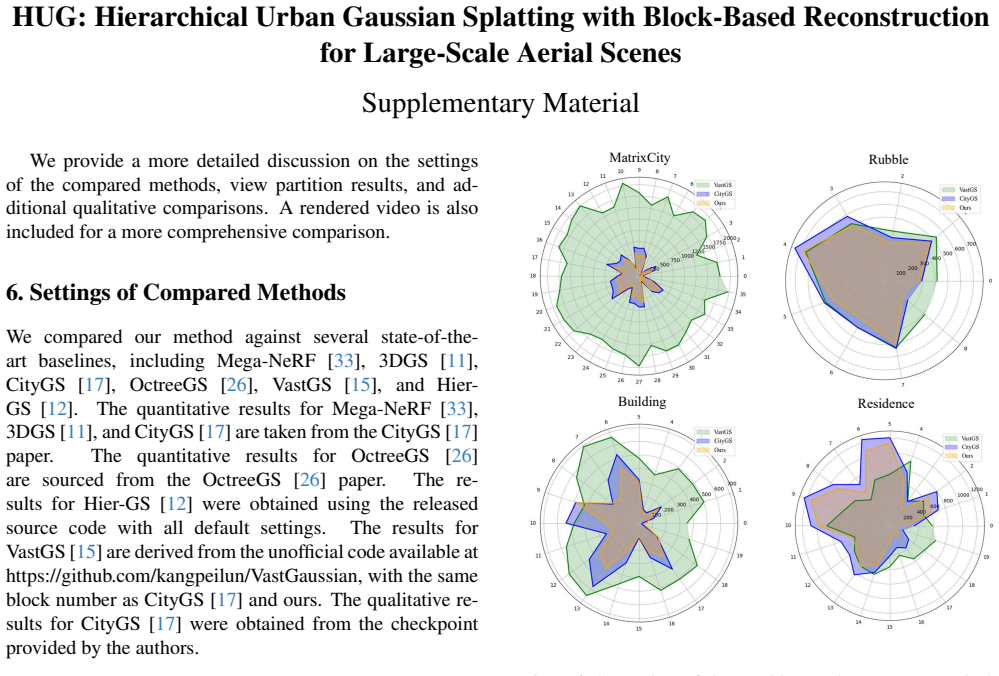
- [Section 3.3, Eq. (9)] Equation (9) is unclear and may be internally inconsistent. The text says an anchor's level is 'gradually increased by 0.01,' but L is used elsewhere as an integer octree level in Eq. (7) and in the anchor-selection rule L ≤ L-hat. Adding 0.01 to an integer level and then flooring the sum is not a standard refinement mechanism, and the formula as written sums an indicator over iterations but does not define the summation index or the update schedule. Please clarify whether L is an integer or a continuous accumulator, and define the update precisely.
- [Table 3 and Section 4.3] The ablation study is reported on a single scene (Rubble) with a single run and no statistical variability. Given that the paper's improvements over baselines are sometimes smaller than 0.01 in SSIM or LPIPS, the absence of multiple seeds or error bars makes it difficult to judge whether the component contributions and the final gains are significant. At minimum, report multiple runs for the ablation and for the main comparison, or justify the computational cost of doing so.
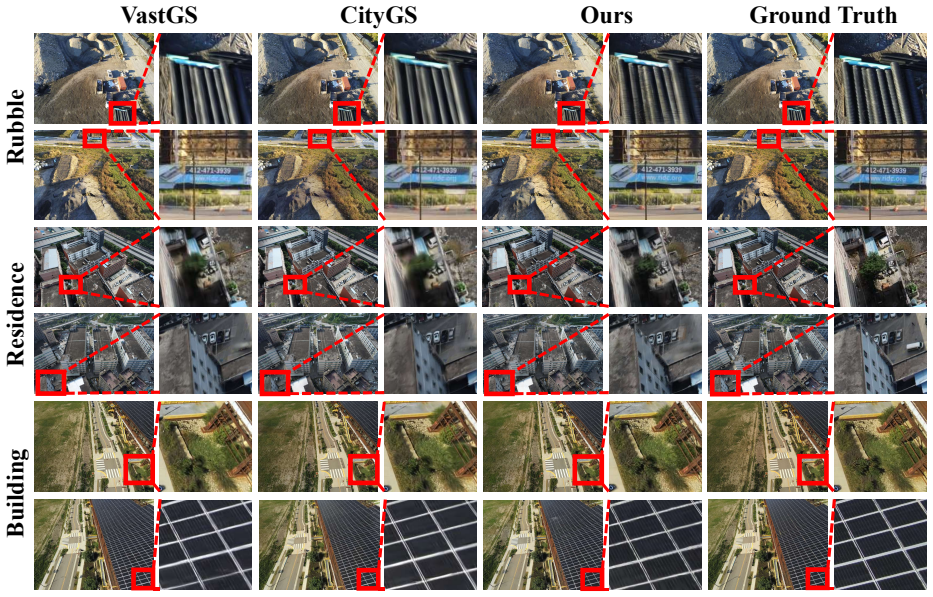
minor comments (4)
- [Section 3, first paragraph] The sentence 'An overview of the proposed method is illustrated in Section 2.1' should refer to Figure 2, not to Section 2.1 (Related Work).
- [Section 4.3, Results Analysis] The text refers to 'CityGS [29]' when comparing results, but CityGS is reference [17]; [29] is City-on-Web. Please correct the citation.
- [Section 3.3, Anchor Splitting] There is a typo: 'hyperprameter' should be 'hyperparameter'.
- [Equation (8)] The hierarchical loss in Eq. (8) would benefit from a one-sentence derivation of the weight choices, especially because the first two terms (λ, γ) and the summed terms (λ/2^{K+1-k}, γ/2^k) are not normalized to sum to a constant across levels. Please clarify whether this weighting is intentionally biased toward the finest level.
Circularity Check
No significant circularity: HUG is an empirical pipeline built on external bases with newly proposed losses and heuristics; no claimed result reduces by construction to a fitted parameter or self-citation.
full rationale
The paper makes no first-principles derivation that could collapse into its own inputs. Its core components — visibility-based partitioning (Eq. 4, Eq. 5), the octree level formula (Eq. 6–7), the hierarchical weighted loss (Eq. 8), dynamic gradient thresholding and anchor level transitions (Eq. 9), and the vote-based refiltering — are constructive heuristics with explicit hyperparameters (τp=800, λ=0.2, γ=0.8, θ=0.02, M=5000, εc=5, etc.). These are training and partitioning settings, not predictions; the reported PSNR/SSIM/LPIPS numbers are evaluated on held-out views against external baselines. The cited bases (3DGS, Scaffold-GS, Octree-GS, CityGS, Mega-NeRF, VastGS, Hier-GS) are works by other groups, so no load-bearing argument reduces to a self-citation. The only substantive weakness is experimental comparability: the supplement states that Mega-NeRF, 3DGS, and CityGS numbers are taken from the CityGS paper and OctreeGS numbers from the OctreeGS paper, while VastGS is from an unofficial codebase and Hier-GS from released code with default settings. That is a protocol-mixing risk that undermines the unqualified state-of-the-art claim — notably the paper itself concedes Sci-Art PSNR is below Mega-NeRF — but it is a benchmarking and correctness concern, not a circularity concern, because none of the compared numbers is generated by fitting the paper's own model to the test set or by renaming its own outputs as baselines. Under the stated criteria of quoting and exhibiting a specific reduction, no circular step can be identified.
Assumptions & free parameters
free parameters (7)
- view partition threshold tau_p =
800
- hierarchical loss weights lambda, gamma, theta =
lambda=0.2, gamma=0.8, theta=0.02
- pruning thresholds epsilon_c and M =
epsilon_c=5, M=5000
- gradient threshold tau_g and decay eta =
tau_g=2e-6, eta=0.8
- level transition factor beta and step 0.01 =
beta=4, step=0.01
- opacity mask threshold =
0.5
- octree depth quantiles =
0.95 and 0.05
assumptions (4)
- standard math 3D Gaussian Splatting differentiable rasterization and alpha blending (Eqs. 1-3) are correctly implemented in the Octree-GS codebase used as the base.
- domain assumption COLMAP sparse point clouds provide sufficiently accurate scene geometry for partitioning and anchor placement.
- ad hoc to paper The chosen hierarchy levels K and the distance-based anchor selection (Eqs. 6-7) yield a valid LOD representation for all scenes.
- domain assumption The evaluation datasets (MatrixCity, Mega-NeRF scenes) are reliable ground truth and the quoted baseline numbers were computed under comparable protocols.
Cite this review
Pith. "Pith review of HUG: Hierarchical Urban Gaussian Splatting with Block-Based Reconstruction for Large-Scale Aerial Scenes." pith.science (2026). https://pith.science/paper/OZ7CISEQ
@misc{pith2026250416606,
  author       = {Pith},
  title        = {Pith review of: HUG: Hierarchical Urban Gaussian Splatting with Block-Based Reconstruction for Large-Scale Aerial Scenes},
  year         = {2026},
  howpublished = {\url{https://pith.science/paper/OZ7CISEQ}},
  note         = {Machine review of arXiv:2504.16606}
}
read the original abstract
3DGS is an emerging and increasingly popular technology in the field of novel view synthesis. Its highly realistic rendering quality and real-time rendering capabilities make it promising for various applications. However, when applied to large-scale aerial urban scenes, 3DGS methods suffer from issues such as excessive memory consumption, slow training times, prolonged partitioning processes, and significant degradation in rendering quality due to the increased data volume. To tackle these challenges, we introduce \textbf{HUG}, a novel approach that enhances data partitioning and reconstruction quality by leveraging a hierarchical neural Gaussian representation. We first propose a visibility-based data partitioning method that is simple yet highly efficient, significantly outperforming existing methods in speed. Then, we introduce a novel hierarchical weighted training approach, combined with other optimization strategies, to substantially improve reconstruction quality. Our method achieves state-of-the-art results on one synthetic dataset and four real-world datasets.
Figures


Figures from the paper (5 more)



Reference graph
Works this paper leans on
-
[1]
Building rome in a day.Communications of the ACM, 54 (10):105–112, 2011
Sameer Agarwal, Yasutaka Furukawa, Noah Snavely, Ian Si- mon, Brian Curless, Steven M Seitz, and Richard Szeliski. Building rome in a day.Communications of the ACM, 54 (10):105–112, 2011. 3
2011
-
[2]
Mip-nerf: A multiscale representation for anti-aliasing neu- ral radiance fields
Jonathan T Barron, Ben Mildenhall, Matthew Tancik, Peter Hedman, Ricardo Martin-Brualla, and Pratul P Srinivasan. Mip-nerf: A multiscale representation for anti-aliasing neu- ral radiance fields. InProceedings of the IEEE/CVF Inter- national Conference on Computer Vision, pages 5855–5864,
-
[3]
Barron, Ben Mildenhall, Dor Verbin, Pratul P
Jonathan T. Barron, Ben Mildenhall, Dor Verbin, Pratul P. Srinivasan, and Peter Hedman. Mip-nerf 360: Unbounded anti-aliased neural radiance fields.CVPR, 2022. 2
work page 2022
-
[4]
sibr: A sys- tem for image based rendering, 2020
Sebastien Bonopera, Jerome Esnault, Siddhant Prakash, Simon Rodriguez, Theo Thonat, Mehdi Benadel, Gaurav Chaurasia, Julien Philip, and George Drettakis. sibr: A sys- tem for image based rendering, 2020. 6
work page 2020
-
[5]
Gigags: Scaling up planar-based 3d gaussians for large scene surface reconstruction, 2024
Junyi Chen, Weicai Ye, Yifan Wang, Danpeng Chen, Di Huang, Wanli Ouyang, Guofeng Zhang, Yu Qiao, and Tong He. Gigags: Scaling up planar-based 3d gaussians for large scene surface reconstruction, 2024. 3, 6
work page 2024
-
[6]
Jiadi Cui, Junming Cao, Yuhui Zhong, Liao Wang, Fuqiang Zhao, Penghao Wang, Yifan Chen, Zhipeng He, Lan Xu, Yu- jiao Shi, et al. Letsgo: Large-scale garage modeling and ren- dering via lidar-assisted gaussian primitives.arXiv preprint arXiv:2404.09748, 2024. 3
arXiv 2024
-
[7]
Lightgaussian: Unbounded 3d gaussian compression with 15x reduction and 200+ fps
Zhiwen Fan, Kevin Wang, Kairun Wen, Zehao Zhu, De- jia Xu, and Zhangyang Wang. Lightgaussian: Unbounded 3d gaussian compression with 15x reduction and 200+ fps. arXiv preprint arXiv:2311.17245, 2023. 2
arXiv 2023
-
[8]
Plenoxels: Radiance fields without neural networks
Sara Fridovich-Keil, Alex Yu, Matthew Tancik, Qinhong Chen, Benjamin Recht, and Angjoo Kanazawa. Plenoxels: Radiance fields without neural networks. InProceedings of the IEEE/CVF Conference on Computer Vision and Pattern Recognition, pages 5501–5510, 2022. 2
2022
Show all 40 references
-
[9]
An automated method for large-scale, ground-based city model acquisition.Inter- national Journal of Computer Vision, 60:5–24, 2004
Christian Fr ¨uh and Avideh Zakhor. An automated method for large-scale, ground-based city model acquisition.Inter- national Journal of Computer Vision, 60:5–24, 2004. 2
2004
-
[10]
Pf3plat: Pose-free feed-forward 3d gaussian splatting.arXiv preprint arXiv:2410.22128, 2024
Sunghwan Hong, Jaewoo Jung, Heeseong Shin, Jisang Han, Jiaolong Yang, Chong Luo, and Seungryong Kim. Pf3plat: Pose-free feed-forward 3d gaussian splatting.arXiv preprint arXiv:2410.22128, 2024. 9
2024 arXiv
-
[11]
3d gaussian splatting for real-time radiance field rendering.ACM Transactions on Graphics, 42 (4), 2023
Bernhard Kerbl, Georgios Kopanas, Thomas Leimk ¨uhler, and George Drettakis. 3d gaussian splatting for real-time radiance field rendering.ACM Transactions on Graphics, 42 (4), 2023. 2, 4, 5, 6, 7, 8, 1
2023
-
[12]
A hierarchical 3d gaussian representation for real-time ren- dering of very large datasets.ACM Transactions on Graphics (TOG), 43(4):1–15, 2024
Bernhard Kerbl, Andreas Meuleman, Georgios Kopanas, Michael Wimmer, Alexandre Lanvin, and George Drettakis. A hierarchical 3d gaussian representation for real-time ren- dering of very large datasets.ACM Transactions on Graphics (TOG), 43(4):1–15, 2024. 7, 8, 1
2024
-
[13]
Modeling and recog- nition of landmark image collections using iconic scene graphs
Xiaowei Li, Changchang Wu, Christopher Zach, Svetlana Lazebnik, and Jan-Michael Frahm. Modeling and recog- nition of landmark image collections using iconic scene graphs. InComputer Vision–ECCV 2008: 10th European Conference on Computer Vision, Marseille, France, Octo- ber 12-...
2008
-
[14]
Matrixcity: A large-scale city dataset for city-scale neural rendering and beyond
Yixuan Li, Lihan Jiang, Linning Xu, Yuanbo Xiangli, Zhen- zhi Wang, Dahua Lin, and Bo Dai. Matrixcity: A large-scale city dataset for city-scale neural rendering and beyond. In Proceedings of the IEEE/CVF International Conference on Computer Vision, pages 3205–3215, 2023. 6
2023
-
[15]
Vastgaussian: Vast 3d gaus- sians for large scene reconstruction
Jiaqi Lin, Zhihao Li, Xiao Tang, Jianzhuang Liu, Shiyong Liu, Jiayue Liu, Yangdi Lu, Xiaofei Wu, Songcen Xu, You- liang Yan, and Wenming Yang. Vastgaussian: Vast 3d gaus- sians for large scene reconstruction. InCVPR, 2024. 3, 7, 8, 1
2024
-
[16]
Pixel-Perfect Structure-from-Motion with Featuremetric Refinement
Philipp Lindenberger, Paul-Edouard Sarlin, Viktor Larsson, and Marc Pollefeys. Pixel-Perfect Structure-from-Motion with Featuremetric Refinement. InICCV, 2021. 4
2021
-
[17]
Citygaus- sian: Real-time high-quality large-scale scene rendering with gaussians
Yang Liu, He Guan, Chuanchen Luo, Lue Fan, Naiyan Wang, Junran Peng, and Zhaoxiang Zhang. Citygaus- sian: Real-time high-quality large-scale scene rendering with gaussians. 2024. 1, 3, 4, 6, 7, 8
2024
-
[18]
Scaffold-gs: Structured 3d gaussians for view-adaptive rendering.arXiv preprint arXiv:2312.00109, 2023
Tao Lu, Mulin Yu, Linning Xu, Yuanbo Xiangli, Limin Wang, Dahua Lin, and Bo Dai. Scaffold-gs: Structured 3d gaussians for view-adaptive rendering.arXiv preprint arXiv:2312.00109, 2023. 2, 3, 4, 5, 6
2023 arXiv
-
[19]
Nerf in the wild: Neural radiance fields for uncon- strained photo collections
Ricardo Martin-Brualla, Noha Radwan, Mehdi SM Sajjadi, Jonathan T Barron, Alexey Dosovitskiy, and Daniel Duck- worth. Nerf in the wild: Neural radiance fields for uncon- strained photo collections. InProceedings of the IEEE/CVF Conference on Computer Vision and Pattern Recogni...
2021
-
[20]
Nerf: Representing scenes as neural radiance fields for view syn- thesis.Communications of the ACM, 65(1):99–106, 2021
Ben Mildenhall, Pratul P Srinivasan, Matthew Tancik, Jonathan T Barron, Ravi Ramamoorthi, and Ren Ng. Nerf: Representing scenes as neural radiance fields for view syn- thesis.Communications of the ACM, 65(1):99–106, 2021. 1, 2, 3
2021
-
[21]
Compact 3d scene representation via self- organizing gaussian grids.arXiv preprint arXiv:2312.13299,
Wieland Morgenstern, Florian Barthel, Anna Hilsmann, and Peter Eisert. Compact 3d scene representation via self- organizing gaussian grids.arXiv preprint arXiv:2312.13299,
-
[22]
Instant neural graphics primitives with a mul- tiresolution hash encoding.ACM Transactions on Graphics (ToG), 41(4):1–15, 2022
Thomas M ¨uller, Alex Evans, Christoph Schied, and Alexan- der Keller. Instant neural graphics primitives with a mul- tiresolution hash encoding.ACM Transactions on Graphics (ToG), 41(4):1–15, 2022. 2
2022
-
[23]
Detailed real- time urban 3d reconstruction from video.International Jour- nal of Computer Vision, 78:143–167, 2008
Marc Pollefeys, David Nist ´er, J-M Frahm, Amir Ak- barzadeh, Philippos Mordohai, Brian Clipp, Chris Engels, David Gallup, S-J Kim, Paul Merrell, et al. Detailed real- time urban 3d reconstruction from video.International Jour- nal of Computer Vision, 78:143–167, 2008. 2
2008
-
[24]
D-nerf: Neural radiance fields for dynamic scenes
Albert Pumarola, Enric Corona, Gerard Pons-Moll, and Francesc Moreno-Noguer. D-nerf: Neural radiance fields for dynamic scenes. InProceedings of the IEEE/CVF Con- ference on Computer Vision and Pattern Recognition, pages 10318–10327, 2021. 2
2021
-
[25]
Merf: Memory-efficient radiance fields for real- time view synthesis in unbounded scenes.ACM Transactions on Graphics (TOG), 42(4):1–12, 2023
Christian Reiser, Rick Szeliski, Dor Verbin, Pratul Srini- vasan, Ben Mildenhall, Andreas Geiger, Jon Barron, and Pe- ter Hedman. Merf: Memory-efficient radiance fields for real- time view synthesis in unbounded scenes.ACM Transactions on Graphics (TOG), 42(4):1–12, 2023. 2
2023
-
[26]
Octree-gs: Towards consistent real-time rendering with lod-structured 3d gaussians, 2024
Kerui Ren, Lihan Jiang, Tao Lu, Mulin Yu, Linning Xu, Zhangkai Ni, and Bo Dai. Octree-gs: Towards consistent real-time rendering with lod-structured 3d gaussians, 2024. 3, 4, 5, 6, 7, 8, 1
2024
-
[27]
Structure-from-motion revisited
Johannes Lutz Sch ¨onberger and Jan-Michael Frahm. Structure-from-motion revisited. InConference on Com- puter Vision and Pattern Recognition (CVPR), 2016. 3, 4, 9
2016
-
[28]
Photo tourism: exploring photo collections in 3d
Noah Snavely, Steven M Seitz, and Richard Szeliski. Photo tourism: exploring photo collections in 3d. InACM siggraph 2006 papers, pages 835–846. 2006. 3
2006
-
[29]
City-on-web: Real-time neural rendering of large-scale scenes on the web.arXiv preprint arXiv:2312.16457, 2023
Kaiwen Song and Juyong Zhang. City-on-web: Real-time neural rendering of large-scale scenes on the web.arXiv preprint arXiv:2312.16457, 2023. 7
2023 arXiv
-
[30]
Neural geometric level of detail: Real-time rendering with implicit 3d shapes
Towaki Takikawa, Joey Litalien, Kangxue Yin, Karsten Kreis, Charles Loop, Derek Nowrouzezahrai, Alec Jacobson, Morgan McGuire, and Sanja Fidler. Neural geometric level of detail: Real-time rendering with implicit 3d shapes. In Proceedings of the IEEE/CVF Conference on Computer...
2021
-
[31]
Block-nerf: Scalable large scene neural view synthesis
Matthew Tancik, Vincent Casser, Xinchen Yan, Sabeek Prad- han, Ben Mildenhall, Pratul P Srinivasan, Jonathan T Barron, and Henrik Kretzschmar. Block-nerf: Scalable large scene neural view synthesis. InProceedings of the IEEE/CVF Con- ference on Computer Vision and Pattern Reco...
2022
-
[32]
Nerfstudio: A modular framework for neural radiance field development
Matthew Tancik, Ethan Weber, Evonne Ng, Ruilong Li, Brent Yi, Terrance Wang, Alexander Kristoffersen, Jake Austin, Kamyar Salahi, Abhik Ahuja, et al. Nerfstudio: A modular framework for neural radiance field development. InACM SIGGRAPH 2023 Conference Proceedings, pages 1–12, 2023. 2
2023
-
[33]
Mega-nerf: Scalable construction of large- scale nerfs for virtual fly-throughs
Haithem Turki, Deva Ramanan, and Mahadev Satya- narayanan. Mega-nerf: Scalable construction of large- scale nerfs for virtual fly-throughs. InProceedings of the IEEE/CVF Conference on Computer Vision and Pattern Recognition, pages 12922–12931, 2022. 3, 6, 7, 8, 1
2022
-
[34]
Sinnerf: Training neural radiance fields on complex scenes from a single image
Dejia Xu, Yifan Jiang, Peihao Wang, Zhiwen Fan, Humphrey Shi, and Zhangyang Wang. Sinnerf: Training neural radiance fields on complex scenes from a single image. InEuropean Conference on Computer Vision, pages 736–753. Springer,
-
[35]
The unreasonable effectiveness of deep features as a perceptual metric
Richard Zhang, Phillip Isola, Alexei A Efros, Eli Shecht- man, and Oliver Wang. The unreasonable effectiveness of deep features as a perceptual metric. InProceedings of the IEEE conference on computer vision and pattern recogni- tion, pages 586–595, 2018. 6
2018
-
[36]
Ef- ficient large-scale scene representation with a hybrid of high-resolution grid and plane features.arXiv preprint arXiv:2303.03003, 2023
Yuqi Zhang, Guanying Chen, and Shuguang Cui. Ef- ficient large-scale scene representation with a hybrid of high-resolution grid and plane features.arXiv preprint arXiv:2303.03003, 2023. 6
2023 arXiv
-
[37]
Switch-nerf: Learning scene de- composition with mixture of experts for large-scale neural radiance fields
MI Zhenxing and Dan Xu. Switch-nerf: Learning scene de- composition with mixture of experts for large-scale neural radiance fields. InThe Eleventh International Conference on Learning Representations, 2022. 6 10 HUG: Hierarchical Urban Gaussian Splatting with Block-Based Recon...
2022
-
[38]
The quantitative results for Mega-NeRF [33], 3DGS [11], and CityGS [17] are taken from the CityGS [17] paper
Settings of Compared Methods We compared our method against several state-of-the- art baselines, including Mega-NeRF [33], 3DGS [11], CityGS [17], OctreeGS [26], VastGS [15], and Hier- GS [12]. The quantitative results for Mega-NeRF [33], 3DGS [11], and CityGS [17] are taken f...
-
[39]
A threshold ofτ p = 800is then applied to determine the assignment of each training image to specific blocks
Data Partitioning Results To associate all training images with their respective blocks, we compute the total number of visible sparse points in each view. A threshold ofτ p = 800is then applied to determine the assignment of each training image to specific blocks. In CityGS [...
-
[40]
1 CityGSHier-GS VastGSHUG(Ours) Ground Truth Figure 7
More Qualitative Comparisons We provide additional qualitative comparisons in Figure 7 and Figure 8. 1 CityGSHier-GS VastGSHUG(Ours) Ground Truth Figure 7. More qualitative comparisons onMatrixCitydataset. 2 VastGS Ours Ground TruthCityGS RubbleResidenceBuilding Figure 8. More...
Reviewed August 16, 2026 · model on record in the stance chip above.
Discussion (0). Continue with ORCID to comment.