REVIEW 5 major objections 4 minor 1 cited by
Self-interacting dark matter with observable $\Delta N_{\rm eff}$
T0 review · 5 major / 4 minor · reviewed 2026-08-16 · deepseek-v4-flash
Pith's one-line read A GeV-scale self-interacting dark matter candidate can match the observed relic abundance while producing an observable ΔNeff through late scalar decay.
desk verdict A fixable but load-bearing gauge-invariance error in Eq. (1) and a benchmark violating its own bound undercut an otherwise plausible SIDM increment to ΔNeff. read the letter →
The pith
A machine-rendered reading of the paper's core claim, the machinery that carries it, and where it could break.
The reading
What carries the argument
The central mechanism is the hybrid relic: thermal freeze-out sets the underabundance and a late scalar decay fills the gap. The scalar $\varphi$ stays in equilibrium with the Standard Model bath through its Higgs portal coupling $\lambda_{h\varphi} \gtrsim 10^{-5}$, then decouples and decays with width $\Gamma_\varphi = y^2 m_\varphi/(16\pi)\,(1 - m_\chi^2/m_\varphi^2)^2$. The same coupling $y$ controls both the injection of $\chi$ and the energy density of $\nu_S$, which is evolved through a Boltzmann equation; because $\rho_\varphi$ grows relative to radiation after $\varphi$ becomes non-relativistic, a smaller $y$ means a later decay and a larger $\Delta N_{\rm eff}$. The light vector $X$, with its Stueckelberg mass and kinetic mixing $\epsilon$, supplies an attractive exponential potential whose transfer cross-section $\sigma_T$ defines the self-interaction regime and also mediates the direct-detection rate.
What would settle it
Check the dark charge of the decay term $y\,\varphi\,\chi\,\nu_S$ under the model's own charge table: the paper assigns the same charge to $\chi$ and $\varphi$ and zero to $\nu_S$, so the operator carries net charge $2q_D$ and is forbidden by the unbroken symmetry; if the charge is not cancelled, both the non-thermal dark matter and the dark radiation are absent and the quoted $\Delta N_{\rm eff}$ vanishes, while any repaired assignment changes the freeze-out and decay dynamics enough to require recomputation.
Extended reading notes
Core claim
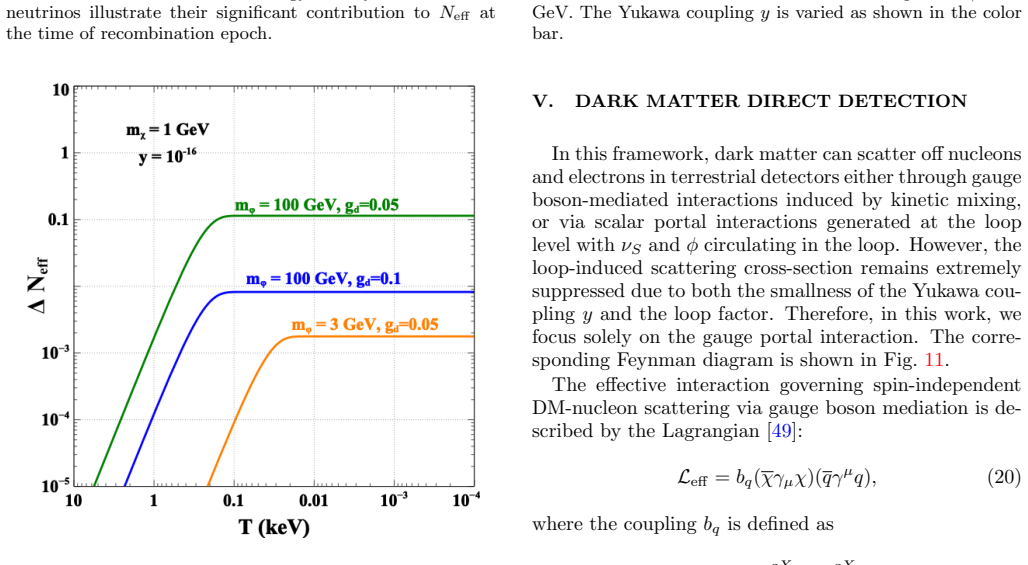
On its own terms, the paper's central claim is that a self-interacting dark matter candidate at the GeV scale can avoid the standard thermal-relic obstruction. The dark sector consists of a fermion $\chi$, a light vector mediator $X$ whose mass is generated through the Stueckelberg mechanism (a mass for a gauge boson without a scalar vacuum expectation value), a singlet scalar $\varphi$, and a dark radiation fermion $\nu_S$; $\chi$ freezes out with a relic density below the observed value because annihilations into the light mediator are efficient. The scalar $\varphi$ freezes out with a larger abundance and later decays through $\varphi \to \chi + \nu_S$, supplying the missing dark matter and simultaneously creating the dark radiation that produces $\Delta N_{\rm eff}$. The paper computes the coupled Boltzmann evolution and finds parameter points, with $\Delta N_{\rm eff}$ from about 0.01 to 0.2, that agree with current CMB measurements and lie within the projected reach of future CMB experiments while respecting direct detection and free-streaming limits. The intended message is that small-scale structure anomalies, the light-thermal-relic underabundance, and the search for extra radiation are three facets of one mechanism.
Load-bearing premise
The whole mechanism depends on the scalar being able to decay into the dark matter particle plus the dark radiation particle, but under the charge assignments stated in the paper that decay is forbidden by the unbroken symmetry of the dark force; unless the assignment is corrected, the late production that generates the relic top-up and the extra radiation does not exist.
Editorial extensions
If this is right
- The model removes the main obstruction for GeV-scale self-interacting dark matter: the thermal underabundance from efficient annihilation into light mediators is compensated by the late scalar decay, so the observed relic density and a self-interaction cross section near 1 cm²/g can coexist.
- The same decay injects a dark radiation component, giving $\Delta N_{\rm eff}$ from roughly 0.01 to 0.2 in the scanned region of parameter space, which current CMB bounds allow and next-generation CMB experiments can test.
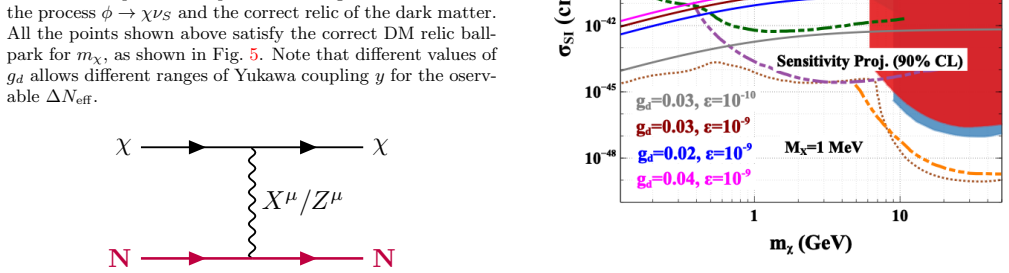
- Direct detection already closes the branch with kinetic mixing $\epsilon = 10^{-9}$ for dark matter masses above about 3 GeV; reducing the mixing to $10^{-10}$ keeps masses up to about 6 GeV viable, so near-future detectors will cover the rest.
- The free-streaming constraint $\lambda_{\rm fs} < 0.1$ Mpc selects a definite band of decay parameters, so relic abundance, $\Delta N_{\rm eff}$, and structure formation jointly pin down the scalar mass, dark matter mass, and coupling $y$.
Reading between the lines
- The charge-assignment issue is repairable, but any repair (giving $\nu_S$ a dark charge or flipping the charge of $\varphi$) changes the dark-sector dynamics, so the benchmark numbers would shift even if the qualitative story survives.
- The thermal-underabundance-plus-late-injection pattern is generic: any model with a strongly annihilating light dark matter candidate and a long-lived heavier scalar decaying into dark matter plus a light fermion will produce a similar $\Delta N_{\rm eff}$ signature, making future CMB measurements a broad probe of non-thermal production.
- The authors' alternative completion in which the scalar decays to dark matter and active neutrinos would blur the cosmological signature, because active neutrinos are already counted in the baseline $N_{\rm eff}$; distinguishing that branch from the $\nu_S$ branch would require more than a total $\Delta N_{\rm eff}$ measurement.
Signed reviews
Editorial analysis
A structured set of objections, weighed in public.
Referee Report
Summary. The manuscript proposes a dark U(1)_D extension of the SM containing a GeV-scale Dirac fermion DM χ, a light Stueckelberg vector X that mediates χ self-interactions, a complex singlet scalar φ, and a sterile neutrino νS. With U(1)_D left unbroken, χ is stable, and the relic density is generated in two stages: thermal freeze-out of χχ→XX, which is underabundant in the SIDM-relevant parameter region, plus non-thermal production through the late decay φ→χ νS occurring after BBN and before the CMB epoch. The same decays produce the dark radiation νS, giving ΔNeff in the range 0.01–0.2, claimed to be compatible with Planck and within reach of SPT-3G/CMB-S4/CMB-HD, while a scan over gd, mφ, mχ, and y imposes the observed relic density, the SIDM self-interaction cross-section, and the free-streaming bound λfs < 0.1 Mpc. Three benchmark points are given in Table I, and the paper includes detailed appendices for the cross-sections, Boltzmann equations, and Stueckelberg mass generation.
Significance. The setup is timely and the hybrid production mechanism is standard and clearly articulated; the paper is honest about the tension between efficient annihilation into light mediators and the resulting underabundant thermal relic, and it documents the model in unusual detail (cross-sections, Boltzmann equations, decay widths, direct detection analysis). Its concrete falsifiable predictions — ΔNeff within reach of next-generation CMB experiments and spin-independent scattering targets in Section V — are a genuine strength. However, the quantitative demonstration of the central claim is not currently reliable: the defining Yukawa interaction is written in a way that violates the stated unbroken U(1)_D; the free-streaming evaluation in Section VI appears to be wrong by orders of magnitude, so the claimed compatibility of the benchmarks (and the scan of Fig. 15) with λfs < 0.1 Mpc is not established; and Table I is internally inconsistent. These problems are fixable in principle but require a substantive recomputation, so the paper is not yet publishable in its present form.
major comments (5)
- [Section II, Eq. (1)] As printed, the interaction (y φ χ νS + h.c.) is not gauge invariant under the charge assignments stated in Section II, namely Qχ = Qφ and QνS = 0: the field product carries net dark charge 2Q and is forbidden by the unbroken U(1)_D that the paper invokes to stabilize χ. This vertex is the sole source of the late-time non-thermal DM production and of the dark radiation νS, so the central decay mechanism is not consistently defined as written. The likely intended operator is y φ \barχ νS, which is invariant under equal charges; please correct the printed operator (or flip one of the charge assignments) and state the charges explicitly.
- [Section VI, Eqs. (26)–(28), Table I] The approximate free-streaming evaluation in Eq. (28) is internally inconsistent. The final expression vkick (Γφ)^{-1} a_d ln(a_eq/a_d) does not follow from the displayed integral: inserting H(a) = H0√Ωr a^{-2} and Γφ = H(a_d) = H0√Ωr a_d^{-2} gives λfs = vkick a_d ln(a_eq/a_d)/(H0√Ωr), not the printed result, which contains an extra factor a_d^2. Moreover, the integral drops the relativistic stage a_d < a < a_nr, where v ≈ 1, and the matter-era tail, both of which are required by Eq. (26). Evaluating Eq. (26) with the kinematics of BP2 (a_d = 6.84e-6, a_nr = 1.56e-4, vkick = 0.999) gives λfs ~ O(100) Mpc: the relativistic segment alone contributes roughly a_nr/(H0√Ωr) ≈ 70 Mpc, and the non-relativistic radiation-era segment contributes another ~45 Mpc, versus the quoted 0.006 Mpc. The paper's central claim that the benchmarks and the scan of Fig. 15 respect λfs < 0.1 Mpc therefore needs to be re-established with the full integral.
- [Table I, BP1 row] BP1 is inconsistent with the paper's own structure-formation constraint. The row reports λfs = 0.256 Mpc, which violates the bound λfs < 0.1 Mpc quoted in Section VI (following Refs. [66–68]), and it also has a_d = 5.2e-4 > a_eq = 2.94e-4 and a_nr > a_eq, contradicting the ordering a_d << a_nr < a_eq used to justify Eqs. (26)–(28). The statement in Section VI that the three benchmark scenarios of Table I illustrate that 'it is indeed possible to satisfy the structure formation constraints' is therefore not correct as printed; BP1 should be removed or replaced with a point that genuinely satisfies all stated constraints.
- [Table I vs. Eq. (16) and Section VI] The quoted Yukawa couplings are inconsistent with the quoted decay epochs. Section VI states that 'the decay happens when Γφ = H(a_d)'; using the width Γφ = y^2 mφ (1 - mχ^2/mφ^2)^2/(16π), BP2 (y = 8.1e-16, mφ = 46.56 GeV) gives Γφ ≈ 9e-7 s^{-1}, which equals H at T ≈ 1.2 keV (a ≈ 2e-7), whereas Table I lists a_d = 6.84e-6, where H(a_d) ≈ 5-8e-10 s^{-1}, i.e., Γφ/H ≈ 10^3. The same discrepancy (Γφ/H(a_d) of order 10^3) occurs for BP1 and BP3. If a_d is intended to be an effective epoch of maximal decay or energy injection rather than the Γφ = H epoch, its definition should be stated; as it stands, the benchmark table and the associated ΔNeff and λfs values cannot be reproduced from the formulas given in the paper.
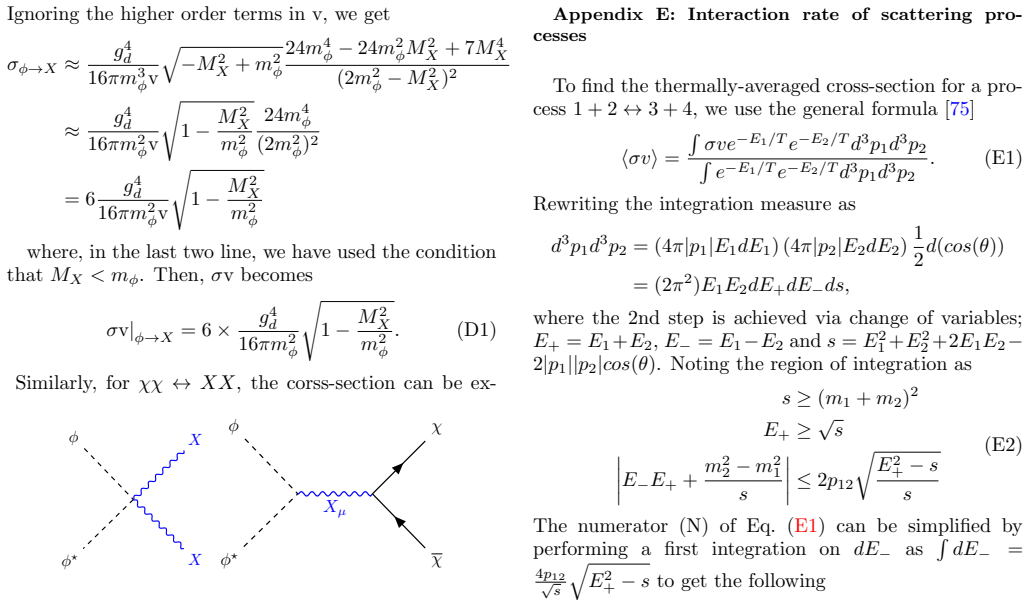
- [Section III.B and Appendix D, Eq. (D1)] The φφ → XX annihilation cross-section is quoted inconsistently: Section III.B states ⟨σv⟩_{φφ→XX} ≃ 6πα_d/mφ^2, while the derivation in Appendix D, Eq. (D1), gives ⟨σv⟩ = 6 g_d^4/(16π mφ^2) = 6πα_d^2/mφ^2. The two expressions differ by a factor α_d ≈ 10^{-4}–10^{-3} for the couplings considered. Since the thermal abundance Yφ — and hence the non-thermal DM component and ΔNeff, both of which are produced from φ decays — is controlled by this cross-section, the correct expression must be identified and the scans (Figs. 5, 8–10, 15) recomputed consistently.
minor comments (4)
- [Sections II and II.A] Several displayed formulas have lost their Dirac conjugation bars in the typeset version, e.g., the mass term 'mχχχ' and the operator 'yφχνS' in Eq. (1), and the phrase 'χχ and χχ interactions are repulsive' in Section II.A should presumably read χ\barχ and \barχ\barχ; please ensure the published version typesets correctly, as these details matter for the gauge-invariance discussion in the first major comment.
- [Appendix F] The text states that for most calculations a 'simplified form of the Boltzmann equation that does not require tracking the co-moving density of X' is adopted, but no numerical justification is given. Since the X boson decays to the SM only through a very small kinetic mixing (ε down to 10^{-10}), the lifetime of X can be comparable to BBN timescales and a residual X abundance could, in principle, alter the χ relic density or inject energy; please state the explicit check that validates dropping YX.
- [Section IV, Eq. (17)] The definition of ΔNeff in Eq. (17) should specify the epoch at which ρνS/ρνL is evaluated and the temperature convention used (photon vs. neutrino temperature); as written, the notation 'ρνS/ρνL|_{TCMB}' is ambiguous about the integration of the Boltzmann equation (18) and about how the SM value N_eff^SM = 3.045 enters.
- [Section IV and Fig. 2] Section IV states that MX is restricted to 1 MeV or below 'ensuring that it can decay only into SM neutrinos', but Fig. 2 displays results for MX = 10 MeV, for which X → e+e- is kinematically open; please clarify that all benchmark and ΔNeff results use MX ≤ 1 MeV, or comment on the e+e- constraints for the 10 MeV case.
Circularity Check
No circular reduction found: ΔNeff is a computed output of a parameter scan, not a fitted input.
full rationale
We walked the claimed derivation chain and found no step in which an output is used to construct an input. The thermal relic of χ is computed from the Boltzmann equations for given gd, mχ, and MX; the shortfall relative to the observed relic density is then identified, and mφ (with y mainly controlling the φ lifetime) is scanned so that late φ→χνS decay fills that deficit. ΔNeff is subsequently evaluated from the same decay and compared with Planck and future CMB sensitivities; it is never used as a fitting target. This is parametric freedom, not circularity: the model has enough parameters that ΔNeff is a consistency window rather than a unique number, but the paper does not fit ΔNeff to itself. The self-citations (e.g., refs. 13–17, 26–30, 44) are motivational or technical formula citations and are not load-bearing arguments; no same-author uniqueness theorem or ansatz is invoked to force the result. External benchmarks (Planck ΔNeff, direct detection, Lyman-α/free-streaming) are treated as constraints. We separately note two internal-consistency problems that are not circular reductions: (a) with the stated charge assignment Qχ=Qφ and QνS=0, the operator yφχνS in Eq. (1) is not U(1)D invariant, and (b) BP1 in Table I lists λfs=0.256 Mpc while Sec. VI requires λfs<0.1 Mpc. These are serious correctness risks, but they do not constitute a circular derivation of the paper's observables from its own inputs.
Assumptions & free parameters
free parameters (7)
- gd (dark U(1)_D gauge coupling) =
~0.01-0.1 (scanned)
- mchi (dark matter mass) =
0.1-10 GeV (benchmarks: 0.118, 1, 2.82 GeV)
- mphi (scalar mass) =
3-200 GeV (benchmarks: 22.4, 46.56, 127.32 GeV)
- y (Yukawa coupling phi chi nuS) =
~1e-17 to 1e-15
- MX (mediator mass) =
1 MeV or below
- epsilon (kinetic mixing) =
1e-9 or 1e-10
- lambda_hphi (Higgs-scalar quartic) =
~1e-3
assumptions (5)
- domain assumption The full Lagrangian is invariant under the U(1)_D gauge symmetry with the stated charge assignments.
- domain assumption Stueckelberg mechanism gives X a mass while preserving an unbroken U(1)_D global symmetry that stabilizes chi.
- domain assumption The dark sector thermalizes with the SM bath via lambda_hphi, and phi stays in equilibrium until its freeze-out.
- ad hoc to paper The simplified Boltzmann equations ignoring the co-moving density of X give accurate relic abundances.
- domain assumption Standard radiation and matter dominated expansion history, with SM g* and no significant extra radiation before phi decay.
invented entities (4)
-
Dirac fermion chi
-
Vector boson Xmu
-
Complex scalar phi
-
Sterile neutrino nuS
Cite this review
Pith. "Pith review of Self-interacting dark matter with observable $\Delta N_{\rm eff}$." pith.science (2026). https://pith.science/paper/HMAFWUIT
@misc{pith2026250416910,
  author       = {Pith},
  title        = {Pith review of: Self-interacting dark matter with observable $\Delta N_\rm eff$},
  year         = {2026},
  howpublished = {\url{https://pith.science/paper/HMAFWUIT}},
  note         = {Machine review of arXiv:2504.16910}
}
abstract
We propose a GeV-scale self-interacting dark matter (SIDM) candidate within a dark $U(1)_D$ gauged extension of the Standard Model (SM), addressing small-scale structure issues in $\Lambda$CDM while predicting an observable contribution to $\Delta N_{\rm eff}$ in the form of dark radiation. The model introduces a fermionic DM candidate $\chi$ and a scalar $\phi$, both charged under an unbroken $U(1)_D$ gauge symmetry. The self-interactions of $\chi$ are mediated by a light vector boson $X^\mu$, whose mass is generated via the Stueckelberg mechanism. The relic abundance of $\chi$ is determined by thermal freeze-out through annihilations into $X^\mu$, supplemented by a non-thermal component from the late decay of $\phi$. Crucially, $\phi$ decays after the Big Bang Nucleosynthesis (BBN) but before the Cosmic Microwave Background (CMB) epoch, producing additional $\chi$ and a dark radiation species ($\nu_S$). This late-time production compensates for thermal underabundance due to efficient annihilation into light mediators, while remaining consistent with structure formation constraints. The accompanying dark radiation yields a detectable $\Delta N_{\rm eff}$, compatible with Planck 2018 bounds and within reach of next-generation experiments such as SPT-3G, CMB-S4, and CMB-HD.
Figures


Figures from the paper (11 more)






Forward citations
Cited by 1 Pith paper
-
Interpreting the Hubble tension with a cascade decaying dark matter sector
A cascade decaying dark matter model combining early and late effects still cannot reduce the Hubble tension below about 3 sigma, and is statistically disfavored relative to Lambda CDM.
Reference graph
Works this paper leans on
-
[1]
For the case of very small ϵ, the quartic coupling λhϕ serves as the only portal (Fig
the kinetic mixing parameterϵ, and 2) the quartic cou- plingλhϕ which quantifies the strength ofhh→ϕ⋆ϕ scat- tering. For the case of very small ϵ, the quartic coupling λhϕ serves as the only portal (Fig. 1) through which the dark sector can thermalize with the SM bath. As shown in Eq. (2), the coupling λhϕ plays a crucial role in deter- mining the thermal...
- [2]
-
[3]
D. N. Spergel and P. J. Steinhardt, Phys. Rev. Lett. 84, 3760 (2000), astro-ph/9909386
arXiv 2000
-
[4]
M. R. Buckley and P. J. Fox, Phys. Rev. D 81, 083522 (2010), 0911.3898
arXiv 2010
-
[5]
J. S. Bullock and M. Boylan-Kolchin, Ann. Rev. Astron. Astrophys. 55, 343 (2017), 1707.04256
arXiv 2017
-
[6]
J. L. Feng, M. Kaplinghat, H. Tu, and H.-B. Yu, JCAP 07, 004 (2009), 0905.3039
arXiv 2009
-
[7]
J. L. Feng, M. Kaplinghat, and H.-B. Yu, Phys. Rev. Lett. 104, 151301 (2010), 0911.0422
arXiv 2010
-
[8]
T. Bringmann, F. Kahlhoefer, K. Schmidt-Hoberg, and P. Walia, Phys. Rev. Lett. 118, 141802 (2017), 1612.00845
arXiv 2017
Show all 77 references
- [9]
-
[10]
L. G. van den Aarssen, T. Bringmann, and C. Pfrommer, Phys. Rev. Lett. 109, 231301 (2012), 1205.5809
2012 arXiv
-
[11]
Kaplinghat, S
M. Kaplinghat, S. Tulin, and H.-B. Yu, Phys. Rev. Lett. 116, 041302 (2016), 1508.03339
2016 arXiv
-
[13]
Tulin, H.-B
S. Tulin, H.-B. Yu, and K. M. Zurek, Phys. Rev. D 87, 115007 (2013), 1302.3898
2013 arXiv
-
[14]
Borah, S
D. Borah, S. Mahapatra, N. Sahu, and V. S. Thounao- jam, Phys. Rev. D 108, 083038 (2023), 2308.06172
2023 arXiv
-
[15]
Borah, S
D. Borah, S. Mahapatra, and N. Sahu, Phys. Rev. D 108, L091702 (2023), 2211.15703
2023 arXiv
-
[16]
Borah, S
D. Borah, S. Mahapatra, P. K. Paul, N. Sahu, and P. Shukla, Phys. Rev. D 110, 035033 (2024), 2404.14912
2024 arXiv
-
[17]
Mahapatra, S
S. Mahapatra, S. K. Sahoo, N. Sahu, and V. S. Thounao- jam, Phys. Rev. D 109, 055036 (2024), 2312.12322
2024 arXiv
-
[18]
B. W. Lee and S. Weinberg, Phys. Rev. Lett. 39, 165 (1977)
1977
-
[19]
Adhikary, D
A. Adhikary, D. Borah, S. Mahapatra, I. Saha, N. Sahu, and V. S. Thounaojam, JCAP 12, 043 (2024), 2405.17564
2024 arXiv
-
[20]
Pospelov, A
M. Pospelov, A. Ritz, and M. B. Voloshin, Phys. Lett. B 14 662, 53 (2008), 0711.4866
2008 arXiv
-
[21]
E. W. Kolb and K. A. Olive, Phys. Rev. D 33, 1202 (1986), [Erratum: Phys.Rev.D 34, 2531 (1986)]
1986
- [22]
-
[23]
R. T. D’Agnolo and J. T. Ruderman, Phys. Rev. Lett. 115, 061301 (2015), 1505.07107
2015 arXiv
-
[24]
Herms, S
J. Herms, S. Jana, V. P. K., and S. Saad, Phys. Rev. Lett. 129, 091803 (2022), 2203.05579
2022 arXiv
-
[25]
R. T. D’Agnolo, D. Liu, J. T. Ruderman, and P.-J. Wang, JHEP 06, 103 (2021), 2012.11766
2021 arXiv
- [26]
- [27]
-
[28]
Borah, M
D. Borah, M. Dutta, S. Mahapatra, and N. Sahu, Phys. Rev. D 105, 015004 (2022), 2110.00021
2022 arXiv
-
[29]
Dutta, S
M. Dutta, S. Mahapatra, D. Borah, and N. Sahu, Phys. Rev. D 103, 095018 (2021), 2101.06472
2021 arXiv
-
[30]
Borah, A
D. Borah, A. Dasgupta, S. Mahapatra, and N. Sahu, Phys. Rev. D 106, 095028 (2022), 2112.14786
2022 arXiv
-
[31]
A central challenge in the GeV-scale SIDM sce- nario is that the efficient annihilation of χ into light me- diators often results in an under-abundant relic density
for simplicity, although the Higgs mechanism is also viable. A central challenge in the GeV-scale SIDM sce- nario is that the efficient annihilation of χ into light me- diators often results in an under-abundant relic density. In our model, this deficit is remedied by the late...
2025 arXiv
-
[32]
Borah, M
D. Borah, M. Dutta, S. Mahapatra, and N. Sahu, Phys. Rev. D 105, 075019 (2022), 2112.06847
2022 arXiv
-
[33]
E. C. G. Stueckelberg, Helv. Phys. Acta 11, 225 (1938)
1938
-
[34]
Aghanim et al
N. Aghanim et al. (Planck), Astron. Astrophys. 641, A6 (2020), [Erratum: Astron.Astrophys. 652, C4 (2021)], 1807.06209
2020 arXiv
-
[35]
J. S. Avva et al. (SPT-3G), J. Phys. Conf. Ser. 1468, 012008 (2020), 1911.08047
2020 arXiv
- [36]
- [37]
- [38]
-
[39]
Boehm and R
C. Boehm and R. Schaeffer, Astron. Astrophys. 438, 419 (2005), astro-ph/0410591
2005 arXiv
-
[40]
Mangano, G
G. Mangano, G. Miele, S. Pastor, T. Pinto, O. Pisanti, and P. D. Serpico, Nucl. Phys. B 729, 221 (2005), hep- ph/0506164
2005
-
[41]
Grohs, G
E. Grohs, G. M. Fuller, C. T. Kishimoto, M. W. Paris, and A. Vlasenko, Phys. Rev. D 93, 083522 (2016), 1512.02205
2016 arXiv
-
[42]
P. F. de Salas and S. Pastor, JCAP 1607, 051 (2016), 1606.06986
2016 arXiv
- [43]
-
[44]
J. J. Bennett, G. Buldgen, P. F. De Salas, M. Drewes, S. Gariazzo, S. Pastor, and Y. Y. Y. Wong, JCAP 04, 073 (2021), 2012.02726
2021 arXiv
-
[45]
Drewes, Y
M. Drewes, Y. Georis, M. Klasen, L. P. Wiggering, and Y. Y. Y. Wong, JCAP 06, 032 (2024), 2402.18481
2024 arXiv
-
[46]
Biswas, D
A. Biswas, D. Borah, N. Das, and D. Nanda, Phys. Rev. D 107, 015015 (2023), 2205.01144
2023 arXiv
-
[47]
M. S. Madhavacheril, N. Sehgal, and T. R. Slatyer, Phys. Rev. D 89, 103508 (2014), 1310.3815
2014 arXiv
-
[48]
T. R. Slatyer, Phys. Rev. D 93, 023527 (2016), 1506.03811
2016 arXiv
-
[49]
G. Elor, N. L. Rodd, T. R. Slatyer, and W. Xue, JCAP 06, 024 (2016), 1511.08787
2016 arXiv
-
[50]
Profumo, F
S. Profumo, F. S. Queiroz, J. Silk, and C. Siqueira, JCAP 03, 010 (2018), 1711.03133
2018 arXiv
-
[51]
E. J. Chun, J.-C. Park, and S. Scopel, JHEP 02, 100 (2011), 1011.3300
2011 arXiv
- [52]
- [53]
-
[54]
A. H. Abdelhameed et al. (CRESST), Phys. Rev. D 100, 102002 (2019), 1904.00498
2019 arXiv
- [55]
-
[56]
Agnes et al
P. Agnes et al. (Global Argon Dark Matter), Phys. Rev. D 107, 112006 (2023), 2209.01177
2023 arXiv
- [57]
- [58]
-
[59]
Schumann, L
M. Schumann, L. Baudis, L. B¨ utikofer, A. Kish, and M. Selvi, JCAP 10, 016 (2015), 1506.08309
2015 arXiv
- [60]
-
[61]
J. H. Chang, R. Essig, and S. D. McDermott, JHEP 01, 107 (2017), 1611.03864
2017 arXiv
-
[62]
Hochberg, E
Y. Hochberg, E. Kuflik, T. Volansky, and J. G. Wacker, Phys. Rev. Lett. 113, 171301 (2014), 1402.5143
2014 arXiv
- [63]
- [64]
- [65]
-
[66]
Aoyama, T
S. Aoyama, T. Sekiguchi, K. Ichiki, and N. Sugiyama, JCAP 07, 021 (2014), 1402.2972
2014 arXiv
-
[67]
A. J. Long and M. Venegas (2024), 2412.14322
2024 arXiv
-
[68]
E. O. Nadler et al. (DES), Phys. Rev. Lett. 126, 091101 (2021), 2008.00022
2021 arXiv
-
[69]
Villasenor, B
B. Villasenor, B. Robertson, P. Madau, and E. Schneider, Phys. Rev. D 108, 023502 (2023), 2209.14220
2023 arXiv
- [70]
-
[71]
E. W. Kolb and M. S. Turner,The Early Universe , vol. 69 (Taylor and Francis, 2019), ISBN 978-0-429-49286-0, 978- 0-201-62674-2
2019
-
[72]
W. B. Lin, D. H. Huang, X. Zhang, and R. H. Bran- denberger, Phys. Rev. Lett. 86, 954 (2001), astro- ph/0009003
2001
-
[73]
Choi, J.-O
K.-Y. Choi, J.-O. Gong, J. Joh, W.-I. Park, and O. Seto, Phys. Lett. B 845, 138126 (2023), 2304.07462
2023 arXiv
- [74]
-
[75]
Tulin, H.-B
S. Tulin, H.-B. Yu, and K. M. Zurek, Phys. Rev. Lett. 110, 111301 (2013), 1210.0900
2013 arXiv
-
[76]
S. A. Khrapak, A. V. Ivlev, G. E. Morfill, and S. K. Zhdanov, Phys. Rev. Lett. 90, 225002 (2003)
2003
-
[77]
Gondolo and G
P. Gondolo and G. Gelmini, Nucl. Phys. B360, 145 (1991)
1991
- [78]
Reviewed August 16, 2026 · model on record in the stance chip above.
Discussion (0). Continue with ORCID to comment.