REVIEW 3 major objections 4 minor 4 cited by
Turbulence-dominated CGM: the origin of UV absorbers with equivalent widths of $\sim1$\AA
T0 review · 3 major / 4 minor · reviewed 2026-08-16 · deepseek-v4-flash
Pith's one-line read A turbulent cool inner CGM, not hot gas, explains the ~1 Å UV absorbers seen around blue star-forming galaxies.
desk verdict A solid, field-relevant paper that plausibly explains the ~1 Å Mg II/C IV absorbers around blue ~L* galaxies as saturated absorption from a volume-filling, supersonically turbulent inner CGM; the observational link is suggestive rather than definitive, and the FIRE-2 feedback/CR caveats keep the central claim from being fully established. read the letter →
The pith
A machine-rendered reading of the paper's core claim, the machinery that carries it, and where it could break.
The reading
What carries the argument
The load-bearing identity is the analytic equivalent-width estimate W_λ ~ 2λ v_c / c (their eq. 13), which follows from assuming saturated absorption in strong UV transitions, a line width b ≈ $\sqrt$(2/3) σ_turb, and σ_turb ≈ v_c in the pre-ICV regime. This is supported by the isothermal-turbulence relation $σ_s^{2}$ = ln(1 + $b_t^{2}$ $M_turb^{2}$) (their eq. 10) connecting the turbulent Mach number to the width of the lognormal density distribution, and by the ICV criterion t_cool^(s) < t_ff that sets when the cool turbulent phase dominates. The simulations supply σ_turb, the density distribution, and ion fractions; the identity converts those to a directly observable quantity, W_λ, which is then compared with survey data.
What would settle it
A stacked-spectrum measurement of mean Mg II rest-frame equivalent width at 0.2 R_vir around blue ~L* galaxies at z≈0.5: the turbulence-dominated prediction gives ≈1 Å, so a mean width below ≈0.3 Å with comparable signal to noise would falsify the central claim.
Extended reading notes
Core claim
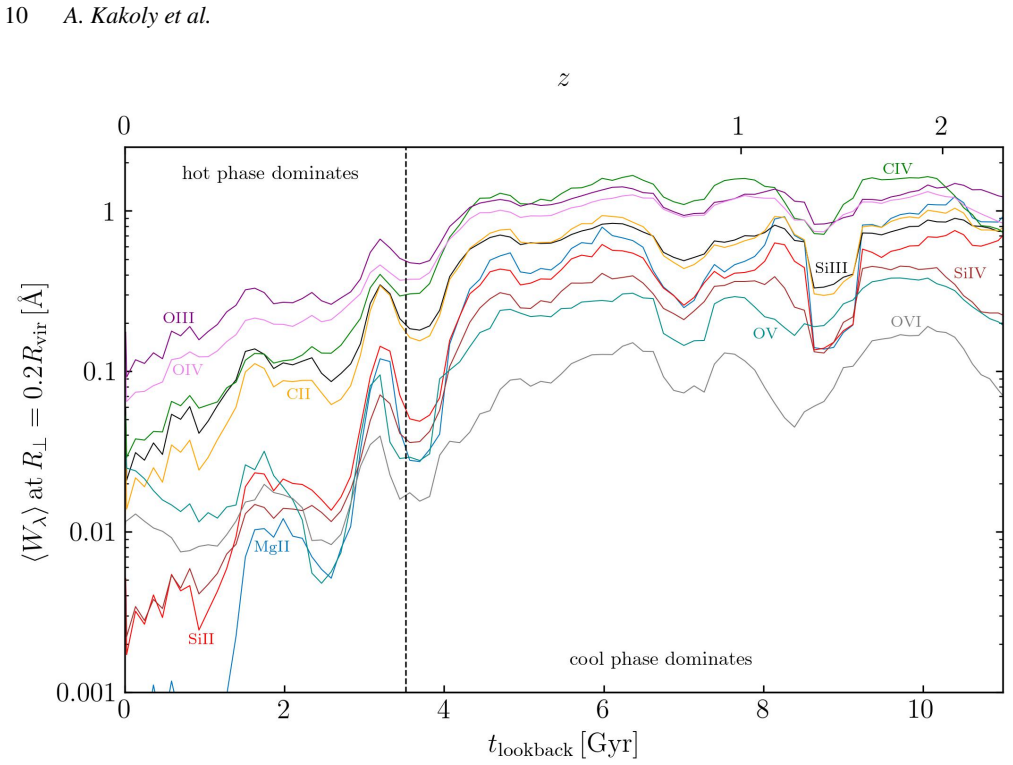
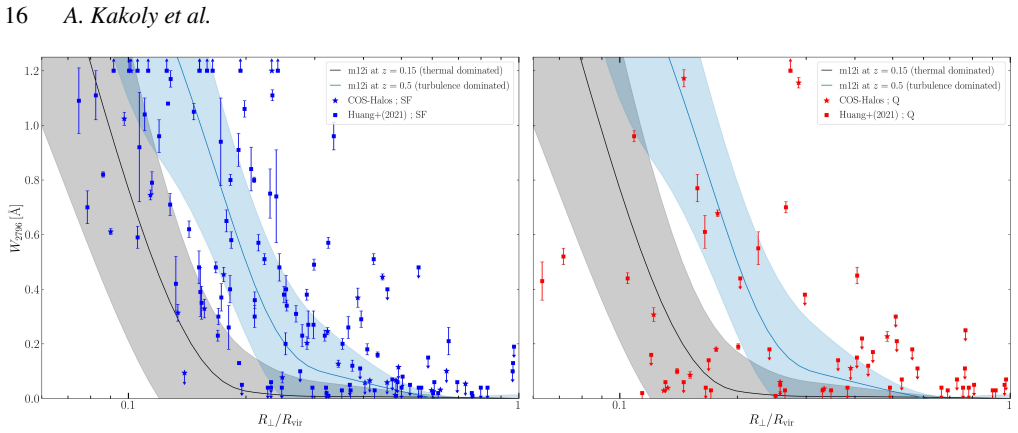
The central discovery is a transition in the nature of the inner CGM at a halo mass around $10^{12}$ Msun, identified by comparing the cooling time of shocked gas t_cool^(s) with the free-fall time t_ff at a given radius. When t_cool^(s) < t_ff, the inner CGM is dominated by cool (T << T_vir) gas with 3D turbulent velocity σ_turb ≈ v_c, so the turbulence is supersonic and the gas density distribution at fixed radius is a wide lognormal with σ_logρ ~ 0.6–0.8 dex. In this regime strong UV absorption lines are saturated, and the equivalent width is set by the Doppler width b ≈ $\sqrt$(2/3) σ_turb, yielding W_λ ~ 2λ v_c / c ~ 1 Å at impact parameters near 0.2 R_vir over 0 ≤ z ≲ 2 for a broad set of ions (Mg II, C II, C IV, Si II–IV, O III–V). The paper shows that observed mean Mg II and C IV equivalent widths around blue ~L* and dwarf galaxies match this prediction to within a factor of about two, while quenched galaxies and massive low-redshift disks such as the Milky Way and M31 show much lower widths, consistent with a hot, thermally supported inner CGM.
Load-bearing premise
The prediction inherits everything from the FIRE-2 simulations, so the load-bearing premise is that their sub-grid stellar feedback model, with no AGN or cosmic rays, faithfully reproduces the turbulent velocity and cool gas content of the inner CGM around ~L* halos; if that fails, the predicted 1 Å widths and the turbulence-dominated interpretation lose their footing.
Editorial extensions
If this is right
- Observed ~1 Å mean Mg II and C IV widths around blue ~L* galaxies imply these systems are pre-ICV, i.e., their inner CGM is dominated by turbulent pressure rather than thermal pressure.
- UV absorbers in turbulence-dominated CGM trace the volume-filling cool phase with a wide lognormal density distribution, so observed column densities and densities should not be interpreted as single uniform clouds.
- Quenched galaxies and massive low-redshift disks (Milky Way, M31) are expected to show mean equivalent widths well below 1 Å at 0.2 R_vir, consistent with a hot, thermally supported inner CGM.
- The transition from ~1 Å to ≪1 Å absorption at a given halo mass provides a way to identify which galaxies have formed a quasi-static hot inner CGM, connecting CGM thermodynamics to the quenching and morphology of the central galaxy.
Reading between the lines
- The same saturated-absorption argument could be extended to other strong UV/EUV transitions not listed, and the scaling W ∝ λ v_c implies that measuring W and an independent v_c estimate could serve as a probe of halo mass at fixed impact parameter.
- If cosmic-ray pressure is significant at the Milky-Way mass scale, the ICV mass threshold could shift; the paper's predictions at lower masses and higher redshifts are less affected, so observations there offer a cleaner test of the turbulence-dominated picture.
- The lognormal density distribution suggests a natural modeling scheme for UV absorbers: replace single-cloud photoionization models with lognormal-distributed density grids, which would produce different inferred metallicities and densities than the cloud paradigm.
Signed reviews
Editorial analysis
A structured set of objections, weighed in public.
Referee Report
Summary. This paper uses FIRE-2 cosmological zoom simulations to study the inner circumgalactic medium (CGM) of halos below roughly 10^12 Msun before 'inner CGM virialization' (ICV), i.e., when the cooling time of shock-heated gas is shorter than the free-fall time. The authors find that in this pre-ICV regime the inner CGM is dominated by cool gas with supersonic turbulence, that the turbulent velocity is comparable to the circular velocity, and that the gas density distribution is broad and approximately lognormal. They derive an analytic estimate W_lambda ~ 2 lambda v_c / c ~ 1 Å for saturated strong UV transitions, verify this in mock sightlines through FIRE-2, and compare the predicted Mg II and C IV equivalent widths with literature measurements around blue, star-forming ~L* galaxies, dwarf galaxies, and red galaxies. They conclude that the inner CGM of star-forming ≲L* and dwarf galaxies is turbulence-dominated rather than thermal-pressure-dominated, whereas red galaxies and massive disks such as the Milky Way and M31 are post-ICV with a thermal-pressure-supported inner CGM.
Significance. If the central claim holds, the paper provides a simple and falsifiable explanation for the ubiquitous ~1 Å UV absorbers around star-forming galaxies, connects inner CGM thermodynamics to galaxy quenching and disk settling, and challenges the standard picture in which UV absorbers are cool clouds embedded in a hot, volume-filling medium. The analytic estimate in eq. (13) is transparent, the prediction is not fitted to the observed equivalent widths, and the paper tests resolution dependence and a range of ions and halo masses. These are genuine strengths. The significance is moderated, however, by the fact that the conclusion depends on a CR-free version of FIRE-2 and by the coarseness of the observational comparison; the paper itself concedes in Section 5.4 that neither a thermal-pressure-dominated origin nor a cosmic-ray-pressure-supported cool phase can be strictly ruled out in the relevant mass and redshift regime.
major comments (3)
- [§5.4, Figs. 10-11] The central observational conclusion that ~1 Å absorbers around blue ≲L* galaxies imply a turbulence-dominated, rather than thermal-pressure-dominated, inner CGM is not uniquely established by the presented evidence. The authors state in Section 5.4 that resolution prevents them from strictly ruling out a thermal-pressure-dominated origin, and that FIRE simulations including cosmic-ray physics can prevent a volume-filling hot phase at the Milky-Way mass scale at z ≲ 1, replacing thermal pressure support with cosmic-ray pressure support. The blue ~L* samples in Fig. 10 and the C IV comparison in §4.2 sit precisely in this mass and redshift regime, and eq. (13) together with the lognormal density argument are inherited from CR-free FIRE-2. As the manuscript stands, the observations are equally consistent with a cool, cosmic-ray-pressure-supported CGM, so the claim should either be backed by CR-including simulations or explicitly weakened to a consistency statement.
- [§4.1, Fig. 10, Table 3] The comparison of predicted and observed Mg II equivalent widths is too heterogeneous to carry the weight of the central inference. The samples in Table 3 combine co-added low-resolution spectra (zCOSMOS, SDSS composites), individual sightlines (COS-Halos, Huang et al.), and lensed arcs, with Rvir inferred through abundance matching and an assumed NFW profile; several entries quote zero uncertainties (e.g., the DESI rows with 1.8±0.0 and 3.0±0.0), and the agreement is only within a factor of about two. The predicted post-ICV drop is not present in the blue-galaxy data and is attributed to a mass mismatch, which means the comparison is not actually testing the ICV transition. A homogeneous analysis or an explicit propagation of systematic uncertainties is needed before concluding that the observed values match the turbulence-dominated prediction.
- [§4.4, eq. (20)] The derived t_cool(s)/t_ff ≈ 0.2–0.7, presented as supporting evidence for the turbulence-dominated interpretation, is not independent of the model being tested: it adopts N_Si+/N_Si = 0.2 from the same m12i simulation used to generate the predictions, and the resulting ratio is within a factor of about two of unity given the stated uncertainties. The authors should show how the inferred ratio changes for a plausible range of N_Si+/N_Si (e.g., 0.05–0.5) and ideally use observationally constrained ionization corrections, or present eq. (20) solely as a consistency check rather than as independent confirmation.
minor comments (4)
- [§3.2, Abstract] The description of the pre-ICV cool gas as a 'volume-filling' phase is overstated relative to the numbers in Fig. 2: at z = 0.75 the hot T > 10^5.5 K gas occupies 58% of the volume (with only 14% of the mass), so the cool phase occupies a minority of the volume. Please clarify whether 'volume-filling' is meant only in the sense of sightline coverage rather than volume fraction.
- [Table 1, §4.1] The listing of z_ICV = 0.27 for m12w appears inconsistent with the statement that this halo 'does not fully transition' to the thermal-energy-dominated regime by z = 0; please reconcile the table entry with the text.
- [§3.4.1, Abstract] The abstract's single value W ~ 1 Å for all listed transitions glosses over the explicit wavelength dependence in eq. (13): for Mg II 2796 at sigma_turb = 150 km/s the analytic estimate is roughly 2.3 Å per line, about twice the Si III value. Please state the normalization or phrase the prediction as order-of-magnitude.
- [Throughout] There are several typographical errors and small wording glitches that should be corrected, including 'contirubion' and 'are conclusions' in Section 2.3 and 'FURE snapshot' in Section 4.1.
Circularity Check
Minor circularity in Section 4.4: the inferred t_cool/t_ff<1 support uses the turbulence-dominated simulation's own Si+ ionization fraction; the central W~1A prediction is otherwise independently grounded.
-
fitted input called prediction
[Section 4.4, eq. (20) and following paragraph]
"We thus get t(s)cool/tff = 1.7 (N_Si+/N_Si) (vc/140 km/s)^4.1 (N_Si+/6e14 cm^-2)^-1 ... For a typical N_Si+/N_Si fraction of 0.2 in turbulence-dominated inner CGM in m12i at z=1, the observationally-inferred t(s)cool/tff is thus ≈0.2−0.7. This value is smaller than unity, which provides further supporting evidence for our conclusion that ⟨WMgII⟩∼1Å absorbers trace turbulence-dominated inner CGM."
The 'observationally-inferred' t_cool/t_ff is not purely observational: it depends on N_Si+/N_Si = 0.2, which is taken from the turbulence-dominated FIRE m12i simulation at z=1. Plugging that model-dependent ion fraction into eq. (20) yields t_cool/t_ff < 1, which is then offered as independent supporting evidence that the observed ⟨WMgII⟩∼1Å absorbers trace turbulence-dominated inner CGM. The inference is thus calibrated by the very regime it claims to test; a different assumed ion fraction (e.g., one appropriate to a thermally supported cloud population) could change the inferred ratio, so the confirmation is partly built into the input.
full rationale
The paper's central prediction Wλ∼1Å is not circular: it follows from measured σ_turb in FIRE and the saturated-line approximation (eq. 13), and is compared to external observed equivalent widths without fitting to them. The lognormal density distribution and its Mach-number scaling use standard isothermal turbulence results (eq. 10), not self-citation. The ICV framework from Stern et al. (2021a) is cited, but the paper re-measures t_cool/t_ff in the simulations and validates against external observations, so self-citation is not load-bearing. The only visible circular step is in Section 4.4, where the t_cool/t_ff < 1 'supporting evidence' is derived using N_Si+/N_Si = 0.2 from the turbulence-dominated simulation itself, making that particular confirmation partly self-referential. This is a minor, non-central validation step; the main absorption-width prediction and its comparison with observations remain independently grounded. The cosmic-ray caveat in Section 5.4 is a robustness concern, not a circularity.
Assumptions & free parameters
free parameters (4)
- pre-ICV Mg II EW relation intercept and slope =
intercept -0.31 dex, slope 0.05 dex/Gyr
- N_Si+/N_Si ion fraction in turbulence-dominated CGM =
0.2
- CGM mass fraction f_CGM =
0.5
- Compressive driving parameter b_t =
1.0 for the supersonic stage
assumptions (6)
- domain assumption FIRE-2 sub-grid feedback (SNe, stellar winds, radiation pressure) yields realistic CGM turbulence and cool gas without AGN or cosmic rays.
- domain assumption Ionization balance for CGM gas is CIE plus PIE with the Haardt and Madau (2012) UV background, with no local stellar sources.
- standard math The isothermal turbulence density PDF relation (eq. 10, Krumholz 2014) applies to the non-isothermal FIRE CGM.
- standard math Strong UV transitions are saturated, so EW is set by velocity width W = 2 b lambda / c.
- domain assumption The t_cool(s)/t_ff criterion determines when a quasi-static hot phase forms (ICV).
- domain assumption Behroozi et al. (2019) M*-Mhalo relation and NFW plus Dutton and Maccio (2014) concentration convert observed stellar masses to Rvir.
Cite this review
Pith. "Pith review of Turbulence-dominated CGM: the origin of UV absorbers with equivalent widths of $\sim1$\AA." pith.science (2026). https://pith.science/paper/NMKAUOTL
@misc{pith2026250417001,
  author       = {Pith},
  title        = {Pith review of: Turbulence-dominated CGM: the origin of UV absorbers with equivalent widths of $\sim1$\AA},
  year         = {2026},
  howpublished = {\url{https://pith.science/paper/NMKAUOTL}},
  note         = {Machine review of arXiv:2504.17001}
}
abstract
Theoretical arguments and observations suggest that in massive halos ($>10^{12}\,M_\odot$), the circumgalactic medium (CGM) is dominated by a 'hot' phase with gas temperature near the virial temperature ($T \approx T_{\rm vir}$) and a quasi-hydrostatic pressure profile. Lower-mass halos are however unlikely to be filled with a similar quasi-static hot phase, due to rapid radiative cooling. Using the FIRE cosmological zoom simulations, we demonstrate that the hot phase is indeed sub-dominant at inner radii ($\lesssim 0.3\,R_{\rm vir}$) of $\lesssim 10^{12}\,M_\odot$ halos, and the inner CGM is instead filled with $T \ll T_{\rm vir}$ gas originating in outflows and inflows, with a turbulent velocity comparable to the halo virial velocity. The turbulent velocity thus exceeds the mass-weighted sound speed in the inner CGM, and the turbulence is supersonic. UV absorption features from such CGM trace the wide lognormal density distributions of the predominantly cool and turbulent volume-filling phase, in contrast with tracing localized cool 'clouds' embedded in a hot medium. We predict equivalent widths of $W_\lambda \sim 2\lambda v_c/c \sim 1A$ for a broad range of strong UV and EUV transitions (Mg II, C II, C IV, Si II-IV, O III-V) in sightlines through inner CGM dominated by turbulent pressure of $\lesssim L^*$ galaxies at redshifts $0 \leq z \lesssim 2$, where $\lambda$ is the transition wavelength, $v_{\rm c}$ is the halo circular velocity and $c$ is the speed of light. Comparison of our predictions with observational constraints suggests that star-forming dwarf and $\lesssim L^*$ galaxies are generally dominated by turbulent pressure in their inner CGM, rather than by thermal pressure. The inner CGM surrounding these galaxies is thus qualitatively distinct from that around quenched galaxies and massive disks such as the Milky-Way and M31, in which thermal pressure likely dominates.
Figures


Figures from the paper (9 more)




Forward citations
Cited by 4 Pith papers
-
SPURS: Massive Stars, Dense Gas, and Ly$\alpha$ Escape in GN-z11 at $z = 10.6$
GN-z11's rest-UV spectrum shows young massive stars with very massive star winds, dense gas, and a broad red Ly alpha wing that may help Ly alpha escape the largely neutral early universe.
-
Project AMIGA: The Inner Circumgalactic Medium of Andromeda from Thick Disk to Halo
New ultraviolet spectra behind Andromeda reveal a corotating thick disk within 30 kpc and a radially stratified inner circumgalactic medium with no detected azimuthal dependence.
-
CRexit observed: probing cosmic ray transport in the circumgalactic medium with absorption line spectra
Efficient cosmic-ray transport in CR-pressure-dominated CGM simulations produces stronger cool-gas absorption (MgII, SiII) and covering fractions matching star-forming galaxies, while slow transport underproduces them.
-
Hot accretion onto spiral galaxies: the origin of extended and warped HI discs
Tilted rotation of a hot galaxy halo makes inflowing gas cool into a large, warped neutral-hydrogen disc, explaining extended and warped HI around spirals and the 'HI desert'.
Reference graph
Works this paper leans on
-
[1]
Abruzzo M. W., Bryan G. L., Fielding D. B., 2022, @doi [ ] 10.3847/1538-4357/ac3c48 , https://ui.adsabs.harvard.edu/abs/2022ApJ...925..199A 925, 199
-
[2]
Afruni A., Fraternali F., Pezzulli G., 2021, @doi [ ] 10.1093/mnras/staa3759 , https://ui.adsabs.harvard.edu/abs/2021MNRAS.501.5575A 501, 5575
-
[3]
Afruni A., et al., 2023, @doi [ ] 10.1051/0004-6361/202347867 , https://ui.adsabs.harvard.edu/abs/2023A&A...680A.112A 680, A112
-
[4]
Aghanim P. C. N., Akrami Y., Ashdown M., et al., 2018, @doi [A&A, A6, 641] https://doi.org/10.1051/0004-6361/201833910e
-
[5]
Anand A., Nelson D., Kauffmann G., 2021, @doi [ ] 10.1093/mnras/stab871 , https://ui.adsabs.harvard.edu/abs/2021MNRAS.504...65A 504, 65
-
[6]
Anderson M. E., Churazov E., Bregman J. N., 2016, @doi [ ] 10.1093/mnras/stv2314 , https://ui.adsabs.harvard.edu/abs/2016MNRAS.455..227A 455, 227
-
[7]
Angl \'e s-Alc \'a zar D., Faucher-Gigu \`e re C.-A., Quataert E., 2017, @doi [MNRAS, 472, L109] https://doi.org/10.1093/mnrasl/slx161
-
[8]
Behroozi P., Wechsler R. H., Hearin A. P., Conroy C., 2019, @doi [ ] 10.1093/mnras/stz1182 , https://ui.adsabs.harvard.edu/abs/2019MNRAS.488.3143B 488, 3143
Show all 125 references
-
[9]
Bhattarai B., Loebman S., Ness M., Cunningham E., Wetzel A., Benincasa S., 2022, Bulletin of the American Astronomical Society, 54
2022
-
[10]
Birnboim Y., Dekel A., 2003, @doi [ ] 10.1046/j.1365-8711.2003.06955.x , https://ui.adsabs.harvard.edu/abs/2003MNRAS.345..349B 345, 349
2003
-
[11]
V., Werk J
Bish H. V., Werk J. K., Peek J., Zheng Y., Putman M., 2021, @doi [ ] 10.3847/1538-4357/abeb6b , https://ui.adsabs.harvard.edu/abs/2021ApJ...912....8B 912, 8
2021 doi
-
[12]
Bordoloi R., et al., 2011, @doi [The Astrophysical Journal, 743, 10] https://doi.org/10.1088/0004-637X/743/1/10
2011 doi
-
[13]
Bordoloi R., et al., 2014, @doi [ ] 10.1088/0004-637X/796/2/136 , https://ui.adsabs.harvard.edu/abs/2014ApJ...796..136B 796, 136
2014 doi
-
[14]
V., Chelouche D., 2010, @doi [The Astrophysical Journal] 10.1088/0004-637X/727/1/47 , 727, 47
Bowen D. V., Chelouche D., 2010, @doi [The Astrophysical Journal] 10.1088/0004-637X/727/1/47 , 727, 47
2010 doi
-
[16]
G., Schaye J., Frenk C
Bower R. G., Schaye J., Frenk C. S., Theuns T., Schaller M., Crain R. A., McAlpine S., 2017, @doi [ ] 10.1093/mnras/stw2735 , https://ui.adsabs.harvard.edu/abs/2017MNRAS.465...32B 465, 32
2017 doi
-
[17]
N., Anderson M
Bregman J. N., Anderson M. E., Miller M. J., Hodges-Kluck E., Dai X., Li J.-T., Li Y., Qu Z., 2018, @doi [ ] 10.3847/1538-4357/aacafe , https://ui.adsabs.harvard.edu/abs/2018ApJ...862....3B 862, 3
2018 doi
-
[18]
N., Hodges-Kluck E., Qu Z., Pratt C., Li J.-T., Yun Y., 2022, @doi [ ] 10.3847/1538-4357/ac51de , https://ui.adsabs.harvard.edu/abs/2022ApJ...928...14B 928, 14
Bregman J. N., Hodges-Kluck E., Qu Z., Pratt C., Li J.-T., Yun Y., 2022, @doi [ ] 10.3847/1538-4357/ac51de , https://ui.adsabs.harvard.edu/abs/2022ApJ...928...14B 928, 14
2022 doi
-
[19]
L., Norman M
Bryan G. L., Norman M. L., 1998, @doi [ ] 10.1086/305262 , https://ui.adsabs.harvard.edu/abs/1998ApJ...495...80B 495, 80
1998 doi
-
[20]
Buck T., Pfrommer C., Pakmor R., Grand R. J. J., Springel V., 2020, @doi [ ] 10.1093/mnras/staa1960 , https://ui.adsabs.harvard.edu/abs/2020MNRAS.497.1712B 497, 1712
2020 doi
-
[21]
S., Quinn T
Butsky I. S., Quinn T. R., 2018, @doi [ ] 10.3847/1538-4357/aaeac2 , https://ui.adsabs.harvard.edu/abs/2018ApJ...868..108B 868, 108
2018 doi
-
[22]
S., Fielding D
Butsky I. S., Fielding D. B., Hayward C. C., Hummels C. B., Quinn T. R., Werk J. K., 2020, @doi [ ] 10.3847/1538-4357/abbad2 , https://ui.adsabs.harvard.edu/abs/2020ApJ...903...77B 903, 77
2020 doi
-
[23]
S., et al., 2022, @doi [ ] 10.3847/1538-4357/ac7ebd , https://ui.adsabs.harvard.edu/abs/2022ApJ...935...69B 935, 69
Butsky I. S., et al., 2022, @doi [ ] 10.3847/1538-4357/ac7ebd , https://ui.adsabs.harvard.edu/abs/2022ApJ...935...69B 935, 69
2022 doi
-
[24]
B., Hopkins P
Byrne L., Faucher-Gigu \`e re C.-A., Stern J., Angl \'e s-Alc \'a zar D., Wellons S., Gurvich A. B., Hopkins P. F., 2023, @doi [ ] 10.1093/mnras/stad171 , https://ui.adsabs.harvard.edu/abs/2023MNRAS.tmp..182B
2023 doi
-
[25]
Chatzikos M., et al., 2023, @doi [ ] 10.22201/ia.01851101p.2023.59.02.12 , https://ui.adsabs.harvard.edu/abs/2023RMxAA..59..327C 59, 327
2023 doi
-
[26]
E., Gauthier J.-R., Shectman S
Chen H.-W., Helsby J. E., Gauthier J.-R., Shectman S. A., Thompson I. B., Tinker J. L., 2010, @doi [ ] 10.1088/0004-637X/714/2/1521 , https://ui.adsabs.harvard.edu/abs/2010ApJ...714.1521C 714, 1521
2010 doi
-
[27]
Chen H.-W., et al., 2023, @doi [ ] 10.3847/2041-8213/acf85b , https://ui.adsabs.harvard.edu/abs/2023ApJ...955L..25C 955, L25
2023 doi
-
[28]
Cherrey M., et al., 2025, @doi [ ] 10.1051/0004-6361/202451165 , https://ui.adsabs.harvard.edu/abs/2025A&A...694A.117C 694, A117
2025 doi
-
[30]
DeFelippis D., Bournaud F., Bouch \'e N., Tollet E., Farcy M., Rey M., Rosdahl J., Blaizot J., 2024, @doi [ ] 10.1093/mnras/stae837 , https://ui.adsabs.harvard.edu/abs/2024MNRAS.530...52D 530, 52
2024 doi
-
[31]
Dekel A., Birnboim Y., 2006, @doi [ ] 10.1111/j.1365-2966.2006.10145.x , https://ui.adsabs.harvard.edu/abs/2006MNRAS.368....2D 368, 2
2006
-
[32]
T., 2011, Physics of the Interstellar and Intergalactic Medium
Draine B. T., 2011, Physics of the Interstellar and Intergalactic Medium. Princeton University Press, Princeton, NJ, https://press.princeton.edu/books/paperback/9780691122144/physics-of-the-interstellar-and-intergalactic-medium
2011
-
[33]
S., Sharma P., Ghosh R., Roy M., Nath B
Dutta A., Bisht M. S., Sharma P., Ghosh R., Roy M., Nath B. B., 2024, @doi [Monthly Notices of the Royal Astronomical Society] 10.1093/mnras/stae977 , 531, 5117
2024 doi
-
[34]
A., Macci \`o A
Dutton A. A., Macci \`o A. V., 2014, @doi [Monthly Notices of the Royal Astronomical Society] 10.1093/mnras/stu742 , 441, 3359
2014 doi
-
[35]
El-Badry K., Quataert E., Wetzel A., 2018, @doi [MNRAS, 473, 1930] https://doi.org/10.1093/mnras/stx2482
2018 doi
-
[36]
Escala I., et al., 2018, @doi [ ] 10.1093/mnras/stx2858 , https://ui.adsabs.harvard.edu/abs/2018MNRAS.474.2194E 474, 2194
2018 doi
-
[37]
F., 2020, @doi [ ] 10.3847/1538-4357/ab7ffc , https://ui.adsabs.harvard.edu/abs/2020ApJ...893...82F 893, 82
Faerman Y., Sternberg A., McKee C. F., 2020, @doi [ ] 10.3847/1538-4357/ab7ffc , https://ui.adsabs.harvard.edu/abs/2020ApJ...893...82F 893, 82
2020 doi
-
[38]
P., 2023, @doi [Annual Review of Astronomy and Astrophysics] 10.1146/annurev-astro-052920-125203 , 61, 131
Faucher-Gigu \`e re C.-A., Oh S. P., 2023, @doi [Annual Review of Astronomy and Astrophysics] 10.1146/annurev-astro-052920-125203 , 61, 131
2023 doi
-
[39]
Faucher-Gigu \`e re C.-A., Lidz A., Zaldarriaga M., Hernquist L., 2009, @doi [PASP, 703, 1416] https://doi.org/10.1088/0004-637X/703/2/1416
2009 doi
-
[40]
J., Korista K
Ferland G. J., Korista K. T., Verner D. A., 1998, @doi [PASP, 110, 761] https://doi.org/10.1086/316190
1998 doi
- [41]
-
[42]
A., 2017, @doi [ ] 10.1093/mnras/stw3326 , https://ui.adsabs.harvard.edu/abs/2017MNRAS.466.3810F 466, 3810
Fielding D., Quataert E., McCourt M., Thompson T. A., 2017, @doi [ ] 10.1093/mnras/stw3326 , https://ui.adsabs.harvard.edu/abs/2017MNRAS.466.3810F 466, 3810
2017 doi
-
[43]
B., Ostriker E
Fielding D. B., Ostriker E. C., Bryan G. L., Jermyn A. S., 2020, @doi [ ] 10.3847/2041-8213/ab8d2c , https://ui.adsabs.harvard.edu/abs/2020ApJ...894L..24F 894, L24
2020 doi
-
[44]
Garrison-Kimmel S., et al., 2017, @doi [Monthly Notices of the Royal Astronomical Society] 10.1093/mnras/stx1710 , 471, 1709
2017 doi
-
[45]
Garrison-Kimmel S., et al., 2019, @doi [Monthly Notices of the Royal Astronomical Society] 10.1093/mnras/stz1317 , 487, 1380
2019 doi
- [46]
-
[47]
Gnat O., Sternberg A., 2007, @doi [ ] 10.1086/509786 , https://ui.adsabs.harvard.edu/abs/2007ApJS..168..213G 168, 213
2007 doi
-
[48]
P., 2018, @doi [ ] 10.1093/mnrasl/sly131 , https://ui.adsabs.harvard.edu/abs/2018MNRAS.480L.111G 480, L111
Gronke M., Oh S. P., 2018, @doi [ ] 10.1093/mnrasl/sly131 , https://ui.adsabs.harvard.edu/abs/2018MNRAS.480L.111G 480, L111
2018 doi
-
[49]
P., Ji S., Norman C., 2022, @doi [ ] 10.1093/mnras/stab3351 , https://ui.adsabs.harvard.edu/abs/2022MNRAS.511..859G 511, 859
Gronke M., Oh S. P., Ji S., Norman C., 2022, @doi [ ] 10.1093/mnras/stab3351 , https://ui.adsabs.harvard.edu/abs/2022MNRAS.511..859G 511, 859
2022 doi
-
[50]
B., et al., 2023, @doi [MNRAS, 519, 2] https://doi.org/10.1093/mnras/stac3712
Gurvich A. B., et al., 2023, @doi [MNRAS, 519, 2] https://doi.org/10.1093/mnras/stac3712
2023 doi
-
[51]
Haardt F., Madau P., 2012, @doi [ApJ, 746, 125] 10.1088/0004-637X/746/2/125
2012 doi
-
[52]
Hafen Z., et al., 2022, @doi [ ] 10.1093/mnras/stac1603 , https://ui.adsabs.harvard.edu/abs/2022MNRAS.514.5056H 514, 5056
2022 doi
- [53]
-
[54]
F., 2015, @doi [ ] 10.1093/mnras/stv195 , https://ui.adsabs.harvard.edu/abs/2015MNRAS.450...53H 450, 53
Hopkins P. F., 2015, @doi [ ] 10.1093/mnras/stv195 , https://ui.adsabs.harvard.edu/abs/2015MNRAS.450...53H 450, 53
2015 doi
-
[55]
F., 2017, @doi [ ] 10.1093/mnras/stw3306 , https://ui.adsabs.harvard.edu/abs/2017MNRAS.466.3387H 466, 3387
Hopkins P. F., 2017, @doi [ ] 10.1093/mnras/stw3306 , https://ui.adsabs.harvard.edu/abs/2017MNRAS.466.3387H 466, 3387
2017 doi
-
[56]
F., Narayanan D., Murray N., 2013, @doi [ ] 10.1093/mnras/stt723 , https://ui.adsabs.harvard.edu/abs/2013MNRAS.432.2647H 432, 2647
Hopkins P. F., Narayanan D., Murray N., 2013, @doi [ ] 10.1093/mnras/stt723 , https://ui.adsabs.harvard.edu/abs/2013MNRAS.432.2647H 432, 2647
2013 doi
-
[57]
F., Kere s D., O \ n orbe J., Faucher-Gigu \`e re C.-A., Quataert E., Murray N., Bullock J
Hopkins P. F., Kere s D., O \ n orbe J., Faucher-Gigu \`e re C.-A., Quataert E., Murray N., Bullock J. S., 2014, @doi [ ] 10.1093/mnras/stu1738 , https://ui.adsabs.harvard.edu/abs/2014MNRAS.445..581H 445, 581
2014 doi
-
[58]
F., et al., 2018, @doi [ ] 10.1093/mnras/sty1690 , https://ui.adsabs.harvard.edu/abs/2018MNRAS.480..800H 480, 800
Hopkins P. F., et al., 2018, @doi [ ] 10.1093/mnras/sty1690 , https://ui.adsabs.harvard.edu/abs/2018MNRAS.480..800H 480, 800
2018 doi
-
[59]
F., et al., 2020, @doi [ ] 10.1093/mnras/stz3321 , https://ui.adsabs.harvard.edu/abs/2020MNRAS.492.3465H 492, 3465
Hopkins P. F., et al., 2020, @doi [ ] 10.1093/mnras/stz3321 , https://ui.adsabs.harvard.edu/abs/2020MNRAS.492.3465H 492, 3465
2020 doi
-
[60]
F., Squire J., Chan T
Hopkins P. F., Squire J., Chan T. K., Quataert E., Ji S., Kere s D., Faucher-Gigu \`e re C.-A., 2021, @doi [ ] 10.1093/mnras/staa3691 , https://ui.adsabs.harvard.edu/abs/2021MNRAS.501.4184H 501, 4184
2021 doi
-
[61]
F., et al., 2023, @doi [ ] 10.1093/mnras/stac3489 , https://ui.adsabs.harvard.edu/abs/2023MNRAS.519.3154H 519, 3154
Hopkins P. F., et al., 2023, @doi [ ] 10.1093/mnras/stac3489 , https://ui.adsabs.harvard.edu/abs/2023MNRAS.519.3154H 519, 3154
2023 doi
-
[62]
D., Weiner B
Huang Y.-H., Chen H.-W., Johnson S. D., Weiner B. J., 2015, @doi [Monthly Notices of the Royal Astronomical Society] 10.1093/mnras/stv2327 , 455, 1713
2015 doi
-
[63]
A., Johnson S
Huang Y.-H., Chen H.-W., Shectman S. A., Johnson S. D., Zahedy F. S., Helsby J. E., Gauthier J.-R., Thompson I. B., 2021, @doi [Monthly Notices of the Royal Astronomical Society, 502, 4743-4761] https://doi.org/10.1093/mnras/stab360
2021 doi
-
[64]
B., Smith B
Hummels C. B., Smith B. D., Silvia D. W., 2017, @doi [ApJ, 847, 59] 10.3847/1538-4357/aa7e2d
2017 doi
-
[65]
B., et al., 2019, @doi [ ] 10.3847/1538-4357/ab378f10.48550/arXiv.1811.12410 , https://ui.adsabs.harvard.edu/abs/2019ApJ...882..156H 882, 156
Hummels C. B., et al., 2019, @doi [ ] 10.3847/1538-4357/ab378f10.48550/arXiv.1811.12410 , https://ui.adsabs.harvard.edu/abs/2019ApJ...882..156H 882, 156
-
[66]
Ji S., et al., 2020, @doi [ ] 10.1093/mnras/staa1849 , https://ui.adsabs.harvard.edu/abs/2020MNRAS.496.4221J 496, 4221
2020 doi
-
[67]
K., Stern J., Hummels C
Ji S., Kere s D., Chan T. K., Stern J., Hummels C. B., Hopkins P. F., Quataert E., Faucher-Gigu \`e re C.-A., 2021, @doi [ ] 10.1093/mnras/stab1264 , https://ui.adsabs.harvard.edu/abs/2021MNRAS.505..259J 505, 259
2021 doi
-
[68]
D., Chen H.-W., Mulchaey J
Johnson S. D., Chen H.-W., Mulchaey J. S., Schaye J., Straka L. A., 2017, @doi [ ] 10.3847/2041-8213/aa9370 , https://ui.adsabs.harvard.edu/abs/2017ApJ...850L..10J 850, L10
2017 doi
-
[69]
A., et al., 2012, @doi [ ] 10.1088/0004-637X/758/2/106 , https://ui.adsabs.harvard.edu/abs/2012ApJ...758..106K 758, 106
Kassin S. A., et al., 2012, @doi [ ] 10.1088/0004-637X/758/2/106 , https://ui.adsabs.harvard.edu/abs/2012ApJ...758..106K 758, 106
2012 doi
-
[71]
R., Knebe A., 2009, @doi [ApJS, 182, 608] https://doi.org/10.1088/0067-0049/182/2/608
Knollmann S. R., Knebe A., 2009, @doi [ApJS, 182, 608] https://doi.org/10.1088/0067-0049/182/2/608
2009 doi
-
[72]
Kroupa P., 2001, @doi [MNRAS, 322, 231] https://doi.org/10.1046/j.1365-8711.2001.04022.x
2001
-
[73]
R., 2014, @doi [Physics Reports, 539, 49] 10.1016/j.physrep.2014.02.001
Krumholz M. R., 2014, @doi [Physics Reports, 539, 49] 10.1016/j.physrep.2014.02.001
2014 doi
-
[74]
Lan T.-W., 2020, @doi [ ] 10.3847/1538-4357/ab989a , https://ui.adsabs.harvard.edu/abs/2020ApJ...897...97L 897, 97
2020 doi
-
[75]
Lan T.-W., Fukugita M., 2017, @doi [ ] 10.3847/1538-4357/aa93eb , https://ui.adsabs.harvard.edu/abs/2017ApJ...850..156L 850, 156
2017 doi
-
[76]
Lan T.-W., Mo H., 2018, @doi [The Astrophysical Journal, 866, 36] https://doi.org/10.3847/1538-4357/aadc08
2018 doi
-
[77]
Lan T.-W., M \'e nard B., Zhu G., 2014, @doi [ ] 10.1088/0004-637X/795/1/31 , https://ui.adsabs.harvard.edu/abs/2014ApJ...795...31L 795, 31
2014 doi
-
[78]
Lehner N., et al., 2020, @doi [The Astrophysical Journal, 900, 9] https://doi.org/10.3847/1538-4357/aba49c
2020 doi
- [79]
-
[80]
D., 1999, @doi [ApJS, 123, 3] https://doi.org/10.1086/313233
Leitherer C., Schaerer D., Goldader J. D., 1999, @doi [ApJS, 123, 3] https://doi.org/10.1086/313233
1999 doi
-
[81]
Li F., et al., 2021, @doi [ ] 10.1093/mnras/staa3322 , https://ui.adsabs.harvard.edu/abs/2021MNRAS.500.1038L 500, 1038
2021 doi
-
[82]
J., Chen H.-W., 2014, @doi [ ] 10.1093/mnras/stu1901 , https://ui.adsabs.harvard.edu/abs/2014MNRAS.445.2061L 445, 2061
Liang C. J., Chen H.-W., 2014, @doi [ ] 10.1093/mnras/stu1901 , https://ui.adsabs.harvard.edu/abs/2014MNRAS.445.2061L 445, 2061
2014 doi
-
[83]
L., Li Y., Li M., Fielding D., 2020, @doi [ ] 10.1093/mnras/staa358 , https://ui.adsabs.harvard.edu/abs/2020MNRAS.493.1461L 493, 1461
Lochhaas C., Bryan G. L., Li Y., Li M., Fielding D., 2020, @doi [ ] 10.1093/mnras/staa358 , https://ui.adsabs.harvard.edu/abs/2020MNRAS.493.1461L 493, 1461
2020 doi
-
[84]
Lopez S., et al., 2020, @doi [Monthly Notices of the Royal Astronomical Society, 491, 4442-4461] https://doi.org/10.1093/mnras/stz3183
2020 doi
-
[85]
D., Charlton J
Manuwal A., Narayanan A., Udhwani P., Srianand R., Savage B. D., Charlton J. C., Misawa T., 2021, @doi [ ] 10.1093/mnras/stab1556 , https://ui.adsabs.harvard.edu/abs/2021MNRAS.505.3635M 505, 3635
2021 doi
-
[86]
P., O'Leary R., Madigan A.-M., 2018, @doi [ ] 10.1093/mnras/stx2687 , https://ui.adsabs.harvard.edu/abs/2018MNRAS.473.5407M 473, 5407
McCourt M., Oh S. P., O'Leary R., Madigan A.-M., 2018, @doi [ ] 10.1093/mnras/stx2687 , https://ui.adsabs.harvard.edu/abs/2018MNRAS.473.5407M 473, 5407
2018 doi
-
[87]
Mo H., Chen Y., Wang H., 2024, @doi [ ] 10.1093/mnras/stae1727 , https://ui.adsabs.harvard.edu/abs/2024MNRAS.532.3808M 532, 3808
2024 doi
-
[88]
Mortensen K., C. K. V. G., Jones T., Faucher-Gigu \`e re C.-A., Sanders R. L., Ellis R. S., Leethochawalit N., Stark D. P., 2021, @doi [The Astrophysical Journal, 914, 92] https://doi.org/10.3847/1538-4357/abfa11
2021 doi
-
[89]
M., Churchill C
Nielsen N. M., Churchill C. W., Kacprzak G. G., 2013, @doi [ ] 10.1088/0004-637X/776/2/115 , https://ui.adsabs.harvard.edu/abs/2013ApJ...776..115N 776, 115
2013 doi
- [90]
-
[91]
Pandya V., et al., 2023, @doi [ ] 10.3847/1538-4357/acf3ea , https://ui.adsabs.harvard.edu/abs/2023ApJ...956..118P 956, 118
2023 doi
-
[92]
S., et al., 2019, @doi [ ] 10.3847/1538-4357/ab065410.48550/arXiv.1810.06566 , https://ui.adsabs.harvard.edu/abs/2019ApJ...873..129P 873, 129
Peeples M. S., et al., 2019, @doi [ ] 10.3847/1538-4357/ab065410.48550/arXiv.1810.06566 , https://ui.adsabs.harvard.edu/abs/2019ApJ...873..129P 873, 129
2019
-
[93]
Pezzulli G., Fraternali F., Binney J., 2017, @doi [ ] 10.1093/mnras/stx029 , https://ui.adsabs.harvard.edu/abs/2017MNRAS.467..311P 467, 311
2017 doi
-
[94]
X., 1999, @doi [ ] 10.1086/311849 , https://ui.adsabs.harvard.edu/abs/1999ApJ...511L..71P 511, L71
Prochaska J. X., 1999, @doi [ ] 10.1086/311849 , https://ui.adsabs.harvard.edu/abs/1999ApJ...511L..71P 511, L71
1999 doi
-
[95]
Ramesh R., Nelson D., 2024, @doi [ ] 10.1093/mnras/stae237 , https://ui.adsabs.harvard.edu/abs/2024MNRAS.528.3320R 528, 3320
2024 doi
-
[96]
J., Ostriker J
Rees M. J., Ostriker J. P., 1977, @doi [ ] 10.1093/mnras/179.4.541 , https://ui.adsabs.harvard.edu/abs/1977MNRAS.179..541R 179, 541
1977 doi
-
[97]
L., Corlies L., 2016, @doi [ ] 10.1093/mnras/stv2641 , https://ui.adsabs.harvard.edu/abs/2016MNRAS.456..582S 456, 582
Salem M., Bryan G. L., Corlies L., 2016, @doi [ ] 10.1093/mnras/stv2641 , https://ui.adsabs.harvard.edu/abs/2016MNRAS.456..582S 456, 582
2016 doi
-
[98]
V., Navarro J
Sales L. V., Navarro J. F., Theuns T., Schaye J., White S. D. M., Frenk C. S., Crain R. A., Dalla Vecchia C., 2012, @doi [ ] 10.1111/j.1365-2966.2012.20975.x , https://ui.adsabs.harvard.edu/abs/2012MNRAS.423.1544S 423, 1544
2012
-
[99]
Samuel J., et al., 2020, @doi [Monthly Notices of the Royal Astronomical Society] 10.1093/mnras/stz3054 , 491, 1471
2020 doi
-
[100]
Schroetter I., et al., 2021, @doi [ ] 10.1093/mnras/stab1447 , https://ui.adsabs.harvard.edu/abs/2021MNRAS.506.1355S 506, 1355
2021 doi
-
[101]
Silk J., 1977, @doi [ ] 10.1086/154972 , https://ui.adsabs.harvard.edu/abs/1977ApJ...211..638S 211, 638
1977 doi
-
[102]
T., Faerman Y., Stern J., Nagai D., 2024, @doi [ ] 10.1093/mnras/stae1695 , https://ui.adsabs.harvard.edu/abs/2024MNRAS.532.3222S 532, 3222
Singh P., Lau E. T., Faerman Y., Stern J., Nagai D., 2024, @doi [ ] 10.1093/mnras/stae1695 , https://ui.adsabs.harvard.edu/abs/2024MNRAS.532.3222S 532, 3222
2024 doi
-
[104]
C., Sobacchi E., Pezzulli G., Binney J., Klessen R
Sormani M. C., Sobacchi E., Pezzulli G., Binney J., Klessen R. S., 2018, @doi [ ] 10.1093/mnras/sty2500 , https://ui.adsabs.harvard.edu/abs/2018MNRAS.481.3370S 481, 3370
2018 doi
-
[105]
Spitzer Lyman J., 1956, @doi [ ] 10.1086/146200 , https://ui.adsabs.harvard.edu/abs/1956ApJ...124...20S 124, 20
1956 doi
-
[106]
Springel V., 2005, @doi [MNRAS, 364, 1105] https://doi.org/10.1111/j.1365-2966.2005.09655.x
2005
-
[107]
F., Prochaska J
Stern J., Hennawi J. F., Prochaska J. X., Werk J. K., 2016, @doi [ ] 10.3847/0004-637X/830/2/87 , https://ui.adsabs.harvard.edu/abs/2016ApJ...830...87S 830, 87
2016 doi
-
[108]
Stern J., Fielding D., Faucher-Gigu \`e re C.-A., Quataert E., 2019, @doi [ ] 10.1093/mnras/stz1859 , https://ui.adsabs.harvard.edu/abs/2019MNRAS.488.2549S 488, 2549
2019 doi
-
[109]
Stern J., Fielding D., Faucher-Gigu \`e re C.-A., Quataert E., 2020, @doi [ ] 10.1093/mnras/staa198 , https://ui.adsabs.harvard.edu/abs/2020MNRAS.492.6042S 492, 6042
2020 doi
-
[110]
Stern J., et al., 2021b, @doi [MNRAS, 507, 2869] https://doi.org/10.1093/mnras/stab2240
-
[111]
Stern J., et al., 2021a, @doi [ApJ, 911, 88] 10.3847/1538-4357/abd776
-
[112]
Stern J., Fielding D., Hafen Z., Su K.-Y., Naor N., Faucher-Gigu \`e re C.-A., Quataert E., Bullock J., 2024, @doi [ ] 10.1093/mnras/stae824 , https://ui.adsabs.harvard.edu/abs/2024MNRAS.530.1711S 530, 1711
2024 doi
- [113]
-
[114]
The yt Project 2025, yt: Pythonic data analysis and visualization for astrophysical simulation data, https://yt-project.org/doc/index.html
2025
-
[115]
Theuns T., 2021, @doi [ ] 10.1093/mnras/staa3412 , https://ui.adsabs.harvard.edu/abs/2021MNRAS.500.2741T 500, 2741
2021 doi
-
[116]
L., et al., 2021, @doi [ ] 10.1093/mnras/stab1692 , https://ui.adsabs.harvard.edu/abs/2021MNRAS.506..323T 506, 323
Tiley A. L., et al., 2021, @doi [ ] 10.1093/mnras/stab1692 , https://ui.adsabs.harvard.edu/abs/2021MNRAS.506..323T 506, 323
2021 doi
-
[117]
Trident 2025, Trident Documentation, https://trident.readthedocs.io/en/latest/
2025
-
[118]
S., Werk J
Tumlinson J., Peeples M. S., Werk J. K., 2017, @doi [ ] 10.1146/annurev-astro-091916-055240 , https://ui.adsabs.harvard.edu/abs/2017ARA&A..55..389T 55, 389
2017 doi
-
[119]
J., Smith B
Turk M. J., Smith B. D., Oishi J. S., Skory S., Skillman S., Abel T., Norman M. L., 2011, @doi [The Astrophysical Journal Supplement Series] 10.1088/0067-0049/192/1/9 , 192, 9
2011 doi
-
[120]
K., Prochaska J
Werk J. K., Prochaska J. X., Thom C., Tumlinson J., Tripp T. M., O'Meara J. M., Peeples M. S., 2013, @doi [The Astrophysical Journal Supplement, 204, 17] https://doi.org/10.1088/0067-0049/204/2/17
2013 doi
-
[121]
R., Hopkins P
Wetzel A. R., Hopkins P. F., Kim J.-h., 2016, @doi [ApJL, 827, L23] https://doi.org/10.3847/2041-8205/827/2/L23
2016 doi
-
[122]
White S. D. M., Frenk C. S., 1991, @doi [ ] 10.1086/170483 , https://ui.adsabs.harvard.edu/abs/1991ApJ...379...52W 379, 52
1991 doi
-
[123]
White S. D. M., Rees M. J., 1978, @doi [ ] 10.1093/mnras/183.3.341 , https://ui.adsabs.harvard.edu/abs/1978MNRAS.183..341W 183, 341
1978 doi
-
[124]
Wiersma R. P. C., Schaye J., Smith B. D., 2009, @doi [ ] 10.1111/j.1365-2966.2008.14191.x , https://ui.adsabs.harvard.edu/abs/2009MNRAS.393...99W 393, 99
2009
- [125]
-
[126]
arXiv:2103.03888
Yu S., et al., 2021, arXiv e-prints, https://ui.adsabs.harvard.edu/abs/2021arXiv210303888Y p. arXiv:2103.03888
2021 arXiv
-
[127]
Yu S., et al., 2023, @doi [ ] 10.1093/mnras/stad1806 , https://ui.adsabs.harvard.edu/abs/2023MNRAS.523.6220Y 523, 6220
2023 doi
-
[128]
F., Faucher-Gigu \`e re C.-A., Feldmann R., Kere s D., Chan T
van de Voort F., Quataert E., Hopkins P. F., Faucher-Gigu \`e re C.-A., Feldmann R., Kere s D., Chan T. K., Hafen Z., 2016, @doi [ ] 10.1093/mnras/stw2322 , https://ui.adsabs.harvard.edu/abs/2016MNRAS.463.4533V 463, 4533
2016 doi
-
[129]
C., Pakmor R., 2019, @doi [ ] 10.1093/mnrasl/sly19010.48550/arXiv.1808.04369 , https://ui.adsabs.harvard.edu/abs/2019MNRAS.482L..85V 482, L85
van de Voort F., Springel V., Mandelker N., van den Bosch F. C., Pakmor R., 2019, @doi [ ] 10.1093/mnrasl/sly19010.48550/arXiv.1808.04369 , https://ui.adsabs.harvard.edu/abs/2019MNRAS.482L..85V 482, L85
2019
Reviewed August 16, 2026 · model on record in the stance chip above.
Discussion (0). Continue with ORCID to comment.