REVIEW 4 major objections 5 minor 51 references
Scene-Aware Location Modeling for Data Augmentation in Automotive Object Detection
T0 review · 4 major / 5 minor · reviewed 2026-08-16 · deepseek-v4-flash
Pith's one-line read The paper shows that placing generated objects at scene-aware predicted locations yields up to a 1.6 point mAP boost on nuImages and a 1.3 point boost on BDD100K, beating both reusing original locations and random placement.
desk verdict Solid engineering with a real placement effect, but single-run numbers and a cherry-picked 2.8× headline need tempering before it's a confident accept. read the letter →
The pith
A machine-rendered reading of the paper's core claim, the machinery that carries it, and where it could break.
The reading
What carries the argument
The central mechanism is the factorized probabilistic location model, which turns a depth map $D$ and a drivable-space map $S$ into a sampleable sequence of conditional densities: class $c$, depth $d$, placement band $(b_x,b_y)$, height $b_h$, and width $b_w$. The depth-conditioned height and aspect-ratio statistics come from empirical histograms of the training set, approximated with log-normals where they fit; the placement band is the set of drivable pixels within a depth threshold of the sampled distance. What this object buys the argument is a way to propose novel but plausible layouts before any object image exists, so the diffusion inpainter can render at a location that already satisfies scene geometry and scale priors.
What would settle it
Run the augmentation pipeline with the location model fed oracle depth and drivable-space maps on nuImages at both resolutions, then repeat with those maps artificially perturbed; if detector mAP does not drop when the maps are perturbed, scene-aware location quality is not what drives the gain, and if the gain over random placement disappears, the central claim is disproved.
Extended reading notes
Core claim
The paper's central claim is that adding a generated object to a driving frame helps a detector most when the object's location and scale are sampled from a model of where such objects actually appear, rather than copied from an existing annotation or drawn at random. Formally, the scene-aware location model approximates the joint distribution of class, depth, and 2D box as a product of conditional densities, then samples it with ancestral sampling and uses an inpainting diffusion model to render the object and its mask at the proposed box. The factorization is $$\hat{p}(c,b_x,b_y,b_w,b_h,d \mid D,S) \approx \hat{p}(b_w\mid b_h,c)\cdot \hat{p}(b_h\mid d,c)\cdot \hat{p}(b_x,b_y\mid d,D,S)\cdot \hat{p}(d\mid c)\cdot \hat{p}(c).$$ On nuImages the augmented Faster R-CNN gains +1.4 mAP at 800×456 and +1.6 mAP at 1600×900; on BDD100K it gains +1.3 mAP; the same setup improves Mask R-CNN instance segmentation by +0.9 mask mAP. Ablations that randomize only location or only scale each recover about half the gain, which the paper reads as evidence that both axes have to be realistic.
Load-bearing premise
The location model's realism depends on off-the-shelf depth estimates and drivable-space segmentation being accurate enough; when those maps are wrong, placement bands and object scales are wrong, and the advantage over random placement shrinks.
Editorial extensions
If this is right
- Rare and long-tailed classes benefit most, because the class prior can oversample them; trailers, construction vehicles, buses, bicycles, and motorcycles show the largest per-class gains.
- With the same generator, scene-aware placement beats both reusing original locations and random placement at every tested resolution and dataset, so the location model, not the inpainting model, drives the improvement.
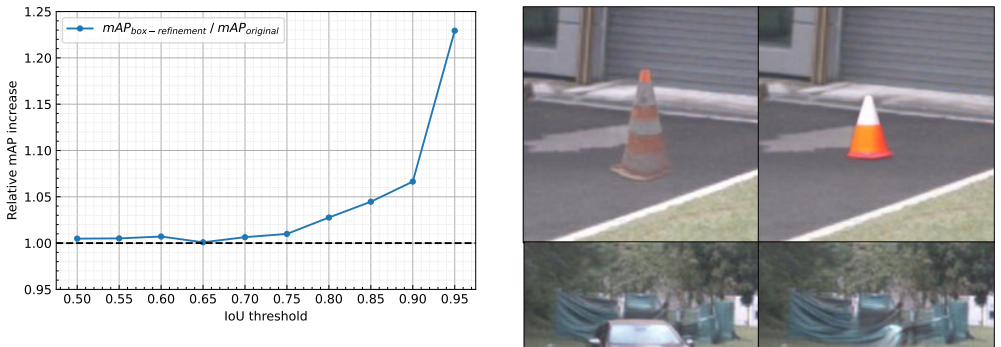
- Predicting an instance mask alongside the object improves detection, enables realistic occlusions between generated objects, and permits bounding-box refinement that matters most at high IoU thresholds.
- Location and scale contribute roughly equally: randomizing either while keeping the other realistic halves the total augmentation gain.
- Scene-aware locations add a small boost even to cut-and-paste augmentation, indicating that location realism helps beyond inpainting-based pipelines.
Reading between the lines
- The factorization should transfer to other geometrically regular scene types, such as indoor corridors, warehouse floors, or aerial road grids, before a fully learned location model becomes necessary; the paper only demonstrates automotive street scenes.
- A natural stress test is to feed the location model oracle depth and drivable-space maps and compare against the off-the-shelf versions; the documented failure cases imply headroom that the current numbers may understate.
- The mask decoder's tendency to exclude shadows, which the paper observes, suggests that adding shadow regions to the pseudo-masks could increase realism and high-IoU performance; this is a testable extension, not a claim of the paper.
- Location realism may also benefit other tasks that use generative augmentation, such as monocular 3D detection or tracking, since the placement bands implicitly encode plausible depth ordering and scale cues.
Signed reviews
Editorial analysis
A structured set of objections, weighed in public.
Referee Report
Summary. The paper proposes a scene-aware probabilistic location model for generative data augmentation in automotive object detection. Given a scene's depth map and drivable-space segmentation, the model factorizes the joint distribution of object class, depth, bounding-box position, and box dimensions into simple conditional distributions (Eq. 1) and samples new placements via ancestral sampling. The authors combine this location model with a finetuned Stable Diffusion inpainting model that also produces instance masks, yielding augmented frames with new objects placed at realistic locations. Experiments on nuImages and BDD100K with Faster R-CNN and Mask R-CNN report mAP gains over the real-data baseline of up to +1.4 at 800×456, +1.6 at 1600×900, and +1.3 on BDD100K, with ablations isolating the effect of location, scale, mask prediction, and finetuning. The abstract and contributions claim up to 2.8× higher gains than the best competing approach, based on +1.4 vs. +0.5 mAP.
Significance. The paper makes a useful and practical contribution: it identifies location realism as an important axis for generative augmentation, decomposes placement into simple, interpretable conditionals, and validates the approach with controlled baselines that use the same inpainting generator. The use of public components (DepthAnything, Dense Prediction Transformer, SD2, mmdetection) and the detailed protocol make the method reproducible in principle. The experiments span two datasets, two tasks, and several ablations, and the supplementary material documents failure modes and provides qualitative comparisons. The main weakness is that the central quantitative claims are built on single-run improvements without uncertainty quantification, and the headline '2.8×' comparison is not against the strongest baseline reported in the paper's own tables. If the improvements are confirmed with repeated runs, the work would be a solid reference for the data-augmentation community.
major comments (4)
- [Abstract and §4.1, Table 1] The headline claim 'up to 2.8× higher gains than the best competing approach (+1.4 vs. +0.5 mAP boost)' is not supported by the paper's own table. At the same 800×456 resolution, the Replacement baseline (same generator, original locations) improves mAP by +0.7, which is higher than GeoDiffusion's +0.5; Ours vs. Replacement is therefore 2.0×, not 2.8×. At full resolution, Ours (+1.6) vs. X-Paste (+1.1) is 1.45×, and vs. Random Loc. (+0.9) is 1.8×. The 'best competing approach' should be the strongest baseline in each protocol, or the claim should be rephrased to state the comparison explicitly. Since the abstract and contributions rest on this number, it must be corrected.
- [§4.1, Tables 1–4] Every detector training run in Tables 1–4 is a single run without seeds, error bars, or significance tests. The margins that carry the central claim—Ours over Random Loc. of +1.0, +0.7, +0.6, and +0.7 mAP in Table 1 (both resolutions), Table 3, and Table 2 respectively—are within the range of run-to-run variation typically observed for Faster/Mask R-CNN in mmdetection, especially for the rare classes where the largest gains are reported. The word 'significantly' in §4.1 is not supported by the evidence as presented. Please repeat each condition with at least three seeds and report mean ± std, or provide another statistical justification for the differences.
- [§4.1, Table 1 and §4.2] GeoDiffusion numbers are taken from the original publication rather than reproduced in the same codebase, and this comparison underlies the 2.8× claim. Even though the authors state they match GeoDiffusion's protocol (800×456, 12 epochs), the cross-paper comparison inherits unknown implementation differences. The paper should either reproduce GeoDiffusion with the same evaluation harness or de-emphasize this comparison in favor of the controlled Replacement and Random Loc. baselines, which use the same generator and are the most direct evidence for the location-model effect.
- [Appendix B.5 and Limitations] The manuscript explicitly states that two documented failure modes—masks that exclude shadows, and drivable-space segmentation errors—were not tested for their effect on augmentation performance ('we were unable to test this'). Because the paper's core argument is that realistic placement is what drives the gains, the sensitivity of the method to errors in the upstream depth and segmentation maps is a load-bearing component of the claim. Please quantify the frequency and impact of these failure modes on mAP (e.g., by ablating or corrupting the depth/segmentation inputs), or restrict the claims to the cases where these inputs are reliable.
minor comments (5)
- [§3.2] The statement that 'simple text prompts ... are sufficient' would benefit from a reference to the qualitative evidence in the Appendix and a brief note on how prompts were selected.
- [Table 3] The 'train' class has AP near 0.0 for most methods and only 15 validation instances, making it uninformative for comparing augmentation strategies; consider reporting it with a footnote or excluding it from the mAP average with a justification.
- [Abstract] The abstract says 'two automotive object detection tasks,' but the paper evaluates on two datasets for object detection and one of them also for instance segmentation; 'two automotive datasets' would be more accurate.
- [Supplementary, Fig. 9] The realism-diversity comparison would be easier to interpret if the FID and Mask R-CNN mAP values were also reported numerically in a table, since the scatter plot makes the 'comparable to real data' claim hard to verify.
- [§3.1, Eq. (1)] In Eq. (1), the conditioning on D and S appears only in the depth-band selection term; the height and width distributions are not scene-conditioned. This is acknowledged in the text, but stating it explicitly next to the equation would help readers anticipate behavior on unusual scene geometries.
Circularity Check
No significant circularity found; the method is evaluated externally via detector mAP on held-out real images.
full rationale
The paper's central claim is empirical rather than derivational: a factorized location model (Eq. 1) is built from training-set statistics for depth, location, height, and width, and then used to place inpainted objects for detector training. The reported gains in Tables 1-4 are measured by Faster R-CNN / Mask R-CNN mAP on real held-out validation images, which is an external evaluation signal independent of the location model's fitted parameters. The controlled baselines (Replacement, Random Loc.) deliberately use the same inpainting generator and differ only in placement strategy, so the comparison isolates the location-model effect without reducing the result to the model's own assumptions. The paper cites the authors' prior work [45] only in Related Work as an example of existing scene-conditioned placement approaches; it is not used to justify the factorization, to impose a uniqueness argument, or to define the evaluation metric, so it is not load-bearing. The documented failure cases in Appendix B.5 concerning depth normalization and drivable-space segmentation are stated limitations, not circular reductions. No equation in the paper is equivalent to its inputs by construction, and no fitted quantity is renamed as a prediction: the location model is an augmentation-policy component whose utility is judged by downstream detector accuracy, which is a valid non-circular benchmark.
Assumptions & free parameters
free parameters (3)
- tau_d (placement band depth threshold) =
5 (in DepthAnything disparity units)
- log-normal parameters for p(d|c) (per class) =
means and standard deviations fitted from training data
- log-normal parameters for p(bh|d,c) and interpolation a,b,c =
per-depth-class parameters, plus fitted curves for log-mean and log-std
assumptions (5)
- domain assumption Depth map D and drivable-space map S are accurate enough to define realistic placement bands.
- ad hoc to paper The factorization in Eq. (1) is a faithful approximation of the true joint distribution of class, depth, box position, and box size.
- ad hoc to paper Log-normal distributions adequately capture depth and height statistics per class.
- domain assumption Drivable space is correctly identified as road, terrain, and sidewalk categories.
- ad hoc to paper Uniform random selection within a depth-constrained placement band is a realistic location prior.
Cite this review
Pith. "Pith review of Scene-Aware Location Modeling for Data Augmentation in Automotive Object Detection." pith.science (2026). https://pith.science/paper/56YNTTVA
@misc{pith2026250417076,
  author       = {Pith},
  title        = {Pith review of: Scene-Aware Location Modeling for Data Augmentation in Automotive Object Detection},
  year         = {2026},
  howpublished = {\url{https://pith.science/paper/56YNTTVA}},
  note         = {Machine review of arXiv:2504.17076}
}
abstract
Generative image models are increasingly being used for training data augmentation in vision tasks. In the context of automotive object detection, methods usually focus on producing augmented frames that look as realistic as possible, for example by replacing real objects with generated ones. Others try to maximize the diversity of augmented frames, for example by pasting lots of generated objects onto existing backgrounds. Both perspectives pay little attention to the locations of objects in the scene. Frame layouts are either reused with little or no modification, or they are random and disregard realism entirely. In this work, we argue that optimal data augmentation should also include realistic augmentation of layouts. We introduce a scene-aware probabilistic location model that predicts where new objects can realistically be placed in an existing scene. By then inpainting objects in these locations with a generative model, we obtain much stronger augmentation performance than existing approaches. We set a new state of the art for generative data augmentation on two automotive object detection tasks, achieving up to $2.8\times$ higher gains than the best competing approach ($+1.4$ vs. $+0.5$ mAP boost). We also demonstrate significant improvements for instance segmentation.
Figures


Figures from the paper (15 more)




Reference graph
Works this paper leans on
-
[45]
Generative lo- cation modeling for spatially aware object insertion
Jooyeol Yun, Davide Abati, Mohamed Omran, Jaegul Choo, Amirhossein Habibian, and Auke Wiggers. Generative lo- cation modeling for spatially aware object insertion. arXiv preprint arXiv:2410.13564, 2024. 2
arXiv 2024
-
[1]
Synthetic data from diffusion models improves imagenet classification
Shekoofeh Azizi, Simon Kornblith, Chitwan Saharia, Mo- hammad Norouzi, and David J Fleet. Synthetic data from diffusion models improves imagenet classification. arXiv preprint arXiv:2304.08466, 2023. 2
arXiv 2023
-
[2]
nuscenes: A multi- modal dataset for autonomous driving
Holger Caesar, Varun Bankiti, Alex H Lang, Sourabh V ora, Venice Erin Liong, Qiang Xu, Anush Krishnan, Yu Pan, Gi- ancarlo Baldan, and Oscar Beijbom. nuscenes: A multi- modal dataset for autonomous driving. In Proceedings of the IEEE conference on Computer Vision and Pattern Recogni- tion, 2020. 5
work page 2020
-
[3]
Smote: synthetic minority over- sampling technique
Nitesh V Chawla, Kevin W Bowyer, Lawrence O Hall, and W Philip Kegelmeyer. Smote: synthetic minority over- sampling technique. Journal of artificial intelligence research, 16:321–357, 2002. 1
work page 2002
-
[4]
Pixart-sigma: Weak-to-strong training of diffusion transformer for 4k text-to-image generation
Junsong Chen, Chongjian Ge, Enze Xie, Yue Wu, Lewei Yao, Xiaozhe Ren, Zhongdao Wang, Ping Luo, Huchuan Lu, and Zhenguo Li. Pixart-sigma: Weak-to-strong training of diffusion transformer for 4k text-to-image generation. arXiv preprint arXiv:2403.04692, 2024. 8
arXiv 2024
-
[5]
MMDetection: Open mmlab detection toolbox and benchmark
Kai Chen, Jiaqi Wang, Jiangmiao Pang, Yuhang Cao, Yu Xiong, Xiaoxiao Li, Shuyang Sun, Wansen Feng, Ziwei Liu, Jiarui Xu, Zheng Zhang, Dazhi Cheng, Chenchen Zhu, Tian- heng Cheng, Qijie Zhao, Buyu Li, Xin Lu, Rui Zhu, Yue Wu, Jifeng Dai, Jingdong Wang, Jianping Shi, Wanli Ouyang, Chen Change Loy, and Dahua Lin. MMDetection: Open mmlab detection toolbox and...
arXiv 1906
-
[6]
Geodiffusion: Text- prompted geometric control for object detection data genera- tion
Kai Chen, Enze Xie, Zhe Chen, Yibo Wang, Lanqing Hong, Zhenguo Li, and Dit-Yan Yeung. Geodiffusion: Text- prompted geometric control for object detection data genera- tion. International Conference on Learning Representations,
-
[7]
MMDetection3D: Open- MMLab next-generation platform for general 3D object detection
MMDetection3D Contributors. MMDetection3D: Open- MMLab next-generation platform for general 3D object detection. https :/ / github. com /open - mmlab / mmdetection3d, 2020. 3
work page 2020
Show all 51 references
-
[8]
J. Deng, W. Dong, R. Socher, L.-J. Li, K. Li, and L. Fei-Fei. ImageNet: A Large-Scale Hierarchical Image Database. In Proceedings of the IEEE conference on Computer Vision and Pattern Recognition, 2009. 5
2009
-
[9]
Meta-sim2: Unsupervised learning of scene structure for synthetic data generation
Jeevan Devaranjan, Amlan Kar, and Sanja Fidler. Meta-sim2: Unsupervised learning of scene structure for synthetic data generation. In Proceedings of the European Conference on Computer Vision, 2020. 2
2020
-
[10]
On the importance of visual context for data augmentation in scene understanding
Nikita Dvornik, Julien Mairal, and Cordelia Schmid. On the importance of visual context for data augmentation in scene understanding. IEEE transactions on pattern analysis and machine intelligence, 43(6):2014–2028, 2019. 2, 3
2014
-
[11]
Cut, paste and learn: Surprisingly easy synthesis for instance de- tection
Debidatta Dwibedi, Ishan Misra, and Martial Hebert. Cut, paste and learn: Surprisingly easy synthesis for instance de- tection. In Proceedings of the IEEE international conference on computer vision, pages 1301–1310, 2017. 2
2017
-
[12]
Divergen: Improv- ing instance segmentation by learning wider data distribu- tion with more diverse generative data
Chengxiang Fan, Muzhi Zhu, Hao Chen, Yang Liu, Weijia Wu, Huaqi Zhang, and Chunhua Shen. Divergen: Improv- ing instance segmentation by learning wider data distribu- tion with more diverse generative data. In Proceedings of the IEEE/CVF Conference on Computer Vision and Patter...
2024
-
[13]
Magicdrive3d: Controllable 3d genera- tion for any-view rendering in street scenes
Ruiyuan Gao, Kai Chen, Zhihao Li, Lanqing Hong, Zhenguo Li, and Qiang Xu. Magicdrive3d: Controllable 3d genera- tion for any-view rendering in street scenes. arXiv preprint arXiv:2405.14475, 2024. 2
2024 arXiv
-
[14]
MagicDrive: Street view generation with diverse 3d geometry control
Ruiyuan Gao, Kai Chen, Enze Xie, Lanqing Hong, Zhenguo Li, Dit-Yan Yeung, and Qiang Xu. MagicDrive: Street view generation with diverse 3d geometry control. In International Conference on Learning Representations, 2024. 1, 2
2024
-
[15]
Dall-e for detection: Language-driven compositional image synthesis for object detection
Yunhao Ge, Jiashu Xu, Brian Nlong Zhao, Neel Joshi, Laurent Itti, and Vibhav Vineet. Dall-e for detection: Language-driven compositional image synthesis for object detection. arXiv preprint arXiv:2206.09592, 2022. 1, 2
2022 arXiv
-
[16]
Layout- transformer: Layout generation and completion with self- attention
Kamal Gupta, Justin Lazarow, Alessandro Achille, Larry S Davis, Vijay Mahadevan, and Abhinav Shrivastava. Layout- transformer: Layout generation and completion with self- attention. In Proceedings of the IEEE/CVF International Conference on Computer Vision, pages 1004–1014, 2021. 2
2021
-
[17]
Adasyn: Adaptive synthetic sampling approach for imbal- anced learning
Haibo He, Yang Bai, Edwardo A Garcia, and Shutao Li. Adasyn: Adaptive synthetic sampling approach for imbal- anced learning. In 2008 IEEE international joint conference on neural networks (IEEE world congress on computational intelligence), pages 1322–1328. Ieee, 2008. 1
2008
-
[18]
Mask r-cnn
Kaiming He, Georgia Gkioxari, Piotr Dollár, and Ross Gir- shick. Mask r-cnn. In IEEE International Conference on Computer Vision, 2017. 5
2017
-
[19]
Is synthetic data from generative models ready for image recognition? In International Conference on Learning Representations, 2023
Ruifei He, Shuyang Sun, Xin Yu, Chuhui Xue, Wenqing Zhang, Philip Torr, Song Bai, and Xiaojuan Qi. Is synthetic data from generative models ready for image recognition? In International Conference on Learning Representations, 2023. 1
2023
-
[20]
Denoising dif- fusion probabilistic models
Jonathan Ho, Ajay Jain, and Pieter Abbeel. Denoising dif- fusion probabilistic models. Neural Information Processing Systems, 2020. 1
2020
-
[21]
Lora: Low-rank adaptation of large language models
Edward J Hu, Yelong Shen, Phillip Wallis, Zeyuan Allen-Zhu, Yuanzhi Li, Shean Wang, Lu Wang, and Weizhu Chen. Lora: Low-rank adaptation of large language models. International Conference on Learning Representations, 2022. 7, 4
2022
-
[22]
Layoutdm: Discrete diffusion model for controllable layout generation
Naoto Inoue, Kotaro Kikuchi, Edgar Simo-Serra, Mayu Otani, and Kota Yamaguchi. Layoutdm: Discrete diffusion model for controllable layout generation. In Proceedings of the IEEE/CVF Conference on Computer Vision and Pattern Recognition, pages 10167–10176, 2023. 2
2023
-
[23]
Layoutvae: Stochastic scene layout gen- eration from a label set
Akash Abdu Jyothi, Thibaut Durand, Jiawei He, Leonid Sigal, and Greg Mori. Layoutvae: Stochastic scene layout gen- eration from a label set. In Proceedings of the IEEE/CVF International Conference on Computer Vision, pages 9895– 9904, 2019. 2
2019
-
[24]
Meta-sim: Learning to generate synthetic datasets
Amlan Kar, Aayush Prakash, Ming-Yu Liu, Eric Cameracci, Justin Yuan, Matt Rusiniak, David Acuna, Antonio Torralba, and Sanja Fidler. Meta-sim: Learning to generate synthetic datasets. In IEEE International Conference on Computer Vision, 2019. 2
2019
-
[25]
Segment any- 9 thing
Alexander Kirillov, Eric Mintun, Nikhila Ravi, Hanzi Mao, Chloe Rolland, Laura Gustafson, Tete Xiao, Spencer White- head, Alexander C Berg, Wan-Yen Lo, et al. Segment any- 9 thing. IEEE International Conference on Computer Vision,
-
[26]
Blt: Bidirectional layout transformer for controllable layout generation
Xiang Kong, Lu Jiang, Huiwen Chang, Han Zhang, Yuan Hao, Haifeng Gong, and Irfan Essa. Blt: Bidirectional layout transformer for controllable layout generation. In European Conference on Computer Vision, pages 474–490. Springer,
-
[27]
Dataset enhance- ment with instance-level augmentations
Orest Kupyn and Christian Rupprecht. Dataset enhance- ment with instance-level augmentations. arXiv preprint arXiv:2406.08249, 2024. 1, 2, 5, 6
2024 arXiv
-
[28]
Black Forest Labs. Flux. https://github.com/ black-forest-labs/flux, 2024. 8
2024
-
[29]
Context-aware synthesis and placement of object instances
Donghoon Lee, Sifei Liu, Jinwei Gu, Ming-Yu Liu, Ming- Hsuan Yang, and Jan Kautz. Context-aware synthesis and placement of object instances. In Neural Information Pro- cessing Systems, 2018. 2
2018
-
[30]
A simple background augmentation method for object detection with diffusion model
Yuhang Li, Xin Dong, Chen Chen, Weiming Zhuang, and Lingjuan Lyu. A simple background augmentation method for object detection with diffusion model. In European Con- ference on Computer Vision, pages 462–479. Springer, 2024. 2, 5
2024
-
[31]
Lawrence Zitnick
Tsung-Yi Lin, Michael Maire, Serge Belongie, James Hays, Pietro Perona, Deva Ramanan, Piotr Dollár, and C. Lawrence Zitnick. Microsoft coco: Common objects in context. In Proceedings of the European Conference on Computer Vision,
-
[32]
T2i-adapter: Learning adapters to dig out more controllable ability for text-to-image diffusion models
Chong Mou, Xintao Wang, Liangbin Xie, Yanze Wu, Jian Zhang, Zhongang Qi, and Ying Shan. T2i-adapter: Learning adapters to dig out more controllable ability for text-to-image diffusion models. In The AAAI Conference on Artificial Intel- ligence, 2024. 7, 4
2024
-
[33]
Faster r-cnn: Towards real-time object detection with region proposal networks
Shaoqing Ren, Kaiming He, Ross Girshick, and Jian Sun. Faster r-cnn: Towards real-time object detection with region proposal networks. Neural Information Processing Systems,
-
[34]
High-resolution image synthesis with latent diffusion models
Robin Rombach, Andreas Blattmann, Dominik Lorenz, Patrick Esser, and Björn Ommer. High-resolution image synthesis with latent diffusion models. In Proceedings of the IEEE conference on Computer Vision and Pattern Recogni- tion, 2022. 1, 4, 5, 8
2022
-
[35]
Sara Mahdavi, Rapha Gontijo Lopes, Tim Salimans, Jonathan Ho, David J
Chitwan Saharia, William Chan, Saurabh Saxena, Lala Li, Jay Whang, Emily Denton, Seyed Kamyar Seyed Ghasemipour, Burcu Karagol Ayan, S. Sara Mahdavi, Rapha Gontijo Lopes, Tim Salimans, Jonathan Ho, David J. Fleet, and Mohammad Norouzi. Photorealistic text-to-image diffusion mo...
2022
-
[36]
Gen2det: Generate to detect
Saksham Suri, Fanyi Xiao, Animesh Sinha, Sean Chang Cu- latana, Raghuraman Krishnamoorthi, Chenchen Zhu, and Abhinav Shrivastava. Gen2det: Generate to detect. arXiv preprint arXiv:2312.04566, 2023. 1, 2, 5, 6, 8, 3
2023 arXiv
-
[37]
Scenegen: Learning to generate realistic traffic scenes
Shuhan Tan, Kelvin Wong, Shenlong Wang, Sivabalan Mani- vasagam, Mengye Ren, and Raquel Urtasun. Scenegen: Learning to generate realistic traffic scenes. In Proceedings of the IEEE conference on Computer Vision and Pattern Recog- nition, 2021. 2
2021
-
[38]
Detdiffusion: Synergizing generative and per- ceptive models for enhanced data generation and perception
Yibo Wang, Ruiyuan Gao, Kai Chen, Kaiqiang Zhou, Yingjie Cai, Lanqing Hong, Zhenguo Li, Lihui Jiang, Dit-Yan Yeung, Qiang Xu, et al. Detdiffusion: Synergizing generative and per- ceptive models for enhanced data generation and perception. arXiv preprint arXiv:2403.13304, 2024. 1
2024 arXiv
-
[39]
Datasetdm: Synthesizing data with perception annotations us- ing diffusion models
Weijia Wu, Yuzhong Zhao, Hao Chen, Yuchao Gu, Rui Zhao, Yefei He, Hong Zhou, Mike Zheng Shou, and Chunhua Shen. Datasetdm: Synthesizing data with perception annotations us- ing diffusion models. Neural Information Processing Systems,
-
[40]
Mosaicfusion: Diffusion models as data augmenters for large vocabulary instance segmentation
Jiahao Xie, Wei Li, Xiangtai Li, Ziwei Liu, Yew Soon Ong, and Chen Change Loy. Mosaicfusion: Diffusion models as data augmenters for large vocabulary instance segmentation. International Journal of Computer Vision, 2024. 2
2024
-
[41]
Layouttransformer: Scene layout gen- eration with conceptual and spatial diversity
Cheng-Fu Yang, Wan-Cyuan Fan, Fu-En Yang, and Yu- Chiang Frank Wang. Layouttransformer: Scene layout gen- eration with conceptual and spatial diversity. In Proceedings of the IEEE/CVF conference on computer vision and pattern recognition, pages 3732–3741, 2021. 2
2021
-
[42]
Depth anything: Unleashing the power of large-scale unlabeled data
Lihe Yang, Bingyi Kang, Zilong Huang, Xiaogang Xu, Jiashi Feng, and Hengshuang Zhao. Depth anything: Unleashing the power of large-scale unlabeled data. In Proceedings of the IEEE conference on Computer Vision and Pattern Recog- nition, 2024. 6, 1, 5
2024
-
[43]
Dense prediction with attentive feature aggregation
Yung-Hsu Yang, Thomas E Huang, Min Sun, Samuel Rota Bulò, Peter Kontschieder, and Fisher Yu. Dense prediction with attentive feature aggregation. In IEEE/CVF Winter Con- ference on Applications of Computer Vision, 2023. 6
2023
-
[44]
Bdd100k: A diverse driving dataset for heterogeneous mul- titask learning
Fisher Yu, Haofeng Chen, Xin Wang, Wenqi Xian, Yingying Chen, Fangchen Liu, Vashisht Madhavan, and Trevor Darrell. Bdd100k: A diverse driving dataset for heterogeneous mul- titask learning. In Proceedings of the IEEE conference on Computer Vision and Pattern Recognition, 2020. 5
2020
-
[46]
Learning object placement by inpainting for compositional data augmentation
Lingzhi Zhang, Tarmily Wen, Jie Min, Jiancong Wang, David Han, and Jianbo Shi. Learning object placement by inpainting for compositional data augmentation. In Proceedings of the European Conference on Computer Vision, 2020. 2
2020
-
[47]
Adding conditional control to text-to-image diffusion models, 2023
Lvmin Zhang, Anyi Rao, and Maneesh Agrawala. Adding conditional control to text-to-image diffusion models, 2023. 4, 6, 7
2023
-
[48]
Diffu- sionengine: Diffusion model is scalable data engine for object detection
Manlin Zhang, Jie Wu, Yuxi Ren, Ming Li, Jie Qin, Xuefeng Xiao, Wei Liu, Rui Wang, Min Zheng, and Andy J Ma. Diffu- sionengine: Diffusion model is scalable data engine for object detection. arXiv preprint arXiv:2309.03893, 2023. 2, 4
2023 arXiv
-
[49]
X-paste: Revisiting scalable copy-paste for in- stance segmentation using clip and stablediffusion
Hanqing Zhao, Dianmo Sheng, Jianmin Bao, Dongdong Chen, Dong Chen, Fang Wen, Lu Yuan, Ce Liu, Wenbo Zhou, Qi Chu, et al. X-paste: Revisiting scalable copy-paste for in- stance segmentation using clip and stablediffusion. Interna- tional Conference on Machine Learning, 2023. 1,...
2023
-
[50]
Using syn- thetic data for data augmentation to improve classification accuracy
Yongchao Zhou, Hshmat Sahak, and Jimmy Ba. Using syn- thetic data for data augmentation to improve classification accuracy. In ICML Workshop on Deployable Generative AI,
-
[51]
car”, “bus
Sijie Zhu, Zhe Lin, Scott Cohen, Jason Kuen, Zhifei Zhang, and Chen Chen. Topnet: Transformer-based object place- ment network for image compositing. In Proceedings of the IEEE conference on Computer Vision and Pattern Recogni- tion, 2023. 2 11 Scene-Aware Location Modeling fo...
2023
Reviewed August 16, 2026 · model on record in the stance chip above.
Discussion (0). Continue with ORCID to comment.