REVIEW 3 major objections 4 minor 50 references
Latent Video Dataset Distillation
T0 review · 3 major / 4 minor · reviewed 2026-08-16 · deepseek-v4-flash
Pith's one-line read Latent-space video distillation beats pixel-space methods on all four benchmarks
desk verdict Useful latent-space coreset idea, but the SOTA claim at IPC 1 is misleading because the method packs 24 real videos per class into the same byte budget. read the letter →
The pith
A machine-rendered reading of the paper's core claim, the machinery that carries it, and where it could break.
The reading
What carries the argument
The load-bearing object is the latent code produced by a pretrained video variational autoencoder, treated as a structured tensor rather than a flat vector; the paper uses a 3D VAE for IPC 5 and a 2D VAE for IPC 1. Three mechanisms act on it. Determinantal point processes, a probabilistic model that favors subsets with low pairwise similarity, select a diverse and representative set of latent trajectories. High-order singular value decomposition (HOSVD) factorizes the selected latent tensor into a core tensor and per-mode orthonormal factor matrices, allowing rank truncation that discards low-energy spatial and temporal components without retraining. Two-stage post-training quantization, INT8 for fully connected layers and FP16 for convolutional layers, shrinks the VAE model itself so that the stored VAE plus distilled tensors fit inside the same storage budget as pixel-space baselines.
What would settle it
Run the same DPP plus HOSVD pipeline on a motion-critical benchmark, for example Something-Something V2, but replace the pretrained VAE encoder with a random linear projection to the same latent dimension; if action-recognition accuracy stays close to the VAE-based result, the claim that the learned latent space carries the gain is false, and if accuracy collapses, the claim is supported. A second check is to vary the HOSVD temporal-mode rank on a dataset where classes differ mainly by motion and look for a sharp accuracy cliff before the reported $r=0.75$ operating point.
Extended reading notes
Core claim
The central claim is that a training-free latent-space pipeline can replace expensive pixel-space synthesis in video dataset distillation. The paper argues that a pretrained 3D variational autoencoder already captures the spatiotemporal structure needed for action recognition, so the distillation problem reduces to selecting a diverse subset of latent trajectories and compressing them. DPP-based selection chooses samples that are both representative and well-spread in the latent space, while HOSVD truncation removes low-energy components in each tensor mode, including the temporal mode, to pack more information into a fixed storage budget. The paper reports new state-of-the-art results on all four datasets, with the largest gains at the most extreme compression: 34.8% versus 22.5% on MiniUCF at one instance per class.
Load-bearing premise
The load-bearing premise is that a pretrained variational autoencoder, a network trained to compress videos into a compact latent space and reconstruct them, keeps the class-discriminating motion and appearance information even after high-order SVD truncation, even though it was trained for reconstruction, not for classification. If truncation removes class-relevant structure, the accuracy gain collapses.
Editorial extensions
If this is right
- Under matched storage budgets, the method reports higher accuracy than all pixel-space baselines on MiniUCF, HMDB51, Kinetics-400, and SSv2 at both IPC 1 and IPC 5.
- Because the pipeline is training-free, distillation runtime drops from hours to minutes on small datasets and to about one hour on Kinetics-400 and SSv2, versus over five hours for the VDSD baseline.
- Distilled latent datasets transfer across evaluation architectures, including ConvNet3D, CNN+GRU, and CNN+LSTM, not just the architecture used during selection.
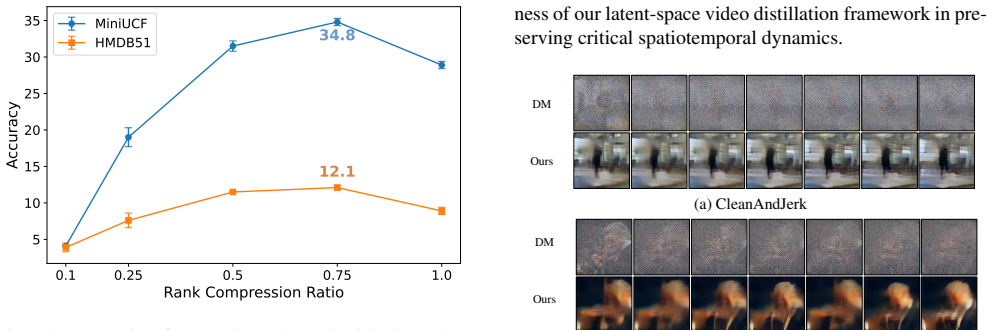
- The HOSVD rank ratio controls the accuracy-storage tradeoff: $r=0.75$ is the reported sweet spot, while $r=0.1$ degrades accuracy to near-random levels.
- Quantizing the VAE achieves more than a 2.6x model compression ratio while retaining reconstruction fidelity, which is what lets the total stored package remain within the IPC storage budget.
Reading between the lines
- Editorial: If the VAE latent space really carries the discriminative signal, the same encode-select-compress recipe could transfer to other data modalities that have strong pretrained autoencoders, such as audio or medical imaging, where pixel-space distillation would be even more expensive.
- Editorial: The training-free nature means the compute advantage should grow with dataset size; a natural testable extension is applying the pipeline at a scale where iterative pixel-space distillation becomes impractical.
- Editorial: HOSVD truncation in the temporal mode acts as an implicit motion summarizer, so the rank ratio could potentially be tuned per class or per motion type rather than globally, which the paper does not explore.
- Editorial: The storage budget includes the quantized VAE model itself, so the method's advantage may depend on how far the VAE cost is amortized; at higher IPC settings the breakeven point relative to pixel-space baselines deserves scrutiny.
Signed reviews
Editorial analysis
A structured set of objections, weighed in public.
Referee Report
Summary. The paper proposes a video dataset distillation method that operates in the latent space of a pretrained variational autoencoder. Input videos are encoded into latents, a determinantal point process (DPP) selects a diverse subset of latent codes, and high-order singular value decomposition (HOSVD) compresses the selected latent tensor. The VAE is post-training quantized and its size is included in the storage budget. The distilled latent set is decoded back to pixels to train a C3D classifier. The paper reports results on MiniUCF, HMDB51, Kinetics-400, and SSv2 under IPC 1 and IPC 5, claims state-of-the-art accuracy over pixel-space baselines including VDSD and IDTD, and provides ablations on sampling strategy, compression ratio, latent compression technique, and cross-architecture generalization.
Significance. If the central claim were established under matched experimental conditions, the idea of storing a compressed latent set plus a compact VAE would be a practically useful and training-free alternative to pixel-space video distillation. The paper has tangible strengths: the compression pipeline is simple and training-free, storage accounting explicitly includes the VAE model, cross-architecture evaluation is reported, and code is released. However, the headline IPC comparison is not matched in the number of reconstructed training instances, so the claimed state-of-the-art is not currently supported. The empirical contribution is therefore conditional on a substantially revised experimental protocol.
major comments (3)
- [Supplementary B.3, Table 1] The central claim of a new state-of-the-art is not established because Instance Per Class is not actually matched. Supplementary B.3 states that for MiniUCF IPC 1 the method samples 24 instances per class before HOSVD, consuming 27MB for the distilled tensors and 80MB for the quantized 2D-VAE, within the 115MB budget. The baselines in Table 1 are evaluated with one distilled instance per class. The decoded training set therefore contains roughly 24 reconstructed videos per class (about 1200 videos for MiniUCF) rather than one per class (about 50 videos), so the large gains, especially the 12.3-point improvement on MiniUCF IPC 1, could be caused by a roughly 24-fold increase in effective training instances rather than by latent-space distillation. Matching byte storage alone is not equivalent to matching IPC. The authors should either compare under the same number of reconstructed instances per class with the same storage budget, or explicitly reframe the contribution as fixed-budget latent coreset selection/compression and compare against coreset baselines under exactly the same instance counts and storage. As written, the abstract's claim that the method outperforms prior methods on all datasets is unsupported.
- [§4.5, Table 3; §B.1] The main hyperparameters appear to be selected using the evaluation datasets, which makes the reported numbers optimistic. The rank compression ratio r is set to 0.75 based on Table 3, which reports accuracy on MiniUCF and HMDB51 at different r values, and the VAE choice changes per setting: a 2D VAE (SD-VAE-FT-MSE) is used for IPC 1 and a 3D VAE (CV-VAE) for IPC 5, as described in Section B.1. No validation split or selection protocol is described. Additionally, Table 3 is non-monotonic: MiniUCF accuracy at r=1.0 is 28.9%, substantially lower than the 34.8% at r=0.75, so the selected ratio is not in a stable plateau. Please report a validation-based selection procedure or demonstrate that the main conclusions are robust over a range of r and across both VAE choices.
- [§4.5, Table 4] The comparison between truncated SVD and HOSVD is described as being under the same storage budget, but the actual storage sizes or rank/truncation settings for each method are not reported. Without knowing the byte counts for the SVD and HOSVD representations, the reported gains (+2.6% on MiniUCF, +1.8% on HMDB51, +1.4% on Kinetics-400, +1.2% on SSv2) could reflect different compression levels rather than an advantage of preserving tensor structure. Please specify the storage consumption for each entry or fix the budget explicitly.
minor comments (4)
- [Appendix A.1] The phrase 'reducing the bid-width from 32 to 8 bits' should read 'bit-width'.
- [Table 6 and Figure 2] Table 6 and the surrounding text in Section 4.5 state that the SSv2 comparison is at IPC 1, but the reported value for Ours (10.5%) matches the IPC 5 result in Table 1 rather than the IPC 1 result (6.9%). The caption appears to be mislabeled and should be corrected.
- [Throughout] The notation 'V AE', 'CV-V AE', and 'SD-V AE-FT-MSE' is inconsistent; the spacing and hyphenation should be unified.
- [Table 6 caption] The word 'distilation' in the Table 6 caption is a typo and should be 'distillation'.
Circularity Check
No formal circularity: the accuracy comparisons are empirical and the method rests on external pretrained models and standard benchmarks; the only scoring-related caveat is a nonstandard IPC accounting in Suppl. B.3, which is a fairness issue rather than a circular reduction.
full rationale
I walked the claimed derivation chain (VAE encoding, DPP selection, HOSVD compression, VAE quantization) and found no equation or fitted parameter that is equivalent by construction to the reported accuracies. The method is evaluated against external baselines on standard benchmarks, and the pretrained VAE is an external component, not an output of this paper. The two self-citations to Cui et al. [4,5] are background references for image dataset distillation and are not load-bearing for the central claim; there is no uniqueness theorem or unverified self-citation chain being invoked. Hyperparameters such as the HOSVD rank ratio r=0.75 are selected through ablations on the evaluation datasets, which is common model selection rather than a fitted parameter renamed as a prediction. The one substantive caveat is in Suppl. B.3: at 'IPC 1' the method samples 24 instances per class and counts the 80MB quantized VAE plus 27MB tensors as fitting within the 115MB budget, so the comparison is byte-matched rather than instance-matched. This is a benchmark comparability / correctness concern that can affect the headline SOTA claim, but it is not a circular derivation: the accuracy is still measured on downstream evaluation, not derived from the storage definition. Therefore the circularity score is low.
Assumptions & free parameters
free parameters (4)
- rank_compression_ratio =
0.75
- DPP kernel bandwidth (sigma) =
not reported
- sampled_instances_per_class =
24 per class for MiniUCF IPC 1, varies by dataset and IPC
- VAE choice per IPC =
SD-VAE-FT-MSE for IPC 1, CV-VAE for IPC 5
assumptions (4)
- domain assumption The pretrained VAE latent space preserves class-discriminative spatiotemporal information needed for action recognition.
- domain assumption HOSVD truncation retains the information essential for classification even under lossy compression.
- domain assumption DPP selection in latent space yields a representative and diverse subset that generalizes to downstream classifiers.
- domain assumption Including the quantized VAE size in the storage budget makes the comparison to pixel-space baselines fair.
Cite this review
Pith. "Pith review of Latent Video Dataset Distillation." pith.science (2026). https://pith.science/paper/MNSQ5TGE
@misc{pith2026250417132,
  author       = {Pith},
  title        = {Pith review of: Latent Video Dataset Distillation},
  year         = {2026},
  howpublished = {\url{https://pith.science/paper/MNSQ5TGE}},
  note         = {Machine review of arXiv:2504.17132}
}
read the original abstract
Dataset distillation has demonstrated remarkable effectiveness in high-compression scenarios for image datasets. While video datasets inherently contain greater redundancy, existing video dataset distillation methods primarily focus on compression in the pixel space, overlooking advances in the latent space that have been widely adopted in modern text-to-image and text-to-video models. In this work, we bridge this gap by introducing a novel video dataset distillation approach that operates in the latent space using a state-of-the-art variational encoder. Furthermore, we employ a diversity-aware data selection strategy to select both representative and diverse samples. Additionally, we introduce a simple, training-free method to further compress the distilled latent dataset. By combining these techniques, our approach achieves a new state-of-the-art performance in dataset distillation, outperforming prior methods on all datasets, e.g. on HMDB51 IPC 1, we achieve a 2.6% performance increase; on MiniUCF IPC 5, we achieve a 7.8% performance increase. Our code is available at https://github.com/liningresearch/Latent_Video_Dataset_Distillation.
Figures


Figures from the paper (3 more)



Reference graph
Works this paper leans on
-
[1]
stabilityai/sd-vae-ft-mse · Hugging Face — huggingface.co. https : / / huggingface . co / stabilityai / sd - vae-ft-mse. [Accessed 07-03-2025]. 11
work page 2025
-
[2]
Quo vadis, action recognition? a new model and the kinetics dataset
Jo ˜ao Carreira and Andrew Zisserman. Quo vadis, action recognition? a new model and the kinetics dataset. In CVPR, pages 4724–4733, 2017. 6
work page 2017
-
[3]
Dataset distillation by matching training trajectories
George Cazenavette, Tongzhou Wang, Antonio Torralba, Alexei A Efros, and Jun-Yan Zhu. Dataset distillation by matching training trajectories. In CVPR, 2022. 2, 5, 6, 7
work page 2022
-
[4]
Dc- bench: Dataset condensation benchmark
Justin Cui, Ruochen Wang, Si Si, and Cho-Jui Hsieh. Dc- bench: Dataset condensation benchmark. arXiv preprint arXiv:2207.09639, 2022. 1
arXiv 2022
-
[5]
Scaling up dataset distillation to imagenet-1k with constant memory
Justin Cui, Ruochen Wang, Si Si, and Cho-Jui Hsieh. Scaling up dataset distillation to imagenet-1k with constant memory. In Proceedings of the International Conference on Machine Learning (ICML), pages 6565–6590, 2023. 1
work page 2023
-
[6]
Dataset dis- tillation in latent space
Yuxuan Duan, Jianfu Zhang, and Liqing Zhang. Dataset dis- tillation in latent space. arXiv preprint arXiv:2311.15547 ,
-
[7]
Bayesian clustering of high-dimensional data via latent repulsive mixtures
Lorenzo Ghilotti, Mario Beraha, and Alessandra Guglielmi. Bayesian clustering of high-dimensional data via latent re- pulsive mixtures. arXiv preprint arXiv:2303.02438 , 2023. 4
work page Pith review arXiv 2023
-
[8]
The ”something something” video database for learning and evaluating visual common sense,
Raghav Goyal, Samira Ebrahimi Kahou, Vincent Michal- ski, Joanna Materzy ´nska, Susanne Westphal, Heuna Kim, Valentin Haenel, Ingo Fruend, Peter Yianilos, Moritz Mueller-Freitag, Florian Hoppe, Christian Thurau, Ingo Bax, and Roland Memisevic. The ”something something” video database for learning and evaluating visual common sense,
Show all 50 references
-
[9]
Imagen video: High definition video generation with diffusion mod- els
Jonathan Ho, William Chan, Chitwan Saharia, Jay Whang, Ruiqi Gao, Alexey Gritsenko, Diederik P Kingma, Ben Poole, Mohammad Norouzi, David J Fleet, et al. Imagen video: High definition video generation with diffusion mod- els. arXiv preprint arXiv:2210.02303, 2022. 3
-
[10]
I-llm: Efficient integer- only inference for fully-quantized low-bit large language models
Xing Hu, Yuan Cheng, Dawei Yang, Zhihang Yuan, Jiangy- ong Yu, Chen Xu, and Sifan Zhou. I-llm: Efficient integer- only inference for fully-quantized low-bit large language models. arXiv preprint arXiv:2405.17849, 2024. 5
2024 arXiv
-
[11]
What makes a video a video: Ana- lyzing temporal information in video understanding models and datasets
De-An Huang, Vignesh Ramanathan, Dhruv Mahajan, Lorenzo Torresani, Manohar Paluri, Li Fei-Fei, and Juan Carlos Niebles. What makes a video a video: Ana- lyzing temporal information in video understanding models and datasets. In CVPR, pages 7366–7375, 2018. 2
2018
-
[12]
K-means clustering algo- rithms: A comprehensive review, variants analysis, and ad- vances in the era of big data
Abiodun M Ikotun, Absalom E Ezugwu, Laith Abualigah, Belal Abuhaija, and Jia Heming. K-means clustering algo- rithms: A comprehensive review, variants analysis, and ad- vances in the era of big data. Information Sciences , 622: 178–210, 2023. 4, 7
2023
-
[13]
Auto-encoding vari- ational bayes, 2013
Diederik P Kingma, Max Welling, et al. Auto-encoding vari- ational bayes, 2013. 2, 3, 4
2013
-
[14]
An introduction to variational autoencoders
Diederik P Kingma, Max Welling, et al. An introduction to variational autoencoders. Foundations and Trends® in Ma- chine Learning, 12(4):307–392, 2019. 3
2019
-
[15]
Videopoet: A large language model for zero-shot video generation
Dan Kondratyuk, Lijun Yu, Xiuye Gu, Jos ´e Lezama, Jonathan Huang, Rachel Hornung, Hartwig Adam, Hassan Akbari, Yair Alon, Vighnesh Birodkar, et al. Videopoet: A large language model for zero-shot video generation. arXiv preprint arXiv:2312.14125, 2023. 3
2023 arXiv
-
[16]
Kuehne, H
H. Kuehne, H. Jhuang, E. Garrote, T. Poggio, and T. Serre. Hmdb: A large video database for human motion recogni- tion. In ICCV, pages 2556–2563, 2011. 6
2011
-
[17]
Determinantal point processes for machine learning
Alex Kulesza and Ben Taskar. Determinantal point processes for machine learning. Foundations and Trends in Machine Learning, 5(2-3):123–286, 2012. 1, 4
2012
-
[18]
Analyzing multimodal in- tegration in the variational autoencoder from an information- theoretic perspective
Carlotta Langer, Yasmin Kim Georgie, Ilja Porohovoj, Ver- ena Vanessa Hafner, and Nihat Ay. Analyzing multimodal in- tegration in the variational autoencoder from an information- theoretic perspective. arXiv preprint arXiv:2411.00522 ,
-
[19]
Generative Dataset Distillation: Balancing global structure and local details
Longzhen Li, Guang Li, Ren Togo, Keisuke Maeda, Takahiro Ogawa, and Miki Haseyama. Generative Dataset Distillation: Balancing global structure and local details. In Proceedings of the IEEE/CVF Conference on Computer Vision and Pattern Recognition (CVPR), Workshop , pages 7664–...
2024
-
[20]
Pintea, Fatemeh Karimi Nejadasl, Olaf Booij, and Jan C
Xin Liu, Silvia L. Pintea, Fatemeh Karimi Nejadasl, Olaf Booij, and Jan C. van Gemert. No frame left behind: Full video action recognition. In CVPR, pages 14892–14901,
-
[21]
Dream: Efficient dataset distillation by repre- sentative matching
Yanqing Liu, Jianyang Gu, Kai Wang, Zheng Zhu, Wei Jiang, and Yang You. Dream: Efficient dataset distillation by repre- sentative matching. arXiv preprint arXiv:2302.14416, 2023. 2
2023 arXiv
-
[22]
Efficient dataset distillation using random feature ap- proximation
Noel Loo, Ramin Hasani, Alexander Amini, and Daniela Rus. Efficient dataset distillation using random feature ap- proximation. arXiv preprint arXiv:2210.12067, 2022. 1
2022 arXiv
-
[23]
Latte: Latent diffusion transformer for video generation
Xin Ma, Yaohui Wang, Gengyun Jia, Xinyuan Chen, Zi- wei Liu, Yuan-Fang Li, Cunjian Chen, and Yu Qiao. Latte: Latent diffusion transformer for video generation. arXiv preprint arXiv:2401.03048, 2024. 2
2024 arXiv
-
[24]
Bayesian pseudocoresets
Dionysis Manousakas, Zuheng Xu, Cecilia Mascolo, and Trevor Campbell. Bayesian pseudocoresets. In NeurIPS,
-
[25]
Latent dataset distillation with diffusion models
Brian B Moser, Federico Raue, Sebastian Palacio, Stanislav Frolov, and Andreas Dengel. Latent dataset distillation with diffusion models. arXiv preprint arXiv:2403.03881, 2024. 3
2024
-
[26]
Diversi- fied sampling for batched bayesian optimization with deter- minantal point processes
Elvis Nava, Mojmir Mutny, and Andreas Krause. Diversi- fied sampling for batched bayesian optimization with deter- minantal point processes. In International Conference on Ar- tificial Intelligence and Statistics, pages 7031–7054. PMLR,
-
[27]
Dataset meta-learning from kernel ridge-regression
Timothy Nguyen, Zhourong Chen, and Jaehoon Lee. Dataset meta-learning from kernel ridge-regression. arXiv preprint arXiv:2011.00050, 2020. 1
2011 arXiv
-
[28]
Dataset distillation with infinitely wide convolutional networks
Timothy Nguyen, Roman Novak, Lechao Xiao, and Jaehoon Lee. Dataset distillation with infinitely wide convolutional networks. In NeurIPS, 2021. 2
2021
-
[29]
Black box variational inference
Rajesh Ranganath, Sean Gerrish, and David Blei. Black box variational inference. In AISTATS, 2014. 1
2014
-
[30]
Active learning for con- volutional neural networks: A core-set approach
Ozan Sener and Silvio Savarese. Active learning for con- volutional neural networks: A core-set approach. In ICLR,
-
[31]
Harp: Autoregressive latent video pre- diction with high-fidelity image generator
Younggyo Seo, Kimin Lee, Fangchen Liu, Stephen James, and Pieter Abbeel. Harp: Autoregressive latent video pre- diction with high-fidelity image generator. In 2022 IEEE In- ternational Conference on Image Processing (ICIP) , pages 3943–3947. IEEE, 2022. 2
2022
-
[32]
UCF101: A dataset of 101 human actions classes from videos in the wild
Khurram Soomro, Amir Roshan Zamir, and Mubarak Shah. UCF101: A dataset of 101 human actions classes from videos in the wild. CoRR, abs/1212.0402, 2012. 6
2012 arXiv
-
[33]
Con- structing bayesian pseudo-coresets using contrastive diver- gence
Piyush Tiwary, Kumar Shubham, Vivek Kashyap, et al. Con- structing bayesian pseudo-coresets using contrastive diver- gence. arXiv preprint arXiv:2303.11278, 2023. 2
2023 arXiv
-
[34]
Videomae: Masked autoencoders are data-efficient learners for self-supervised video pre-training
Zhan Tong, Yibing Song, Jue Wang, and Limin Wang. Videomae: Masked autoencoders are data-efficient learners for self-supervised video pre-training. In NeurIPS, pages 10078–10093. Curran Associates, Inc., 2022. 1, 2
2022
-
[35]
Learning spatiotemporal features with 3d convolutional networks
Du Tran, Lubomir Bourdev, Rob Fergus, Lorenzo Torre- sani, and Manohar Paluri. Learning spatiotemporal features with 3d convolutional networks. In 2015 IEEE International Conference on Computer Vision (ICCV), pages 4489–4497,
2015
-
[36]
Cafe: Learning to condense dataset by aligning features
Kai Wang, Bo Zhao, Xiangyu Peng, Zheng Zhu, Shuo Yang, Shuo Wang, Guan Huang, Hakan Bilen, Xinchao Wang, and Yang You. Cafe: Learning to condense dataset by aligning features. In CVPR, 2022. 1
2022
-
[37]
Dim: Distilling dataset into genera- tive model
Kai Wang, Jianyang Gu, Daquan Zhou, Zheng Zhu, Wei Jiang, and Yang You. Dim: Distilling dataset into genera- tive model. arXiv preprint arXiv:2303.04707, 2023. 2
2023 arXiv
-
[38]
Dataset distillation
Tongzhou Wang, Jun-Yan Zhu, Antonio Torralba, and Alexei A Efros. Dataset distillation. arXiv preprint arXiv:1811.10959, 2018. 1, 2
2018 arXiv
-
[39]
Dancing with still images: Video distillation via static-dynamic dis- entanglement
Ziyu Wang, Yue Xu, Cewu Lu, and Yong-Lu Li. Dancing with still images: Video distillation via static-dynamic dis- entanglement. In Proceedings of the IEEE/CVF Conference on Computer Vision and Pattern Recognition (CVPR), pages 6296–6304, 2024. 1, 2, 4, 5, 6, 7
2024
-
[40]
Herding dynamical weights to learn
Max Welling. Herding dynamical weights to learn. In ICML,
-
[41]
Shuo Yang, Zeke Xie, Hanyu Peng, Minjing Xu, Mingming Sun, and P. Li. Dataset pruning: Reducing training data by examining generalization influence. ArXiv, abs/2205.09329,
-
[42]
Standalone 16-bit training: Missing study for hardware-limited deep learning practitioners
Juyoung Yun, Sol Choi, Francois Rameau, Byungkon Kang, and Zhoulai Fu. Standalone 16-bit training: Missing study for hardware-limited deep learning practitioners. arXiv preprint arXiv:2305.10947, 2023. 6
2023 arXiv
-
[43]
Show-1: Marrying pixel and latent dif- fusion models for text-to-video generation
David Junhao Zhang, Jay Zhangjie Wu, Jia-Wei Liu, Rui Zhao, Lingmin Ran, Yuchao Gu, Difei Gao, and Mike Zheng Shou. Show-1: Marrying pixel and latent dif- fusion models for text-to-video generation. arXiv preprint arXiv:2309.15818, 2023. 3
2023 arXiv
-
[44]
Dataset condensation with differ- entiable siamese augmentation
Bo Zhao and Hakan Bilen. Dataset condensation with differ- entiable siamese augmentation. In ICML, 2021. 1
2021
-
[45]
Dataset condensation with distri- bution matching
Bo Zhao and Hakan Bilen. Dataset condensation with distri- bution matching. In WACV, 2023. 2, 5, 6, 7
2023
-
[46]
Dataset condensation with gradient matching
Bo Zhao, Konda Reddy Mopuri, and Hakan Bilen. Dataset condensation with gradient matching. arXiv preprint arXiv:2006.05929, 2020. 2
2006 arXiv
-
[47]
Cv- vae: A compatible video vae for latent generative video mod- els
Sijie Zhao, Yong Zhang, Xiaodong Cun, Shaoshu Yang, Muyao Niu, Xiaoyu Li, Wenbo Hu, and Ying Shan. Cv- vae: A compatible video vae for latent generative video mod- els. Advances in Neural Information Processing Systems, 37: 12847–12871, 2025. 1, 2, 5, 6, 11
2025
-
[48]
Video set distillation: Information di- versification and temporal densification
Yinjie Zhao, Heng Zhao, Bihan Wen, Yew-Soon Ong, and Joey Tianyi Zhou. Video set distillation: Information di- versification and temporal densification. arXiv preprint arXiv:2412.00111, 2024. 1, 2, 5, 6
2024 arXiv
-
[49]
Dataset distillation using neural feature regression
Yongchao Zhou, Ehsan Nezhadarya, and Jimmy Ba. Dataset distillation using neural feature regression. arXiv preprint arXiv:2206.00719, 2022. 5, 6 10 A. V AE A.1. 2D-V AE Quantization Variational Autoencoders (V AEs) enable significant data compression by encoding each image as ...
2022 arXiv
-
[2024]
Accessed: 2024-11-01. 4
2024
Reviewed August 16, 2026 · model on record in the stance chip above.
Discussion (0). Continue with ORCID to comment.