REVIEW 3 major objections 7 minor 40 references
Causal rule ensemble approach for multi-arm data
T0 review · 3 major / 7 minor · reviewed 2026-08-16 · deepseek-v4-flash
Pith's one-line read The paper claims that one set of if-then rules, shared across all treatment arms and fitted under group-wise sparsity, estimates multi-arm heterogeneous treatment effects with lower bias than meta-learner baselines in most simulated…
desk verdict Solid extension of the authors' binary rule-ensemble HTE method to multi-arm data, with a broad simulation study, but the abstract overstates a 'comparable' empirical result and the rule-generation step may miss arm-specific HTE as T grows. read the letter →
The pith
A machine-rendered reading of the paper's core claim, the machinery that carries it, and where it could break.
The reading
What carries the argument
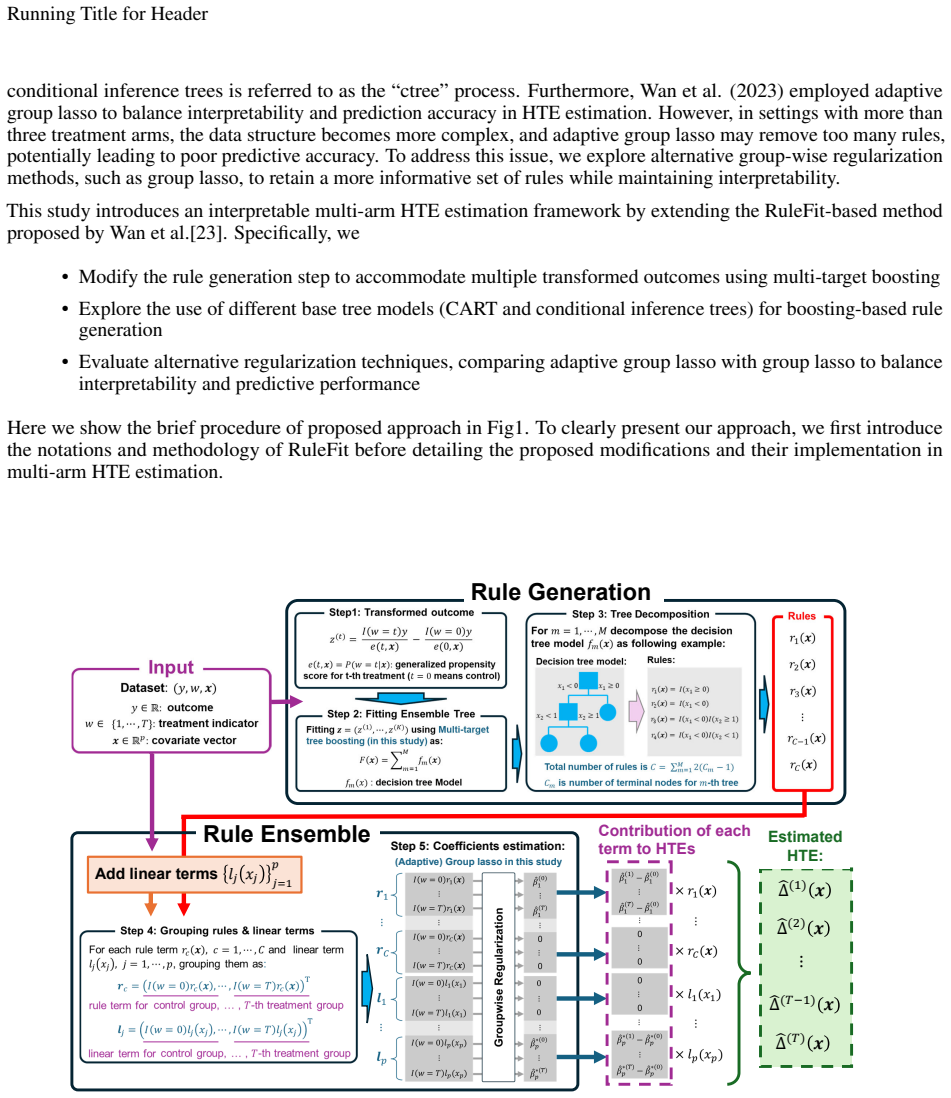
The load-bearing object is the shared-basis additive model: an outcome model in which every treatment arm and the control arm are linear combinations of the same base functions, namely the decision rules $r_c(x)$ decomposed from boosted trees plus winsorized linear terms $\ell_j(x_j)$, with coefficients $\beta^{(t)}_c$ that differ by arm. The group-wise sparsity regularizer groups each base function's coefficients across arms and forces them to be zero or non-zero together, so a rule either enters every arm's model or none. The HTE identity $$\hat{\$\Delta$}^{(t)}(x_i) = (\$beta^{{(t)}}$_0 - \$beta^{{(0)}}$_0) + \sum_c (\$beta^{{(t)}}$_c - \$beta^{{(0)}}$_c) r_c(x_i) + \sum_j (\$beta^{{*(t)}}$_j - \$beta^{{*(0)}}$_j) \ell_j(x_{ij})$$ does the interpretive work: the treatment effect of arm $t$ is a support-weighted signed sum of rule coefficients, and the difference between any two arms is the same sum with the two arms substituted in. The rule set itself is produced by multi-target boosting on transformed outcomes, so the rules that survive regularization are claimed to be the ones that genuinely separate effect-modifying subpopulations.
What would settle it
Generate an observational multi-arm dataset whose true treatment effect contains an arm-specific nonlinear interaction (for example, one arm's effect scaled by $\sin(x_1 x_2)$ with the other arms flat), estimate the generalized propensity score with a deliberately misspecified multinomial logistic model, and compare mPEHE and absolute relative bias against S- and X-learners with BART; a clear degradation of the rule-based estimates in that setting would confirm that the shared additive basis, not just the propensity weighting, is the binding constraint.
Extended reading notes
Core claim
The central claim is that an interpretable rule-based additive model, with rules and linear terms shared across all treatment arms and estimated under group-wise sparsity, yields accurate and interpretable multi-arm HTE estimates. The multi-arm HTE for treatment $t$ is written as $$\hat{\$\Delta$}^{(t)}(x_i) = \$gamma^{{(t)}}$_0 + \sum_{c=1}^{C}\$gamma^{{(t)}}$_c r_c(x_i) + \sum_{j=1}^{p}\$gamma^{{*(t)}}$_j \ell_j(x_{ij})$$ where $\gamma^{(t)} = \beta^{(t)} - \beta^{(0)}$ are the coefficient differences between the $t$-th treatment and the control, and the same base functions $r_c$ and $\ell_j$ appear in every arm. Because the coefficients of each base function across arms are forced to be zero or non-zero together (group lasso or adaptive group lasso), every rule's contribution to the HTE of every arm, and to the difference between any pair of arms, is a comparable and interpretable quantity. The rules are generated upstream by multi-target boosting fitted to inverse-probability-weighted transformed outcomes, and the authors report over 54 simulation scenarios lower bias and higher estimation accuracy than meta-learners in most settings, with Cohen's kappa above 0.8 for optimal treatment selection in most scenarios.
Load-bearing premise
The load-bearing premise is that the rule-plus-linear additive basis shared across all arms is flexible enough to represent the true heterogeneity of treatment effects; if the real effect surface contains strong nonlinear interactions, the paper's own authors concede the model loses accuracy to flexible black-box learners.
Editorial extensions
If this is right
- If the shared-rule model is right, a clinician can read the estimated treatment effect of any arm as the support-weighted sum of signed rule coefficients, in the same way one reads a regression table.
- Comparisons between any two arms reduce to the same base functions, so a clinician can see which covariates drive, say, ZDV+ZAL versus ZDV+DID for a given patient and act on the difference.
- The framework extends the binary-treatment rule-ensemble method to any number of arms, with rule-generation (boosting with CART versus conditional inference trees) and sparsity (group lasso versus adaptive group lasso) choices providing a menu of accuracy-versus-complexity trade-offs.
- Optimal treatment selection stays reliable as the trial grows: reported Cohen's kappa remained above 0.8 in most scenarios with three to five groups.
- The accuracy claim is explicitly conditional: for strongly nonlinear treatment-effect surfaces the model trails S- and X-learners with BART, so interpretability is bought for well-structured effect shapes.
Reading between the lines
- If the shared-basis structure is sound, the same construction should transfer to other causal targets, such as time-to-event or survival outcomes, where rule-based additive models could be fit with pseudo-outcome losses; the paper does not take that step.
- Because rule generation happens on inverse-probability-weighted outcomes, the method's advantage over S- and X-learners should shrink as the generalized propensity score degrades; a testable consequence is that observational settings with badly misspecified propensity models are where the shared-rule approach is most fragile.
- The group-sparsity constraint is a strong structural assumption: a covariate is either effect-modifying for every arm or for none; real multi-arm data may contain genuinely arm-specific modifiers, and measuring how often those are wrongly pruned would be a natural stress test.
- The rule-level and variable-level importance rankings could double as a prescreening device for confirmatory subgroup analyses, since they name the exact patient characteristics that separate the arms.
Signed reviews
Editorial analysis
A structured set of objections, weighed in public.
Referee Report
Summary. The manuscript proposes an interpretable rule-ensemble method for heterogeneous treatment effect (HTE) estimation in multi-arm studies. It generalizes the two-arm RuleFit-based method of Wan et al. (2023) by: (i) generating candidate rules via multi-target boosting applied to T transformed outcomes constructed from inverse-probability-weighted pseudo-outcomes (Eq. 3); (ii) enforcing a shared basis of rules and linear terms across all treatment arms; and (iii) estimating arm-specific coefficients on this shared basis with group lasso or adaptive group lasso (Eq. 11). The shared-basis constraint lets the difference between any two arms be expressed as an additive function of the same base functions (Eq. 10), which supports pairwise interpretability. The method is evaluated on 54 simulated scenarios spanning 3-5 arms, RCT and observational designs, and linear/stepwise/nonlinear main and treatment effects, with comparisons to 21 meta-learner configurations (S-, T-, X-, M-, DR-, R-, and reference-free R-learners with XGBoost, random forest, and BART). A real-data application on ACTG175 is also presented, including a proposed metric (Eq. 24) for model selection when true HTEs are unknown.
Significance. If validated, this would be a useful contribution to multi-arm HTE estimation: the shared-basis constraint is an elegant way to make multi-arm HTE models directly interpretable, and the interpretability tools of Section 3.4 and the detailed rule-level analysis of Section 5.3.2 are practical assets. The simulation study is unusually extensive—54 scenarios with full tables in the appendices—and the authors should be credited for comparing against BART-based meta-learners in addition to XGBoost and random forest variants, and for making the algorithm steps concrete. That said, the paper's central accuracy claim is not supported by its own results: the body repeatedly reports 'comparable' accuracy, and for nonlinear treatment effects the best proposed variant (ctree.gl) is outperformed by S- and X-learners on mPEHE. The rule-generation step also rests on an untested structural assumption about the sufficiency of the multi-target boosting dictionary. The contribution is therefore plausible but needs substantial reconciliation of claims and evidence.
major comments (3)
- [Abstract; §4.4; Tables 3 and 4] The abstract claims the proposed approach 'achieved lower bias and higher estimation accuracy compared with those of existing methods', but Section 4.4 states that prediction accuracy was only 'comparable' when the treatment effect is stepwise or nonlinear, and that the best proposed approach 'did not outperform the S- or X-learners in terms of prediction accuracy' for nonlinear treatment effects. The tables corroborate the weaker statement: for example, in Table 3 (RCT, 3 groups, N-N) ctree.gl has mPEHE 0.45 versus sbart 0.43 and xbart 0.42, and the same pattern appears in the observational setting in Table 4. The abstract should be rewritten to match the body's more measured conclusion, or the authors must provide targeted evidence (e.g., a superiority test across the 54 scenarios) for the claimed higher accuracy.
- [§3.3.1, Eq. (3)] The rule-generation step fits a multi-target boosting model to the T-dimensional pseudo-outcome vector z_i. For a subject assigned to arm t, only one coordinate contributes signal (y_i/e(t,x_i)); the other T-1 coordinates are structural zeros or constant control terms. Under a squared-error boosting loss, a split that improves the fit for a single arm has its loss reduction diluted by a factor of 1/T. As T grows, effect modifiers specific to one arm become progressively less likely to be selected into the rule dictionary. If such a modifier is absent, the group-lasso ensemble in Eq. (11) cannot represent that arm's HTE, and the pairwise interpretability claim in Eq. (10) silently omits it. This is a load-bearing assumption that the manuscript does not test. The nonlinear treatment-effect results in Tables 3 and 4 are consistent with this failure mode. I request a diagnostic experiment (e.g., a simulation with one arm-specific interaction and measurement of rule-recovery rates) or a theoretical discussion of why the multi-target loss does not systematically miss arm-specific structure.
- [§5.2, Eq. (24)] The model-selection metric used for the real-data tuning is mis-specified. As written, the formula divides the mean absolute error by the indicator I(sign(Δ_actual)=sign(Δ̂)); any subgroup with a sign mismatch produces a division by zero, and the asserted limiting behavior ('when HTEs are perfectly estimated, this metric is equal to 0') does not follow from this expression. Since this metric is used to select the rule-generation method, the ensemble method, and all hyperparameters for the ACTG175 analysis, the real-data tuning rests on an undefined quantity. Please correct the definition—the indicator should presumably multiply or weight the absolute error—and re-run the grid search or at least report how robust the chosen configuration is to the corrected metric.
minor comments (7)
- [Assumption 3, §2.1] The acronym 'SUVTA' should be 'SUTVA' (Stable Unit Treatment Value Assumption).
- [§4.2] In the PEHE description, the phrase 'represents the true the, and' is a typo and should read 'represents the true HTE, and'.
- [Figure 4 caption] The caption states the y-axis denotes 'Spearman's rank correlation', but the figure shows Cohen's kappa; this should be corrected.
- [Figure 6 caption] The caption refers to 'the mean the Spearman's rank correlation values' whereas the figure plots the average number of terms; the caption should be rewritten.
- [§2.2.3, Eq. (4)] The displayed R-learner objective contains garbled notation (the brackets and inner product expression). Please re-typeset the equation.
- [§5.2] The text says 'The results are shown in AppendixB', but the grid-search table appears in Appendix C; the cross-reference should be fixed.
- [§4.3] The parameter settings sentence is missing a verb ('were set to' or 'are 333, 2, and 0.01'), and the final sentence about the Appendix is cut off mid-word in the manuscript; please complete it.
Circularity Check
No circularity: the proposed method estimates HTE from shared rule and linear terms selected by group-wise regularization, with all claims evaluated against independent simulation ground truth and observed real-data outcomes.
full rationale
The paper's derivation chain is self-contained in the sense relevant to circularity. The transformed outcomes in Eq. (3) are standard M-learner pseudo-outcomes constructed from the outcome and estimated generalized propensity scores; they are used only to generate candidate rules in Section 3.3.1, not to fit the final ensemble. The final HTE estimates come from a group-lasso fit (Eq. (11)) of the original outcomes on shared rule and linear terms, and the difference-of-coefficients representation (Eqs. (8)-(10)) is a definitional consequence of the additive shared-basis model, not a fitted quantity renamed as a prediction. No parameter is fitted to a subset of the target and then used to 'predict' that same target. The paper's own Section 4.4 concedes that the additive rule-plus-linear structure can limit approximation of complex nonlinear HTE; that is a stated limitation, not a circular step. The cited prior work by the same authors (Wan et al., 2023) is used as the starting point of the framework and is extended, not invoked as a uniqueness theorem or as the source of a fitted parameter. The real-data model selection uses an evaluation metric comparing estimated HTE with subgroup-level observed outcome differences, but that is an external evaluation of predictive validity rather than a derivation of the estimates from themselves. There is therefore no exhibited reduction of a derived quantity to its own inputs by construction or by self-citation.
Assumptions & free parameters
free parameters (3)
- Rule generation hyperparameters (number of boosting trees, base depth, shrinkage) =
333 trees, mean depth 2, shrinkage 0.01 in simulations; grid search over {333,666,1000} x {2,3,4} x {0.1,0.01,0.001}…
- Winsorizing quantile q and linear term scaling factor =
q=0.025, scale=0.4 (from Friedman and Popescu 2008)
- Rule depth randomization mean L_bar =
L_bar=2 (mean depth of base learners in simulations)
assumptions (3)
- domain assumption Unconfoundedness, overlap, and SUTVA
- domain assumption Generalized propensity scores are correctly specified by multinomial logistic regression
- ad hoc to paper Multi-target boosting on transformed outcomes generates rules sufficient for the shared additive outcome model
Cite this review
Pith. "Pith review of Causal rule ensemble approach for multi-arm data." pith.science (2026). https://pith.science/paper/UPHSKAF3
@misc{pith2026250417166,
  author       = {Pith},
  title        = {Pith review of: Causal rule ensemble approach for multi-arm data},
  year         = {2026},
  howpublished = {\url{https://pith.science/paper/UPHSKAF3}},
  note         = {Machine review of arXiv:2504.17166}
}
read the original abstract
Heterogeneous treatment effect (HTE) estimation is critical in medical research. It provides insights into how treatment effects vary among individuals, which can provide statistical evidence for precision medicine. While most existing methods focus on binary treatment situations, real-world applications often involve multiple interventions. However, current HTE estimation methods are primarily designed for binary comparisons and often rely on black-box models, which limit their applicability and interpretability in multi-arm settings. To address these challenges, we propose an interpretable machine learning framework for HTE estimation in multi-arm trials. Our method employs a rule-based ensemble approach consisting of rule generation, rule ensemble, and HTE estimation, ensuring both predictive accuracy and interpretability. Through extensive simulation studies and real data applications, the performance of our method was evaluated against state-of-the-art multi-arm HTE estimation approaches. The results indicate that our approach achieved lower bias and higher estimation accuracy compared with those of existing methods. Furthermore, the interpretability of our framework allows clearer insights into how covariates influence treatment effects, facilitating clinical decision making. By bridging the gap between accuracy and interpretability, our study contributes a valuable tool for multi-arm HTE estimation, supporting precision medicine.
Figures


Figures from the paper (8 more)


Reference graph
Works this paper leans on
-
[1]
John C. Reed. Toward a new era in cancer treatment: Message from the new editor-in-chief. Molecular Cancer Therapeutics, 11(8):1621–1622, 08 2012
work page 2012
-
[2]
James M. S. Wason and Lorenzo Trippa. A comparison of bayesian adaptive randomization and multi-stage designs for multi-arm clinical trials. Statistics in Medicine, 33(13):2206–2221, 2014
work page 2014
-
[3]
MaheshK. B. Parmar, James Carpenter, and Matthew R. Sydes. More multiarm randomised trials of superiority are needed. The Lancet, 384:283–284, 2014
work page 2014
-
[4]
Jared C. Foster, Jeremy M.G. Taylor, and Stephen J. Ruberg. Subgroup identification from randomized clinical trial data. Statistics in Medicine, 30(24):2867–2880, 2011
work page 2011
-
[5]
Jennifer L. Hill. Bayesian nonparametric modeling for causal inference. Journal of Computational and Graphical Statistics, 20(1):217–240, 2011
2011
-
[6]
Recursive partitioning for heterogeneous causal effects
Susan Athey and Guido Imbens. Recursive partitioning for heterogeneous causal effects. Proceedings of the National Academy of Sciences, 113(27):7353–7360, 2016
2016
-
[7]
Estimation and inference of heterogeneous treatment effects using random forests
S Wager and S Athey. Estimation and inference of heterogeneous treatment effects using random forests. Journal of the American Statistical Association, 113(523):1228–1242, 2018. 24 Running Title for Header
work page 2018
-
[8]
Estimating treatment effects with causal forests: An application
Susan Athey and Stefan Wager. Estimating treatment effects with causal forests: An application. Observational studies, 5(2):37–51, 2019
work page 2019
Show all 40 references
-
[9]
Some methods for heterogeneous treatment effect estimation in high dimensions
S Powers, J Qian, K Jung, A Schuler, N H Shah, T Hastie, and R Tibshirani. Some methods for heterogeneous treatment effect estimation in high dimensions. Statistics in Medicine, 37(11):1767–1787, 2018
2018
-
[10]
Künzel, Jasjeet S
Sören R. Künzel, Jasjeet S. Sekhon, Peter J. Bickel, and Bin Yu. Metalearners for estimating heterogeneous treatment effects using machine learning. Proceedings of the National Academy of Sciences, 116(10):4156–4165, 2019
2019
-
[11]
Double/debiased machine learning for treatment and structural parameters
Victor Chernozhukov, Denis Chetverikov, Mert Demirer, Esther Duflo, Christian Hansen, Whitney Newey, and James Robins. Double/debiased machine learning for treatment and structural parameters. The Econometrics Journal, 21(1):C1–C68, 2018
2018
-
[12]
Quasi-oracle estimation of heterogeneous treatment effects
X Nie and S Wager. Quasi-oracle estimation of heterogeneous treatment effects. Biometrika, 108(2):299–319, 2020
2020
-
[13]
Derya Uysal, Andrew Ryan, and John L
Ariel Linden, S. Derya Uysal, Andrew Ryan, and John L. Adams. Estimating causal effects for multivalued treatments: a comparison of approaches. Statistics in Medicine, 35(4):534–552, 2016
2016
-
[14]
Estimation of causal effects of multiple treatments in observational studies with a binary outcome
Liangyuan Hu, Chenyang Gu, Michael Lopez, Jiayi Ji, and Juan Wisnivesky. Estimation of causal effects of multiple treatments in observational studies with a binary outcome. Statistical Methods in Medical Research, 29:3218–3234, 11 2020
2020
-
[15]
Comparison of meta-learners for estimating multi-valued treatment heterogeneous effects
Naoufal Acharki, Ramiro Lugo, Antoine Bertoncello, and Josselin Garnier. Comparison of meta-learners for estimating multi-valued treatment heterogeneous effects. In Proceedings of the 40th International Conference on Machine Learning, volume 202 of Proceedings of Machine Learn...
2023
-
[16]
Big data and black-box medical algorithms
WN Price. Big data and black-box medical algorithms. Science Translational Medicine, 10(471):eaao5333, 2018
2018
-
[17]
Opening the black box: The promise and limitations of explainable machine learning in cardiology
J Petch, S Di, and W Nelson. Opening the black box: The promise and limitations of explainable machine learning in cardiology. Canadian Journal of Cardiology, 38(2):204–213, 2022
2022
-
[18]
Lundberg and Su-In Lee
Scott M. Lundberg and Su-In Lee. A unified approach to interpreting model predictions. In Proceedings of the 31st International Conference on Neural Information Processing Systems, NIPS’17, page 4768–4777, 2017
2017
-
[19]
Nonparametric machine learning for precision medicine with longitudinal clinical trials and bayesian additive regression trees with mixed models
C Spanbauer and R Sparapani. Nonparametric machine learning for precision medicine with longitudinal clinical trials and bayesian additive regression trees with mixed models. Statistics in Medicine, 40(11):2665–2691, 2021
2021
-
[20]
Bargagli-Stoffi, Riccardo Cadei, Kwonsang Lee, and Francesca Dominici
Falco J. Bargagli-Stoffi, Riccardo Cadei, Kwonsang Lee, and Francesca Dominici. Causal rule ensemble: Interpretable discovery and inference of heterogeneous treatment effects. arXiv preprint arXiv:2009.09036, 2023
2009 arXiv
-
[21]
Definitions, methods, and applications in interpretable machine learning
W Murdoch, C Singh, K Kumbier, R Abbasi-Asl, and B Yu. Definitions, methods, and applications in interpretable machine learning. Proceedings of the National Academy of Sciences, 116(44):22071–22080, 2019
2019
-
[22]
Stop explaining black box machine learning models for high stakes decisions and use interpretable models instead
C Rudin. Stop explaining black box machine learning models for high stakes decisions and use interpretable models instead. Nature Machine Intelligence, 1(5):206–215, 2019
2019
-
[23]
Rule ensemble method with adaptive group lasso for heterogeneous treatment effect estimation
Ke Wan, Kensuke Tanioka, and Toshio Shimokawa. Rule ensemble method with adaptive group lasso for heterogeneous treatment effect estimation. Statistics in Medicine, 42(19):3413–3442, 2023
2023
-
[24]
Causal rule ensemble method for estimating heterogeneous treatment effect with consideration of prognostic effects
Mayu Hiraishi, Ke Wan, Kensuke Tanioka, Hiroshi Yadohisa, and Toshio Shimokawa. Causal rule ensemble method for estimating heterogeneous treatment effect with consideration of prognostic effects. Statistical Methods in Medical Research, 2024
2024
-
[25]
A new causal rule learning approach to interpretable estimation of heterogeneous treatment effect, 2025
Ying Wu, Hanzhong Liu, Kai Ren, Shujie Ma, and Xiangyu Chang. A new causal rule learning approach to interpretable estimation of heterogeneous treatment effect, 2025
2025
-
[26]
Estimating causal effects of treatments in randomized and nonrandomized studies
D B Rubin. Estimating causal effects of treatments in randomized and nonrandomized studies. Journal of Educational Psychology, 66(5):688–701, 1974
1974
-
[27]
Guido W. Imbens. The role of the propensity score in estimating dose-response functions. Biometrika, 87(3):706– 710, 2000
2000
-
[28]
Identification and estimation of causal effects of multiple treatments under the conditional independence assumption
Michael Lechner. Identification and estimation of causal effects of multiple treatments under the conditional independence assumption. In Michael Lechner and Friedhelm Pfeiffer, editors, Econometric Evaluation of Labour Market Policies, pages 43–58, Heidelberg, 2001. Physica-Verlag HD
2001
-
[29]
Causal inference with general treatment regimes
Kosuke Imai and David A van Dyk. Causal inference with general treatment regimes. Journal of the American Statistical Association, 99(467):854–866, 2004. 25 Running Title for Header
2004
-
[30]
Nonparametric estimation of heterogeneous treatment effects: From theory to learning algorithms
Alicia Curth and Mihaela van der Schaar. Nonparametric estimation of heterogeneous treatment effects: From theory to learning algorithms. In Proceedings of The 24th International Conference on Artificial Intelligence and Statistics, volume 130 of Proceedings of Machine Learnin...
2021
-
[31]
A reference-free r-learner for treatment recommendation
Junyi Zhou, Ying Zhang, and Wanzhu Tu. A reference-free r-learner for treatment recommendation. Statistical Methods in Medical Research, 32(2):404–424, 2023
2023
-
[32]
Multi-target regression with rule ensembles.The Journal of Machine Learning Research, 13(1):2367–2407, 2012
Timo Aho, Bernard Ženko, Sa¸ so Džeroski, and Tapio Elomaa. Multi-target regression with rule ensembles.The Journal of Machine Learning Research, 13(1):2367–2407, 2012
2012
-
[33]
Fitting prediction rule ensembles with r package pre
M Fokkema. Fitting prediction rule ensembles with r package pre. Journal of Statistical Software, 92(12):1–30, 2020
2020
-
[34]
Predictive learning via rule ensembles
J H Friedman and B E Popescu. Predictive learning via rule ensembles. The Annals of Applied Statistics , 2(3):916–954, 2008
2008
-
[35]
Stepwise induction of multi-target model trees
Annalisa Appice and Saso Džeroski. Stepwise induction of multi-target model trees. In Machine Learning: ECML 2007, pages 502–509. Springer Berlin Heidelberg, 2007
2007
-
[36]
Model selection and estimation in regression with grouped variables
Ming Yuan and Yi Lin. Model selection and estimation in regression with grouped variables. Journal of the Royal Statistical Society: Series B (Statistical Methodology), 68:49–67, 2 2006
2006
-
[37]
A note on adaptive group lasso
Hansheng Wang and Chenlei Leng. A note on adaptive group lasso. Computational Statistics & Data Analysis, 52(12):5277–5286, 2008
2008
-
[38]
Horowitz, and Fengrong Wei
Jian Huang, Joel L. Horowitz, and Fengrong Wei. Variable selection in nonparametric additive models. The Annals of Statistics, 38(4):2282 – 2313, 2010
2010
-
[39]
Richard Landis and Gary G
J. Richard Landis and Gary G. Koch. The measurement of observer agreement for categorical data. Biometrics, 33(1):159–174, 1977
1977
-
[40]
main effect function - treatment effect function
A A Tsiatis, M Davidian, M Zhang, and X Lu. Covariate adjustment for two-sample treatment comparisons in randomized clinical trials: A principled yet flexible approach. Statistics in Medicine, 27(23):4658–4677, 2008. 26 Running Title for Header A Appendix 1: Simulation Results...
2008
Reviewed August 16, 2026 · model on record in the stance chip above.
Discussion (0). Continue with ORCID to comment.