REVIEW 3 major objections 6 minor 116 references
DIVE: Inverting Conditional Diffusion Models for Discriminative Tasks
T0 review · 3 major / 6 minor · reviewed 2026-08-16 · deepseek-v4-flash
Pith's one-line read The paper claims that a frozen, pretrained layout-to-image diffusion model can be inverted into an object detector that is competitive with a basic Faster R-CNN baseline on COCO, and that the same inversion speeds up generative…
desk verdict The classification speedup is real and useful, but the detection claim rests on an asserted objective and a thin eval, so treat the headline as provisional. read the letter →
The pith
A machine-rendered reading of the paper's core claim, the machinery that carries it, and where it could break.
The reading
What carries the argument
The load-bearing identity is Bayes' posterior maximization, $\arg\max_y p_\theta(x|y)p(y)$, converted into an optimization over a learnable layout embedding. The carrying mechanism is gradient-based discrete optimization inside the frozen embedding vocabulary: the current vector $v$ is replaced by its nearest vocabulary embedding via a straight-through gradient copy, so both the layout-to-image denoiser $\epsilon_\theta$ and the prior layout denoiser $\epsilon_\phi$ backprop into $v$ while the optimized value is forced to decode to a legal box/class sequence. The prior layout diffusion model plays a necessary role: it supplies the non-uniform $p(y)$, since layouts, unlike classes, cannot be assumed uniformly distributed.
What would settle it
Estimate the true conditional log-likelihoods of DIVE's predicted layouts with a proper likelihood estimator (for example, annealed importance sampling or an ELBO with many noise samples), and compare the ranking induced by the sum-of-MSE objective with the ranking induced by the estimated likelihoods on a set of correct and incorrect layouts; a mismatch would show the objective is not the posterior. A cheaper check is to re-run detection while scaling the prior loss by a free weight; if AP changes substantially with that weight, the unweighted combination in Eq. (4) is not the unique Bayes objective.
Extended reading notes
Core claim
The central discovery, stated on the paper's own terms, is that the discriminative information needed to detect objects is already present in a frozen layout-to-image diffusion model and can be extracted by optimizing the conditional input. Substituting the two diffusion training objectives into Bayes' rule gives a single inversion objective (Eq. 4): minimize the sum of the denoising error of the image model with respect to the layout and the denoising error of a separately trained layout-prior model. Because the layout is represented by discrete vocabulary embeddings, DIVE uses a nearest-embedding replacement with gradient copying, so the optimizer stays in the model's vocabulary and the final prediction is read off as nearest-neighbor indices. With this machinery the paper reports AP 7.1 versus 6.8 for Faster R-CNN R50 at the same low resolution, better AP75 than AP50 (indicating precise but incomplete detections), and a 14x speedup over enumeration for classification with nearly identical accuracy.
Load-bearing premise
The load-bearing premise is that adding the conditional image model's denoising loss and the prior layout model's denoising loss equals the log-posterior in Bayes' rule; if that equality is only approximate or mis-weighted, the optimized layout is not a MAP estimate and the reported AP is not evidence of the frozen generator's discriminative power.
Editorial extensions
If this is right
- A frozen generative model can act as a zero-training detector: no detector head, no finetuning, and no enumeration of candidate labels are required.
- The Bayes-inversion recipe transfers from classification to detection, so any conditional diffusion model with a differentiable condition encoder is a candidate discriminative model.
- Detection quality tracks the model's generative prior: the paper's layout prior removes redundant objects and illegal boxes that appear when it is ablated.
- DIVE offers a self-contained evaluation metric for conditional diffusion models that does not depend on external classifiers; its rankings agree with FID, with the caveat that diversity rather than realism tracks discriminative ability.
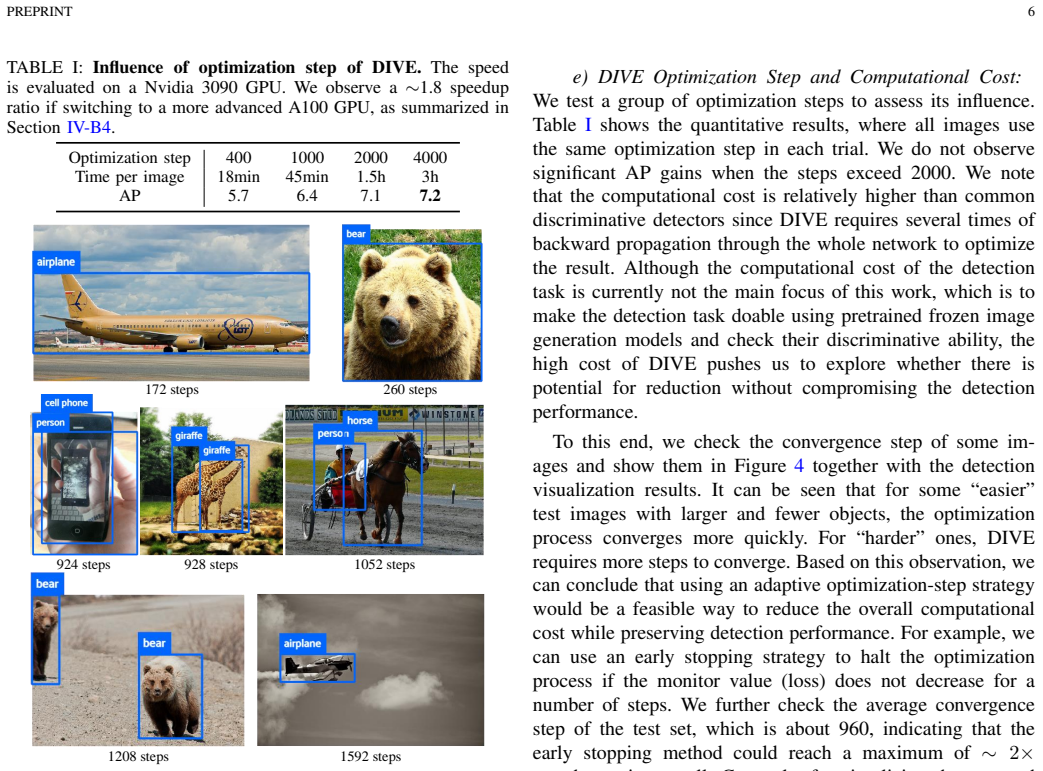
- Optimization-based inversion is the main cost bottleneck; early stopping on the monitor loss could roughly halve the average 2000-step budget without, the authors argue, hurting performance.
Reading between the lines
- The objective in Eq. (4) simply adds two unweighted denoising losses; a natural extension is to learn or tune a weighting between the image-conditional and prior terms, and the resulting AP would reveal how much of the detection quality owes to the prior.
- The poor small- and medium-object AP is attributed to 8x latent downsampling; testing the same inversion on a pixel-space or higher-resolution latent model would isolate that cause and might raise small-object AP without changing the algorithm.
- Because DIVE's advantage over Faster R-CNN appears at AP75, the method may be most useful as a precise proposal generator or verifier rather than a full detector; combining DIVE candidates with a cheap discriminative ranker is a testable hybrid.
- The same inversion could be pointed at dense tasks such as semantic segmentation, but the optimization space would explode and per-pixel gradient contributions would be small; coarse-to-fine or grouped optimization would be needed before that becomes feasible.
Signed reviews
Editorial analysis
A structured set of objections, weighed in public.
Referee Report
Summary. This paper proposes DIVE, a method for repurposing pretrained conditional diffusion models for discriminative tasks, specifically object detection. Following the Bayes-rule inversion paradigm of prior 'diffusion classifier' work, DIVE treats the detection label (a layout sequence of class and bounding-box tokens) as learnable parameters and optimizes it by gradient descent on the sum of two diffusion denoising losses: one from a frozen layout-to-image model (the likelihood term) and one from an auxiliary prior layout diffusion model (the prior term). To handle the discrete label vocabulary, the method uses a straight-through nearest-neighbor embedding replacement. Experiments on COCO 2017 report AP 7.1 on a 500-image subset, comparable to a 256x256 from-scratch Faster R-CNN R50 (AP 6.8); ablations on 100 images show that both the prior model and the in-vocabulary optimization contribute. On ImageNet classification, DIVE matches the enumeration-based Diffusion Classifier (77.2 vs 77.3) at roughly 14x lower per-image cost. The paper additionally proposes DIVE as an evaluation metric for conditional diffusion models.
Significance. Assuming the central derivation holds, this is the first non-enumeration inversion of a frozen conditional diffusion model for a structured discriminative task with a non-uniform label space, and the learned prior-layout model is a sensible response to the non-uniform layout distribution. The paper has real strengths: code and models are promised; the ablations isolate both proposed components; the classification experiments validate the optimization-based inversion against the enumeration baseline at matched accuracy with a 14x speedup; and the detection baselines are reproduced at matching resolution, which is transparent. The paper also candidly acknowledges its limitations, including compute cost and a concluding caveat about dense-task scalability. The result, however, rests on the asserted identification in Eq. (4) between a sum of two denoising-MSE losses and the log-posterior, and the detection evaluation is thin: a 500-image subset without selection details, no error bars, and a 0.3-AP gap to the 'competitive' Faster R-CNN baseline. These issues are addressable in revision but are load-bearing for the paper's central claims.
major comments (3)
- [Section III-B2, Eq. (4)] The identification of the unweighted sum of two denoising-MSE expectations with log p_theta(x|y) + log p_phi(y) is asserted rather than derived. Eq. (1) itself is only approximate (the simplified epsilon-prediction loss is a reweighted version of the ELBO, with per-timestep coefficients and variance-schedule constants dropped), and Eq. (4) compounds this by summing two losses that live in different spaces (the 32x32x4 latent image space vs. the 100xd layout-embedding space) with independent noise and timestep samplings and different intrinsic scales. The default weight of 1 between the two terms is therefore not justified by any common log-density. This matters because the abstract and Section III-B frame DIVE as making 'more accurate use of the Bayes' rule' and obtaining the posterior maximum. Please either derive the relationship explicitly (e.g., via a weighted ELBO decomposition with the appropriate per-timestep coefficients), or reframe the objective as a heuristic surrogate objective; and add a validity check: on a set of held-out images, compare the objective value at the ground-truth layout against the value at corrupted or random layouts, and sweep the relative weight between the two loss terms to test whether the unit weight is near-optimal. If AP depends strongly on a non-unit weight, the method is not optimizing the stated posterior.
- [Section IV-A1a and Table II] The detection evaluation is currently too thin to support the headline comparison. The 500-image subset of COCO val is not described (random, seeded, or filtered), no error bars or significance tests are given, and the main claim of being on par with Faster R-CNN R50 rests on AP 7.1 vs 6.8, a 0.3-point gap that is likely within noise at this sample size; on AP50 DIVE is actually lower (11.0 vs 12.7). In addition, the optimization-step hyperparameter K is swept on the same 500 images in Table I before being fixed at 2000, so the reported AP is a test-set-selected result. Please report bootstrap confidence intervals for AP, AP50, and AP75, describe the subset selection procedure explicitly, and either temper the statement about 'competitive performance compared to discriminative methods' or support it with variance-aware comparisons.
- [Section IV-A1b and Section IV-A2b] The manuscript should clarify what 'frozen pretrained image generation model' means in this setup. The layout-to-image LDM-8 (363M) is retrained by the authors on COCO itself because no public model exists (footnote 1), and the prior layout model is trained on the same COCO layout distribution, so both the likelihood and the prior are in-distribution for the test task. This is not a deficiency of the inversion idea, since the Diffuser Classifier line of work has the same property, but the claim in Section IV-A2b ('the first to show that using a frozen pretrained image generation model can successfully tackle the challenging object detection task') should be qualified: the model is frozen at inference, but it is not an externally pretrained model transferring to a new task, and the prior is learned from the target label distribution. The abstract's wording about 'leveraging pretrained diffusion models' should be adjusted to match this setup.
minor comments (6)
- [Section IV-A1a] Please state explicitly how the 500-image subset was selected (for example, a random draw with a fixed seed) so that the reader can judge its representativeness; the current sentence 'we evaluate DIVE on a subset of 500 images' is underspecified.
- [Algorithm 1 / Section III-B3a] In Algorithm 1, the eval function drops none-value and illegal boxes before computing monitor losses; please clarify how the sequence is re-padded to the fixed length of 100 for the loss computation, since both diffusion models expect a fixed-length input.
- [Section III-B3a] The timestep set T is shared between the image model and the prior model, but the two models add noise to different spaces (image latents vs. layout embeddings) with different scales; please state the noise schedules used in each model and justify the shared T, or report sensitivity to this choice.
- [Section III-B2, Eqs. (5)-(7)] The notation is confusing because v is used both for the learnable continuous parameters and for the output of the frozen embedding mapping v_theta; consider distinguishing the soft and discretized versions (for example, v_soft and v_discrete) to make the straight-through operation in Eq. (6) and the decoding in Eq. (7) easier to follow.
- [Table I] The time-per-image cells are formatted inconsistently ('18min, 45min, 1.5h, 3h'); please unify the units and state in the caption that these AP numbers are measured on the same 500-image subset used in Table II.
- [Section V (Conclusion)] The concluding caveat about dense tasks, namely that the optimization space becomes large and the per-pixel objective contribution is small 'which may be problematic and needs to be addressed', is an important self-identified limitation; it should be reflected in the introduction or abstract so that the scope of the claimed contribution is clear from the start.
Circularity Check
No circularity: Eq. (4) is an explicit approximation, and detection results are benchmarked externally.
full rationale
Walking the derivation chain: DIVE starts from Bayes' rule (Eq. 2) and replaces the two log-densities with denoising-MSE surrogates (Eqs. 1 and 3), giving the combined objective in Eq. (4). The paper explicitly labels Eq. (1) as an approximation ('≈'), and for Eq. (4) it says 'we simply add the losses of the two diffusion models', so the combination is a stated modeling choice rather than a definitional identity. The predicted layout y* is obtained by optimizing this objective with fixed pretrained models; it is not fit to ground-truth detection labels, and the monitor only selects among noised/timestep evaluations using the same objective, again without label information. The central empirical claims are checked against external discriminative baselines (Faster R-CNN, DETR, DiffDet) and against the previous Diffusion Classifier, so the main result is falsifiable outside the paper's fitted values. The paper contains no self-citations and imports no uniqueness theorem from the authors' prior work. The COCO-trained layout-to-image model and COCO-trained prior do weaken the 'frozen pretrained' transfer narrative, but this is a data-distribution overlap, not an algebraic reduction of the prediction to the training input; the detection AP is still an independent function of the test image. No circular step meeting the quoted-evidence bar was found.
Assumptions & free parameters
free parameters (5)
- Optimization steps K =
2000
- Loss weighting lambda (image vs prior) =
1:1 equal weights
- Learning rate =
0.01
- Timestep interval =
5 (timesteps {2,7,...,997})
- Monitor noise sets Eforθ, Eforϕ =
random draws, seeds not specified
assumptions (5)
- standard math The conditional diffusion training loss in Eq. (1) is an unbiased surrogate for log pθ(x|y) up to a constant.
- ad hoc to paper The sum of the two diffusion losses in Eq. (4) is proportional to log p(y|x).
- domain assumption The prior layout diffusion model pϕ(y) trained by Eq. (3) accurately models the prior distribution of object layouts.
- ad hoc to paper Nearest-neighbor embedding replacement with straight-through gradient (Eq. 6) yields a good discrete solution.
- ad hoc to paper The COCO validation subset of 500 images is representative of the full validation set.
Cite this review
Pith. "Pith review of DIVE: Inverting Conditional Diffusion Models for Discriminative Tasks." pith.science (2026). https://pith.science/paper/NXIYSCE7
@misc{pith2026250417253,
  author       = {Pith},
  title        = {Pith review of: DIVE: Inverting Conditional Diffusion Models for Discriminative Tasks},
  year         = {2026},
  howpublished = {\url{https://pith.science/paper/NXIYSCE7}},
  note         = {Machine review of arXiv:2504.17253}
}
read the original abstract
Diffusion models have shown remarkable progress in various generative tasks such as image and video generation. This paper studies the problem of leveraging pretrained diffusion models for performing discriminative tasks. Specifically, we extend the discriminative capability of pretrained frozen generative diffusion models from the classification task to the more complex object detection task, by "inverting" a pretrained layout-to-image diffusion model. To this end, a gradient-based discrete optimization approach for replacing the heavy prediction enumeration process, and a prior distribution model for making more accurate use of the Bayes' rule, are proposed respectively. Empirical results show that this method is on par with basic discriminative object detection baselines on COCO dataset. In addition, our method can greatly speed up the previous diffusion-based method for classification without sacrificing accuracy. Code and models are available at https://github.com/LiYinqi/DIVE .
Figures


Figures from the paper (2 more)

Reference graph
Works this paper leans on
-
[1]
Your diffusion model is secretly a zero-shot classifier
Alexander C Li, Mihir Prabhudesai, Shivam Duggal, Ellis Brown, and Deepak Pathak. Your diffusion model is secretly a zero-shot classifier. In IEEE ICCV, pages 2206–2217, 2023
2023
-
[2]
Text-to-image diffusion models are zero-shot classifiers
Kevin Clark and Priyank Jaini. Text-to-image diffusion models are zero-shot classifiers. NeurIPS, 36, 2023
2023
-
[3]
Deep unsupervised learning using nonequilibrium thermody- namics
Jascha Sohl-Dickstein, Eric Weiss, Niru Maheswaranathan, and Surya Ganguli. Deep unsupervised learning using nonequilibrium thermody- namics. In ICML, pages 2256–2265, 2015
2015
-
[4]
Denoising diffusion probabilistic models
Jonathan Ho, Ajay Jain, and Pieter Abbeel. Denoising diffusion probabilistic models. NeurIPS, 33:6840–6851, 2020
2020
-
[5]
Score-based generative modeling through stochastic differential equations
Yang Song, Jascha Sohl-Dickstein, Diederik P Kingma, Abhishek Ku- mar, Stefano Ermon, and Ben Poole. Score-based generative modeling through stochastic differential equations. In ICLR, 2021
2021
-
[6]
Diffusion models beat GANs on image synthesis
Prafulla Dhariwal and Alexander Nichol. Diffusion models beat GANs on image synthesis. NeurIPS, 34:8780–8794, 2021
2021
-
[7]
High-resolution image synthesis with latent diffu- sion models
Robin Rombach, Andreas Blattmann, Dominik Lorenz, Patrick Esser, and Bj ¨orn Ommer. High-resolution image synthesis with latent diffu- sion models. In IEEE CVPR, pages 10684–10695, 2022
2022
-
[8]
Photorealistic text-to-image diffusion models with deep language understanding
Chitwan Saharia, William Chan, Saurabh Saxena, Lala Li, Jay Whang, Emily L Denton, Kamyar Ghasemipour, Raphael Gontijo Lopes, Burcu Karagol Ayan, Tim Salimans, Jonathan Ho, David J Fleet, and Moham- mad Norouzi. Photorealistic text-to-image diffusion models with deep language understanding. NeurIPS, 35:36479–36494, 2022
2022
Show all 116 references
-
[9]
Neural discrete representation learning
Aaron van den Oord, Oriol Vinyals, and Koray Kavukcuoglu. Neural discrete representation learning. NeurIPS, 30, 2017
2017
-
[10]
Generating diverse high-fidelity images with VQ-V AE-2
Ali Razavi, Aaron van den Oord, and Oriol Vinyals. Generating diverse high-fidelity images with VQ-V AE-2. NeurIPS, 32, 2019
2019
-
[11]
Taming transformers for high-resolution image synthesis
Patrick Esser, Robin Rombach, and Bjorn Ommer. Taming transformers for high-resolution image synthesis. In IEEE CVPR , pages 12873– 12883, 2021
2021
-
[12]
Zero-shot text- to-image generation
Aditya Ramesh, Mikhail Pavlov, Gabriel Goh, Scott Gray, Chelsea V oss, Alec Radford, Mark Chen, and Ilya Sutskever. Zero-shot text- to-image generation. In ICML, pages 8821–8831, 2021
2021
-
[13]
Generative adversarial nets
Ian Goodfellow, Jean Pouget-Abadie, Mehdi Mirza, Bing Xu, David Warde-Farley, Sherjil Ozair, Aaron Courville, and Yoshua Bengio. Generative adversarial nets. NeurIPS, 27, 2014
2014
-
[14]
Large scale GAN training for high fidelity natural image synthesis
Andrew Brock, Jeff Donahue, and Karen Simonyan. Large scale GAN training for high fidelity natural image synthesis. In ICLR, 2019
2019
-
[15]
A style-based generator architecture for generative adversarial networks
Tero Karras, Samuli Laine, and Timo Aila. A style-based generator architecture for generative adversarial networks. In IEEE CVPR, pages 4401–4410, 2019
2019
-
[16]
Is synthetic data from generative models ready for image recognition? In ICLR, 2023
Ruifei He, Shuyang Sun, Xin Yu, Chuhui Xue, Wenqing Zhang, Philip Torr, Song Bai, and Xiaojuan Qi. Is synthetic data from generative models ready for image recognition? In ICLR, 2023
2023
-
[17]
Fake it till you make it: Learning transferable represen- tations from synthetic imagenet clones
Mert B ¨ulent Sarıyıldız, Karteek Alahari, Diane Larlus, and Yannis Kalantidis. Fake it till you make it: Learning transferable represen- tations from synthetic imagenet clones. In IEEE CVPR, pages 8011– 8021, 2023
2023
-
[18]
Shekoofeh Azizi, Simon Kornblith, Chitwan Saharia, Mohammad Norouzi, and David J. Fleet. Synthetic data from diffusion models improves imagenet classification. TMLR, 2023
2023
-
[19]
DiffuMask: Synthesizing images with pixel-level annotations for semantic segmentation using diffusion models
Weijia Wu, Yuzhong Zhao, Mike Zheng Shou, Hong Zhou, and Chun- hua Shen. DiffuMask: Synthesizing images with pixel-level annotations for semantic segmentation using diffusion models. In IEEE ICCV , pages 1206–1217, 2023
2023
-
[20]
Dataset diffusion: Diffusion-based synthetic data generation for pixel-level semantic segmentation
Quang Nguyen, Truong Vu, Anh Tran, and Khoi Nguyen. Dataset diffusion: Diffusion-based synthetic data generation for pixel-level semantic segmentation. NeurIPS, 36, 2023
2023
-
[21]
GeoDiffusion: Text-prompted geometric control for object detection data generation
Kai Chen, Enze Xie, Zhe Chen, Yibo Wang, Lanqing Hong, Zhenguo Li, and Dit-Yan Yeung. GeoDiffusion: Text-prompted geometric control for object detection data generation. In ICLR, 2024
2024
-
[22]
Data augmentation for object detection via controllable diffusion models
Haoyang Fang, Boran Han, Shuai Zhang, Su Zhou, Cuixiong Hu, and Wen-Ming Ye. Data augmentation for object detection via controllable diffusion models. In IEEE WACV, pages 1257–1266, 2024
2024
-
[23]
Label-efficient semantic segmentation with diffusion models
Dmitry Baranchuk, Andrey V oynov, Ivan Rubachev, Valentin Khrulkov, and Artem Babenko. Label-efficient semantic segmentation with diffusion models. In ICLR, 2022
2022
-
[24]
Open-vocabulary panoptic segmentation with text-to-image diffusion models
Jiarui Xu, Sifei Liu, Arash Vahdat, Wonmin Byeon, Xiaolong Wang, and Shalini De Mello. Open-vocabulary panoptic segmentation with text-to-image diffusion models. In IEEE CVPR , pages 2955–2966, 2023
2023
-
[25]
Diffusion model as representation learner
Xingyi Yang and Xinchao Wang. Diffusion model as representation learner. In IEEE ICCV, pages 18938–18949, 2023
2023
-
[26]
DreamTeacher: Pretraining image backbones with deep generative models
Daiqing Li, Huan Ling, Amlan Kar, David Acuna, Seung Wook Kim, Karsten Kreis, Antonio Torralba, and Sanja Fidler. DreamTeacher: Pretraining image backbones with deep generative models. In IEEE ICCV, pages 16698–16708, 2023
2023
-
[27]
Unleashing text-to-image diffusion models for visual perception
Wenliang Zhao, Yongming Rao, Zuyan Liu, Benlin Liu, Jie Zhou, and Jiwen Lu. Unleashing text-to-image diffusion models for visual perception. In IEEE ICCV, pages 5729–5739, 2023
2023
-
[28]
Text-image alignment for diffusion- based perception
Neehar Kondapaneni, Markus Marks, Manuel Knott, Rogerio Guimaraes, and Pietro Perona. Text-image alignment for diffusion- based perception. In IEEE CVPR, pages 13883–13893, 2024
2024
-
[29]
Diffusion models trained with large data are transferable visual models
Guangkai Xu, Yongtao Ge, Mingyu Liu, Chengxiang Fan, Kangyang Xie, Zhiyue Zhao, Hao Chen, and Chunhua Shen. Diffusion models trained with large data are transferable visual models. arXiv preprint arXiv: 2403.06090, 2024
2024 arXiv
-
[30]
On discriminative vs
Andrew Ng and Michael Jordan. On discriminative vs. generative clas- sifiers: A comparison of logistic regression and naive bayes. NeurIPS, 14, 2001
2001
-
[31]
Microsoft COCO: Common objects in context
Tsung-Yi Lin, Michael Maire, Serge Belongie, James Hays, Pietro Per- ona, Deva Ramanan, Piotr Doll ´ar, and C Lawrence Zitnick. Microsoft COCO: Common objects in context. In ECCV, pages 740–755, 2014
2014
-
[32]
Faster R-CNN: Towards real-time object detection with region proposal networks
Shaoqing Ren, Kaiming He, Ross Girshick, and Jian Sun. Faster R-CNN: Towards real-time object detection with region proposal networks. NeurIPS, 28, 2015
2015
-
[33]
AnimeDiff: Customized image generation of anime characters using diffusion model
Yuqi Jiang, Qiankun Liu, Dongdong Chen, Lu Yuan, and Ying Fu. AnimeDiff: Customized image generation of anime characters using diffusion model. IEEE TMM, pages 1–13, 2024
2024
-
[34]
SGDM: An adaptive style-guided diffusion model for personalized text to image generation
Yifei Xu, Xiaolong Xu, Honghao Gao, and Fu Xiao. SGDM: An adaptive style-guided diffusion model for personalized text to image generation. IEEE TMM, 26:9804–9813, 2024
2024
-
[35]
SDEdit: Guided image synthesis and editing with stochastic differential equations
Chenlin Meng, Yutong He, Yang Song, Jiaming Song, Jiajun Wu, Jun- Yan Zhu, and Stefano Ermon. SDEdit: Guided image synthesis and editing with stochastic differential equations. In ICLR, 2022
2022
-
[36]
DiffFashion: Reference-based fashion design with structure-aware transfer by diffusion models
Shidong Cao, Wenhao Chai, Shengyu Hao, Yanting Zhang, Hangyue Chen, and Gaoang Wang. DiffFashion: Reference-based fashion design with structure-aware transfer by diffusion models. IEEE TMM, 26:3962–3975, 2024
2024
-
[37]
MMGInpainting: Multi-modality guided image inpainting based on diffusion models
Cong Zhang, Wenxia Yang, Xin Li, and Huan Han. MMGInpainting: Multi-modality guided image inpainting based on diffusion models. IEEE TMM, 26:8811–8823, 2024
2024
-
[38]
Video diffusion models
Jonathan Ho, Tim Salimans, Alexey Gritsenko, William Chan, Moham- mad Norouzi, and David J Fleet. Video diffusion models. NeurIPS, 35:8633–8646, 2022
2022
-
[39]
Conditional video diffusion network for fine-grained temporal sentence grounding
Daizong Liu, Jiahao Zhu, Xiang Fang, Zeyu Xiong, Huan Wang, Renfu Li, and Pan Zhou. Conditional video diffusion network for fine-grained temporal sentence grounding. IEEE TMM, 26:5461–5476, 2024
2024
-
[40]
TA2V: Text-audio guided video generation
Minglu Zhao, Wenmin Wang, Tongbao Chen, Rui Zhang, and Ruochen Li. TA2V: Text-audio guided video generation. IEEE TMM, 26:7250– 7264, 2024
2024
-
[41]
Imagi- naryNet: Learning object detectors without real images and annotations
Minheng Ni, Zitong Huang, Kailai Feng, and Wangmeng Zuo. Imagi- naryNet: Learning object detectors without real images and annotations. In ICLR, 2023
2023
-
[42]
Diffusion models and semi-supervised learners benefit mutually with few labels
Zebin You, Yong Zhong, Fan Bao, Jiacheng Sun, Chongxuan Li, and Jun Zhu. Diffusion models and semi-supervised learners benefit mutually with few labels. NeurIPS, 36, 2023
2023
-
[43]
Diversify your vision datasets with automatic diffusion-based augmentation
Lisa Dunlap, Alyssa Umino, Han Zhang, Jiezhi Yang, Joseph E Gonzalez, and Trevor Darrell. Diversify your vision datasets with automatic diffusion-based augmentation. NeurIPS, 36, 2023
2023
-
[44]
FreeMask: Synthetic images with dense annotations make stronger segmentation models
Lihe Yang, Xiaogang Xu, Bingyi Kang, Yinghuan Shi, and Hengshuang Zhao. FreeMask: Synthetic images with dense annotations make stronger segmentation models. NeurIPS, 36, 2023
2023
-
[45]
Diffusion models for open-vocabulary segmentation
Laurynas Karazija, Iro Laina, Andrea Vedaldi, and Christian Rupprecht. Diffusion models for open-vocabulary segmentation. In ECCV, 2024
2024
-
[46]
Mosaicfusion: Diffusion models as data aug- menters for large vocabulary instance segmentation
Jiahao Xie, Wei Li, Xiangtai Li, Ziwei Liu, Yew Soon Ong, and Chen Change Loy. Mosaicfusion: Diffusion models as data aug- menters for large vocabulary instance segmentation. arXiv preprint arXiv:2309.13042, 2023
2023 arXiv
-
[47]
Gen2Det: Generate to detect
Saksham Suri, Fanyi Xiao, Animesh Sinha, Sean Culatana, Raghu- raman Krishnamoorthi, Chenchen Zhu, and Abhinav Shrivastava. Gen2Det: Generate to detect. In IEEE CVPRW, 2024. PREPRINT 11
2024
-
[48]
Open-vocabulary object segmentation with diffusion models
Ziyi Li, Qinye Zhou, Xiaoyun Zhang, Ya Zhang, Yanfeng Wang, and Weidi Xie. Open-vocabulary object segmentation with diffusion models. In IEEE ICCV, pages 7667–7676, 2023
2023
-
[49]
Do text-free diffusion models learn discriminative visual representations? In ECCV, 2024
Soumik Mukhopadhyay, Matthew Gwilliam, Yosuke Yamaguchi, Vat- sal Agarwal, Namitha Padmanabhan, Archana Swaminathan, Tianyi Zhou, and Abhinav Shrivastava. Do text-free diffusion models learn discriminative visual representations? In ECCV, 2024
2024
-
[50]
Bridging generative and discriminative models for unified visual perception with diffusion priors
Shiyin Dong, Mingrui Zhu, Kun Cheng, Nannan Wang, and Xinbo Gao. Bridging generative and discriminative models for unified visual perception with diffusion priors. In IJCAI, pages 740–748, 2024
2024
-
[51]
ECoDepth: Effective conditioning of diffusion models for monocular depth estimation
Suraj Patni, Aradhye Agarwal, and Chetan Arora. ECoDepth: Effective conditioning of diffusion models for monocular depth estimation. In IEEE CVPR, pages 28285–28295, 2024
2024
-
[52]
SegDiff: Image segmentation with diffusion probabilistic models
Tomer Amit, Tal Shaharbany, Eliya Nachmani, and Lior Wolf. SegDiff: Image segmentation with diffusion probabilistic models. arXiv preprint arXiv:2112.00390, 2021
2021 arXiv
-
[53]
A generalist framework for panoptic segmentation of images and videos
Ting Chen, Lala Li, Saurabh Saxena, Geoffrey Hinton, and David J Fleet. A generalist framework for panoptic segmentation of images and videos. In IEEE ICCV, pages 909–919, 2023
2023
-
[54]
DiffusionDet: Diffusion model for object detection
Shoufa Chen, Peize Sun, Yibing Song, and Ping Luo. DiffusionDet: Diffusion model for object detection. In IEEE ICCV , pages 19830– 19843, 2023
2023
-
[55]
DiffusionDepth: Diffusion denoising approach for monocular depth estimation
Yiqun Duan, Xianda Guo, and Zheng Zhu. DiffusionDepth: Diffusion denoising approach for monocular depth estimation. arXiv preprint arXiv:2303.05021, 2023
2023 arXiv
-
[56]
DDP: Diffusion model for dense visual prediction
Yuanfeng Ji, Zhe Chen, Enze Xie, Lanqing Hong, Xihui Liu, Zhaoqiang Liu, Tong Lu, Zhenguo Li, and Ping Luo. DDP: Diffusion model for dense visual prediction. In IEEE ICCV, pages 21741–21752, 2023
2023
-
[57]
Exploiting diffusion prior for generalizable dense prediction
Hsin-Ying Lee, Hung-Yu Tseng, Hsin-Ying Lee, and Ming-Hsuan Yang. Exploiting diffusion prior for generalizable dense prediction. In IEEE CVPR, pages 7861–7871, 2024
2024
-
[58]
Repurposing diffusion-based image generators for monocular depth estimation
Bingxin Ke, Anton Obukhov, Shengyu Huang, Nando Metzger, Ro- drigo Caye Daudt, and Konrad Schindler. Repurposing diffusion-based image generators for monocular depth estimation. In IEEE CVPR , pages 9492–9502, 2024
2024
-
[59]
DSIS- DPR: Structured instance segmentation and diffusion prior refinement for dental anatomy learning
Xianyun Wang, Linhong Wang, Zhenchen Yang, Jiacong Zhou, Yuchen Zheng, Feng Chen, Richang Hong, Jun Yu, and Fan Yang. DSIS- DPR: Structured instance segmentation and diffusion prior refinement for dental anatomy learning. IEEE TMM, 2024
2024
-
[60]
Attention is all you need
Ashish Vaswani, Noam Shazeer, Niki Parmar, Jakob Uszkoreit, Llion Jones, Aidan N Gomez, Łukasz Kaiser, and Illia Polosukhin. Attention is all you need. NeurIPS, 30, 2017
2017
-
[61]
Diffuse attend and segment: Unsupervised zero-shot segmentation using stable diffusion
Junjiao Tian, Lavisha Aggarwal, Andrea Colaco, Zsolt Kira, and Mar Gonzalez-Franco. Diffuse attend and segment: Unsupervised zero-shot segmentation using stable diffusion. In IEEE CVPR, pages 3554–3563, 2024
2024
-
[62]
LD-ZNet: A latent diffusion approach for text-based image segmentation
Koutilya Pnvr, Bharat Singh, Pallabi Ghosh, Behjat Siddiquie, and David Jacobs. LD-ZNet: A latent diffusion approach for text-based image segmentation. In IEEE ICCV, pages 4157–4168, 2023
2023
-
[63]
Diffusion model is secretly a training-free open vocabulary semantic segmenter
Jinglong Wang, Xiawei Li, Jing Zhang, Qingyuan Xu, Qin Zhou, Qian Yu, Lu Sheng, and Dong Xu. Diffusion model is secretly a training-free open vocabulary semantic segmenter. arXiv preprint arXiv:2309.02773, 2023
2023 arXiv
-
[64]
From text to mask: Localizing entities using the attention of text-to-image diffusion models
Changming Xiao, Qi Yang, Feng Zhou, and Changshui Zhang. From text to mask: Localizing entities using the attention of text-to-image diffusion models. Neurocomputing, 610:128437, 2024
2024
-
[65]
Scalable diffusion models with transformers
William Peebles and Saining Xie. Scalable diffusion models with transformers. In IEEE ICCV, pages 4195–4205, 2023
2023
-
[66]
Score-based generative classifiers
Roland S Zimmermann, Lukas Schott, Yang Song, Benjamin Adric Dunn, and David A Klindt. Score-based generative classifiers. In NeurIPS Workshop on Deep Generative Models and Downstream Applications, 2021
2021
-
[67]
Robust classification via a single diffusion model
Huanran Chen, Yinpeng Dong, Zhengyi Wang, Xiao Yang, Chengqi Duan, Hang Su, and Jun Zhu. Robust classification via a single diffusion model. In ICML, 2024
2024
-
[68]
Your diffusion model is secretly a certifiably robust classifier
Huanran Chen, Yinpeng Dong, Shitong Shao, Zhongkai Hao, Xiao Yang, Hang Su, and Jun Zhu. Your diffusion model is secretly a certifiably robust classifier. arXiv preprint arXiv: 2402.02316 , 2024
2024 arXiv
-
[69]
Are diffusion models vision-and-language reasoners? NeurIPS, 36, 2023
Benno Krojer, Elinor Poole-Dayan, Vikram V oleti, Christopher Pal, and Siva Reddy. Are diffusion models vision-and-language reasoners? NeurIPS, 36, 2023
2023
-
[70]
SelfEval: Leveraging the discriminative nature of generative models for evaluation
Sai Saketh Rambhatla and Ishan Misra. SelfEval: Leveraging the discriminative nature of generative models for evaluation. arXiv preprint arXiv: 2311.10708 , 2023
2023 arXiv
-
[71]
Generative visual manipulation on the natural image manifold
Jun-Yan Zhu, Philipp Kr ¨ahenb¨uhl, Eli Shechtman, and Alexei A Efros. Generative visual manipulation on the natural image manifold. In ECCV, pages 597–613, 2016
2016
-
[72]
GAN inversion: A survey
Weihao Xia, Yulun Zhang, Yujiu Yang, Jing-Hao Xue, Bolei Zhou, and Ming-Hsuan Yang. GAN inversion: A survey. IEEE TPAMI , 45(3):3121–3138, 2022
2022
-
[73]
Plug- and-play diffusion features for text-driven image-to-image translation
Narek Tumanyan, Michal Geyer, Shai Bagon, and Tali Dekel. Plug- and-play diffusion features for text-driven image-to-image translation. In IEEE CVPR, pages 1921–1930, 2023
1921
-
[74]
MasaCtrl: Tuning-free mutual self-attention control for consistent image synthesis and editing
Mingdeng Cao, Xintao Wang, Zhongang Qi, Ying Shan, Xiaohu Qie, and Yinqiang Zheng. MasaCtrl: Tuning-free mutual self-attention control for consistent image synthesis and editing. In IEEE ICCV , pages 22560–22570, 2023
2023
-
[75]
Inverting the generator of a generative adversarial network
Antonia Creswell and Anil Anthony Bharath. Inverting the generator of a generative adversarial network. IEEE TNNLS , 30(7):1967–1974, 2018
1967
-
[76]
Image2StyleGAN: How to embed images into the StyleGAN latent space? In IEEE ICCV, pages 4432–4441, 2019
Rameen Abdal, Yipeng Qin, and Peter Wonka. Image2StyleGAN: How to embed images into the StyleGAN latent space? In IEEE ICCV, pages 4432–4441, 2019
2019
-
[77]
Improved StyleGAN embedding: Where are the good latents? arXiv preprint arXiv:2012.09036 , 2020
Peihao Zhu, Rameen Abdal, Yipeng Qin, John Femiani, and Peter Wonka. Improved StyleGAN embedding: Where are the good latents? arXiv preprint arXiv:2012.09036 , 2020
2012 arXiv
-
[78]
Encoding in style: A StyleGAN encoder for image-to-image translation
Elad Richardson, Yuval Alaluf, Or Patashnik, Yotam Nitzan, Yaniv Azar, Stav Shapiro, and Daniel Cohen-Or. Encoding in style: A StyleGAN encoder for image-to-image translation. In IEEE CVPR , pages 2287–2296, 2021
2021
-
[79]
Designing an encoder for StyleGAN image manipulation
Omer Tov, Yuval Alaluf, Yotam Nitzan, Or Patashnik, and Daniel Cohen-Or. Designing an encoder for StyleGAN image manipulation. ACM TOG, 40(4):1–14, 2021
2021
-
[80]
HyperStyle: StyleGAN inversion with hypernetworks for real image editing
Yuval Alaluf, Omer Tov, Ron Mokady, Rinon Gal, and Amit Bermano. HyperStyle: StyleGAN inversion with hypernetworks for real image editing. In IEEE CVPR, pages 18511–18521, 2022
2022
-
[81]
Unsupervised image-to- image translation via pre-trained StyleGAN2 network
Jialu Huang, Jing Liao, and Sam Kwong. Unsupervised image-to- image translation via pre-trained StyleGAN2 network. IEEE TMM , 24:1435–1448, 2022
2022
-
[82]
In-domain GAN inversion for real image editing
Jiapeng Zhu, Yujun Shen, Deli Zhao, and Bolei Zhou. In-domain GAN inversion for real image editing. In ECCV, pages 592–608, 2020
2020
-
[83]
Denoising diffusion implicit models
Jiaming Song, Chenlin Meng, and Stefano Ermon. Denoising diffusion implicit models. In ICLR, 2021
2021
-
[84]
EDICT: Exact diffusion inversion via coupled transformations
Bram Wallace, Akash Gokul, and Nikhil Naik. EDICT: Exact diffusion inversion via coupled transformations. In IEEE CVPR, pages 22532– 22541, 2023
2023
-
[85]
Exact diffusion inver- sion via bi-directional integration approximation
Guoqiang Zhang and W Bastiaan Kleijn. Exact diffusion inver- sion via bi-directional integration approximation. arXiv preprint arXiv:2307.10829, 2023
2023 arXiv
-
[86]
Null-text inversion for editing real images using guided diffusion models
Ron Mokady, Amir Hertz, Kfir Aberman, Yael Pritch, and Daniel Cohen-Or. Null-text inversion for editing real images using guided diffusion models. In IEEE CVPR, pages 6038–6047, 2023
2023
-
[87]
Negative-prompt inversion: Fast image inversion for editing with text- guided diffusion models
Daiki Miyake, Akihiro Iohara, Yu Saito, and Toshiyuki Tanaka. Negative-prompt inversion: Fast image inversion for editing with text- guided diffusion models. arXiv preprint arXiv:2305.16807 , 2023
2023 arXiv
-
[88]
An image is worth one word: Personalizing text-to-image generation using textual inversion
Rinon Gal, Yuval Alaluf, Yuval Atzmon, Or Patashnik, Amit Haim Bermano, Gal Chechik, and Daniel Cohen-or. An image is worth one word: Personalizing text-to-image generation using textual inversion. In ICLR, 2023
2023
-
[89]
De-diffusion makes text a strong cross-modal interface
Chen Wei, Chenxi Liu, Siyuan Qiao, Zhishuai Zhang, Alan Yuille, and Jiahui Yu. De-diffusion makes text a strong cross-modal interface. In IEEE CVPR, pages 13492–13503, 2024
2024
-
[90]
Prompting hard or hardly prompting: Prompt inversion for text-to- image diffusion models
Shweta Mahajan, Tanzila Rahman, Kwang Moo Yi, and Leonid Sigal. Prompting hard or hardly prompting: Prompt inversion for text-to- image diffusion models. In IEEE CVPR, pages 6808–6817, 2024
2024
-
[91]
Conditional generative adversarial nets
Mehdi Mirza and Simon Osindero. Conditional generative adversarial nets. arXiv preprint arXiv:1411.1784 , 2014
2014 arXiv
-
[92]
Bernstein, Alexander C
Olga Russakovsky, Jia Deng, Hao Su, Jonathan Krause, Sanjeev Satheesh, Sean Ma, Zhiheng Huang, Andrej Karpathy, Aditya Khosla, Michael S. Bernstein, Alexander C. Berg, and Li Fei-Fei. Imagenet large scale visual recognition challenge. IJCV, 115:211–252, 2015
2015
-
[93]
Frido: Feature pyramid diffusion for complex scene image synthesis
Wan-Cyuan Fan, Yen-Chun Chen, DongDong Chen, Yu Cheng, Lu Yuan, and Yu-Chiang Frank Wang. Frido: Feature pyramid diffusion for complex scene image synthesis. In AAAI, volume 37, pages 579– 587, 2023
2023
-
[94]
LayoutDiffuse: Adapting foundational diffusion models for layout-to-image generation
Jiaxin Cheng, Xiao Liang, Xingjian Shi, Tong He, Tianjun Xiao, and Mu Li. LayoutDiffuse: Adapting foundational diffusion models for layout-to-image generation. arXiv preprint arXiv: 2302.08908 , 2023
2023 arXiv
-
[95]
LayoutDiffusion: Controllable diffusion model for layout-to-image generation
Guangcong Zheng, Xianpan Zhou, Xuewei Li, Zhongang Qi, Ying Shan, and Xi Li. LayoutDiffusion: Controllable diffusion model for layout-to-image generation. In IEEE CVPR, pages 22490–22499, 2023
2023
-
[96]
COCO-Stuff: Thing and stuff classes in context
Holger Caesar, Jasper Uijlings, and Vittorio Ferrari. COCO-Stuff: Thing and stuff classes in context. In IEEE CVPR, pages 1209–1218, 2018. PREPRINT 12
2018
-
[97]
ReCo: Region-controlled text-to-image generation
Zhengyuan Yang, Jianfeng Wang, Zhe Gan, Linjie Li, Kevin Lin, Chenfei Wu, Nan Duan, Zicheng Liu, Ce Liu, Michael Zeng, and Lijuan Wang. ReCo: Region-controlled text-to-image generation. In IEEE CVPR, pages 14246–14255, 2023
2023
-
[98]
GLIGEN: Open-set grounded text-to-image generation
Yuheng Li, Haotian Liu, Qingyang Wu, Fangzhou Mu, Jianwei Yang, Jianfeng Gao, Chunyuan Li, and Yong Jae Lee. GLIGEN: Open-set grounded text-to-image generation. In IEEE CVPR , pages 22511– 22521, 2023
2023
-
[99]
U-Net: Con- volutional networks for biomedical image segmentation
Olaf Ronneberger, Philipp Fischer, and Thomas Brox. U-Net: Con- volutional networks for biomedical image segmentation. In MICCAI, pages 234–241, 2015
2015
-
[100]
Decoupled weight decay regulariza- tion
Ilya Loshchilov and Frank Hutter. Decoupled weight decay regulariza- tion. In ICLR, 2019
2019
-
[101]
End-to-end object detection with transformers
Nicolas Carion, Francisco Massa, Gabriel Synnaeve, Nicolas Usunier, Alexander Kirillov, and Sergey Zagoruyko. End-to-end object detection with transformers. In ECCV, pages 213–229, 2020
2020
-
[102]
Deep residual learning for image recognition
Kaiming He, Xiangyu Zhang, Shaoqing Ren, and Jian Sun. Deep residual learning for image recognition. In IEEE CVPR , pages 770– 778, 2016
2016
-
[103]
Feature pyramid networks for object detection
Tsung-Yi Lin, Piotr Doll ´ar, Ross Girshick, Kaiming He, Bharath Hariharan, and Serge Belongie. Feature pyramid networks for object detection. In IEEE CVPR, pages 2117–2125, 2017
2017
-
[104]
Fully convolutional instance-aware semantic segmentation
Yi Li, Haozhi Qi, Jifeng Dai, Xiangyang Ji, and Yichen Wei. Fully convolutional instance-aware semantic segmentation. In IEEE CVPR , pages 2359–2367, 2017
2017
-
[105]
Detectron2
Yuxin Wu, Alexander Kirillov, Francisco Massa, Wan-Yen Lo, and Ross Girshick. Detectron2. https://github.com/facebookresearch/ detectron2, 2019
2019
-
[106]
Adversarial attacks on image generation with made- up words
Rapha ¨el Milli`ere. Adversarial attacks on image generation with made- up words. arXiv preprint arXiv:2208.04135 , 2022
2022 arXiv
-
[107]
A pilot study of query- free adversarial attack against stable diffusion
Haomin Zhuang, Yihua Zhang, and Sijia Liu. A pilot study of query- free adversarial attack against stable diffusion. In IEEE CVPRW, pages 2385–2392, 2023
2023
-
[108]
Evaluat- ing the robustness of text-to-image diffusion models against real-world attacks
Hongcheng Gao, Hao Zhang, Yinpeng Dong, and Zhijie Deng. Evaluat- ing the robustness of text-to-image diffusion models against real-world attacks. arXiv preprint arXiv:2306.13103 , 2023
2023 arXiv
-
[109]
An image is worth 16x16 words: Transformers for image recognition at scale
Alexey Dosovitskiy, Lucas Beyer, Alexander Kolesnikov, Dirk Weis- senborn, Xiaohua Zhai, Thomas Unterthiner, Mostafa Dehghani, Matthias Minderer, Georg Heigold, Sylvain Gelly, Jakob Uszkoreit, and Neil Houlsby. An image is worth 16x16 words: Transformers for image recognition ...
2021
-
[110]
ImageNet classification with deep convolutional neural networks
Alex Krizhevsky, Ilya Sutskever, and Geoffrey E Hinton. ImageNet classification with deep convolutional neural networks. NeurIPS, 25, 2012
2012
-
[111]
Girshick, Piotr Doll ´ar, Z
Saining Xie, Ross B. Girshick, Piotr Doll ´ar, Z. Tu, and Kaiming He. Aggregated residual transformations for deep neural networks. In IEEE CVPR, 2016
2016
-
[112]
Ze Liu, Yutong Lin, Yue Cao, Han Hu, Yixuan Wei, Zheng Zhang, Stephen Lin, and B. Guo. Swin transformer: Hierarchical vision transformer using shifted windows. In IEEE ICCV, 2021
2021
-
[113]
Rethinking the inception architecture for computer vision
Christian Szegedy, Vincent Vanhoucke, Sergey Ioffe, Jon Shlens, and Zbigniew Wojna. Rethinking the inception architecture for computer vision. In IEEE CVPR, pages 2818–2826, 2016
2016
-
[114]
GANs trained by a two time-scale update rule converge to a local nash equilibrium
Martin Heusel, Hubert Ramsauer, Thomas Unterthiner, Bernhard Nessler, and Sepp Hochreiter. GANs trained by a two time-scale update rule converge to a local nash equilibrium. NeurIPS, 30, 2017
2017
-
[115]
Improved techniques for training GANs
Tim Salimans, Ian Goodfellow, Wojciech Zaremba, Vicki Cheung, Alec Radford, and Xi Chen. Improved techniques for training GANs. NeurIPS, 29, 2016
2016
-
[116]
Improved precision and recall metric for assessing generative models
Tuomas Kynk ¨a¨anniemi, Tero Karras, Samuli Laine, Jaakko Lehtinen, and Timo Aila. Improved precision and recall metric for assessing generative models. NeurIPS, 32, 2019
2019
Reviewed August 16, 2026 · model on record in the stance chip above.
Discussion (0). Continue with ORCID to comment.